An Affiliate Marketing Guide for Arbitrage Teams
A no-fluff affiliate marketing guide for traffic arbitrage and media buyers. Learn to manage ad accounts, use proxies, and scale campaigns on FB & TikTok.
You're probably dealing with the same three problems most arbitrage teams hit at the same time. Accounts die faster than they mature. Tracking breaks the moment a platform changes attribution rules. Margins disappear because one weak link in the stack poisons the rest of the funnel.
That's why most affiliate marketing guide content is useless for operators. It talks about niches, content calendars, and “building trust” in the abstract. It doesn't deal with Facebook ad account loss, TikTok review pressure, account farming, cloaking logic, geo splits, or the fact that a multi-account setup falls apart when browser fingerprints, proxy quality, and tracker rules don't line up.
This guide treats affiliate marketing like what it is for serious teams. An infrastructure problem first, a creative problem second, and a profit problem at every step.
Table of Contents
Affiliate Marketing for Professionals
Professional affiliate work doesn't look like the beginner version. You're not choosing a niche and waiting for SEO traffic. You're buying traffic, splitting it across geos, feeding it through trackers, protecting ad accounts, and trying to keep attribution clean while Facebook and TikTok push more review automation into the workflow.
The scale of the channel explains why the operational standard is higher now. The worldwide affiliate market is estimated at $18.5 billion in 2025, with North America contributing 40% of revenue, and the market is projected to grow at an 8% CAGR through 2031. The same roundup also notes that 81% of marketers use affiliate marketing as a core channel, which tells you this isn't a side lane anymore. It's mainstream performance infrastructure, not a hobby tactic, according to these affiliate marketing statistics.
Why generic advice fails operators
Generic affiliate marketing guide content assumes the main problem is traffic generation. For arbitrage teams, that's rarely the hardest part. The hard part is keeping each identity separate and believable across browser profile, IP, payment behavior, account history, ad creative, and landing path.
That's why traffic buyers end up relying on tools beginner guides barely mention:
Antidetect browsers like AdsPower, Dolphin Anty, GoLogin, Multilogin, and Hidemyacc to isolate browser fingerprints.
Dedicated proxy allocation to avoid linking Facebook and TikTok ad accounts through shared infrastructure.
Trackers and routing rules to handle pre-landers, offer paths, and geo-targeted campaign logic.
Cloaking systems to control what reviewers, bots, and real users see.
Practical rule: If your account setup, routing setup, and attribution setup were built by different people without one owner checking the whole chain, expect bad data and short account life.
What a professional team actually optimizes
A serious team optimizes for survivability first. Profit only compounds when campaigns keep running long enough to collect usable data. That's why account farming isn't just about creating volume. It's about producing stable identities that can warm, launch, spend, and survive audits.
What works is boring and repeatable. One profile per identity. One proxy logic per account type. Clear separation between ad-facing assets and money pages. Tight naming conventions inside the tracker. No random operator changes in the middle of a live test.
What doesn't work is the usual shortcut stack. Shared proxies across unrelated accounts. Direct-Listing linking aggressive offers from fresh TikTok or Facebook ad accounts. Throwing cloaking on top of a broken lander. Optimizing off pixel noise when your postback chain is incomplete.
The Modern Affiliate Operations Stack
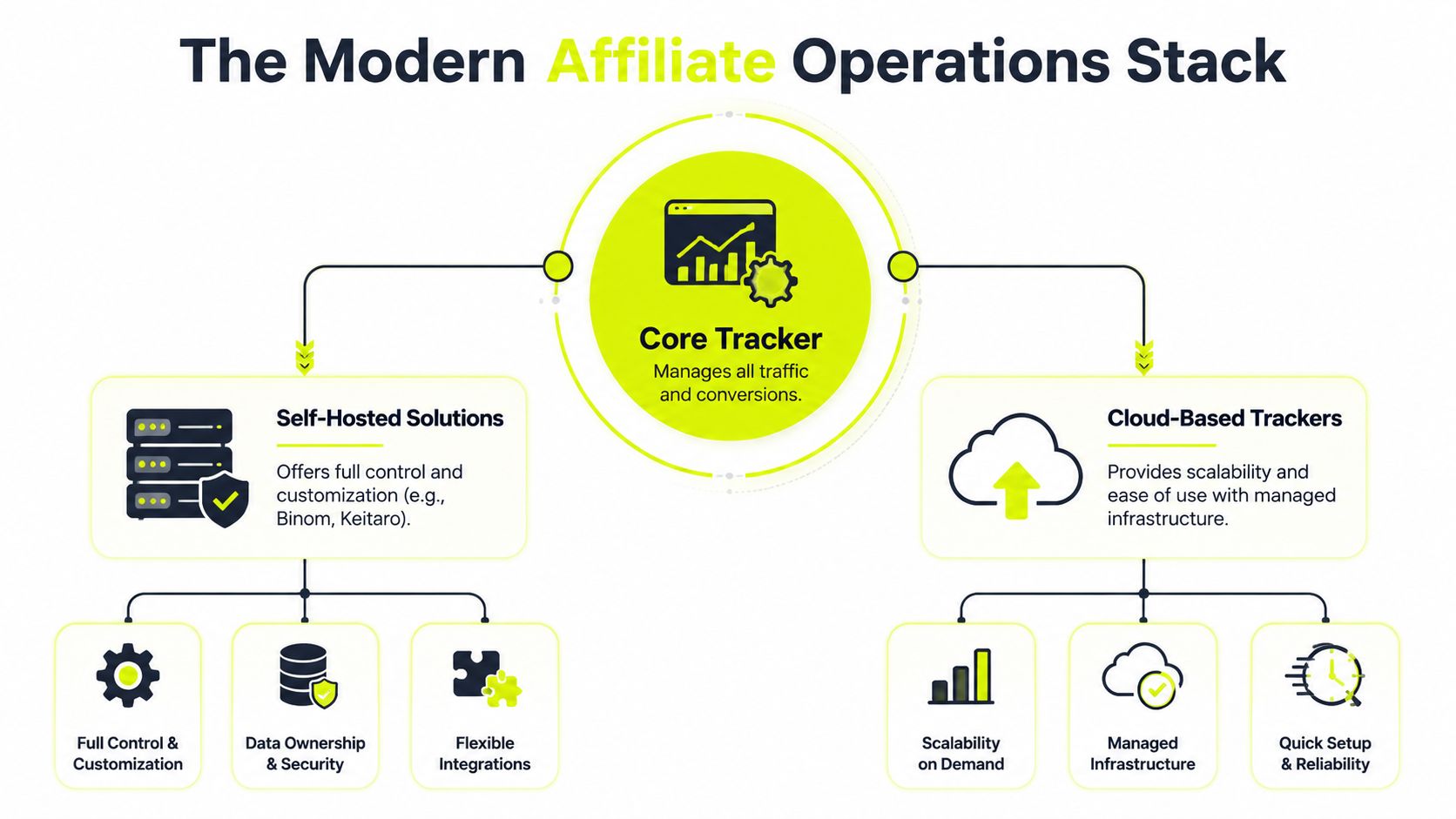
The core of a real affiliate operation is the stack. If the stack is weak, the media buying skill on top of it won't matter for long.
Start with the center of the system.
The core components
A modern stack usually has four operational layers.
Tracker
Self-hosted trackers such as Binom or Keitaro are often employed when tighter control over logs, routing, and postbacks is desired. Cloud trackers are simpler to maintain, but self-hosted setups usually give media buyers more flexibility when they need custom paths, faster rule changes, or deeper debugging.
Antidetect browser
AdsPower, Dolphin Anty, GoLogin, Multilogin, and Hidemyacc solve a specific problem. They let a team run separate browser environments with distinct fingerprints so Facebook ad accounts, TikTok ad accounts, and farmed assets don't collapse into one detectable identity.
Proxy layer
The antidetect profile is only half the identity. The IP context finishes it. Without a clean proxy matched to the use case, the browser profile won't hold up.
Cloaker
A cloaker sits in front of the offer path and decides what traffic sees which page. In practice, that means reviewers and suspicious traffic can hit a safe route while approved traffic continues deeper into the funnel.
A good stack also needs proper measurement plumbing. A functional setup must include UTM parameters, an affiliate dashboard, and conversion pixels, because each tool captures a different part of the funnel. ZINFI also notes that A/B testing those elements is necessary to find drop-off points and isolate what's lifting conversion, as described in this affiliate tracking stack guide.
How the stack fits together
The ad click starts the chain. The click lands on a pre-lander or bridge page. The tracker records the source through UTMs. Routing rules inspect source, geo, device, placement, and other conditions. The cloaker applies filtering logic where needed. The user then hits the right lander or offer, and the tracker waits for the conversion event to come back.
That sounds clean on a whiteboard. It breaks in practice when teams let one layer drift from the others.
Here's the simplest working logic:
Ad account identity lives in the antidetect profile
Network identity lives in the proxy
Traffic identity lives in the tracker parameters
Page visibility logic lives in the cloaker
Revenue truth lives in the attribution callback
For teams building feed automation, URL management, or bulk traffic operations, this kind of logic benefits from scriptable workflows. Even a lightweight parsing setup can clean up repetitive tasks if the team understands how XML and Python fit operational data work.
A quick walkthrough helps more than a static diagram, so this video is worth reviewing before you build templates around your own stack.
Where teams usually break the chain
The common failure isn't lack of tools. It's tool misalignment.
A few examples:
Tracker mismatch: Campaign names in Facebook don't match tracker tokens, so nobody trusts placement-level data.
Proxy mismatch: A buyer assigns the wrong geo to a profile, then wonders why review friction spikes.
Cloaker misuse: The team hides poor campaign structure behind filtering instead of fixing the path.
Pixel obsession: Operators trust front-end signals more than server-confirmed events.
Most account bans blamed on “platform aggression” are partly self-inflicted. Bad identity hygiene and bad routing create the review pressure.
Campaign Architecture for Facebook and TikTok
Facebook and TikTok punish sloppy affiliate structures. The platforms don't just review creatives. They review patterns. If your ad account, destination path, domain behavior, and on-page claims all point straight at an aggressive money page, you've made the reviewer's job easy.
Separation keeps campaigns alive
A clean campaign architecture separates the public-facing asset from the monetized destination. The ad should usually point to a safe pre-lander, neutral article page, quiz flow, or compliant bridge page. That page qualifies the user, frames the angle, and controls the redirect to the actual offer.
This matters most when you're launching fresh assets. A farmed account with little spend history shouldn't be used like an aged account with proven payment behavior. The path needs to match the trust level of the account.
A practical chain often looks like this:
LayerPurposeWhat goes wrong when skippedAd creativeGets the click without triggering obvious policy flagsReview friction rises fastPre-landerFilters intent and softens the transitionLow-quality clicks hit the offer coldTracker routeApplies source and geo rulesTraffic mixes and reporting gets dirtyOffer pageMonetizes approved trafficAccounts get linked to risky content too directly
For teams managing aggressive social campaigns, account isolation matters as much as page structure. If you're building or warming ad assets, this breakdown of a proxy setup for Facebook account work maps closely to how buyers separate identities in practice.
Geo rules and review-safe routing
Geo-targeted campaigns need more than translated creatives. They need routing logic that respects both compliance pressure and user intent.
A strong setup does three things at once:
Shows compliant content to the wrong audience: If traffic comes from a geo you don't monetize well, send it to a harmless page or dead-end route.
Keeps restricted paths isolated: Don't let broad campaigns accidentally expose the offer page to users or bots outside your target conditions.
Matches lander language and context: If the ad screams local relevance but the page doesn't, user trust drops and review risk climbs.
Many teams tend to overbuild. They create too many branches too early. Start with a few meaningful decision points. Geo, device, source quality, and campaign type usually matter more than a maze of micro-rules.
Creative logic for high-scrutiny traffic
Creative should create curiosity, not confess the full sales angle in the first frame. On Facebook and TikTok, direct claim-heavy creatives often collapse faster than softer hooks that let the pre-lander carry the persuasion.
What usually works:
Problem framing: Show the pain point without overclaiming.
Curiosity hooks: Let the user click to “see the method,” “check the comparison,” or “find the reason.”
Native-looking presentation: Blend with platform norms instead of looking like a hard-sell banner.
What usually fails:
Over-explicit claims in the ad itself
Instant redirects to the hardest sell page
One creative angle copied across every geo
Fresh farmed accounts pushing mature-aggression funnels on day one
Review systems look for directness, repetition, and mismatch. If the ad says one thing, the page says another, and the account history says nothing, you'll get flagged.
Proxy Selection for Account Integrity
For affiliate operators, proxies aren't a privacy accessory. They're identity infrastructure. You use them to keep accounts separated, maintain believable location context, and stop platforms from stitching unrelated assets into one network pattern.
If you run account farming across Facebook and TikTok, proxy choice changes everything from registration flow to ad review stability.
What each proxy type is actually for
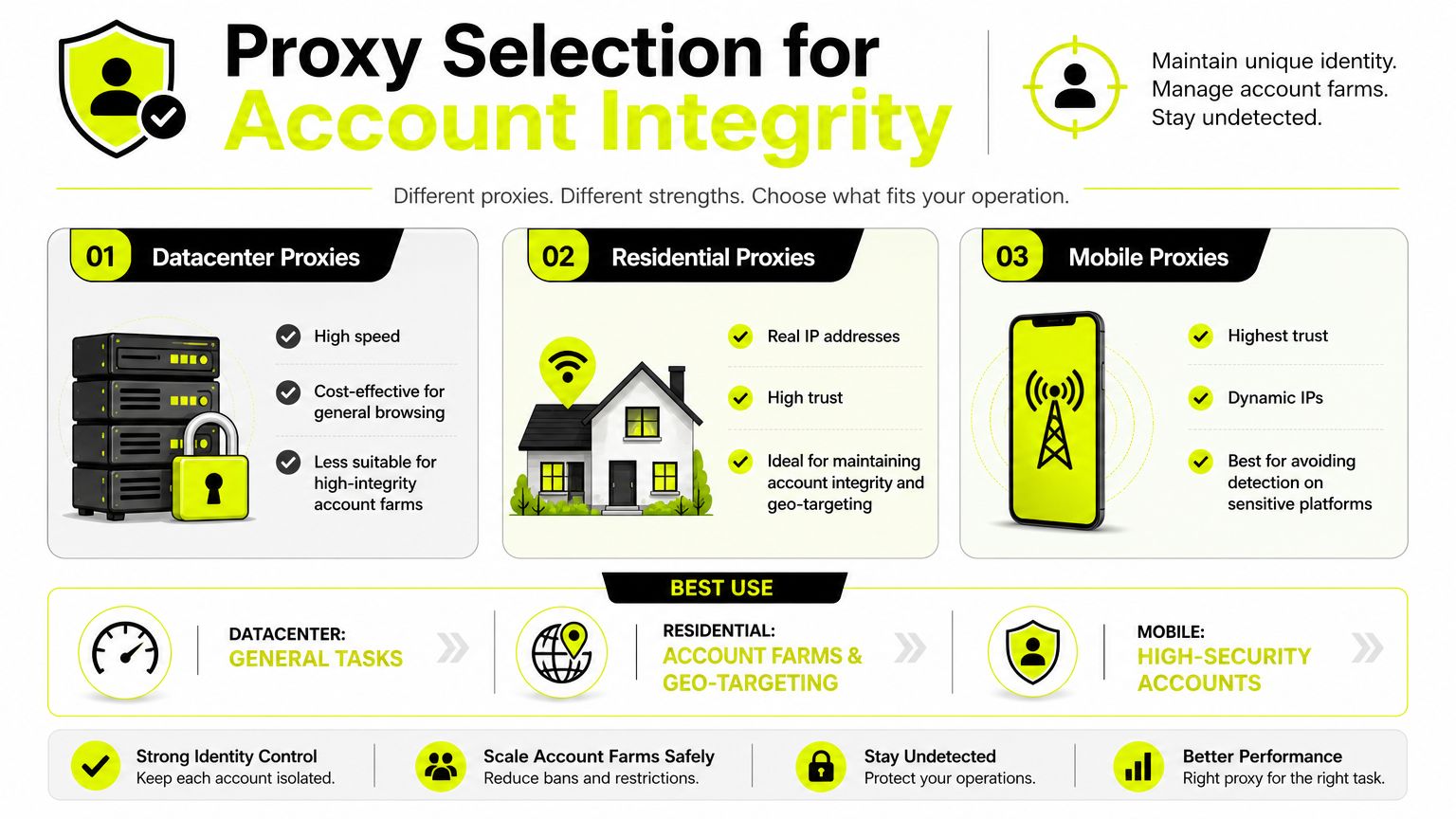
Datacenter proxies are the fastest and usually the cheapest. They come from hosting providers, not consumer ISPs. That makes them useful for low-sensitivity tasks such as checking pages, scraping public data, or validating links at speed. It also makes them easier for major ad platforms to classify as non-consumer traffic.
Residential proxies come from ISP-assigned consumer networks. That's why they're the standard for managing ad accounts that need a believable home-user context. If you're logging into Facebook business assets, warming profiles in AdsPower, or operating geo-targeted campaign accounts that need regional consistency, residential usually makes more sense than datacenter.
Mobile proxies route through carrier networks. For TikTok especially, they fit the platform's native environment better. Mobile traffic often looks more natural for account creation, warm-up, and early session behavior because the network context resembles ordinary app-based usage.
IPv6 proxies are a separate case. They offer a large address pool and lower cost in some setups, but support is uneven. On IPv4-heavy platforms and tools, IPv6 can create compatibility problems or stand out in the wrong way if the rest of the identity doesn't match.
A practical comparison
Proxy typeStrengthWeaknessCommon affiliate use caseDatacenterSpeed and low costLower trust on ad platformsScraping, QA, low-risk checksResidentialReal ISP contextHigher cost than datacenterFacebook ad accounts, geo-targeted browsing, account farmingMobileStrong trust for mobile-first platformsMore expensive and less predictableTikTok warm-up, sensitive account actionsIPv6Large pool and budget flexibilityLimited support in some workflowsSelect automation tasks where platform support is verified
The wrong way to buy proxies is by headline speed alone. Media buyers care more about match quality than raw throughput. A clean residential IP in the right country usually beats a faster but suspicious datacenter IP when the goal is account survival.
For teams that need session control across repeated account actions, rotation policy matters too. Sticky sessions help when one identity needs continuity. Rotation helps when tasks benefit from broader distribution. This matters enough that buyers should understand how proxy IP rotation affects operational behavior before they assign pools blindly.
How teams assign proxies to workflows
Teams that stay organized usually assign proxies by account role, not by whoever asks first.
A common internal split looks like this:
Farm creation profiles: mobile or high-trust residential
Aged Facebook business assets: sticky residential matched to account geo
TikTok launch profiles: mobile-first where possible
Scraping and research tools: datacenter or lower-cost pool
QA across regions: residential matched to target city or country
One provider option used in these setups is Sota Proxy, which offers residential, mobile, ISP, datacenter, and IPv6 pools, along with geo selection and session controls. It also has a referral program with up to 40% commission for referrals, which can matter if your team already recommends infrastructure to partners.
The key is consistency. Don't create an account on one type of IP, warm it on another, and launch spend on a third unless you have a reason and a documented process.
Cloaking Attribution and Compliance
Cloaking gets discussed badly. People treat it like magic. It isn't. It's a traffic filtering system with rules.
At a technical level, the cloaker decides whether incoming traffic should see a safe page or continue to the monetized path. The decision can depend on source patterns, bot databases, browser traits, device context, referrer logic, or other review signals. That's useful for protecting landers and controlling exposure. It also creates risk if the offer or network terms don't allow it.
What cloaking really does
A decent cloaker doesn't fix a reckless campaign. It buys operational separation.
The practical jobs are straightforward:
Filter obvious review and bot traffic
Send uncertain traffic to a neutral page
Preserve offer visibility for approved user paths
Keep high-risk content away from broad inspection
That's why cloaking usually works better when paired with boring architecture. Stable domain behavior. Predictable routing. Safe pre-landers. Tight source rules. If the rest of the setup is chaotic, the cloaker turns into a patch, not a system.
Cloaking protects a funnel that already makes sense. It won't rescue a funnel built on contradictions.
Why S2S tracking matters more than cookies
On the attribution side, browser-side logic keeps getting weaker. Cookie reliability drops, privacy features strip data, and platform-side reporting often disagrees with what the network says converted.
That's why server-to-server tracking matters. Adobe recommends S2S tracking as the method that best preserves conversion measurement as cookies become less reliable, and it also recommends using that cleaner data to reward stronger partners, as outlined in Adobe's affiliate marketing guide to S2S attribution.
A postback flow is simple in principle. The click gets a unique tracker ID. When the conversion happens, the affiliate network or advertiser sends a direct server request back to your tracker with the conversion data tied to that ID. No browser dependency. No fragile client-side assumption.
That changes how teams optimize. When the postback is clean, buyers can trust the route, the creative split, and the geo split more confidently. When it isn't, every optimization call becomes guesswork.
Compliance decisions that affect account survival
The compliance part is where operators get lazy and then act surprised.
Three rules matter:
Check network terms before you launch
Some affiliate programs explicitly restrict traffic filtering methods, page behavior, or redirect logic. If you violate those terms, the network can shut down the account regardless of campaign profitability.
Separate ad-platform compliance from network compliance
Passing Facebook review doesn't mean you're compliant with the offer owner's rules. Those are different gates.
Keep disclosure logic in mind for creator-led channels
If your operation also pushes traffic through YouTube, Instagram, TikTok creators, or email, disclosure placement affects trust and can affect performance quality. Sloppy disclosure often correlates with sloppy traffic.
DNS behavior also matters more than many operators realize. Resolver patterns, leak points, and mismatched network behavior can create signals that undermine an otherwise clean setup. Teams debugging identity issues should understand the basics of proxy DNS behavior in account workflows.
Scaling Workflows with Antidetect Browsers
Scaling from a handful of accounts to a real farm changes the job. At small volume, one buyer can remember how each asset behaves. At scale, memory gets replaced by systems. That's where antidetect browsers stop being a convenience and become the operating layer.
From single buyer to team operation
Tools like AdsPower, Dolphin Anty, GoLogin, Multilogin, and Hidemyacc let a team create isolated browser profiles with separate fingerprints. Each profile can carry its own cookies, local storage, timezone, language context, user agent profile, and extension state.
That's what makes multi-account operation possible without constant cross-linking. One operator can log into multiple Facebook Business Managers, TikTok Ads accounts, Gmail inboxes, payment surfaces, and e-commerce support assets from the same machine, provided each profile has its own clean identity chain.
A lot of teams pair proxy infrastructure with antidetect environments through prebuilt integrations. If you're already standardizing on anti-detect tooling, the Afina Browser antidetect partner setup is one example of how teams wire browsing environments to proxy assignment in a more structured way.
How profiles get structured at scale
The best profile systems are boring. They rely on naming discipline and role separation.
A workable structure often includes:
Farm stage in the name: fresh, warming, spend-ready, limited, dead
Platform tag: FB, TT, Google, marketplace, email
Geo tag: country first, then city if relevant
Proxy tag: residential, mobile, sticky, rotating
Owner tag: who touched it last
A profile should answer basic questions without opening notes. What platform is it for? What geo should it operate in? What kind of IP should be attached? Is it in warm-up or production?
That matters because account farming breaks down through human error more than tool failure. People launch the wrong campaign from the wrong profile. They open a restricted account in the wrong timezone. They attach a fresh payment asset to an account that should've stayed isolated.
Where automation helps and where it hurts
Automation helps with repetitive tasks. It's useful for opening profile batches, checking ad account status, loading internal dashboards, and collecting routine observations.
It hurts when teams automate behavior they don't yet understand. If the manual process is sloppy, automation just scales the sloppiness.
A sensible scaling workflow looks like this:
Warm manually first: learn what normal behavior looks like
Template second: build repeatable profile configs only after patterns are clear
Automate narrow tasks: log checks, folder assignment, naming validation, basic status pull
Keep launch decisions human: especially for sensitive Facebook and TikTok assets
The point of antidetect browsers isn't to look invisible. The point is to make each account look separate and internally consistent.
Performance Measurement and Optimization
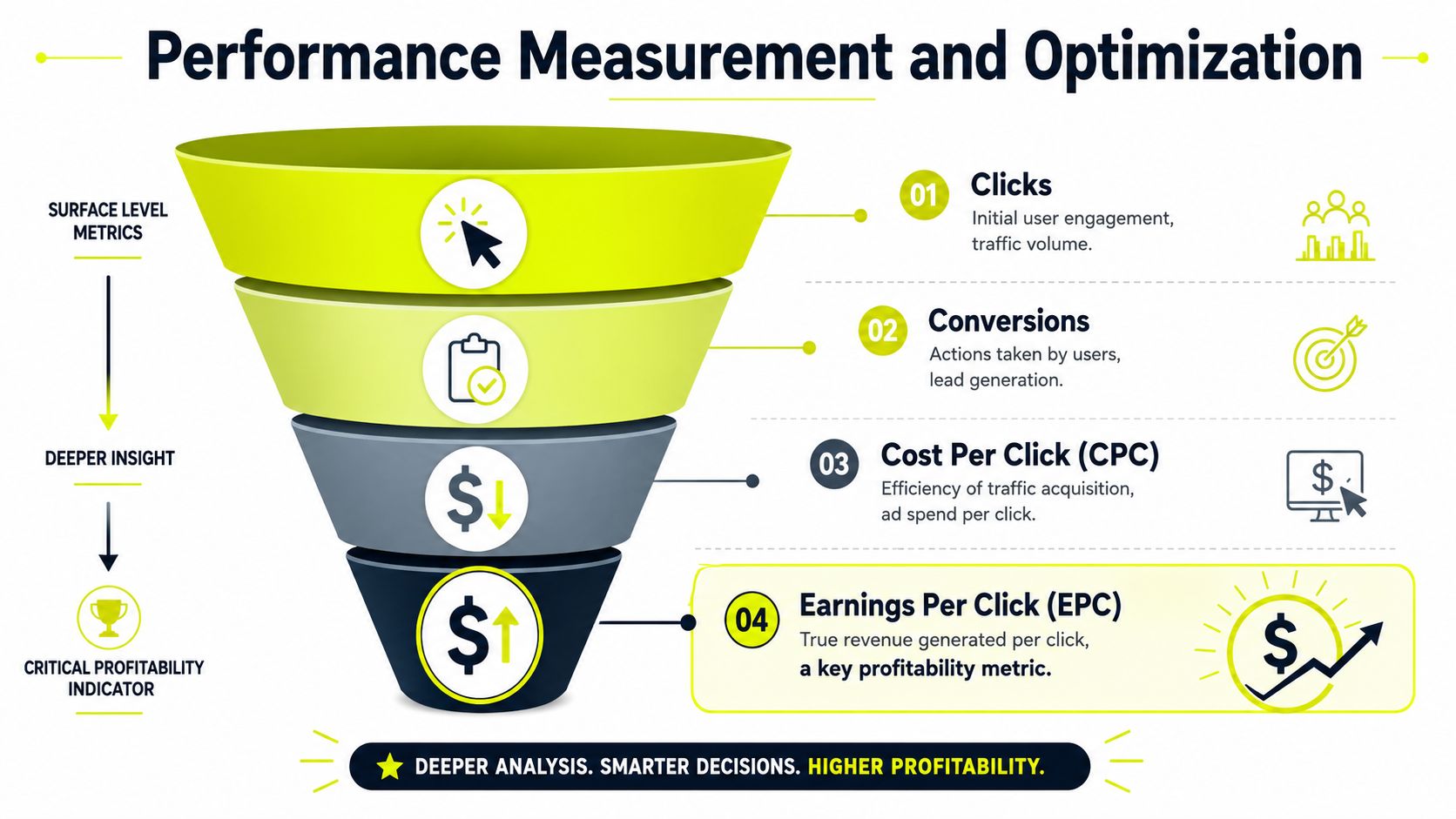
Most losing campaigns don't die because the offer is bad. They die because the team reads weak data, optimizes the wrong variable, or keeps buying traffic after the spread between revenue per click and cost per click has already collapsed.
The profitable way to use an affiliate marketing guide is to treat it like a measurement manual. The creative, proxy, cloaker, and browser decisions only matter if the tracker can tell you which combination makes money.
The metrics that matter
At operator level, surface metrics aren't enough. Click volume feels useful, but it can hide a bad campaign. You need to watch the relationship between traffic cost and monetized output.
The core numbers are:
CPC
Your cost per click from the traffic source. This is your buying price.
EPC
Your earnings per click from the affiliate side. This is your monetization reality.
ROI
The spread between what you spent and what you got back.
LTV
Relevant when the offer has recurring value, delayed approvals, or downstream monetization you can track.
This is why affiliate remains a performance-first channel. Industry estimates cited by BigCommerce put U.S. affiliate spending at $10.72 billion in 2024 with forecasts of $12 billion in 2025, and one estimate says the channel produces about $15 return for every $1 spent. The same overview notes average affiliate click-through rates of 0.5% to 1% and typical conversion rates of 1% to 3%, while top programs can exceed 5%, according to this BigCommerce affiliate marketing benchmark overview.
Those benchmarks are useful for calibration, not comfort. Your job isn't to hit an average. It's to know whether your traffic source, lander, and offer combination beats your buy cost after all leakage.
How to read a campaign without lying to yourself
A campaign can look busy and still be bad. Buyers fool themselves when they stare at top-line clicks and ignore where quality falls apart.
Read the campaign in layers:
LayerQuestionAction if weakCreativeDoes it attract the right click?Cut misleading hooksPre-landerDoes it qualify the click?Rewrite framing or CTAOffer pathDoes approved traffic convert?Change offer or routeGeo splitDoes one country carry the rest?Isolate winnersDevice splitDoes one device family drag EPC down?Exclude or bid down
Clean S2S attribution and tracker discipline pay off. You need to compare EPC by creative, lander, geo, device, placement, and account cluster. If one Android slice kills the campaign while iOS traffic stays profitable, the answer isn't philosophical. Cut the Android slice or separate it into its own test path.
Optimization rules that protect margin
Most strong operators end up following a few hard rules.
Don't optimize on platform claims alone: Ad platform reporting is useful for spend management, not final truth.
Don't scale before path clarity: If you can't identify where earnings are coming from, scaling only magnifies confusion.
Don't mix incompatible traffic: A broad geo bucket can hide one profitable segment behind several weak ones.
Don't keep sentimental creatives: If a creative gets cheap clicks but weak EPC, it's not helping.
The best campaign reviews are ruthless and boring. No attachment to the angle. No excuses for a weak path. No pretending that “the algo needs time” when the funnel already shows structural failure.
A short review loop usually works best:
Validate attribution
Compare EPC against CPC by slice
Cut obvious losers
Fork promising segments into cleaner tests
Refresh creatives only after route quality is understood
That's how thin margins survive long enough to scale.
If your team runs Facebook and TikTok campaigns across multiple profiles, geos, and offers, infrastructure quality decides how much of your data you can trust. Sota Proxy is one option for teams that need residential, mobile, ISP, datacenter, and IPv6 pools inside a single dashboard with location control and session management.
Related articles
Multiple Account Management a Secure Scalable Framework
Build a secure, scalable multiple account management system. This guide covers threat modeling, proxies, antidetect browsers, and automation for media buyers.

Landing Page Optimization: Strategies for Media Buyers
Master landing page optimization strategies for media buyers in 2026. Drive higher conversions and maximize ad spend with our expert playbook.
Mastering Consumer Behavior Analysis for Arbitrage
Master consumer behavior analysis for traffic arbitrage & account farming. Learn data collection, proxy workflows, & analysis for Facebook & TikTok.
WiFi Proxy Settings for Ad Accounts & Antidetect Browsers
Configure your WiFi proxy settings on Windows, macOS, iOS, and Android for antidetect browsers. A direct guide for media buyers managing multiple ad accounts.

Proxy for Google Ads: The Technical Operator's Guide
A technical guide to using a proxy for Google Ads. Learn to choose IPs, manage sessions in AdsPower/GoLogin, and run multi-account campaigns without detection.
Australia Proxy Server: A Guide for Marketers & Farmers
A technical guide to using an Australia proxy server for Facebook/TikTok ads, account farming, and cloaking. Compare residential vs. mobile IPs.