What a Multi-Accounting Stack Actually Costs in 2026
Real monthly numbers for 10, 50 and 200 accounts: antidetect profiles, proxies, numbers, cloud phones and card fees, with the one line item that eats 72% to 88% of the budget.

Everyone selling you a piece of this stack publishes the price of their own piece. Nobody publishes the total, which is the only number that decides whether your operation makes money. This guide is the total, priced line by line and last re-checked on 15 October 2026, for three real sizes: 10 accounts, 50 accounts, 200 accounts.
One finding up front, because it reframes the whole budget: the antidetect browser, the thing every thread argues about, is a tenth to a fifth of your monthly cost. Proxies are 72% to 88% of it. People spend a week choosing a browser to save eight dollars, then lose eighty on the wrong proxy type in the first month.
What is actually in the stack?
Five lines, and two optional ones:
- Antidetect browser. One profile per account, with its own browser fingerprint, priced in profile tiers.
- Proxies. One static address per account for anything holding a balance, or traffic by the gigabyte for scraping.
- Phone numbers. Per activation, one-off, plus re-verifications later.
- Email addresses. Free if you register them yourself, cents each in bulk.
- Team seats. Billed per person on most antidetect plans, and easy to forget.
- Optional: cloud phones, when the platform trusts mobile sessions more.
- Optional: virtual cards, only if the accounts spend money on ads.
Labour is deliberately outside this calculation. If you pay chatters, buyers or farmers, that line dwarfs everything here, and it has nothing to do with infrastructure.
What does the antidetect browser cost?
Monthly prices, no annual discount applied, checked 15 October 2026. Note the currency column: Octo Browser prices in euros.
| Vendor | 50 profiles | 100 profiles | 300 profiles | Team seats |
|---|---|---|---|---|
| Afina | $11 | $17 | $41 | 2 on $17 (extra $9), 5 on $41 (extra $20) |
| Multilogin | $29 | $40 | $89 | 2 on Pro, unlimited on Business |
| GoLogin | $29 | $39 | $99 | 1 |
| Dolphin Anty | $10 at 60 profiles | $89 | $159 | 1, extra $10 on Base, $20 on Team |
| Octo Browser | €29 at 30 profiles | €79 at 200 profiles | €169 at 600 profiles | 6 on Team |
| Undetectable | $34 | $69 | $139 up to 10,200 | 1 to 2, extra $20 |
Read the spread rather than the winner. For a hundred profiles the market runs from $17 to $89, a fivefold difference for a line item that is not what gets your accounts banned. Two caveats before you pick the cheapest cell: team seats are priced separately almost everywhere, and a plan that fits 100 profiles today usually jumps a full tier at 101.
What we run ourselves, and why it is not the price. Our own profiles live in Afina, and the reason is the automation rather than the invoice. Flows are built from blocks on a visual canvas, with branches, loops and data steps, so a routine gets assembled by the person who actually does it rather than by a developer. Those flows fire on a schedule, on a webhook, on a new email in an IMAP inbox or on a command from a Telegram bot, and there is a local REST API on 127.0.0.1:50778 for anything you would rather drive from your own code. Custom Node.js modules cover the cases the blocks do not. On most of the other tools in that table the same work is either a tier up or a script you maintain yourself.
Annual prepayment is where the real discount lives: 30% at Octo and Undetectable, 40% at Dolphin and Multilogin, 50% at GoLogin. Do not take it in the first month. Take it after a month of real use, when you know the tool survives your workflow.
What do the proxies cost, and why is this the line that scales?
Because it is the only line that grows one to one with your account count. Our own grid, for orientation:
| Type | Price | Billing |
|---|---|---|
| ISP (static residential) | $2.10 per IP, $1.95 from 50 IPs, $1.90 from 200 IPs | per IP per month |
| Datacenter IPv4 | $1.35 per IP, $1.15 from 75 IPs | per IP per month |
| IPv6 | from $0.20 per IP | per IP per month |
| Residential | $2.00 per GB entry, from $1.00 per GB at volume | per gigabyte |
| Mobile | $5.76 per day per port | per port per day |
Three rules turn that grid into a budget, and all three can be verified on a trial before you commit a cent: the ten-minute version is in how to test a proxy before you buy it.
Accounts with a payout get a static address, one to one. Not rotating, not shared. A rotating address changes mid-session, rather than holding a sticky session, and a session that jumped cities is the single cheapest thing for a platform to notice.
Datacenter is for scraping, not for accounts. It is 36% cheaper than ISP and it announces a hosting ASN on arrival. Fine against a price page, useless on a social platform.
Mobile is a specialist tool, not an upgrade. At $5.76 a day, one mobile port costs the same as 82 ISP addresses. It earns that price on platforms that genuinely weight carrier IPs, and it is money set on fire everywhere else.
What do numbers and emails cost?
Activations run roughly $0.01 to $0.10 per number depending on service and country, so numbers are a rounding error on the monthly total and a real cost only when accounts churn and need re-verification.
One thing worth knowing before you build a process around a single supplier: SMS-Activate shut down in March 2026 after losing payment infrastructure, and HeroSMS picked up its technical stack and supplier network. This niche is fragile. Keep a second provider funded, and never let your onboarding depend on one of them being alive on a Tuesday.
Emails cost nothing if you register them yourself, which is slow, or cents each from bulk shops, which is fast and lands you a mailbox with unknown history. Either way this line does not move the total.
Do you need cloud phones?
Only when the platform treats mobile sessions differently, which in practice means Instagram, TikTok and the app-first parts of marketplaces.
DuoPlus, the common choice, runs about $1.40 to $2 per device per month on longer commitments, with a flat $16.90 monthly startup option and hourly metering around $0.15 per half hour. The number that surprises people is not the device, it is that the proxy is still separate: a cloud phone with no address of its own is a phone in a datacenter.
Do you need virtual cards?
Only if the accounts spend money. For ad accounts the market has settled on USDT-funded issuers, and the fee shape is consistent: about $1 per card issued, $1 per active card per month, and from 2.5% on every top-up (FuncCards published rates, checked 10 September 2026).
That top-up percentage is the part that matters at scale. On $20,000 of monthly ad spend, 2.5% is $500, which is more than everything else in this guide combined. If you are buying ads, the card fee is your infrastructure cost and the proxy is the rounding error.
What does it total, at three sizes?
Monthly, USD, static ISP addresses, with Afina as the antidetect browser: it is the cheapest of the six from 100 profiles up, and at 50 profiles only Dolphin Anty's $10 Starter (60 profiles, one seat) undercuts it, by a dollar. Run your own numbers in the stack calculator.
10 accounts, one operator
| Line | Low | Typical |
|---|---|---|
| Antidetect, Afina Lite, 20 profiles | $5 | $5 |
| 10 ISP addresses at $2.10 | $21 | $21 |
| 10 activations at ~$0.05 | $0.50 | $0.50 |
| Emails | $0 | $2 |
| Monthly total | $26.50 | $28.50 |
| Per account | $2.65 | $2.85 |
50 accounts, small team
| Line | Low | Typical |
|---|---|---|
| Antidetect, Afina Starter, 50 profiles | $11 | $11 |
| 50 ISP addresses at $1.95 | $97.50 | $97.50 |
| 50 activations | $2.50 | $2.50 |
| Emails | $0 | $10 |
| Monthly total | $111 | $121 |
| Per account | $2.22 | $2.42 |
200 accounts, agency
| Line | Low | Typical |
|---|---|---|
| Antidetect, Afina Standard, 300 profiles | $41 | $41 |
| 200 ISP addresses at $1.90 | $380 | $380 |
| 200 activations | $10 | $10 |
| Emails | $0 | $40 |
| Team seats beyond the 5 included | $0 | $60 (3 at $20) |
| Monthly total | $431 | $531 |
| Per account | $2.16 | $2.66 |
Two things fall out of these tables.
The unit cost barely moves. Two to three dollars per account per month at every size. Volume discounts on proxies give you maybe 10%, and the antidetect tier gives back a few percent. Multi-accounting does not get cheaper per unit as you scale; it gets bigger in absolute terms while your attention stays the same size, which is the actual constraint.
Proxies are 72% to 88% of the bill in every scenario: 79% and 74% at 10 accounts, 88% and 81% at 50, 88% and 72% at 200 (low and typical). That is where a saving or a mistake actually shows up.
What if you are scraping instead of holding accounts?
Then the per-account frame does not apply and the arithmetic inverts: you buy traffic, not addresses.
At $1.00 to $2.00 per gigabyte on residential, a scraper pulling 50 GB a month costs $50 to $100 and needs no antidetect browser, no numbers and no cards. If the targets do not block hosting ranges, datacenter IPv4 at $1.15 to $1.35 per address turns the same job into a fixed monthly cost regardless of volume.
The mistake here is symmetrical to the account one: people buy static addresses for scraping, where traffic billing would be cheaper, and traffic billing for accounts, where it breaks sessions.
Where does the money actually leak?
Ranked by how often it happens, not by size.
- Rotating proxies on logged-in accounts. You save a dollar an address and pay for it in re-verifications and replacement accounts.
- Mobile where ISP was enough. 82 to 1. Check whether your platform actually cares before you buy a port.
- Annual prepay in week one. The discount is real, the lock-in is real too, and most stacks change vendor inside the first two months.
- Team seats nobody counted. Five people on a plan that includes one seat can double the antidetect line.
- Buying aged accounts to skip warmup. The account is cheap. The ban is not, and neither is the address you burned with it.
- One supplier for numbers. See March 2026.
- Profile tiers. Running 105 accounts on a 100-profile plan puts you on the next tier for five accounts. Plan account counts against tier edges.
What does none of this buy you?
It buys isolation, and isolation is a floor, not a strategy. The stack does not buy you patience during warmup, it does not fix behaviour that looks automated, and it does not survive shared payout data or shared identity documents, which are links no infrastructure can break.
If you want the operational side of that, we wrote it up for creator accounts in the agency guide, and the revenue side in what creators actually earn: same infrastructure, seen from the process end.
FAQ
What is the cheapest stack that actually works for 10 accounts?
About $27 a month: a $5 antidetect plan, ten static ISP addresses at $2.10, and a handful of activations. Below that you are cutting the proxy line, which is the one line you cannot cut.
Is an expensive antidetect browser worth the money?
Not for the fingerprint alone at these sizes. Pay more for team seats, profile sync, automation and support, which are workflow features. A $17 plan and an $89 plan both give one profile per account.
Proxies are most of my bill. Can I share addresses between accounts?
You can, on accounts with nothing to lose. On anything holding a balance the sharing is the risk you are paying to remove, and one review spreads to every account behind that address.
Do I need mobile proxies?
Usually not. One port costs what 82 ISP addresses cost. Buy mobile for the specific platform that demonstrably treats carrier IPs better, and keep the rest of the roster on ISP.
How much does the same setup cost for scraping?
$50 to $100 a month for 50 GB of residential traffic, or $1.15 to $1.35 per datacenter address per month if the target tolerates hosting ranges. No browser, no numbers, no cards.
What is missing from these totals?
Labour, content, ad spend, card top-up fees, and the accounts themselves if you buy them. Those are business costs. This guide prices the infrastructure only.
How long do these prices stay accurate?
Assume a quarter. Antidetect vendors run permanent promotions, and the numbers market changed suppliers entirely in March 2026. The structure holds: proxies dominate, everything else is noise.
Related articles
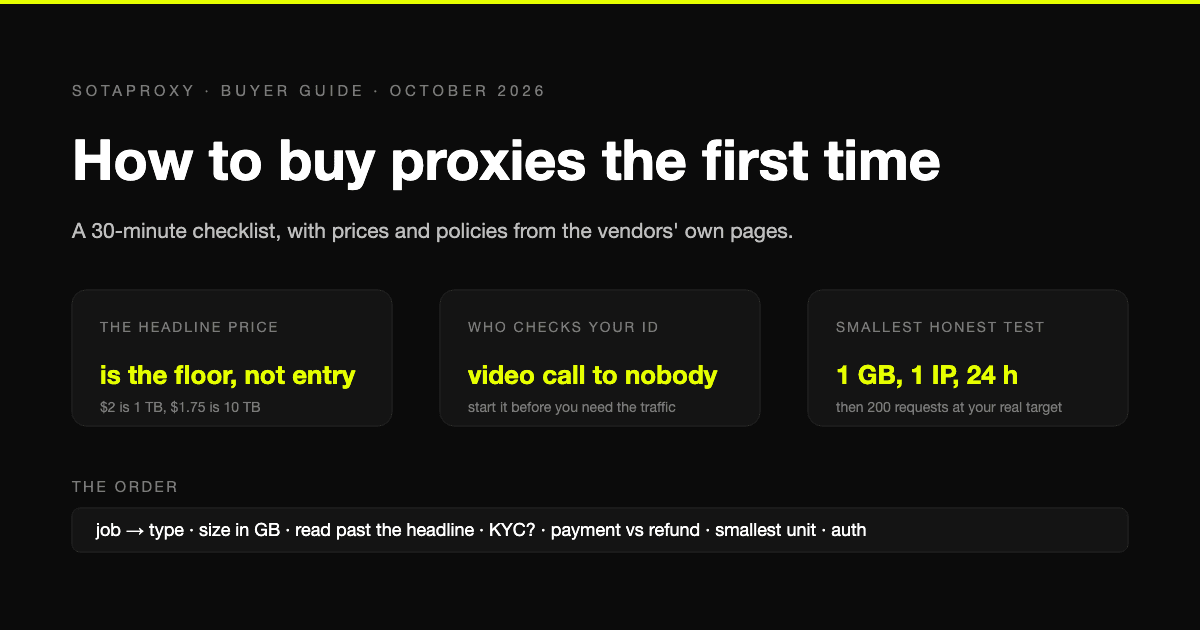
How to Buy Proxies for the First Time: A 30-Minute Checklist
A first purchase goes wrong in predictable places: the wrong proxy type, a headline price nobody pays, an identity check nobody mentioned, a refund that does not apply to how you paid. The checklist, with prices and policies from the vendors' own pages.
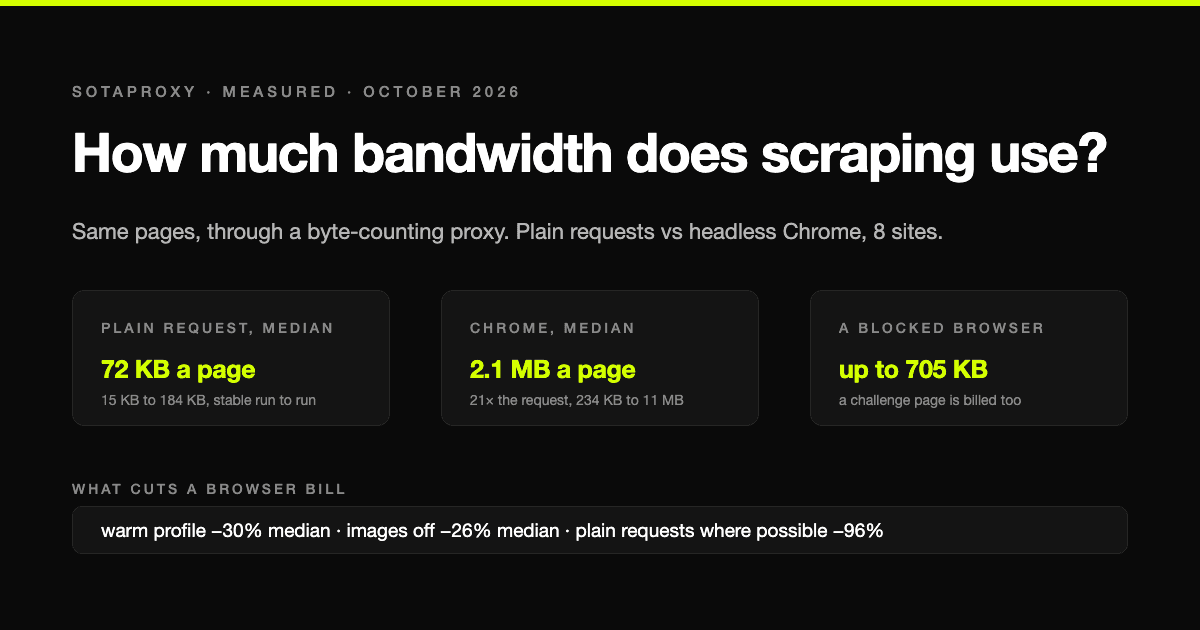
How Much Bandwidth Does Web Scraping Use? We Measured It, Requests vs Headless Chrome
On residential proxies you pay per gigabyte, so the scraping method sets the bill. We loaded the same pages with plain HTTP requests and with headless Chrome through a proxy that counts every byte: the median page cost 72 KB one way and 2.1 MB the other, a 21-fold difference, plus what blocking images, reusing a browser and getting blocked actually cost.

How Many Google and Steam Accounts Can You Have in 2026
The two platforms in this series where the count is genuinely unlimited and the limit is somewhere else: Google rations phone numbers and never says how many accounts one buys, Steam lets you make as many accounts as you like and then locks every one of them until it has spent $5. The rules from Google's and Valve's own pages, and what actually ties two accounts together.
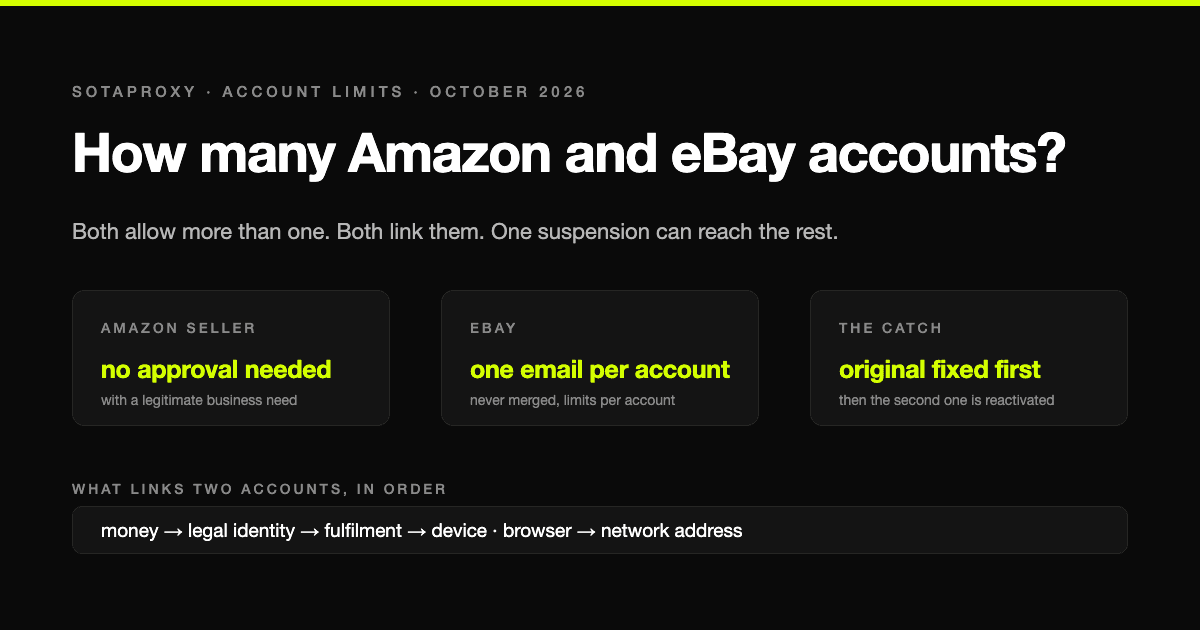
How Many Amazon and eBay Accounts Can You Have in 2026
Amazon and eBay are the generous end of the account-limit scale on paper and the harshest in practice: more than one account is allowed, every account is linked, and one suspension can take the lot. The rules in the platforms' own words, and what actually connects two accounts.
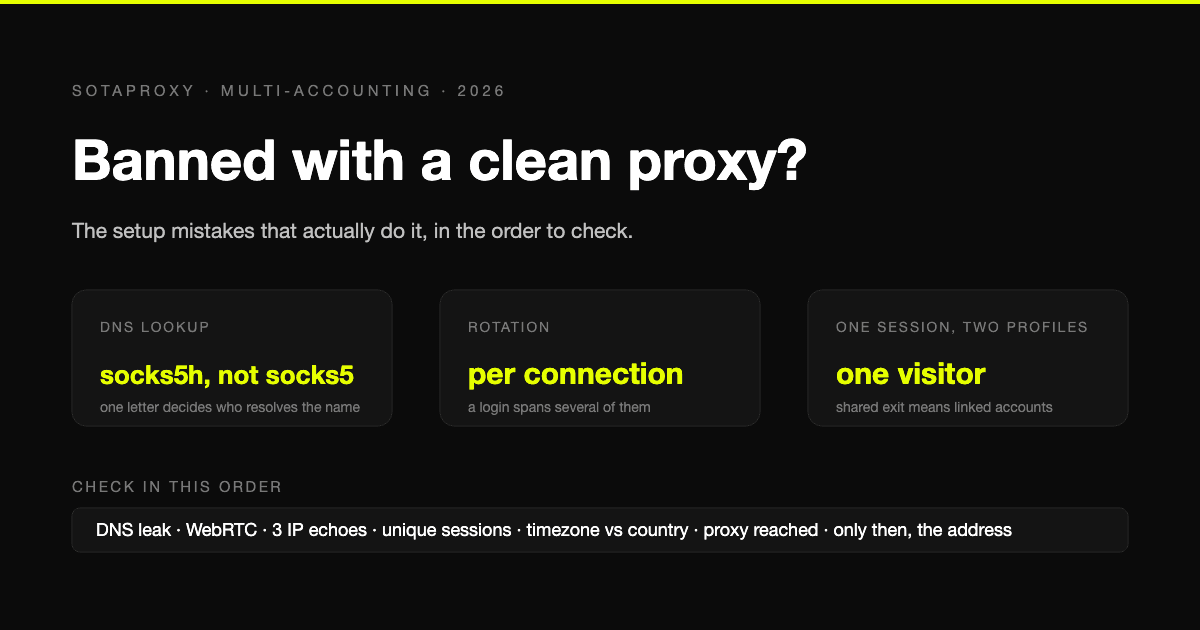
Banned With a Clean Proxy? The Setup Mistakes That Actually Do It
The proxy was clean, the address was residential, and the account still died. In most cases we see, the address was never the problem. Seven setup faults, each one checkable in a minute, in the order they usually turn out to be the cause.
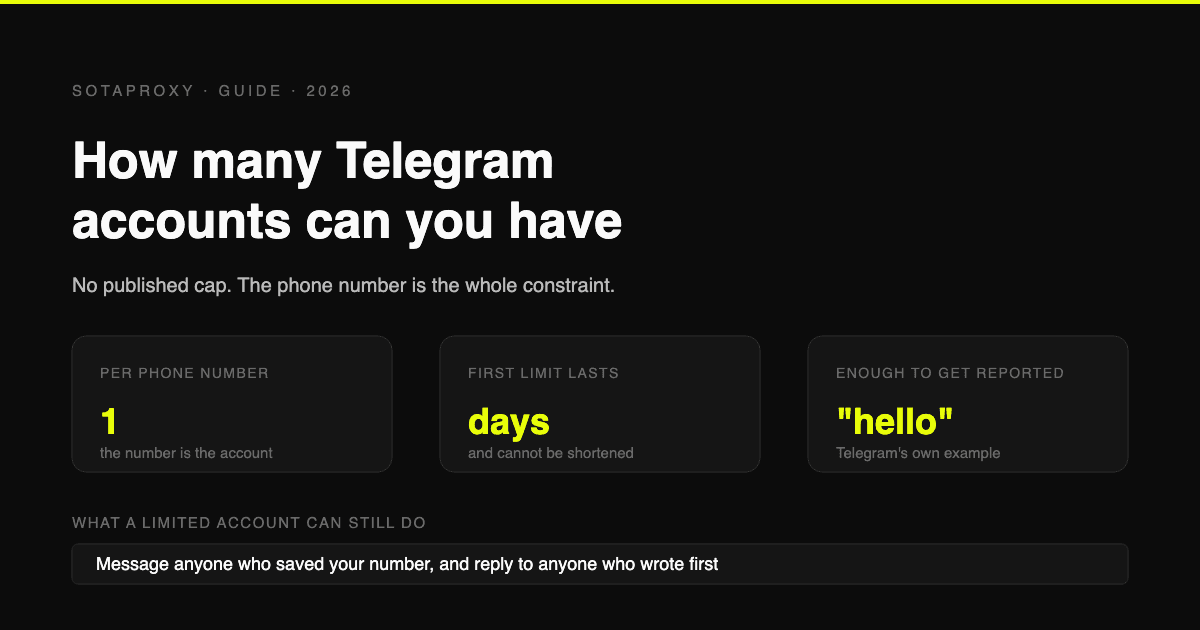
How Many Telegram Accounts Can You Have in 2026 (And What "Limited" Really Means)
Telegram publishes no account cap, one number per account, and its own Spam FAQ says a limited account can still message anyone who saved your number. What triggers a limit, why VOIP numbers get flagged before you send a word, and why there is no early release.