IPv6 Proxy Service: Boost Ad Accounts & Automation
Boost ad accounts & automation with our IPv6 proxy service. Discover optimal IPv6 vs IPv4 use for Facebook, TikTok, and antidetect browsers in 2026.
Infinite IP supply is the easiest part of the IPv6 sales pitch. It is also the part that causes expensive mistakes.
An IPv6 proxy service can make sense for scraping, large-volume account creation, ad verification, and other workflows that exhaust IPv4 pools fast. In some setups, IPv6 routes also perform well. That sounds attractive on a provider landing page. In live ad operations, though, raw IP volume is only one variable, and often not the one that decides whether accounts survive.
Teams running Facebook ad accounts, TikTok Business Manager, cloaking setups, account farms, and geo-targeted campaigns inside AdsPower, Dolphin Anty, GoLogin, Multilogin, or Hidemyacc usually run into a different set of problems. Trust scoring can be weak. Geo signals can conflict across IP, browser language, time zone, and device profile. Mixed IPv4 and IPv6 paths can introduce compatibility issues that do not show up in a proxy dashboard. A cheap IPv6 pool can look efficient until it burns a warm account, trips a review loop, or forces manual recovery work across dozens of profiles.
That is the primary filter. An IPv6 proxy service is not good or bad on its own. It is either aligned with the platform, session pattern, and risk tolerance of the workflow, or it is a hidden cost.
I look at IPv6 proxies as a margin tool with sharp edges. If the target platform accepts IPv6 traffic cleanly and the operation needs scale more than trust, the cost per IP can be hard to beat. If the workflow depends on stable reputation, high-value ad accounts, or clean geo consistency, the wrong IPv6 setup often costs more than it saves.
A provider page such as proxy features for automation and multi-account workflows can show the available pool types, protocols, and session controls. However, the true work begins after that. You need to know where IPv6 reduces costs, where it creates support debt, and where residential, mobile, or ISP proxies still produce better account survival.
Table of Contents
- IPv6 vs IPv4 Proxies The Core Technical Differences
- Strategic Use Cases for IPv6 Proxies
- Risks and Limitations in Ad and Account Workflows
- Rotating vs Static IPv6 Proxy Strategies
- Integrating IPv6 Proxies with Your Automation Stack
- Evaluating and Selecting an IPv6 Proxy Service
IPv6 vs IPv4 Proxies The Core Technical Differences
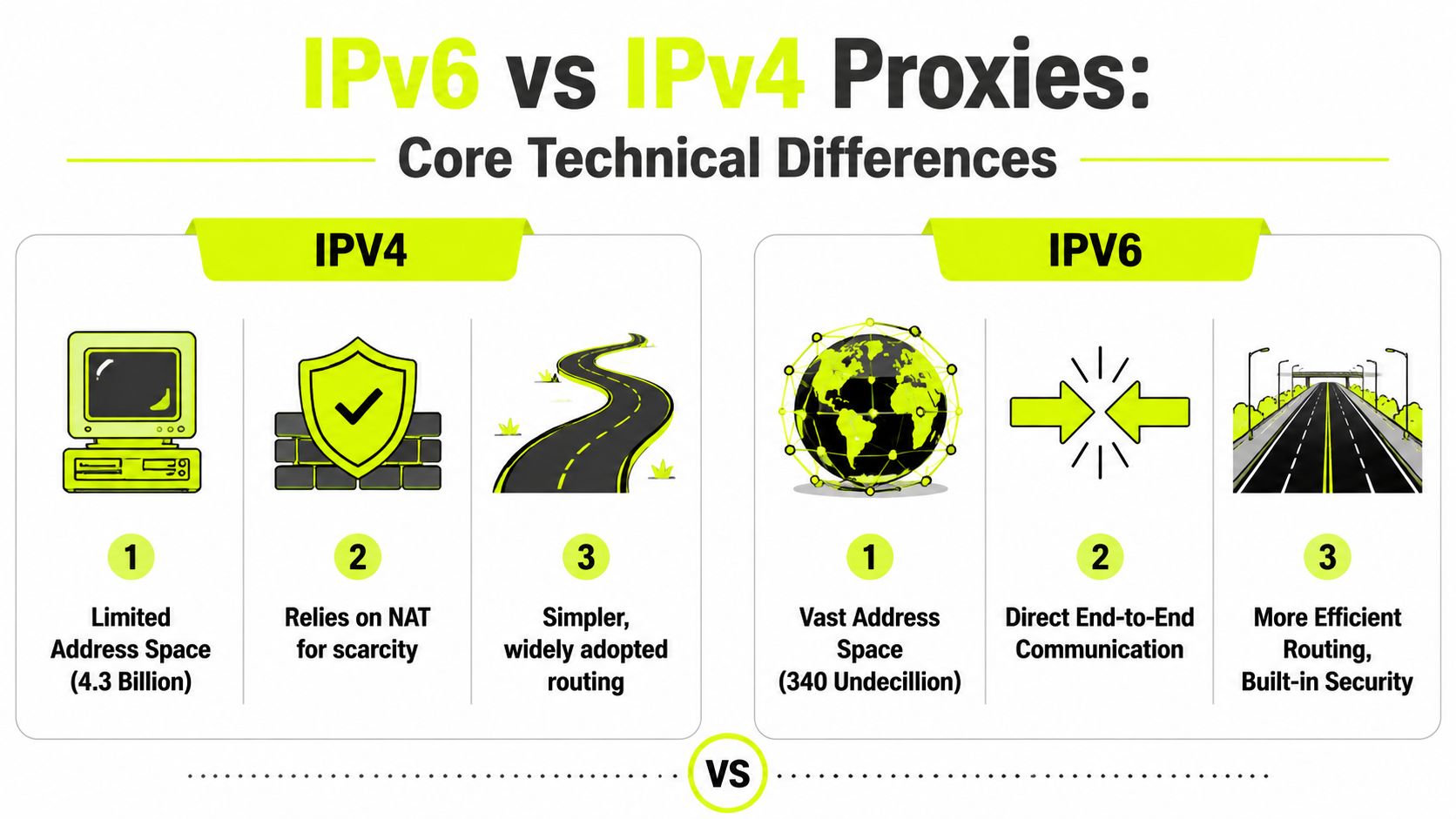
For operators, the primary difference between IPv4 and IPv6 is inventory pressure.
IPv4 space is limited, so clean addresses cost more and get reused harder. IPv6 gives providers far more room to issue distinct addresses at scale. That changes pricing, rotation design, and how aggressively a provider can separate sessions. It does not automatically improve trust on platforms that score account behavior, device fingerprints, billing patterns, and ASN quality together.
What this means in practice
In day-to-day operations, IPv6 usually changes three things.
- Address supply: Providers can assign more unique IPs without squeezing a small pool.
- Rotation patterns: Large jobs can rotate longer before obvious reuse shows up.
- Cost structure: The price per IP often looks attractive, but the cheaper unit cost can hide higher failure costs if the target platform treats IPv6 traffic as lower trust.
That last point is where teams get burned. On paper, a huge IPv6 pool looks efficient for account creation, browser profile separation, or distributed automation. In a high-stakes workflow, cheap inventory only helps if the target accepts those sessions. If Facebook, Google, TikTok, or a payment flow puts extra weight on reputation signals tied to network type, ASN history, or household-like behavior, the savings disappear fast through bans, reverification loops, and lost operator time.
Why proxy type still matters
IPv6 proxies are a network format first, not a trust shortcut.
A large IPv6 pool can be excellent for concurrency. It can also be the wrong tool for ad account logins, spend ramping, or aged account preservation, where one flagged session can cost far more than the proxy itself. That is the core trade-off. IPv4 scarcity raises proxy cost. IPv6 misfit raises workflow cost.
| Proxy type | Best fit | Where it usually fails |
|---|---|---|
| IPv6 proxies | High-concurrency tasks, broad IP rotation, some automation stacks | Sensitive trust-heavy actions on strict platforms |
| Residential proxies | Account logins, ad accounts, geo checks, lower-friction identity work | High-volume tasks that need cheap scale |
| Mobile proxies | Tough anti-fraud environments, aggressive social platforms | Cost control and broad task parallelism |
| Datacenter IPv4 proxies | Speed-sensitive automation, stable infrastructure tasks | Platforms that heavily score datacenter ASN patterns |
Teams running AdsPower or GoLogin at scale need to read this correctly. The protocol version affects supply and routing. The business outcome depends on whether the platform accepts the session as believable enough to survive repeated use.
For a broader breakdown of proxy types used in automation workflows, compare them by failure mode, not just by IP count or advertised speed.
Practical rule: Use IPv6 where scale and address diversity matter more than long-term session trust. For valuable accounts, judge proxies by survival rate, not pool size.
Strategic Use Cases for IPv6 Proxies
IPv6 works best when quantity beats trust score.
If the job is broad, repetitive, and tolerant of occasional friction, an IPv6 proxy service can be efficient. If the job is tied to valuable identities, billing profiles, or ad spend continuity, you need to be far more selective.

Where IPv6 usually pulls its weight
A scraping team targeting IPv6-friendly sites can use IPv6 rotation to spread requests across a large set of exits. That's one of the clearest fits. The objective is throughput and parallelism, not convincing a platform that one user is a stable real person for weeks.
The same logic applies to lower-stakes account farming. If you're seeding large numbers of accounts for early-stage warmup, testing registration flows, or distributing noncritical operations across many browser profiles in AdsPower, Dolphin Anty, GoLogin, Multilogin, or Hidemyacc, IPv6 can be a practical option. It gives room to separate sessions without recycling the same small pool too aggressively.
Geo-targeted ad verification is another good fit. If you need to check how creatives, landing pages, redirects, or cloaking rules render in different regions, an IPv6 setup can work well when the target path supports it cleanly and the session doesn't need deep behavioral trust.
Where operators get overconfident
Trouble starts when people treat IPv6 like a replacement for every other proxy class.
For Facebook and TikTok ad accounts, the cost of a bad proxy choice is rarely just a failed request. It's disabled spend, rejected billing actions, account review loops, or profile contamination inside your antidetect stack. That's why experienced buyers usually separate tasks:
- Bulk verification or fetches: IPv6 can make sense.
- Primary account logins: Residential or mobile usually makes more sense.
- Cloaking checks and creative QA: Depends on target and geo sensitivity.
- Long-life asset management: Stable trust usually matters more than broad IP count.
A large pool helps when the task is disposable. It doesn't help much when the account isn't.
A lot of teams also split by campaign stage. Early research, page checks, and infrastructure testing can run on cheaper, more scalable routes. Once they touch revenue-critical Facebook or TikTok assets, they switch to higher-trust proxies and keep the browser fingerprint stable.
For buyers handling Google campaign verification, landing page review, and regional ad checks, this guide to choosing proxies for Google Ads workflows is relevant because the same operational split applies there too.
A simple way to think about fit
Use IPv6 when the workflow needs breadth, not reputation.
Use residential or mobile when the workflow needs a believable user environment.
Use dedicated datacenter or ISP options when you need stable performance and a consistent route, but the target isn't scoring you like a consumer identity.
That distinction saves more accounts than most optimization tricks.
Risks and Limitations in Ad and Account Workflows
IPv6 proxy sales pages usually overstate the upside for ad work.
In real account operations, the problem is not raw connectivity. The problem is whether the session looks normal enough to survive login review, billing checks, device consistency checks, and repeated platform scrutiny. A cheap IPv6 pool can look efficient on paper and still cost more than a higher-trust option once accounts start tripping review flows.
Better transport can still produce worse account outcomes
The common pitch is simple. IPv6 is newer, abundant, and often performs well at the network layer. That part can be true. It still does not answer the question that matters to buyers and farm operators: will the platform trust the session?
For Facebook, TikTok, Google, and similar systems, trust is built from a stack of signals. IP version is only one part. ASN quality, geolocation accuracy, reuse patterns, browser fingerprint stability, cookie age, action timing, and account history all matter. If your IPv6 exits sit in low-trust datacenter space or map poorly by region, faster requests do not help much. The page loads. The account gets challenged anyway.
I have seen this show up in a predictable way. The first few actions work. Then the riskier ones fail. Password resets, payment changes, BM admin actions, pixel setup, and repeated logins from the same profile start producing friction. That is where the hidden cost starts.
The expensive part is recovery work
Teams rarely lose money because a proxy request was slow. They lose money because the wrong IP path creates cleanup.
That cleanup usually looks like this:
- Asset contamination: a weak login path can taint an ad account, business manager, or warmed profile
- Rework inside antidetect browsers: profiles in AdsPower, GoLogin, Dolphin Anty, Multilogin, and Hidemyacc become harder to trust after location or session mismatches
- Staff time loss: operators spend hours retesting proxy groups, replacing cookies, rebuilding browser profiles, and replaying warmup steps
- Launch delays: geo checks, reviewer-path checks, or approval-sensitive actions fail at the worst time
- Higher replacement cost: once a stable account is damaged, the replacement is rarely as cheap as the original setup model assumed
This is the part provider marketing skips. A large IPv6 pool lowers the unit cost of access. It does not lower the cost of account loss.
Where IPv6 breaks first
IPv6 is usually weakest in workflows that depend on long-lived identity continuity and believable user context.
That includes:
- billing and payment updates
- admin role changes
- repeated daily logins to the same asset
- account recovery flows
- profile warmup that depends on stable geography
- high-value actions inside old or heavily reviewed accounts
These actions are sensitive because the platform is not only checking whether the request succeeds. It is checking whether the session behavior matches a credible user history.
Support tasks are different. Large-scale page fetches, broad ad checks, low-risk monitoring, and disposable research jobs can often tolerate more friction. If one request gets challenged, the business impact is low. If one billing admin session gets flagged, the cost is much higher.
Test by risk tier, not by provider pitch
The safer way to roll out IPv6 is to test it where failure is cheap.
Start with low-trust, low-value actions. Measure challenge rate, geo consistency, login retention, and how often browser profiles stay usable after repeated sessions. Only move IPv6 into revenue-critical account actions if it holds up under that pressure. If it does not, cut it early and keep IPv6 for support workloads where broad IP supply helps.
If the main concern is survivability, this guide to reducing IP ban risk in automation stacks follows the same operating logic. Use the lowest-risk route that still completes the task.
The core trade-off is simple. IPv6 often gives scale at a low entry cost. In ad account management and multi-account farming, the hidden bill shows up later in flagged sessions, damaged profiles, and replacement work. That is why experienced operators treat IPv6 as a tool for selected tasks, not as a default routing layer for everything.
Rotating vs Static IPv6 Proxy Strategies
The wrong session model breaks a good proxy pool.
Most operators choosing an IPv6 proxy service shouldn't ask “rotating or static?” as a general question. They should ask, “Does this task need session continuity or churn?”
Decision matrix for real tasks
| Task | Recommended Strategy | Rationale |
|---|---|---|
| Large-scale web scraping | Rotating IPv6 | Spreads requests across many exits and reduces reuse pressure |
| Ad verification across many pages and regions | Rotating IPv6 | Good for repeated checks where identity persistence isn't the priority |
| Bulk account registration for low-value farms | Rotating IPv6 | Helps separate signups and warmup attempts across a wider pool |
| Managing a Facebook ad account day to day | Static IPv6 only if the platform tolerates it, otherwise use higher-trust proxy types | Session persistence matters more than broad rotation |
| TikTok account maintenance | Static IPv6 only with careful testing, otherwise avoid | Repeated identity checks can punish unstable routing behavior |
| Cloaking infrastructure checks | Mixed approach | Use rotating for broad fetches, static for controlled reviewer-path testing |
| Persistent antidetect browser profiles | Static IPv6 | AdsPower, Dolphin Anty, GoLogin, Multilogin, and Hidemyacc profiles need consistency |
Rotating works when the session is disposable
If the request only needs to complete once, rotation is usually the better play. Scrapers, parsers, ad preview fetchers, and regional landing page checks all fit that pattern.
Rotation also helps when you're mapping what a target tolerates. You can separate requests, reduce obvious repetition, and avoid anchoring too much activity to one exit.
Static works when the browser profile must stay believable
A static IPv6 setup only makes sense if the task needs continuity and the platform handles IPv6 well enough to support it. That's the key condition people skip.
If you tie a GoLogin or Multilogin profile to a stable fingerprint, timezone, language set, and behavior pattern, changing IPs too often will often create more suspicion than it solves. Static routing gives the profile a home base. But if the IPv6 route itself is a poor fit for the platform, “static” won't save it.
Don't rotate logins that need memory. Don't pin an IP for tasks that only need throughput.
A practical split many teams use
Operators often divide IPv6 strategy like this:
- Rotation for machines: scraping bots, monitors, parsers, verifiers
- Static for profiles: browser-based identities tied to repeat actions
- No IPv6 at all for premium assets: high-value ad accounts, mature seller accounts, or payment-sensitive profiles where residential or mobile trust is safer
That split is more useful than any blanket recommendation.
Integrating IPv6 Proxies with Your Automation Stack
A proxy that passes a connection test can still be a bad fit for production.
That happens all the time with IPv6. The provider dashboard looks clean, the browser says the proxy is live, and then the workflow fails on the step that counts. Login review. Payment check. Asset transfer. Ad approval. Setup mistakes show up there, not in the ping result.
Build around the task, not the proxy
Teams running AdsPower, Dolphin Anty, GoLogin, Multilogin, Hidemyacc, or custom browser automation usually make the same mistake first. They test whether the proxy connects, then assume the profile is ready.
What matters is session alignment. The proxy IP, timezone, locale, DNS resolution, WebRTC behavior, browser fingerprint, and account history all need to make sense together. If one layer points to Frankfurt and another points to Manila, the proxy did not fail. The operator built an incoherent session.
The usual proxy format stays simple:
protocol://username:password@host:port
The hard part starts after that.
A safer rollout process looks like this:
- Create the browser profile with the final device and locale settings.
- Attach the IPv6 proxy and test DNS, WebRTC, and external IP output.
- Open the actual target platform and check the detected region inside the platform, not only in public IP checkers.
- Run the first high-risk action on a low-value profile.
- Clone only the setups that survive real tasks.
That last step saves money. Bad IPv6 integrations do not just burn proxies. They burn warmed profiles, ad accounts, and operator time.
Mixed protocol paths create hidden cost
A lot of platforms still handle IPv6 unevenly. Some login flows, fraud systems, CDNs, and geo databases are cleaner on IPv4 than on IPv6. In practice, that creates two problems.
First, the location signal can drift. An IP checker may show the city you bought, while the target platform classifies the session differently. Second, some routes add translation or detours before the request reaches the target. The session still loads, but it feels off. Slower redirects, extra checkpoints, and inconsistent risk scoring are common symptoms.
Those are expensive failures in ad account work. A scraper can tolerate a few messy requests. A billing profile or agency asset cannot.
Tool-specific advice that holds up in production
- AdsPower and GoLogin: Use them for controlled testing by workflow. Separate login, spend, and admin actions into different proxy cohorts before wider rollout.
- Dolphin Anty and Multilogin: Good for stable browser identities, but only if the IPv6 route stays consistent over time. Watch for silent route changes from the provider.
- Hidemyacc: Fine for bulk profile operations. It does not fix weak geo recognition, poor DNS behavior, or unstable upstream routing.
If your stack includes browser automation, scripts, and account panels, review the provider's integration guides for automation tools and environments before rollout. Compatibility problems usually start at the handoff between systems.
What breaks first in real workflows
Authentication is rarely the first problem.
The usual failure pattern is softer. The account logs in, then gets hit with a checkpoint on the second session. The ad account opens, then payment review triggers earlier than expected. The farm runs for two days, then a whole profile batch starts seeing extra verification because the network path was never stable enough for repeated use.
That is why IPv6 has to be tested at the action level. Fetching a page, creating a session, editing billing, and launching spend are different risk events. Treat them that way.
If the workflow is high stakes, test IPv6 where a miss is affordable. Do not make your oldest profiles the lab environment.
Evaluating and Selecting an IPv6 Proxy Service
Price is the easiest filter and the worst primary filter.
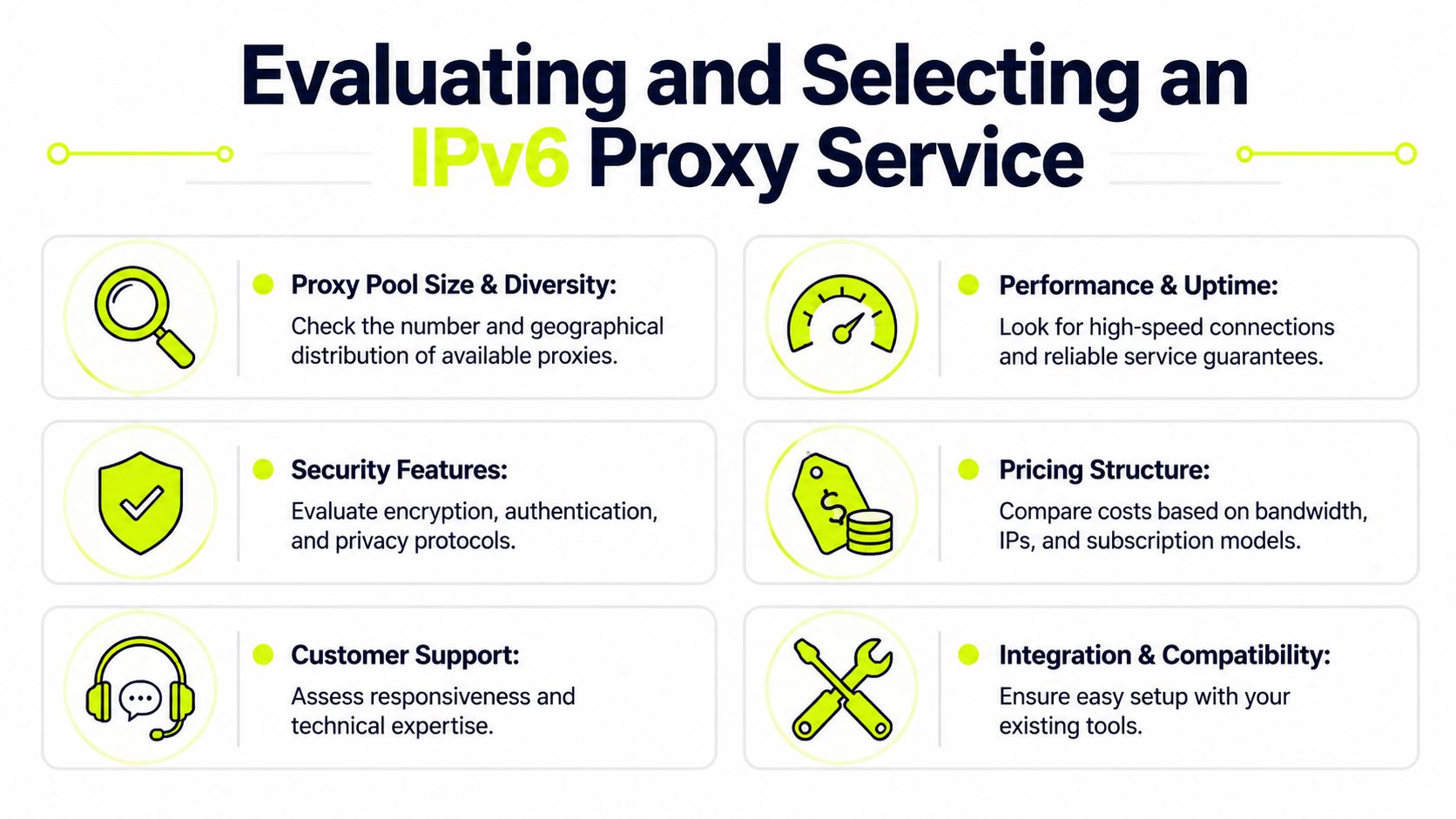
If you're buying an IPv6 proxy service for ad accounts, account farming, scraping, cloaking, or geo-targeted campaigns, the useful questions are technical. How is the pool structured? How stable is routing? How clean are the subnets? How does the provider handle mixed protocol environments? Can you keep session behavior consistent?
What to check before you buy
- Subnet diversity: A huge pool isn't useful if too many exits cluster in patterns that targets can group easily.
- Protocol support: Make sure the service supports the way your stack connects, not just the protocol listed in a feature table.
- Geo accuracy in practice: Advertised location and platform-recognized location aren't always the same thing.
- Session control: You need to know whether you can rotate, stick, or reserve behavior by task.
- Dashboard usability: If your team can't assign, replace, and segment proxies quickly, operational drag will eat the savings.
- Support quality: When account workflows break, generic replies aren't enough.
One technical criterion most buyers ignore
For infrastructure use, IPv6 proxies often act as translation gateways between IPv4 and IPv6 environments. F5 describes IPv6 proxies as devices that translate IPv4 address, header, and routing information before forwarding traffic to IPv6 systems, and it also notes that an IPv4-to-IPv6 reverse proxy can relay HTTP/HTTPS via SNI without decrypting TLS, which preserves certificates and reduces operational complexity. That makes SNI support a real evaluation point in mixed environments, as described in this F5 explanation of IPv6 proxy translation behavior.
If a provider can't explain how it handles that layer, you're buying blind.
What good selection looks like
Pick by workflow, not by hype.
If you run scraping or broad verification, prioritize scale and rotation control. If you run Facebook and TikTok assets, prioritize trust fit and session consistency. If you manage both, split the stack instead of forcing one proxy class to do everything.
Agencies and power users should also pay attention to commercial alignment. If you already recommend infrastructure to clients or peers, a referral model can matter. Sota Proxy, for example, offers an affiliate program with up to 40% commission, which can make sense for agencies that already influence proxy buying decisions.
If you need an infrastructure provider that covers more than one proxy class, Sota Proxy is worth a look. It gives teams access to residential, mobile, ISP, datacenter, IPv4, and IPv6 options, which is the practical way to build around real workflow differences instead of forcing every task through one proxy type. For agencies, arbitrage teams, and operators who already refer tools to clients, its affiliate program offers up to 40% commission.
Related articles
Boost Proxy Performance: Reliability Testing Guide
Ensure peak proxy performance with effective reliability testing. Learn key metrics, test types, & practical test cases for ad arbitrage & account farming.
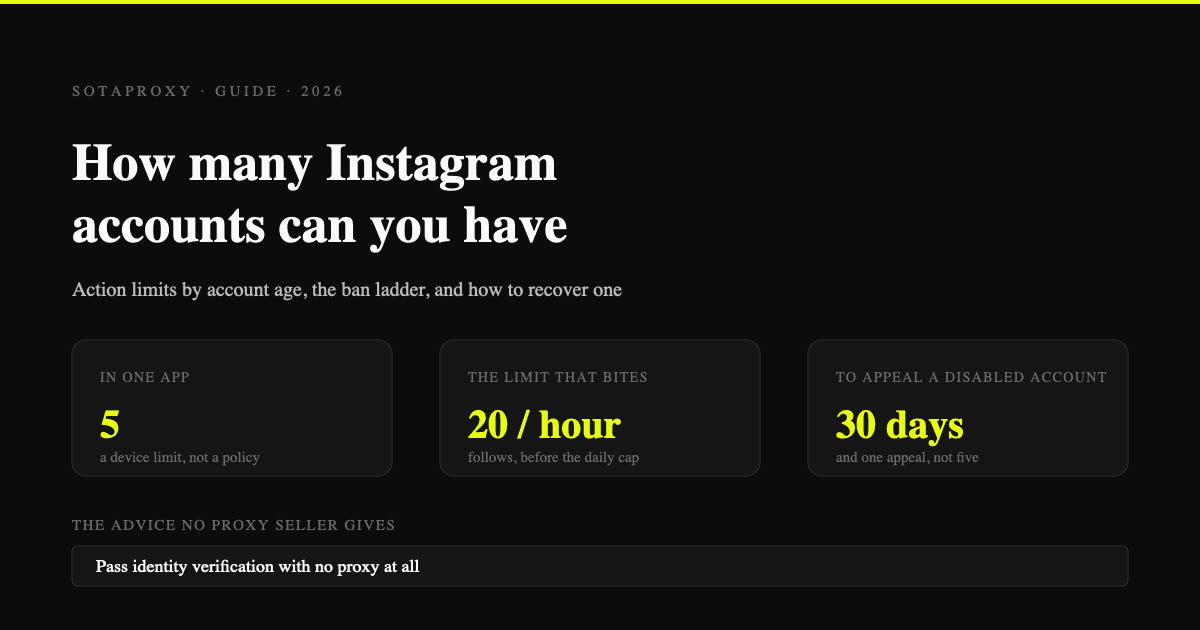
How Many Instagram Accounts Can You Have in 2026 (And What Gets Them Banned)
The five-account switcher is a device limit, not a policy. Instagram's action limits by account age, how it links accounts, the enforcement ladder, and how to recover a restricted account.
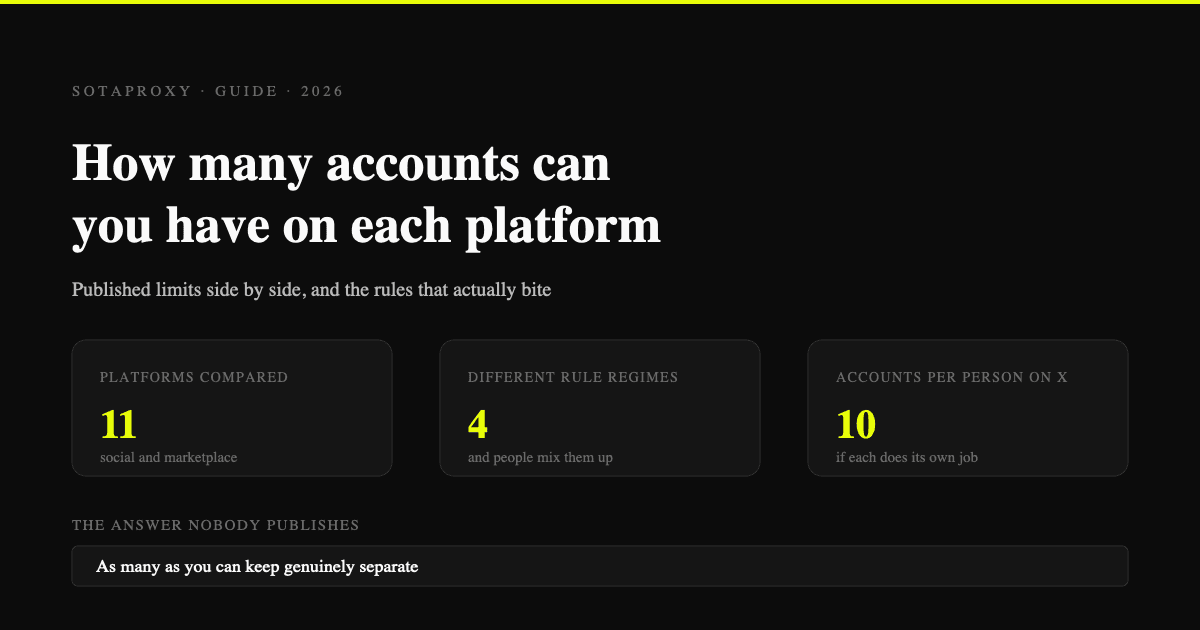
How Many Accounts Can You Have on Each Platform in 2026
Published limits for eleven platforms side by side, the four different rule regimes behind them, and why the number in the app is never the real constraint.

How Much You Actually Make on OnlyFans in 2026: The Full Fee Stack
The published earnings distribution, every cut between a fan's dollar and your bank account, when the money actually lands, and the one metric that decides whether promotion works.
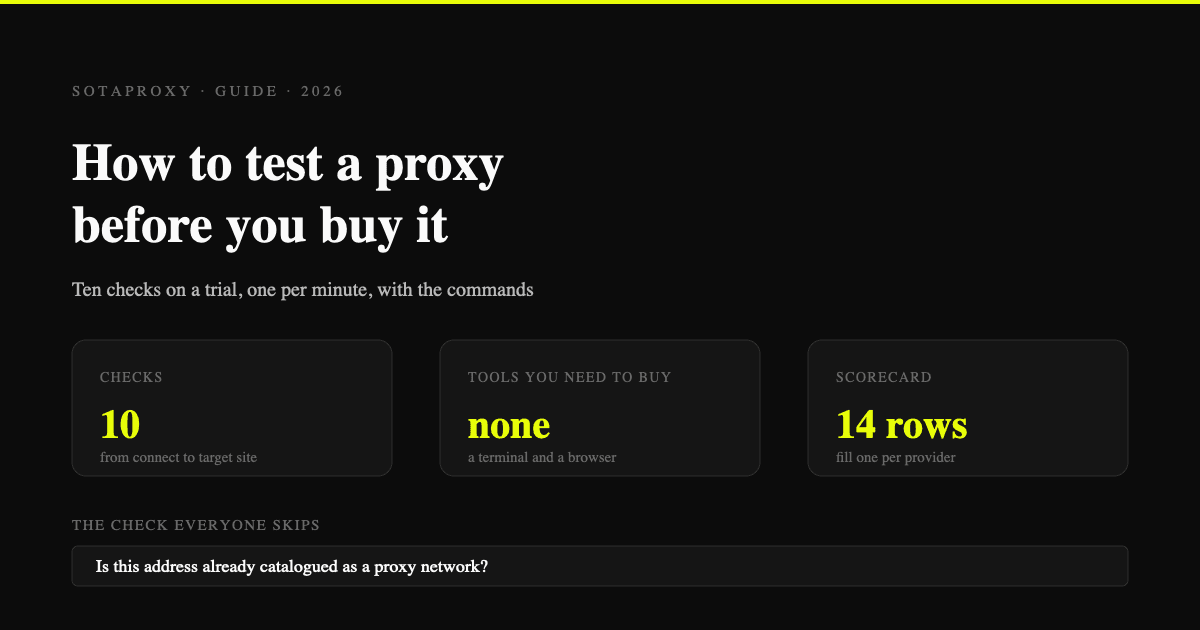
How to Test a Proxy Before You Buy It: A 10-Minute Checklist
Ten checks that tell you whether a proxy trial is worth paying for: exit ASN, hosting flags, rotation behaviour, subnet spread, DNS and WebRTC leaks, and success rate on your own target.

How to Make Money With Web Scraping in 2026: Five Models, Priced
Five ways scrapers get paid, what each one charges, and what a scrape actually costs to run, measured on real pages: HTML-only against a full browser render.