Top Brightdata Alternatives for Proxy Teams in 2026
Explore the best brightdata alternatives for scraping, ad verification, and geo-targeted campaigns in 2026, plus migration tips.
The biggest mistake in brightdata alternatives research is treating pool size like the only variable that matters. It doesn't. Traffic arbitrage teams, media buyers, account farmers, and scraper operators care about how residential, mobile, ISP, datacenter, and IPv6 proxies behave under real load, how sessions stick, how rotation breaks, how geo routing lands, and how much cleanup the team has to do after anti-bot systems start flagging traffic.
That's why the market split in two directions. One side still buys raw proxy infrastructure, the other side wants managed scraping or structured-data delivery that skips a lot of parser maintenance. Bright Data became a very large, enterprise-oriented platform, with comparisons citing 1.3 million datacenter IPs, 150 million+ residential proxies, broad country coverage, and a higher entry bar around $500/month minimum. That scale pushed buyers to look for easier onboarding and lower-cost options, not because demand disappeared, but because use cases got more specific, from Facebook and TikTok ad accounts to cloaking, account farming, sneaker bots, and geo-targeted campaigns (Scrape.do's Bright Data alternatives comparison).
The ten providers below aren't ranked by raw size alone. They're ranked by workload fit, session behavior, platform support, trust signals, and operational friction. Sota Proxy is included alongside independent alternatives, because the right answer depends on whether you need city-level targeting, sticky sessions, fast onboarding, or a cleaner path across antidetect browsers like AdsPower, Dolphin Anty, GoLogin, Multilogin, and Hidemyacc.
Table of Contents
- 1. Sota Proxy
- 2. Oxylabs
- 3. Smartproxy, Now Decodo
- 4. SOAX
- 5. NetNut
- 6. IPRoyal
- 7. Rayobyte
- 8. Webshare
- 9. ProxyRack
- 10. Zyte
- Top 10 BrightData Alternatives Comparison
- How to Test and Switch Without Breaking Operations
1. Sota Proxy
Sota Proxy is strongest for teams that care about operational control more than brand size. It combines residential, mobile, ISP, datacenter, and IPv6 proxies, which gives operators room to match the proxy type to the job instead of forcing every workflow through one pool. That matters on mixed stacks, where one run needs sticky residential identities, another needs carrier-like behavior, and a third only needs lower-cost throughput for scraping or ad verification. The platform's own positioning around instant issuance, city-level targeting, and live usage monitoring fits day-to-day proxy work, especially for operators handling Facebook account warming, TikTok ad testing, and a separate scraping queue.
The advantage is the workflow, not just the mix of IP types. Sota Proxy's Bright Data comparison page is aimed at buyers who want a simpler operating model, and that matches a common migration pattern. Teams often move when they no longer need the full enterprise layer that Bright Data sells, but still need stable routing, session control, and manageable cost.
Practical rule: if your workflow depends on sticky sessions, geo precision, and fast swaps between proxy types, test Sota Proxy before you rebuild your stack around one vendor's pricing structure.
A few details make it relevant for high-friction use cases. Residential proxies usually fit profile consistency better, while mobile proxies can carry stronger carrier-style trust signals. Datacenter proxies remain the cheaper choice for lower-sensitivity tasks. City-level targeting matters for geo-targeted campaigns, local SERP checks, and ad verification where country-level routing is not enough. Clean onboarding also reduces the time between purchase and first test batch, which helps when the work involves time-sensitive cloaking or account farming.
Pros
- Broad proxy mix for mixed automation stacks.
- Self-serve setup that suits fast-moving operators.
- Fits ad accounts, scraping, and multi-account workflows.
Cons
- Heavy mobile usage can cost more than simpler bulk providers.
- Public third-party social proof is thinner than the biggest incumbents.
Website: Sota Proxy's residential proxy plans
2. Oxylabs
Oxylabs is the safer choice when a team wants enterprise proxy infrastructure with fewer operational surprises. Independent roundups place it in the enterprise-scale bucket (Sota Proxy comparison of Oxylabs vs Bright Data), and practitioner comparisons consistently frame it as a high-stability option for agencies, data teams, and operators who need deep targeting and predictable sessions rather than the lowest possible bandwidth.
That fit shows up in real workflows. If you are running AdsPower or Multilogin profiles across multiple markets, sticky sessions need to hold without drifting mid-run. If you are verifying ads, monitoring SERPs, or testing geo-specific landing pages, routing has to stay consistent at both country and city level. Oxylabs' public framing around residential, mobile, ISP, and datacenter coverage makes it a practical candidate for teams that need to mix proxy classes without moving vendors.
The trade-off is cost and commercial friction. Oxylabs sits on the premium side of the market, and buyers usually get fewer self-serve shortcuts than they would from lower-cost providers. That is acceptable if uptime and support matter more than experimentation speed, but it slows testing for smaller teams or one-off workloads.
For teams that need Facebook account operations or stealthier cloaking setups, session continuity matters more than headline pool size. Oxylabs fits repeated production runs better than casual trial-and-error because the operational model is built around stable routing, controlled access, and predictable behavior under load.
If your target list changes often, Oxylabs works best when one team owns procurement and another owns execution. It is less convenient for casual testing, and stronger for repeatable production runs.
For high-volume scraping, the fit depends on whether the target set justifies premium bandwidth and whether the engineering team already knows how to use it. If the workload also includes TikTok ad accounts, account farming, or geo-targeted campaigns, the practical test is whether the proxy type, session behavior, and geo precision match the workflow without forcing constant resets or extra manual cleanup.
Website: Oxylabs
3. Smartproxy, Now Decodo
Decodo, formerly Smartproxy, is the value-minded choice that still feels built for real operators. G2's 2026 comparison names Decodo (formerly Smartproxy) as the top Bright Data alternative overall and lists it ahead of several close substitutes, which is a useful market signal because it reflects verified user reviews rather than vendor copy (G2 Bright Data alternatives). The price posture in the market also tells the story. Practitioners routinely treat Decodo as the lower-cost mainstream option, with benchmark roundups framing it as a simpler path for buyers who don't want enterprise procurement overhead.
That makes it attractive for account farming, ad account testing, and mid-scale scraping. It supports the proxy types that are typically needed, especially when you're switching between browser automation and data collection. For GoLogin or Hidemyacc profiles, the combination of sticky sessions and geo targeting matters more than raw network bragging rights.
The migration angle matters as well. If a team comes off Bright Data and wants less friction, Decodo usually lands well because the onboarding feels lighter and the billing model is easier to reason about. The commercial rebrand from Smartproxy to Decodo can still create confusion inside older playbooks, though. Some operators still search the old name when they ask for proxy recommendations in Telegram groups or internal docs.
Where Decodo Fits Best
- Multi-account management: stable enough for profile-based work without forcing enterprise complexity.
- Scraping with budget control: good when costs matter more than massive pool depth.
- Trial-driven evaluation: easier to test than the most procurement-heavy vendors.
The limit is support depth. Decodo is strong for self-serve usage and transparent entry, but if your workflow needs the deepest enterprise controls, you may still outgrow it. For many teams, that's fine. They don't need a cathedral of features, they need a proxy stack that opens fast, rotates cleanly, and doesn't eat the budget.
Website: Smartproxy
4. SOAX
SOAX works well for teams that need to compare proxy classes without rebuilding the buying process each time. Its unified credit model lets you move between residential, mobile, ISP, and datacenter proxies, plus the Web Data API, under one subscription. That matters when the same operator is testing what holds up for scraping, what holds up for Facebook profiles, and what holds up for geo-targeted campaign checks.
The technical value is flexibility. One workflow may need sticky residential sessions for browser consistency in Dolphin Anty. Another may need mobile behavior for a tougher platform. Another may need datacenter IPs for less sensitive monitoring tasks. SOAX lets agencies shift between those layers with less administrative churn than vendors that split every proxy type into separate billing tracks.
It also gives practical protocol coverage, including HTTP, SOCKS5, UDP, and QUIC. That matters if your automation stack is not uniform. Different scripts, browser profiles, and scraping jobs can sit in the same environment without forcing every task onto the same connection pattern.
What Works and What Doesn't
Practical rule: use SOAX when you are still figuring out which proxy class fits a target. Use it less when you already know the exact workload and want the cheapest specialized package.
The downside is entry friction. The model favors teams ready to buy meaningful volume, not people looking for tiny micro-tests. If your workflow is irregular, or you only need a handful of sessions for a cloaking test or a short campaign burst, cheaper options may be easier to justify.
SOAX is a useful middle ground for operators who want one commercial relationship and multiple technical paths. It is less of a one-trick proxy shop and more of a testing platform for teams that keep changing targets.
Website: SOAX
5. NetNut
NetNut fits teams that need rotating residential traffic and static, ISP-like behavior without forcing those workloads into separate vendors. That split matters in practice. Rotating sessions help when freshness matters, while static identities matter when the session itself has to hold up, especially in account-heavy workflows and browser profiles that need to stay consistent across repeated actions.
NetNut's one-hop architecture and targeting options make it a workable fit for SERP monitoring, e-commerce checks, and ad verification. Teams that need country, city, or state routing can use it without falling back to a broad global pool that adds noise. It also fits Multilogin or Hidemyacc profiles that need stable identities across repeated visits, where the proxy layer has to behave like a real session instead of a constantly changing source.
The trade-off is commercial clarity. Public pricing is often fragmented, so buyers usually end up speaking with sales before they can compare the cost of a workload. That makes evaluation slower for teams that prefer to test several providers quickly and then decide which one matches the target.
Use Cases That Benefit Most
- SERP monitoring: long-lived sessions can cut down on location noise when the target has to stay stable.
- E-commerce and pricing checks: static and rotating access can be assigned to different target classes.
- Ad verification: geo routing plus identity stability matters more here than raw pool size.
NetNut still deserves scrutiny for sensitive use cases because proxy selection should be based on behavior, not marketing copy. The right check is whether the provider stays steady on your actual targets. For account farming, that means repeated login behavior and whether sessions survive normal retries. For scraping, that means how often the session breaks under pressure and whether the proxy identity stays clean enough to keep the task running.
Website: NetNut
6. IPRoyal
IPRoyal is the budget-friendly choice for teams that need to keep buying access without signing up for a heavy enterprise contract. It supports residential, ISP, datacenter, and mobile proxies, which matters because many operators do not run a single clean workload. They use a low-cost datacenter layer for broad automation, then move to residential or mobile for higher-trust actions in Facebook or TikTok account work.
The market signal is straightforward. IPRoyal appears often in comparison lists for buyers who want self-serve access and a lower entry barrier, and it is a common starting point for smaller teams that need a usable proxy stack before they can justify premium vendors. That makes it a strong migration target for operators who care about control but do not want to overbuy, (Sota Proxy comparison of IPRoyal vs Bright Data).
The platform also fits mixed environments. If you are using AdsPower or GoLogin and need to route different profiles through different proxy classes, IPRoyal gives enough flexibility to keep the stack organized. It is not the most prominent vendor in the list, but it is one of the easier options to deploy without buying more capacity than you need.
Budget providers win when the task is clear and the target is forgiving. They lose when you need high resilience against heavy anti-bot pressure.
The limitation is consistency. Smaller providers can work for moderate targets, but teams running cloaking, sneaker bots, or harsher account-farming flows should test blacklist frequency, challenge frequency, and IP reuse carefully before trusting production traffic to the pool. The right evaluation is not just whether the proxy connects, but whether sessions stay usable under repeated logins and whether the IPs remain clean enough for the target platform.
Website: IPRoyal
7. Rayobyte
Rayobyte appeals to operators who care about sourcing posture and abuse controls as much as proxy routing. That makes it different from many price-first alternatives. If your team has to explain procurement choices internally, or if a compliance reviewer asks where the traffic comes from and how the vendor handles abuse, Rayobyte gives you more documentation to work with than a generic budget proxy shop.
Technically, the fit is straightforward. Residential, ISP, and datacenter proxies cover the usual split between sticky identities and high-throughput access. That matters when the same team is handling long-lived browser sessions in Multilogin one day and straight scraping jobs the next. For account workflows, especially when you're moving between cloaking and ad verification, documented sourcing can be as important as raw performance.
The downside is simple. Entry-level performance can vary by target, and the best economics usually show up when your volume is already meaningful. If you're just testing the waters, another vendor may be easier to start with. If you're running sustained production load, Rayobyte becomes more interesting.
Where Rayobyte Makes Sense
- Compliance reviews: useful when sourcing and abuse controls need to be explained.
- Large-scale scraping: better when volume justifies the commercial model.
- Mixed workflows: viable when your stack shifts between proxies and automation.
Rayobyte is less about flashy features and more about being defensible in a review. That can matter a lot in agencies and performance teams with multiple stakeholders.
Website: Rayobyte
8. Webshare
Webshare is the easy test-bed vendor in this category, and the Sota Proxy comparison of Webshare vs Bright Data is useful if you want a direct reference point before you move traffic. It is built for low-friction onboarding, public pricing, and fast provisioning, which fits teams comparing brightdata alternatives without spending a long time in sales calls. It also covers the basics well enough for mixed stacks, with rotating residential, static residential, and datacenter options.
That makes it a practical fit for operators who split traffic by risk class. Datacenter IPs can handle benign automation, while residential IPs are better for higher-trust sessions in AdsPower or Dolphin Anty. Webshare gives you a straightforward way to separate those jobs without adding much admin overhead, which matters when the same team is also juggling scraping jobs, ad accounts, or account farming workflows.
The operational advantage is speed of testing. If you need to spin up a few geo-targeted sessions, validate a route, and move on, Webshare is easy to work with. Session behavior is simple to evaluate, and the public pricing makes it easier to compare cost against uptime, IP cleanliness, and support response before you migrate anything real. That makes it useful for crawler tests, sneaker bot checks, and short-lived antidetect browser runs where the goal is to find out whether the proxy class fits the job.
Webshare does not try to be the most premium enterprise choice in the room. That is fine for many teams, because a lot of proxy work only needs working IPs, stable sessions, and a dashboard that stays out of the way. The trade-off is that buyers who want heavier compliance packaging, more hand-holding, or a deeper enterprise sales motion may prefer a different vendor once production risk gets higher.
Website: Webshare
9. ProxyRack
ProxyRack is a solid option when unmetered access is more useful than a fancy stack of antiban extras. That matters for long-running account work and repetitive automation jobs where the team wants to avoid constant bandwidth math. It also helps when a workflow combines residential, datacenter, and ISP traffic and the operator wants one place to manage the mix.
This kind of setup is practical for account farming, some scraping loads, and broad monitoring jobs. It's less about precision features and more about making steady work cheaper to operate. If you're using browser automation in GoLogin or Hidemyacc, the ability to keep a session alive without obsessing over every gigabyte can make a real difference.
The downside is that pricing details can move around more than buyers like, so teams often need to validate the checkout flow carefully before they commit. That's not unusual in this segment, but it does mean you should not treat the public landing page as the last word.
Best Fit Signals
- Long-running jobs: unmetered residential access can simplify cost planning.
- Mixed proxy routing: useful when one account stack needs more than one proxy class.
- Straightforward dashboards: easier for operators who don't want complex workflows.
ProxyRack is not the strongest pick for teams that need advanced antiban automation or the slickest API-first experience. It earns its place by making the economics simple enough for repetitive work.
Website: ProxyRack
10. Zyte
Zyte stands apart because it prices around successful requests rather than raw bandwidth, and that changes the budgeting conversation completely. For teams that hate trying to forecast how many gigabytes a site will burn, that model is much easier to reason about. It also suits scraped data flows where the output matters more than the proxy mechanics behind it.
That architecture is especially useful when you don't want to maintain parsers, browser orchestration, or block-handling logic yourself. Zyte's API-centric approach lets the platform handle proxy rotation, unblocking, and rendering behind the scenes, which reduces the amount of infrastructure your team has to own directly. That's attractive for structured scraping, ad verification support, and controlled retrieval pipelines.
The trade-off is control. If you want to hand-pick proxy classes for edge cases, Zyte is less flexible than a pure proxy vendor. That doesn't make it worse, it makes it different. Teams that want clean delivery and fewer moving parts often prefer that trade.
For workloads that keep breaking your parsers, an API that returns usable results can save more time than a cheaper proxy ever will.
Zyte is one of the clearest examples of the market shifting away from proxy-only thinking. Some buyers don't need more IPs, they need fewer operational headaches.
Website: Zyte
Top 10 BrightData Alternatives Comparison
| Provider | Core features | Target audience / Use cases | Pricing & value | USP & reliability |
|---|---|---|---|---|
| Sota Proxy (Recommended) | Residential, mobile (4G/LTE), ISP, datacenter; 220+ geolocations; AI Pool Manager & route optimizer; rotation/sticky; real-time dashboard | Web scraping, ad verification, price/SEO monitoring, social-media mgmt, automation at scale | PAYG per-GB (residential ~ $2.00/GB; corp from $1.00/GB); IPv6 $0.20/mo; IPv4/dedicated ~$1.80/mo; ISP ~$3/mo; mobile ~$6.72/day; crypto/card top-ups; volume discounts | AI-driven self-healing pools; 99.9% SLA; redundant clusters; 24/7/365 human support; predictable performance |
| Oxylabs | 100M+ residential IPs, mobile, ISP/static residential, datacenter; sticky/rotating; Unblocker & Scraper APIs | Enterprises & agencies needing deep geo targeting and mission-critical automations | Premium enterprise pricing; many plans require sales engagement | Enterprise SLAs; advanced unblocking/CAPTCHA handling; high uptime & 24/7 support |
| Smartproxy (Decodo) | 115M+ residential; HTTP(S)/SOCKS5; city/state targeting; static residential & datacenter | Cost-conscious teams for scraping, multi-account mgmt, quick onboarding | PAYG & monthly subscriptions; low entry cost and clear pricing | Easy self-serve onboarding and trials; strong value for mid-market users |
| SOAX | Single credit model across residential, mobile, ISP, DC; sticky/rotating; HTTP/SOCKS5/UDP/QUIC; unlimited concurrent sessions | Teams testing multiple proxy types without switching plans; flexible testing | Credit-based subscriptions; competitive $/GB at higher tiers; trial available (small bundle) | Simple cross-product pricing; trialable UX; some compliance items listed as in-progress |
| NetNut | 50M+ rotating residential; static residential; one-hop architecture; SDK-style integrations | SERP, e‑commerce, ad verification, tasks needing long sticky/static IPs | Public pricing fragmented by geo; many enterprise quotes require sales | Rotating + static under one vendor; strong docs/integrations; mixed public sentiment, diligence advised |
| IPRoyal | Residential, ISP/static, datacenter, mobile; SOCKS5 & HTTP(S); rotation & sticky | Small teams and projects needing granular PAYG and mixed proxy stacks | Granular PAYG tiers and subscriptions; low barrier to entry | Quick self-serve setup and transparent pricing; pool quality can vary vs enterprise vendors |
| Rayobyte | Residential, ISP, datacenter; sticky sessions; published ethics & abuse policies | Organizations wanting documented sourcing, reseller programs, and aggressive volume pricing | Aggressive volume pricing (best at mid/high volumes); some features behind sales | Consent-based sourcing and ethics docs; strong volume economics; entry performance varies |
| Webshare | Rotating residential per GB; static residential per IP; free/cheap datacenter tier; instant provisioning | Testers and teams mixing DC & residential to optimize cost | Very low entry cost; transparent public pricing and free limited DC tier | Extremely easy self-serve scaling and testing; not positioned as premium enterprise pool |
| ProxyRack | Residential, datacenter, ISP; metered and unmetered plans; dashboard/ports | Long-running account work and users preferring unmetered residential packages | Unmetered residential options reduce bandwidth concerns; pricing varies and changes | Unmetered packages for sustained jobs; straightforward dashboard; fewer advanced antiban features |
| Zyte (Smart Proxy Manager) | Smart Proxy Manager + Zyte API; automatic proxy selection & rotation; browser rendering; client libs | Teams wanting outcome-based billing and built-in antiban/rendering for hard targets | Priced by successful requests (pay per outcome), not $/GB; budgeting model differs | Built-in block handling and rendering; reduces need for custom antiban stack; high automation focus |
How to Test and Switch Without Breaking Operations
The safest migration path starts with workload definition, not vendor marketing. Split your traffic by job type first, then test each class separately. Run one set for residential sessions, one for mobile, one for ISP, one for datacenter, and one for IPv6 if your stack uses it. That separation matters because the best proxy for scraping is not always the best proxy for Facebook ad accounts, TikTok campaigns, account farming, cloaking, sneaker bots, or geo-targeted browsing.
Then test each candidate against the same requests. Use identical URLs, identical headers, identical browser profiles, and the same timing window. Record success rate, latency, uptime, geo accuracy, IP reuse, blacklist or challenge frequency, and session stability. If you use AdsPower, Dolphin Anty, GoLogin, Multilogin, or Hidemyacc, wire those profiles in early so you see whether the proxy behaves well inside the tool, not just in a raw curl test.
A clean switch usually happens in three stages. Start with a small canary group, keep the incumbent live, and verify that the new pool holds steady on the exact targets that matter. Keep rollback credentials ready. That sounds basic, but teams lose hours when a shiny new provider works on easy test URLs and fails on the one account cluster that drives revenue.
Practical rule: don't judge a proxy provider by one successful login. Judge it by repeated sessions, repeated geos, and repeated retries under pressure.
Cost comparison comes last, after reliability. Compare bandwidth-based pricing against request-based pricing only after you know which provider can handle your workload. For some teams, the cheapest proxy is the one that reduces retries, not the one with the lowest sticker price.
If you run a traffic or affiliate operation, Sota Proxy's referral and affiliate program, with up to 40% commission, can also offset acquisition cost when proxy spend is recurring. That matters only after the operational test passes, because commission doesn't help if the pool can't hold session quality in production. For structured lead workflows, you can also pair the migration with a data collection plan, like to export B2B contacts from Sales Navigator, so the proxy decision and the outreach pipeline stay aligned.
If you want a proxy stack that covers residential, mobile, ISP, datacenter, and IPv6 use cases without forcing a brittle enterprise workflow, take a close look at Sota Proxy. It's built for the same practical jobs that drive most brightdata alternatives searches, scraping, ad verification, account management, and geo-targeted automation. Visit the platform, test your workload, and decide from real session behavior instead of pool-size headlines.
Related articles

10 Best Proxy Services for Ads, Scraping, and Automation
Compare the best proxy services for ad verification, scraping, account operations, and geo-targeting by IP type, price, uptime, and controls.
10 Oxylabs Alternatives for Scraping and Ad Operations
Compare 10 oxylabs alternatives by proxy type, geo coverage, uptime, rotation, pricing, and use case for scraping, ad verification, and account farming.
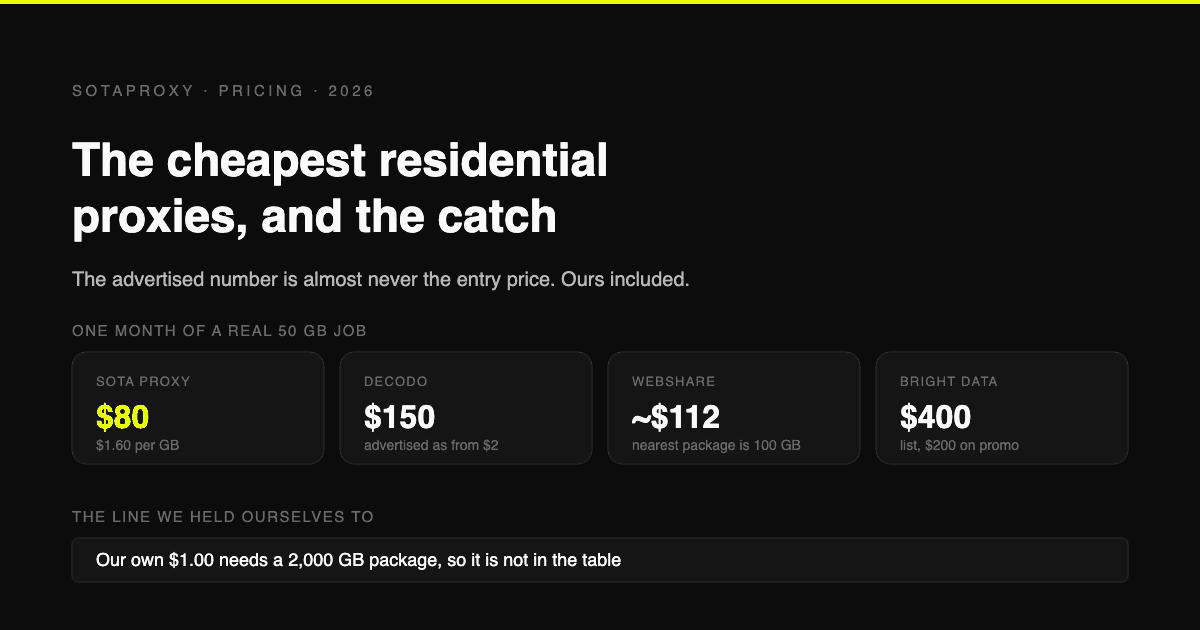
The Cheapest Residential Proxies in 2026, With the Catch Each One Hides
Verified per-gigabyte prices from five vendors' own pages, not from last year's blog posts. Why the advertised number is almost never the entry price, which providers put a monthly floor under your bill, and how to work out your real cost per gigabyte.
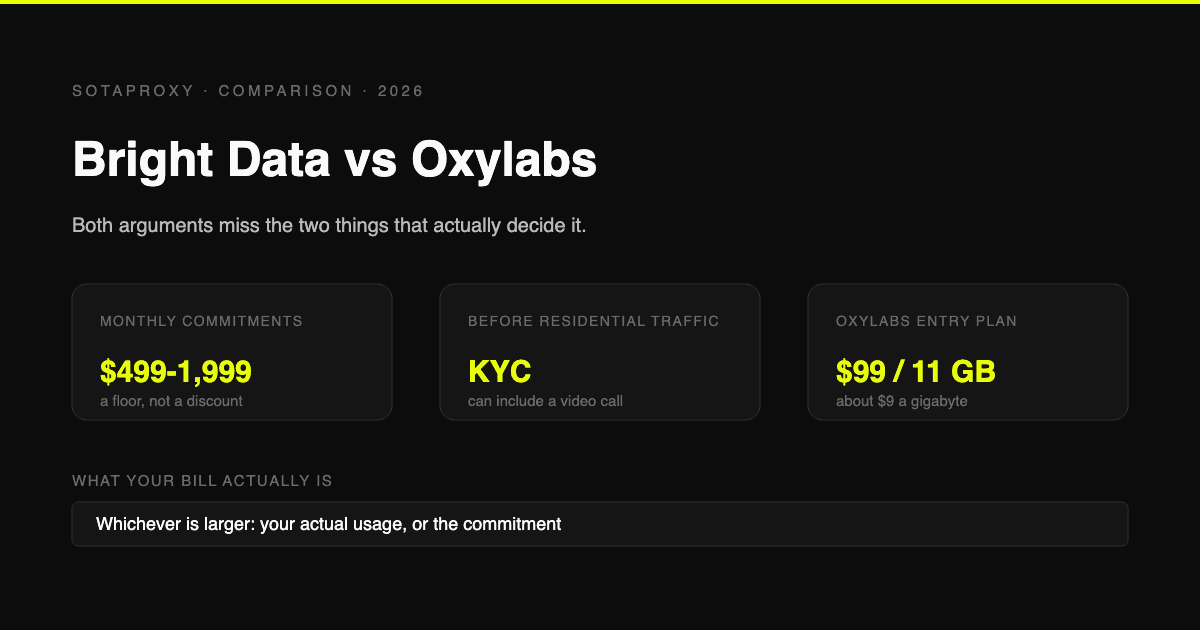
Bright Data vs Oxylabs in 2026: Prices, Commitments and the KYC Nobody Mentions
Both are enterprise platforms with minimum monthly commitments and a compliance check before you can touch residential traffic. Current prices from both vendors' own pages, what the commitment actually costs if you underuse it, and who each one is genuinely for.
Decodo Alternatives in 2026: Who to Move to, and Who Not to Bother
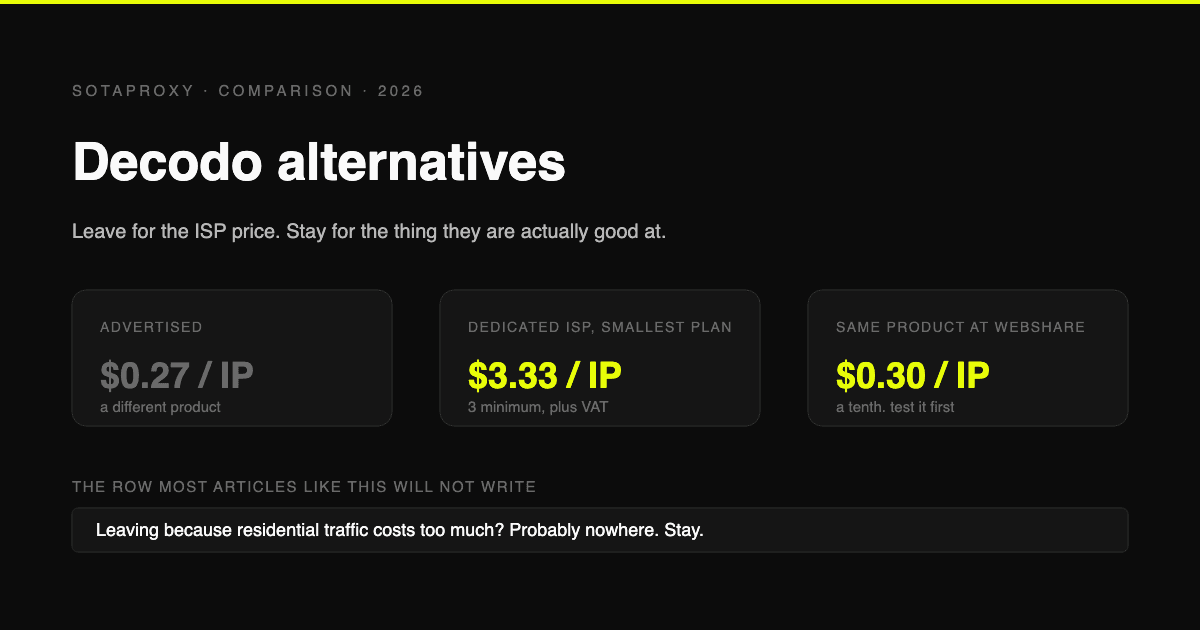
Decodo is the cost leader on rotating residential and one of the pricier options on dedicated ISP. Verified prices for both, the reasons people actually leave, and which alternative fits each one.

Proxy Load Balancing Explained for Practitioners
Learn how proxy load balancing works for Facebook, TikTok, and multi-account workflows. Covers algorithms, architectures, and best practices.