How Many Proxies Do I Need? Two Formulas: One for Accounts, One for Scraping
The answer depends on whether you are running accounts or collecting pages, and the two questions have different units: addresses for accounts, requests per address or gigabytes for scraping. Both formulas, the real per-address limits that platforms publish or that we measured, and four worked examples with what they cost.
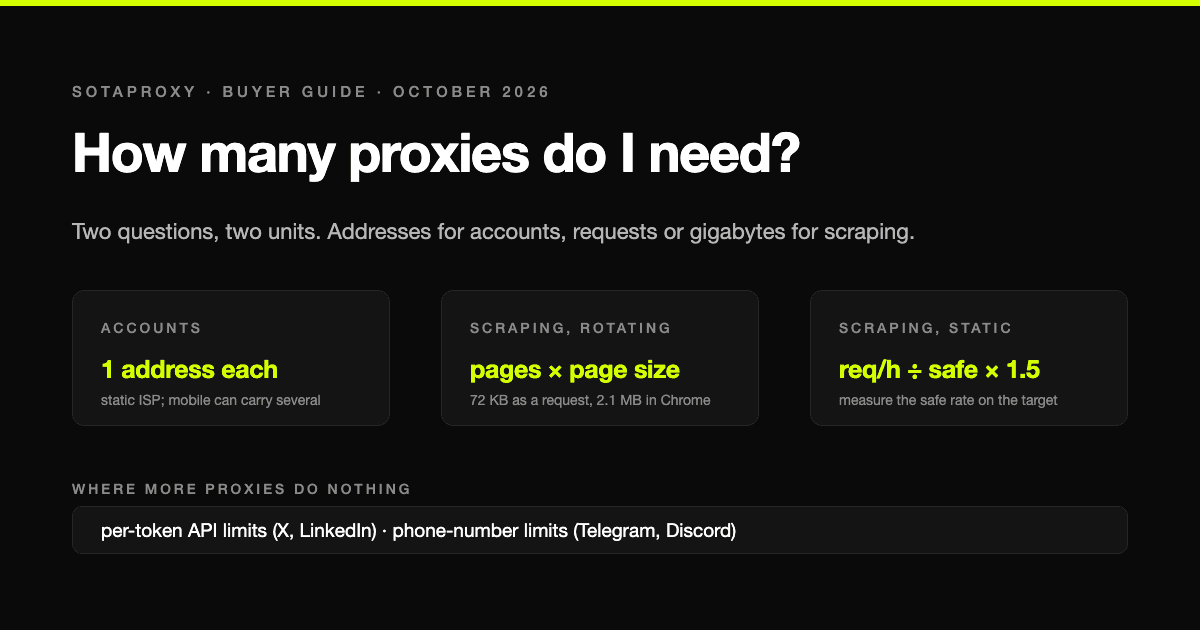
"How many proxies do I need" is two different questions wearing the same words. If you are running accounts, the answer is a count of addresses, and it comes from how many accounts you are willing to put behind one address. If you are collecting pages, the answer is either a count of addresses or a number of gigabytes, and it comes from how many requests one address can make to your target before it gets a challenge.
Mixing the two up is the most common sizing mistake there is: people buy a rotating residential pool for twenty social accounts, or twenty static addresses for a scraping job that needs two hundred. This guide gives each question its own formula, fills it with real limits rather than rules of thumb, and ends with four worked examples priced out.
Question one: how many proxies for accounts?
Formula: addresses = accounts ÷ accounts per address, rounded up.
The whole answer sits in the divisor, and for any account that matters the divisor is one. Platforms that link accounts look at the network address next to stronger signals, and two accounts on one address hand them a free link. How that plays out platform by platform is in how many accounts you can have on each platform, but the sizing rule that falls out of it is simple:
| Account type | Accounts per address | Address type |
|---|---|---|
| Seller accounts on Amazon or eBay | 1 | Static ISP, never shared |
| Ad accounts, business managers | 1 | Static ISP |
| Creator accounts on OnlyFans, Instagram, TikTok | 1 | Static ISP or mobile |
| Social accounts used by hand, low value | 1, sometimes 2 to 3 | Static ISP |
| Telegram or Discord accounts | Usually not the limit | The phone number is |
Two exceptions are worth understanding rather than memorising.
Mobile addresses carry more than one account by design. Mobile carriers put many subscribers behind one public address. RFC 6269, the standard that describes this, puts it plainly: where one address is shared between several subscribers, it "no longer uniquely identifies a subscriber", and blocking it hits everyone behind it. Platforms know that a mobile address is a crowd, so several accounts on one is what ordinary traffic from it looks like. The catch is in the same document: geolocation of shared addresses becomes less precise, so a mobile exit is a poor fit when the account's location has to be exact.
On some platforms the address is not the scarce resource. Telegram ties every account to a phone number and Discord to an email and a phone number. A hundred accounts on a hundred addresses with ten phone numbers is ten accounts. Size the numbers first.
What the formula never does is round down because the budget is tight. One address shared by two accounts that must look unrelated is not half the cost, it is the link you were paying to avoid.
Question two: how many proxies for scraping?
Here the unit depends on what you buy.
If you buy rotating residential, you are not buying addresses. You buy gigabytes, and every request can leave from a different address in the provider's pool. The number you need is traffic:
Formula: gigabytes = pages × size of a page.
We measured page size on eight sites through a proxy that counts every byte: a plain HTTP request cost a median 72 KB a page and headless Chrome 2.1 MB, about 21 times more. The full numbers and what reduces them are in how much bandwidth web scraping uses. That one choice, request or browser, moves the answer by more than any other input.
If you buy static addresses, ISP or datacenter, you are buying capacity per address, and the count comes from the target's tolerance:
Formula: addresses = requests per hour ÷ safe requests per address per hour × headroom.
The headroom covers addresses that get flagged and requests that get retried. Webshare suggests 1.5 for forgiving targets and 2 or more for strict ones.
The hard input is "safe requests per address", and almost every guide leaves it blank. A few targets publish it or show it clearly:
| Target | What limits one address | Source |
|---|---|---|
| Discord API | 10,000 invalid requests (401, 403, 429) in 10 minutes and the address is temporarily cut off; 50 requests per second per bot | Discord developer docs |
| Avito | Four homepage requests 20 seconds apart passed, the fifth got a 429 captcha; without pauses the captcha came almost at once | Our measurement, September 2026 |
| X API | Limits are per access token, not per address | X developer docs |
| LinkedIn API | Quotas per application and per member, not per address | LinkedIn API docs |
The bottom two rows matter as much as the top two. When a platform rate-limits by token or by account, more addresses buy you nothing: the limit follows the login, not the network. Adding proxies to an API that counts tokens is the most expensive way to stay exactly where you were.
For everything else, measure: run one address against the real target at a steady pace, raise the pace until the first challenge or 429 appears, and take about half of that rate as your safe figure.
Four worked examples
An agency with 20 creator accounts. Accounts ÷ 1 = 20 static ISP addresses, one per creator, in the creator's usual country. At our ISP price of $2.10 an address from ten addresses up, that is $42 a month. The full per-account setup is in how OnlyFans agencies run 20 creator accounts.
A seller with two Amazon storefronts. Two addresses, never shared, never rotated, because Amazon links related accounts and a deactivation on one reaches the other. Two ISP addresses: $4.40 a month at our two-address price. Why the address is the smallest part of that problem is in how many Amazon and eBay accounts you can have.
Price monitoring, 20,000 product pages a day. If the data is in the HTML, plain requests at about 72 KB a page come to roughly 1.4 GB a day and 42 GB a month on rotating residential. If the pages need a browser, the same job is about 42 GB a day, which is why the first question is always whether you need the browser at all.
A crawler against a site that allows about 60 requests an hour per address. 3,000 requests an hour ÷ 30 safe requests per address × 1.5 headroom = 150 static addresses, or the same traffic on rotating residential if the site does not care which address a request comes from. When it does not care, rotating is cheaper; when sessions must stick, static wins.
The mistakes that make people buy twice
- Rotating pool for accounts. An account whose address changes every session looks compromised, and compromised accounts get locked. Accounts want static addresses.
- Static addresses for a broad crawl. A few hundred static addresses cost more than the same traffic on a rotating pool and burn faster.
- Sizing on page count, forgetting the method. 100,000 pages is 7 GB as requests and 210 GB in a browser.
- More addresses against a per-token limit. If the API counts tokens or accounts, the network is not the bottleneck.
- No headroom. Some addresses will get flagged in the first week. Plan for them, or the job stops when they do.
Before buying the full count, buy the smallest unit and run the target test from how to test a proxy before you buy. One address for a day tells you more about the right number than any table.
For transparency, our place in this: ISP addresses from one at $3.00 a month, $2.20 each from two and $2.10 from ten; residential from $1.00 per GB at volume with a $2.00 entry package. The point of the formulas is that you should know the number before you look at anyone's prices, ours included.
Frequently asked questions
How many proxies do I need for multiple accounts?
One static address per account that matters, so the count equals the number of accounts. Mobile addresses can carry several accounts because carriers already share them between many subscribers, and on Telegram or Discord the phone number, not the address, is usually the limit.
How many proxies do I need for web scraping?
On rotating residential you buy gigabytes, not addresses: pages × page size. We measured a median 72 KB a page for plain requests and 2.1 MB for headless Chrome. On static addresses: requests per hour ÷ safe requests per address per hour × 1.5 to 2 for headroom.
Can I use one proxy for several accounts?
Only for accounts that are allowed to look related, or on a mobile address, where sharing is normal. For seller, ad and creator accounts, one address per account, because a shared address is a direct link between them.
How do I find the safe number of requests per proxy?
Run one address against the real target at a steady pace and raise it until the first challenge or 429. Use about half that rate. Some limits are published: Discord cuts off an address after 10,000 invalid requests in 10 minutes.
Do more proxies help with API rate limits?
Not when the API limits by token or account, as the X and LinkedIn APIs do. The limit follows the login, so extra addresses add cost without capacity.
Related articles
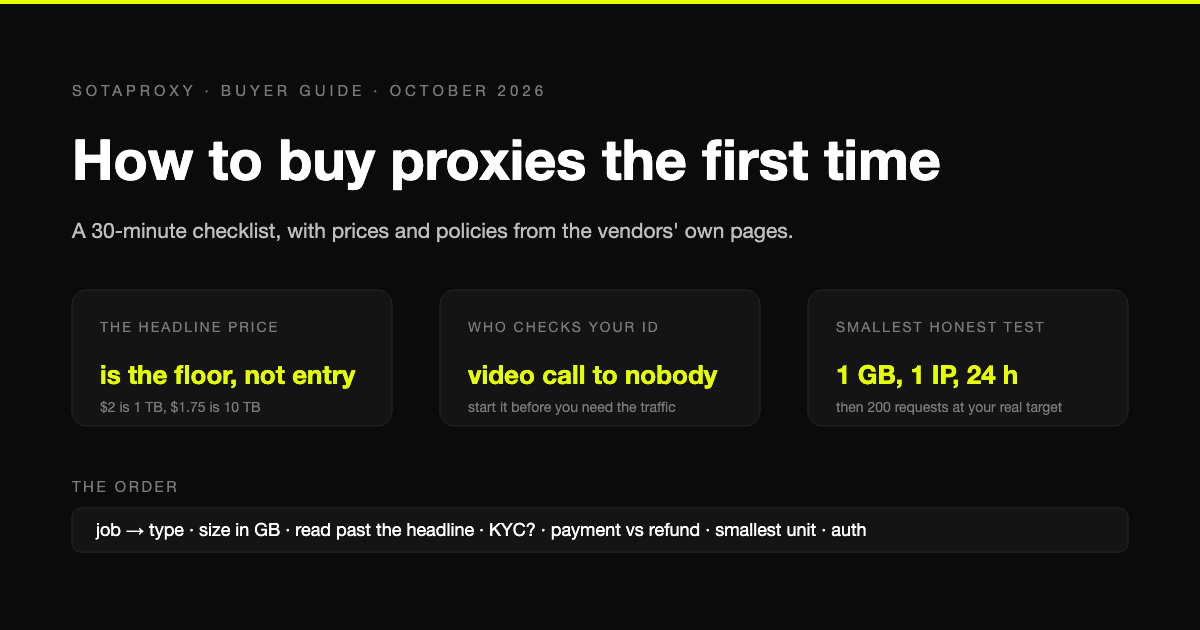
How to Buy Proxies for the First Time: A 30-Minute Checklist
A first purchase goes wrong in predictable places: the wrong proxy type, a headline price nobody pays, an identity check nobody mentioned, a refund that does not apply to how you paid. The checklist, with prices and policies from the vendors' own pages.
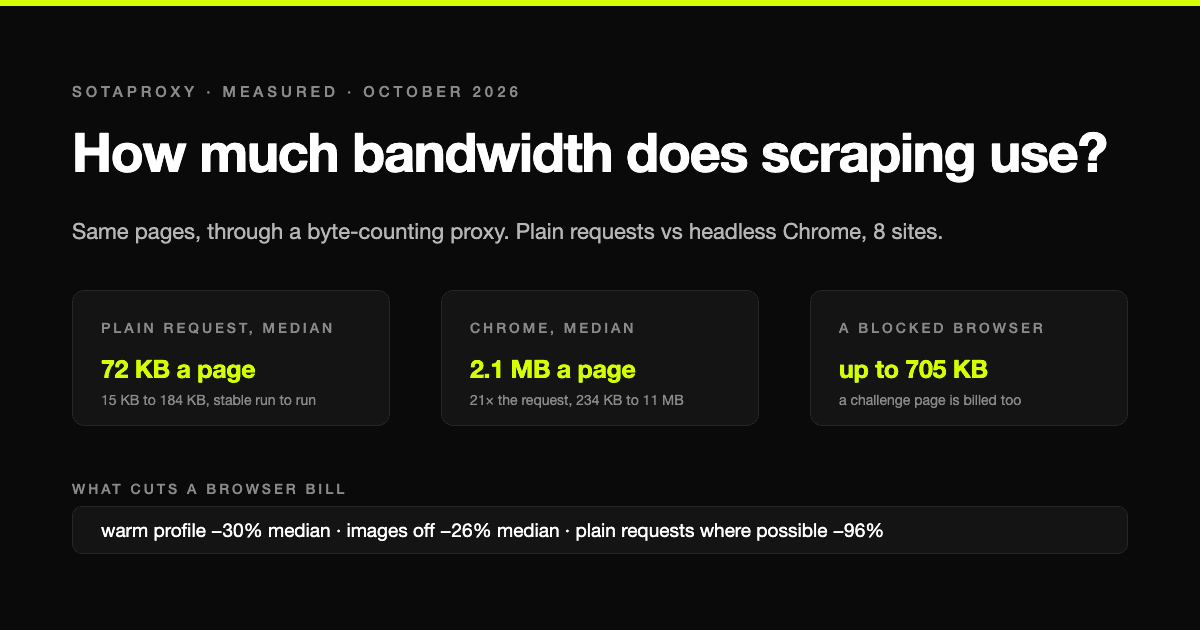
How Much Bandwidth Does Web Scraping Use? We Measured It, Requests vs Headless Chrome
On residential proxies you pay per gigabyte, so the scraping method sets the bill. We loaded the same pages with plain HTTP requests and with headless Chrome through a proxy that counts every byte: the median page cost 72 KB one way and 2.1 MB the other, a 21-fold difference, plus what blocking images, reusing a browser and getting blocked actually cost.

How Many Google and Steam Accounts Can You Have in 2026
The two platforms in this series where the count is genuinely unlimited and the limit is somewhere else: Google rations phone numbers and never says how many accounts one buys, Steam lets you make as many accounts as you like and then locks every one of them until it has spent $5. The rules from Google's and Valve's own pages, and what actually ties two accounts together.
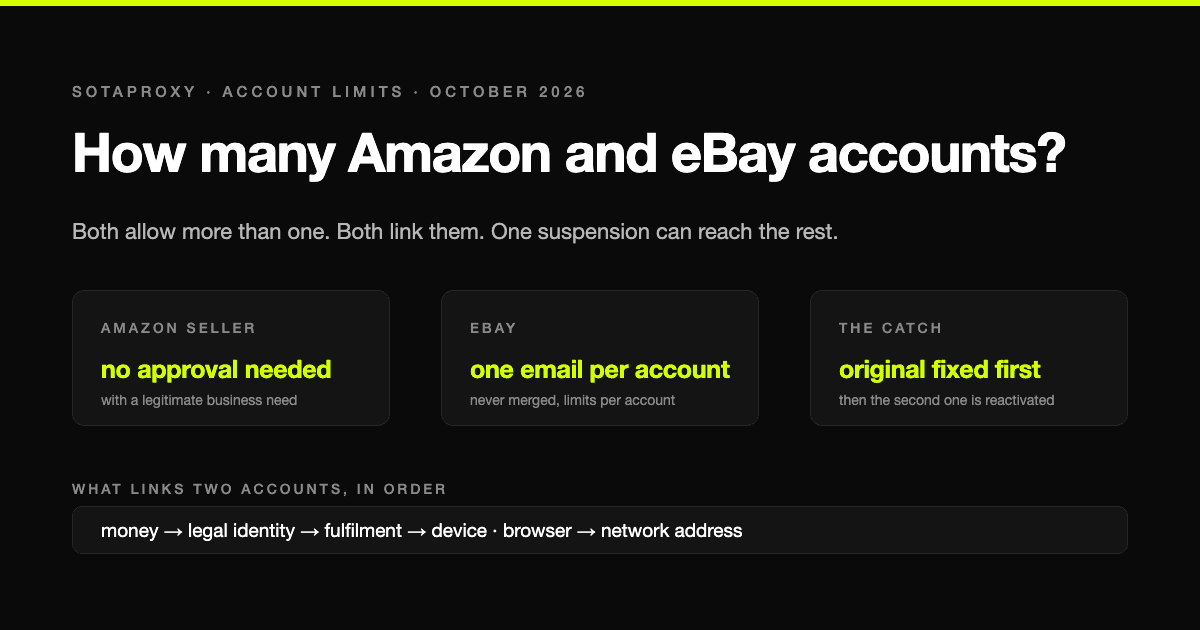
How Many Amazon and eBay Accounts Can You Have in 2026
Amazon and eBay are the generous end of the account-limit scale on paper and the harshest in practice: more than one account is allowed, every account is linked, and one suspension can take the lot. The rules in the platforms' own words, and what actually connects two accounts.
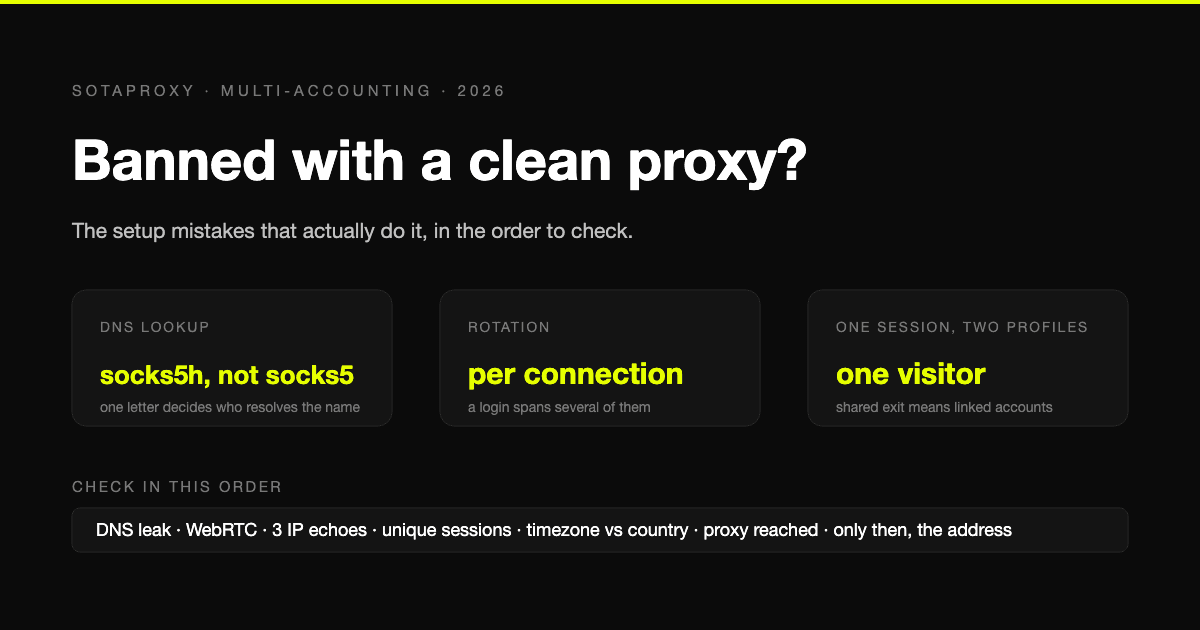
Banned With a Clean Proxy? The Setup Mistakes That Actually Do It
The proxy was clean, the address was residential, and the account still died. In most cases we see, the address was never the problem. Seven setup faults, each one checkable in a minute, in the order they usually turn out to be the cause.
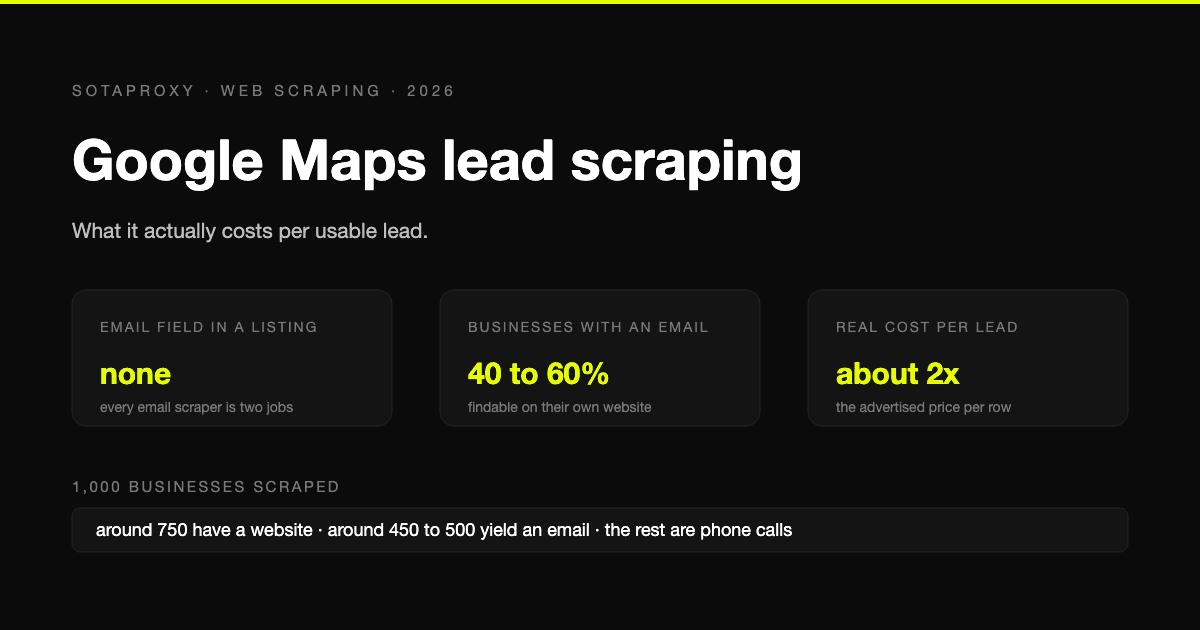
Google Maps Lead Scraping: What It Actually Costs Per Usable Lead
Google Maps has no email field, so every email scraper is a two-stage pipeline and only about half of businesses yield an address. What a thousand listings really costs per usable lead, the businesses-without-websites play, and where the law stands after the SerpApi ruling.