OnlyFans Agency Contracts: The Clauses That Decide What You Keep
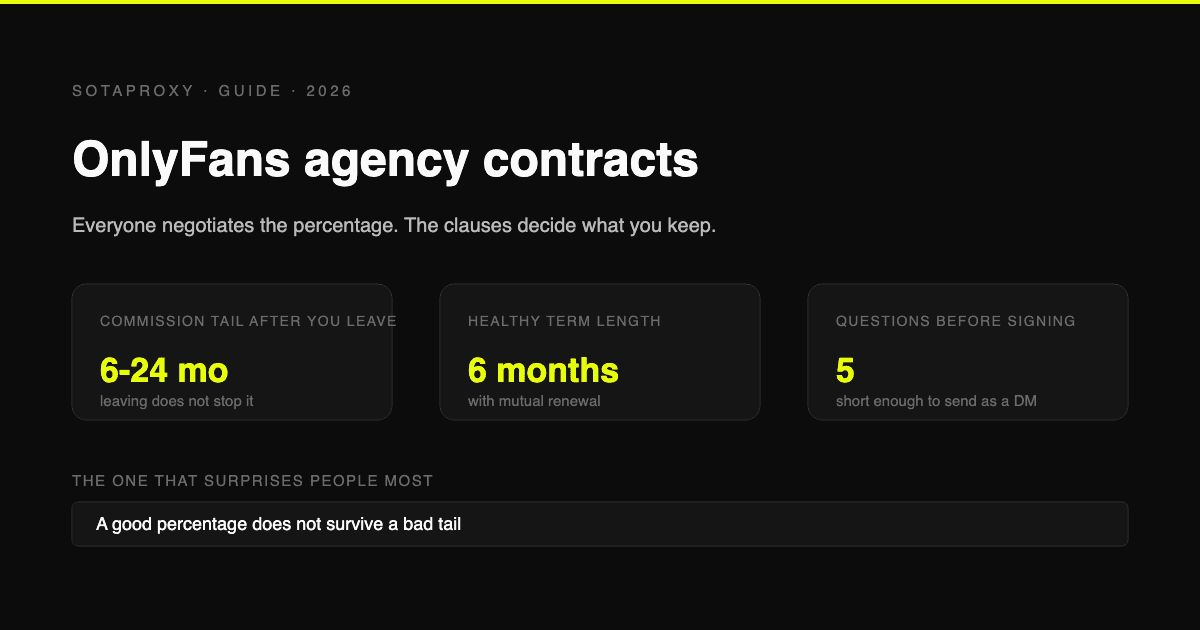
The split is the part everyone negotiates and the part that matters least. Commission tails, clawbacks, perpetual subscriber commission, exclusivity and content ownership are what decide whether leaving costs you anything.
Almost everything written about OnlyFans agencies is written by OnlyFans agencies. That does not make it wrong, but it does mean the genre has a shape: agencies are the answer, the only question is which one.
We sell proxies to the people running these operations, so agencies are our customers rather than our competitors, and we have no reason to sell you one.
This page is about the part creators skip. Everyone negotiates the percentage. Almost nobody reads the clauses that decide whether leaving costs you anything, whether you can work on another platform, and who owns what you filmed. Those clauses outlive the split, and a good percentage does not survive a bad tail.
What does an agency actually do?
The work splits into four buckets, and which ones you are buying is the single biggest driver of the price:
- Chatting. Staff answering DMs in the creator's voice, selling pay-per-view content and upsells. This is the largest line item in most agencies and the one that actually moves revenue, because most earnings on the platform come from messages rather than subscriptions.
- Marketing and traffic. Getting new subscribers in, usually through unpaid posting on Reddit, X and TikTok rather than ads, which most ad platforms will not take for this category.
- Content direction. Shot lists, schedules, pricing, what to post and when.
- Business operations. Payouts, scheduling, sometimes legal and tax coordination.
An agency doing all four is a different product from one doing only the first. Which is why the percentage on its own tells you nothing.
What is the standard split, briefly
We have covered the money side in full elsewhere, so here is only what you need to read a contract. Market rates track how much of the list above an agency actually does:
| What they do | Typical share |
|---|---|
| Chatting only | 20 to 30% |
| Chatting plus marketing | 30 to 45% |
| Full management | 40 to 50% |
One thing decides whether those numbers mean anything: whether the percentage is calculated on gross earnings or on what is left after the platform's 20%. A 40% share of gross and a 50% share of net are the same money. Ask in writing which one they mean, and treat an agency that will not answer in one sentence as having answered.
The full breakdown of where a fan's dollar goes, what an agency share costs at different revenue levels, and how that compares to running it yourself is in what you actually make on OnlyFans and how agencies run creator accounts. This page is about the contract you sign on top of that number.
Are OnlyFans agencies legal?
Yes. Hiring people to run your business is an ordinary commercial arrangement, and the platform expects creators to have help. There is no rule against management.
What does get accounts closed is misrepresentation: accounts created in someone else's name, accounts run without the creator's authorisation, or one person presented as another in a way that deceives the buyer. The line is not delegation, it is identity.
Two practical consequences for anyone signing:
- The verification identity, the bank details and the tax data are yours. They should never sit with the agency and never be shared between creators. An agency that wants to verify the account with its own documents is creating a problem that lands on you.
- Authorisation should be written, scoped and revocable. That protects the agency too, which is why a competent one will offer it before you ask.
This is general information rather than legal advice, and contract law varies by country. For anything with a term longer than a few months, a lawyer reading it costs less than the clause you did not notice.
What is in the contract, and which parts bite?
The percentage is the part everyone negotiates. These are the parts that actually decide what happens:
Commission duration. Standard contracts pay the agency for 12 to 24 months from signup. Some offer lifetime commission at a lower percentage, paired with clawbacks. Aggressive ones run as short as 6 months, which sounds generous until you see what replaces it.
Post-termination tails. A commission tail keeps paying the agency after you leave, commonly 30 to 50% for 6 to 24 months. This is the clause that surprises people most, because it means leaving does not stop the payments.
Perpetual subscriber commission. A harder version: the agency keeps commission on every subscriber acquired during the contract, for as long as that subscriber stays. A fan who signed up in month one and stays five years pays the agency for five years, whether or not you are still with them.
Clawbacks. Money returns to the agency if you stop, underperform or are dropped inside a window, usually 30 to 90 days. Some contracts recover it out of future commissions.
Exclusivity. Clauses that bar you from Fansly, Fanvue, Passes and sometimes even your own Instagram. Platform concentration is the single biggest risk to creator income, so a clause that enforces it is working against you by design.
Content ownership. Some contracts assign the agency ownership or co-ownership of content made during the term. That is content you shot, with your own body, on your own equipment, and you can lose the right to use it.
Account access. Permanent handover of credentials, or access that cannot be revoked. There are safe ways to give a team access to an account, and sharing the password permanently is not one of them.
Term and exit. The healthy shape is short with mutual renewal. Anything over 12 months without a clean termination clause is a lock-in, whatever it is called.
The five questions to ask before signing
Short enough to send as a message, and the answers tell you most of what you need:
- Is your percentage on gross or net? One sentence. No hedging.
- What happens to commission if I leave in month three? You are asking for the tail and the clawback without using the words.
- Who owns the content I shoot during the contract? The answer should be "you do", without qualification.
- Can I work on other platforms? Any answer other than yes is a concentration risk you are being asked to take for free.
- How do your chatters access my account, and how do I revoke it? A serious operation has an answer involving separate logins and revocable access. A password over Telegram is the other kind of answer.
When is an agency actually worth it?
The honest arithmetic. An agency takes 30 to 50% to do work you could pay for directly or do yourself. That is worth it when the work is genuinely the constraint and you cannot buy it cheaper.
Worth it when:
- Messages are the bottleneck. If you are leaving money in unanswered DMs because you cannot be online enough, chatters convert directly into revenue.
- You have traffic and no time. An account with an audience and no capacity to work it is exactly what agencies are good at.
- You want the business run, not advised. Payouts, scheduling and content direction handled by someone else has real value if you would otherwise not do it at all.
Not worth it when:
- You have no audience yet. An agency taking 40% of very little is not transforming your situation. Traffic comes first, and it comes from posting, not from signing.
- The offer is only chatting, at a full-management price. Chat-only work sits at 20 to 30% for a reason.
- You could hire directly. A chatter you employ costs a wage. A chatter through an agency costs a share of everything, forever, under the tail clause.
- The contract has any of the clauses above. A good split does not survive a bad tail.
"Buying an agency" and starting one
A separate search intent worth answering: people looking to buy or start one rather than sign with one.
The business is not glamorous and it is not passive. It is a staffing operation with a heavy compliance surface: you are running chat teams across time zones, handling other people's identity documents and payouts, and keeping accounts that are not yours from being linked to each other. That last part is where most small agencies quietly fail, because two creator accounts sharing infrastructure look like one operation to the platform.
The operational side of that, including what can and cannot be shared between creators and what it costs per account, is written up separately in how agencies run 20 creator accounts without linking them. Traffic economics, which is the other half of the business, are in the earnings breakdown.
What to do if you have already signed something bad
Not legal advice, but the order that usually helps:
- Read the termination clause first, not the percentage. Find out what leaving actually costs and when the window opens.
- Get the earnings statements. An agency that cannot produce a clean breakdown of gross, platform fee, its share and your share is a problem independent of the contract.
- Change what you can change unilaterally. Account credentials, recovery email, payout details. These are yours.
- Have a lawyer read it before you announce anything. Tail and clawback clauses are often enforceable, and the timing of your notice can matter more than the wording of it.
FAQ
How does an OnlyFans agency work?
It supplies some combination of chatters answering DMs and selling content, marketing to bring subscribers in, content direction and business operations, in exchange for a percentage of revenue. The percentage tracks how much of that list they actually do: roughly 20 to 30% for chatting alone, 30 to 45% with marketing, 40 to 50% for full management.
What percentage do OnlyFans agencies take?
Between 20 and 50%, but the base matters as much as the number. The platform takes 20% first, so a 40% share of gross equals a 50% share of net. Always ask in writing which one they mean.
Are OnlyFans agencies legal?
Yes, management is an ordinary business arrangement and the platform expects creators to have help. What causes problems is misrepresentation: accounts created or verified with someone else's identity, or run without the creator's authorisation. Identity and banking details should always stay with the creator.
Are OnlyFans agencies worth it?
When messages are the bottleneck and you already have traffic, often yes, because chatters convert directly into revenue. When you have no audience yet, usually no: a percentage of very little does not fix the underlying problem, and traffic comes from posting rather than from signing a contract.
What are the biggest red flags in an agency contract?
Commission tails that continue after you leave, perpetual commission on subscribers acquired during the term, content ownership or co-ownership clauses, exclusivity that blocks other platforms, permanent handover of account credentials, and any term over 12 months without a clean exit.
Can an agency take my OnlyFans account?
They should never be in a position to. The account, the verification identity, the bank details and the recovery email belong to the creator. Contracts that assign content ownership or permanent credential access are the mechanism by which people lose control, which is why those two clauses matter more than the split.
Should I use an agency as a beginner?
Usually not. Beginners have the least leverage to negotiate and the least revenue for a percentage to work on, which is the worst combination. Build an audience first, then an agency is buying you time rather than hope.
Related articles
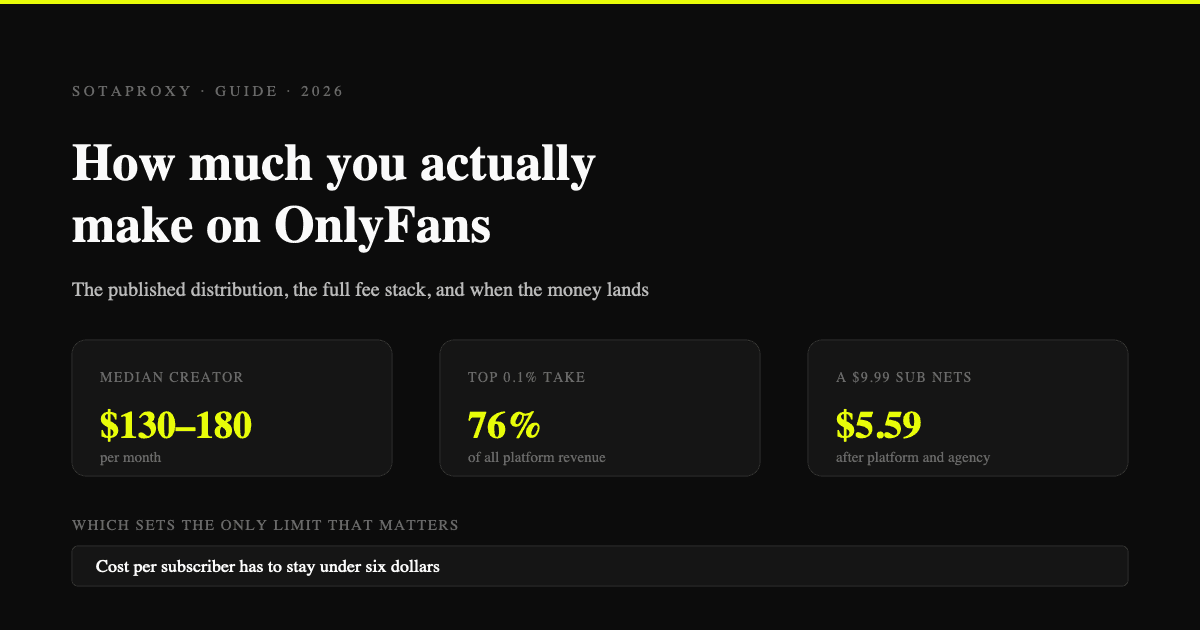
How Much You Actually Make on OnlyFans in 2026: The Full Fee Stack
The published earnings distribution, every cut between a fan's dollar and your bank account, when the money actually lands, and the one metric that decides whether promotion works.
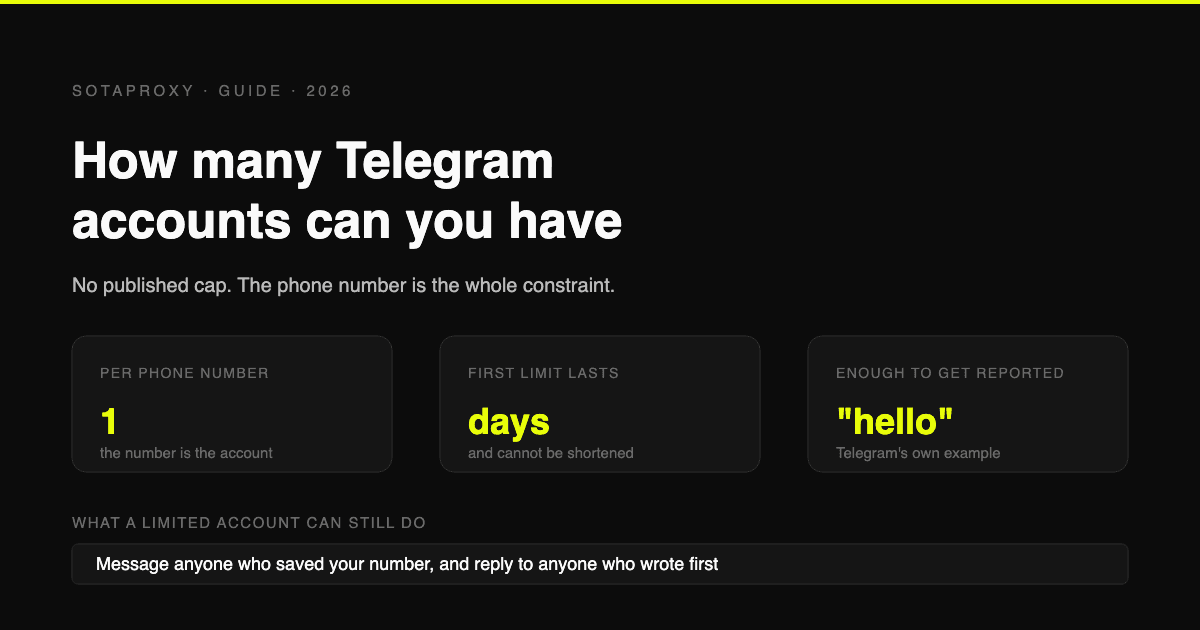
How Many Telegram Accounts Can You Have in 2026 (And What "Limited" Really Means)
Telegram publishes no account cap, one number per account, and its own Spam FAQ says a limited account can still message anyone who saved your number. What triggers a limit, why VOIP numbers get flagged before you send a word, and why there is no early release.
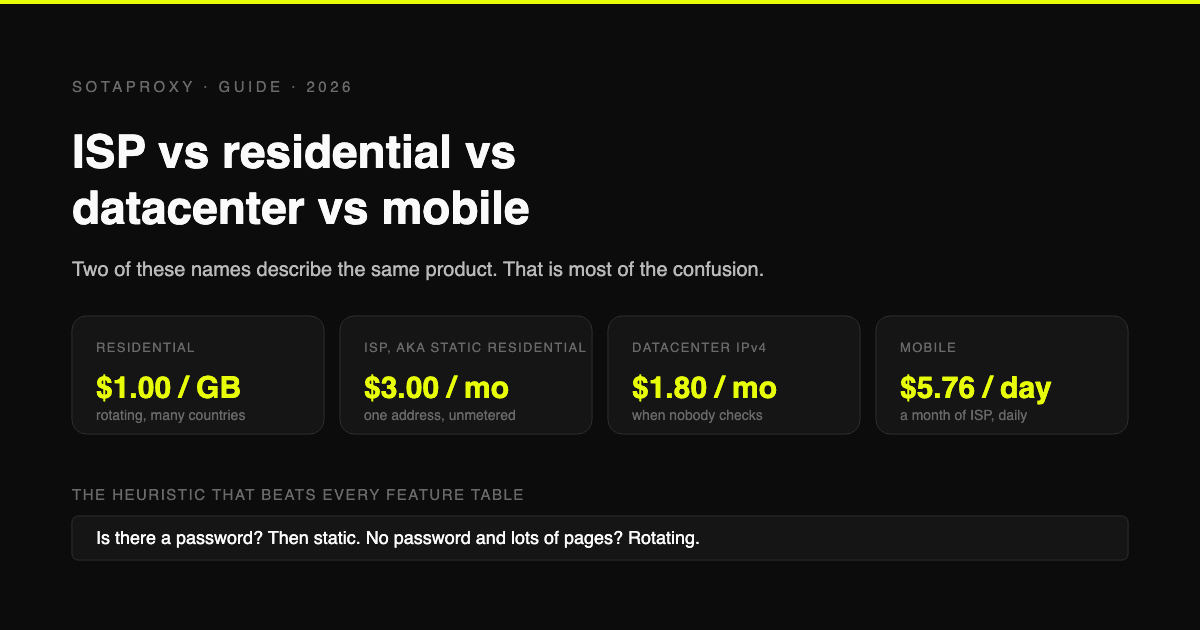
ISP vs Residential vs Datacenter vs Mobile Proxies: Which One You Actually Need
Static residential and ISP are the same product under two names, which is why half these comparisons compare a thing to itself. What each type is, what it costs per unit, and the one task each is genuinely best at.
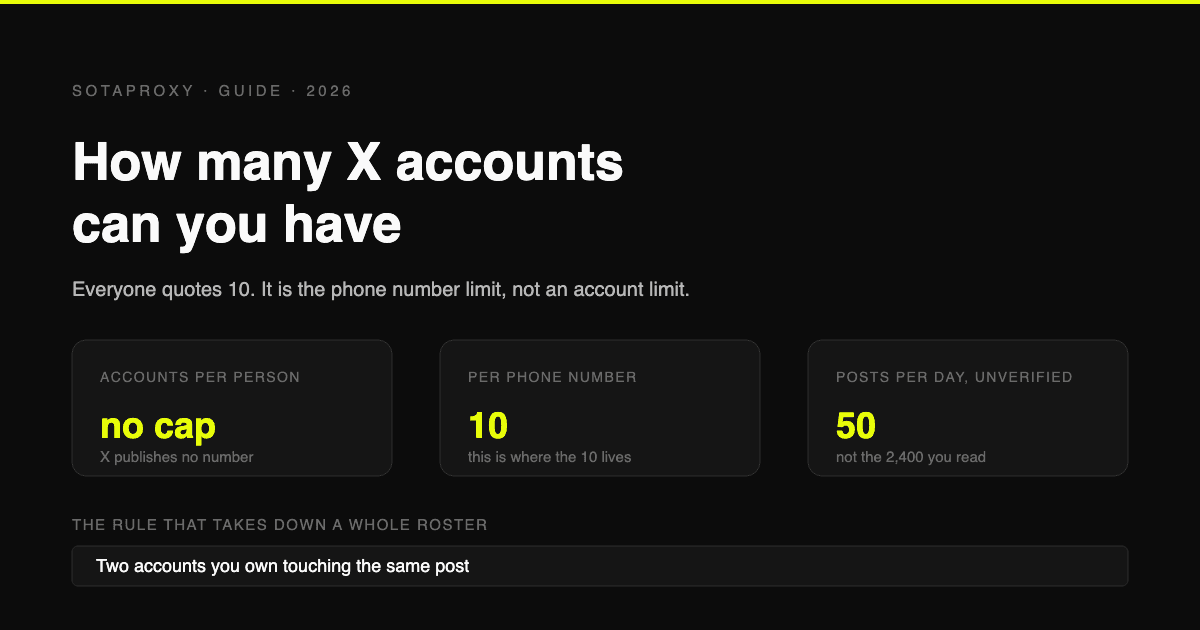
How Many X (Twitter) Accounts Can You Have in 2026 (The 10 Is a Phone Limit, Not an Account Limit)
X publishes no cap on accounts per person. The 10 everyone quotes is the number of accounts one phone number can cover. The real constraints are 50 posts a day on a free account, duplicative use cases, and accounts that interact with each other.
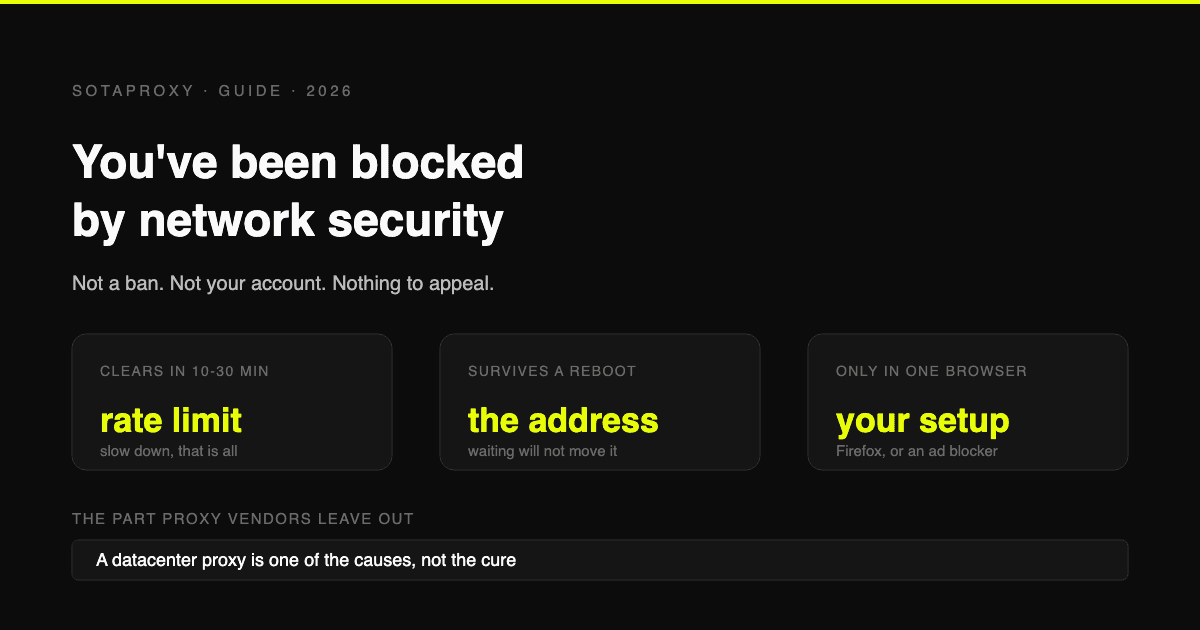
Reddit "You've Been Blocked by Network Security": Every Cause, and the Fix for Each
It is not a ban and there is nothing to appeal. It comes from Reddit's edge, applies to your connection, and has six causes. Here is how to tell which one you have, and how long each lasts.
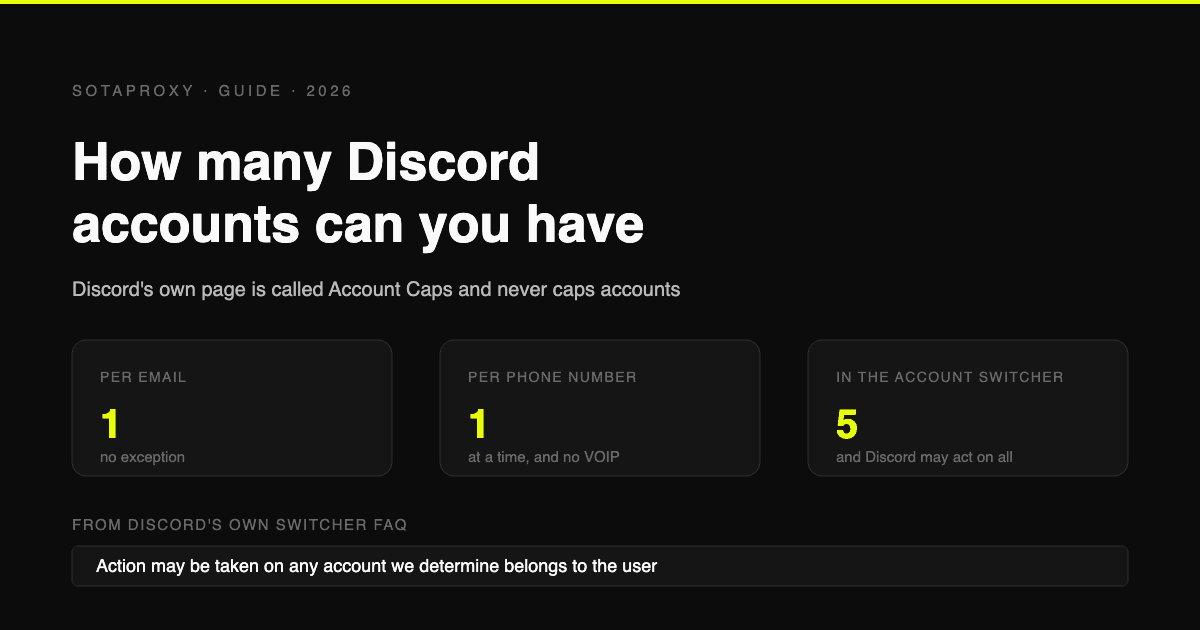
How Many Discord Accounts Can You Have in 2026 (Per Email, Per Phone, Per Device)
Discord publishes no cap on accounts. The real limits are one per email, one phone number at a time with no VOIP, and five in the Account Switcher, which Discord says it may enforce across.