How Much You Actually Make on OnlyFans in 2026: The Full Fee Stack
The published earnings distribution, every cut between a fan's dollar and your bank account, when the money actually lands, and the one metric that decides whether promotion works.
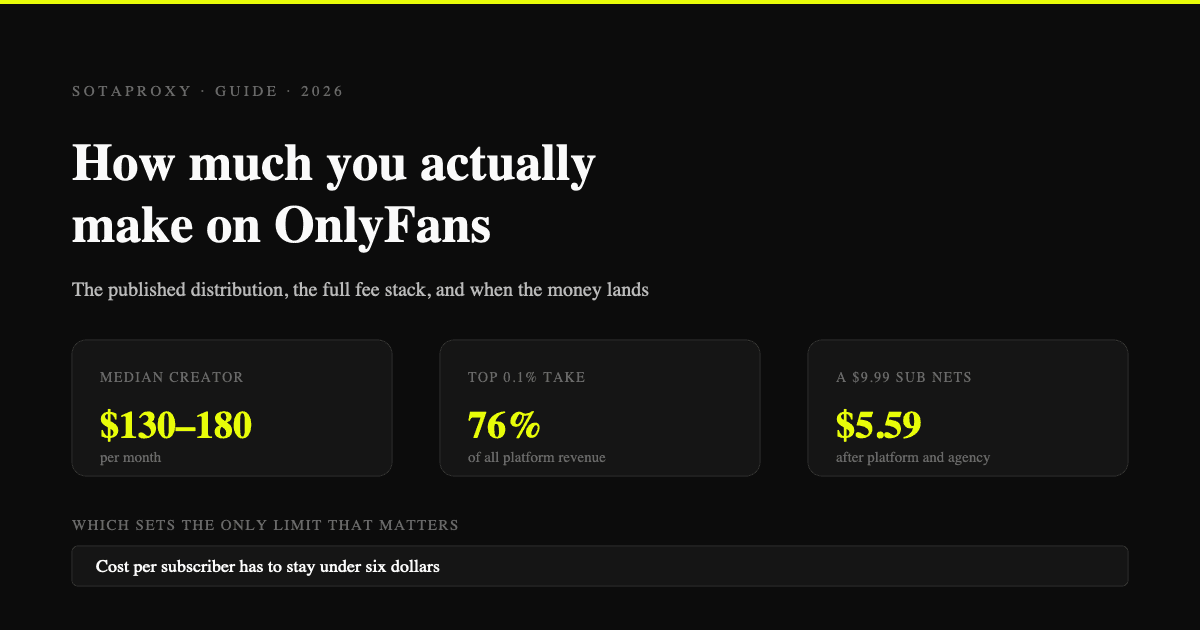
Most guides about earning on OnlyFans skip the two numbers that decide whether this is a business or a hobby: what the median creator actually takes home, and how much of a fan's dollar survives the trip to a bank account.
This one starts with both. Every figure below comes from published 2026 data or from vendors' own price pages, and the sources are listed at the end. Nothing here is advice about what to post.
What does the median creator actually earn?
Published 2026 estimates put the median somewhere between $130 and $180 a month. The bottom half of accounts sit between $0 and $24, and around 70% of active creators clear less than $200 a month after the platform takes its cut.
At the other end the concentration is extreme:
| Tier | Typical earnings | Share of all platform revenue |
|---|---|---|
| Median creator | $130 to $180 per month | rounding error |
| Top 1% | around $4,000 per month | about 33% |
| Top 0.1% | six figures per month | about 76% |
Read that table as a power law, not a ladder. The gap between the median and the top tenth of a percent is roughly four thousand times, and it is not explained by content quality alone: it is distribution, retention and inbox monetisation, which is to say marketing and operations rather than photography.
The practical consequence: treat the first $200 a month as a test, not as income. If a creator cannot cross that line, adding tooling and staff makes the loss bigger rather than smaller.
Where does a dollar from a fan actually go?
Every layer here is real and most guides mention one of them.
| Layer | What it takes | When it applies |
|---|---|---|
| Platform commission | 20% of everything | Always |
| Agency or manager | 20% to 50% of what remains | If someone manages the account |
| Chatting and CRM software | $15 per account per month, or $99 plus 5% of AI-assisted sales | If the inbox is run by a team |
| Chargeback fee | $15 to $25 per dispute, plus the reversed payment | Every time a fan disputes |
| Paid traffic | whatever you spend, and it is the largest line for most operations | If growth is bought rather than earned |
| Isolation stack | about $2.10 per account per month for a static address | If accounts are run at scale |
On $1,000 collected from fans, the platform leaves $800. A management-only agency at 20% leaves the creator $640; a full-service agency at 50% leaves $400. The infrastructure line at the bottom of that table is 0.2% of the total, priced from our own grid, and it is the one people try to cut first, which is the subject of what a multi-accounting stack actually costs.
Scale it to $10,000 and the shape does not change, but two lines start to hurt: the percentage-based ones. A 5% cut on AI-assisted sales and a 30% agency share are invisible at $1,000 and are $3,500 a month at $10,000.
What does a month actually look like on paper?
Take a creator collecting $3,000 a month from fans, which already puts the account far above the median, and run it both ways.
| Line | Self-managed | Agency-managed, 30% |
|---|---|---|
| Collected from fans | $3,000 | $3,000 |
| Platform commission, 20% | −$600 | −$600 |
| Agency share, 30% of the remainder | not applicable | −$720 |
| Chatting and CRM software | −$15 | paid by the agency |
| Static address and antidetect profile | −$7 | paid by the agency |
| Paid traffic at 100 new subscribers, $5 each | −$500 | paid by the agency |
| Chargebacks, 3 disputes | −$75 | −$75 |
| Creator keeps | $1,803 | $1,605 |
| Hours the creator spends on chat and promo | 60 to 100 | close to zero |
The comparison is not "agency takes a third of my money". It is "agency takes a third and absorbs the traffic budget, the software, the rota and the night shift, and the delta is about two hundred dollars". Whether that trade is good depends entirely on whether they actually buy traffic and work the inbox, which is the only reason the percentage exists.
Two lines in that table deserve attention. Paid traffic is bigger than every other cost combined in the self-managed column, and it is the line most creators leave at zero while wondering why growth stopped. And chargebacks are not noise: three disputes a month at $25 each is more than the entire tooling bill.
When do you actually get the money?
This is the part that breaks operations rather than accounts.
- Pending balance. Earnings sit in a holding period before they can be withdrawn: typically 7 days, and up to 21 for newer accounts or certain regions, while fraud and chargeback checks run.
- Minimum withdrawal. As of 1 April 2026 the minimum is $10 with next-day processing available to all creators; some payout methods still reference the older $20 floor.
- Methods. Bank transfer and ACH land in one to two business days, wires and e-wallets like Skrill and Paxum are often faster. PayPal and native crypto payouts are not supported.
- Non-US and non-UK accounts. Early 2026 brought extra verification requirements and adjusted processing times for creators outside those two countries.
Now put that against your outgoings. Chatters expect to be paid weekly. Software bills monthly. Paid promo is prepaid. Money arrives on a seven to twenty-one day lag, minus disputes that can claw back revenue you already counted. An operation with no cash buffer is one chargeback wave away from missing payroll, and that has nothing to do with how well the content performs.
What does traffic cost, and why is that the real business?
Because OnlyFans is not a discovery platform. Nobody browses it the way they browse TikTok. Every subscriber arrives from somewhere else, and in 2026 that somewhere is Reddit and X for high-intent traffic, a short-form platform for reach, and increasingly paid shoutouts in Telegram channels. Running those feeder accounts is its own multi-account problem.
The one metric that matters is cost per subscriber against first-month revenue per subscriber, and the arithmetic is unforgiving:
- Median subscription price in 2026 sits at $7.50 to $9.99, with most creators charging between $4.99 and $9.99.
- The platform takes 20%, so a $9.99 subscription nets $7.99.
- An agency at 30% of the remainder leaves $5.59.
So for a managed account, cost per subscriber has to stay under roughly five or six dollars to survive the first month, and that is before you count the subscribers who cancel after one cycle. Everything else in a growth plan is noise next to that ceiling.
The common failure is buying traffic that converts at a number nobody measured. A shoutout that brings a thousand clicks and eleven subscribers is not cheap traffic at any price. Test with a few hundred dollars across channels, measure cost per subscriber per channel, and only then scale the one that clears the ceiling.
Why most promotion is unpaid posting rather than ads
Because the ad channels are closed. Meta, TikTok, YouTube and LinkedIn prohibit adult content outright, so the usual playbook of buying impressions does not exist here. What is left is posting, at volume, on the two platforms that tolerate the content:
- X formally allows consensually produced adult content, but with conditions: creator enrolment, a sensitive-media label on every post, age verification for the most explicit material, exclusion from For You recommendations, and no adult imagery in profile photos or banners. Reach is deliberately reduced, which is exactly why volume replaces targeting.
- Reddit allows it inside specific communities, each with its own gates. The realistic floor for adult subreddits in 2026 is an account at least 30 days old with 100 to 500 comment karma, and mid-sized subs commonly want 200 to 500 combined karma. Both gates are checked independently, so clearing one does not help if the other fails, and many subs keep exact numbers private to deter ban evaders.
That is what turns promotion into an account problem. One profile cannot post at the volume this requires, and every account you add has to look like a separate person: its own address, its own fingerprint, its own posting rhythm. Accounts are consumable here, and the constraint on growth becomes how fast you can warm new ones rather than how much budget you have. The isolation rules for a fleet like that are the same ones agencies use on the creator accounts themselves, written up in how agencies run twenty creator accounts without linking them.
The economics are different from paid traffic in a useful way. Twenty posting accounts cost about $42 a month in static addresses plus a shared antidetect plan, so roughly $55 to $60 a month all in. At the five to six dollar ceiling from the previous section, that whole setup pays for itself at ten or eleven subscribers a month. The expensive inputs are warm-up time and the writing, not infrastructure.
Two honest limits. Karma and age gates mean a fresh account is worth nothing for the first month, so the pipeline has to be started before you need it. And posting the same text from twenty profiles is the fastest way to lose all twenty: platforms match content, not just addresses.
What should the account actually charge?
The market has converged: $4.99 to $9.99 a month, median $7.50 to $9.99. Two structural points behind that range.
Free pages with paid messaging behave differently from paid subscriptions. A free page removes the decision at the door and moves all revenue into the inbox, which raises the value of the chat team and lowers the value of the subscriber count as a metric.
The inbox, not the subscription, is where managed accounts make their money. That is the working assumption behind every agency price list and every piece of chatting software sold: you are paying for someone to work the messages. If your plan assumes subscriptions alone will carry it, the cost structure above will not close.
What does it cost to run five or twenty creators?
Software and infrastructure only. Labour is deliberately separate, because it dwarfs both.
| Line | 5 creators | 20 creators |
|---|---|---|
| CRM and chatting software at $15 per account | $75 | $300 |
| AI-assisted tier instead, $99 per account plus 5% of AI sales | $495 plus 5% | $1,980 plus 5% |
| Static ISP addresses at $2.10 each | $10.50 | $42 |
| Antidetect browser profiles | $11 to $17 total | $41 total |
| Tooling subtotal, basic tier | about $100 | about $385 |
Two observations. The free tier of the mainstream CRM covers up to ten accounts, so a five-creator operation can genuinely start at the cost of the addresses. And the AI tier is not a small upgrade: at twenty accounts it is a $2,000 a month decision plus a revenue share, which needs to be justified by measured inbox lift rather than by the feature list.
Labour is the real number. A single chatter covering one shift is a salary; a 24-hour rota across a roster is a company. That is why agency shares sit where they sit.
What would we watch in the first 90 days?
Four numbers, and none of them is follower count.
- Cost per subscriber, per channel. Not blended. One channel almost always carries the whole result, and the blended average hides it.
- Second-month retention. A subscriber who renews once is worth roughly double one who does not, which is the difference between a traffic budget that compounds and one that leaks.
- Revenue per subscriber in the inbox. If subscriptions are the only line, the cost structure above will not close at any realistic price.
- Disputes as a share of revenue. Above 1% it stops being an accounting detail and starts attracting payout review.
If those four are unknown after 90 days, the operation does not have a growth problem, it has a measurement problem, which is the cheaper of the two to fix.
What actually kills these operations?
Ranked by how often it happens rather than by how dramatic it sounds.
- One creator carrying the roster. When 70% of revenue sits in one account, you are not running an agency, you are managing a single client who can leave.
- Chargeback waves. Each dispute costs the reversed payment plus $15 to $25, and a pattern of them attracts payout review.
- Accounts linked to each other. The cheapest self-inflicted wound: shared addresses, shared devices, shared payout data. Rotating addresses on a logged-in account belong in the same category. The process side is in how agencies run twenty creator accounts without linking them.
- Buying traffic above the ceiling. Spending $12 to acquire a subscriber worth $5.59 net, and calling it a growth phase.
- Payout verification surprises. Especially for accounts outside the US and UK after the 2026 changes: the money exists and cannot move.
- No cash buffer against the hold period. Weekly outgoings against a seven-to-twenty-one-day inbound lag.
Where does the infrastructure actually fit?
Small line, narrow job: it keeps accounts from being linked to each other and keeps sessions stable enough that logins do not trigger reviews. It does not grow revenue and it is not a growth tactic.
Two honest boundaries. A proxy does not make an account safe if payout details or identity documents are shared between creators, because those links are legal and financial rather than technical. And it does nothing for the thing that actually decides earnings, which is where the traffic comes from.
If you want the operational version, it is in the agency guide, and the before-you-buy checks for a pool are in how to test a proxy before you buy it.
FAQ
What does the average OnlyFans creator make in 2026?
Published estimates put the median between $130 and $180 a month, with the bottom half of accounts under $24. About 70% of active creators earn less than $200 a month after the platform's 20% commission.
How much does OnlyFans take?
20% of everything, applied before any other cut. Agency shares, software fees and traffic costs all come out of the remaining 80%.
How long until the money reaches my bank?
Earnings hold in a pending balance for about 7 days, up to 21 for newer accounts or certain regions. After that, withdrawals start at a $10 minimum with next-day processing, and bank transfers typically land in one to two business days.
Can I get paid to a crypto wallet?
Not natively. The supported routes are bank transfer, wire and e-wallets such as Skrill and Paxum. PayPal is not supported either.
What is a realistic cost per subscriber?
Under five or six dollars for a managed account, because a $9.99 subscription nets $7.99 after the platform fee and about $5.59 after a 30% agency share. Anything above that has to be justified by retention beyond the first month.
Is an agency worth 30% to 50%?
Only if it brings traffic or runs the inbox around the clock, because those are the two functions that move earnings. Paying an agency percentage for content scheduling alone is buying a calendar at revenue-share prices.
How much of this is infrastructure cost?
Around $2.10 per account per month for a static address, plus $11 to $41 for antidetect profiles across a roster. That is under 1% of the budget, and it is the last line worth cutting.
Related articles

How Many Google and Steam Accounts Can You Have in 2026
The two platforms in this series where the count is genuinely unlimited and the limit is somewhere else: Google rations phone numbers and never says how many accounts one buys, Steam lets you make as many accounts as you like and then locks every one of them until it has spent $5. The rules from Google's and Valve's own pages, and what actually ties two accounts together.
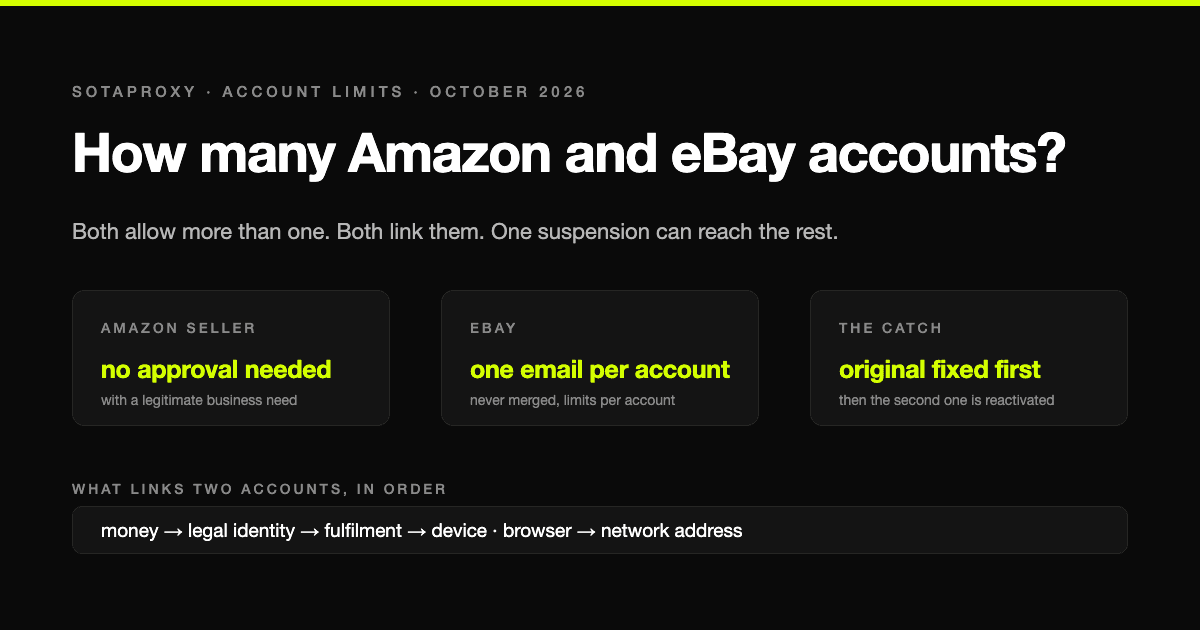
How Many Amazon and eBay Accounts Can You Have in 2026
Amazon and eBay are the generous end of the account-limit scale on paper and the harshest in practice: more than one account is allowed, every account is linked, and one suspension can take the lot. The rules in the platforms' own words, and what actually connects two accounts.
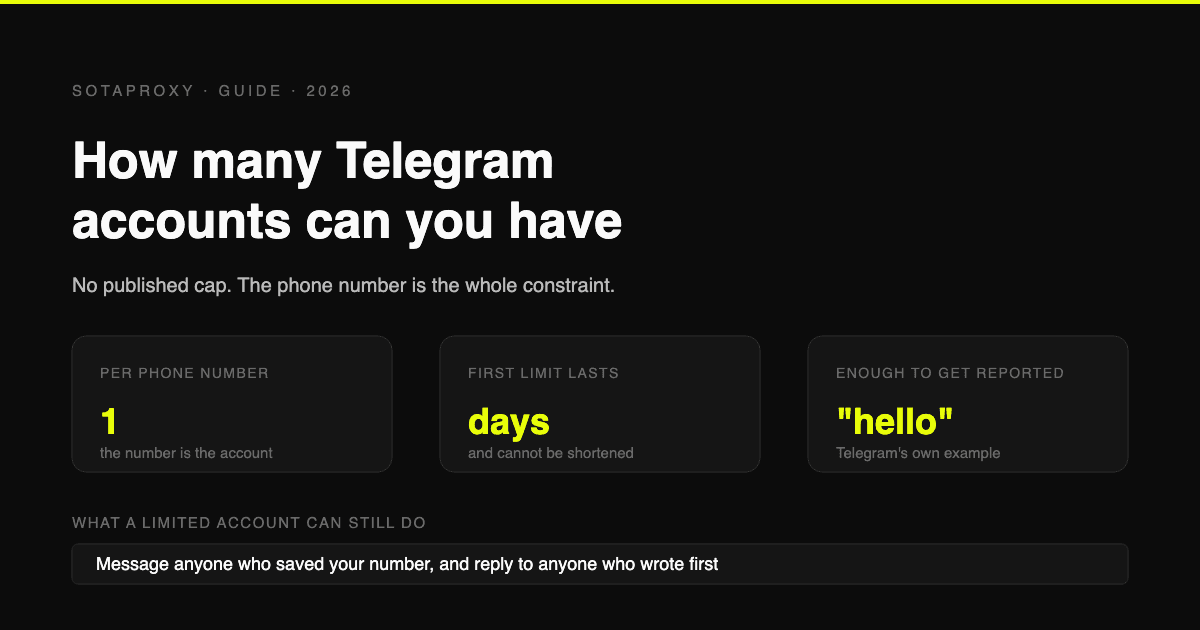
How Many Telegram Accounts Can You Have in 2026 (And What "Limited" Really Means)
Telegram publishes no account cap, one number per account, and its own Spam FAQ says a limited account can still message anyone who saved your number. What triggers a limit, why VOIP numbers get flagged before you send a word, and why there is no early release.
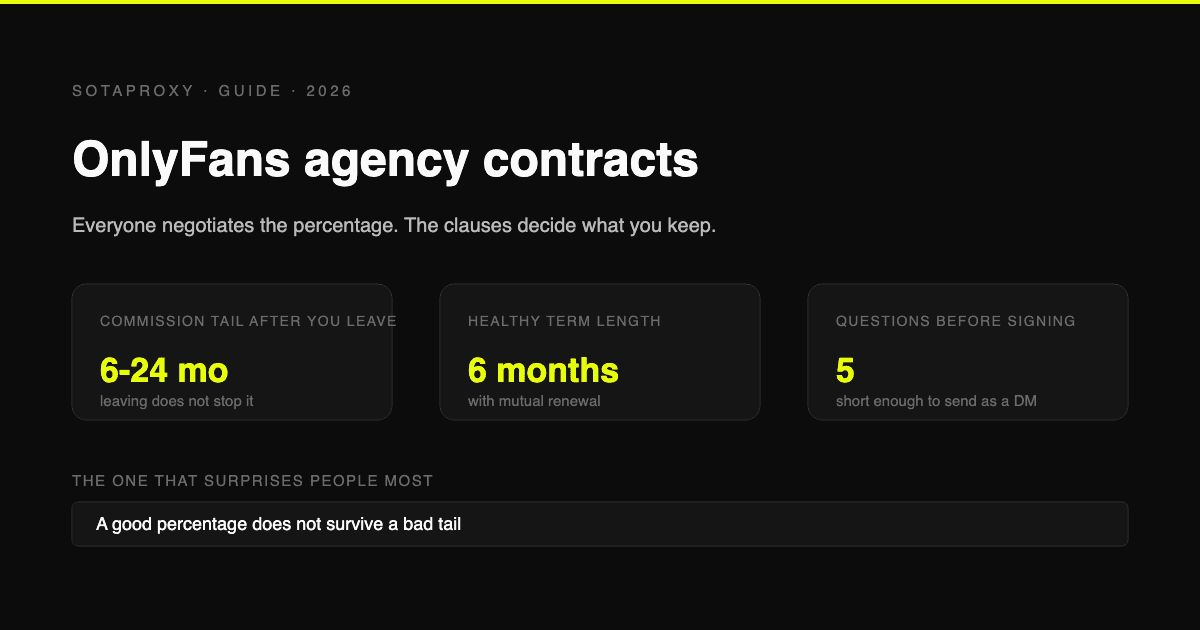
OnlyFans Agency Contracts: The Clauses That Decide What You Keep
The split is the part everyone negotiates and the part that matters least. Commission tails, clawbacks, perpetual subscriber commission, exclusivity and content ownership are what decide whether leaving costs you anything.
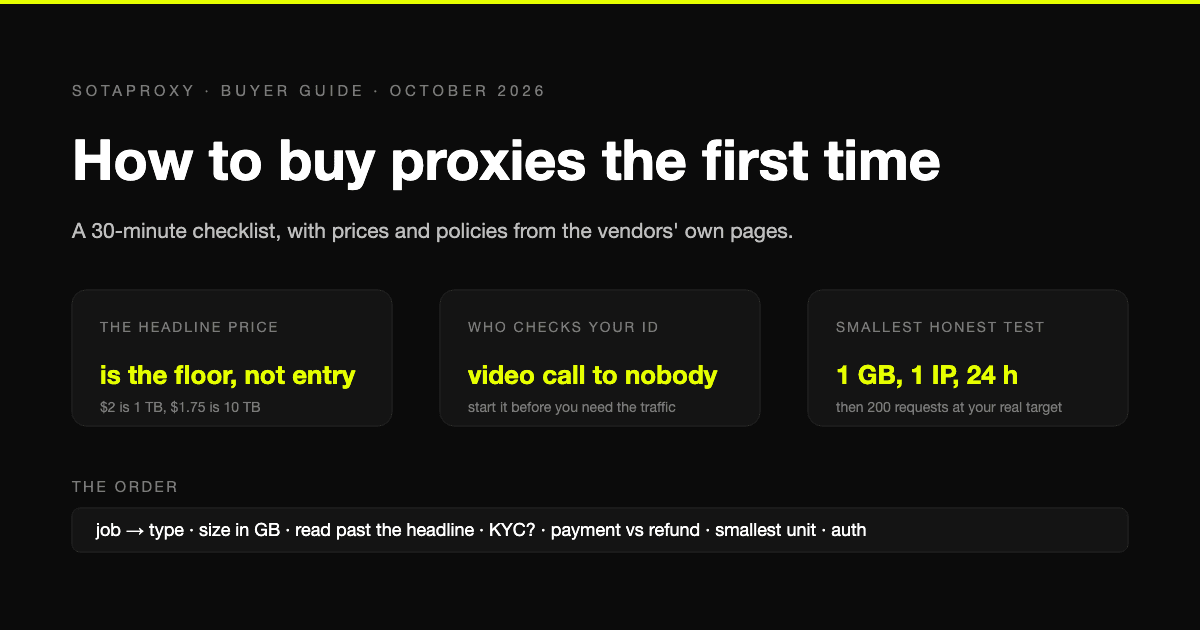
How to Buy Proxies for the First Time: A 30-Minute Checklist
A first purchase goes wrong in predictable places: the wrong proxy type, a headline price nobody pays, an identity check nobody mentioned, a refund that does not apply to how you paid. The checklist, with prices and policies from the vendors' own pages.
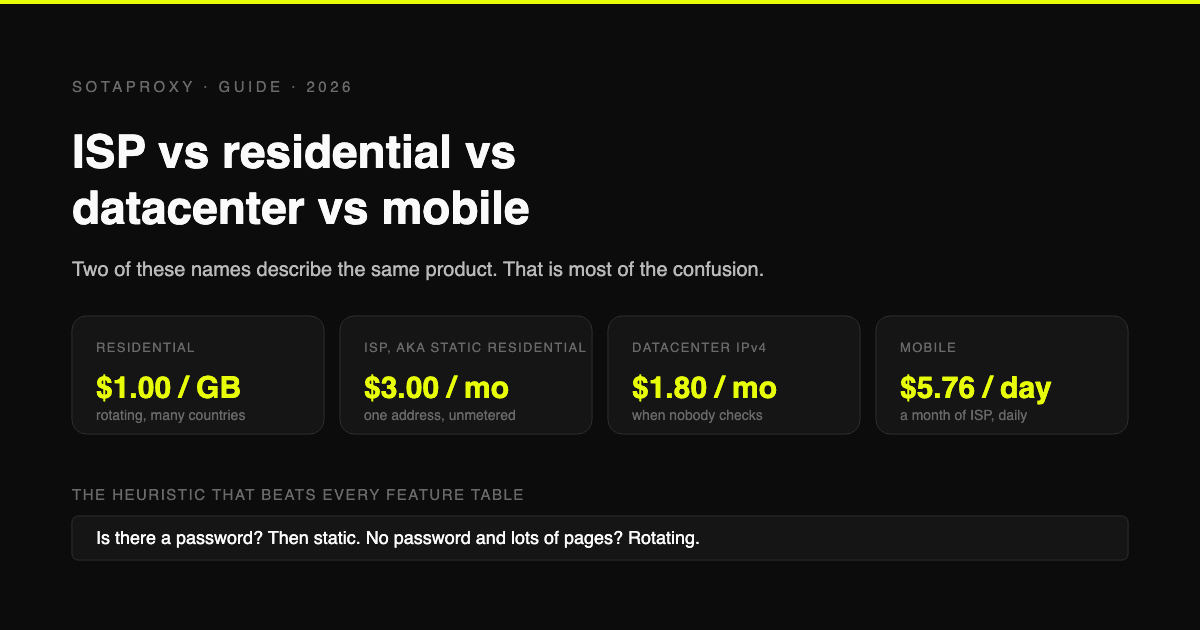
ISP vs Residential vs Datacenter vs Mobile Proxies: Which One You Actually Need
Static residential and ISP are the same product under two names, which is why half these comparisons compare a thing to itself. What each type is, what it costs per unit, and the one task each is genuinely best at.