API Call with Python for Ad Automation
Master the API call with Python for ad automation. Learn async patterns, proxy rotation, retries, and fingerprinting for multi-account workflows.

Making an API call with Python is a core skill for ad automation. Use requests for synchronous jobs and httpx for async fan-out. Wrap calls in Sessions to reuse TCP connections and reduce overhead, especially when managing dozens of antidetect browser profiles.
Table of Contents
- Setting Up a Solid Foundation
- Handling the GET Cycle and Errors
- Proxies, Retries, and Practical Tactics
- Managing Authentication and Headers for Multi-Account Safety
- Implementing Retries and Rate Limit Handling
- Scaling With Async Requests and Pagination
- Integrating Rotating and Sticky Proxies for Automation
- Practical Differences And When To Use Each
- Proxy Types for Ad Automation Workflows
- Sota Proxy Sticky Session Setup
- Practical Configuration Tips
- SSL and TLS Handshake Failures
- The Sneaky DNS Leak
- Geographic Mismatches
- The "Silent Fail" on a 200 OK
- Proactive Habits to Prevent Failures
- A Quick Debugging Checklist
Setting Up a Solid Foundation

Start with a client module that separates transport, auth, and retries. Keep the configuration for each profile minimal: proxy details, locale, user agent, and session ID. This prevents header drift that gets flagged across AdsPower, Dolphin Anty, GoLogin, Multilogin, or Hidemyacc profiles.
- Use
requestsfor synchronous tasks like checking Facebook or TikTok ad accounts, where simplicity and predictable blocking behavior are key. - Switch to
httpxwithasynciofor fan-out work, such as bulk creative verification across 220+ geos for a geo-targeted campaign.
Use Session objects to pool connections and set explicit timeouts. For high-volume ad account checks, this approach drops connection setup costs and reduces the chance that transient 5xx errors will disrupt your throughput.
Header hygiene per profile is critical to avoid flags. Match your
Accept-Languageand timezone to the proxy's geolocation, especially for account farming.
Handling the GET Cycle and Errors
For reliable JSON parsing, follow this sequence:
- Construct the URL and query parameters for the specific account.
- Attach auth in the
Authorizationheader or use HMAC when required. - Check
response.status_code: treat 4xx errors as client configuration issues and 5xx errors as transient server problems. - Parse JSON inside a try/except block and validate keys before processing the data.
When posting data, use JSON bodies for structured payloads and form-encoding for legacy endpoints. For example, you will send creatives to TikTok via JSON with token auth in the headers, but some verification endpoints still expect multipart/form-data.
If you are translating curl examples into Python, a quick reference helps when debugging headers or proxy issues: Python HTTP requests with curl
Proxies, Retries, and Practical Tactics
Implement a retry policy with exponential backoff and jitter, and always respect the Retry-After header. For proxy-driven setups, switch between rotating and sticky proxies based on the task. Sticky proxies maintain session continuity for account farming and cloaking, while rotating proxies are better for fresh lookups.
To map out Sota Proxy API integration and credential patterns, check their Sota Proxy API docs.
A practical tip for traffic arbitrage teams: if you resell infrastructure, look into the Sota Proxy referral program. It pays up to 40% commission, which can significantly offset your operational costs.
Managing Authentication and Headers for Multi-Account Safety

Ad platforms flag accounts more often for bad headers than for bad code. Place bearer tokens and API keys in the Authorization header by default. This avoids logging credentials in URLs and query caches, reducing risk when polling Facebook and TikTok ad accounts across many profiles.
Match User-Agent, Accept-Language, and timezone headers to the proxy geo and profile locale. This preserves fingerprint consistency for antidetect browsers like AdsPower, GoLogin, Dolphin Anty, Multilogin, and Hidemyacc. Mismatched headers can trigger silent failures during bulk creative verification and ad status checks.
Keep headers and proxy geo aligned to avoid account flags and hidden verification failures in geo-targeted campaigns.
Credential Placement Strategies for Ad Platforms
Where you place an auth token affects logging and caching. The wrong choice can expose credentials or trigger platform heuristics. Here is how the options stack up for multi-account operations:
| Method | Best For | Risk Level | Operational Notes |
|---|---|---|---|
| Header | API tokens, HMAC | Low | Preferred for auth; pair with TLS and short expiry |
| Cookie | Session continuity | Medium | Use for sticky proxy and antidetect browser combinations |
| Query | Public tokens | High | Avoid for multi-account operations |
| Body | Token exchange | Low | Use for POST-only flows |
Headers are the safest default for most API work-they stay out of URL logs and are not cached by intermediaries. Cookies work for session persistence in antidetect browser flows, but sharing them across profiles leads to cross-contamination. Query strings should be reserved for public, ephemeral endpoints where exposure is not a concern. The request body is effective for token exchanges and POST flows but is not useful for GET-based verification calls.
Align locale and currency headers with account settings to prevent platform heuristics from flagging sudden locale mismatches during cloaking or geo-targeted campaigns.
Practical Checklist and Tips
Lock your profile configuration first-proxy geo, timezone, Accept-Language, and currency must all match before you send a request. A mismatch is the fastest way to trigger a silent ban.
Centralize auth rotation to cycle short-lived tokens and record which profile used which token last. If an account gets flagged, you need to know which credential was involved.
Log safely by capturing a hash of the token and the proxy exit IP instead of storing raw tokens. If your logs leak, you will not expose usable credentials in plaintext.
Test verification endpoints against a mirror staging profile before running at mass scale. A single bad header combination can burn through dozens of accounts.
For proxy-driven setups, use sticky sessions when farming accounts or running cloaking flows. Use rotating residential or mobile proxies for broad scraping. Datacenter and IPv6 proxies are suitable for high-volume, low-trust tasks but have higher flag rates on Facebook and TikTok.
Read also: Learn more about Python requests headers in our detailed guide Python Requests Headers Guide.
If you resell or share infrastructure, the Sota Proxy referral program offers up to 40% commission for partners.
Implementing Retries and Rate Limit Handling
Ad platforms throttle aggressively, which can burn quotas or flag entire account farms. Implement exponential backoff with full jitter and always respect Retry-After headers to avoid synchronous retries that amplify failures. Track server-provided wait windows and honor them per endpoint and per profile.
Use a token bucket to cap global throughput. This prevents a single runaway script from exhausting the pipeline during a campaign launch. Track timestamps per call, decrement tokens on send, and refill at a controlled rate to keep hourly requests below platform thresholds.
Implement exponential backoff with jitter.
- Start with a base delay of 200–500ms.
- Multiply by 2 each retry up to a maximum (e.g., 60s).
- Add uniform jitter to prevent thundering herds.
Respect Retry-After headers.
- If present, override backoff and sleep for the indicated seconds.
- Prioritize server guidance over local heuristics.
Circuit breakers isolate failing endpoints so other pipelines continue running. Trip when the error rate exceeds 10% over a 1-minute window, then probe with single requests.
Example Patterns and Tips
Wrap requests in a retry decorator that distinguishes between:
- 429 and 503 → transient, retryable with backoff.
- 4xx (except 429) → client errors, fail fast.
- Network errors → retry with a capped attempt count.
Numbered checklist for robust handling:
- Record the proxy exit IP and profile ID per request for post-mortems.
- Cap concurrent requests per proxy pool and per antidetect browser profile (AdsPower, GoLogin, Dolphin Anty, Multilogin, Hidemyacc).
- Use sticky sessions for account farming and cloaking; use rotating residential or mobile proxies for wide scraping.
Use circuit breaker states (closed, open, half-open) to prevent repeated hits to a misbehaving endpoint. Probe gradually in the half-open state with a single request and return to closed only after a set number of successes.
Understanding an API's limits on data requests is essential for implementing effective retry mechanisms.
Practical caps for media buyers: keep Facebook/TikTok hourly pulls per account under 500 and stagger bulk pulls across geo regions. Monitor response headers, implement alerts on Retry-After spikes, and link this behavior to proxy pools to avoid correlated bans.
Read also: Learn more about rate limiting mechanics in our glossary Rate Limiting Explained.
Scaling With Async Requests and Pagination
Switching to async with httpx or aiohttp is effective when checking geo availability across 220+ locations or verifying thousands of creatives for a geo-targeted campaign. It is the correct choice for high fan-out but introduces complexity around proxies, DNS, and semaphore limits.
First, cap concurrency with asyncio.Semaphore. This protects your CPU, sockets, and proxy pools from being overwhelmed. Run dozens of tasks concurrently, but never exceed a set limit per proxy pool or antidetect browser profile-whether you are using AdsPower or GoLogin. Tight limits prevent resource exhaustion and lower the risk of correlated bans.
Assign a dedicated Semaphore per proxy pool. This prevents you from burning through sticky sessions and triggering account flags.
Async Fan-Out Pattern
- Spin up bounded async workers using
httpx.AsyncClientoraiohttp.ClientSession. - Group calls with
asyncio.gatherto fetch multiple pages in parallel. - For page-heavy endpoints, use an async iterator to stream pages and keep memory usage flat.
You will encounter a few standard pagination patterns:
- Cursor pagination: Persist the cursor token between requests and stop when it returns null.
- Offset pagination: Increment the offset and limit, but back off when counts exceed expected thresholds.
- Link-header pagination: Parse the Link headers and follow
rel=nextuntil it disappears.
When Synchronous Wins
Synchronous requests are sometimes simpler. Stick with sync when you need strict ordering, per-request sticky proxies, or are debugging authentication flows across Facebook and TikTok ad accounts. Standard requests or httpx sync clients offer more predictable error surfaces.
A few tactical tips:
- Always respect
Retry-Afterheaders on a per-endpoint and per-profile basis. - Stagger bulk pulls over several hours to keep Facebook and TikTok hourly pulls under 500 per account.
- Log the proxy exit IP, profile ID, and exact timing for every page. This makes post-mortems faster.
If you are doing account farming or cloaking, stick with sticky sessions so your antidetect browser profiles maintain their identity. Save rotating residential or mobile proxies for city-level scraping.
| Pattern | Best For | Notes |
|---|---|---|
| Async iterator | Large datasets | Keeps memory use low |
| Bounded gather | High fan-out | Protects proxy pools |
| Sync client | Debugging | Simpler failure modes |
If you resell infrastructure, Sota Proxy's referral program offers up to 40% commission. This can offset operational costs when running large-scale async campaigns.
Integrating Rotating and Sticky Proxies for Automation
When making an API call with Python for ad automation, how you route traffic is as important as the code. Residential, mobile, datacenter, and IPv6 proxies each serve a specific role. The goal is to pass them through requests or httpx without leaking DNS or WebRTC fingerprints that could link your operations.
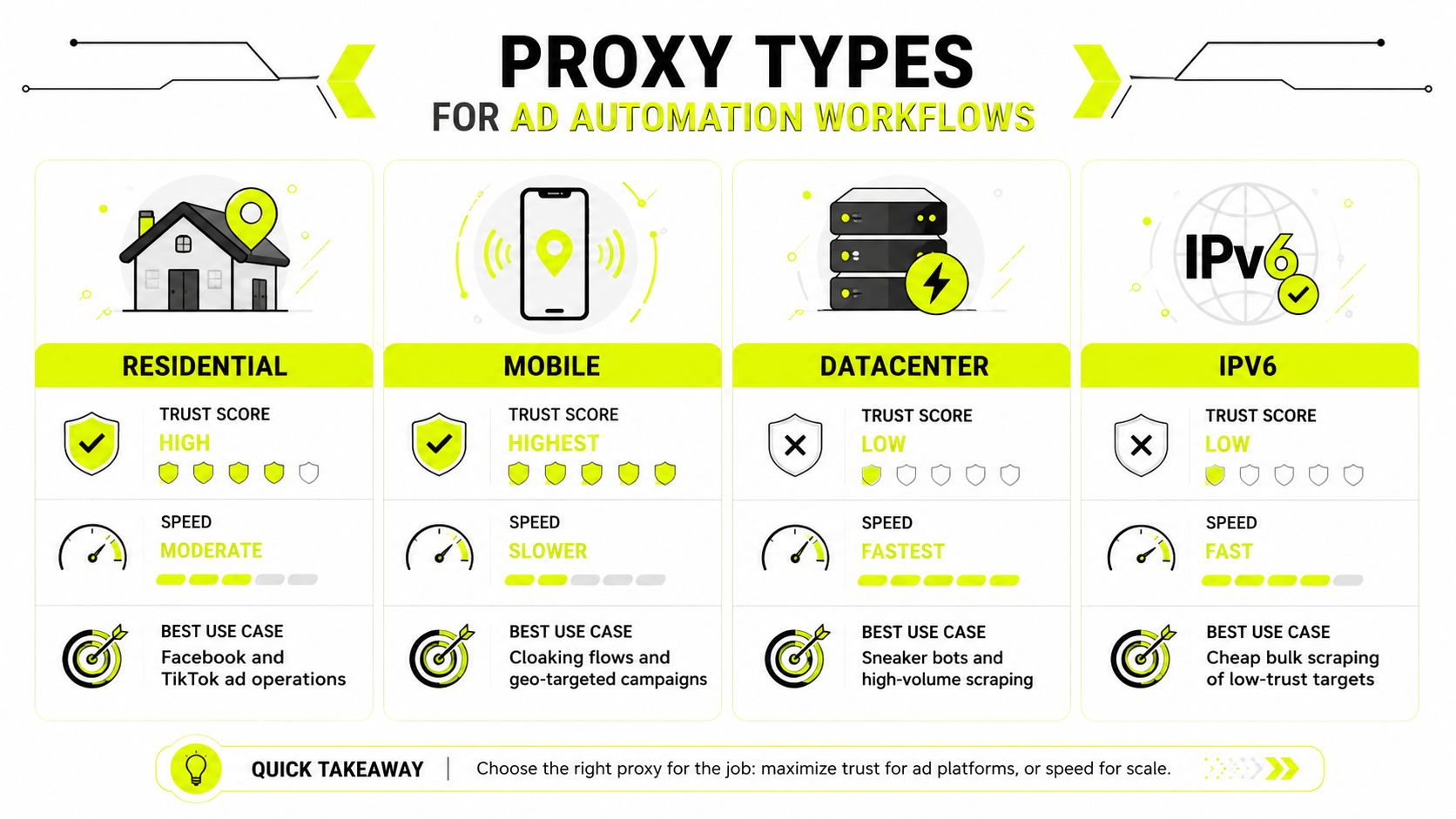
This infographic breaks down trust score, speed, and best use case across the four main proxy types, helping you match the right proxy to the task.
Practical Differences And When To Use Each
Residential Proxies: These are IPs from real home internet connections. They are the standard for API calls to Facebook and TikTok ad accounts, especially with antidetect browsers like AdsPower, Dolphin Anty, GoLogin, Multilogin, or Hidemyacc. They balance high trust with moderate speed.
Mobile Proxies: These IPs are from mobile carrier networks. They offer the highest trust and are best for cloaking and strict geo-targeted campaigns where the device fingerprint and carrier ASN are critical. Expect slower speeds but better account longevity.
Datacenter Proxies: These are artificial IPs from servers in data centers. They offer high speed and are ideal for high-volume scraping. Use them with short-lived sessions and aggressive backoff strategies to avoid bans.
IPv6 Proxies: These offer a vast, cheap supply of IPs. They are suitable for high-volume, low-trust tasks but have a high flag rate on major ad platforms like Facebook and TikTok.
Key takeaway: Use sticky sessions for account farming or any task requiring a consistent identity across requests in an antidetect browser profile. Use rotating pools for large-scale scraping to minimize reuse-based flags.
Proxy Types for Ad Automation Workflows
Here is a side-by-side comparison to help map proxy selection to your automation tasks.
| Proxy Type | Trust Score | Speed | Best Use Case |
|---|---|---|---|
| Residential | High | Moderate | Facebook/TikTok ad account management, antidetect browser profiles |
| Mobile | Very High | Slow | Cloaking, strict geo-targeted campaigns, account longevity |
| Datacenter | Low | Very Fast | High-volume scraping, speed-critical tasks |
| IPv6 | Low | Fast | Low-trust scraping, high-volume tasks where cost is the priority |
The choice involves a trade-off. Pick mobile or residential proxies for ad operations where trust is critical. Choose datacenter for speed, and IPv6 when cost and volume are more important than trust.
Sota Proxy Sticky Session Setup
Here is an example using Sota Proxy's sticky session format to maintain a consistent identity.
- Gateway:
proxy.sotaproxy.com - Port:
10000(example) - Username:
user-region-sessionid - Password:
strongpass123 - Session-id format:
session-{profile_id}-{timestamp}
Two common usage patterns:
- For account farming and cloaking, use sticky sessions tied directly to profile IDs.
- For scraper fan-out, use rotating residential or mobile pools.
Practical Configuration Tips
- Pass proxies explicitly into
httpx.AsyncClientorrequests.Sessionto avoid DNS leaks. - When required, disable system DNS resolution and set
trust_env=Falseinhttpx. - Ensure WebRTC is disabled inside your antidetect browser configurations, and match your
Accept-Languageand timezone to the proxy's geo-location. - Monitor the exit IP per request for effective post-mortems.
- Log hashed credentials and the proxy exit IP, never raw tokens.
If you resell or share infrastructure, Sota Proxy’s referral program offers up to 40% commission, which can help offset operational costs.
Read also: Learn about session persistence and sticky behavior in our guide Session Persistence With Sota Proxy.
To understand the broader implications and practical applications where these advanced automation techniques become crucial, you might explore various Vision use cases.
Even well-written scripts fail in production. When your API calls start failing, the reasons are often unexpected. Here are common issues and how to solve them.
SSL and TLS Handshake Failures
Unexpected SSL failures often indicate a corporate proxy or a misconfigured TLS stack is interfering. These are difficult to debug live.
Replicate the production environment in staging with a proxy that mirrors the real setup. This lets you capture the TLS handshake and certificate chain. Often, a middlebox is downgrading your cipher suites or injecting its own certificates. If this happens on an endpoint like Facebook or TikTok, it is almost certainly a corporate Man-in-the-Middle (MITM) proxy. Once you identify it, you can filter those certificates or pin the ones you trust.
The Sneaky DNS Leak
A common blind spot with async clients is the DNS leak. If you use your system's default DNS resolution, your requests might bypass your proxy to resolve the domain name. This exposes your script's real geographic location, undermining your cloaking strategy.
To fix this, either switch to a dedicated async DNS resolver or explicitly bind your httpx client to a resolver that routes its requests through your proxy.
Geographic Mismatches
This issue is frequent. Your request fails with a vague error or no error at all. The cause is often a mismatch between your proxy's IP address location and the geographic data in your request headers.
For any work involving antidetect browsers (AdsPower, Dolphin Anty, GoLogin, Multilogin, Hidemyacc), this is non-negotiable. You must align the Accept-Language, timezone, and currency headers with the proxy's exit IP. This alignment reduces false positives, especially when verifying ad accounts or creatives.
The "Silent Fail" on a 200 OK
Sometimes, the most dangerous failures are those that do not look like failures. You get a 200 OK status code, but the response body is an error message, a CAPTCHA, or empty.
Always treat an unexpected response schema as a failure. Log the response body's hash and the response time alongside the status code. If a response body's structure suddenly changes, fail that request immediately. This prevents bad data from corrupting your aggregated reports.
One Simple Habit to Save Hours of Debugging For every request, log the proxy's exit IP, the response time, and the status code. When running multi-account operations, this simple discipline can turn a multi-hour investigation into a five-minute fix.
Proactive Habits to Prevent Failures
Build habits to catch problems before they cost money.
- Shadow Production Traffic: Before a large campaign goes live, run a portion of your traffic in a staging environment that uses the same proxy pools and session IDs as production. This helps identify subtle issues.
- Set Up Regional Alerts: Monitor the error rate for each proxy region. If the error rate climbs above 5% in any two-minute window, trigger an alert and pause activity in that region to stop wasting ad spend.
- Correlate Errors to Profiles: When an error occurs, tie it back to the specific profile ID or token hash you were using. This makes it fast to find and isolate a compromised or blocked account.
A Quick Debugging Checklist
When things break, follow these steps:
- Can you reproduce the TLS error with a staging gateway using the same Sota Proxy pool and session format?
- Have you forced DNS resolution through the proxy or a known-good async resolver?
- Did you double-check that your request headers match the proxy IP's geography?
- Are you parsing the response body for platform-specific error messages, even on 200 OK responses?
- Have you tried rotating proxy pools or falling back to a different provider if you see a regional spike in errors?
If you are dealing with many transient errors, learn about handling HTTP 503 and transient errors in our article How To Interpret HTTP 503 Responses With Practical Fixes.
For reliable proxy infrastructure and up to 40% referral commission on partner accounts try Sota Proxy https://sotaproxy.com/en
Related articles

Ad Creative Testing: Boost Ad Performance in 2026
Master ad creative testing to optimize your campaigns. Discover proven strategies to boost ROI and drive better results for your arbitrage team in 2026.

7 Best Items to Resell for Profit in 2026
Discover the 7 best items to resell for profit in 2026. This guide covers sneakers, LEGO, and more for high-margin flipping with actionable sourcing tips.

Session Persistence for Proxy Operators and Antidetect
Master session persistence for proxy rotation and antidetect browsers. Learn sticky session types, TTL strategies, and SotaProxy setups.

What Is Geo Targeting: The Complete Guide for 2026
Learn what is geo targeting and how IP, GPS, and Wi-Fi signals shape it. Residential, mobile, and ISP proxies power real geo-targeted campaigns.

Top Bandwidth Management Tools: Compare 10 Solutions For
Find top bandwidth management tools for traffic arbitrage, scraping & ad ops. Compare 10 solutions to control & prioritize network traffic in 2026.

Contains in Xpath
Contains in xpath - Master the `contains` in XPath function. Get syntax, examples, advanced patterns, and performance tips for Selenium and proxy automation