Session Persistence for Proxy Operators and Antidetect
Master session persistence for proxy rotation and antidetect browsers. Learn sticky session types, TTL strategies, and SotaProxy setups.
You're in the middle of a campaign, the browser profile looks clean, and then the platform asks for another login because the session vanished when the proxy changed. That's the part many users blame on the antidetect browser, but the core issue is usually session persistence. If the backend can't keep a user tied to the same server long enough, Facebook, TikTok, ad verification tools, cloaking layers, and geo-targeted flows all start behaving like the session never existed.
For operators running AdsPower, Dolphin Anty, GoLogin, Multilogin, or Hidemyacc, the theory turns into money. A stable browser fingerprint means very little if the network path keeps breaking state. Session persistence, also called sticky sessions or session affinity, is the routing layer that keeps consecutive requests attached to the same backend so the session doesn't fall apart mid-flow, which is exactly why browsers, proxies, and application state have to be treated as one system rather than three separate tools. Sokko's breakdown of always-on and session-based agents is a useful adjacent read on how durable state behaves in practice, even though the mechanics are different, Sokko's always-on agent guide. If you're also checking whether the proxy side of the stack is already dirty, the practical starting point is IP reputation checks.
Table of Contents
- Why Your Ad Accounts Keep Dropping Sessions
- How IP Affinity, Cookie, and Header Persistence Actually Work
- Proxy Types and Their Persistence Behavior
- Configuring TTL and Monitoring Sticky Sessions
- Real Configurations for Scraping, Ad Verification, and Account Management
- When Session Persistence Hurts Reliability
- Session Persistence Decision Checklist
Why Your Ad Accounts Keep Dropping Sessions
You already know the pattern. A Facebook ad account stays alive in AdsPower or Multilogin, you switch proxies because the workflow needs a clean geo, and the next request lands somewhere else. The login survives for a moment, then the platform forces a re-auth, or worse, starts treating the account like it's moving through a bot stack. That's not random platform behavior, it's what happens when stateless HTTP meets a workflow that needs continuity.
Session persistence solves that by routing all requests from one user to the same backend server for the duration of the session. F5 describes the core idea clearly, HTTP is stateless, so the infrastructure creates a session ID, often passed as a cookie, and uses it to find the same session on the server even after the original connection closes. IBM also frames the same split in practical terms, Layer 4 can key off the client IP in the TCP header, while Layer 7 can use an HTTP cookie to keep a client on the same reverse proxy server during the session.
Why this matters in real operator workflows
Account farming, cloaking, and geo-targeted campaigns all depend on uninterrupted server-side context. The browser can stay open, the fingerprint can stay consistent, and still the workflow breaks if the backend forgets who the client is between requests. That's why cookie-based persistence became the default approach for maintaining state across otherwise stateless web requests, not because it sounds elegant, but because it keeps logins, carts, and multi-step forms from falling apart.
Practical rule: if a session can't survive a request chain, the problem isn't just the proxy. It's the whole routing path.
For operators, this also changes how you read platform instability. A bad session often looks like a bad account, but the root cause can be a backend that keeps bouncing the same user around. That's where the difference between a sticky session and a rotating proxy becomes operationally important. If you're setting up around proxy behavior, the cleanest mental model is to treat persistence as the thing that preserves continuity while the proxy handles reachability, not as a decorative extra on top of the stack. For a broader vendor-side explanation of how persistence is usually described, Sota Proxy's sticky session glossary is the most direct reference in the provider's documentation.
How IP Affinity, Cookie, and Header Persistence Actually Work
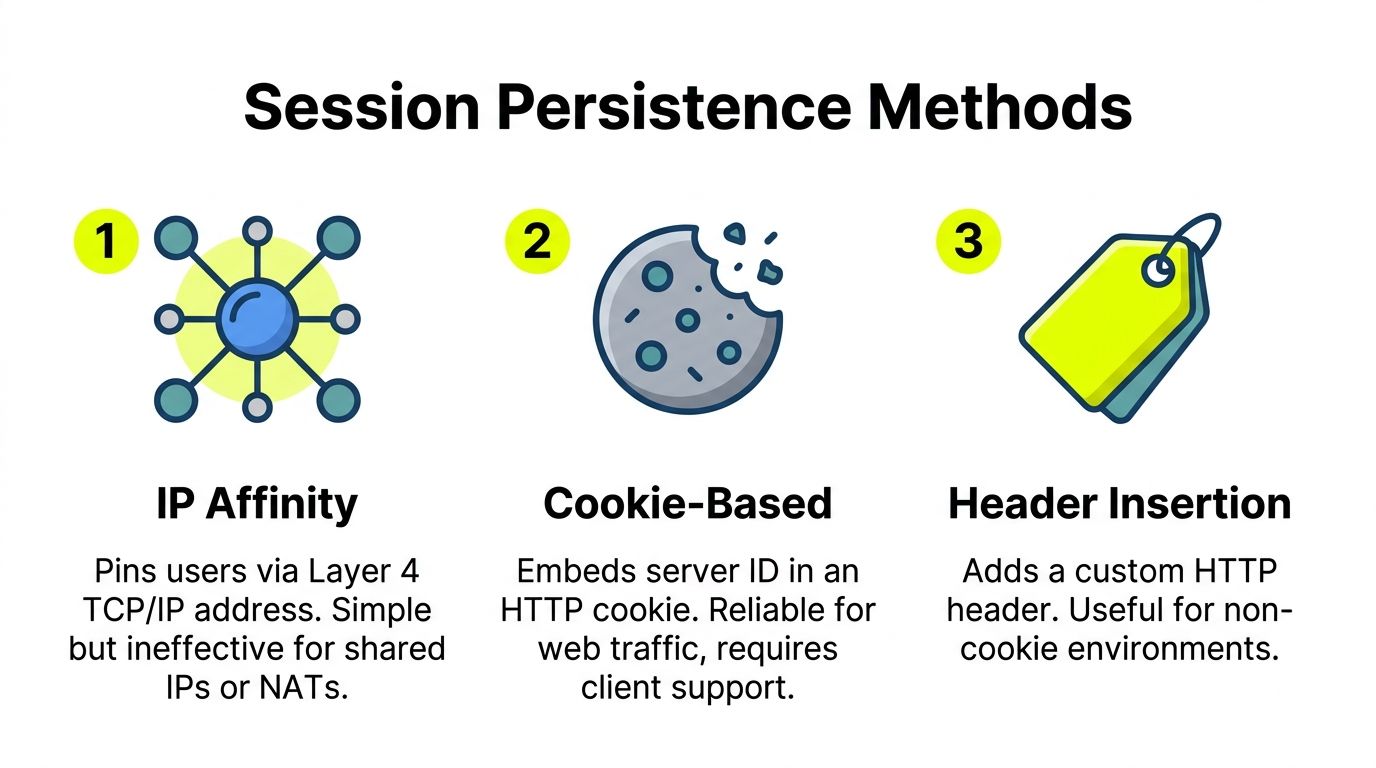
IP affinity is simple, but it breaks fast
IP affinity keys the session to the client IP address. IBM's Layer 4 example is the cleanest version of that model, the load balancer reads the TCP header and keeps routing that client to the same reverse proxy server. It works when the source IP is stable and uniquely tied to one client, which is why it still shows up in controlled environments.
The problem is that modern traffic rarely looks that clean. NAT, CGNAT, mobile networks, VPNs, and CDN egress all make the source IP a weak identity signal. Imperva's guidance on sticky sessions makes the operational trade-off obvious, cookie-based persistence is generally the practical choice for HTTP and L7 traffic, especially when multiple users can share one public IP or when the IP itself changes under the user. In those cases, IP affinity doesn't preserve identity, it concentrates traffic.
Cookie persistence is the workhorse for HTTP
Cookie-based persistence operates at Layer 7. The proxy inserts a dedicated cookie, then later requests carrying that cookie keep going to the same backend server. That is why it's the default choice for web sessions, especially in antidetect setups where the browser profile already handles client-side continuity and the proxy has to preserve server-side continuity as well.
If you're running GoLogin, Multilogin, or Hidemyacc profiles for Facebook and TikTok, cookie stickiness is the cleaner fit because the application can keep a stable server path even when the network path is noisy. The browser sends the same cookie, the backend recognizes the session, and the user doesn't get thrown back into login loops just because the proxy layer moved.
Header insertion is for systems that can't rely on cookies
Header-based persistence carries the session identifier in a custom HTTP header instead of a cookie. That's common in API gateways and microservice traffic where cookies don't make sense or the client can't store them reliably. It's also useful in proxy chains that need explicit session tagging without browser state.
Header persistence is a tool for controlled application flows, not a shortcut for unstable proxy design.
For attribution-heavy setups, the distinction matters. Evoteam's server-side tracking discussion is a good parallel reference for how server-side state can reduce attribution loss when the client path is messy, reduce attribution loss server side. That logic maps cleanly to persistence. If the server can consistently recognize the client, the workflow stays intact longer. If it can't, the session becomes a guessing game.
When people ask which method to use, the answer is usually boring. For browser traffic, cookie persistence wins. For custom API flows, header persistence can be cleaner. IP affinity only makes sense when the source IP is stable and shared-identity problems don't exist. That's the line most proxy-heavy operators should use when they choose their persistence model.
Proxy Types and Their Persistence Behavior
The proxy type changes the stickiness problem
Residential, mobile, datacenter, and IPv6 proxies don't behave the same way under persistence. That matters because session persistence is only useful if the underlying IP behavior matches the session strategy. SotaProxy's broader proxy-type overview is a useful framing reference if you want the taxonomy in one place, proxy types.
| Proxy Type | Best Persistence Method | Trust Level | Primary Use Case |
|---|---|---|---|
| Residential | Cookie-based, with sticky rotation | Medium to high | Geo-targeted browsing, ad verification, scraping with continuity |
| Mobile | Cookie-based, sticky sessions only | High | Facebook and TikTok account farming, mobile-like social workflows |
| Datacenter | IP affinity or cookie-based, depending on target | Lower trust than residential or mobile | Fast scraping, bulk automation, controlled environments |
| IPv6 | Cookie-based or header-based, if the target supports it | Varies by target acceptance | Large-scale testing, bulk paths, platform-specific operations |
Residential proxies give you ISP-assigned IPs that usually look more natural to platforms than cheap datacenter ranges. The catch is rotation. If the session changes too often, persistence loses its value, so the TTL has to match the workflow instead of fighting it.
Mobile proxies are the hard requirement for a lot of account farming and social media management work. The carrier-grade environment gives them stronger trust characteristics, but the shared nature of mobile networks makes IP-based affinity unreliable in practice. Cookie-based stickiness is the sane default there because shared source IPs can't serve as a stable user identity.
Datacenter proxies are still useful, especially for scraping at scale and internal automation, but they need a cleaner pool and tighter discipline. Platforms know those ranges. Persistence can keep a session alive, but it can't turn a bad IP pool into a trusted one.
IPv6 is different. The address space is huge, which helps in bulk operations, but target support decides whether that advantage matters. If the platform or route doesn't handle IPv6 cleanly, the extra space is just noise.
Operational rule: pick the proxy type first, then pick the persistence model that matches how the target interprets identity.
For teams running geo-targeted campaigns, city-level targeting adds one more layer. The proxy needs to stay local enough to preserve the scenario, and the session needs to stay sticky enough that the target sees one consistent path instead of a shifting footprint. That's the essential combo. Everything else is vendor decoration.
Configuring TTL and Monitoring Sticky Sessions
TTL should match the session, not your mood
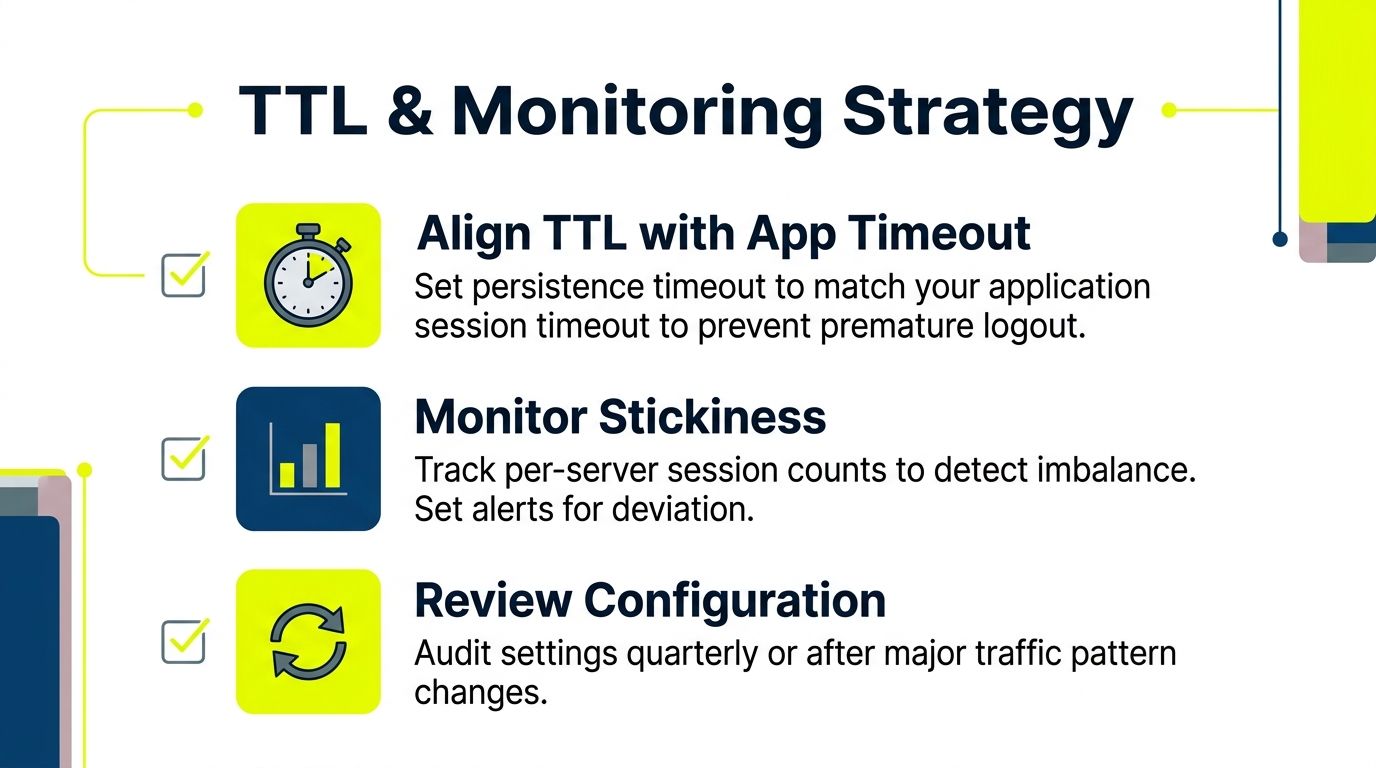
Persistence time needs to line up with the application's own timeout. Too short, and the backend keeps rebalancing a client that should have stayed pinned. Too long, and you waste capacity or keep traffic stuck to a server that's already degraded. HAProxy's stick-table model shows how tightly people often bound this state, with client IP mappings expiring after 30 minutes if unused, which is a good illustration of how aggressively systems control memory and churn session persistence guidance.
For ad platform workflows, the practical move is to align the sticky window with the session behavior you observe, not with a generic proxy default. If a browser profile gets re-keyed too fast, you'll notice repeated logins and unstable state. If it stays pinned too long, a degraded node can hold the session hostage.
Watch the backend distribution, not just the proxy uptime
Real monitoring starts with backend balance. If one server keeps receiving the same user set while others stay quiet, your persistence policy is too sticky or your pool is too concentrated. You also want alerts for session concentration on single nodes, because that's how a “stable” setup turns into a failure cluster when one backend goes bad.
The other check is failover behavior. A persistence rule that looks good on paper can still collapse if the node disappears and the recovery path doesn't exist. OneUpTime's session persistence overview describes the recovery model directly, session data can be written to a database or file for later recovery, and clients can continue after a server failure when the state is preserved properly. That's the difference between a route that survives a blip and one that dumps every user back to square one.
Keep one eye on stickiness and one eye on churn. A perfect session that overloads one backend is still a bad setup.
If you're using rotating infrastructure, people often over-rotate and then blame the platform. The fix is straightforward, monitor session duration, check per-server counts, and verify that a backend failure doesn't silently nuke the whole state chain. The article on rotating proxy server behavior is a useful companion if you're trying to separate clean rotation from destructive rotation.
Real Configurations for Scraping, Ad Verification, and Account Management
Scraping needs consistency, not fake stability
For web scraping at scale, sticky sessions on residential proxies usually make sense when you need to keep one identity across paginated results, product detail pages, or multi-request flows. The practical setup is a short sticky window, enough to preserve continuity without pinning the scraper so long that the target starts to recognize the pattern. That's the part people get wrong. They treat persistence as a permanent identity, when it really needs to behave like a controlled session window.
If the scraper keeps losing its place, the issue is usually that the proxy rotates before the target has finished the flow. Keep the sticky assignment alive long enough for the sequence to complete, then let it roll over cleanly. That's the useful version of persistence in scraping.
Ad verification depends on geographic continuity
For ad verification, the session matters because the creative, placement, and landing behavior have to be viewed from the right city without the path changing halfway through. Cookie-based persistence on geo-targeted residential IPs does that job well. You keep one session attached to one location, then verify Facebook and TikTok output without mixing geography between checks.
That's also where a disciplined browser profile matters. The proxy supplies the location and the stable backend route, while the antidetect browser keeps the local fingerprint from drifting. If either side changes too much, the verification result becomes noisy. Earlybird AI's discussion of bidding and KPI strategies for Upwork isn't about proxies, but it's a useful reminder that multi-account operations work best when the operational layer stays tight and measurable.
Account management needs one profile, one sticky path
For social media account management with AdsPower or Dolphin Anty, bind each browser profile to a dedicated sticky session on a mobile proxy. That gives the platform a stable IP path and a consistent session state across logins, posting, and normal engagement actions. It also reduces the chance that one profile's behavior spills into another profile's network identity.
A clean workflow usually looks like this:
- Profile isolation: one browser profile per account, no shared cookies, no shared local storage.
- Sticky assignment: keep the same proxy session attached to that profile until the workflow is done.
- Target-aware routing: use the right city or region for the account's actual use case, not a random geo.
- Recovery plan: if a session breaks, rebuild it deliberately instead of forcing the same profile through a damaged path.
For technical setup, the provider-side configuration guide on proper proxy configuration in Afina is a decent operational reference if you're aligning profile settings with proxy stickiness. The main thing is discipline. Don't let one browser profile bounce across sessions because the shortcut feels faster. It usually costs more time later.

When Session Persistence Hurts Reliability
IP stickiness gets ugly when the network moves
The under-covered problem is that session persistence can backfire when the client IP isn't stable. NAT, CGNAT, mobile networks, VPNs, and CDN egress IPs all distort the source address, which means IP-based affinity can pin unrelated users together or keep a session locked to the wrong backend. OneUpTime's newer implementation guidance explicitly recommends cookie-based affinity over IP-based affinity for web traffic because shared IPs and mobile churn make source-address stickiness unreliable session persistence and unstable client IPs.
That matters in proxy-heavy workflows because IP-based persistence can create false confidence. The session looks pinned, but the backend is really just following a noisy identity signal. In large shared pools, that can push too many requests onto one node and make the whole setup look uneven.
Continuity helps until failover gets real
Persistence improves continuity, but it also makes failover harder. If the session times out or the backend fails, the stored information can disappear unless the system writes it to a database or other recovery storage. NexJ's recovery model shows why that matters, persistence is not just routing logic, it's also about whether the session state can survive after the original server is gone. That's a real operational distinction, especially when traffic has been pinned aggressively to one node.
In proxy rotation scenarios, the same thing happens at the edge. If the sticky window is too aggressive, a degraded proxy node can trap traffic longer than it should. If the window is too loose, the session breaks too often and you end up with repeated logins, broken carts, and half-finished forms. Either way, the root problem is not “too much persistence” or “too little persistence” in the abstract. It's mismatched state control.
Practical rule: use persistence to preserve continuity, not to freeze traffic in place forever.
For traffic arbitrage teams, that means separating convenience from reliability. Cookie stickiness works because it preserves the application's view of the session without leaning on unstable source IPs. IP affinity only belongs where the source address is dependable and shared-IP side effects won't sabotage the backend.
Session Persistence Decision Checklist
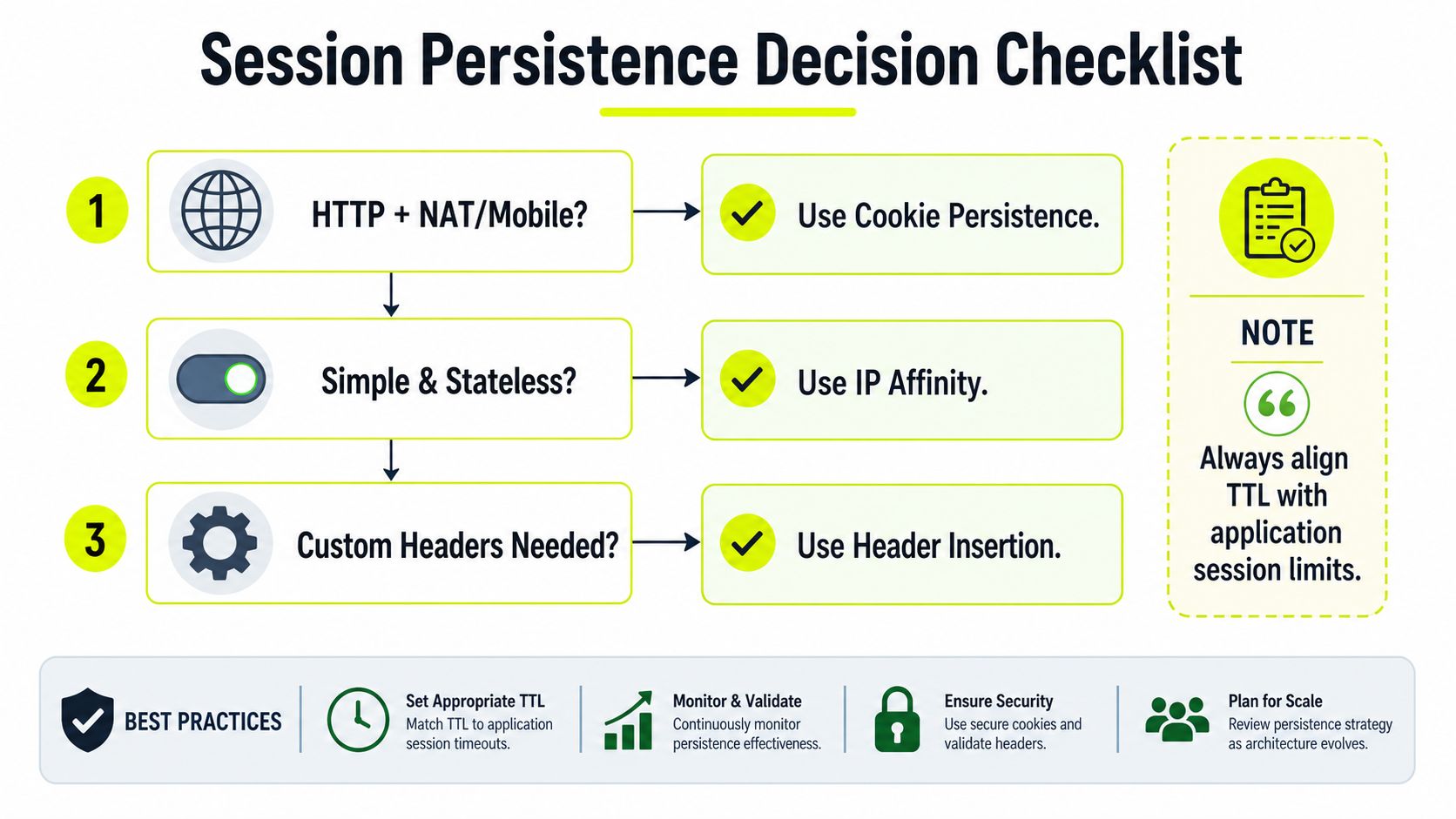
Use this when you're setting up proxies, browser profiles, or backend routing for real work:
- HTTP traffic behind NAT or mobile networks: choose cookie-based persistence. It's the most practical option when many users can share one public IP.
- Stable datacenter environment with dedicated IPs: use IP affinity only if the source address is reliable and you're not fighting shared-IP edge cases.
- Custom headers required by your stack: use header insertion for API or gateway flows where cookies don't fit the client.
- Sticky window tuning: align TTL with the application session limit, not with a random proxy default.
- Load balance checks: watch for session concentration on one backend, because imbalance usually means your affinity model is too blunt.
- Failover design: write recovery state somewhere durable, then test backend restart behavior before sending real traffic.
- Profile management: keep one browser profile tied to one clean sticky path, especially in AdsPower, Dolphin Anty, GoLogin, Multilogin, or Hidemyacc.
- Proxy strategy: use residential for geo-targeted continuity, mobile for high-trust account work, datacenter for speed-sensitive automation, and IPv6 only where the target supports it.
Sota Proxy supports sticky sessions across residential, mobile, ISP, and datacenter proxies with 99.9% uptime, city-level targeting, and rotation control that fits real operator workflows. If your team is scaling proxy infrastructure and you want a payout model that matches that growth, the referral program also pays up to 40% commission.
If you need proxy infrastructure that behaves properly under sticky sessions, test Sota Proxy against the workflows you run, not a demo sandbox. Set up your residential, mobile, ISP, or datacenter sessions, then verify how they hold up in AdsPower, Dolphin Anty, GoLogin, Multilogin, or Hidemyacc. Visit Sota Proxy and use the stack against real Facebook, TikTok, scraping, and geo-targeting jobs before you trust it with production traffic.
Related articles

How to Build an Amazon Review Scraper That Actually Works
Build a reliable Amazon review scraper with proven proxy, anti-blocking, and parsing tactics. Step-by-step guide for technical operators and agencies.

How to Get Around an IP Ban: A Technical Guide for 2026
Facing an IP ban? Learn how to get around an IP ban with technical steps for diagnosing block types, choosing the right proxies, and configuring your stack.

Residential Backconnect Proxy: 2026 Guide & Best Practices
Master the residential backconnect proxy. A 2026 guide on how it works, its benefits over other proxies, and best practices for ad verification & account

How to Avoid IP Ban: 2026 Guide
Learn how to avoid IP ban in 2026. Practical steps for proxy rotation, browser fingerprinting, and session management for high-volume workflows.
What Is Sticky Session: A Technical Guide for Proxy Users
Learn what is sticky session, how session affinity works in load balancers and proxies, and when to use it for multi-accounting, scraping, and ad campaigns.

AdsPower Proxy Integration: The Complete Setup Guide
Step-by-step AdsPower proxy integration with SotaProxy. Covers setup, proxy types, rotation, troubleshooting, and best practices for multi-account workflows.