What Is Geo Targeting: The Complete Guide for 2026
Learn what is geo targeting and how IP, GPS, and Wi-Fi signals shape it. Residential, mobile, and ISP proxies power real geo-targeted campaigns.

You can tell a geo setup is broken before the campaign even scales. The Facebook account warms on one region, the proxy comes from another, the browser says a third, and TikTok starts treating the whole profile like a risk event. That's usually when people blame the ad account, when the problem is that the location story never lined up in the first place.
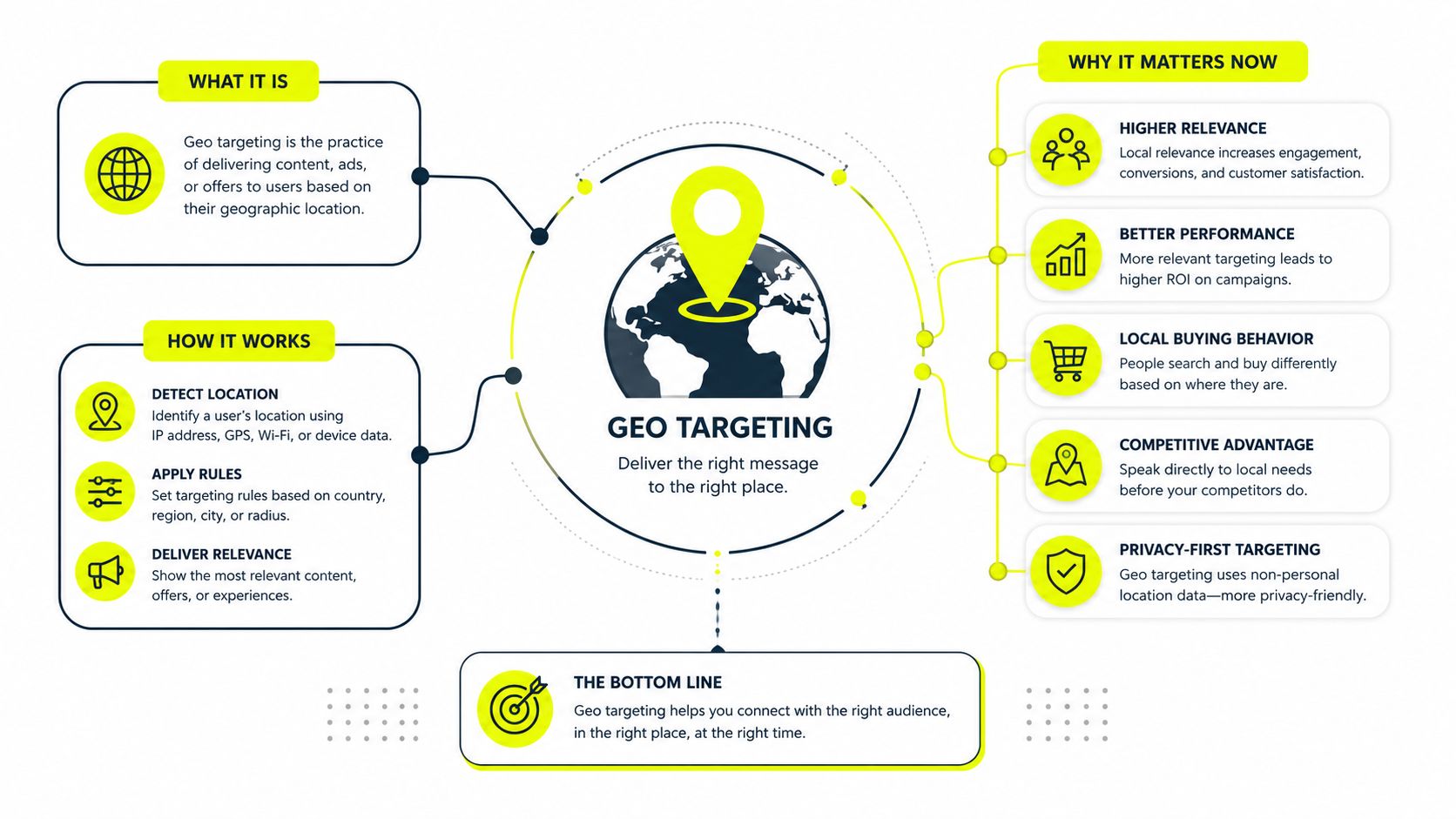
What is geo targeting in practice? It's the delivery layer that changes what a user sees based on geographic scope, from country and region down to city, ZIP code, ISP, IP address, or radius around a point. Major platforms already treat location as a control variable, not a novelty. Google Ads supports country and radius targeting around a chosen address, and geo targeting can also update content by city, state, or region in rich media workflows, including images, text, and video Google Ads location targeting, Google rich media geo targeting. If you run Facebook and TikTok campaigns, manage multiple accounts in AdsPower, Dolphin Anty, GoLogin, Multilogin, or Hidemyacc, or do account farming, cloaking, and geo-targeted campaigns, the job is not “target a country.” It's aligning the signals that decide whether the platform trusts the session.
If you're building landing pages or swapping regional creative, a practical place to look is access ProdSnap creative features, because geo work only matters when the ad and the page speak the same local language.
Table of Contents
- What Is Geo Targeting and Why It Matters Now
- The Location Signals Behind Every Geo Filter
- Proxy Types Mapped to Geo Signals
- Practical Use Cases for Advertisers Scrapers and Account Managers
- How Geo Targeting Works in Google Ads Meta and TikTok
- Performance Measurement and Privacy Tradeoffs
- Troubleshooting Common Geo Targeting Failures
What Is Geo Targeting and Why It Matters Now
A lot of teams still talk about geo targeting like it starts and ends with “pick a country.” That version is too shallow for anyone running live traffic, account operations, or verification. Geo targeting is the mechanism that serves different content, ads, or experiences based on location, and that location can be country, region, city, ZIP, radius, ISP, or IP address Wikipedia overview of geotargeting.
A local campaign can fail for reasons that never show up in the media plan. One profile is seeded in one locale, the proxy exits in another, the browser language points somewhere else, and the platform reads the session as inconsistent. On Facebook, TikTok, and other systems that score risk from multiple signals, that mismatch turns geo targeting into an account trust issue, not just a delivery setting.
Platforms do not need to prove fraud before they slow a session down. They only need enough conflicting signals to decide the request does not belong.
Geo targeting controls which markets can receive an ad, which markets are excluded, and which markets see localized creative. Google Ads supports country targeting and radius targeting around a chosen address, so location control is built into the buying interface rather than bolted on later Google Ads location targeting. The operational point is straightforward. The tighter the location signal, the tighter the match between message, inventory, and demand. That applies whether you are buying local leads, running regional offers, or testing whether a market deserves spend at all.
The old mistake is treating geo as a front-end checkbox. In production, it is a layered signal problem, and proxy choice changes which layer you can control. A residential exit, a mobile exit, and a datacenter exit do not tell the same story to a platform, even before browser and device data get involved. That is why teams that need to access ProdSnap creative features for multi-market work still have to think about the location story behind every session.
The Location Signals Behind Every Geo Filter
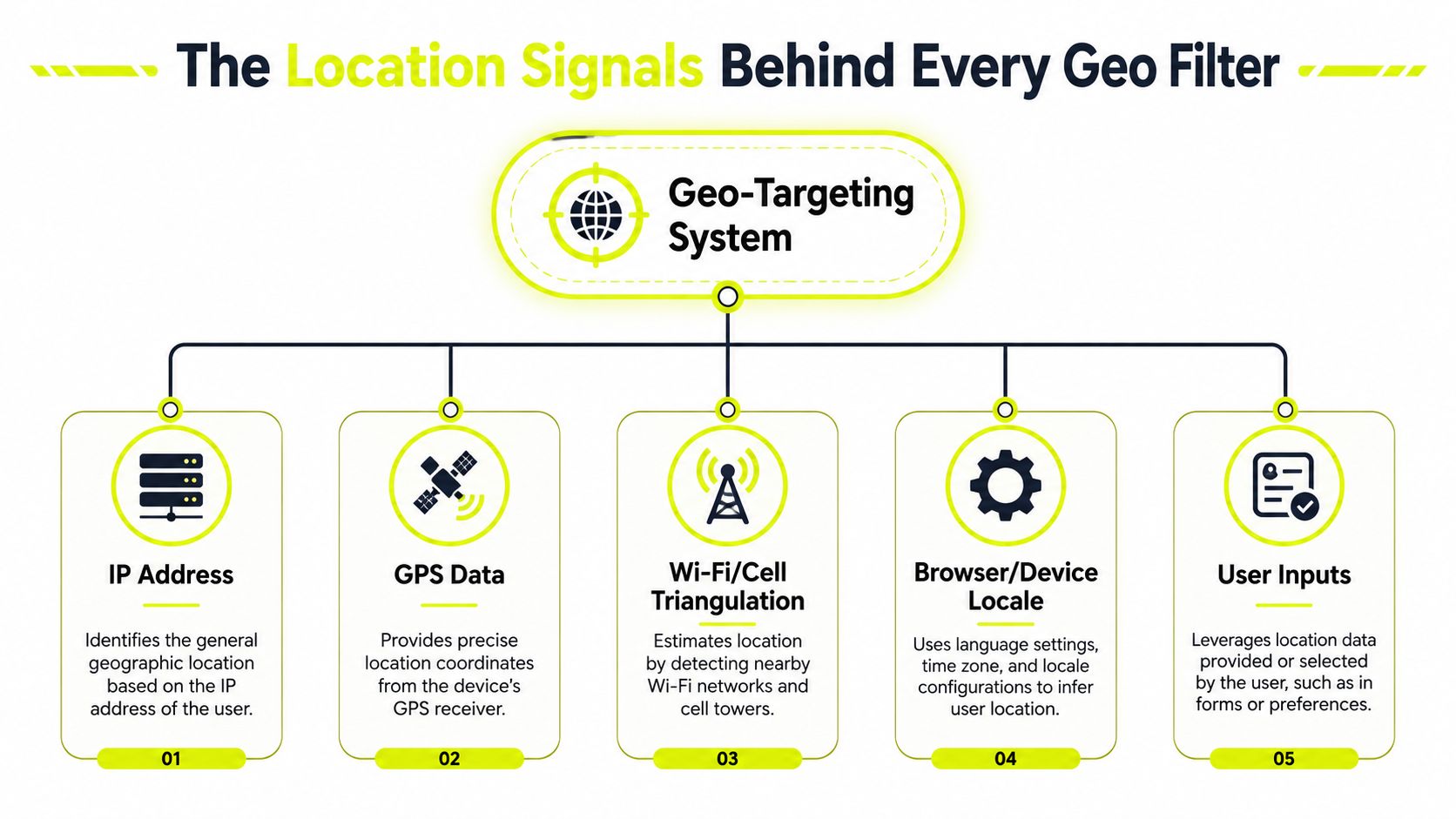
Geo targeting only works because a system can infer where a session is coming from. The usual inputs are IP address, GPS, Wi-Fi, cell-tower data, browser and device locale, and whatever user-supplied location a platform asks for or stores. Each one carries a different level of trust and precision, and each one can break in a different way Improvado on geotargeting signals.
IP, GPS, Wi-Fi, and cell towers are not interchangeable
IP is the easiest signal to buy and the easiest to scale for web scraping, ad verification, and broad routing. It's also the least personal. It ties to the network, not the human, so it can misread mobile traffic, carrier routing, or VPN use. That's why a mobile user can look “wrong” even when the user is physically in the target market. For a practical primer on the network layer, see what an IP address is.
GPS is the sharpest signal when the device allows it. It's precise on mobile, but only when the phone grants permission and the app can read it. That's why mobile proxies that route through real phones carry a stronger location story than generic server exits. Wi-Fi and cell-tower data help fill the gaps indoors and in dense urban areas, where GPS can drift or vanish. Platform and ad-tech guidance also points out that these signals often get combined rather than used alone Google location targeting docs.
Locale settings leak more than people think
Browser locale, device language, and timezone are often set inside antidetect browsers like AdsPower, Dolphin Anty, GoLogin, Multilogin, and Hidemyacc. That's not window dressing. Those settings shape how the session looks before the platform even checks the IP. If the locale says one region and the proxy says another, you've created a weak fingerprint. If GPS exists and points elsewhere, the mismatch gets louder.
The cleanest setup is boring. One region, one proxy exit, one locale, one timezone, one language pattern, one story.
For cloaking and geo-targeted creatives, the platform response gets better when the IP, locale, and GPS all point at the same region. When they don't, automated review systems have more reasons to slow the session, especially on Facebook and TikTok accounts where consistency matters during validation and account farming.
Audit the signal stack, not just the proxy
A quick audit should ask five questions. Does the IP geo match the profile locale? Does the timezone match the target market? Does the browser language match the ad language? Is there a GPS or Wi-Fi layer that contradicts the proxy? Are you relying on a platform field that the browser or network already undermines? If you can answer those cleanly, you're debugging location. If you can't, you're guessing.
Proxy Types Mapped to Geo Signals
Proxy choice decides which location signal you can influence. In production, the four types that matter most are residential, mobile, ISP, and datacenter. IPv6 sits on a separate axis, because it changes address supply and routing options, but it does not replace the trust profile of the other four. Sota Proxy also publishes a proxy types overview that matches how these setups behave in real campaigns.
Residential, mobile, ISP, and datacenter behave differently
Residential proxies exit through consumer ISPs, so the IP looks like a household connection tied to a real access provider. That matters for scraping, ad verification, and price checks, where the session needs to resemble a normal desktop user in a specific market. Mobile proxies route through cellular networks and carrier NAT, which gives them a stronger fit for Facebook and TikTok account farming, plus cloaking flows that need a phone-like footprint. The platform sees a shared carrier pool, not a neat single-device identity, and that is exactly why they often hold up better under review.
ISP proxies sit in data centers but are registered to consumer internet providers. They usually combine better speed with a trust profile that sits above a plain datacenter exit, so they work well for SEO monitoring, sticky sessions, and workflows that need steadier continuity. Datacenter proxies are still the blunt instrument. They are fast, cheap, and easy to scale, which makes them useful for low-stakes scraping, brand monitoring, and launch-window work where speed matters more than trust. For IPv6, the supply is large and the cost can be attractive, but support is uneven, and the geo mapping does not always line up cleanly with platform checks, including the Google location targeting API docs.
Pick the proxy for the signal you need to change
If the task depends on trusted mobile behavior, use mobile. If the task depends on consumer-style stability, use residential or ISP. If the task is mostly about speed at scale, datacenter can do the job. That sounds simple until people use the wrong family for account warming, then wonder why the account never settles.
A useful reference for local discovery workflows is the Instagram location search guide, because Instagram often exposes how much it is reading from region, language, and location metadata. That is not the same as ad delivery, but the signal patterns overlap more than teams expect.
| Proxy type | Geo accuracy | Trust score | Best fit | Main tradeoff |
|---|---|---|---|---|
| Residential | High for consumer-style routing | Medium to high | Ad verification, scraping, price checks | Slower than datacenter, trust varies by pool |
| Mobile | High for mobile sessions | High | Facebook and TikTok account farming, cloaking | More expensive, sticky quality matters |
| ISP | High and stable | Medium to high | SEO monitoring, sticky sessions, persistent workflows | Less flexible than pure residential pools |
| Datacenter | Medium | Low to medium | Fast scraping, low-stakes monitoring | Easier to flag |
| IPv6 | Variable | Variable | Cheap scale where support exists | Uneven geo coverage, patchy platform support |
The table is the blunt version. The true test is whether the proxy family changes the signal the platform is reading, then stays stable long enough for the session to hold. Geo accuracy means little if the trust profile falls apart after the first few requests.
Practical Use Cases for Advertisers Scrapers and Account Managers
Traffic teams usually don't need a theory lesson. They need a setup that survives first contact with platform enforcement. For Facebook and TikTok ad accounts, that means regional consistency, stable sessions, and enough separation between accounts that one bad login doesn't contaminate the rest.
Advertisers use geo to cut waste and keep accounts alive
For arbitrage teams, the clean pattern is pushing creatives only to the markets where the offer works, then keeping each account inside a stable, narrow geo footprint. Mobile proxies help when the account behavior needs to resemble a real phone user in that market. Residential or ISP proxies are safer when you're dealing with region-specific landing pages, ad verification, or feed checks. If the account is hopping cities or countries every time it wakes up, you're teaching the platform not to trust you.
Account farmers run a different play. They spin up multiple profiles in AdsPower, Dolphin Anty, GoLogin, Multilogin, or Hidemyacc, then pair each browser profile with a sticky residential or mobile IP from the region the identity is supposed to live in. That's not about pretending to be everywhere. It's about making each account boringly consistent.
Practical rule: keep one account, one geo, one proxy family, one browser profile. The more you share, the faster the cluster becomes visible.
Cloaking, scraping, and launch-day buying each need different proxies
Cloaking setups usually need white-page and black-page routing by IP. Residential or mobile proxies work better here because moderator views and user views need to land on different content without tripping obvious flags. Scraping and data parsing agencies lean on residential or ISP proxies for geo-restricted pricing, SERP, and inventory pulls, because those exits are less likely to get blocked than simple datacenter nodes.
Sneaker bot operators and limited-drop buyers are the exception. They often want datacenter or ISP proxies for speed during launch windows, then mobile fallbacks when queues or fingerprint layers start judging the connection. The key is not “best proxy.” It's matching the proxy family to the failure mode you're trying to avoid.
If you need ad-side verification logic, Sota Proxy's ad verification use case lines up with the same regional workflow, because verification only works when the exit and the expected market match.
One operational note: Sota Proxy also runs a referral program that pays up to 40% commission, which matters if you're already moving volume and want to offset proxy costs without changing your stack.
How Geo Targeting Works in Google Ads Meta and TikTok
A campaign can be set to one city and still be judged on a very different location signal. That is the part operators miss. The platform layer decides where delivery is allowed, but the session layer decides whether the account looks like it belongs in that market.
Google Ads is the cleanest example. It gives you country, region, city, radius, and exclusion controls, so the targeting UI is explicit about the market you want. The problem is that delivery still has to survive the rest of the stack, including IP consistency, device signals, and how the session behaves once the ad account is live. The proxy for Google Ads guide is useful because it reflects the same operational reality, the setting you choose is only one part of the location check.
Meta and TikTok care about what the session looks like
Meta Ads Manager lets you target by country, region, city, ZIP, and location categories. That is the visible layer. Underneath, the account still gets judged against IP-derived location inference and the rest of the device fingerprint, so a clean location setting does not save a session that looks inconsistent. If the target says one market and the session says another, review and delivery can slow down or get isolated.
TikTok looks simpler in the interface, but the enforcement logic still depends on device and IP consistency. That is why proxy selection matters more than the settings panel suggests. A proxy that matches the market helps the session look native, while the wrong exit can make a correct geo setup fail for reasons that have nothing to do with targeting.
DV360 is built for bulk location control
Display & Video 360 gives operators more room to work at scale. It supports country and region targeting, radius or proximity targeting, and can accept up to 10,000 postal codes or 10,000 street addresses or lat-long pairs in a location list. That makes it easier to run large market builds without hand-editing every placement or audience slice.
The trade-off is operational. Bigger location lists are easier to centralize, but they also make account hygiene and proxy discipline more visible, especially when teams run multiple markets from the same buying stack. For practitioners who want the market logic, session logic, and account structure to stay aligned, the digital media buying guide is a practical reference point.
Google also supports geo-specific creative and location-based targeting workflows in rich media and API-driven setups, which is useful when the buy needs to adapt by market instead of just by campaign. That matters for teams running geo-restricted accounts, because the platform is checking more than the dropdown you clicked.
The blunt takeaway is simple. The targeting UI decides eligibility, but the proxy and device layer decide trust. If those disagree, the platform does not care that your media plan looked clean in the spreadsheet.
Performance Measurement and Privacy Tradeoffs
Tighter geo targeting feels like a win, but tighter doesn't always mean better. Sometimes it just means you're concentrating budget inside a market that already wanted the product. Serious teams use geo experiments and geo-based marketing mix modeling to test whether a region is incremental, then move budget out of saturated areas when the response flattens Tinuiti on geotargeting measurement.
Measurement has to answer a harder question than delivery
The core question is not “did the ad run in the right city.” It's “did that city add revenue that wouldn't have happened anyway.” Control geos help with that. So does comparing regional response against a clean benchmark instead of chasing the prettiest click curve. If a market is already maxed out, more geo precision can just sharpen inefficiency.
The best geo test is usually boring. Hold one market back, watch another market move, and compare the difference without changing five other variables.
Privacy changes the proxy choice
The compliance burden rises as the signal gets more precise. IP-based geo is relatively straightforward from a consent perspective because it doesn't need the same kind of explicit opt-in that GPS or Wi-Fi fingerprinting can require. Precise GPS and some Wi-Fi-based location use cases are more sensitive, and mobile proxies that mirror those signals can carry more operational baggage if you're handling location data carelessly.
That matters for GDPR, CCPA, and platform rules on precise location data. If your workflow depends on GPS-grade location, you need clearer consent logic, tighter storage rules, and a more careful rationale for why you're collecting or using that signal. If your workflow only needs broad geo routing, IP-based targeting is cleaner and easier to defend. The practical choice is often not “more precise,” but “precise enough to do the job without expanding the compliance surface.”
Troubleshooting Common Geo Targeting Failures
A geo campaign usually breaks in the same few places. The proxy IP says one market, the browser locale says another, timezone drifts, or the account history still looks anchored in last week's region. Fix the full stack before you blame the ad platform. Align timezone, language, and IP geo inside the antidetect browser, then warm the account instead of throwing a brand-new location shift at it too early.
Delivery often falls apart after a proxy rotation because the session stopped looking stable. Switch to sticky sessions, then verify the new exit through a third-party lookup before you relaunch. If Facebook or TikTok starts flagging the account right after a geo change, move through a neighboring region first, then settle into the final city. If scraping returns the wrong localized page even though the IP matches, check the Accept-Language header and the browser locale, because some sites localize from headers before they trust the IP. DNS can also point you at the wrong resolver path, so confirm it with a clean check like what proxy DNS reveals. If a cloaking page gets rejected, the moderator view needs to come from a residential or mobile pool in the same region as the user-facing creative.
SotaProxy's dashboard supports city-level targeting and sticky or rotating sessions, which covers most of these failures directly. Before any geo-targeted launch, run this checklist, IP geo check, locale match, timezone match, Accept-Language header, platform-level verification.
Related articles
Zip Code Targeting for Ad Campaigns: The Practitioner Guide
Zip code targeting explained for media buyers and traffic arbitrage teams. Covers proxy setup, ad platform rules, detection risks, and best practices.
IPRoyal vs Webshare in 2026: Same List Price, Half the Bill, and Who Checks Your ID
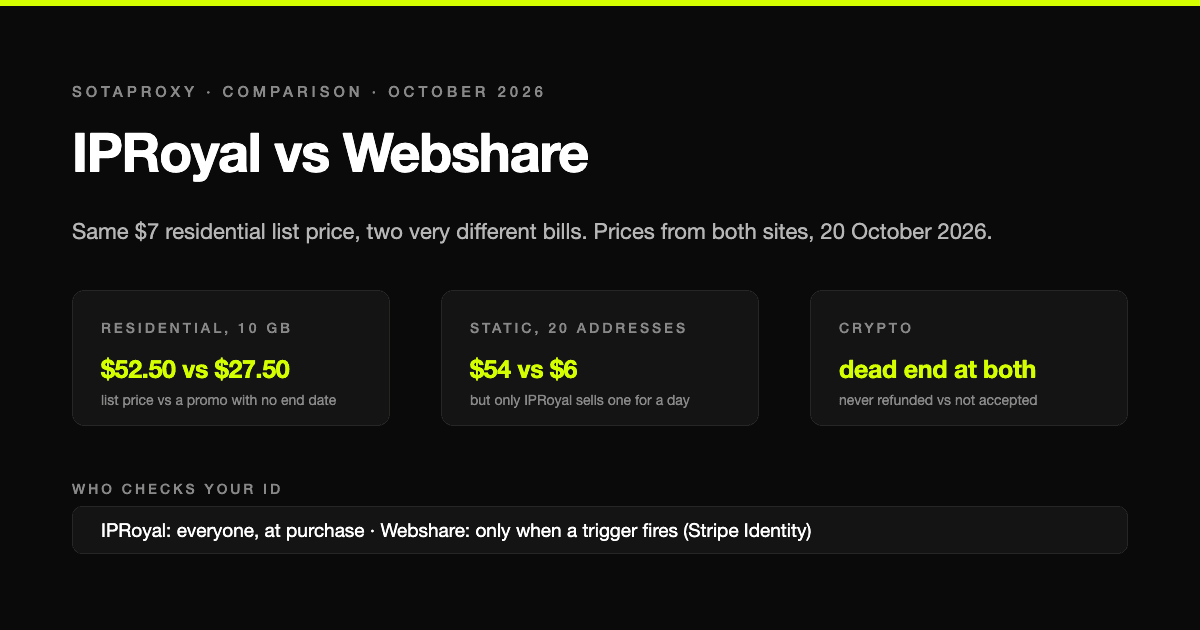
IPRoyal and Webshare print the same $7 per gigabyte on their residential pages and charge very different money for it. Prices from both sites on 20 October 2026, whose traffic expires, static addresses at a tenth of the price, who verifies identity before you can buy, and why crypto is a dead end at both for different reasons.
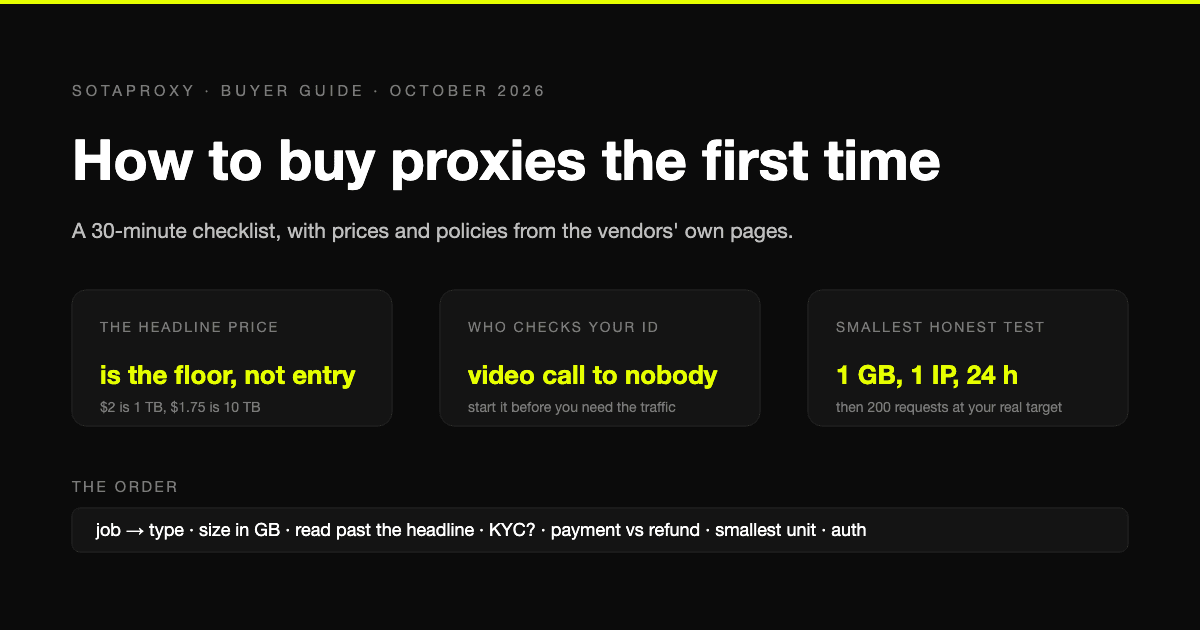
How to Buy Proxies for the First Time: A 30-Minute Checklist
A first purchase goes wrong in predictable places: the wrong proxy type, a headline price nobody pays, an identity check nobody mentioned, a refund that does not apply to how you paid. The checklist, with prices and policies from the vendors' own pages.
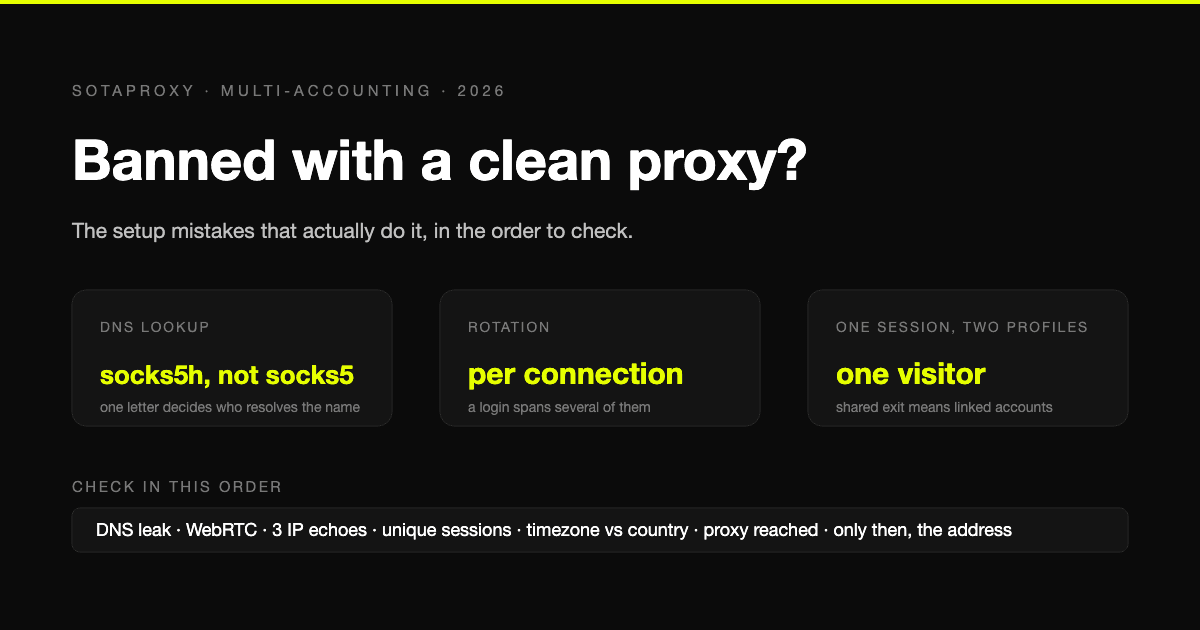
Banned With a Clean Proxy? The Setup Mistakes That Actually Do It
The proxy was clean, the address was residential, and the account still died. In most cases we see, the address was never the problem. Seven setup faults, each one checkable in a minute, in the order they usually turn out to be the cause.
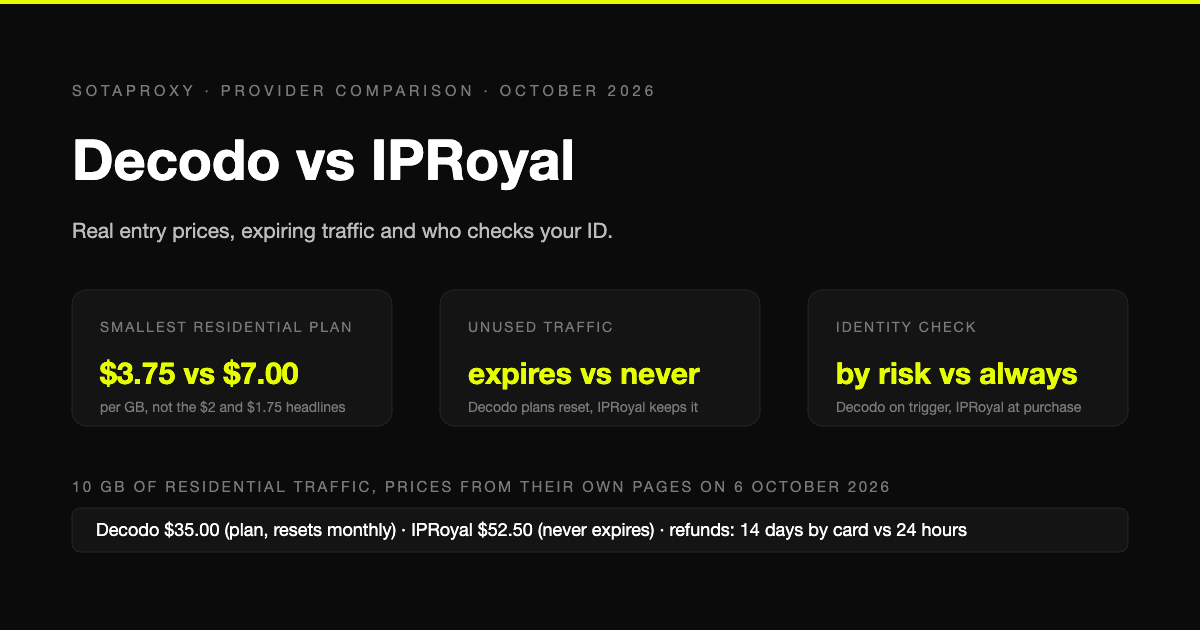
Decodo vs IPRoyal in 2026: Real Entry Prices, Expiring Traffic and Who Checks Your ID
Both are mid-market proxy vendors that take cards and crypto and sell by the gigabyte. The prices on their own pages on 6 October 2026, why neither headline rate is an entry price, whose traffic expires, who checks your identity before you can buy, and who gives money back.
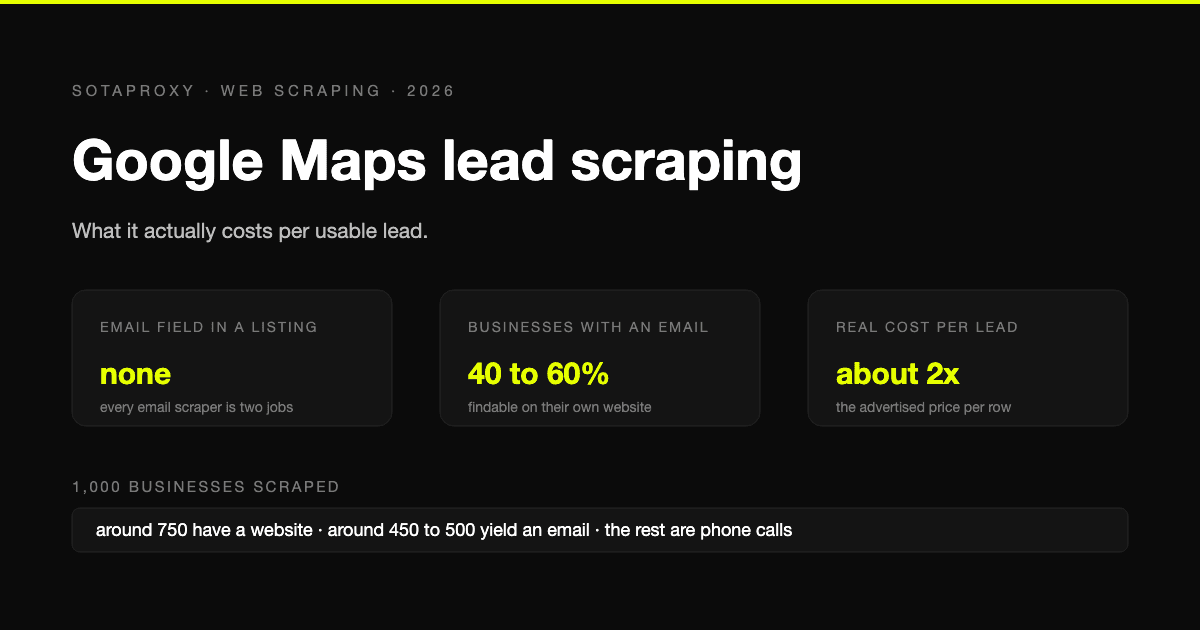
Google Maps Lead Scraping: What It Actually Costs Per Usable Lead
Google Maps has no email field, so every email scraper is a two-stage pipeline and only about half of businesses yield an address. What a thousand listings really costs per usable lead, the businesses-without-websites play, and where the law stands after the SerpApi ruling.