Buy Proxies for Geo Surfing That Actually Work
Learn how to buy proxies for geo surfing the right way - choose types, target cities, configure antidetect browsers and validate geo results.

You've launched a Facebook campaign for one market, opened the landing page through a clean profile, and still see the wrong currency, the wrong compliance banner, or no ad at all. Then the account gets reviewed because the browser profile says one thing, the IP says another, and the session keeps changing cities.
That's the practical problem with geo surfing. Buying an IP isn't enough. You need the right network class, a stable session, matching browser signals, and a test that proves the target site is serving the intended market. This guide focuses on that validation workflow for AdsPower, Dolphin Anty, GoLogin, Multilogin, Hidemyacc, Facebook and TikTok ad accounts, account farming, cloaking checks, and geo-targeted campaigns.
Table of Contents
- Why Geo Surfing Needs Proxies and When It Does Not
- Choosing the Right Proxy Type for Geo Surfing
- Location Targeting and Session Control That Holds
- How to Buy and Configure Proxies for Antidetect Workflows
- Testing and Monitoring Geo Surfing Results Like a Pro
- Cost Control Compliance and Troubleshooting for Long Term Use
Why Geo Surfing Needs Proxies and When It Does Not
Geo-blocking creates a real operating problem for media buyers. A campaign can look correct from one country and fail completely from another. The offer may show a different price, the ad library may return different creatives, or the platform may refuse access to a locally restricted page.
A large study of 8,000 Alexa Top 10K domains found a median of 3 domains inaccessible per country because of geoblocking, with a maximum of 71 blocked domains in Syria. Across the Alexa Top Million, 4.4% of domains used a CDN geoblocking feature in at least one country. The research also recorded 596 geoblocking instances across 100 unique domains in 165 countries. These findings are documented in the global study of CDN geoblocking.
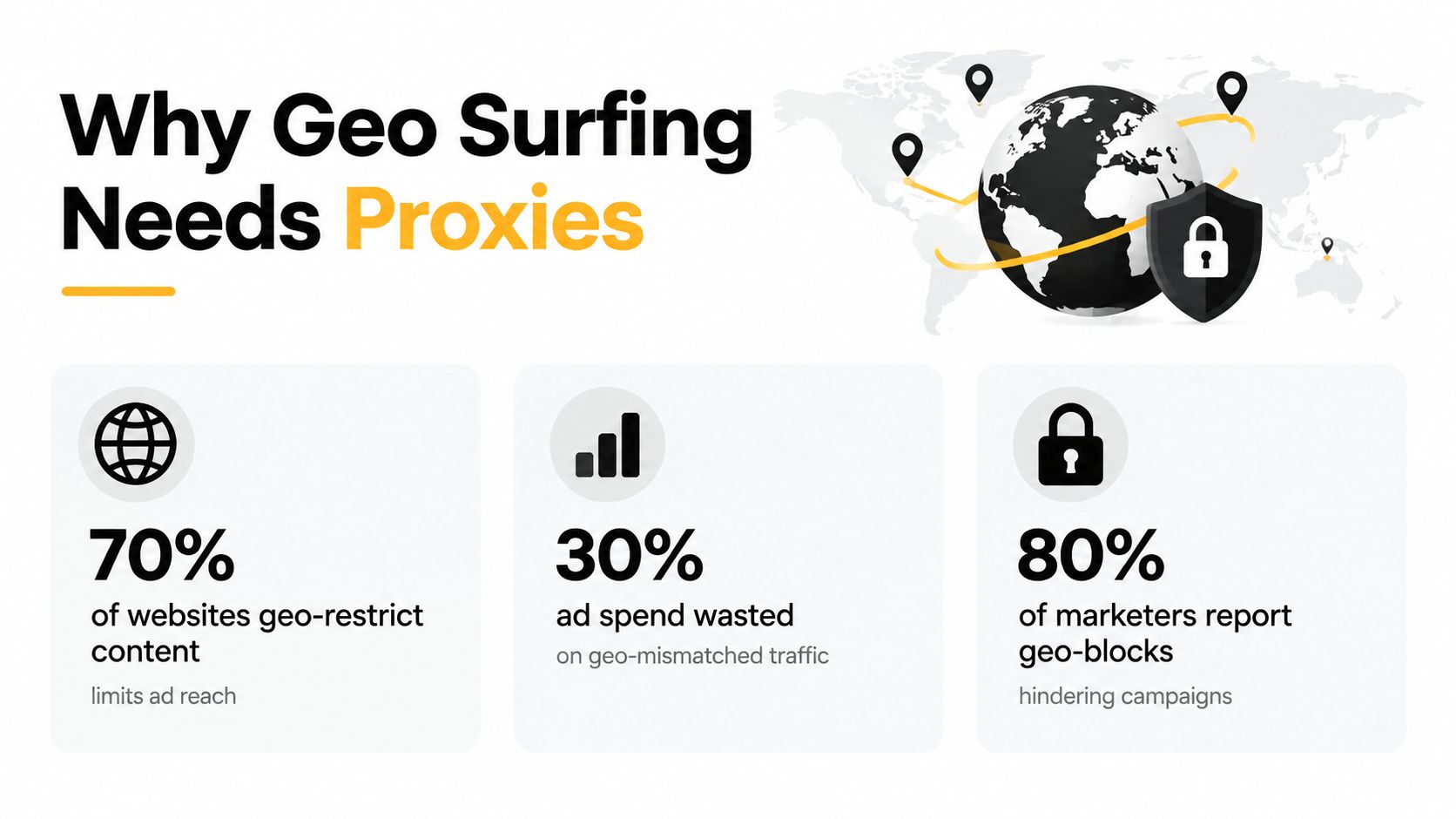
The scale explains why teams buy proxies for geo surfing. GWI reports that 30% of internet users used a VPN or proxy server in the past month, equivalent to roughly 1.6 billion people when applied to current global internet-user counts. The same report identifies especially high-use markets including Indonesia, India, the UAE, Thailand, Malaysia, and Turkey. You can review the figures in GWI's VPN usage report.
Separate IP geography from browser identity
A proxy solves an IP-origin problem. It doesn't automatically change:
- Browser language
- Time zone
- GPS data
- Cookies
- Device signals
- Legal eligibility
- Account history
- TLS or HTTP fingerprints
That distinction matters in an antidetect browser. AdsPower or Dolphin Anty can isolate profiles, but a profile still needs coherent signals. A French exit IP paired with English locale settings, a US time zone, old cookies, and a device fingerprint associated with another market can produce a poor geo test.
A proxy also isn't a substitute for legal access. The right question is whether the workflow requires a public-IP country, region, ASN, or carrier network. If the result depends on age verification, physical presence, contractual eligibility, or a platform rule, buying a proxy may not solve the underlying issue.
Decision filter: Buy a proxy when the test depends on how a site responds to network origin. Don't buy one to solve a browser fingerprint, account-history, or legal-eligibility problem.
For ad verification, local landing-page checks, price monitoring, and public geo content, a proxy usually fits. For a restricted age-gated service, a regulated offer, or a Facebook account with contradictory identity signals, start with the platform and compliance requirements instead. The proxy should support the test, not disguise a workflow that the platform or law prohibits.
Choosing the Right Proxy Type for Geo Surfing
Proxy selection comes down to trust versus throughput. Residential and mobile networks look closer to ordinary user access. Datacenter networks deliver speed and low cost. ISP proxies sit between those choices, while IPv6 can provide high capacity with narrower compatibility.
The infrastructure gap is substantial. A 2026 proxy infrastructure report lists residential proxies at 92M+ IPs, 130–310 ms median latency, and $3.5–$8/GB. Mobile 4G/5G proxies are listed at 6.5M+ IPs, 200–385 ms, and $8–$22/GB. Datacenter proxies show 3.2M+ IPs, 35–130 ms, and $0.4–$1.2/GB, while IPv6 has 120M+ allocations, 40–140 ms, and $0.2–$0.6/GB.
| Proxy Type | Trust and Speed | Best For Geo Surfing |
|---|---|---|
| Residential | Higher trust, slower than datacenter, ISP-assigned household origins | Facebook and TikTok ad accounts, account farming, cloaking checks, local pages |
| Mobile | Carrier-network behavior, usually slower and more expensive | App-like workflows, mobile trust signals, carrier-specific tests |
| ISP | Stable assigned access with a more consistent identity | Long-lived sessions where stability matters more than broad rotation |
| Datacenter | Fast and inexpensive, but easier for targets to classify as hosting traffic | Compatible scraping, rapid checks, and high-throughput tasks |
| IPv6 | Low cost and high capacity, but compatibility-first | Targets that demonstrably support IPv6, including some major platforms |
Residential backconnect is usually the sensible starting point for ad-spend profiles. Traffic routes through real household devices behind ISP-assigned IPs, which makes this type a better fit for Facebook and TikTok ad accounts, account farming, cloaking checks, and geo-targeted campaigns than low-trust datacenter ranges. A technical guide on residential backconnect proxies specifically recommends residential backconnect for Multilogin and GoLogin profiles tied to ad spend, while pointing to mobile proxies when platforms rely heavily on mobile trust signals or app-like behavior.
Mobile isn't automatically better. It adds carrier realism, but it also adds cost, latency, and a smaller practical pool for some markets. Use it when the test depends on operator-level behavior, carrier NAT, or a mobile application context. Don't pay mobile rates for a desktop landing-page check that only needs a regional residential IP.
Datacenter proxies can work well for speed-sensitive tasks, but they're a poor default for Facebook account farming or TikTok cloaking checks when the target evaluates network class. IPv6 is even more conditional. Technical proxy comparisons describe datacenter IPv6 as cheaper but narrower in compatibility, often fitting major platforms such as Facebook, YouTube, and Google rather than every target.
For a broader practical comparison, use this proxy type guide before choosing a plan. Match the network to the decision you're making, not to the largest advertised pool.
Location Targeting and Session Control That Holds
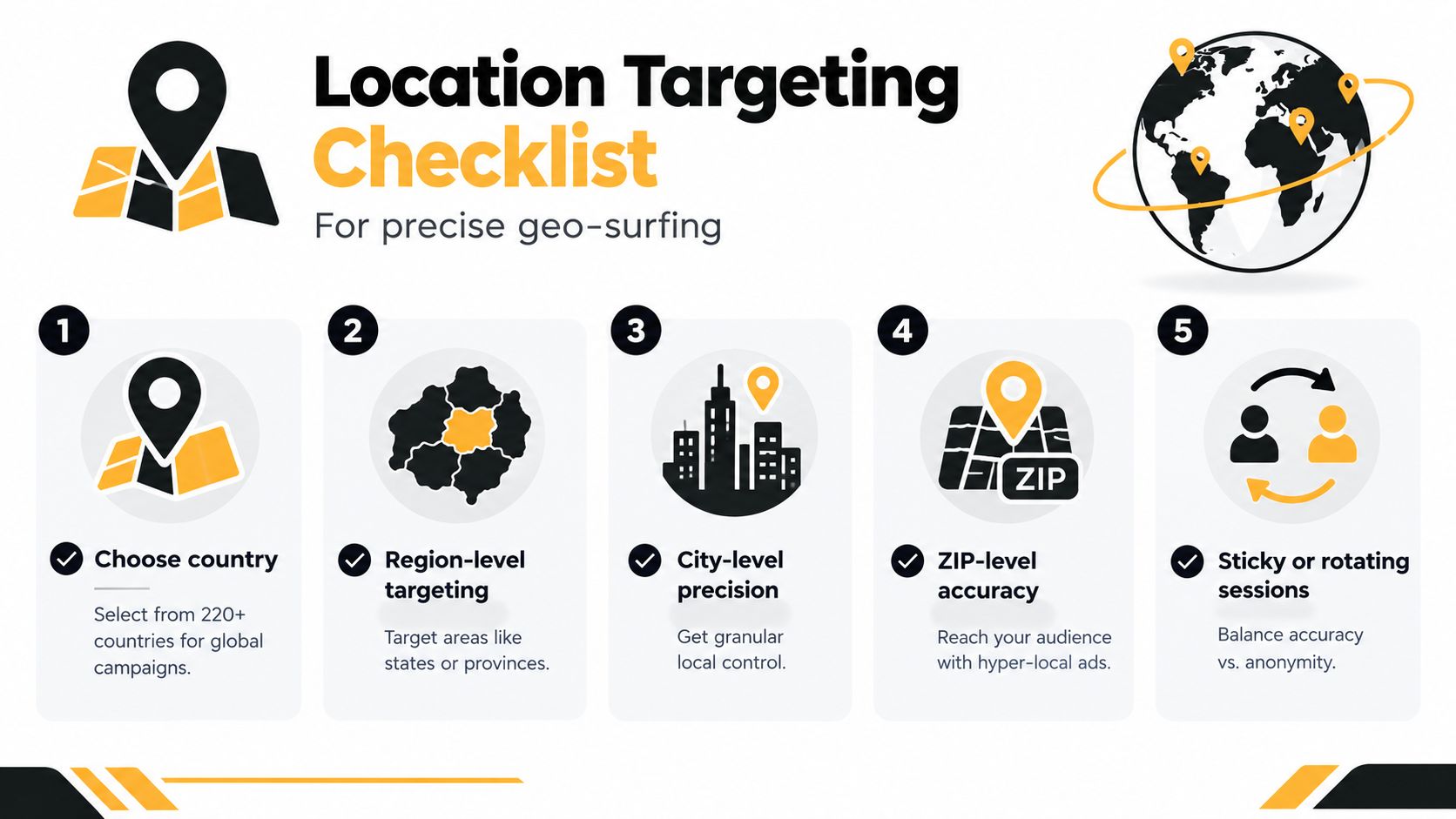
Start at the country layer. Only move to region, state, city, ZIP, or ASN when the broader location hides a decision that affects the campaign or test.
Country targeting is generally more reliable than city targeting. Benchmark-style reporting cites residential country targeting at about 99.5% accuracy, region or state targeting at roughly 80–90%, and city targeting at 55–80%. Those figures come from geo-targeting guidance for residential proxies. The drop happens because city databases disagree, dense metros share infrastructure, and ISP assignments change.
Choose the minimum viable geo
Use this decision order:
- Country first. Confirm the site returns the right domain, currency, language, and broad offer.
- Region or state next. Add it when taxes, delivery zones, regulatory banners, or campaign eligibility differ within the country.
- City only with a reason. Local inventory, city-specific ads, and metropolitan targeting can justify it. A random city lookup doesn't.
- ZIP or ASN last. Use these only when the campaign depends on a local service area, ISP class, or network-specific behavior.
City targeting often fails in dense metros. The IP database may place an address in the surrounding county, the carrier may move the assignment, or the platform may use a different location source. One successful lookup doesn't prove repeatable delivery.
Operational rule: Define the decision before selecting the geo granularity. If country-level output answers the question, city targeting adds noise and cost.
Session control matters just as much. Use a sticky session for a Facebook or TikTok account, an antidetect profile, account farming, or a cloaking review where the same identity must persist across login, navigation, and conversion checks. A rotating session can make an account appear to jump between locations during one workflow.
Use rotation for scraping, broad ad verification, and repeated public-page checks when you need fresh origins. Keep rotation controlled. Randomly changing the country, city, and ASN at every request makes the data harder to interpret and can trigger defensive systems.
Align the browser with the proxy. Clear cookies, remove conflicting extensions, set the language and time zone to the target market, and test the local domain first. Then keep the session open long enough to verify stability. The geo-targeting documentation is useful when you need country or city selection combined with session control.
How to Buy and Configure Proxies for Antidetect Workflows
The purchase decision should follow the profile, not the other way around. For a Facebook or TikTok account in AdsPower, Dolphin Anty, GoLogin, Multilogin, or Hidemyacc, choose the target country first, then decide whether the account needs residential, mobile, ISP, datacenter, or IPv6 access.
Sota Proxy provides residential, mobile, ISP, and datacenter IPs across 220+ geolocations, with country and city selection, rotating or sticky sessions, usage monitoring, balance control, and pay-as-you-go options. It also supports cryptocurrency top-ups and unlimited-bandwidth options on applicable plans. Those controls matter to teams that need to cap spend while testing several markets.
Build one clean profile before scaling
Create a single test profile first. Set the proxy location, browser language, time zone, and device environment to the same market. Don't import old cookies from another country, and don't leave extensions active unless the workflow requires them.
For account farming, use a sticky residential or ISP session when the platform expects a stable identity. For cloaking checks, test the same URL from a clean profile and compare the response against the control environment. For geo-targeted campaigns, open the local domain before visiting the offer page. This helps you see local currency, language, compliance banners, and payment options rather than relying on an IP checker.
Configure the proxy inside the browser profile, not as a shared machine-wide setting. A shared proxy can leak consistency between unrelated profiles. It also makes troubleshooting harder because you can't tell whether the problem comes from the profile, the proxy, or the platform session.
Review the provider's session options before you pay. Rotation is useful for public-page verification and scraping. Sticky sessions are more appropriate for ad accounts and multi-step flows. City targeting should remain optional until country and region tests show that city precision affects the result.
Here's a practical setup sequence:
- Select the market: Choose the country, then narrow only when the test requires it.
- Select the network: Start with residential for ad-spend profiles. Move to mobile for carrier or app-like signals.
- Set the session: Use sticky access for accounts and rotating access for repeated public checks.
- Clean the profile: Clear cookies, remove conflicting extensions, and align locale settings.
- Run the local page: Check currency, language, payment methods, banners, and content.
- Record the result: Save the session behavior, not only the initial IP location.
A provider's referral program can also matter for teams that standardize tooling across operators. Sota Proxy offers a referral or affiliate program with up to 40% commission, which may suit agencies or media buyers recommending infrastructure to other teams. Keep that separate from the technical decision. Commission doesn't make a proxy suitable for a target.
Use the following video as a product and configuration reference, then validate the actual workflow inside your own antidetect profile.
Testing and Monitoring Geo Surfing Results Like a Pro
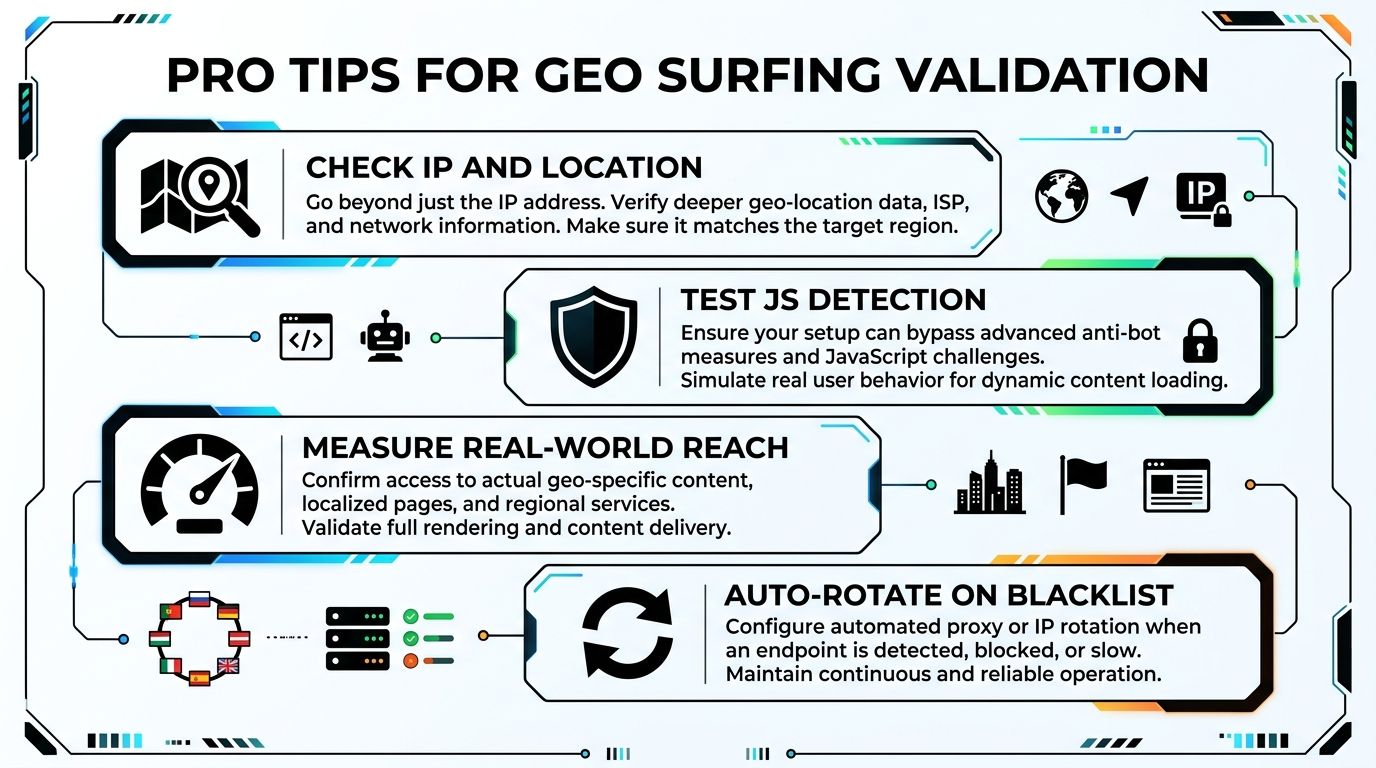
An HTTP 200 response proves very little. The server may have returned a generic shell, a consent page, a blocked template, or content that ignores the proxy location. A successful geo test measures the user-visible outcome.
Residential proxies can reach about 94.6% average success on protected sites, compared with 30–60% for datacenter proxies. Geo-matching the proxy to the target country adds roughly 4.2 percentage points to success, while city-level matching adds nearly 5 more points and can reduce latency. These benchmark figures are reported in independent residential proxy research. Treat them as benchmark context, not a guarantee for your target.
Test the page, not just the connection
Run repeated checks through the same clean profile. Keep a sticky session open for 5–10 minutes when the workflow requires persistence. Measure:
- Block rate: How often the target returns a denial, challenge, or restricted page.
- Timeout rate: Whether the session remains usable under normal navigation.
- Content match rate: Whether the page shows the correct offer, language, currency, and market rules.
- Session persistence: Whether the same profile keeps its expected location throughout the test.
A local currency switch is useful, but it isn't enough. Check language, payment options, compliance banners, delivery information, regional promotions, and the actual ad or landing-page variant. For Facebook and TikTok, verify the account view, billing flow, campaign interface, and preview behavior separately. For cloaking, compare the expected user path with the control path and record each redirect or content change.
A clean IP lookup is only the first check. The page response is the evidence.
Modern anti-bot systems combine IP reputation with TLS and HTTP fingerprints, browser settings, cookies, and behavior signals. A proxy can match the country while the profile still exposes a contradictory environment. That's why AdsPower, Dolphin Anty, GoLogin, Multilogin, and Hidemyacc profiles need consistent locale settings and limited extension noise.
If the block rate rises, stop rotating blindly. Test one country, one network class, and one profile at a time. Replace the failing variable, then rerun the same page sequence. This isolates whether the issue comes from city accuracy, IP reputation, session churn, browser identity, or the target's policy.
Cost Control Compliance and Troubleshooting for Long Term Use
The cheapest proxy isn't the cheapest workflow if it produces false geo results or burns account trust. Use datacenter or IPv6 access for compatible, speed-sensitive targets such as some Google or YouTube workflows when testing confirms that the network class works. Use residential or ISP access when the target evaluates consumer origin, account continuity, or ad-spend behavior.
IPv6 deserves a compatibility test before broad deployment. It can reduce infrastructure cost, but it isn't universal. A target may accept IPv6 connections while still returning incomplete geo behavior, inconsistent redirects, or a different trust decision than it gives IPv4.
Keep a troubleshooting log
When a session fails, record the exact symptom:
- Wrong market content: Check country, locale, cookies, and the local domain sequence.
- City mismatch: Move back to country or region targeting and compare repeated results.
- Repeated blocks: Test residential or mobile access instead of changing cities at random.
- Latency spikes: Compare network class and session route, then remove unnecessary precision.
- Session drops: Use sticky access and confirm that the browser profile doesn't reconnect through a different route.
- Account review: Check contradictions across IP, time zone, language, device signals, cookies, and account history.
Compliance needs the same operational discipline. Geo surfing for public ad verification, localization checks, and market research isn't automatically permission to bypass every control. Age gates, regulated offers, platform terms, and physical-location rules can apply even when traffic exits through another country.
Utah provides a clear warning. In April 2026, the state's law treated someone as accessing a website from Utah based on physical location even when they used a VPN or proxy to disguise it. It also prohibited some commercial entities from facilitating or encouraging VPN use to bypass age checks, as described by the Electronic Frontier Foundation's coverage of Utah's VPN law.
Use provider support when the issue is route quality, location availability, or session configuration. Sota Proxy offers 24/7/365 human support, which can help teams troubleshoot configuration and scaling problems. Still, support can't make an impermissible workflow compliant. Define the allowed use first, then choose the proxy that produces a stable and auditable test.
Sota Proxy offers residential, mobile, ISP, and datacenter proxies across 220+ geolocations, with city targeting, sticky sessions, rotation, usage monitoring, and pay-as-you-go control for geo surfing workflows. Visit Sota Proxy to configure a test profile for your ad verification, antidetect, cloaking, or market research workflow, then validate the actual page response before scaling.
Related articles
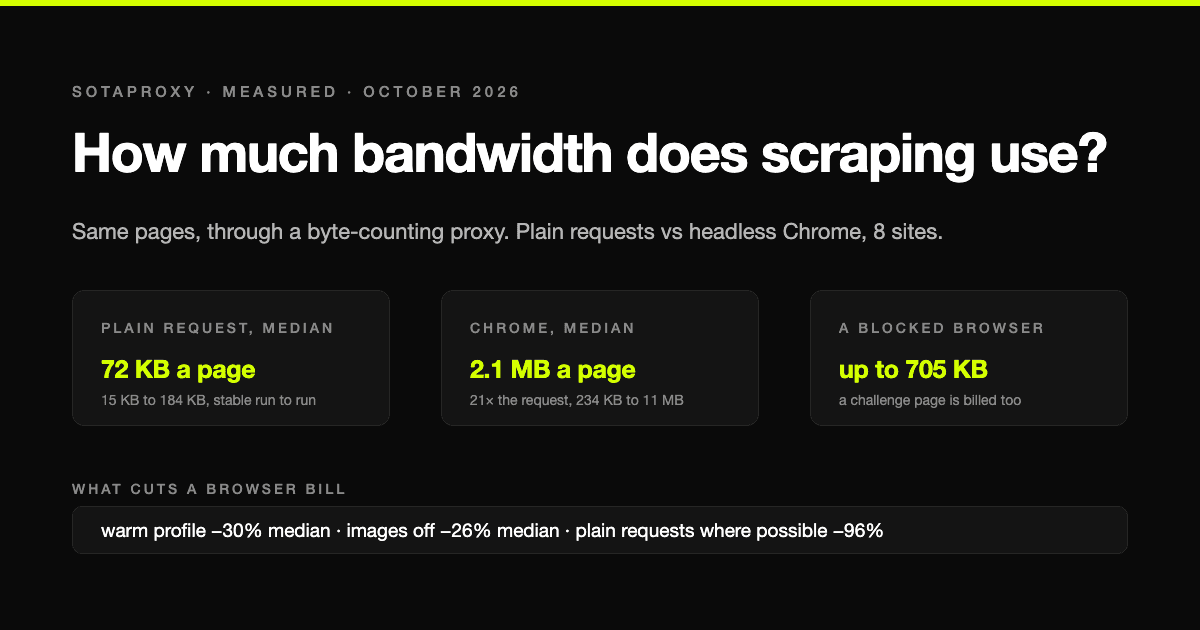
How Much Bandwidth Does Web Scraping Use? We Measured It, Requests vs Headless Chrome
On residential proxies you pay per gigabyte, so the scraping method sets the bill. We loaded the same pages with plain HTTP requests and with headless Chrome through a proxy that counts every byte: the median page cost 72 KB one way and 2.1 MB the other, a 21-fold difference, plus what blocking images, reusing a browser and getting blocked actually cost.
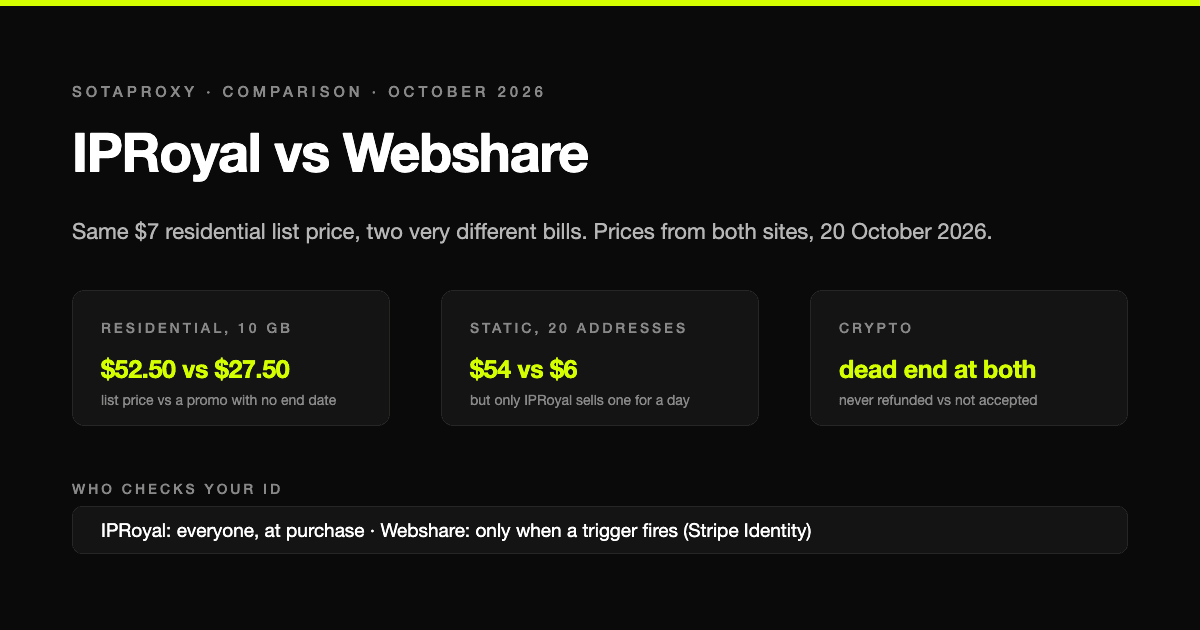
IPRoyal vs Webshare in 2026: Same List Price, Half the Bill, and Who Checks Your ID
IPRoyal and Webshare print the same $7 per gigabyte on their residential pages and charge very different money for it. Prices from both sites on 20 October 2026, whose traffic expires, static addresses at a tenth of the price, who verifies identity before you can buy, and why crypto is a dead end at both for different reasons.
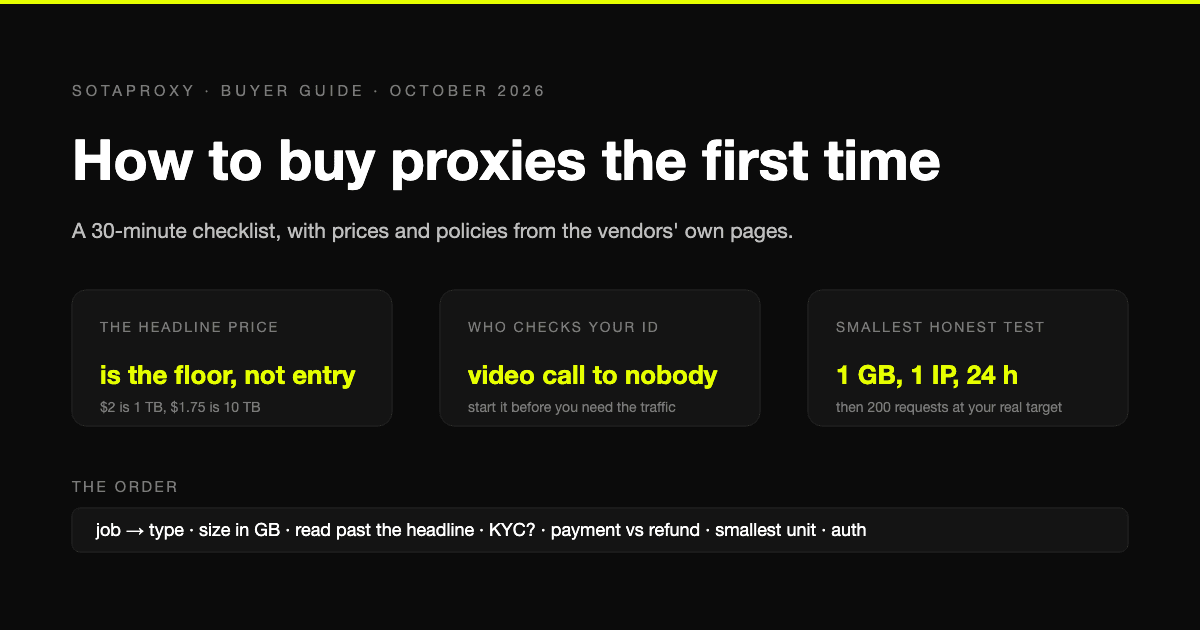
How to Buy Proxies for the First Time: A 30-Minute Checklist
A first purchase goes wrong in predictable places: the wrong proxy type, a headline price nobody pays, an identity check nobody mentioned, a refund that does not apply to how you paid. The checklist, with prices and policies from the vendors' own pages.
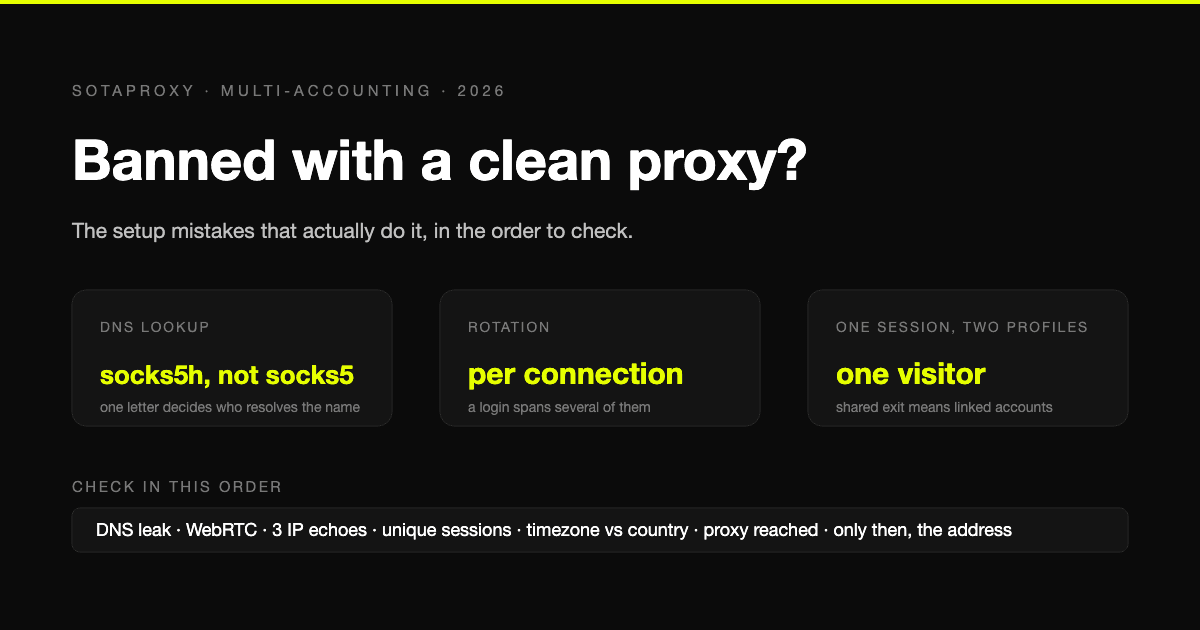
Banned With a Clean Proxy? The Setup Mistakes That Actually Do It
The proxy was clean, the address was residential, and the account still died. In most cases we see, the address was never the problem. Seven setup faults, each one checkable in a minute, in the order they usually turn out to be the cause.
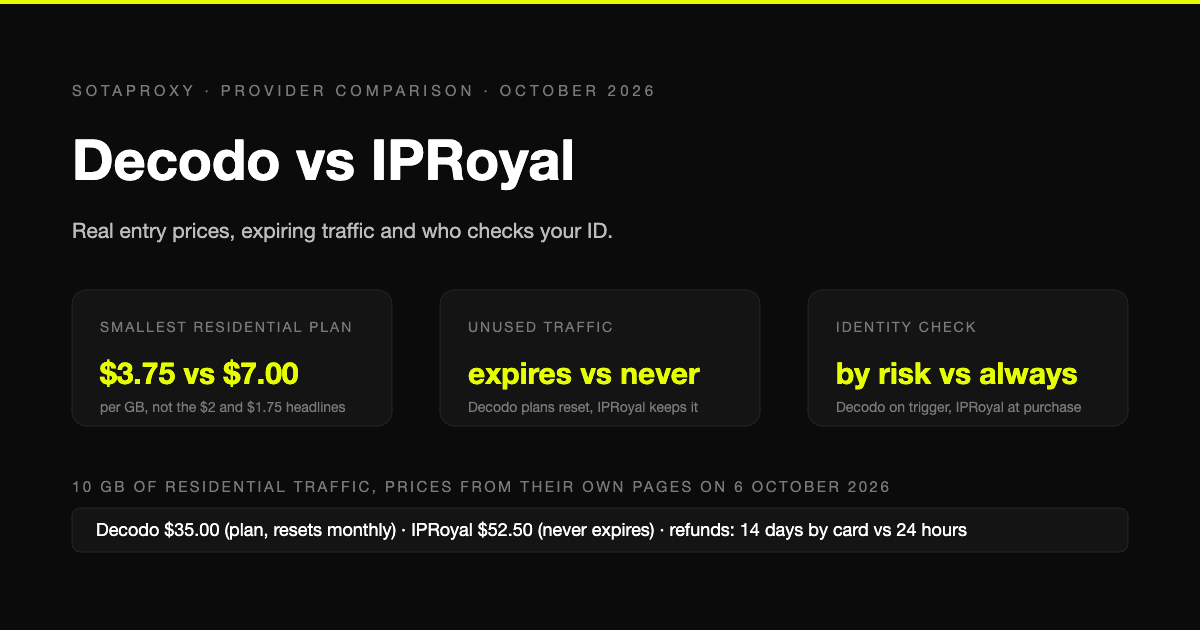
Decodo vs IPRoyal in 2026: Real Entry Prices, Expiring Traffic and Who Checks Your ID
Both are mid-market proxy vendors that take cards and crypto and sell by the gigabyte. The prices on their own pages on 6 October 2026, why neither headline rate is an entry price, whose traffic expires, who checks your identity before you can buy, and who gives money back.
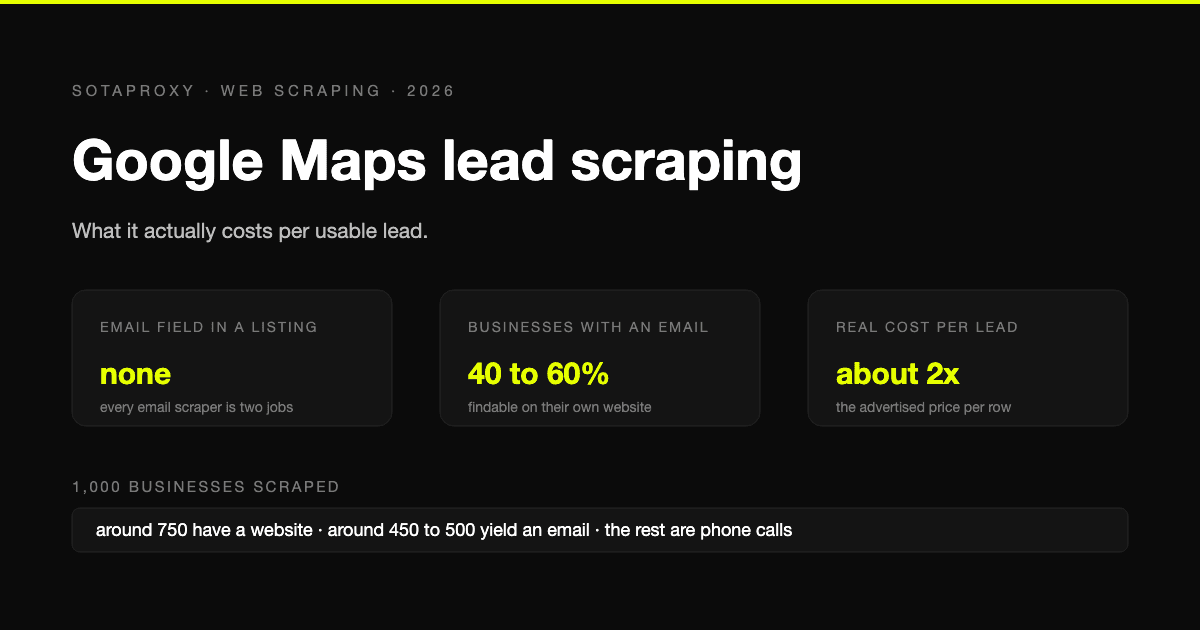
Google Maps Lead Scraping: What It Actually Costs Per Usable Lead
Google Maps has no email field, so every email scraper is a two-stage pipeline and only about half of businesses yield an address. What a thousand listings really costs per usable lead, the businesses-without-websites play, and where the law stands after the SerpApi ruling.