Decodo vs IPRoyal in 2026: Real Entry Prices, Expiring Traffic and Who Checks Your ID
Both are mid-market proxy vendors that take cards and crypto and sell by the gigabyte. The prices on their own pages on 6 October 2026, why neither headline rate is an entry price, whose traffic expires, who checks your identity before you can buy, and who gives money back.
Decodo, which was Smartproxy until 2025, and IPRoyal are the two names that come up when someone has decided Bright Data and Oxylabs are too big for them and wants a residential pool, a few static addresses, and a bill under a hundred dollars. The comparisons in search mostly argue about pool size and quote prices from whenever they were written.
The numbers below are from each vendor's own pricing pages on 6 October 2026. Three things decide this for most buyers, and none of them is pool size: what the entry price actually is once you ignore the headline, whether unused traffic survives the month, and whether you have to prove who you are before you can pay.
We sell proxies too. We are smaller than both, we only take crypto, and we say so at the end rather than pretending to be a neutral reviewer.
The short version
| Decodo | IPRoyal | |
|---|---|---|
| Residential, headline on the site | "From $2/GB" | "From $1.75/GB" |
| What that headline actually is | Enterprise tier at 1 TB a month | Custom plan from 10 TB |
| Residential, smallest plan | 3 GB at $3.75 per GB, $11.25 | 1 GB at $7.00 per GB |
| Residential at 10 GB | $3.50 per GB | $5.25 per GB |
| Residential, pay as you go | $4.00 per GB | $7.35 per GB |
| Does unused traffic expire? | Plan traffic: yes, at renewal. Pay as you go: valid 12 months | No, traffic never expires |
| Sticky sessions | "Minutes to days" | Up to 7 days |
| Residential pool claimed | 115M+ IPs, 195+ locations | 64M+ IPs, 195+ countries |
| ISP (static), entry | 3 addresses minimum, $3.33 each, plus VAT | From $1.80 per address for 24 hours, $2.70 for 30 days |
| Identity check | Not by default; triggered by risk or restricted targets | At purchase, for all customers |
| Refunds | 14 days on a first purchase, not for crypto, under 20% of traffic used | Fees non-refundable; 24-hour exception if the proxies do not work |
| Payment | Cards, PayPal, Alipay, Google Pay, Apple Pay, crypto (not for pay-per-IP) | Cards, PayPal, Alipay, crypto |
Neither headline price is an entry price
Both sites lead with a number you will not pay.
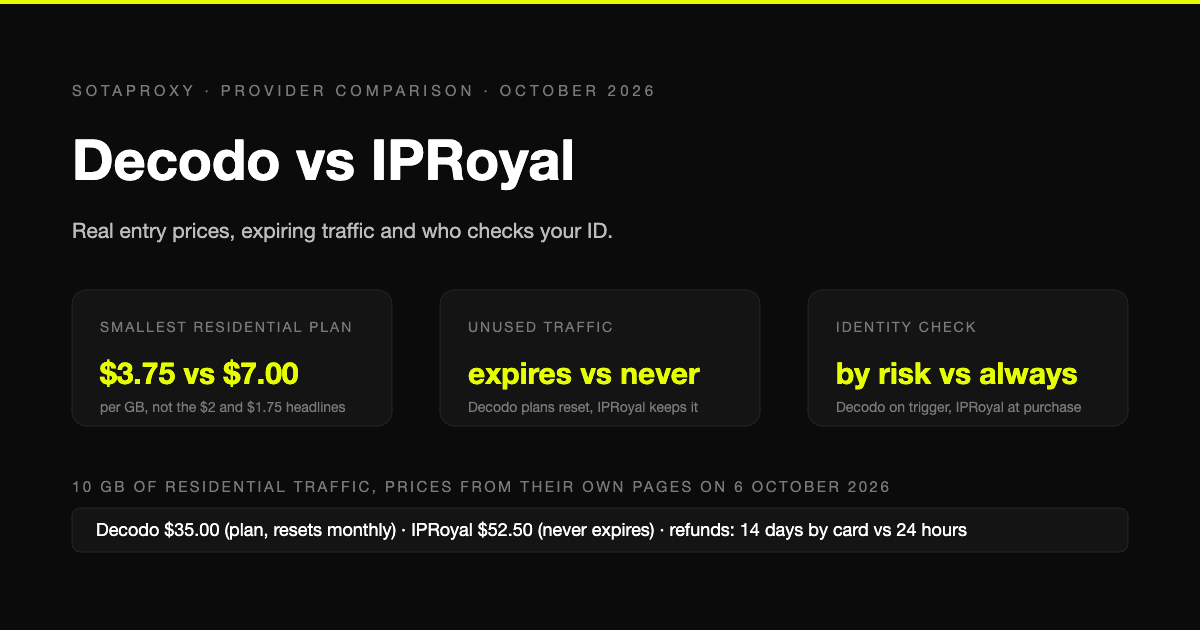
Decodo's "from $2/GB" is the enterprise rate at 1 TB a month. The smallest plan on the pricing page is 3 GB at $3.75 per GB, which is $11.25, and the ladder runs $3.50 at 10 GB, $3.25 at 25 GB, $3.00 at 50 GB and $2.75 at 100 GB. Pay as you go is $4.00 per GB, bought in 1 GB steps from a wallet.
IPRoyal's "from $1.75/GB" is a custom plan from 10 TB. The published ladder is $7.00 per GB for 1 GB, $5.95 for 2 GB and $5.25 for 10 GB on a subscription, or $7.35, $6.25 and $5.51 pay as you go. Nothing between 10 GB and 10 TB is priced on the page.
So at the sizes most people actually buy, Decodo is roughly 35 to 45 percent cheaper per gigabyte: $3.50 against $5.25 at 10 GB, $3.75 against $7.00 at the bottom. That is the opposite of what the two headlines suggest.
Whose traffic expires
This is the quiet difference, and over a few months it can outweigh the price gap.
IPRoyal's residential traffic never expires. Buy 10 GB, use 3 GB this month, and the remaining 7 GB are still there next month and the month after. Their subscription option is the same traffic with a 5 percent discount, and you can cancel it with the unused traffic staying available until used.
Decodo's plans are monthly subscriptions, and unused plan traffic is lost when the plan renews or is downgraded. Upgrading carries it over, and pay as you go traffic is valid for 12 months. So the cheaper per-gigabyte rate is only cheaper if you actually use the gigabytes inside the month.
Run the arithmetic on an uneven workload. A buyer who needs 25 GB in a busy month and 5 GB in a quiet one pays Decodo for a 25 GB plan every month to be safe, $81.25, and throws most of it away in the quiet months. At IPRoyal the same buyer tops up 30 GB once and draws it down over two months. At that point the effective prices are closer than the ladder suggests, and the non-expiring pool is the more forgiving shape for anyone who cannot predict their volume.
The rule: steady volume favours Decodo's plans, lumpy volume favours IPRoyal's non-expiring traffic, and if you are not sure which you are, you are lumpy.
Static addresses: minimums and terms
Both sell ISP proxies, static addresses registered to consumer providers, and the structures differ more than the prices.
Decodo sells dedicated ISP addresses from a minimum of 3, at $3.33 each ($9.99), falling to $2.90 at 10, $2.80 at 20, $2.70 at 50, $2.60 at 100 and $2.50 at 200. Prices are plus VAT, billed monthly, 19 countries. There is a shared pay-per-IP option from $0.27 and a pay-per-GB option from $1.30, both for traffic-heavy rather than account work.
IPRoyal sells dedicated ISP addresses with no stated minimum and by term: from $1.80 per address for 24 hours, $2.70 for 30 days, $2.55 for 60 and $2.40 for 90, across 31+ countries with city-level targeting.
The 24-hour option is the useful one. If you want to test whether a target accepts a particular provider's addresses before buying a month, IPRoyal lets you do that for under two dollars. Decodo's entry is three addresses for a month plus tax.
For 20 addresses for a month the bills are close: $56 plus VAT at Decodo, $54 at IPRoyal. For one address for a day, only one of them sells it.
Who checks your identity
Neither vendor runs the video-call compliance process the enterprise tier does, but they are not the same.
IPRoyal verifies identity at the purchase stage, for all customers. Its KYC policy describes a three-stage process: a risk assessment of your registration data, identity verification at purchase through what it calls independent identity verification and automated detection, and monitoring afterwards. Its own wording is that verification "ensures unrestricted access to all our services and features", which is a polite way of saying that without it you do not get all of them.
Decodo does not require KYC by default. Its stated position is that the procedure can be triggered if an account looks risky or if you want access to restricted targets. Most buyers never see it.
Which one this favours depends on you. If you want to sign up, pay and start in ten minutes, Decodo is the one that lets you. If you are running a legitimate business and do not mind a verification step, IPRoyal's gate is also what keeps its pool cleaner of the people who make residential addresses get blocked.
Refunds, and the crypto catch
Decodo offers a 14-day money-back guarantee on a first purchase, if you bought through the self-service platform, did not use a free trial first, are not on an enterprise plan, and have used no more than 20 percent of the plan's traffic or 1 GB, whichever comes first. One more condition matters here: the payment must not have been made with cryptocurrency. Pay in crypto and the guarantee does not apply.
IPRoyal's default is that fees are non-refundable. The exception is narrow: if proxies are inactive or broken within 24 hours of purchase because of a fault on their side and support cannot fix it in that window, you get a full refund.
So the practical guidance is the reverse of what you might expect. At Decodo, if you want the refund option, pay by card, not crypto. At IPRoyal, there is no 14-day window to protect, so the payment method makes no difference to your exit; the 24-hour ISP term is the real trial.
Both have free trials of some form: Decodo advertises 100 MB for 3 days on residential, IPRoyal has a trial option on its residential page. Both are small enough that the test you run matters more than the allowance, and the checks worth running are in how to test a proxy before you buy it.
Where they genuinely differ
Beyond the four points above, the products are closer than either marketing page admits.
Decodo has the broader catalogue. Residential, ISP, datacenter and mobile, plus a Site Unblocker and a Web Scraping API priced per thousand requests, and targeting down to ZIP code and ASN on residential. It is the one to pick if you expect to grow into a scraping stack rather than just addresses.
IPRoyal is the simpler store. Residential, ISP, datacenter from $1.39 per address and mobile from $117 a month, with the non-expiring traffic model as its main structural idea, plus a web unblocker priced per thousand requests. City and state targeting on residential and ISP.
Both claim 195 or more countries, both support HTTP and SOCKS5, both sell sticky sessions, and both publish uptime and success figures that mean nothing until you have tested on your own targets. Independent benchmarks have generally placed Decodo ahead on residential performance; we have not measured either and are not going to quote numbers we did not produce.
Who should pick which
Decodo if: your monthly volume is steady enough to use a plan inside the month; you want the lowest per-gigabyte rate below 100 GB; you want to start without an identity check; or you expect to need the unblocker and scraping API later.
IPRoyal if: your volume is lumpy and you want traffic that does not expire; you want to test static addresses for a day before committing to a month; you need ISP addresses in a country Decodo does not cover; or you are fine with verification and prefer a vendor that gates its pool.
Neither if:
- You need one or two static addresses for accounts and nothing else. Both are priced and structured for buyers of tens of addresses. The reasoning on which address type an account actually needs is in ISP vs residential vs datacenter.
- You want to pay in crypto and keep a refund option. Decodo removes the guarantee for crypto; IPRoyal has no guarantee to begin with.
- You will not complete an identity check and your targets are the kind that might trigger Decodo's.
- Per-gigabyte cost is the only thing that matters. Then the comparison is really the cheapest residential proxies, where both of these are mid-table.
On the last point, and for transparency: we sell residential traffic from $1.00 per GB at volume with a $2.00 entry package that does not expire while the package is active, and ISP addresses from one address at $3.00 a month falling to $1.90, with crypto as the only payment method and no identity check to buy. That is a different shape of vendor, smaller pool, fewer countries on static, no scraping API, and it suits a different buyer. If the paragraph above describes you, we are one of the options; if you need 195 countries and a ZIP code, you are on the right page comparing these two.
For the rest of the market: the enterprise tier above both is covered in Bright Data vs Oxylabs, and the wider field around Decodo in Decodo alternatives.
How to decide in an afternoon
- Write down last month's gigabytes and the month before. If the two numbers differ by more than half, you are lumpy, and non-expiring traffic is worth a premium.
- Price your real volume on both ladders, not the headline. At 10 GB that is $35 against $52.50; at 3 GB it is $11.25 against roughly $19 for two 1 GB and one 2 GB purchases, or $21 for three.
- If you need static addresses, buy one from IPRoyal for 24 hours and run it against your actual target. It is the cheapest honest test in this market.
- Decide how you will pay before you buy. Card at Decodo keeps the 14-day guarantee; crypto removes it.
- Start the verification at IPRoyal before you need the traffic, so it is not the step that delays you.
FAQ
Is Decodo or IPRoyal cheaper?
Below 100 GB a month, Decodo: $3.75 per GB on the smallest plan and $3.50 at 10 GB, against $7.00 and $5.25 at IPRoyal, on prices from both sites on 6 October 2026. The two headline rates, $2 and $1.75, are 1 TB and 10 TB tiers. Over several months the gap narrows if your usage is uneven, because IPRoyal's traffic never expires and Decodo's plan traffic is lost at renewal.
Does IPRoyal traffic expire?
No. Residential traffic bought from IPRoyal stays on the account until used, including after a subscription is cancelled. Decodo's monthly plan traffic expires when the plan renews or is downgraded; its pay-as-you-go traffic is valid for 12 months.
Does IPRoyal require KYC?
Yes. Its KYC policy describes identity verification at the purchase stage for all customers, with a risk check before and monitoring after. Decodo does not require it by default and says it can be triggered by risk signals or restricted targets.
Can I get a refund from Decodo or IPRoyal?
Decodo: within 14 days of a first purchase, if you used under 20 percent of the traffic or 1 GB, did not use a free trial first, and did not pay in cryptocurrency. IPRoyal: fees are non-refundable, with a 24-hour exception when the proxies do not work because of a fault on their side.
Which is better for ISP proxies?
For a short test, IPRoyal, which sells a single address from $1.80 for 24 hours and covers 31+ countries. For a steady block of addresses the monthly prices are close, $2.80 plus VAT at Decodo against $2.70 at IPRoyal for 20 addresses, and Decodo requires a minimum of three.
Do Decodo and IPRoyal accept crypto?
Both do. Decodo excludes crypto from its pay-per-IP ISP and datacenter checkout and from its money-back guarantee. IPRoyal accepts it alongside cards, PayPal and Alipay, and since it has no general refund policy, the method does not change what you can get back.
Related articles
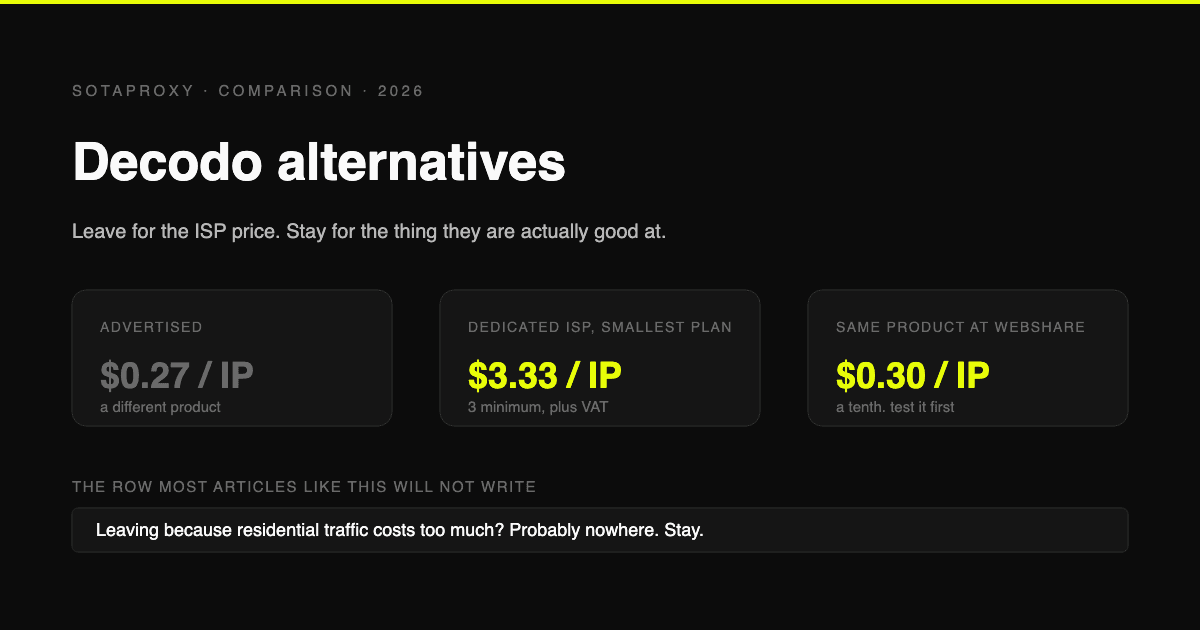
Decodo Alternatives in 2026: Who to Move to, and Who Not to Bother
Decodo is the cost leader on rotating residential and one of the pricier options on dedicated ISP. Verified prices for both, the reasons people actually leave, and which alternative fits each one.
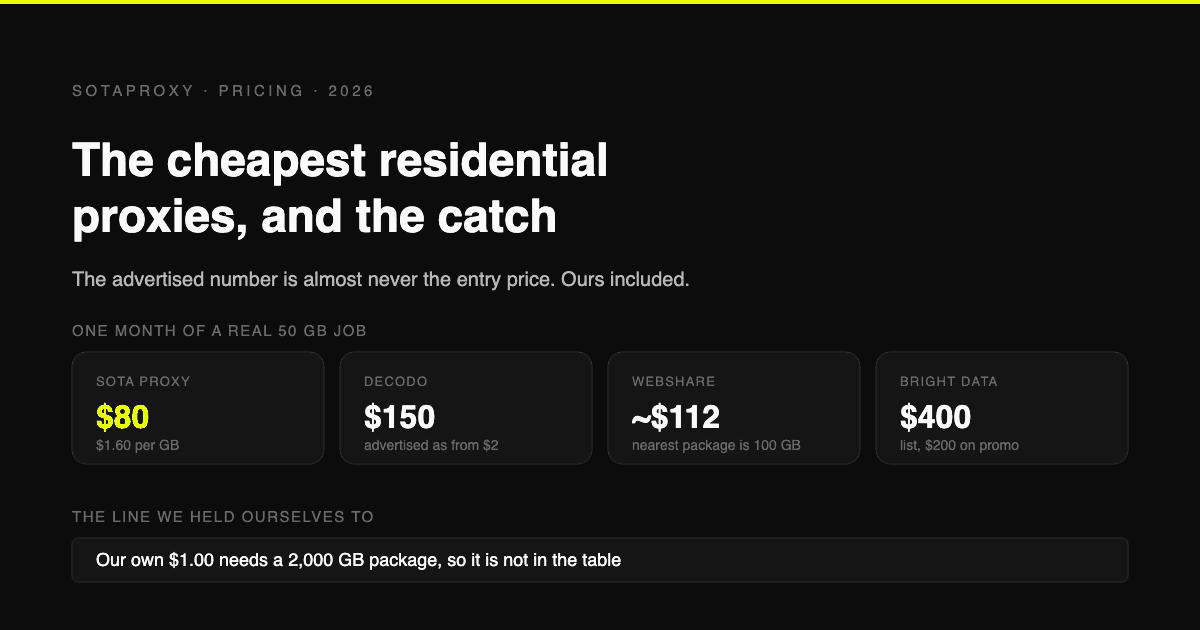
The Cheapest Residential Proxies in 2026, With the Catch Each One Hides
Verified per-gigabyte prices from five vendors' own pages, not from last year's blog posts. Why the advertised number is almost never the entry price, which providers put a monthly floor under your bill, and how to work out your real cost per gigabyte.
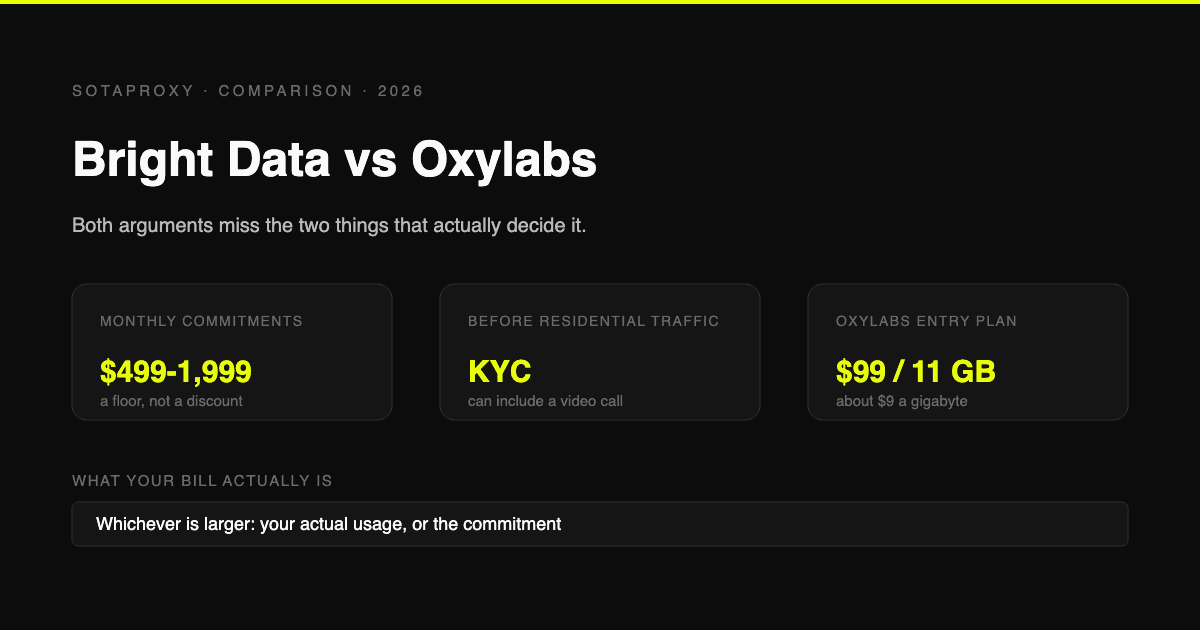
Bright Data vs Oxylabs in 2026: Prices, Commitments and the KYC Nobody Mentions
Both are enterprise platforms with minimum monthly commitments and a compliance check before you can touch residential traffic. Current prices from both vendors' own pages, what the commitment actually costs if you underuse it, and who each one is genuinely for.
Webshare Alternatives in 2026: When the Cheapest Proxies Stop Being Cheap
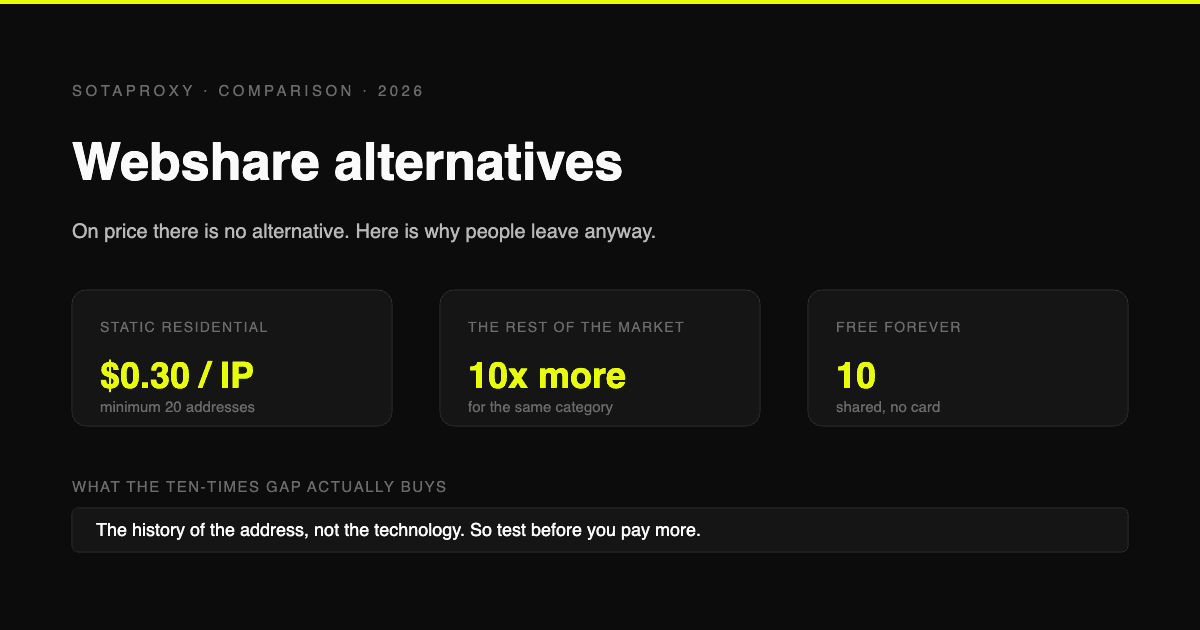
Webshare gives away 10 proxies and sells static residential at $0.30 an IP, a tenth of what most vendors charge. Verified prices, the four reasons people still leave, and the one reason to stay.
ISP vs Residential vs Datacenter vs Mobile Proxies: Which One You Actually Need
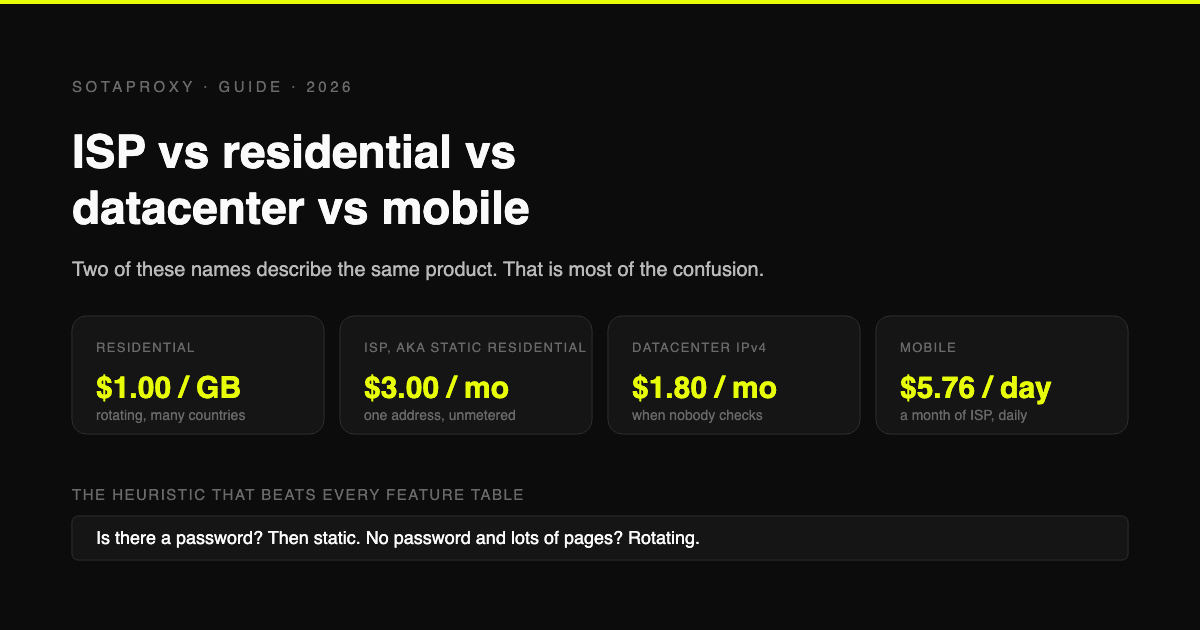
Static residential and ISP are the same product under two names, which is why half these comparisons compare a thing to itself. What each type is, what it costs per unit, and the one task each is genuinely best at.