IPRoyal vs Webshare in 2026: Same List Price, Half the Bill, and Who Checks Your ID
IPRoyal and Webshare print the same $7 per gigabyte on their residential pages and charge very different money for it. Prices from both sites on 20 October 2026, whose traffic expires, static addresses at a tenth of the price, who verifies identity before you can buy, and why crypto is a dead end at both for different reasons.
IPRoyal and Webshare are compared because they occupy the same slot: the vendor you pick after deciding the enterprise platforms are too big and the Telegram shops are too small. Both sell residential, static residential and datacenter from a self-service dashboard, both take cards, both have a free or near-free way to try. The comparisons in search argue about pool size and copy whichever prices were current when they were written.
The numbers below are from each vendor's own pages on 20 October 2026. The first thing they show is that the two residential list prices are identical, $7.00 per gigabyte, and the two bills are not. The rest of the decision lives in four places that are not on a pricing page: whether unused traffic survives, what the smallest static purchase is, who has to prove their identity, and what happens to your money if it goes wrong.
We sell proxies too, and say so at the end rather than pretending to be a neutral reviewer.
The short version
| IPRoyal | Webshare | |
|---|---|---|
| Residential, list | $7.00 per GB at 1 GB, $5.25 at 10 GB; custom from 10 TB at $1.75 | $7.00 per GB list on every plan |
| Residential, what you pay today | The list price; subscription is 5 percent under pay as you go | Promotion: $3.50 at 1 GB, $2.75 at 10 GB, $2.25 at 100 GB, $1.75 at 500 GB, $1.40 at 3 TB |
| Unused residential traffic | Never expires | Monthly plan; the page says nothing about rollover |
| Static residential (ISP) | From $1.80 per address for 24 hours, $2.70 for 30 days, no stated minimum | $0.30 per address, minimum 20, $6 a month, 250 GB included |
| Datacenter | $1.57 per address for 30 days, $1.39 for 90, with 100 GB per address pooled | 100 shared addresses for $2.99 a month with 250 GB; dedicated from $0.825; 10 shared free with 1 GB |
| Pool claimed | 64M+ residential IPs | 80M+ residential IPs, 195 countries |
| Identity check | At purchase, for everyone, by policy | Not for everyone; triggered by payment checks, large volumes to rate-limited sites or the affiliate programme; Stripe Identity |
| Refunds | Fees non-refundable; full refund only if the service is defective in the first 24 hours; never for crypto | Within 48 hours if under 1 GB used on datacenter or static, under 0.1 GB on residential, under 1,000 proxies; credits never refunded |
| Payment | Cards, PayPal, Alipay, crypto | Cards, Google Pay, Apple Pay; no PayPal, no crypto, none planned |
Residential: one list price, two bills
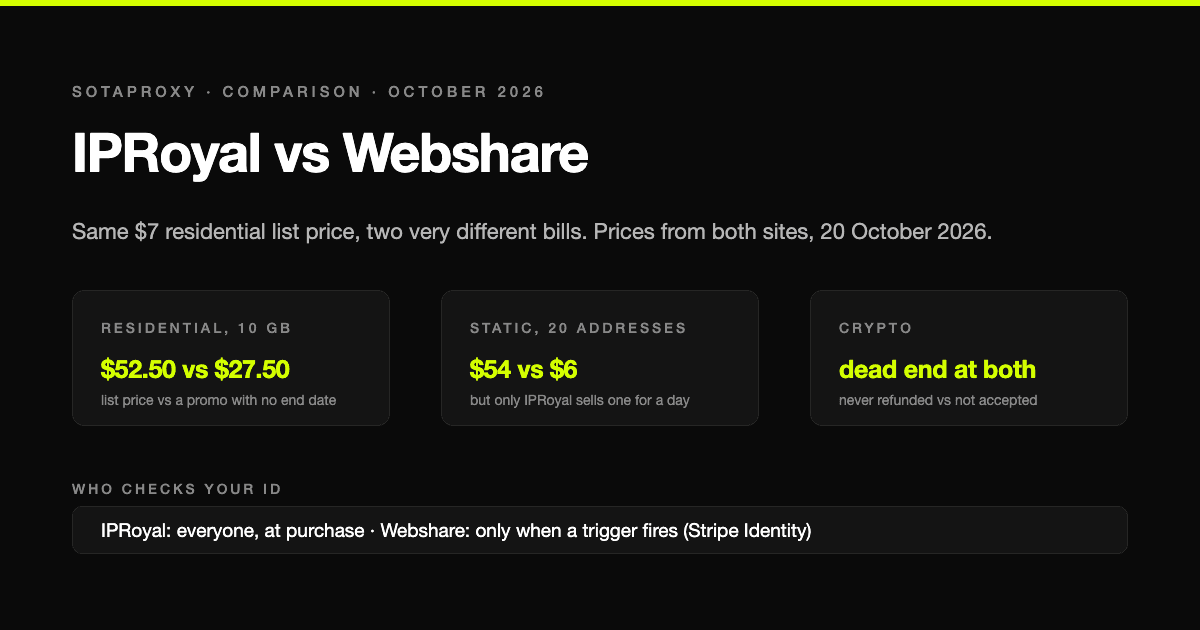
Both vendors show $7.00 per gigabyte as the price of 1 GB of residential traffic. At IPRoyal that is what you pay, $7.00 on a subscription or $7.35 pay as you go, falling to $5.25 at 10 GB. At Webshare it is a crossed-out number: the promotion underneath sells 1 GB for $3.50, 10 GB for $2.75, 100 GB for $2.25 and 3 TB for $1.40.
The promotion has been running since at least September, it carries no end date, and it has changed between our checks: in September the page said "from $2.99", in mid-October $3.50 at 1 GB. So plan on the promo being there and do not plan on the exact figure.
Two consequences follow. For 10 GB a month the bills are $52.50 at IPRoyal and $27.50 at Webshare. And IPRoyal's advertised "from $1.75 per GB", which is a custom plan from 10 TB, is matched by Webshare's public price at 500 GB and undercut at 1 TB. On the per-gigabyte number alone Webshare wins at every size a small buyer will ever reach.
Where IPRoyal takes it back is in what happens to traffic you did not use. IPRoyal's residential traffic never expires. Buy 10 GB, use 3 GB this month and the other 7 GB are still there next year. Webshare sells monthly plans and its residential page does not say what happens to the remainder, which in practice means do not count on it.
That turns the comparison into a question about your usage shape. Steady 10 GB every month: Webshare, at roughly half the price. Ten gigabytes once, then nothing for two months, then four: IPRoyal, because the $52.50 buys 10 GB you will actually consume, and Webshare's $27.50 a month may buy three plans of which you use one.
If the per-gigabyte number at steady volume is the whole decision for you, the field is wider than these two and is laid out in the cheapest residential proxies.
Static addresses: a tenth of the price, with a catch
This is the largest gap on the page. Webshare sells static residential addresses at $0.30 each with a minimum of 20, so the entry is $6 a month for 20 addresses with 250 GB included, dropping to $0.225 at 10,000 addresses. IPRoyal sells them by term with no stated minimum: from $1.80 per address for 24 hours, $2.70 for 30 days, $2.55 for 60 and $2.40 for 90, across 31 or more countries with unlimited sessions.
Twenty addresses for a month is $6 against $54. That is not a rounding difference, and it is the reason Webshare's static plan is the one people quote.
The catch is the minimum. If you need one address, or three, Webshare does not sell that; the smallest order is 20. And if you want to find out whether a target accepts a particular vendor's addresses before committing to a month, only IPRoyal sells a single address for a day, for under two dollars. For a seller account or a handful of logins that need one stable address each, the 24-hour term is the cheapest honest test on either site.
The right order is to run that test before buying either plan, and the checks worth running are in how to test a proxy before you buy.
Datacenter: units again
Webshare's datacenter product is sold by the address with a bandwidth allowance: 10 shared addresses free with 1 GB a month and no card, 100 shared addresses for $2.99 a month with 250 GB, down to $0.0179 per address at 60,000. Dedicated addresses start at $0.825. IPRoyal sells datacenter addresses at $1.57 each for 30 days, $1.48 for 60 and $1.39 for 90, and each address comes with 100 GB a month pooled across the order.
The like-for-like comparison is dedicated against dedicated, and there Webshare is still cheaper, from $0.825 against $1.39 to $1.57. What IPRoyal's price buys is bandwidth: 100 addresses carry 10 TB a month between them, against 250 GB on the Webshare plan before you move to the unlimited option. If the job is bandwidth-heavy, that difference matters more than the per-address price. If the job is many addresses and little traffic, it does not.
Who checks your identity
IPRoyal verifies identity at the purchase stage, for all customers. Its KYC policy describes checks at registration, where "the IP address, email, and other data" are screened, and identity verification at purchase, which it says "ensures unrestricted access to all our services and features". The polite reading is that without it you do not get all of them.
Webshare does not verify everyone. Its help centre says ID verification is not required for all users and is triggered by payment checks, by large volumes of traffic to rate-limited sites, or by joining the affiliate programme, and that it is handled by Stripe Identity.
So the default experience is opposite. At Webshare you sign up, pay by card and are running within minutes, and most buyers never meet the check. At IPRoyal the check is part of buying. Which you prefer is a matter of taste and of what you are doing, but if you choose IPRoyal, start the verification before the day you need the traffic.
Refunds, and why crypto is a dead end at both
The refund terms are the clearest difference on paper.
IPRoyal's terms say fees are "non-cancelable and non-refundable." The one exception is a full refund if the service "is inactive/works with defects during the first 24 hours from the purchase" for reasons on their side. And the same terms add, in their own words, that "payments effected in cryptocurrency shall in no event be eligible for refunds, whether partial or full." Pay in crypto and even the 24-hour exception is gone.
Webshare's help centre says plainly that it does not offer a money-back guarantee, with one narrow window: cancel within 48 hours of payment with under 1 GB used on a datacenter or static plan, under 0.1 GB on residential, and fewer than 1,000 proxies used, and the payment is refunded. Account credits are never refunded.
Then the payment page. IPRoyal lists cards, PayPal, Alipay and crypto. Webshare takes cards, Google Pay and Apple Pay, and its help centre states it does not plan to add PayPal or crypto.
Put together: if you need to pay in crypto, Webshare is not an option, and IPRoyal takes it on the condition that you will never see the money again. If you need a refund window, Webshare's 48 hours is the only one on this page, and it requires almost no usage. The practical rule is the 24-hour static address at IPRoyal or the free 10 addresses at Webshare as the test, and the real purchase only after.
Where they genuinely differ
Strip the prices away and two products are left.
Webshare is the volume store. Static addresses in blocks of 20, datacenter in blocks of 100, residential on a promotional ladder that rewards size, a free tier to try on, cards only, and a refund window measured in hours. It is built for a buyer who knows the volume and wants the lowest number next to it.
IPRoyal is the per-unit store. One static address for a day, residential traffic that never expires, an identity check at the door, crypto accepted without a safety net. It is built for a buyer whose volume is uneven and who would rather pay more per unit than pay for units they do not use.
Neither is better. They are priced for different shapes of demand, and the mistake is buying one for the other's shape: a 20-address block at Webshare for a job that needs three, or 10 GB a month at IPRoyal for a job that burns 10 GB every month without fail.
Who should pick which
Webshare if: your volume is steady and known; you need 20 or more static addresses or 100 or more datacenter addresses; you pay by card; you want the lowest per-unit price and can live with no crypto and a 48-hour refund window.
IPRoyal if: your volume is lumpy and you want traffic that waits for you; you need one or a few static addresses, or a 24-hour test before a month; you pay in crypto and accept that it is final; you do not mind verifying identity before buying.
Neither if:
- You need crypto and a refund. Webshare has no crypto; IPRoyal refunds nothing paid in crypto.
- You need a single static address without an identity check. Webshare's minimum is 20, IPRoyal verifies everyone.
- You need the cheapest steady residential gigabyte full stop. Then look wider than these two, including the vendors in Webshare alternatives.
For transparency, our place in this: we sell residential from $1.00 per GB at volume with a $2.00 entry package, ISP addresses from one address at $3.00 a month, and datacenter addresses from $1.80, crypto only, 34 coins from $1, no identity check to buy. Against Webshare's static block we are not the cheap option and do not claim to be; against IPRoyal we are the single-address shop without the verification step. If one of their plans passes your test, buy it.
The other pairs in this family are Decodo vs IPRoyal and Webshare vs Decodo, and the first-purchase checklist that applies to all of them is in how to buy proxies for the first time.
How to decide in an afternoon
- Write down the shape of your volume, not the size: steady or lumpy, gigabytes or addresses, how many addresses at minimum.
- If it is addresses, buy one from IPRoyal for 24 hours and run it against the real target; if 20 is a number you can use, take Webshare's free 10 datacenter addresses as the test instead.
- If it is gigabytes, check today's Webshare promo price at your size and compare it with IPRoyal's list price at the same size, then ask whether you will use the whole plan this month.
- Decide how you will pay before you decide where. Crypto rules Webshare out and removes IPRoyal's only refund exception.
- If it is IPRoyal, start the identity check today.
FAQ
Is IPRoyal or Webshare cheaper?
Webshare, on every published price at small and medium sizes, on 20 October 2026: residential $3.50 against $7.00 at 1 GB and $2.75 against $5.25 at 10 GB, static addresses $0.30 against $2.70 a month, dedicated datacenter from $0.825 against $1.39 to $1.57. IPRoyal is cheaper only when the shape of your usage wastes Webshare's monthly plans, because IPRoyal's traffic never expires.
Does Webshare residential traffic roll over?
Webshare's residential page describes monthly plans and does not say what happens to unused bandwidth, so do not plan on it carrying over. IPRoyal states that residential traffic never expires.
Does IPRoyal require KYC?
Yes. Its KYC policy describes checks at registration and identity verification at purchase, which it says ensures unrestricted access to all services. Webshare verifies only when a trigger fires, such as a payment check or heavy traffic to rate-limited sites.
Can I get a refund from IPRoyal or Webshare?
IPRoyal: fees are non-refundable, with a full refund only if the service is defective in the first 24 hours for reasons on their side, and never for crypto payments. Webshare: a refund within 48 hours if usage is under 1 GB on datacenter or static, under 0.1 GB on residential, and under 1,000 proxies; account credits are never refunded.
Do IPRoyal and Webshare accept crypto?
IPRoyal accepts it, and its terms exclude crypto payments from any refund. Webshare does not accept it and its help centre says it has no plans to.
Which is better for a single static address?
IPRoyal, because Webshare's minimum order is 20 addresses. IPRoyal sells one from $1.80 for 24 hours or $2.70 for 30 days.
Related articles
Decodo vs IPRoyal in 2026: Real Entry Prices, Expiring Traffic and Who Checks Your ID
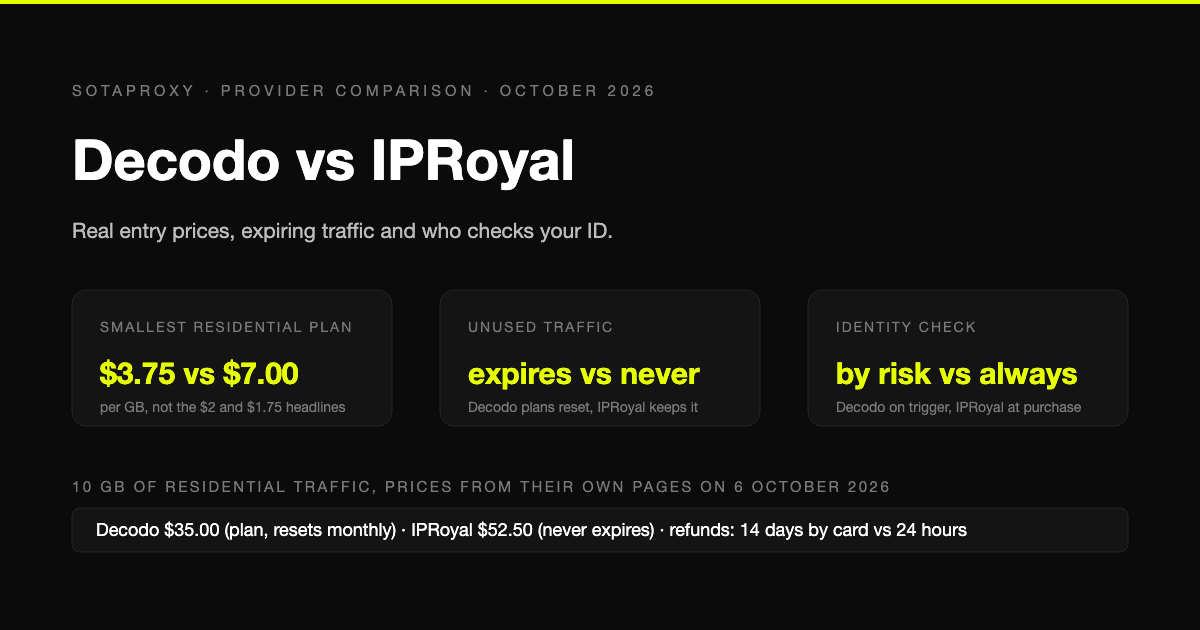
Both are mid-market proxy vendors that take cards and crypto and sell by the gigabyte. The prices on their own pages on 6 October 2026, why neither headline rate is an entry price, whose traffic expires, who checks your identity before you can buy, and who gives money back.
Webshare vs Decodo in 2026: Datacenter Value, a $7 Residential List Price, and Cards Only
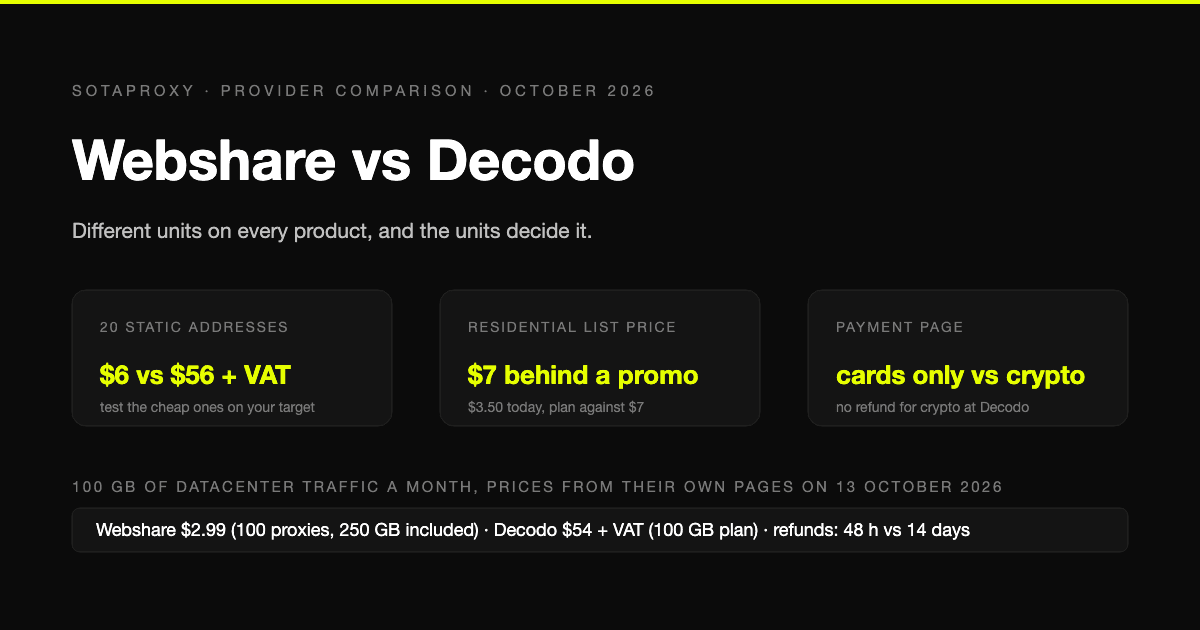
Webshare and Decodo sell the same three products in different units, and the units decide the comparison. Datacenter by the address against by the gigabyte, static addresses at $0.30 against $3.33, a residential list price of $7 that nobody pays, and a payment page with no crypto on one side and no refund for crypto on the other.
The Cheapest Residential Proxies in 2026, With the Catch Each One Hides
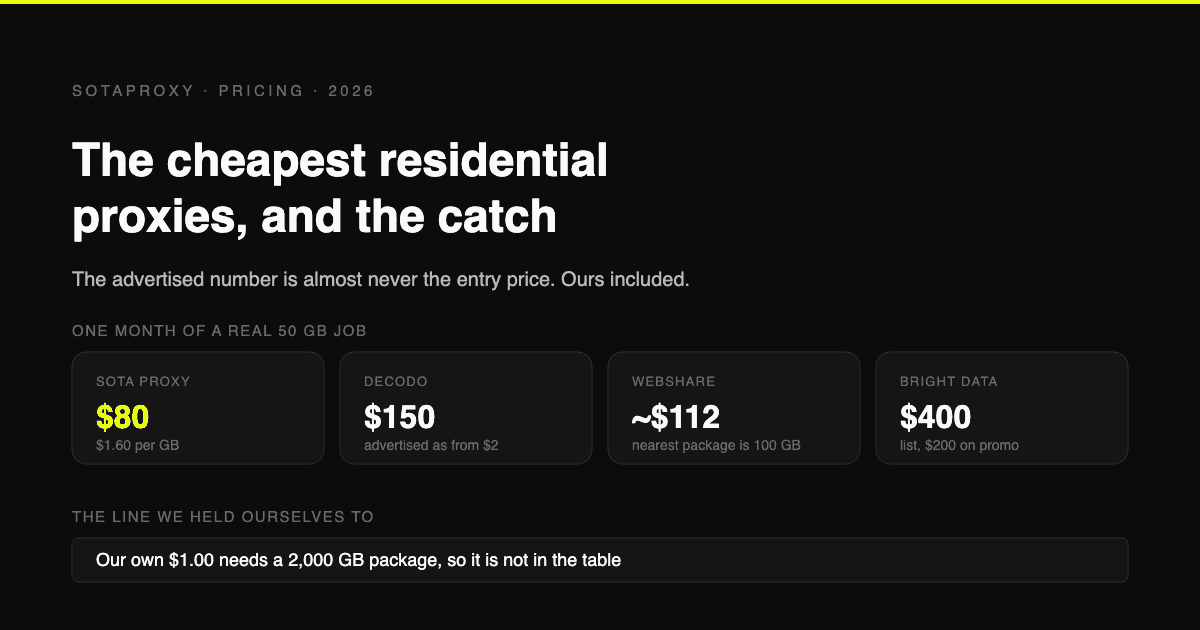
Verified per-gigabyte prices from five vendors' own pages, not from last year's blog posts. Why the advertised number is almost never the entry price, which providers put a monthly floor under your bill, and how to work out your real cost per gigabyte.
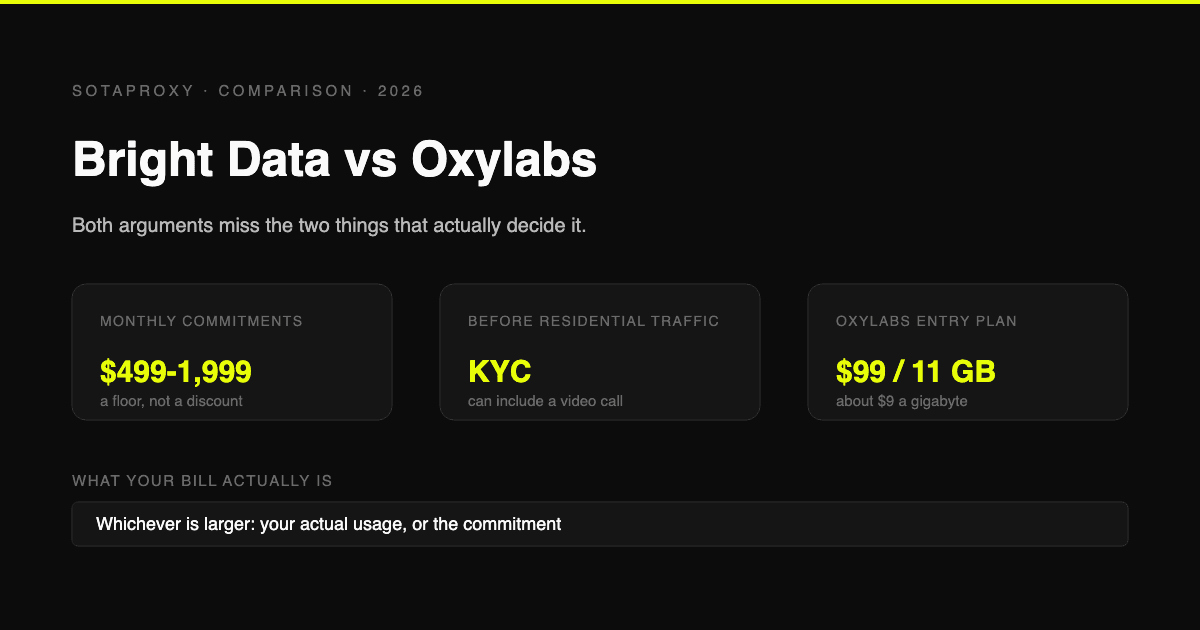
Bright Data vs Oxylabs in 2026: Prices, Commitments and the KYC Nobody Mentions
Both are enterprise platforms with minimum monthly commitments and a compliance check before you can touch residential traffic. Current prices from both vendors' own pages, what the commitment actually costs if you underuse it, and who each one is genuinely for.
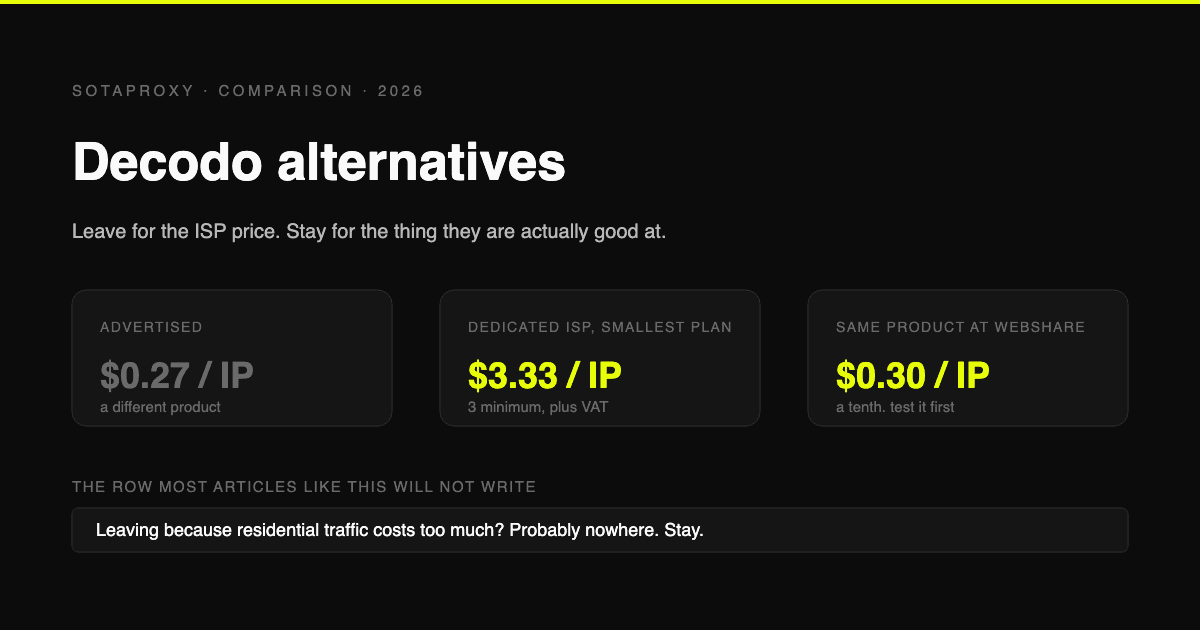
Decodo Alternatives in 2026: Who to Move to, and Who Not to Bother
Decodo is the cost leader on rotating residential and one of the pricier options on dedicated ISP. Verified prices for both, the reasons people actually leave, and which alternative fits each one.
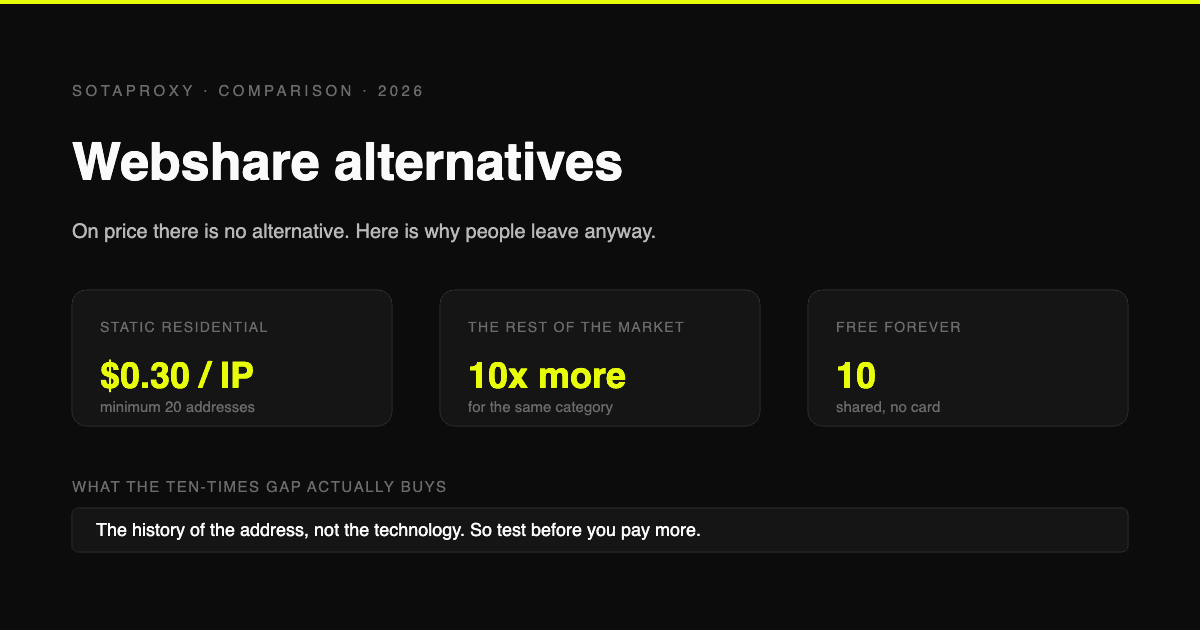
Webshare Alternatives in 2026: When the Cheapest Proxies Stop Being Cheap
Webshare gives away 10 proxies and sells static residential at $0.30 an IP, a tenth of what most vendors charge. Verified prices, the four reasons people still leave, and the one reason to stay.