Google Maps Lead Scraping: What It Actually Costs Per Usable Lead
Google Maps has no email field, so every email scraper is a two-stage pipeline and only about half of businesses yield an address. What a thousand listings really costs per usable lead, the businesses-without-websites play, and where the law stands after the SerpApi ruling.
Google Maps is the most complete business directory ever assembled, it is free to look at, and the tooling to extract it costs a few dollars. That combination is why "Google Maps lead scraper" is a permanent search, and why the market is full of actors advertising results at a third of a cent each.
Those prices are real. They are also not the price of a lead, and the gap is roughly a factor of two. Here is the arithmetic nobody publishes, followed by the two things that actually decide whether this is a business or a hobby.
The thing to understand first: Maps has no email field
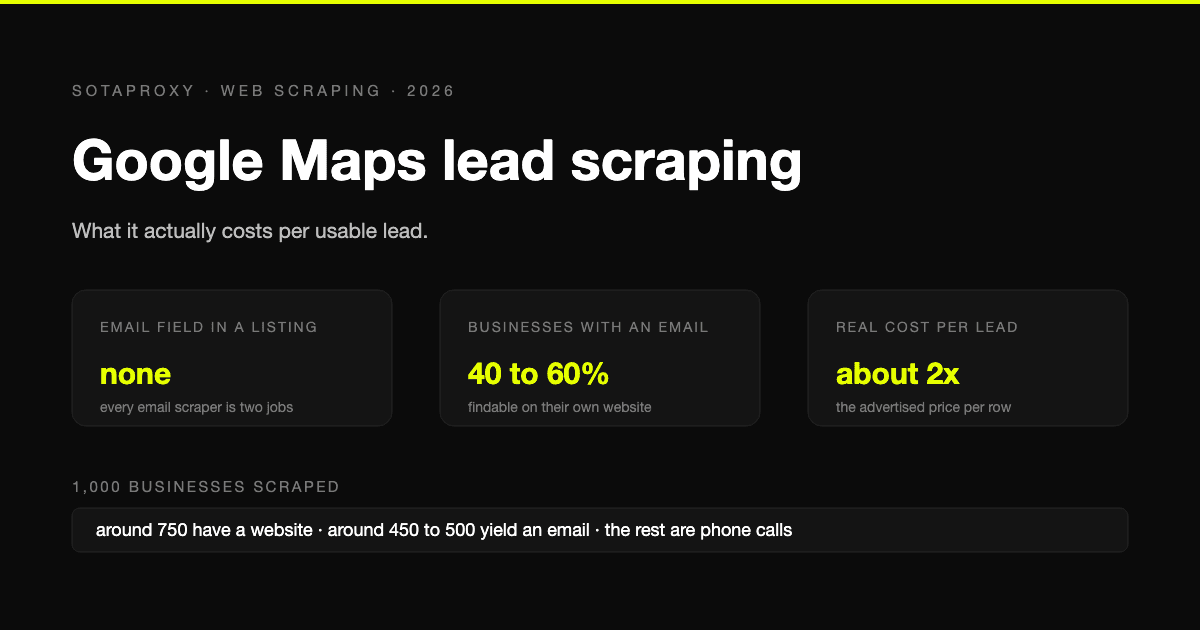
A Google Maps listing contains the business name, address, phone number, website URL, category, rating, review count and opening hours. It does not contain an email address. There is no hidden field and no API parameter that returns one.
So every product sold as a "Google Maps email scraper" is doing two jobs:
- Scrape Maps for the listing data, including the website URL.
- Visit each business website and extract an email from it, usually from a contact page, a footer, or a mailto link.
That second stage is the entire difficulty. It is more requests than stage one, against a thousand different sites rather than one, with wildly varying page structures and a real failure rate. It is also where your traffic bill lives.
And it only works about half the time. Across the tools that publish a rate, somewhere between 40% and 60% of local businesses have an email findable on their website. The rest either have no site, hide contact behind a form, or use an image or an obfuscated address.
What a thousand businesses actually costs you
Take the common advertised rate of roughly $0.003 per business and run it honestly.
| Line | Amount |
|---|---|
| Businesses scraped | 1,000 |
| Advertised cost at $0.003 each | $3 |
| Businesses with a website | around 750 |
| Emails actually found, at ~50% of all businesses | around 450 to 500 |
| Real cost per usable lead | about $0.006 to $0.007 |
Still cheap. But notice what changed: the advertised number describes rows returned, and your pipeline produces leads. Every plan built on "a third of a cent per lead" is out by around half before anything else goes wrong.
Two more costs that do not appear on anyone's rate card:
- Traffic for stage two. Fetching 750 business websites is not free if you run it through residential addresses, and page weight varies enormously. Per-gigabyte economics are in the cheapest residential proxies, and the honest answer for this job is usually that you do not need residential at all, which is the next section.
- Verification. A scraped email is unverified by definition. Sending to an unverified list damages your sending domain, so either you pay for verification or you pay in deliverability.
Which proxies this job actually needs
The default assumption is residential, and for most of this work that is overpaying.
- Stage two, fetching business websites, is the bulk of the requests, and those sites are small-business WordPress installs that do not check address class. Datacenter addresses do this job at a fraction of the price.
- Stage one, Maps itself, is the part that is defended. This is where the address class starts to matter and where rate limiting shows up first.
That split is the single biggest cost lever in the whole pipeline, and the reasoning behind it is in ISP vs residential vs datacenter. Check whatever you buy before you scale it, per how to test a proxy before you buy it.
The businesses-without-websites play
This is the part worth reading if you are looking for an angle rather than a tool.
When a Maps listing has no website URL, most scrapers treat it as a low-value row. It is the opposite. A business with no website, with a real address, real reviews and a phone number, is a qualified lead for anyone selling websites, hosting, SEO or online ordering. The absence of the field is the qualification.
The same logic extends:
- No website, but many reviews means an established business that has been ignoring the internet successfully. Easier to reach, harder to convince.
- A Facebook page in the website field means they tried, and they know they need something.
- A website that fails to load is an even warmer lead than no website.
- Low rating with many reviews is a reputation-management lead.
- No opening hours and no photos is an unclaimed or neglected listing, which is a lead for listing management itself.
None of that requires an email. These are phone calls and physical addresses, which is why this angle sidesteps the entire 50% email problem that makes the generic play thin.
Is scraping Google Maps legal?
The short version: public business data, collected without logging in, is not the part that gets people sued. The method is.
What the landscape actually looks like:
- Public data and the CFAA. In hiQ Labs v. LinkedIn, US courts held that scraping publicly available data does not violate the Computer Fraud and Abuse Act, even where it breaches a site's terms. That is about criminal and quasi-criminal liability, not about permission.
- Google's terms. They prohibit automated extraction. Breaching them is a contract matter: Google can ban accounts, block addresses and pursue civil claims. Logged-out access to public listing pages sits differently from API use, because API terms bind API customers and a logged-out visitor is not one.
- The case that tried a new theory, and lost the first round. On 19 December 2025 Google sued SerpApi in the Northern District of California. Notably, it pleaded the DMCA's anti-circumvention provisions, alleging SerpApi defeated Google's anti-bot system, which Google calls SearchGuard, rather than pleading the CFAA or breach of contract. On 20 July 2026 the court granted SerpApi's motion to dismiss. The part of the claim that rested on search results with no copyrighted content was dismissed for good, on the reasoning that the DMCA protects locks on copyrighted works and does not reach material that is not copyrighted. A narrower part, about licensed images in Knowledge Panels, was dismissed with leave to amend. Google filed an amended complaint on 10 August 2026 built around its content licences, SerpApi moved to dismiss again on 25 August, and that motion is pending.
That last point is the one to take away. Google tried to move the argument from "you read data you were not allowed to read" to "you defeated the lock", and the first ruling says the lock theory only works where the thing behind the lock is copyrighted. A business name, an address and a phone number are facts, and facts are not. Photos and the text of reviews are a different matter.
Two cautions before reading too much into it. It is one district court ruling at the pleading stage, in a case that is still being litigated, mostly about Google Search: by SerpApi's account, the Maps and Shopping theories of the original complaint were dropped from the amended one rather than decided. And none of it touches Google's terms, which still let it ban accounts and block addresses whatever a court says about the DMCA.
On personal data, the distinction that matters under GDPR and similar regimes is business facts versus people. A company name, address and switchboard number are business data. A sole trader's name, a reviewer's name and user-uploaded photos are personal data even when publicly visible, and scraping them carries obligations that scraping a phone number does not.
None of this is legal advice, the rules differ by country, and a lawyer reading your specific plan costs less than a mistake at scale.
Can you sell scraped data?
A recurring search, and the honest answer has three parts.
Selling raw scraped lists is the weakest version of this business. It has no moat, the buyer can run the same tool, and you inherit every compliance question about the data while capturing the least value.
Selling the outcome is the strong version. The same pipeline, pointed at a niche you understand, sold as appointments, qualified conversations or a managed campaign. The data becomes an input cost rather than the product.
Selling to the businesses in the list is the strongest version, and it is the businesses-without-websites play above: you are not selling data at all, you are using it to find customers for something you already do.
The broader menu of ways to turn scraping into revenue, with the numbers, is in how to make money with web scraping.
What the tooling actually looks like
Three tiers, and the right one depends on volume rather than skill.
- Browser extensions. Free or nearly free, fine for tens of results, capped by what one browser session can do. Good for testing whether a niche is worth pursuing at all.
- Hosted actors and services. Priced per result in the range this article opened with, no infrastructure, and the fastest route from idea to list. You pay per row forever.
- Open-source scrapers you run yourself. Free software, and your costs become proxies, servers and your own time. Worth it at sustained volume, wasteful below it.
The honest decision rule: do not build infrastructure until a hosted tool has already made you money on the same niche. Most people who buy proxies for this job before validating the niche end up paying for addresses to fetch a list they never call.
FAQ
Can you scrape Google Maps?
Technically, yes, and it is done at scale every day. Google's terms prohibit automated extraction, which makes it a contract matter rather than a criminal one under current US precedent for public data. The practical risks are account bans and address blocks. Google's attempt to sue a scraper under the DMCA for defeating its anti-bot system was dismissed in July 2026 and is being re-pleaded on narrower grounds.
Does Google Maps have email addresses?
No. A listing carries name, address, phone, website, category, rating, reviews and hours, but no email field. Every tool advertising emails is visiting the business website afterwards to find one, which succeeds for roughly 40% to 60% of local businesses.
How much does Google Maps lead scraping cost?
Advertised rates run around $0.001 to $0.004 per business. Per usable lead with an email, expect roughly double that, because only about half of businesses yield an address. Add traffic for the website-fetching stage and email verification, neither of which appears on the rate card.
How do I find businesses without websites?
Scrape a category and filter for listings where the website field is empty. Those rows are not waste: for anyone selling websites, hosting or SEO, an established business with reviews and no site is the most qualified lead in the dataset, and it needs a phone call rather than an email.
Is it legal to sell scraped data?
It depends far more on what the data contains than on how you got it. Business facts sit differently from personal data: a sole trader's name or a reviewer's name is personal data under GDPR even when public. Selling raw lists also concentrates the compliance burden on you while capturing the least value, which is why selling the outcome usually beats selling the list.
What proxies do I need for Google Maps scraping?
Split the job. Fetching business websites is most of the volume and those sites rarely check address class, so datacenter addresses are enough. Maps itself is the defended half and is where address quality starts to matter. Paying residential rates for the whole pipeline is the most common way to overspend here.
Related articles
How to Test a Proxy Before You Buy It: A 10-Minute Checklist
Ten checks that tell you whether a proxy trial is worth paying for: exit ASN, hosting flags, rotation behaviour, subnet spread, DNS and WebRTC leaks, and success rate on your own target.

How to Make Money With Web Scraping in 2026: Five Models, Priced
Five ways scrapers get paid, what each one charges, and what a scrape actually costs to run, measured on real pages: HTML-only against a full browser render.
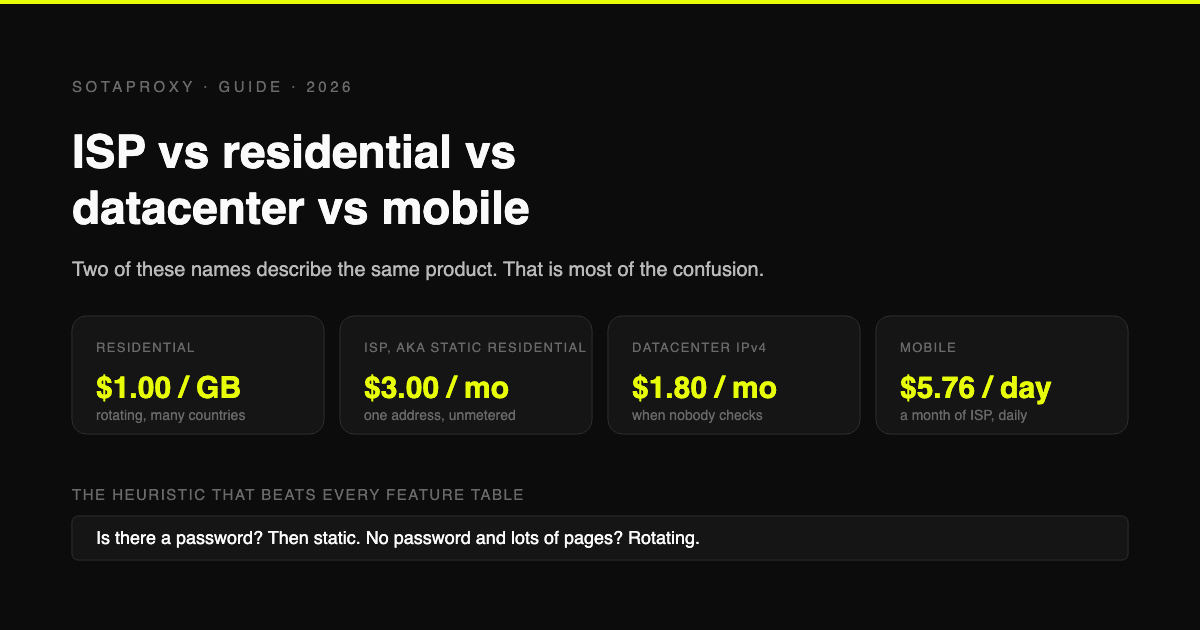
ISP vs Residential vs Datacenter vs Mobile Proxies: Which One You Actually Need
Static residential and ISP are the same product under two names, which is why half these comparisons compare a thing to itself. What each type is, what it costs per unit, and the one task each is genuinely best at.
Reddit "You've Been Blocked by Network Security": Every Cause, and the Fix for Each
It is not a ban and there is nothing to appeal. It comes from Reddit's edge, applies to your connection, and has six causes. Here is how to tell which one you have, and how long each lasts.

10 Smartproxy Alternatives for Technical Teams
Compare 10 smartproxy alternatives by proxy type, IP quality, targeting, rotation, speed, pricing, and use case for technical teams.
10 IPRoyal Alternatives for Serious Proxy Workloads
Compare 10 IPRoyal alternatives for scraping, ad verification, account farming, antidetect browsers, geo campaigns, pricing, rotation, and support.