10 IPRoyal Alternatives for Serious Proxy Workloads
Compare 10 IPRoyal alternatives for scraping, ad verification, account farming, antidetect browsers, geo campaigns, pricing, rotation, and support.
The cheapest residential proxy isn't automatically the best IPRoyal replacement. A low per-GB rate can become expensive when retries, unstable sessions, poor geo accuracy, and blocked Facebook or TikTok accounts consume the budget. The right choice starts with the workflow, not the headline price.
Residential proxies use real home connections and usually provide stronger trust signals than datacenter IPs. Mobile proxies route through carrier networks and SIM-backed devices, which gives them a different profile for sensitive social workflows. Datacenter proxies are faster and usually cheaper, while ISP proxies offer a useful balance between persistence, speed, and reliability. IPv6 datacenter proxies can reduce costs further, but they only work consistently where the target supports IPv6.
This roundup ranks IPRoyal alternatives by operational fit, not pool size alone. The focus is practical: scraping, ad verification, Facebook and TikTok ad accounts, account farming, cloaking, geo-targeted campaigns, sneaker bots, and antidetect browsers such as AdsPower, Dolphin Anty, GoLogin, Multilogin, and Hidemyacc. If your team also needs an endpoint for Instagram data enrichment, the same questions apply: session continuity, location precision, rotation behavior, and the cost of successful requests.
Table of Contents
- 1. Sota Proxy
- 2. Bright Data
- 3. Oxylabs
- 4. Decodo
- 5. SOAX
- 6. Zyte API
- 7. Rayobyte
- 8. Webshare
- 9. Proxyrack
- 10. PacketStream
- Top 10 iProyal Alternatives Comparison
- Make the Switch Without Breaking Your Workflow
1. Sota Proxy
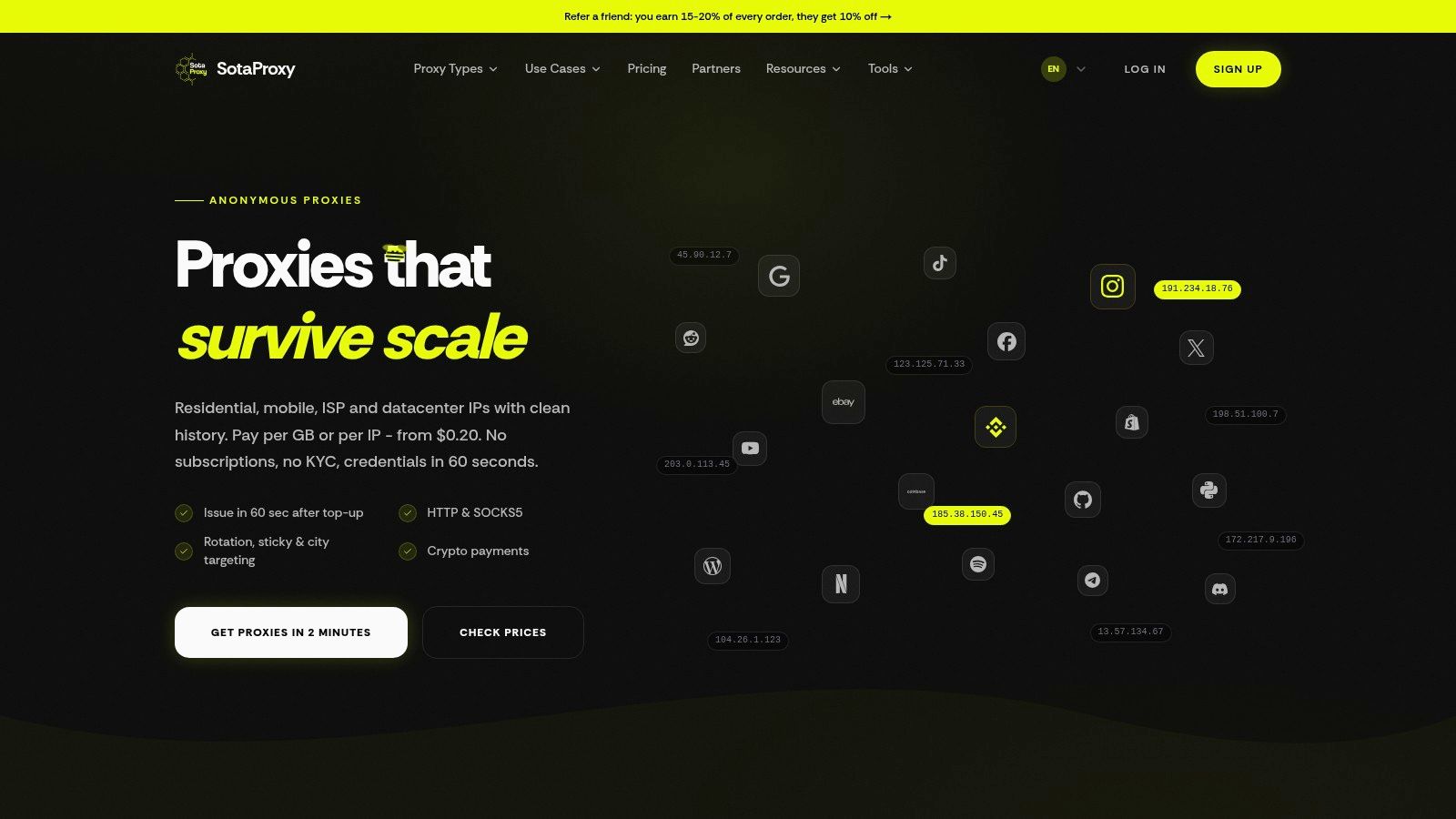
Sota Proxy ranks first for teams that want one operational layer across residential, mobile, ISP, and datacenter traffic. It supports these proxy types across 220+ geolocations, with city targeting, rotating access, sticky sessions, and HTTP/SOCKS5 support. That combination fits traffic arbitrage teams that need one provider for ad verification, geo-targeted campaigns, web scraping, and social account operations.
The practical advantage is control. A media buyer can use residential IPs for Facebook and TikTok account checks, mobile IPs for higher-friction social workflows, ISP proxies for longer sessions, and datacenter or IPv6 access for fast parsing and monitoring. The same dashboard handles credentials, usage, balance control, rotation, and top-ups. Sota Proxy advertises a 99.9% uptime SLA on its platform, which is relevant when a failed endpoint interrupts an active campaign or breaks a long-running scraper. Sota Proxy's platform also supports crypto payments and pay-as-you-go billing.
Why it fits demanding automation
Sota Proxy's AI-powered pool manager removes flagged addresses and chooses routes based on latency. That can reduce manual pool maintenance, although every serious team should still test its own targets before moving production traffic. Fast provisioning also helps during a migration. You can create credentials, select a proxy type and location, configure rotation or sticky sessions, and connect an antidetect browser without waiting for a lengthy infrastructure rollout.
The fit is strongest for teams running multiple workflows at once:
- Antidetect browsers: AdsPower, Dolphin Anty, GoLogin, Multilogin, and Hidemyacc can use dedicated or rotating endpoints according to profile requirements.
- Social operations: Residential and mobile access are better starting points than datacenter traffic for Facebook and TikTok account workflows.
- Traffic arbitrage: City-level targeting supports regional ad verification, cloaking tests, and localized landing-page checks.
- High-throughput work: Datacenter, IPv6, and dedicated IP options suit parsing, SEO monitoring, price tracking, and sneaker bot testing where speed matters.
Practical rule: Keep account identity traffic separate from bulk scraping traffic. A stable sticky ISP or residential session and a fast datacenter parser solve different problems.
The trade-off is cost at scale. Residential and mobile traffic can become expensive for large workloads unless you secure volume discounts or use an unlimited-bandwidth plan. Regional latency and availability can also vary, so test the exact countries, cities, and targets before migrating every profile. Sota Proxy advertises volume discounts of up to 25% and offers 24/7/365 human support, which can reduce troubleshooting time during rollout. Its referral and affiliate program offers up to 40% commission, a relevant factor for agencies and resellers managing proxy budgets across client accounts.
2. Bright Data
A traffic-arbitrage team checking Facebook and TikTok campaigns across cities may need more than proxy endpoints. Bright Data combines residential, ISP, mobile, and datacenter access with country and city targeting, dashboards, APIs, compliance tooling, and managed scraping products. That setup suits teams handling ad verification, brand monitoring, and difficult targets without maintaining every retry rule internally.
Its operational advantage is the ability to keep several workflows under one account. Engineers can use raw endpoints for browser profiles in AdsPower, GoLogin, or Multilogin, while data teams run structured collection for price monitoring and SEO checks. The same vendor can support localized campaign validation and larger scraping jobs, although configuration takes more planning than a lightweight proxy service.
Bright Data offers pay-as-you-go and subscription models. Small teams should calculate bandwidth, session requirements, and tooling costs before committing. Enterprise controls may justify the higher operating cost when failed requests create manual review or delayed campaign decisions. For account farming, a few stable dedicated or rotating endpoints may be more economical with a simpler provider, especially in Hidemyacc or similar antidetect setups.
Where Bright Data works best
Use Bright Data when you need:
- Hard-target scraping: Managed access products reduce the custom proxy logic engineers must maintain.
- Broad geo verification: Country and city controls support regional ad checks, cloaking tests, and localized campaign validation.
- Governance: Compliance documentation and enterprise controls give security teams material for vendor review.
- Data products: Scraper IDE and APIs fit repeatable collection better than manually operated browser sessions.
IP cleanliness and rotation still require target-specific testing. A rotating residential pool may suit broad verification, while persistent ISP or datacenter access can fit dedicated account sessions. Mobile availability may depend on customer status and current policy, so confirm access before building a Facebook or TikTok workflow around it.
Bright Data is less attractive for low-volume account farming, where migration effort and subscription complexity can outweigh its managed tooling. Teams comparing operating models can review this Bright Data alternatives guide.
3. Oxylabs
Oxylabs is built for enterprise teams that need stable proxy infrastructure and managed data-collection products. It provides residential, mobile, ISP, and datacenter proxies with rotating and sticky sessions, plus Web Unblocker, APIs, documentation, and support. The platform lists 175M+ residential IPs across 195+ countries, with city, ZIP, and ASN targeting available on supported products. That breadth makes it a strong choice for localized ad verification, SEO monitoring, price tracking, and large-scale scraping. Oxylabs' product information provides the current details for each proxy type and targeting option.
The main advantage is predictable enterprise operation. Teams can assign rotating residential access to broad collection, sticky sessions to account-level workflows, and ISP or dedicated datacenter access to persistent automation. That separation works well when one organization runs both data extraction and multi-account operations, but the product catalog requires careful configuration.
Best fit and trade-offs
Oxylabs suits organizations that value stability, documentation, and support over the lowest entry cost. Its higher-tier targeting features can help when city or ASN precision affects the result, especially for ad verification and local search monitoring. The same capability can be excessive for a small account-farming team that only needs a few country-specific sessions in Multilogin or Hidemyacc.
For Facebook and TikTok ad accounts, start with residential or mobile traffic and keep session rules conservative. Datacenter IPs remain useful for fast auxiliary tasks, but they're easier for platforms to classify as infrastructure traffic. For scraping, Oxylabs' managed products can reduce engineering work, while raw proxies give experienced teams more control over headers, concurrency, retries, and browser fingerprints.
Entry costs are higher than many mid-market providers, and some advanced targeting features sit behind higher-tier plans. Run a target-specific pilot and compare cost per successful response, not just bandwidth consumption. A team considering a more flexible alternative can also examine this Oxylabs alternatives comparison.
4. Decodo
Decodo, formerly Smartproxy, occupies the practical middle ground. It offers residential and static ISP proxies, targeting by country, city, ZIP, and ASN, plus a proxy generator, browser extensions, a proxy checker, and scraping tools. The platform lists 115M to 125M+ residential IPs, depending on the product presentation, which gives growing teams enough breadth for testing without forcing an enterprise-style deployment.
Its dashboard is a good match for operators who need to move quickly. A team can generate endpoints, test rotation, and connect profiles in AdsPower, Dolphin Anty, GoLogin, Multilogin, or Hidemyacc without building a custom management layer. Static ISP access is useful for account sessions that need continuity, while rotating residential traffic fits scraping, ad verification, and geo-targeted campaign checks.
What works and what doesn't
Decodo works well for small and medium-sized traffic arbitrage teams that need a balance of usability, targeting, and price. It can support separate proxy groups for Facebook and TikTok accounts, landing-page checks, and automated collection. Its tooling also reduces setup time for teams that don't want to manage raw endpoints through scripts alone.
The weakness is product complexity. Pricing menus differ across proxy types and plans, so compare the actual billing unit, session behavior, and included controls. Quality can also vary by target. A proxy that performs well for SEO monitoring may not provide the same account stability on a protected social platform.
Use a small endpoint sample before moving account groups. Measure successful logins, session persistence, page load behavior, and replacement speed. This Smartproxy comparison is useful when deciding whether Decodo's mid-market tooling outweighs the migration effort from IPRoyal.
5. SOAX
SOAX is a strong option for teams that treat sourcing and compliance as operational requirements rather than sales copy. Its network includes residential, mobile, ISP, and datacenter proxies, with city-level targeting, rotation, and sticky sessions. The provider emphasizes GDPR and CCPA compliance, ethical sourcing, self-serve trials, and startup discounts.
That positioning matters for agencies managing Facebook and TikTok advertising work for clients. A documented sourcing process can simplify vendor review, especially when the team uses residential or mobile IPs for ad verification, regional landing-page checks, and account management. It also fits market research and price monitoring where precise location matters more than raw throughput.
When SOAX is the right choice
SOAX works best when your target list is geographically specific and you need a cleaner procurement story. City-level selection can improve local ad checks and regional SEO monitoring. Sticky sessions help with longer browser tasks, while rotation supports broader scraping and verification jobs.
The trade-off is economics at small volumes. Entry bundles can cost more per GB than mid-market competitors, and niche locations may require a conversation with sales to achieve the best routing. That makes SOAX less compelling for cheap bulk parsing or broad sneaker bot experimentation. It's better suited to deliberate, location-sensitive workflows.
For antidetect browsers, assign each profile group a tested location and session policy. Don't assume a city label guarantees the same performance across every target. Test Facebook, TikTok, and the exact e-commerce endpoints separately, then keep the provider for the workflows where its sourcing and geo controls produce a measurable operational advantage.
6. Zyte API
Zyte API takes a different approach from most IPRoyal alternatives. Instead of asking your team to select and maintain a proxy fleet, it automatically chooses proxy types and rendering options for a target. The service charges per successful response, which changes the main optimization question from bandwidth cost to solved-request cost.
That model is attractive for scraping teams that care about delivered pages rather than endpoint ownership. Zyte API can select datacenter or residential access and invoke headless browser rendering when a target requires it. Spending limits, tiered plans, and volume discounts make budgeting easier for teams with stable request patterns. Zyte's API documentation outlines the managed approach and integration options.
Less proxy control, less maintenance
The benefit is reduced operational overhead. Engineers don't need to build every rotation rule, retry path, or rendering fallback. That works well for product catalogs, price monitoring, SEO data, and structured collection where the output matters more than the specific IP.
The limitation is control. You won't manage the underlying IP mix with the same precision, and the per-request model can cost more on easy, high-volume targets. Zyte API also isn't the natural choice for Facebook or TikTok account operations, account farming, cloaking checks, or antidetect browser profiles. Those workflows usually require explicit session ownership, dedicated endpoints, and a predictable identity layer.
Use Zyte API when your team wants a managed scraping outcome. Use raw residential, mobile, ISP, datacenter, or IPv6 proxies when you need to tune browser profiles, session persistence, geo identity, or concurrency yourself. Teams integrating a managed API into an existing stack can follow this proxy API integration guide.
7. Rayobyte
Rayobyte is a practical choice for teams that want transparent, volume-based pricing and a strong emphasis on ethical sourcing. It offers residential traffic, static ISP proxies, rotating access, city, state, and country targeting, plus non-expiring bandwidth options and a Web Unblocker or scraping API.
The provider's position in the market is changing. Its datacenter share fell from 85% of revenue in 2023 to 42.4% in 2025, while residential proxies rose to 35%, according to Proxyway's 2026 market research. That shift reflects a broader buyer preference for harder-to-classify IP types in anti-bot and geo-targeted work.
Where Rayobyte earns its place
Rayobyte makes sense for teams that can forecast usage but don't want bandwidth to expire. Non-expiring options help agencies with uneven campaign schedules, seasonal product monitoring, and intermittent ad verification. Static ISP access can support persistent sessions in GoLogin or Multilogin, while rotating residential traffic handles scraping and local campaign checks.
The pool is smaller than the largest enterprise providers, and the best per-GB economics depend on higher volumes. Test exact targets before relying on Rayobyte for sensitive Facebook or TikTok account groups. It's a better fit for transparent procurement and controlled scaling than for teams chasing the largest possible endpoint inventory.
8. Webshare
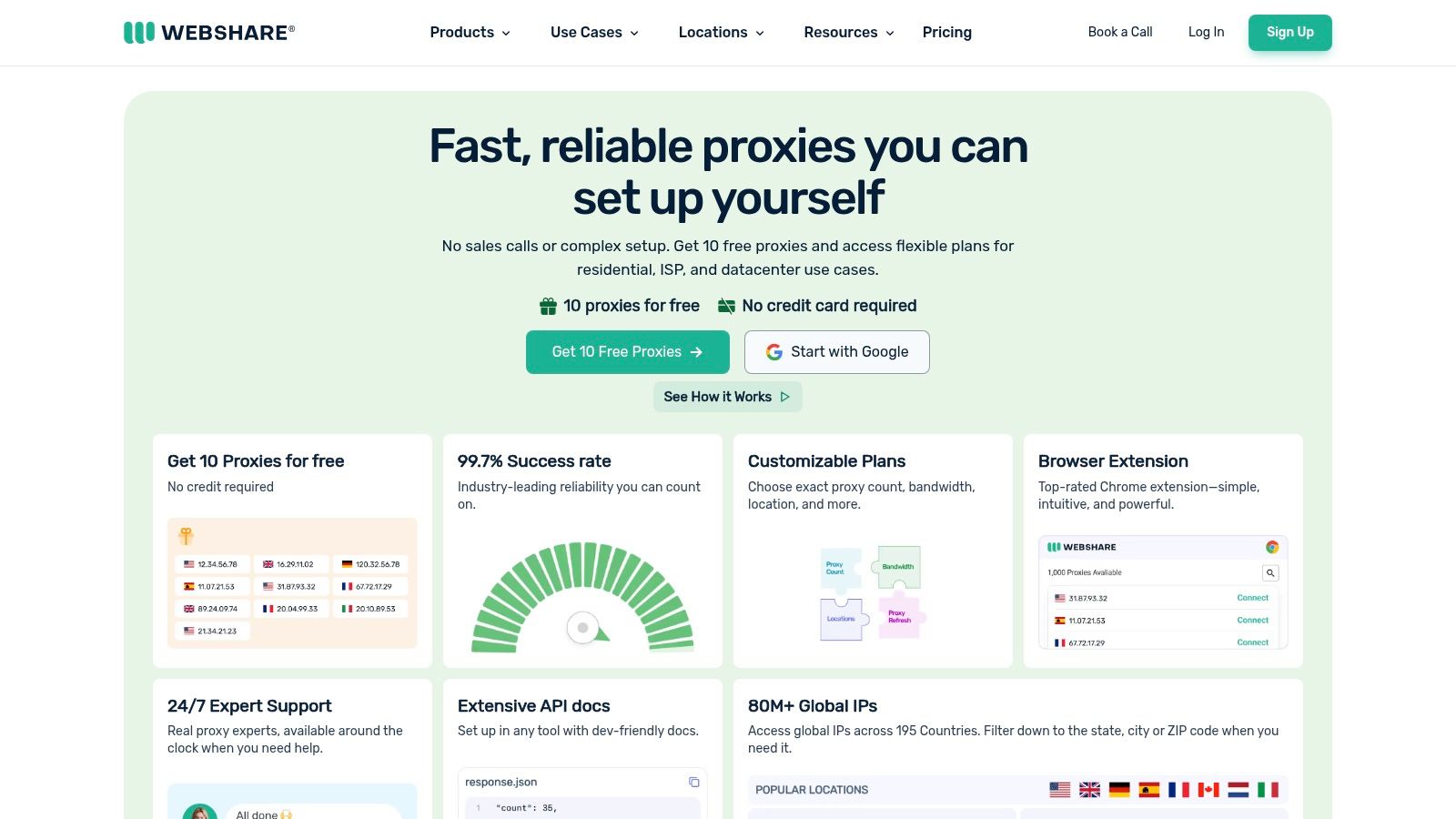
Webshare is designed for self-service buyers who need inexpensive testing, simple automation, and flexible prepaid access. It offers rotating residential, static residential or ISP, and datacenter proxies. The platform lists 80M+ residential IPs across 195+ locations and states 99.97% uptime on its product materials. Those figures come from Webshare's platform, so validate performance against your own target list rather than treating them as a guarantee for every endpoint.
The main attraction is operational simplicity. A team can buy a prepaid tier, generate endpoints, and test a parser or monitoring job without negotiating an enterprise contract. Static residential access can support browser profiles, while rotating residential traffic suits bulk collection and regional checks.
Best for controlled experiments
Webshare is useful for prototype scraping, large-thread parsing, SEO monitoring, and low-risk geo testing. It can also work in AdsPower or Hidemyacc when the profile group doesn't require premium trust signals. However, restricted target categories and variable pool quality mean you should test exact endpoints before using it for Facebook and TikTok accounts, cloaking checks, or account farming.
Annual discounts can make the public per-GB economics attractive at higher tiers, but compare the full cost of retries, failed sessions, and replacement IPs. A cheap proxy becomes expensive when it forces your team to rebuild browser profiles or repeat verification jobs. This Webshare comparison can help frame the migration against a broader multi-type provider.
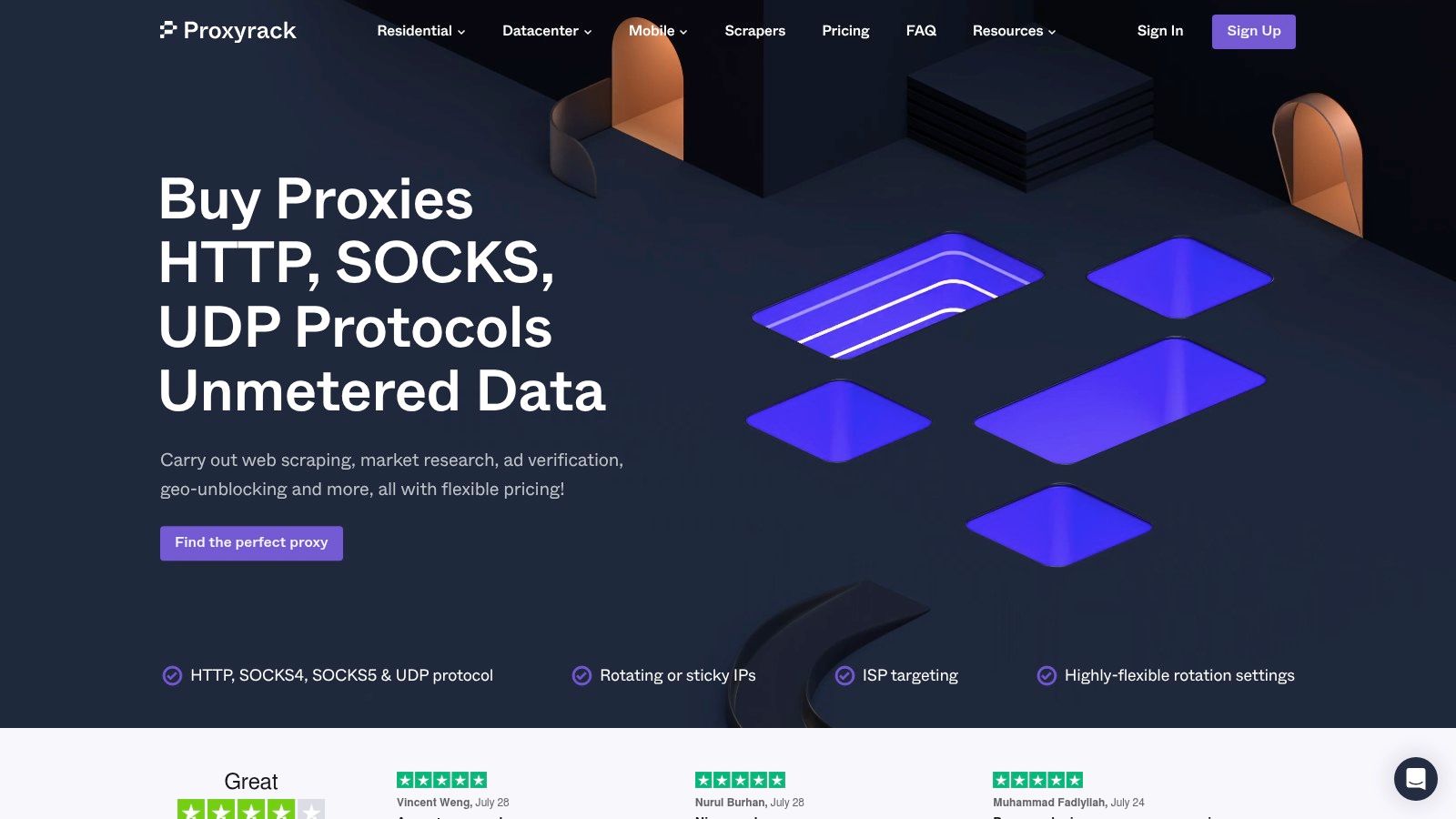
9. Proxyrack
Proxyrack stands out because it offers two different ways to budget for traffic. Teams can choose per-GB residential plans or uncapped subscriptions based on thread capacity. That distinction matters for sustained automation, where bandwidth usage is difficult to predict but concurrency is relatively stable.
The product range includes residential, datacenter, mobile, and USA ISP options, with country, city, and ISP targeting. HTTP and SOCKS support makes integration straightforward across scripts, browser profiles, and automation tools. Proxyrack's website provides the current plan structure and trial details.
Capacity planning is the deciding factor
Thread-based pricing can work well for always-on scraping, monitoring, and ad verification. If your team knows how many concurrent sessions it needs, an uncapped plan may be easier to forecast than per-GB billing. It can also suit traffic arbitrage teams that run persistent browser workers across AdsPower or Dolphin Anty.
The limitation is that thread limits become a hard capacity boundary. A sudden campaign launch or sneaker drop can create contention even when the plan appears unlimited from a bandwidth perspective. Plan concurrency around the browser and request workload, not the number of accounts alone.
Proxyrack is less feature-rich than enterprise vendors, so teams needing advanced governance, managed unblocking, or deep data APIs may need another layer. It's a practical option for stable, repeatable workloads where the team can monitor threads and separate account traffic from high-volume scraping.
10. PacketStream
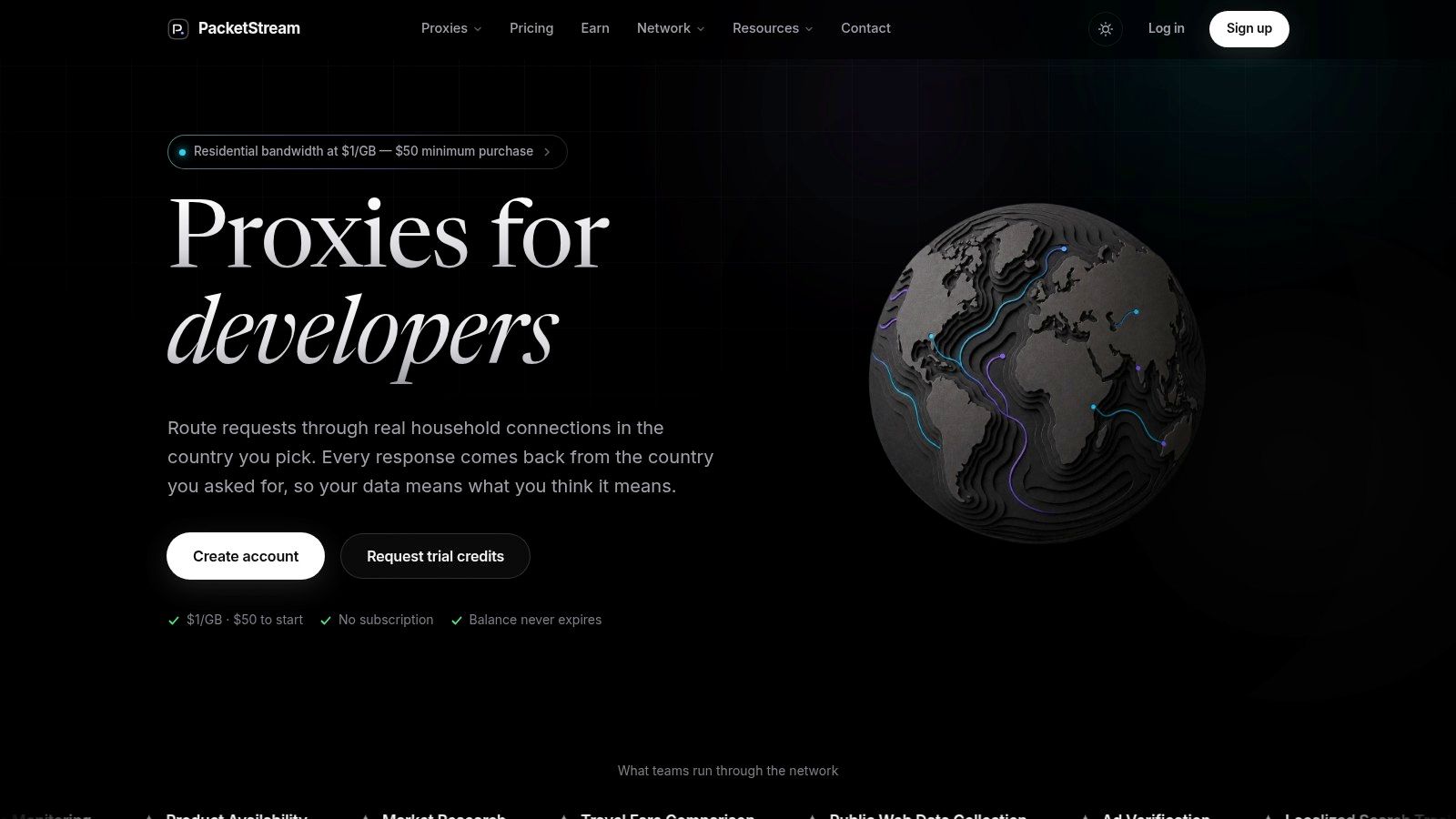
PacketStream keeps the buying process simple. It provides peer-to-peer residential access on a pay-as-you-go basis, with rotating and sticky sessions and HTTP, HTTPS, and SOCKS5 support. The listed model is $1 per GB, with a $50 minimum purchase, according to PacketStream's pricing information. That minimum can be too large for a tiny proof of concept, but it remains straightforward for low-to-moderate traffic.
The platform fits inexpensive testing, basic geo checks, and simple residential automation. A developer can validate a scraper, check localized content, or test a browser integration without signing up for a complex subscription. It can also support low-risk experiments in an antidetect browser, although serious Facebook and TikTok account operations need more careful IP-quality testing.
Keep expectations realistic
Peer-to-peer residential quality varies. Tough targets may require retries, and the platform has fewer enterprise targeting and management controls than Bright Data, Oxylabs, or Sota Proxy. That makes PacketStream a poor default for mission-critical cloaking, large account-farming operations, or campaigns where a broken session can damage account stability.
It's better for a controlled test than a universal replacement. Use sticky sessions when a browser identity must remain consistent, rotating access for broader collection, and separate endpoint pools by workflow. Don't send high-value account traffic through the same pool used for bulk scraping.
Top 10 iProyal Alternatives Comparison
| Provider | Core types & coverage | Quality & UX | Pricing & value | Target audience | Unique selling points |
|---|---|---|---|---|---|
| Sota Proxy | Residential, Mobile (4G/LTE), ISP, Datacenter, IPv4/IPv6, 220+ geos | 99.9% SLA, AI self-healing pool, low latencies, fast provisioning, 24/7 support | Pay-as-you-go, crypto, volume discounts (up to 25%), examples: IPv6 $0.20/mo, resi ~$2/GB, mobile ~$6.72/day; unlimited options | Teams needing predictable, mission-critical automation, large-scale scraping, ad verification | AI route optimizer, clean pools, instant credentials, dedicated IPs, fast scale-up |
| Bright Data | Residential, ISP/static, Mobile, Datacenter, global coverage | Huge IP pools, enterprise tooling, high success on hard targets | PAYG & subscriptions; premium pricing for enterprise scale | Enterprises needing maximum coverage and advanced targeting | Web Unlocker, Scraper IDE, strong compliance & controls |
| Oxylabs | Residential, Mobile, ISP, Datacenter, 175M+ resi IPs | Strong uptime/stability, high success rates, 24/7 support | Transparent pricing, higher entry costs for advanced features | Enterprise scraping, price monitoring, SEO, geo verification | Precise geo/ZIP/ASN targeting, broad product portfolio |
| Decodo (Smartproxy) | Residential, Static ISP, 115M+ IPs | Easy onboarding, automation-friendly tooling, antidetect support | Subscriptions & PAYG, competitive SMB-to-enterprise pricing | SMBs to enterprises using antidetect browsers and multi-account workflows | Proxy generator, browser tools, ISO/IEC 27001:2022 noted |
| SOAX | Residential, Mobile, ISP, Datacenter, ~190M+ | Emphasis on clean sourcing and compliance, straightforward setup | Flexible plans, self-serve trial, startup discounts | Teams prioritizing compliance and ethically sourced pools | GDPR/CCPA focus, documented sourcing, simple bundles |
| Zyte API | Managed scraping + proxy API | Minimal ops, automatic proxy selection & rendering, high RPM limits | Per-success (per-response) pricing, predictable cost-per-solved-request | Teams that prefer paying for outcomes over managing fleets | Auto-rendering, intelligent routing, pay-for-success model |
| Rayobyte | Residential & Static ISP, ~40M pool | Transparent $/GB tiers, non-expiring bandwidth, ethical sourcing | Volume-based $/GB tiers, non-expiring bandwidth options | SMBs/enterprises seeking clear pricing and flexible use | Non-expiring bandwidth, transparent tiered pricing |
| Webshare | Rotating residential, static residential/ISP, Datacenter, ~80M+ | Claimed 99.97% uptime, variable pool quality | Very competitive $/GB at scale, large prepaid tiers | Budget-conscious testing, prototyping, large-thread tasks | Low public $/GB, simple self-serve prepaid plans |
| Proxyrack | Residential, Datacenter, Mobile | Flexible concurrency (thread-based) and unmetered options | Per-GB or thread-based subscriptions, unmetered plans | Sustained automation with predictable concurrency needs | Uncapped/thread pricing, private/unlimited residential plans |
| PacketStream | P2P Residential PAYG network | Low-friction entry, variable quality, best for easy targets | $1/GB flat PAYG, $50 min, non-expiring balance | Trials, low-to-moderate volume tasks, low-cost testing | Very low entry price, simple PAYG P2P model |
Make the Switch Without Breaking Your Workflow
A migration should preserve behavior before it improves economics. Start by inventorying every IPRoyal endpoint, credential, proxy type, target country, city rule, rotation interval, and sticky-session requirement. Export the configuration for each AdsPower, Dolphin Anty, GoLogin, Multilogin, and Hidemyacc profile group. Record which profiles use dedicated access and which can tolerate rotation.
Next, map each task to the right proxy type. Residential access fits many scraping, ad verification, and geo-targeting workflows because it resembles household traffic. Mobile access is more appropriate when carrier identity and stronger trust signals matter, especially for selected Facebook and TikTok account operations. ISP proxies work well for persistent sessions that need better continuity without the full cost or latency profile of residential traffic. Datacenter proxies suit fast parsing, SEO monitoring, sneaker bot experiments, and high-throughput automation. IPv6 datacenter access can reduce cost and increase speed where the target supports IPv6, but it isn't a universal replacement for IPv4, residential, or mobile access.
Independent benchmark data gives a useful baseline for this trade-off. Datacenter proxies recorded the lowest median connection time at 85ms and the fastest median TTFB at 247ms. ISP proxies delivered a 96.1% overall success rate, with a 145ms median connection time and 385ms median response time. Residential proxies recorded a 94.6% success rate, 340ms median connection time, and 1,140ms median response time. Mobile proxies had the highest success rate at 97.4%, but the slowest median response time at 1,680ms. These figures come from the 2026 proxy speed benchmark, and they should guide testing rather than replace it.
Run a controlled migration
Reproduce your existing country and city targeting first. Then test rotation, sticky sessions, latency, block rates, login stability, and account behavior on a small sample. Keep one control group on IPRoyal while a matching group uses the candidate provider. Measure successful requests and stable sessions, not just delivered bandwidth.
The market gives buyers more room to specialize. A 2025 review identified more than 250 proxy providers globally, including 11 major companies plus one additional entrant across residential, mobile, shared datacenter, and dedicated ISP segments, as documented in Proxyway's 2025 proxy market review. That fragmentation means you can choose a provider by workflow instead of forcing every task through one pool.
For web scraping, start with Zyte API when your priority is successful responses and low fleet maintenance. Choose Bright Data or Oxylabs for enterprise data operations and managed tooling. Use Sota Proxy, Decodo, Webshare, Rayobyte, or PacketStream when direct endpoint control and flexible billing matter more.
For ad verification, prioritize city and country accuracy, then compare residential, ISP, and mobile routes on the actual Facebook, TikTok, and landing-page checks you run. For Facebook and TikTok ad accounts, use separate identity pools, retain sticky or dedicated sessions where continuity matters, and avoid treating fast datacenter IPs as a universal solution. For account farming, isolate profile groups and test account stability over time rather than judging a provider from one successful login.
Cloaking and geo-targeted campaigns need clean separation between crawler checks, advertiser previews, and account identity traffic. Assign each function its own endpoint policy. Sneaker bots and limited-drop buyers should prioritize latency and session concurrency, but still test target compatibility because a fast IPv6 route can fail where IPv4 or residential access is required.
Sota Proxy is a sensible long-term candidate when you want residential, mobile, ISP, datacenter, and IPv6 options under one dashboard. Its pay-as-you-go model, crypto top-ups, 24/7/365 support, rotation and sticky-session controls, and referral or affiliate program offering up to 40% commission give agencies several ways to manage both operational spend and partner economics. Compare the total cost of stable outcomes, including retries, blocked profiles, support time, and migration effort, instead of choosing on headline per-GB pricing alone.
Sota Proxy brings residential, mobile, ISP, datacenter, and IPv6 access together with city targeting, rotation, sticky sessions, crypto top-ups, and pay-as-you-go billing for demanding automation. Test it against your IPRoyal setup across AdsPower, Dolphin Anty, GoLogin, Multilogin, or Hidemyacc, then visit Sota Proxy to build a proxy stack around your actual scraping, ad verification, account, and geo-targeting workflows.
Related articles

10 Smartproxy Alternatives for Technical Teams
Compare 10 smartproxy alternatives by proxy type, IP quality, targeting, rotation, speed, pricing, and use case for technical teams.
10 Oxylabs Alternatives for Scraping and Ad Operations
Compare 10 oxylabs alternatives by proxy type, geo coverage, uptime, rotation, pricing, and use case for scraping, ad verification, and account farming.
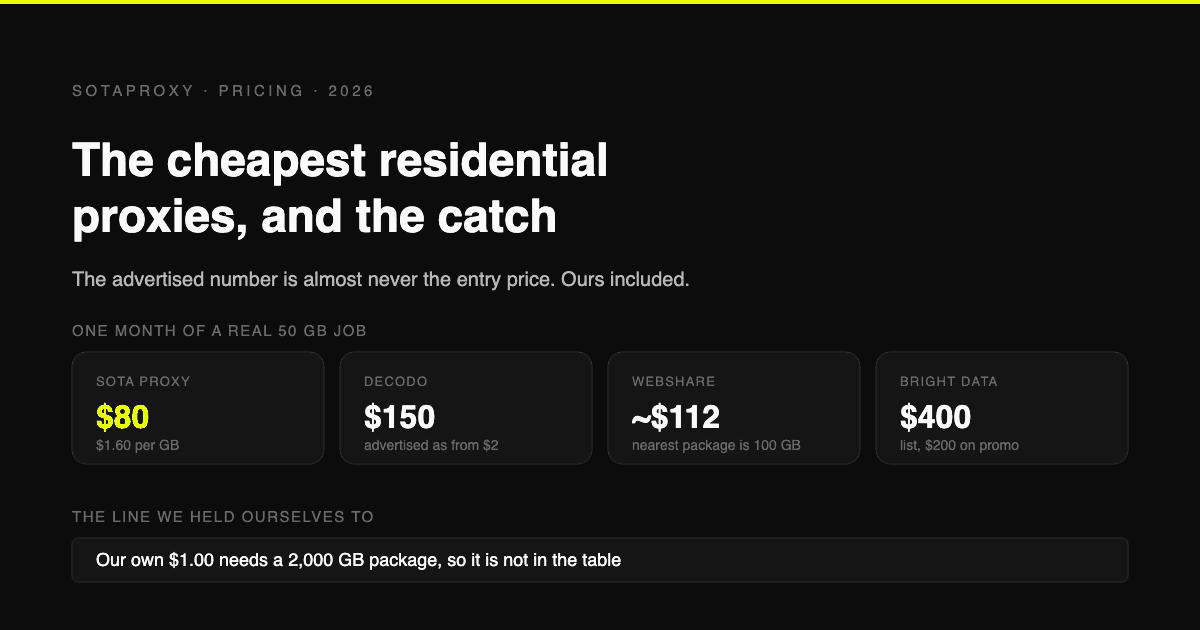
The Cheapest Residential Proxies in 2026, With the Catch Each One Hides
Verified per-gigabyte prices from five vendors' own pages, not from last year's blog posts. Why the advertised number is almost never the entry price, which providers put a monthly floor under your bill, and how to work out your real cost per gigabyte.
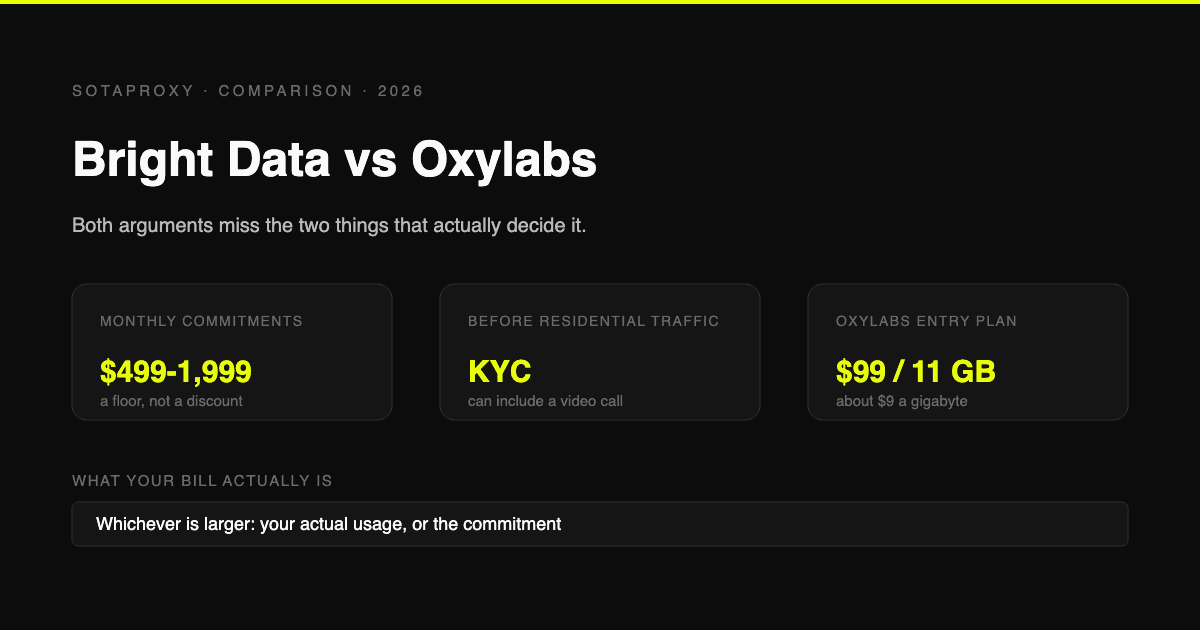
Bright Data vs Oxylabs in 2026: Prices, Commitments and the KYC Nobody Mentions
Both are enterprise platforms with minimum monthly commitments and a compliance check before you can touch residential traffic. Current prices from both vendors' own pages, what the commitment actually costs if you underuse it, and who each one is genuinely for.
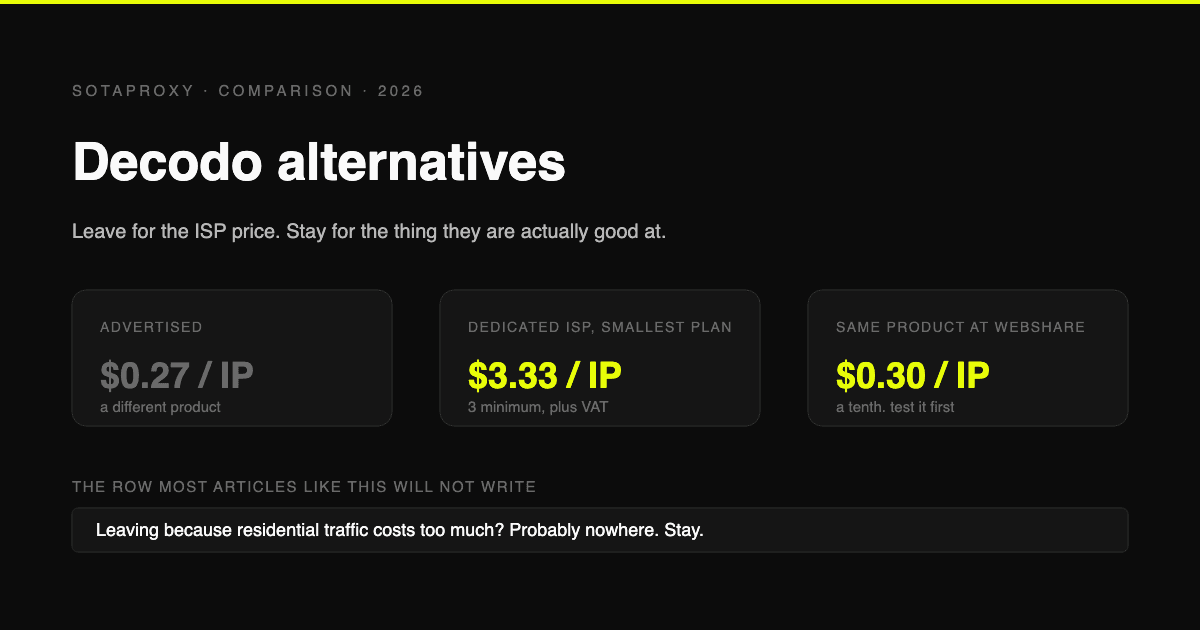
Decodo Alternatives in 2026: Who to Move to, and Who Not to Bother
Decodo is the cost leader on rotating residential and one of the pricier options on dedicated ISP. Verified prices for both, the reasons people actually leave, and which alternative fits each one.
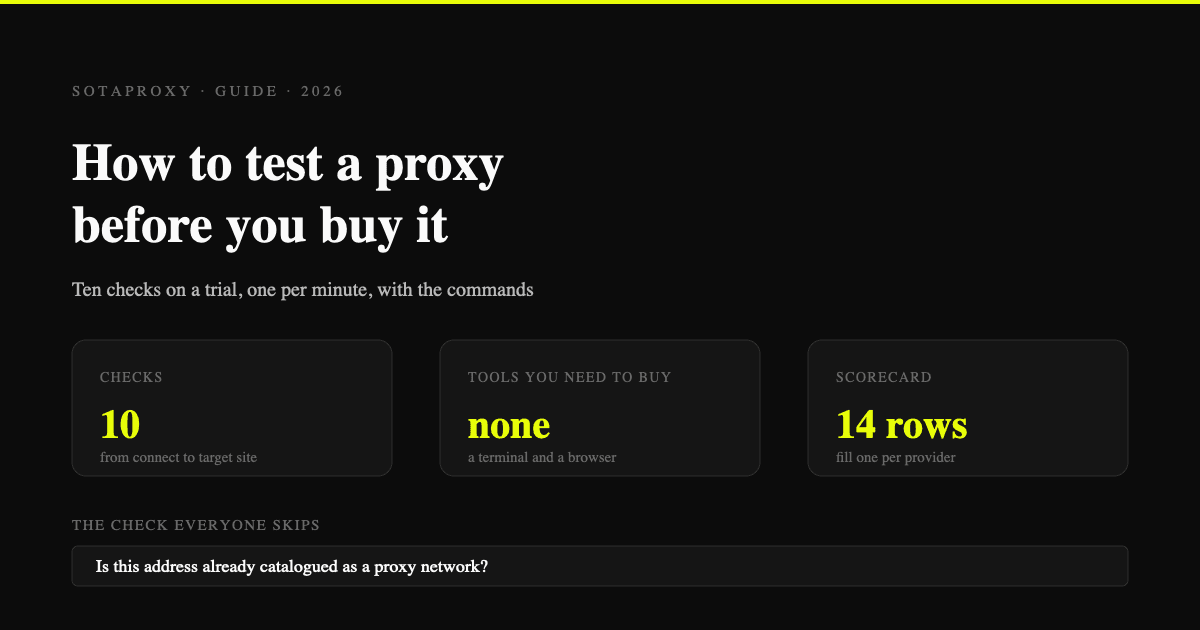
How to Test a Proxy Before You Buy It: A 10-Minute Checklist
Ten checks that tell you whether a proxy trial is worth paying for: exit ASN, hosting flags, rotation behaviour, subnet spread, DNS and WebRTC leaks, and success rate on your own target.