10 Smartproxy Alternatives for Technical Teams
Compare 10 smartproxy alternatives by proxy type, IP quality, targeting, rotation, speed, pricing, and use case for technical teams.

The best Smartproxy alternative depends on the job, not on a leaderboard. A residential pool that works for regional ad verification may be the wrong choice for a sneaker bot, a Facebook account, or a scraper that needs fast, repeatable requests. Mobile, ISP, datacenter, and IPv6 routes each expose different trade-offs in trust, latency, session stability, and cost.
This comparison focuses on those deployment decisions. It looks at IP quality, geolocation depth, rotation and sticky sessions, speed, uptime, provisioning, billing, and operational fit. The workloads include traffic arbitrage, Facebook and TikTok ad accounts, account farming, cloaking, geo-targeted campaigns, web scraping, sneaker bots, and antidetect browsers such as AdsPower, Dolphin Anty, GoLogin, Multilogin, and Hidemyacc.
The market has moved beyond a single-provider mindset. Proxyway's 2026 proxy market research records a shift from datacenter-heavy purchasing toward residential networks. At Rayobyte, datacenter proxies declined from 85% of revenue in 2023 to 42.4% in 2025, while residential proxies reached 35%. Byteful's residential business also grew from 10% to 30–40% during 2025. Buyers are comparing networks by outcome, not only by price per gigabyte.
The list starts with Sota Proxy, then covers nine established alternatives. For broader research beyond proxy infrastructure, you can also find AI video generator options.
Table of Contents
- 1. Sota Proxy
- 2. Bright Data
- 3. Oxylabs
- 4. SOAX
- 5. IPRoyal
- 6. Rayobyte
- 7. ProxyEmpire
- 8. Infatica
- 9. PacketStream
- 10. Shifter
- Top 10 Smartproxy Alternatives Comparison
- Choose by Workload, Then Migrate in Stages
1. Sota Proxy
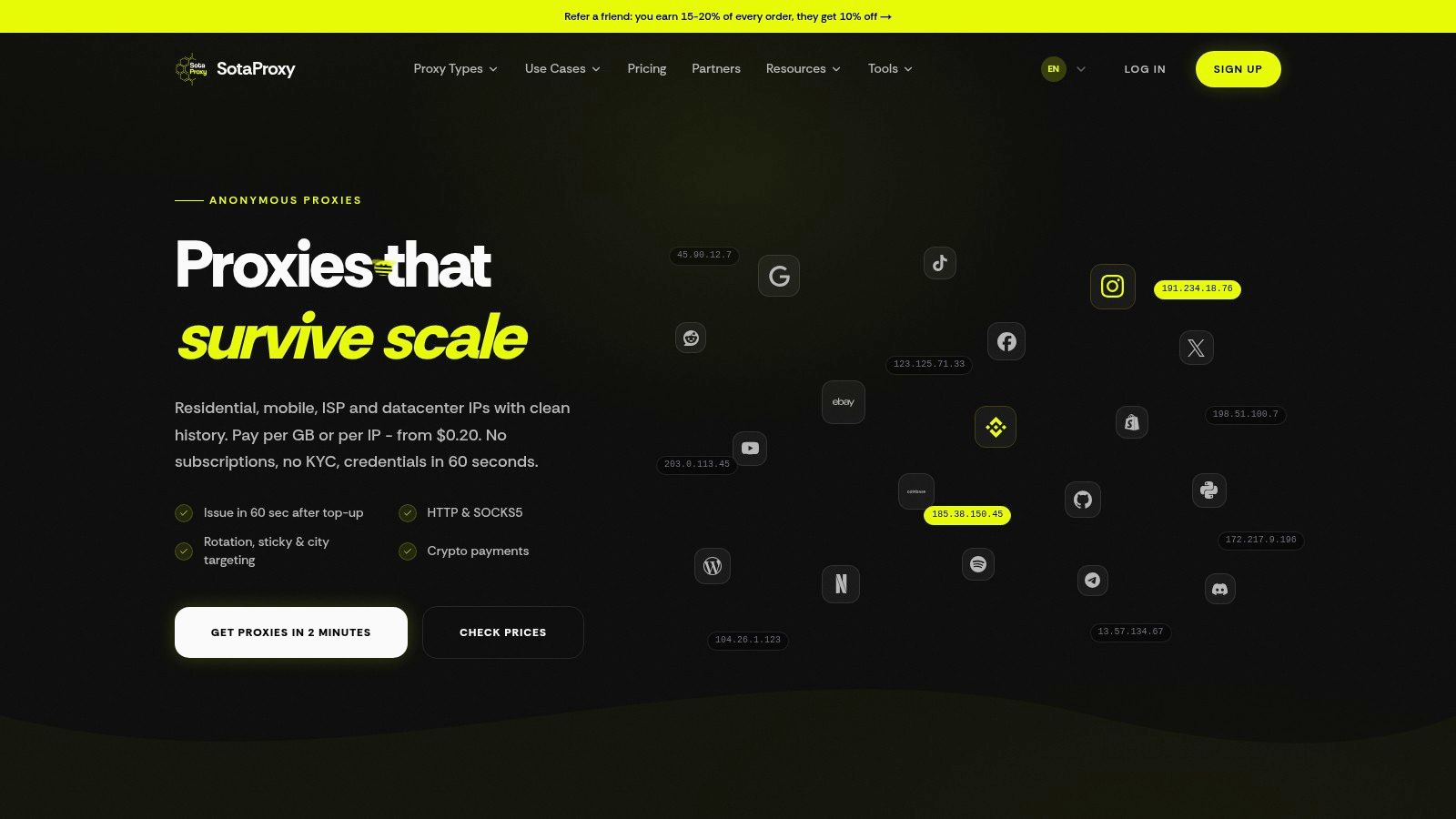
Sota Proxy is the most balanced choice here for teams that need several proxy types without splitting operations across multiple dashboards. It offers residential, mobile, ISP, datacenter, IPv4, and IPv6 routes across 220+ geolocations, with country and city-level controls. That mix suits traffic arbitrage teams, ad verification, scraping, price monitoring, and social account management.
The practical advantage is workload separation. Use residential routes when Facebook or TikTok campaigns need a more legitimate home-network identity. Use mobile routes for sensitive TikTok sessions and operations where carrier IPs carry a stronger trust profile. Use ISP or dedicated datacenter routes when latency and stable identity matter more than residential appearance.
Sota Proxy's pool manager removes flagged addresses and selects lower-latency paths automatically. The platform describes self-healing pools and routing that is approximately 18% faster, while its published service target is 99.9% uptime. Its pool contains 2.84M+ active IPs, and the platform reports average latency in the 30–60ms range across major regions. These figures come from the Sota Proxy platform information.
Where Sota Proxy fits best
Antidetect browser users can assign one proxy to each profile, then keep country, city, DNS, WebRTC, and browser signals aligned. That setup works with AdsPower, Dolphin Anty, GoLogin, Multilogin, and Hidemyacc. Facebook Business Manager typically benefits from static residential routes and sticky sessions. TikTok account work often favors mobile routes with stable session assignment.
The dashboard supports rotation and sticky sessions, HTTP(S) and SOCKS5, usage monitoring, balance controls, API access, and browser integrations. Credentials can be provisioned in 60–120 seconds, according to the platform's product material. Card and crypto payments, instant top-ups, no subscriptions, and no KYC create a useful operating model for teams that need to test several routes before committing.
Pricing is pay-as-you-go. Published examples include IPv4 dedicated proxies from $1.80 per month per IP, ISP proxies from $3.00 per month, residential traffic from $2.00 per GB, IPv6 from $0.20 per month, and mobile access from approximately $6.72 per day. Corporate residential volumes can reach $1.00 per GB, and platform discounts can reach approximately 25%. Check the current Sota Proxy pricing and product options before budgeting, because the best model depends on traffic volume and session duration.
Practical rule: Use one proxy identity per antidetect profile. Don't reuse the same endpoint across Facebook or TikTok accounts, even when the provider supports unlimited concurrency.
The trade-off is clear. Pay-as-you-go mobile access can cost more than a flat monthly plan for sustained, high-volume use. Sota Proxy also has fewer publicly visible third-party testimonials and awards than the largest enterprise vendors, so a controlled trial matters. Its referral program offers 15–20% to customers, with 10% off for referred users. Separate affiliate benchmarks in the proxy industry advertise commissions of up to 40%, which makes Sota Proxy relevant to operators who monetize traffic, media buying, or referrals.
2. Bright Data
Bright Data is the enterprise alternative for difficult targets, large-scale collection, and teams that need more than raw proxy access. Its stack includes residential, ISP, mobile, and datacenter proxies, plus Web Unlocker and integrated scraping tools. The provider also supports city, ASN, and granular session targeting.
The main strength is control at the network and compliance layers. Enterprise buyers can apply KYC, auditing, and governance processes around access. That helps organizations running ad verification, brand monitoring, market intelligence, and protected-site collection where procurement teams need formal controls.
Bright Data's published network coverage includes 400M+ residential IPs across 195+ countries, as stated on the Bright Data website. That scale can help when a scraper needs unusual locations or when an arbitrage team tests many regional landing pages. It doesn't automatically make every endpoint suitable for Facebook, TikTok, or cloaking. Trust still varies by route, session history, ASN, and target.
Workload fit
Bright Data fits enterprise scraping, ad verification, SERP collection, and anti-bot-heavy workflows. Web Unlocker can reduce the engineering burden when a team would otherwise build its own retry, rotation, and browser-handling layer. City and ASN targeting also helps local SEO and regional campaign checks.
It's less attractive for a small account-farming operation that only needs a handful of stable residential sessions. KYC and compliance reviews can slow initial access, while the effective cost tends to be high for smaller teams. Buyers should also separate proxy spend from scraper API spend. A managed unblocker may improve success, but it changes the cost model and can reduce low-level control.
Teams evaluating this provider should compare it with Bright Data alternatives from Sota Proxy, especially when they need mixed residential, mobile, ISP, and datacenter access in one operating account.
3. Oxylabs
Oxylabs makes sense when proxy infrastructure sits inside a larger data-collection operation. It provides residential, ISP, mobile, and datacenter products, along with Web Scraper API and SERP tools. Its positioning favors stability, detailed documentation, engineering support, and granular targeting rather than bare-bones access.
The provider is particularly useful for local SEO, ad verification, price monitoring, and e-commerce research. A team checking product availability across cities may need more than country selection. City, region, and ASN controls help keep the request origin consistent with the market being measured.
Oxylabs also offers SLA-backed uptime and 24/7 engineering and enterprise support, according to its proxy and scraping platform. That support matters when a scraper feeds a business process and an outage affects reporting, repricing, or campaign decisions.
What works and what doesn't
Residential routes are the natural choice for protected retail pages and regional search results. Datacenter routes remain useful for fast, lower-risk requests, health checks, and workloads where the target doesn't aggressively classify hosting ranges. ISP routes can occupy the middle ground when the team needs a more stable identity without the variability of rotating residential traffic.
Oxylabs' drawback is procurement friction. Entry costs are higher than deep-budget providers, and some advanced controls sit behind higher tiers. That structure can be justified for a mature data team, but it's harder to justify for casual scraping or small-scale geo checks.
For teams comparing premium infrastructure against a more flexible deployment model, the Oxylabs alternatives guide is a useful parallel evaluation. Test the exact target, not a generic speed endpoint. A proxy that performs well on public pages may still fail during Facebook login, TikTok session validation, or a protected checkout flow.
4. SOAX
SOAX is built around a unified credit model across residential, mobile, ISP, and datacenter proxies. That design suits teams that change proxy type by task but want one dashboard, one balance, and consistent access patterns. It supports HTTP(S) and SOCKS5, with city, region, ISP, and session controls.
The provider's strongest operational feature is targeting depth. A media buyer can select the campaign market, city, and ISP, then choose rotating or sticky behavior based on the workflow. A scraper can use rotation for broad collection, while an antidetect profile keeps a sticky session for account management.
SOAX documents session TTL controls and deep targeting on its proxy platform. Those controls are useful for Facebook and TikTok accounts where session continuity matters more than raw request volume. They also help geo-targeted campaigns that need the same regional identity across login, creative review, and landing-page checks.
The billing trade-off
The unified model simplifies procurement, but per-gigabyte credit pricing can become expensive for always-on tasks. A high-volume scraper may prefer an unlimited or IP-based datacenter plan, while an ad verification team may value the flexibility of moving credits between proxy types.
SOAX is strongest in mid-tier and higher-tier deployments where targeting and session behavior justify the spend. It's less compelling when the only requirement is cheap, fast datacenter throughput. It also shouldn't be treated as a universal answer for multi-account work. Facebook often benefits from static residential sessions, while TikTok may require mobile routes and stricter profile separation.
5. IPRoyal
IPRoyal targets cost-conscious teams that still need residential, mobile, ISP, and datacenter options. Its billing supports both subscriptions and pay-as-you-go use, which gives small media buyers a way to test routes before adopting a longer commitment.
The dashboard is straightforward, and provisioning is quick. That matters for operators setting up AdsPower, Dolphin Anty, GoLogin, Multilogin, or Hidemyacc profiles without building a custom proxy management layer. City-level routing and sticky sessions can support bulk account management, regional ad checks, and controlled creative testing.
IPRoyal's proxy offering is a reasonable fit for mixed workloads where the team doesn't need enterprise scraping APIs. Residential routes can handle general scraping and ad verification. ISP or static residential routes are better for long-lived account identities. Datacenter proxies remain the practical choice for high-throughput, lower-sensitivity tasks.
Where the lower price shows up
Aggressive entry pricing and frequent promotions make IPRoyal attractive for experiments and smaller deployments. The trade-off is pool consistency. IP quality may vary more than it does with Tier-1 enterprise networks, and some plan details appear only after signup.
That variability matters for Facebook and TikTok ad accounts. A cheap endpoint that triggers repeated checkpoints costs more than its advertised rate suggests. Operators should test login persistence, session duration, block frequency, and location accuracy before moving live accounts.
The same applies to account farming and cloaking. Residential or ISP routes may provide a better identity than datacenter ranges, but proxy choice alone doesn't make a workflow compliant or stable. Keep browser fingerprints, time zones, language settings, DNS behavior, and account history consistent.
Teams that want to compare the same cost-sensitive profile against another operating model can review IPRoyal alternatives from Sota Proxy. The comparison should focus on successful sessions and total operating cost, not just the first deposit.
6. Rayobyte
Rayobyte is a strong candidate for operations that need static identity, especially in the United States. Its product mix includes static ISP, residential, and datacenter proxies, plus a scraping API. Static routes can reduce fingerprint drift for account management, marketplace operations, and long-lived sessions.
That makes Rayobyte relevant to account farming teams and operators managing e-commerce accounts through antidetect browsers. A dedicated ISP route can remain attached to one browser profile, while separate profiles receive separate endpoints. The approach is more predictable than assigning a rotating residential pool to every login.
Rayobyte also publishes sourcing transparency materials and offers account management support for enterprise buyers. Its proxy infrastructure includes unlimited-bandwidth options on some static products, which can simplify budgeting for sustained workloads.
Best use cases
Rayobyte fits US-focused Facebook campaigns, marketplace operations, account management, and scraping tasks that need predictable origin. It can also support geo-targeted creative checks where a stable city or network identity matters more than maximum IP diversity.
It's not the simplest option for a team comparing many small SKUs. Pricing varies across products, and the best value generally requires volume commitments. Rotating residential access may also be a better fit for broad scraping than static ISP access, especially when the target frequently blocks repeated identities.
Traffic arbitrage teams should separate campaign account stability from landing-page request volume. Use static routes for profiles and mobile routes where carrier identity is important. Use datacenter or rotating residential capacity for lower-risk verification and collection, after testing the target's response.
7. ProxyEmpire
ProxyEmpire focuses on residential and mobile access with flexible billing. It offers both bandwidth-metered and unlimited residential models, with some unlimited products priced by port speed rather than traffic. That distinction can make a major difference for always-on price monitoring, SEO checks, and market research.
The provider supports country, region, city, and ISP targeting. A scraper can rotate across locations, while a media buyer can pin a session to a target market. The self-serve trial panel also makes it easier to test a particular country or city before making a larger purchase.
ProxyEmpire's residential and mobile proxy platform is well suited to sustained scraping where throughput matters more than access to a very large enterprise pool. Mobile routes can support sensitive social workflows, but they need tighter concurrency and session planning than ordinary residential access.
Billing by workload
PAYG works well for irregular ad checks or short research runs. Unlimited plans can work better for continuous collection, but they demand careful planning around concurrency, port speed, and target behavior. Unlimited bandwidth doesn't mean unlimited successful requests. The target can still impose rate limits, challenge sessions, or block an ASN.
ProxyEmpire's pool is smaller than the largest enterprise providers. That can matter on heavily protected targets, narrow geographies, or workloads that exhaust a small set of clean routes quickly. Its responsive sales support and custom geo discussions can offset that limitation when the requirement is specific.
For sneaker bots, test connection stability and target timing rather than assuming residential rotation is always superior. A fast datacenter or ISP route may be better for public product checks, while sensitive checkout and account workflows need a cleaner, more stable identity.
8. Infatica
Infatica offers residential, mobile, ISP, and datacenter proxies with a simple pay-as-you-go approach. Rotation and sticky modes cover the two main operating patterns. Rotation supports distributed scraping and ad verification, while sticky sessions support account management and multi-page workflows.
The platform also includes API integration and dashboard usage controls. That gives a small data team enough structure to monitor spend, adjust traffic, and separate campaigns without adopting a full enterprise data platform.
Infatica positions its network around transparent billing and ethically described IP sourcing on its proxy service website. That emphasis matters as compliance and consent scrutiny around residential networks increases. Procurement teams should still review the provider's current terms, acceptable-use rules, and sourcing documentation before deploying sensitive workflows.
Practical fit
Infatica is a reasonable middle ground for ad verification, e-commerce monitoring, and multi-region research. Its balanced product set helps teams that need both residential and datacenter routes but don't need a specialized unblocker.
The main limitation is brand and pool depth relative to Bright Data or Oxylabs. Entry tiers may require tuning on difficult anti-bot targets. Start with a narrow test that measures successful responses, location accuracy, session persistence, and time spent handling retries.
For Facebook and TikTok ad accounts, assign a dedicated residential or mobile endpoint to each profile. Check WebRTC and DNS leakage inside the antidetect browser. For cloaking and geo-targeted campaigns, keep the proxy country and city aligned with the intended audience, then validate the complete path from ad click to landing page.
9. PacketStream
PacketStream is a budget-oriented peer-to-peer residential network. Its simple metered model and lack of subscription lock-ins make it useful for low-risk scraping, broad geo checks, and ad verification where premium unblock success isn't mandatory.
The service supports sticky and rotating sessions over HTTP and SOCKS, with straightforward documentation. It also offers a white-label program, which may interest resellers and operators packaging proxy access into a broader service.
PacketStream advertises $1 per GB pricing on its residential proxy service. That low entry point is useful for testing, but cost alone doesn't predict performance on protected targets.
Keep sensitive workflows separate
The smaller and more variable pool can underperform against strong bot protection. That makes PacketStream a poor default for valuable Facebook or TikTok accounts, account farming, cloaking, and sneaker checkout flows without a measured trial.
It can work for public content collection, low-sensitivity SEO checks, and initial location validation. Use sticky sessions when a workflow spans several requests. Use rotation when the target tolerates distributed requests and the output matters more than identity continuity.
Teams comparing P2P residential access with backconnect infrastructure can review residential backconnect proxy options. The decision should include endpoint quality, replacement behavior, support response, and the cost of failed requests.
10. Shifter
Shifter fits workflows that need residential rotation, static ISP routes, or long sticky sessions rather than a large feature catalogue. It is practical for e-commerce price and availability checks that visit several pages under one regional identity.
The gateway supports HTTP(S) and SOCKS5. Per-request rotation and sticky sessions are controlled through a session ID, while country, city, and ASN targeting support local availability checks and regional SEO monitoring.
Shifter lists a residential pool of 205M+ on its proxy provider website. Higher data tiers can suit growing collection jobs, while static ISP products provide a separate option for stable account sessions.
Session behavior matters
A scraper collecting a product page, stock status, and delivery estimate should keep related requests in one session. Broad SERP collection or public-page crawling may work better with per-request rotation. For a comparison of the best rotating proxy options, evaluate rotation control alongside target-specific success rates.
Shifter provides fewer built-in unblocker tools than some enterprise providers. Teams using AdsPower, Dolphin Anty, GoLogin, Multilogin, or Hidemyacc may need to configure more routing, cookie, and recovery logic themselves. That suits experienced operators, but increases maintenance work for account farming, cloaking, and Facebook or TikTok ad accounts.
For traffic arbitrage and geo-targeted campaigns, choose Shifter when city precision and session continuity outweigh the need for carrier-grade mobile identity. Test mobile routes separately for TikTok operations. Sneaker bots should measure checkout latency and consistency before committing to a long-term plan. Scrapers should also test failure recovery, not only headline speed.
Top 10 Smartproxy Alternatives Comparison
| Provider | Core features & USP | Performance & reliability | Pricing & value | Target use cases | Management & support |
|---|---|---|---|---|---|
| Sota Proxy | Residential, mobile, ISP, datacenter; 220+ geos; AI pool manager & route optimizer; city-level targeting; pay‑as‑you‑go & crypto | 99.9% uptime, self‑healing pools, avg 30–60 ms, redundant clusters | PAYG per GB/IP, dedicated IPs, volume discounts, no KYC | Large-scale scraping, ad verification, price/SEO monitoring, social media, market research | Intuitive dashboard, API, instant top‑ups, real‑time monitoring, 24/7 human support |
| Bright Data | 400M+ residential IPs, ISP/mobile/datacenter, Web Unlocker & integrated scraping tools | Very high success on protected targets, enterprise-grade SLAs | Premium pricing, PAYG & tiered plans, enterprise contracts | High-difficulty scraping, unblock workflows, global data collection | Enterprise KYC/compliance, auditing, enterprise support |
| Oxylabs | Residential/ISP/mobile/datacenter, Scraper API & SERP tools, granular geo targeting | SLA-backed uptime, stable network, fine-grained geo/session controls | Competitive at scale, higher entry costs | Ad verification, local SEO, price monitoring, SERP scraping | 24/7 engineering support, strong documentation |
| SOAX | Residential/mobile/ISP/datacenter, single-credit model, city/ISP targeting, sticky & rotating | Reliable sticky sessions, best performance on mid/high tiers | Credit (per-GB) model; flexible bundles but can be pricey always-on | Social automation, ad verification, targeted scraping | Unified dashboard, good docs for session TTL and targeting |
| IPRoyal | Residential, mobile, ISP/static residential, datacenter; PAYG or subscription | Quick provisioning, pool quality can vary vs Tier‑1 | Aggressive entry pricing, frequent promotions, subscription options | Anti-detect browsers, bulk account management, city routing | Simple dashboard, fast provisioning, basic support |
| Rayobyte | Static ISP, residential, datacenter; scraping API, unlimited bandwidth SKUs | Predictable/static IP identity, strong US footprint | SKU-complex pricing, volume discounts for large buyers | Account farming, marketplace ops, US-focused monitoring | Responsive enterprise support, account management tools |
| ProxyEmpire | Rotating residential & mobile, bandwidth-metered & unlimited-by-port options, geo targeting | Good value for sustained always-on scraping, smaller pool than enterprise peers | PAYG and unlimited plans; good value for long-running tasks | Price monitoring, SEO, ad verification, market research | Self-serve trial panel, responsive sales for custom geos |
| Infatica | Residential/mobile/ISP/datacenter, PAYG billing, API integration | Balanced feature set, smaller brand footprint than Tier‑1 | Straightforward PAYG with volume breaks | Ad verification, e‑commerce monitoring, multi-region research | API + dashboard controls, clear sourcing/ethical positioning |
| PacketStream | P2P residential network, flat $/GB pricing, sticky & rotating sessions | Budget performance, variable IP pool, may underperform on bot-protected targets | Very low entry cost (~$1/GB), no subscriptions, balances don't expire | Cost-sensitive scraping, ad checks, quick tests | Simple docs, easy integration, reseller/white‑label options |
| Shifter | Large residential pool (205M+), static ISP options, session ID/TTL controls | Strong session controls for long sticky sessions, good per‑GB scaling at volume | Competitive per‑GB rates at high volumes, unlimited bandwidth SKUs | Long sessions, e‑commerce price/availability checks, account management | Integrations for scraping tools, solid support for multi-page workflows |
Choose by Workload, Then Migrate in Stages
There isn't one universal Smartproxy alternative. The right provider depends on the identity the target expects, the session behavior the workflow requires, and the cost of failed requests.
For traffic arbitrage teams, start with a provider that offers residential, mobile, ISP, and datacenter routes in one account. Sota Proxy is the balanced option when campaigns span Facebook, TikTok, ad verification, and geo-targeted landing pages. Its 220+ geolocations, city-level targeting, rotation and sticky sessions, published 99.9% uptime, pay-as-you-go billing, and human support cover more operating patterns than a single residential-only supplier.
Facebook and TikTok ad accounts need stricter separation. Assign one dedicated proxy to each antidetect profile in AdsPower, Dolphin Anty, GoLogin, Multilogin, or Hidemyacc. Facebook Business Manager generally fits static residential proxies with sticky sessions. TikTok workflows often favor mobile proxies because carrier IPs provide a stronger trust profile for sensitive session validation. Match the proxy country and city to the account's origin or target region, then check WebRTC and DNS inside every profile.
Account farming needs stable identity more than raw bandwidth. Rayobyte and Sota Proxy are sensible starting points for static ISP or residential assignments. IPRoyal can suit budget-conscious teams, but test pool quality and checkpoint frequency before adding valuable accounts. PacketStream is better reserved for low-sensitivity validation and broad collection.
Cloaking and geo-targeted campaigns require careful separation of traffic roles. Use residential or mobile routes when the workflow depends on legitimacy and regional identity. Use datacenter or IPv6 routes for fast, lower-risk checks where the target doesn't heavily block hosting ranges. IPv6 can offer attractive scale economics, but datacenter IPv6 is easier for websites to flag than ISP-sourced residential IPv6.
Scrapers should choose by target difficulty. Bright Data and Oxylabs fit protected, enterprise-scale collection with integrated tooling. SOAX and Shifter work well when city, ISP, and session controls matter. ProxyEmpire and Infatica offer practical middle-ground models. PacketStream can reduce test costs when premium success rates aren't required. Sneaker bots need target-specific testing, because a route that works for product-page monitoring may fail during login, cart, or checkout.
Use this migration sequence:
- Inventory endpoints: Record every current IP, port, protocol, country, city, ASN, session ID, and browser profile assignment.
- Match proxy types: Use residential for legitimacy, mobile for carrier-sensitive social workflows, ISP for stable identity, datacenter for speed, and IPv6 where the target and software stack support it.
- Preserve geography: Recreate country, city, carrier, and ASN requirements before moving accounts or campaigns.
- Test real actions: Measure login success, block rates, checkpoint frequency, page completion, checkout behavior, and ad rendering. A generic latency test isn't enough.
- Map sessions: Rebuild sticky-session parameters, port mappings, authentication, rotation rules, WebRTC settings, and DNS behavior.
- Stage accounts gradually: Move a small group of profiles first. Don't switch every Facebook or TikTok account at once.
- Monitor operations: Track latency, successful requests, retries, spend, session failures, and endpoint replacement.
- Keep rollback access: Maintain the old provider until the new routes perform consistently across the full workflow.
Sota Proxy is the strongest general recommendation for teams that need mixed proxy types, broad geolocation, city targeting, flexible sessions, transparent usage billing, and direct human support. Bright Data and Oxylabs suit enterprise data teams that need mature scraping products and formal procurement controls. Rayobyte is a better fit for US-heavy static identity work. SOAX and Shifter suit detailed targeting and session control. IPRoyal, PacketStream, Infatica, and ProxyEmpire are more practical when budget flexibility matters.
The commercial angle also matters for traffic operators. Sota Proxy's referral program offers up to 40% commission as a relevant acquisition consideration, although teams should confirm the current terms before modeling revenue. Choose the provider that reduces failed sessions and manual cleanup for your workload, then migrate in stages instead of trusting a generic feature comparison.
Sota Proxy combines residential, mobile, ISP, datacenter, IPv4, and IPv6 access across 220+ geolocations with city-level targeting, rotation or sticky sessions, pay-as-you-go billing, and 24/7 human support. Visit Sota Proxy to test a proxy setup against your Facebook, TikTok, scraping, antidetect browser, or geo-targeted campaign workflow before you move production traffic.
Related articles
10 IPRoyal Alternatives for Serious Proxy Workloads
Compare 10 IPRoyal alternatives for scraping, ad verification, account farming, antidetect browsers, geo campaigns, pricing, rotation, and support.
10 Oxylabs Alternatives for Scraping and Ad Operations
Compare 10 oxylabs alternatives by proxy type, geo coverage, uptime, rotation, pricing, and use case for scraping, ad verification, and account farming.
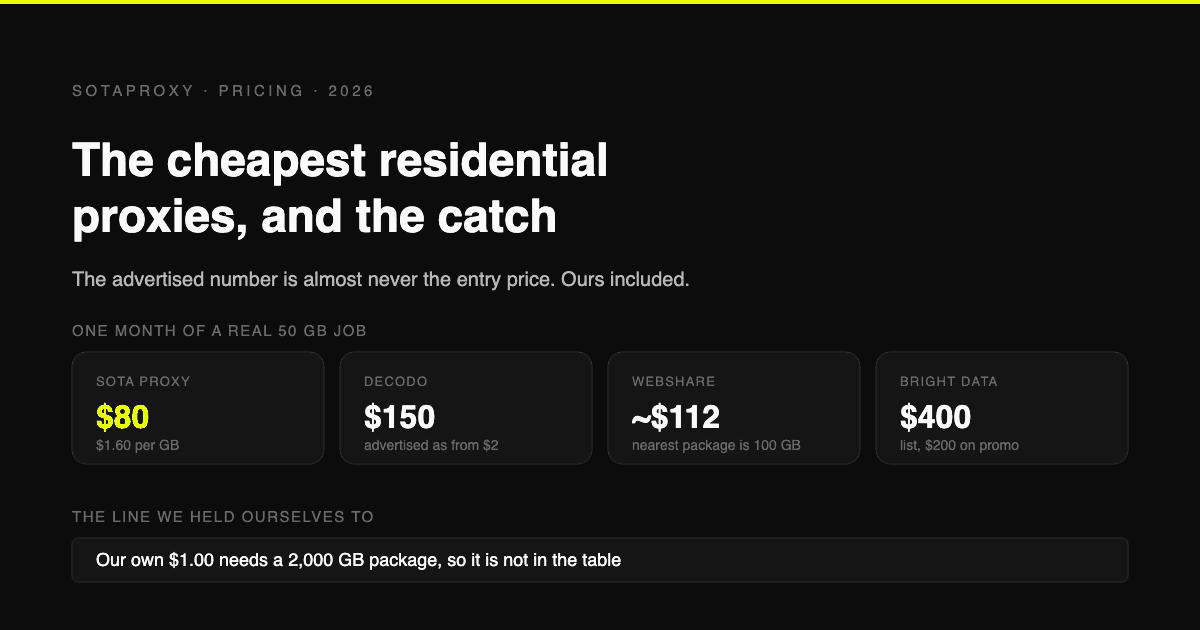
The Cheapest Residential Proxies in 2026, With the Catch Each One Hides
Verified per-gigabyte prices from five vendors' own pages, not from last year's blog posts. Why the advertised number is almost never the entry price, which providers put a monthly floor under your bill, and how to work out your real cost per gigabyte.
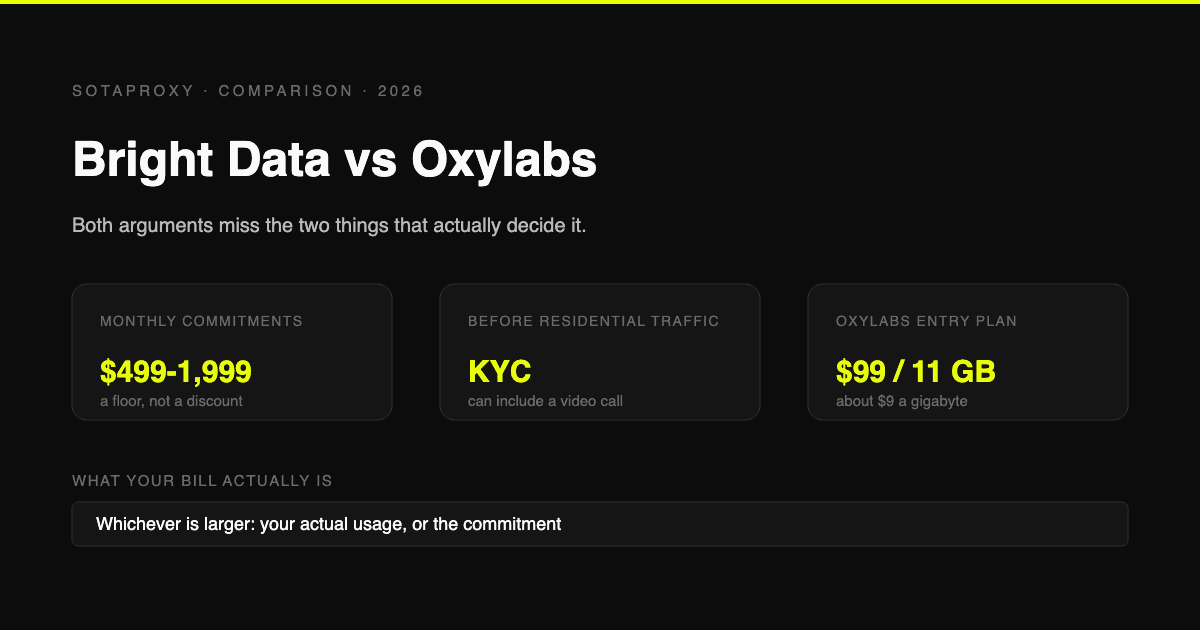
Bright Data vs Oxylabs in 2026: Prices, Commitments and the KYC Nobody Mentions
Both are enterprise platforms with minimum monthly commitments and a compliance check before you can touch residential traffic. Current prices from both vendors' own pages, what the commitment actually costs if you underuse it, and who each one is genuinely for.
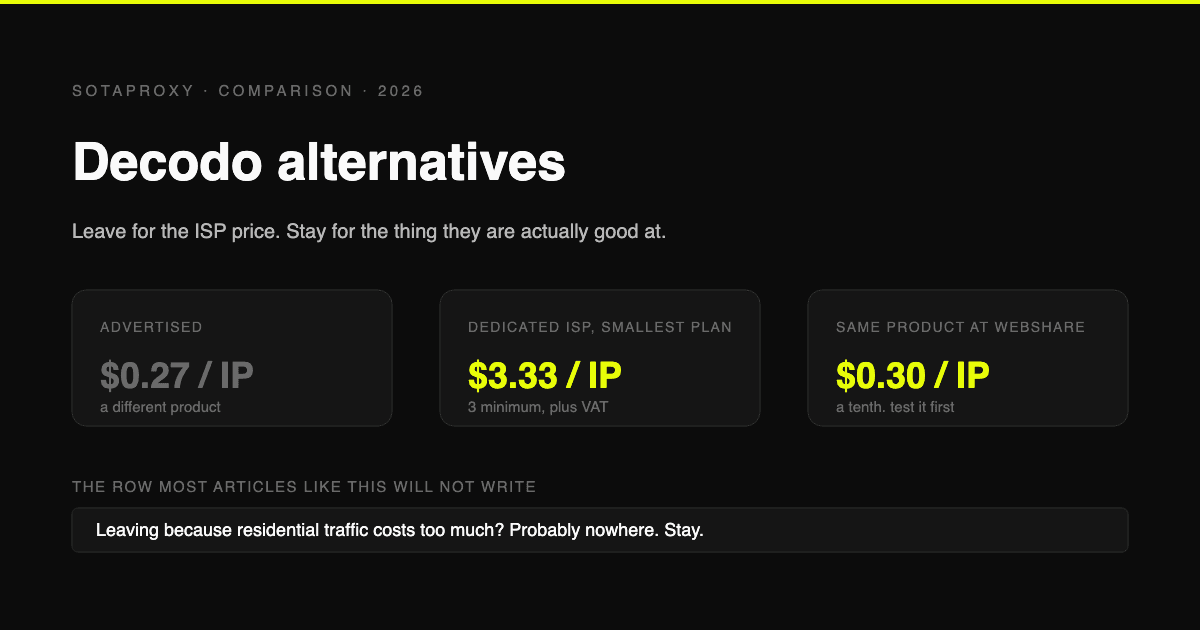
Decodo Alternatives in 2026: Who to Move to, and Who Not to Bother
Decodo is the cost leader on rotating residential and one of the pricier options on dedicated ISP. Verified prices for both, the reasons people actually leave, and which alternative fits each one.
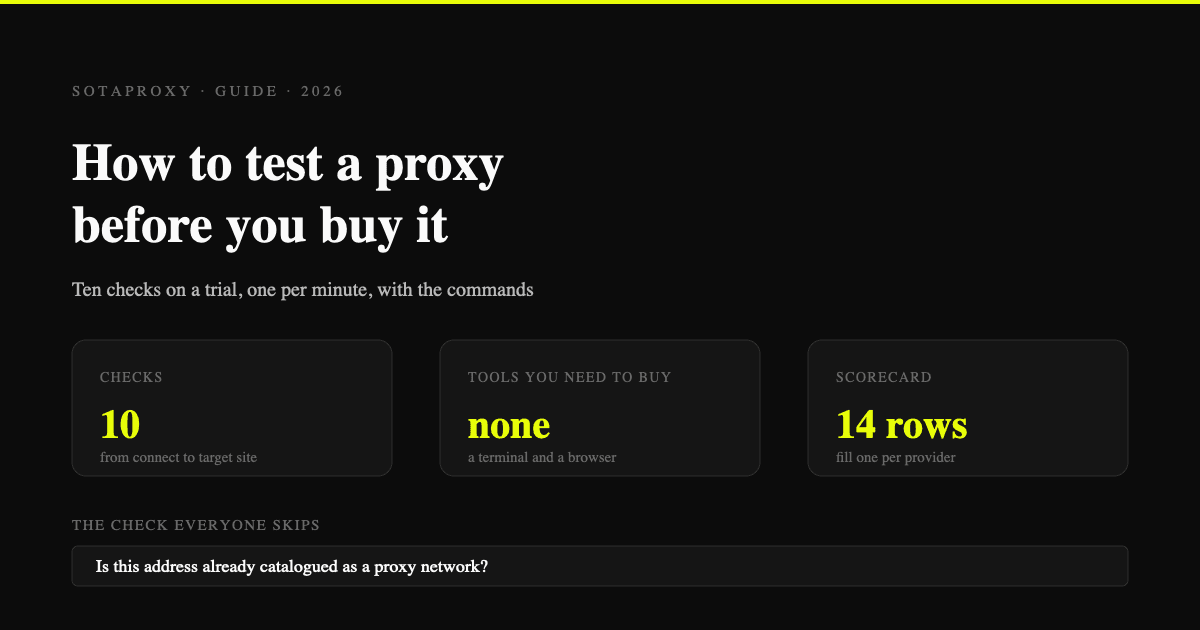
How to Test a Proxy Before You Buy It: A 10-Minute Checklist
Ten checks that tell you whether a proxy trial is worth paying for: exit ASN, hosting flags, rotation behaviour, subnet spread, DNS and WebRTC leaks, and success rate on your own target.