How Many Amazon and eBay Accounts Can You Have in 2026
Amazon and eBay are the generous end of the account-limit scale on paper and the harshest in practice: more than one account is allowed, every account is linked, and one suspension can take the lot. The rules in the platforms' own words, and what actually connects two accounts.
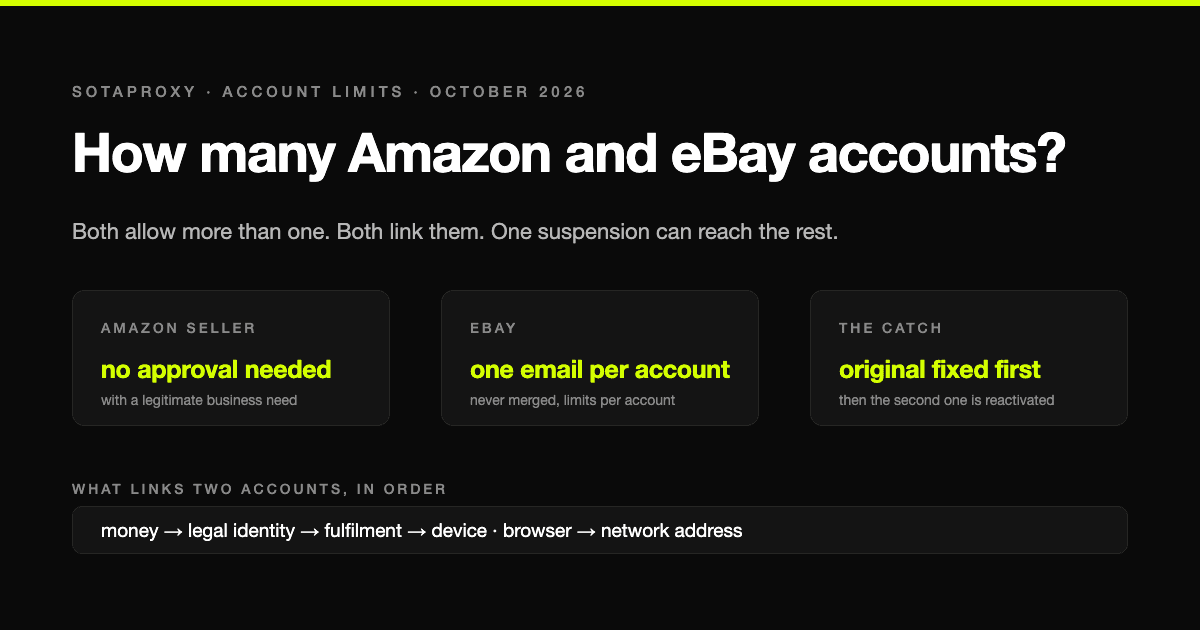
Amazon and eBay sit at the opposite end of this series from Facebook. Neither caps the number of accounts, both say in writing that more than one is fine, and both are the platforms where a second account costs the most when it goes wrong. The permission is generous. The linkage is total.
The short version of both policies is the same sentence: you may have several accounts, as long as none of them exists to get around something that happened to another one.
How many Amazon accounts can you have?
Seller accounts. Amazon's starting position is one Seller Central account per seller. Since 2020 it no longer asks for approval before a second one: according to Amazon's own community managers quoting the policy on Seller Forums, "Selling Partners who have a legitimate business need can operate multiple Selling Accounts and do not require Amazon's approval." The same answer adds the recommendation that matters: only open a second account "if you have a legitimate business need and all of your current accounts are in good standing."
Amazon gives three examples of a legitimate business need:
- owning multiple brands and keeping a separate business for each, for example a parent company that wants a separate storefront name per brand;
- manufacturing products for two distinct and separate companies;
- being recruited into an Amazon program that requires separate accounts.
Note what is not on that list: selling the same catalogue twice, getting a second shot at a category, or spreading risk. Those are the reasons people actually want a second account, and none of them is a business need in Amazon's sense.
Buyer accounts. There is no published number. Amazon's Conditions of Use say nothing about how many you may hold and a great deal about Amazon's right to close any of them at its discretion. In practice buyer accounts are governed by the same linkage logic as seller accounts, just with lower stakes.
One honesty note: Amazon's full policy page, Selling Policies and Seller Code of Conduct, is only readable behind a Seller Central login. The quotes above are from Amazon staff reproducing it in public, which is the closest thing to a primary source available to someone who has not registered yet.
The platform-by-platform comparison is in how many accounts you can have on each platform.
How many eBay accounts can you have?
eBay is more direct. Its Multiple accounts policy opens with "Users may have multiple accounts on eBay. We understand that there are various reasons why someone would choose to have more than one account." eBay even lists the reasons it has in mind: separate accounts for buying and selling, separate accounts for different product lines such as auto parts and skin care, and selling on different international eBay sites.
The mechanics, from eBay's own pages:
- one email address per account, and the same buying and selling policies apply to every account you hold;
- accounts are never merged, and feedback scores stay separate forever;
- selling limits are per account, reviewed monthly, and a new account can raise its limits by linking to your other, more established seller account;
- you cannot bid on your own items from another account;
- you cannot open a new account while one is suspended.
The one prohibited thing is the same as Amazon's: "Registering new accounts or using other existing accounts to avoid buying and selling restrictions or limits or other policy consequences" is not allowed.
eBay does not publish the starting numbers for selling limits on the policy page. It describes the process instead: limits are set per account, reviewed every month against sales and feedback, and can be raised on request when you get close to them.
Where the two sit against the rest of the series
| Platform | Published cap | What a second account must not be |
|---|---|---|
| Amazon, seller | None, with a legitimate business need | A way around a deactivation, feedback or metrics |
| eBay | None, one email per account | A way around limits, restrictions or a suspension |
| Telegram | None, one phone number per account | Nothing about count |
| Facebook, personal | One per person | Any second personal profile |
Read the right column. Amazon and eBay are the only two platforms in the series whose rule is written entirely in terms of what you are escaping from. That is why a second account is low risk when the first is healthy and the worst idea available when it is not.
Why one suspension reaches every account
Both platforms say this out loud, which is unusual.
Amazon, in the same policy text: "If one of these accounts violates an Amazon policy and is deactivated, this could affect the selling ability across all associated accounts." And the order of repair is fixed: "Only when the original account is reactivated, can the secondary account be reactivated." You cannot abandon the first account and keep the second. The second is held hostage to the first.
eBay: "If we apply restrictions or limits to one account, then similar restrictions or limits may be applied to the member's other linked accounts." eBay adds an appeal route for mistakes, "If you believe we've linked your account in error, please contact us to appeal", which is also an admission that linking is done by signal, not by confession.
So the practical question is not how many accounts you are allowed. It is what makes two accounts one in the platform's eyes.
What actually links two accounts
Neither platform publishes its matching rules, and the forum folklore around them is mostly guesswork. What can be said with confidence is which signals are available to a marketplace, because a marketplace sees more than a social network does:
- Money. Bank account, card, payout destination, tax identity. Amazon's community managers have said in public that two seller accounts in one region cannot share a bank account. This is the strongest signal on either platform, and no proxy touches it.
- Legal identity. Business registration, address, the documents from verification.
- Fulfilment. Return address, warehouse, shipping accounts, the same SKUs and photos.
- Device and browser. Cookies, fingerprint, logins from one machine.
- Network. The IP address, its history, and whether it is a home line, a data centre or a known proxy range.
Order matters here. The first three are where most real links come from, and they are the ones a technical setup cannot fix. The last two are the ones people spend money on, and they only help once the first three are genuinely separate. A dedicated address under a shared bank account is theatre.
What the network signal needs to look like
If the accounts are legitimately separate businesses, the network side has two requirements, and they are modest.
One account, one address, permanently. Marketplaces are not sensitive to the occasional new IP the way an ad platform is, but they do notice two storefronts sharing one line, and they notice an address that changes every request. A static address per account is the correct shape, which is what an ISP proxy is: a home-line address that stays yours. Rotating residential traffic is the wrong tool for a seller account, not because it is detectable per se, but because an account that logs in from a different city every day looks like a compromised account, and compromised accounts get locked.
The address class has to be residential. Data centre ranges are the cheapest thing to buy and the first thing a risk system scores. For an account that moves money, that score is not worth the saving.
Before relying on an address, check what it actually looks like from the outside: the country, the ASN, and whether it is already on a list. The cost of doing this properly is small next to the rest of a seller stack, and the multi-accounting stack breakdown has the numbers.
Using a second account after a suspension
This is the case the whole series keeps coming back to, and both platforms have already answered it. eBay: you cannot open a new account while one is suspended. Amazon: the second account cannot be reactivated until the first one is. A fresh account, a fresh address and a fresh device do not change that. They add "account created to avoid consequences", which is the one prohibited reason in both policies, on top of whatever caused the suspension.
The route that works is the unglamorous one: appeal the first account, fix what it was suspended for, and only then think about a second. On Amazon that order is not advice, it is the written reactivation sequence.
Frequently asked questions
Can I have two Amazon seller accounts?
Yes, if there is a legitimate business need, such as separate brands or separate companies, and all your current accounts are in good standing. No prior approval is required. Amazon links related accounts, so a deactivation on one can affect the others, and the original must be reactivated first.
Can I have two eBay accounts?
Yes, with a different email address for each. eBay lists buying and selling separately, different product lines and different international sites as normal reasons. Accounts are never merged, feedback stays separate, and a new account cannot be created to get around limits or a suspension.
What links two eBay or Amazon accounts?
The platforms do not publish their rules. The signals a marketplace has are money and payout details, legal identity and documents, fulfilment addresses and listings, device and browser, and the network address. The first three carry most of the weight, and no proxy changes them.
Do I need a proxy for a second seller account?
Only once the accounts are separate in every other way. Then one static, residential-class address per account, never shared and never rotating. An address on its own does not make two accounts separate.
Can I open a new account after a suspension?
Not under either policy. eBay forbids opening a new account while one is suspended, and Amazon reactivates a secondary account only after the original one. The working route is to appeal and fix the first account.
Related articles
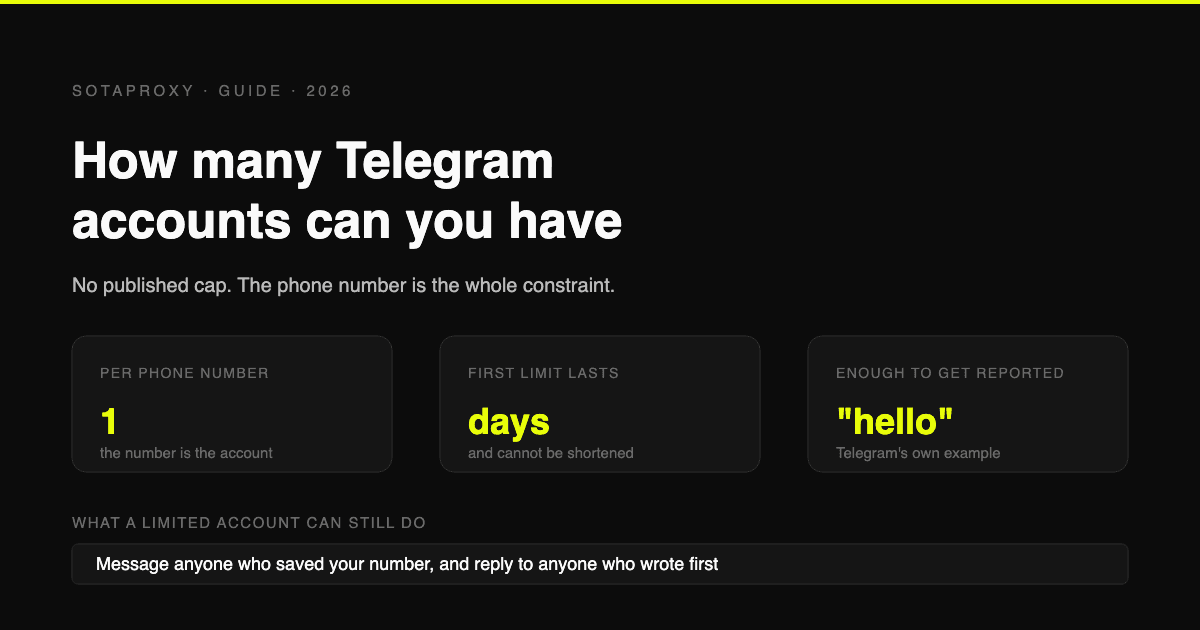
How Many Telegram Accounts Can You Have in 2026 (And What "Limited" Really Means)
Telegram publishes no account cap, one number per account, and its own Spam FAQ says a limited account can still message anyone who saved your number. What triggers a limit, why VOIP numbers get flagged before you send a word, and why there is no early release.
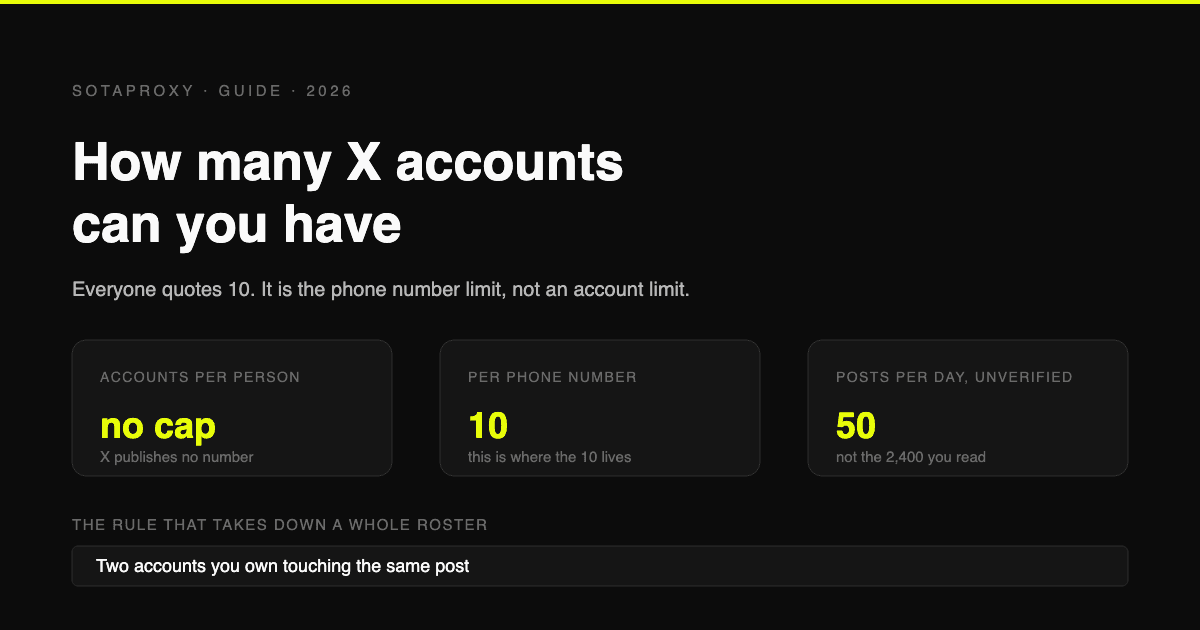
How Many X (Twitter) Accounts Can You Have in 2026 (The 10 Is a Phone Limit, Not an Account Limit)
X publishes no cap on accounts per person. The 10 everyone quotes is the number of accounts one phone number can cover. The real constraints are 50 posts a day on a free account, duplicative use cases, and accounts that interact with each other.
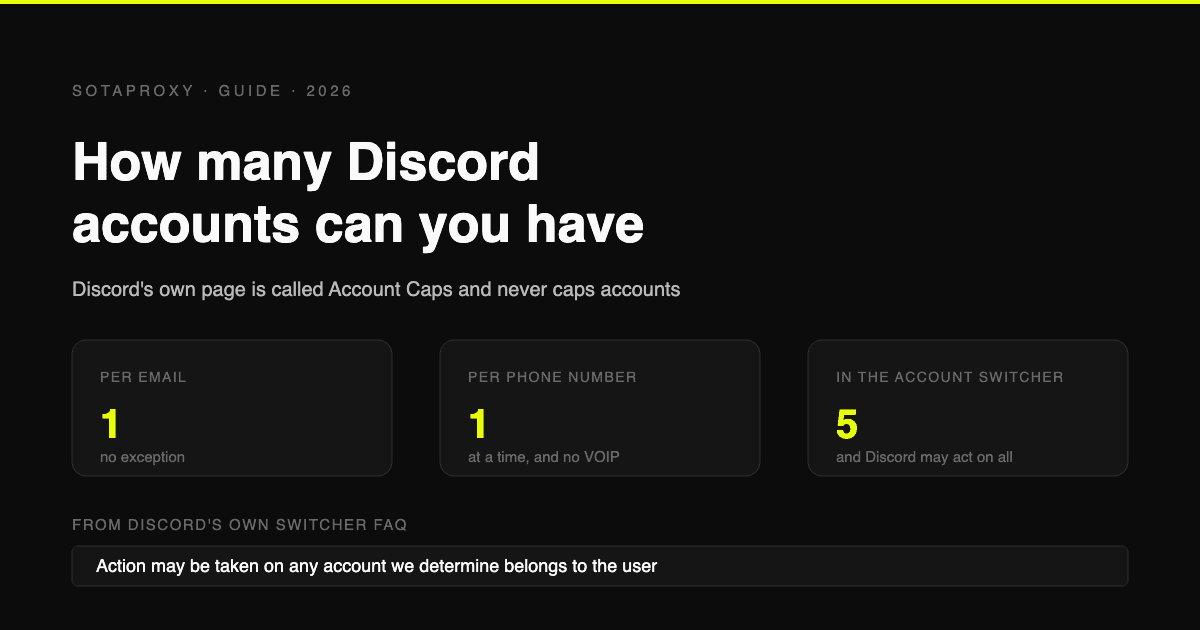
How Many Discord Accounts Can You Have in 2026 (Per Email, Per Phone, Per Device)
Discord publishes no cap on accounts. The real limits are one per email, one phone number at a time with no VOIP, and five in the Account Switcher, which Discord says it may enforce across.
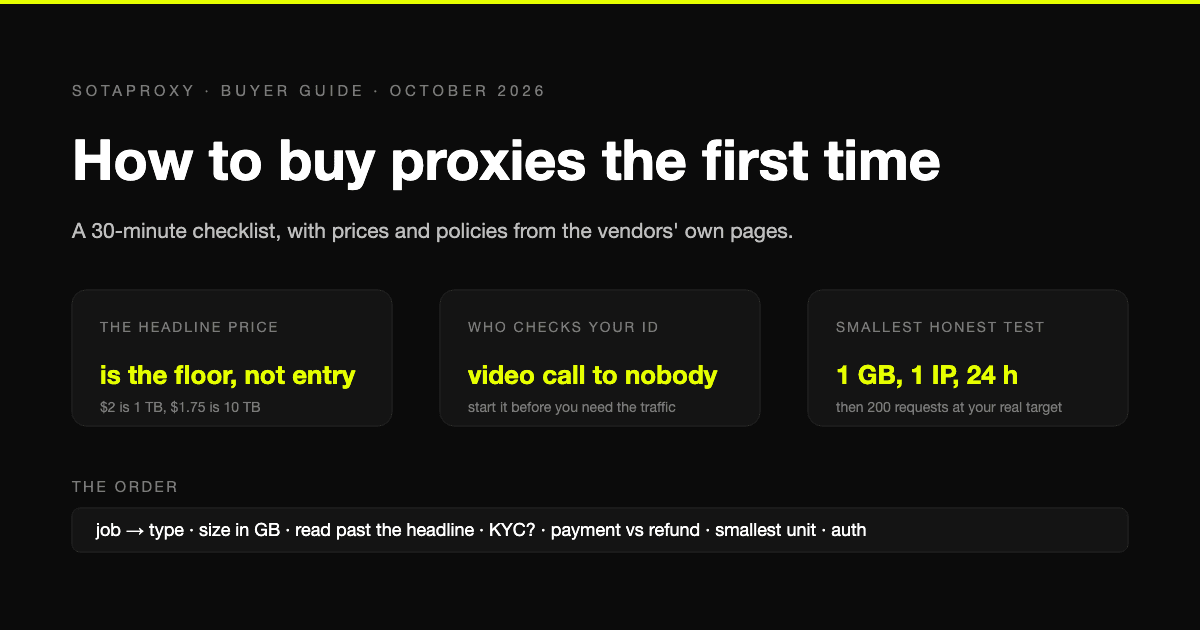
How to Buy Proxies for the First Time: A 30-Minute Checklist
A first purchase goes wrong in predictable places: the wrong proxy type, a headline price nobody pays, an identity check nobody mentioned, a refund that does not apply to how you paid. The checklist, with prices and policies from the vendors' own pages.
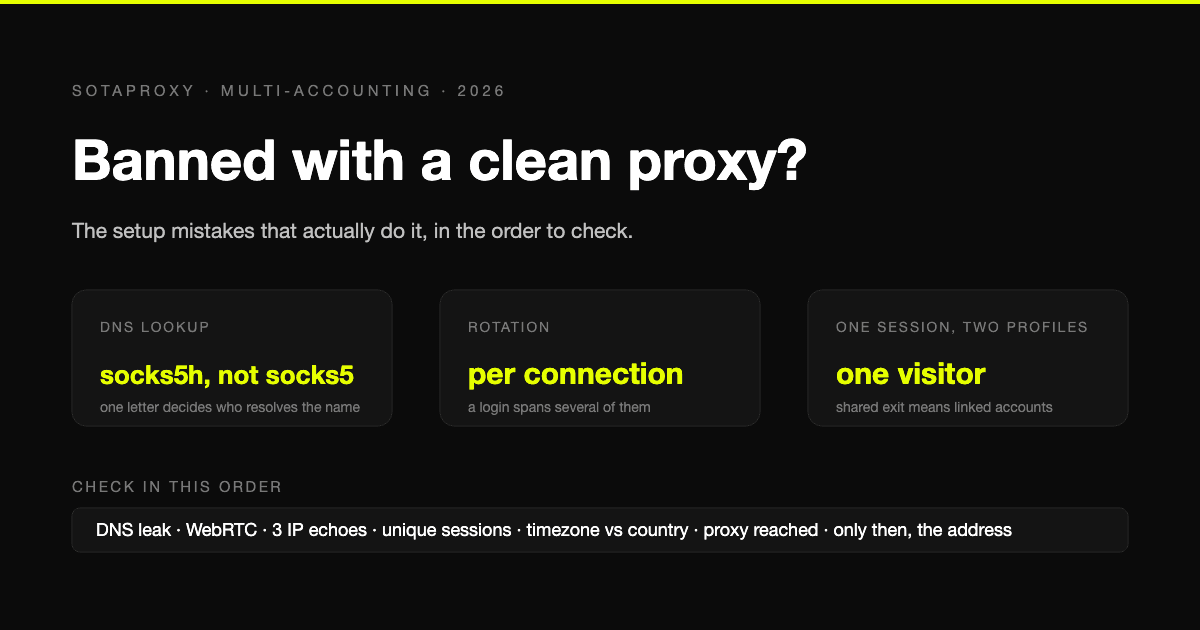
Banned With a Clean Proxy? The Setup Mistakes That Actually Do It
The proxy was clean, the address was residential, and the account still died. In most cases we see, the address was never the problem. Seven setup faults, each one checkable in a minute, in the order they usually turn out to be the cause.
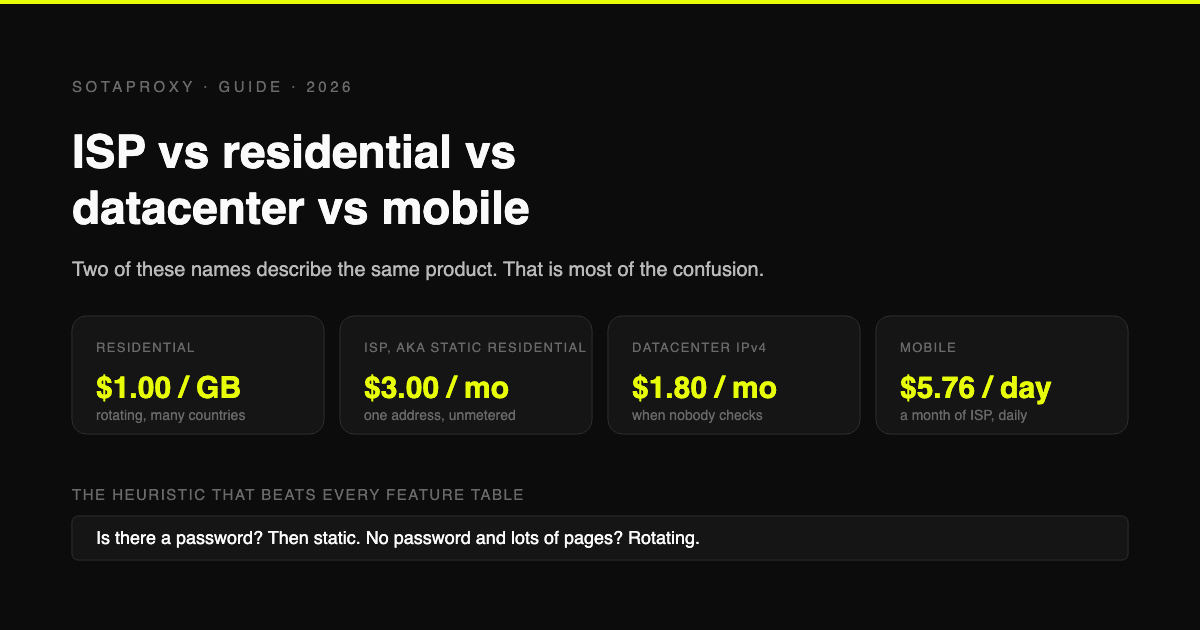
ISP vs Residential vs Datacenter vs Mobile Proxies: Which One You Actually Need
Static residential and ISP are the same product under two names, which is why half these comparisons compare a thing to itself. What each type is, what it costs per unit, and the one task each is genuinely best at.