How Many Accounts Can You Have on Each Platform in 2026
Published limits for eleven platforms side by side, the four different rule regimes behind them, and why the number in the app is never the real constraint.
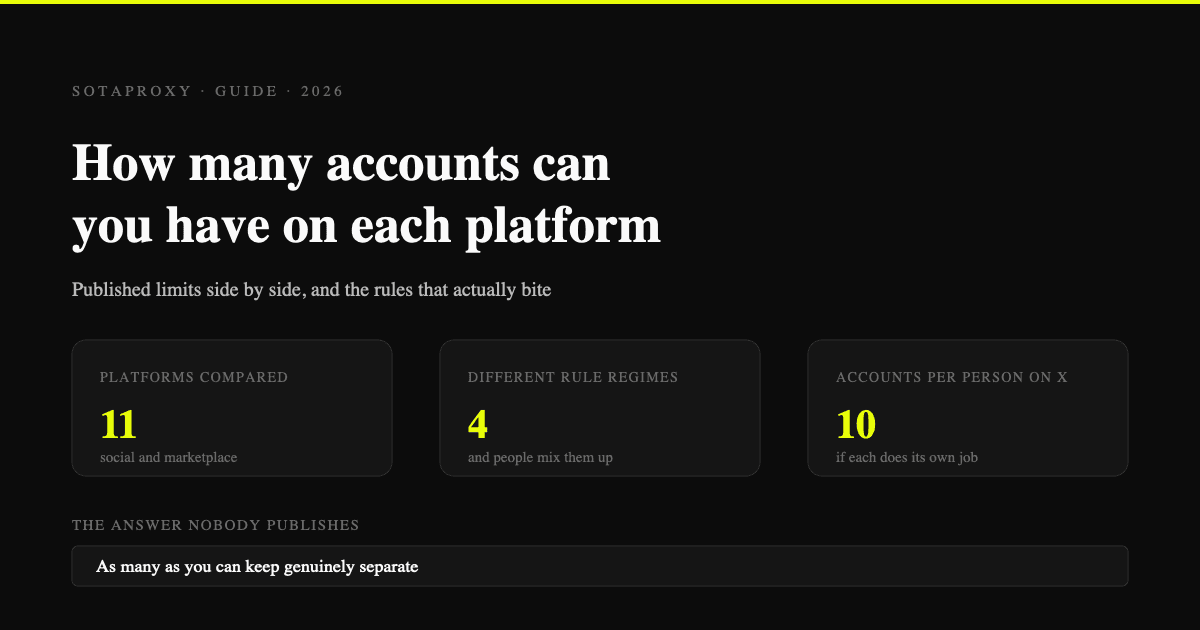
This is the most asked question in multi-accounting and the least useful one. Every platform has an answer, the answers contradict each other, and none of them is the number that decides whether your accounts survive.
Here are all of them in one table, then the part that actually matters: the four completely different rule regimes hiding behind those numbers.
Policies as published in September 2026. Platforms change both the wording and the in-app limits, so re-check before you build a process on any single row.
What does each platform actually allow?
| Platform | Official stance | Practical cap | What it explicitly forbids |
|---|---|---|---|
| Facebook, personal | One personal account per person | Extra personal accounts get restricted | Second personal profiles; pages and business assets are the sanctioned route |
| Multiple allowed | About 5 per email or device in the app | Impersonation, coordinated inauthentic behaviour | |
| TikTok | No published cap | 6 accounts per device in the app, up from 3; around 5 per email | Inauthentic behaviour, ban evasion |
| X | Multiple allowed, reported ceiling around 10 per person | 10 | Overlapping use cases, identical cross-posting, mutual likes and reposts, suspension evasion |
| Explicitly allowed, no cap | 2 to 5 is the common working range | Vote manipulation across your own accounts, ban evasion | |
| Discord | As many as you want | One per email and phone number | Creating accounts to evade enforcement |
| Steam | Not prohibited, no cap | Unlimited accounts can share one recovery email | Nothing about count; enforcement is about trading and payment abuse |
| Telegram | Multiple allowed | 3 inside one app, 4 with Premium, each needs its own number | Nothing about count |
| Google and Gmail | No published maximum | 4 accounts per phone number; the app shows up to 5 | Bulk automated creation |
| Amazon, seller | Multiple allowed with a legitimate business need and accounts in good standing, no prior approval needed | Not capped | Accounts created to dodge policy, feedback or metrics |
| eBay | Multiple allowed and supported for growth | Not capped, unique email and username each | Accounts created to bypass selling limits or a suspension |
Read down the last column rather than the middle one. That is where the actual rules live.
Why do the numbers contradict each other?
Because those numbers come from four different kinds of rule, and they are usually mixed up in the same conversation.
Regime 1: a device or email limit, not a policy. Instagram's five, TikTok's six per device, Telegram's three in one app, Google's four per phone number. None of these say you may not have more accounts. They say one installation or one phone number cannot hold more than that. Every antidetect browser and cloud phone exists because of this distinction.
Regime 2: unlimited, but purpose is policed. X, Reddit, Discord, Steam. The count is free and the intent is not. X's wording is the clearest example: it prohibits accounts with overlapping use cases, identical cross-posting and mutual amplification. You can have ten accounts; you cannot have ten accounts doing the same job.
Regime 3: conditionally allowed for business reasons. Amazon and eBay let you run several seller accounts, provided there is a real business reason and existing accounts are in good standing. The catch is what happens next: related accounts are linked in their systems, and a suspension on one can take the others with it. The permission is real and the blast radius is shared.
Regime 4: one per person. Facebook personal profiles. Here the sanctioned path is not more profiles but pages, business manager assets and ad accounts under one identity.
Most bad advice comes from applying the rule of one regime to a platform in another.
What does the platform mean by "one account"?
Not the login. The cluster of signals it can tie together, which is why the count in the policy and the count you can actually run are different numbers.
Every platform in that table links accounts on some combination of: email, phone, device, IP address, browser fingerprint, payment instrument, shipping address, recovery contacts and behaviour. Amazon and eBay say this out loud in their seller guidance. The rest simply do it.
Two consequences worth internalising:
- Sharing one signal can merge two accounts that are individually compliant. Two legitimate eBay accounts registered from the same name, address or IP are one entity as far as enforcement is concerned.
- The in-app switcher does not isolate anything. Five Instagram accounts in one app are five accounts on one device with one fingerprint, which is exactly the pattern that gets them grouped.
The full list of what links accounts, and what each countermeasure actually fixes, is in how agencies run twenty creator accounts without linking them.
What does "circumventing" actually mean?
This is where accounts die, and it has nothing to do with how many you own. Across every policy above, the forbidden patterns are the same four:
- Evading enforcement. A new account after a ban or restriction. Named explicitly by Discord, TikTok, Reddit, X and eBay.
- Manufacturing consensus. Reddit's vote manipulation, X's mutual likes and reposts, coordinated amplification anywhere.
- Duplicating one job across many identities. X's "overlapping use cases". Ten accounts posting the same content is one account with nine copies.
- Dodging limits or consequences. Amazon's policy-circumvention clause, eBay's selling limits, avoiding negative feedback.
Notice what is absent: no platform in that table forbids simply having several accounts for several genuinely different purposes. The rules are about what the accounts do together.
What is the real bottleneck: addresses or phone numbers?
Phone numbers, on most of this list, and that surprises people who arrive thinking about proxies.
Look at the mechanical limits again. Google: four accounts per phone number. Telegram: one number per account, three accounts in one app. Discord: a unique number per account. Instagram and TikTok lean on the number for recovery and for trust. An address can be bought for two dollars a month and reused for years; a number is consumed per account, and a cheap recycled one arrives with somebody else's history attached.
That reorders the shopping list. For a roster of twenty accounts you need twenty addresses at about $42 a month, and you need twenty numbers that will still receive a code in six months when the platform asks for re-verification. The second half is where operations actually break, because the number that registered the account is the number that unlocks it later.
Two rules that follow:
- Never register an account on a number you cannot keep. A disposable activation is fine for a throwaway; it is not fine for anything holding money.
- Record which number registered which account. Sounds obvious, and the single most common reason an otherwise healthy account becomes unrecoverable is that nobody wrote it down.
What happens when they do link them?
Not an instant ban, usually. The ladder runs in the same order almost everywhere:
- Silent association. Nothing visible. The accounts are grouped internally and now share a reputation.
- Friction. A verification prompt, a phone re-check, reduced reach, a selling limit that does not grow.
- Restriction on the weakest account. Usually the newest one, because it has the least history to weigh against the signal.
- Spread. On Amazon and eBay this is explicit: a suspension on one related account can take the others. On social platforms it shows up as a wave of restrictions within days.
- Money held. The last and most expensive step, when a payout sits behind a review that a support ticket cannot hurry.
The useful part of that ladder is step two. Friction is the platform telling you it has already grouped the accounts, and it is the last cheap moment to fix the setup. Most operators read it as bad luck and keep going.
So how many can you actually run?
The honest answer: as many as you can keep genuinely separate, which is a budget and attention problem rather than a policy one.
Two constraints set the real ceiling.
Cost. One static address per account that holds a balance, plus a profile in an antidetect browser, plus a number and an email. That lands at two to three dollars per account per month at any roster size, worked out line by line in what a multi-accounting stack actually costs. At that price money is not what stops people.
Attention. Every account needs a plausible reason to exist, its own posting rhythm and someone who notices when it breaks. Twenty accounts nobody looks at are twenty accounts about to be grouped and removed at once. The operations constraint arrives long before the policy one.
A useful sanity check before adding the next account: can you name, in one sentence, what this account does that no other account of yours does? If not, it is a copy, and copies are what every policy in the table above targets.
Which platforms are strictest in practice?
Ranked by how much damage a single mistake causes, which is a different order from how strict the wording sounds.
- Amazon and eBay. The permission is generous and the linkage is total: one suspension can take every related account. Highest stakes on the list.
- Facebook personal profiles. One per person, and the enforcement is on the profile you actually use.
- Instagram and TikTok. Generous in-app limits, aggressive device and behaviour grouping, and the recovery path after a restriction is thin.
- X. Explicit and specific about what it forbids, which makes it the easiest to comply with deliberately: distinct purpose per account, no cross-posting, no mutual engagement.
- Reddit. Permissive by policy, unforgiving on the one rule it names: never let two of your accounts touch the same post.
- Discord, Telegram, Steam, Google. Count is a non-issue; the limits are mechanical, tied to phone numbers and installations.
What to do before you add account number two
- Decide the purpose first, in one sentence, and make sure it is different from every existing account.
- Give it its own email and phone. These are the cheapest links to break and the most commonly shared.
- Give it its own address if it will hold money, a balance or a payout. Static ISP addresses exist for exactly this.
- Give it its own browser profile, not a tab in the same browser. Feeder accounts for promotion count too, and that is its own multi-account problem.
- Never reuse an address or a device that carried a restricted account. History travels.
- Verify the setup before the first login rather than after the first problem: the ten-minute version is in how to test a proxy before you buy it.
FAQ
How many Instagram accounts can I have?
Instagram allows multiple accounts and the app holds about five per email or device. That app limit is not a policy cap: more accounts are allowed, they just cannot live in the same installation, and accounts grouped on one device are easy for Instagram to associate.
How many accounts can I have on X?
Reported ceiling is around ten per person. The stricter rule is qualitative: X forbids accounts with overlapping use cases, identical cross-posting and mutual likes or reposts, so ten accounts doing one job breaks the rules even under the limit.
Does Reddit allow multiple accounts?
Yes, explicitly, with no stated cap. The hard line is vote manipulation: never use two of your accounts to vote on the same post or comment, and never create an account to evade a ban.
Can I have two Amazon seller accounts?
Yes, if you have a legitimate business reason and your existing accounts are in good standing, and no prior approval is needed. Amazon links related accounts, so a suspension on one can affect all of them.
How many Gmail accounts can one person have?
There is no published maximum. The practical limit is four accounts per phone number, and the Gmail app displays up to five at once.
Is it against the rules to use an antidetect browser?
No platform policy in this comparison mentions the tool. They target behaviour: ban evasion, manufactured consensus, duplicated purpose, dodging limits. A browser that keeps two legitimate accounts from being grouped is not on that list; using ten profiles to amplify one message is, whatever tool produced them.
What is the real limit on accounts?
How many you can keep separate and supervise. At two to three dollars a month per account the infrastructure is not the constraint. Attention is: an account nobody watches is the one that takes the others down with it.
Related articles
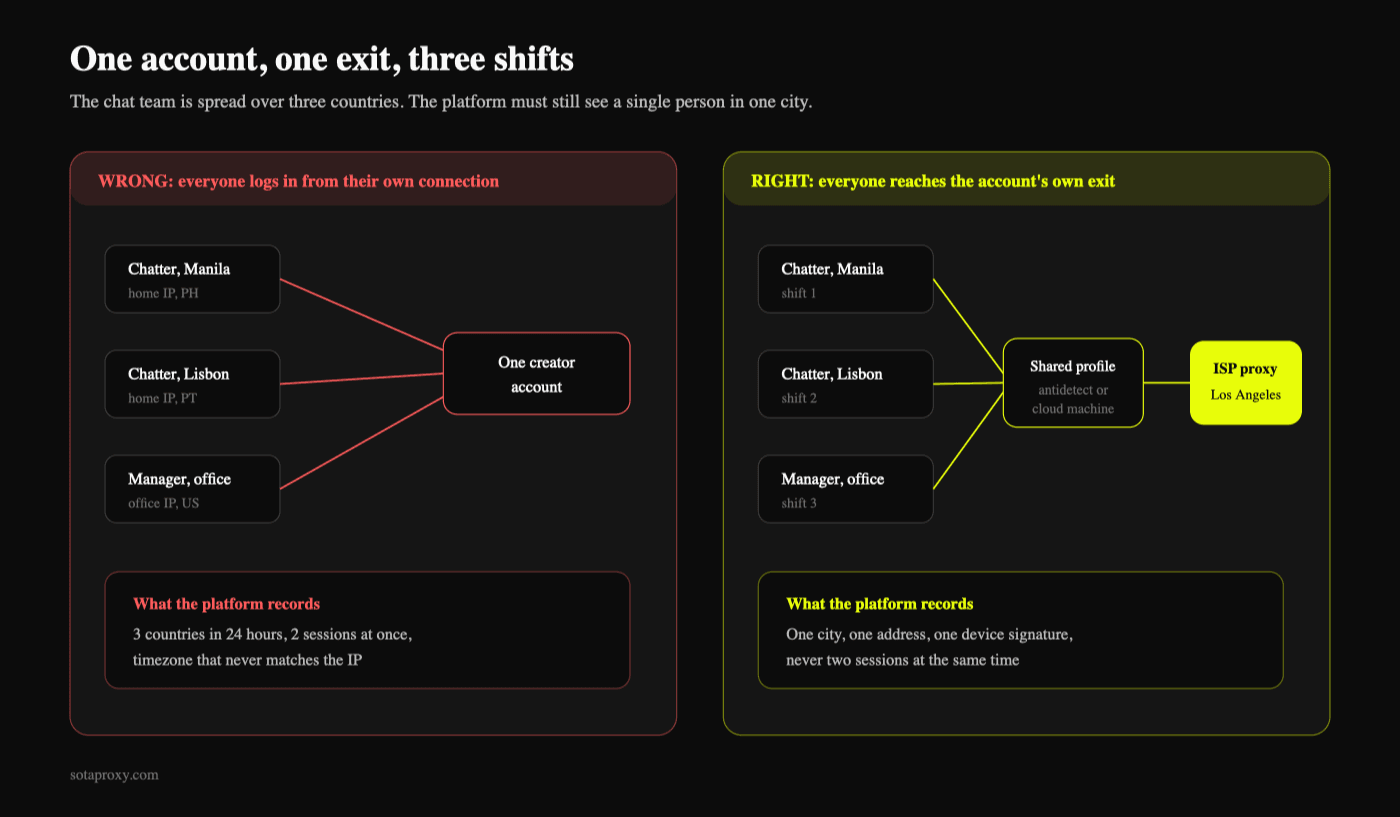
How OnlyFans Agencies Run 20 Creator Accounts Without Linking Them
What actually links creator accounts, which proxy type each one needs, how chatters in three countries share a single login, and what the isolation layer costs next to a 20 to 50 percent agency share.
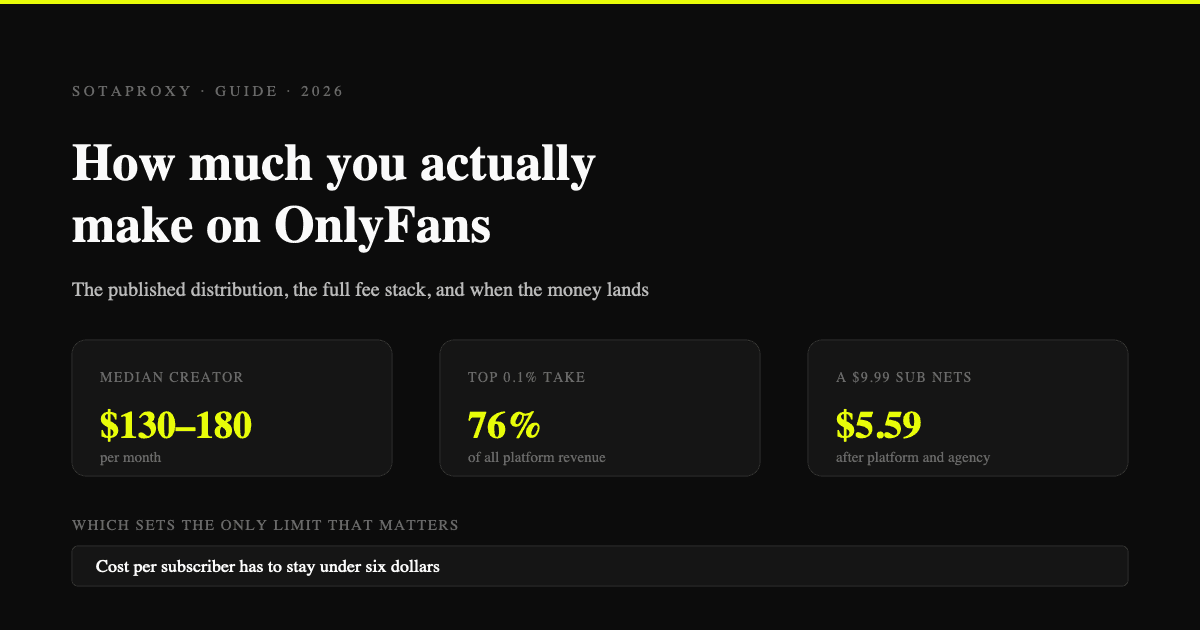
How Much You Actually Make on OnlyFans in 2026: The Full Fee Stack
The published earnings distribution, every cut between a fan's dollar and your bank account, when the money actually lands, and the one metric that decides whether promotion works.

What a Multi-Accounting Stack Actually Costs in 2026
Real monthly numbers for 10, 50 and 200 accounts: antidetect profiles, proxies, numbers, cloud phones and card fees, with the one line item that eats three quarters of the budget.
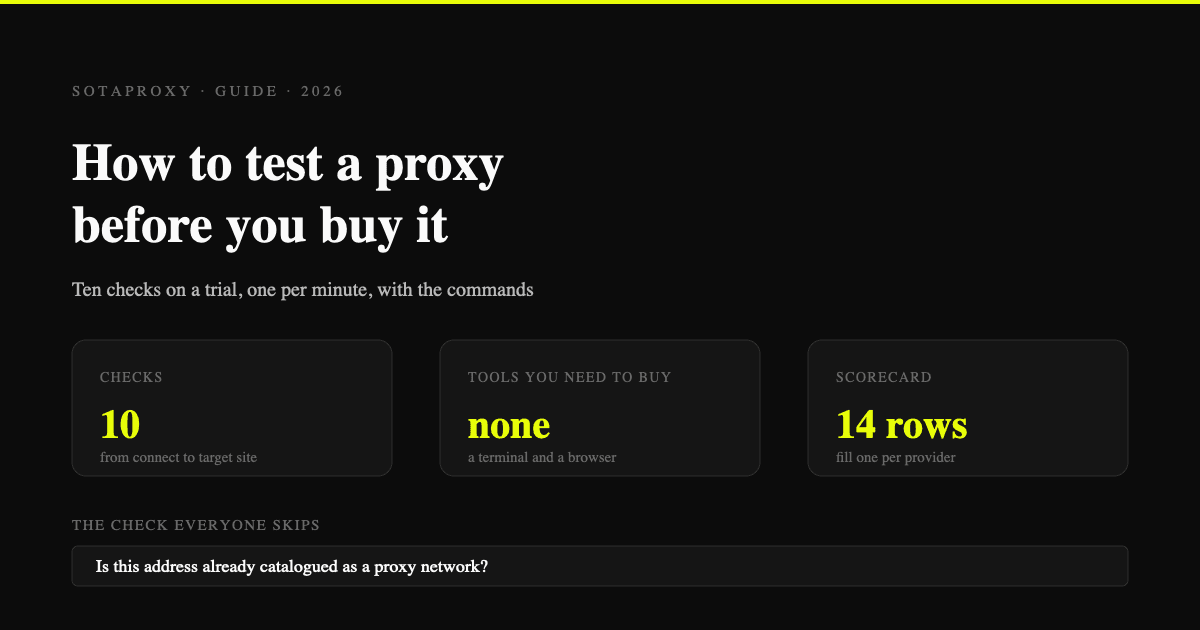
How to Test a Proxy Before You Buy It: A 10-Minute Checklist
Ten checks that tell you whether a proxy trial is worth paying for: exit ASN, hosting flags, rotation behaviour, subnet spread, DNS and WebRTC leaks, and success rate on your own target.

How to Make Money With Web Scraping in 2026: Five Models, Priced
Five ways scrapers get paid, what each one charges, and what a scrape actually costs to run, measured on real pages: HTML-only against a full browser render.

Top Brightdata Alternatives for Proxy Teams in 2026
Explore the best brightdata alternatives for scraping, ad verification, and geo-targeted campaigns in 2026, plus migration tips.