How Many Instagram Accounts Can You Have in 2026 (And What Gets Them Banned)
The five-account switcher is a device limit, not a policy. Instagram's action limits by account age, how it links accounts, the enforcement ladder, and how to recover a restricted account.
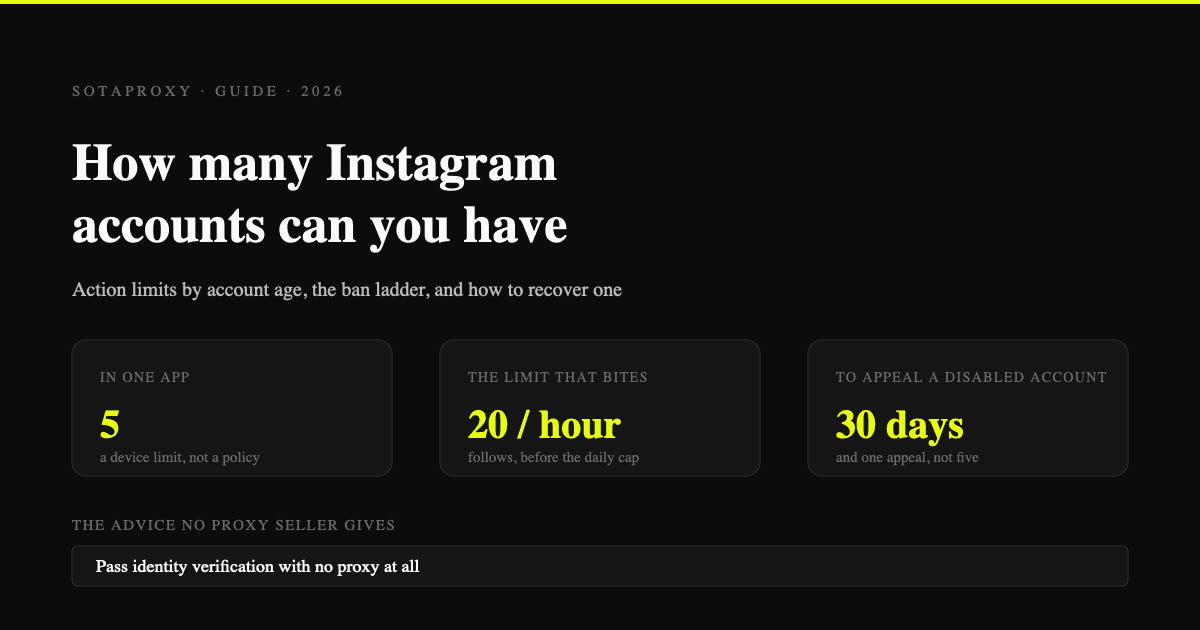
Instagram lets you hold five accounts in one app and switch between them with two taps. That number is the answer to a different question than the one people are asking, and confusing the two is why rosters get grouped and removed together.
The short version: more than five accounts is allowed; five accounts in one installation is the problem. Below are the action limits that actually trigger blocks, the signals Instagram uses to tie accounts together, what the enforcement ladder looks like step by step, and what to do when an account is already restricted.
How many Instagram accounts can you actually have?
Three separate numbers get quoted as if they were one.
- Five. The number of accounts the mobile app will hold and switch between, tied to one device or one email. This is an interface limit.
- No published maximum. Instagram does not state a cap on how many accounts one person may own. Multiple accounts are permitted.
- As many as you can keep separate. The operational answer, and the only one that predicts survival.
The distinction matters because the five-account switcher is the single most common way a set of accounts gets grouped. All five share one device, one fingerprint, one IP and usually one recovery email. If Instagram restricts one of them, it has everything it needs to reach the rest.
The same three-number confusion exists on every platform, and the comparison is in how many accounts you can have on each platform.
What are Instagram's action limits in 2026?
Limits scale with account age and history, which is why the same script that runs safely on a two-year-old account gets a fresh one blocked in an hour. Reported ranges, not published figures, so treat them as ceilings to stay well under rather than targets:
| Action | New account, 0 to 3 months | Established account |
|---|---|---|
| Follows | roughly 100 to 200 per day | 300 to 500 per day, about 20 per hour |
| Likes | 100 to 300 per day | up to 1,000 per day, about 20 per hour |
| Comments | a handful per hour | 12 to 14 per hour, with pauses of several minutes |
| DMs to followers | 20 to 50 per day | around 100 per day |
| DMs to non-followers | avoid entirely | 30 to 40 per day |
| Total accounts followed | no separate limit | hard ceiling of 7,500 |
Two practical readings of that table.
The hourly limit bites before the daily one. Twenty follows in an hour is the usual trigger, so a script that does 300 follows in two hours breaks the rules even though 300 a day is inside the range.
A new account is not a small version of an old one. For the first three months treat every limit as roughly a third of the established figure. Most "Instagram banned me for no reason" stories are an account under 90 days old running at veteran speed.
Why does the five-account switcher get accounts banned?
Because it removes every separation that matters while looking convenient.
Inside one app, five accounts share:
- the device identifiers and the browser or app fingerprint;
- the IP address, which is one home or office connection;
- often the recovery email and phone, because that is what was to hand;
- the behaviour pattern, because one person operates all five at the same hours in the same way.
None of that is against the rules. It simply makes the five accounts one entity in Instagram's eyes, which is fine until one of them does something the platform does not like. Then the association that was harmless becomes the delivery mechanism for the restriction.
How does Instagram link two accounts?
In rough order of how strong the signal is:
- Device and app identifiers. The strongest link, and the one the in-app switcher guarantees.
- Recovery email and phone number. A shared number is a hard link, and it is also the thing that unlocks the account later, which makes it expensive to reuse and dangerous to share.
- IP address. One connection behind several accounts, especially if they log in within minutes of each other.
- Behaviour. Same hours, same rhythm, same content, mutual follows and likes between your own accounts.
- Contact graph. Uploaded contact lists and overlapping followers.
The countermeasures map one to one: a separate profile in an antidetect browser or a separate device for the first, its own number and email for the second, a static address for the third, and process discipline for the last two. The full mapping, with what each measure does not fix, is in how agencies run twenty creator accounts without linking them.
What does the enforcement ladder look like?
Instagram rarely jumps to a ban. The sequence, and what each step means:
- Action block. "Try again later" on follows, likes or comments. Usually lasts 24 to 48 hours and applies to the specific action, not the account. It is a rate-limit message, not a judgement.
- Feature limit. Longer restrictions on specific features, often after repeated action blocks.
- Login verification. A code by email or SMS when the account is seen from a new device, a new IP or an unusual country. Not a punishment, but a fork in the road: fail it and you are in the recovery flow.
- Account disabled. The account stops loading and you are told you can appeal, typically within 30 days.
- Identity verification. In the appeal flow, Instagram asks for a code by email, then a code by SMS, then a selfie or a short video selfie to confirm a real person. Instagram states the video is not shown anywhere and is deleted from its servers within 30 days.
The step to respect is the first one. An action block on a young account means the account is running too fast for its age, and the fix is pacing rather than a new proxy.
What do you do when an account is restricted?
The recovery playbook, in order, and one piece of counterintuitive advice.
- Stop all activity on that account. No retries, no scripts, no extra logins. Each failed attempt adds noise to the review.
- Do not create a replacement account on the same device, number or address. This is ban evasion by Instagram's definition, and it puts the rest of the roster in the blast radius.
- Appeal once, inside the window, and then wait. Repeated appeals queue behind each other and slow the decision.
- Pass identity verification from the most boring network you have. This is the exception to everything else on this site: for a selfie or ID check, use a normal mobile connection, no proxy, no VPN, no filtering, in steady light, without a hat or glasses. The check is about matching a face to a person, and an unusual network path turns a five-minute step into a repeated failure.
- Expect the number to matter. If the account was registered on a number you no longer control, recovery is usually over. That is the practical reason to keep registration numbers rather than burn them.
If the account held money or a payout, treat the whole roster as under review and slow everything else down for a week.
How do you set up account number two properly?
Short version, in the order that matters:
- Name the purpose in one sentence, and make sure it differs from account number one. Duplicated purpose is what platform policies target.
- Its own email and its own number, both of which you keep.
- Its own browser profile or device, not a second slot in the same app.
- Its own static address if the account will hold a balance, a shop or a payout.
- Its own warm-up. Two weeks of ordinary use before any volume: no mass follows, no imported lists, no automation.
- Verify the setup before the first login, not after the first problem. The ten-minute version of that check is in how to test a proxy before you buy it.
The cost of all that is two to three dollars a month per account, which is worked out line by line in what a multi-accounting stack actually costs.
What does a two-week warm-up actually look like?
Nobody publishes this, and it is the difference between an account that survives month one and an account that collects action blocks. Numbers are deliberately under the ceilings from the table above, because the point of a warm-up is to build history, not to test limits.
| Day | Follows | Likes | Comments | DMs | Posting |
|---|---|---|---|---|---|
| 1 to 3 | 0 to 10 | 10 to 20 | 0 | 0 | profile photo, bio, one post |
| 4 to 7 | 10 to 20 | 20 to 40 | 1 to 3 | 0 | one post or story per day |
| 8 to 14 | 20 to 40 | 40 to 80 | 3 to 5 | only replies | daily, plus stories |
| 15 onward | scale toward the established column | 10 to 20 outbound | normal rhythm |
Three rules that matter more than the numbers:
- Consume before you act. Scroll, watch stories, open profiles. An account that follows fifty people before it has ever looked at a feed is not a new user, it is a script.
- Keep the hours human. Two or three sessions a day at plausible local times for the account's stated location, not a flat rate around the clock.
- Never mutually follow your own accounts. It is the cheapest possible link and it is invisible to you until the whole group is grouped.
Does a personal, creator or business account change anything?
Not the limits. It changes what gets linked.
A creator or business profile can be connected to a Facebook Page, an Accounts Center identity and an ad account, which is often necessary and is also a fresh set of shared signals between accounts. If two creator profiles sit under the same business identity, they are related by design, not by accident.
Practical reading:
- Keep personal identity out of it where the account is a working asset.
- One business identity per account cluster, not one identity spanning unrelated accounts.
- Switch to professional only when you need what it gives you, which is insights, scheduling and ads. If the account does not need those, the extra linkage is a cost with no return.
What does a proxy fix here, and what does it not?
It fixes exactly one link in the list above: the IP address. A static residential or ISP address per account keeps two accounts from sharing one connection, and keeps the connection stable enough that a login does not look like a trip across three countries.
It does not fix the device fingerprint, a shared phone number, mutual follows between your own accounts, or an account running at triple the speed its age allows. And, as above, it actively gets in the way during identity verification.
That is the whole honest claim. Anyone selling a proxy as ban protection for Instagram is selling you one link out of five.
FAQ
How many Instagram accounts can I have on one phone?
Five in the official app. More than five is allowed as accounts, they just cannot live in the same installation, and five in one app is the arrangement most likely to get them grouped.
Does Instagram ban you for having multiple accounts?
Not for the count. Restrictions follow impersonation, inauthentic behaviour, ban evasion and running past the action limits. Several accounts with genuinely different purposes are within the rules.
How long does an Instagram action block last?
Typically 24 to 48 hours on the specific action. Repeated blocks escalate into longer feature limits, so the correct response is to slow down rather than to switch addresses.
How long do I have to appeal a disabled account?
Around 30 days, and one appeal is better than several. The flow usually runs email code, SMS code, then a selfie or video selfie.
Should I use a proxy while passing the selfie verification?
No. Use an ordinary mobile connection with no proxy or VPN. Identity checks are the one step where an unusual network makes things worse rather than better.
Can I use the same phone number for two Instagram accounts?
Technically sometimes, operationally never. A shared number is a hard link between the accounts and the single point of failure in recovery, because the number that registered the account is what unlocks it later.
What is a safe number of accounts to run?
As many as you can give a distinct purpose, its own identity signals and actual supervision. The infrastructure cost is trivial; attention is the real ceiling.
Related articles
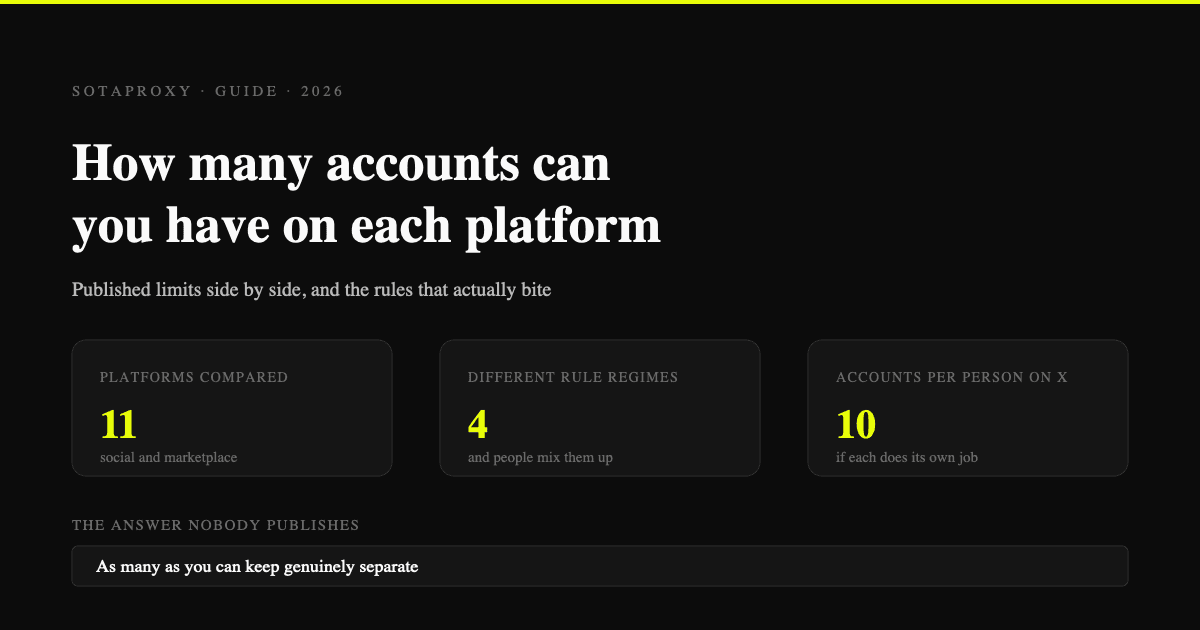
How Many Accounts Can You Have on Each Platform in 2026
Published limits for eleven platforms side by side, the four different rule regimes behind them, and why the number in the app is never the real constraint.
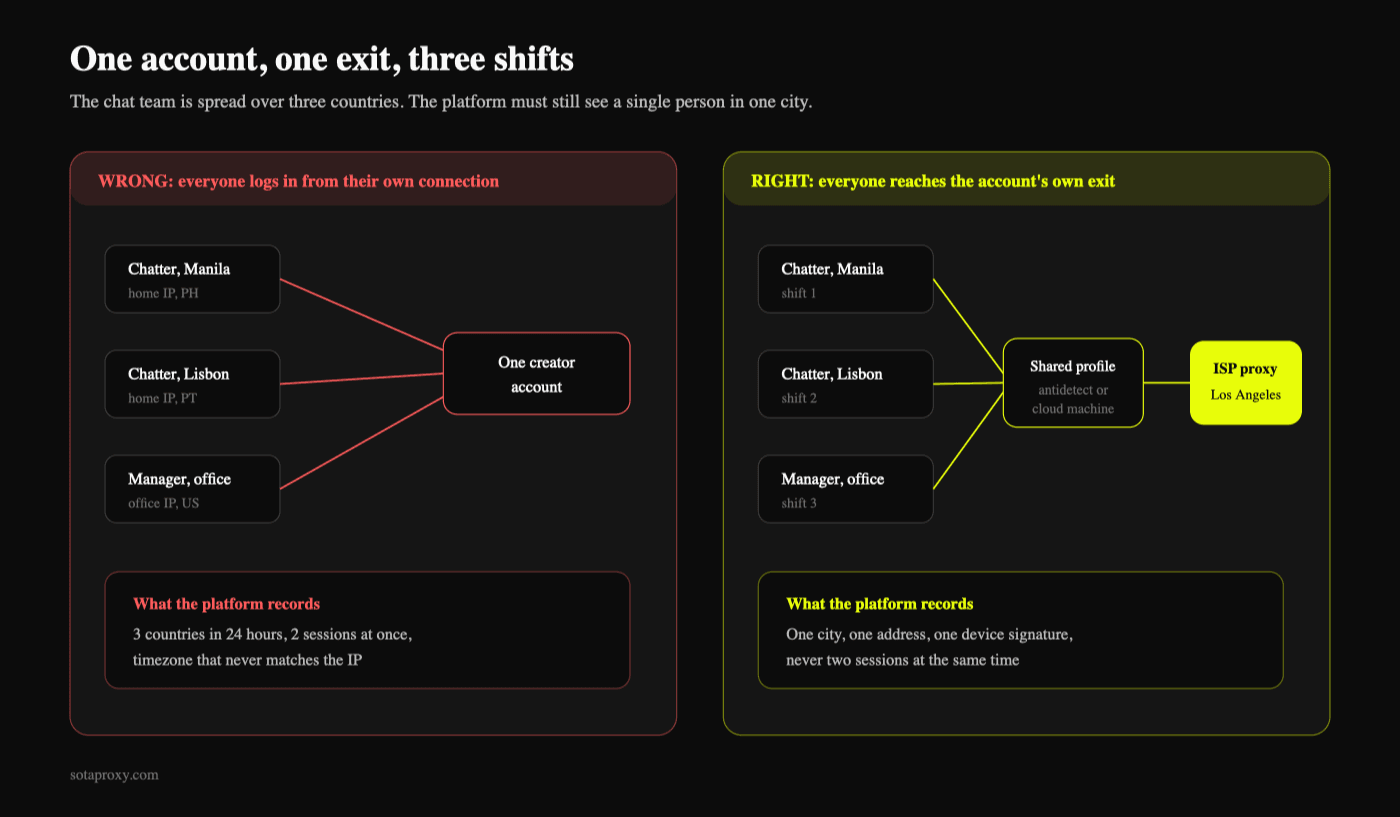
How OnlyFans Agencies Run 20 Creator Accounts Without Linking Them
What actually links creator accounts, which proxy type each one needs, how chatters in three countries share a single login, and what the isolation layer costs next to a 20 to 50 percent agency share.
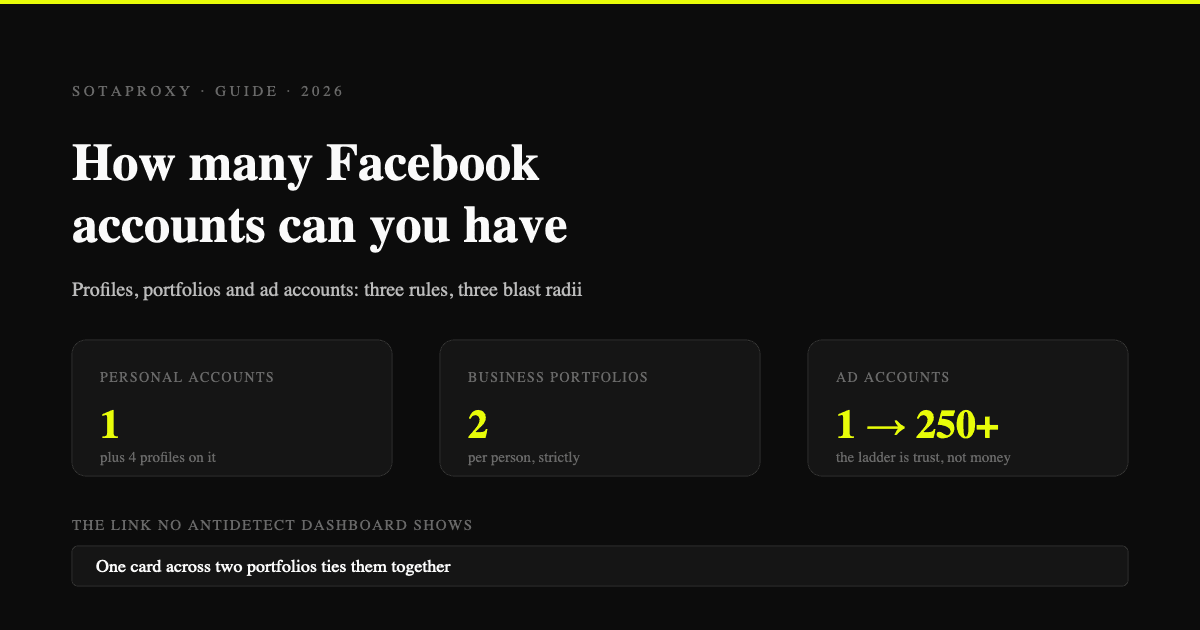
How Many Facebook Accounts Can You Have in 2026 (Profiles, Portfolios, Ad Accounts)
One personal account, four additional profiles that share its enforcement, two business portfolios per person, and an ad account limit that grows with trust. What actually gets restricted and in what order.
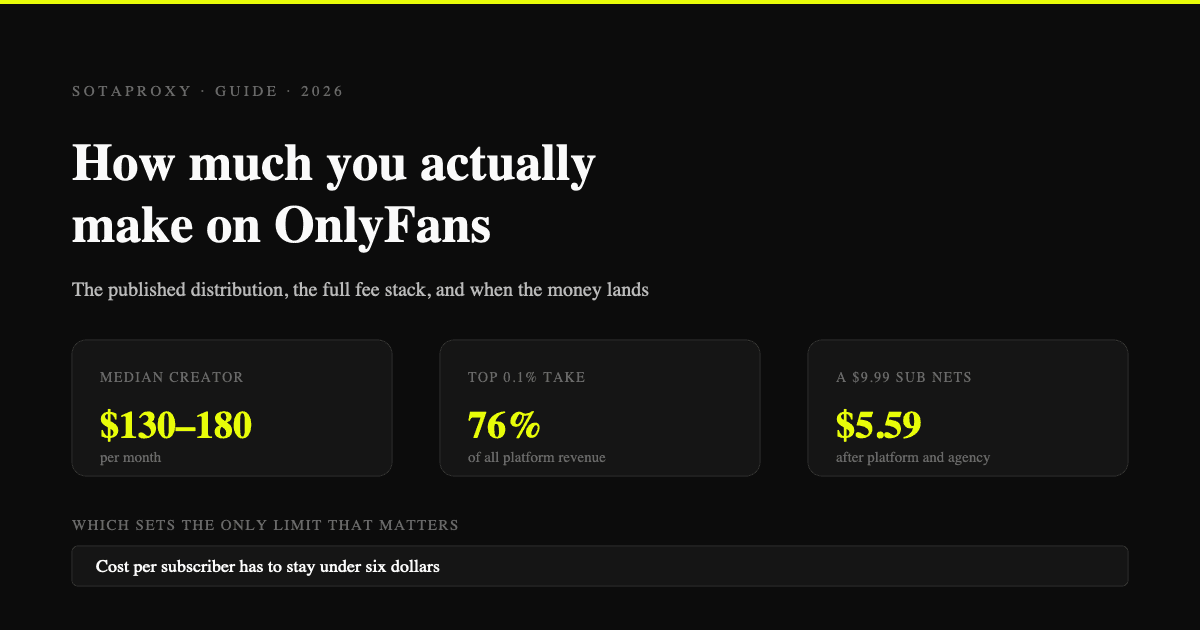
How Much You Actually Make on OnlyFans in 2026: The Full Fee Stack
The published earnings distribution, every cut between a fan's dollar and your bank account, when the money actually lands, and the one metric that decides whether promotion works.

What a Multi-Accounting Stack Actually Costs in 2026
Real monthly numbers for 10, 50 and 200 accounts: antidetect profiles, proxies, numbers, cloud phones and card fees, with the one line item that eats three quarters of the budget.
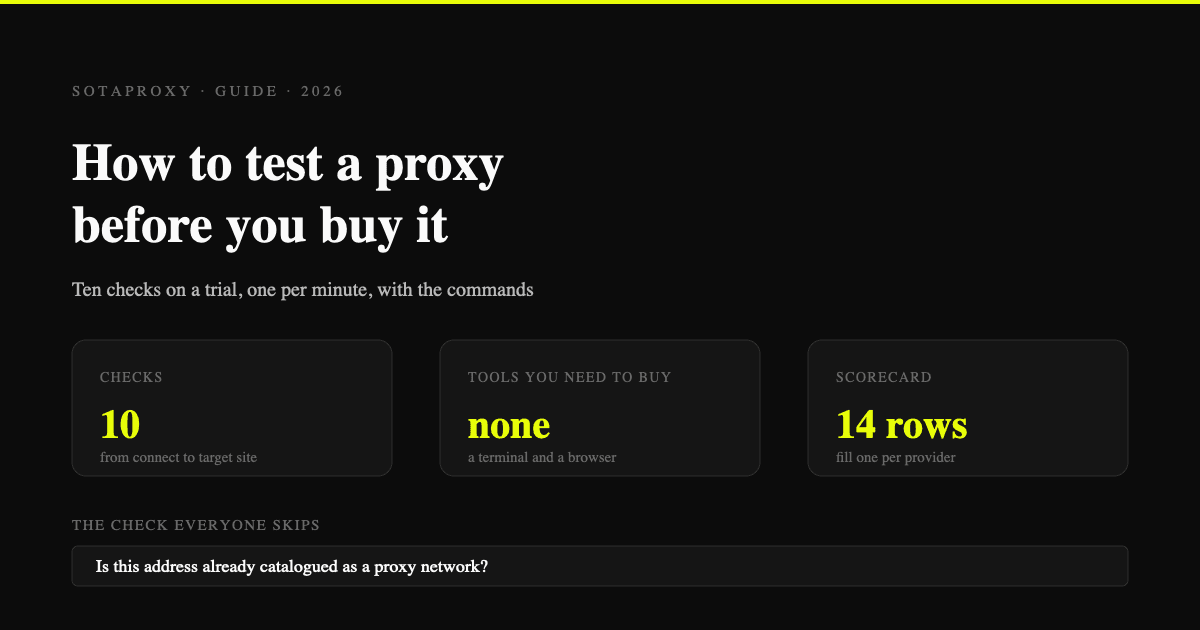
How to Test a Proxy Before You Buy It: A 10-Minute Checklist
Ten checks that tell you whether a proxy trial is worth paying for: exit ASN, hosting flags, rotation behaviour, subnet spread, DNS and WebRTC leaks, and success rate on your own target.