Mastering Node Web Scraping: Advanced Anti-Detection 2026
Master node web scraping in 2026! Build production-grade tools covering proxy rotation, fingerprinting, and anti-detection for high-stakes data extraction.

Most advice on Node web scraping is built for demos, not operations. A script that pulls a few pages on your laptop says nothing about whether it can survive Facebook ad account checks, TikTok workflow scraping, account farming pipelines, cloaking audits, or geo-targeted campaign validation without burning IPs and profiles.
That gap matters more now because scraping is no longer a side task. The global web scraping market is projected to surpass $9 billion USD by the end of 2025, with estimated growth of 12% to 15% CAGR through 2030, while scraping saved companies an estimated 30% of the time spent on manual collection in 2024, according to 2025 web scraping market and efficiency projections. The operational problem isn't how to select a DOM node. It's how to keep extraction stable when anti-bot systems score every request.
Traffic arbitrage teams already know the basics. The hard part is running Node.js scrapers alongside antidetect browsers like AdsPower, Dolphin Anty, GoLogin, Multilogin, and Hidemyacc, while keeping fingerprints, sessions, geos, and proxy behavior aligned. That's where most tutorials stop being useful.
Table of Contents
- Node Web Scraping Beyond the Basics
- Architecting Your Node JS Scraping Toolkit
- Evading Blocks with Advanced Anti Detection
- Integrating Proxies for Scalable Operations
- Building a Resilient and Scalable Scraper
- Navigating CAPTCHAs and Ethical Lines
Node Web Scraping Beyond the Basics
Node web scraping gets oversimplified. Most guides teach request, parse, export. That's fine for a catalog page. It falls apart when the target fights back, when your scraper shares infrastructure with Facebook and TikTok ad account operations, or when an antidetect profile has to stay believable across repeated sessions.
For multi-account operators, scraping isn't isolated. It sits next to account warmup, campaign checks, landing page QA, cloaking verification, and geo validation. A fetch failure can waste buyer time. A fingerprint mismatch can poison a profile used later in AdsPower or GoLogin. A bad proxy assignment can trigger review friction on a farmed account that was stable the day before.
The production mindset is different. You don't ask, "Can this script scrape the page?" You ask:
- Can it keep session behavior consistent across account farming and ad account management workflows?
- Can it separate cheap collection jobs from sensitive account-linked jobs so one doesn't contaminate the other?
- Can it fail safely without hammering a target or corrupting your own data?
- Can it stay believable when the same geo, timezone, language, and browser fingerprint must line up?
Practical rule: If a scraper touches infrastructure that also touches ad accounts, treat it like account infrastructure, not a throwaway script.
That means tighter isolation, better logs, and cleaner proxy strategy. It also means dropping beginner assumptions, especially the idea that "just add Puppeteer" solves protected targets. It doesn't. It often makes detection easier if the browser, TLS behavior, timezone, and IP reputation don't match.
A lot of teams discover this only after scaling. Then they start rebuilding around proxy pools, controlled concurrency, and profile-aware request flows. If you're running serious data collection, it helps to look at web scraping infrastructure patterns used for large-scale operations with that production lens from day one.
Architecting Your Node JS Scraping Toolkit
Tool choice decides cost, speed, and detection surface. Pick the wrong stack and you'll either overspend on browsers or underbuild and get blocked on dynamic targets.
Choose the lightest tool that can finish the job
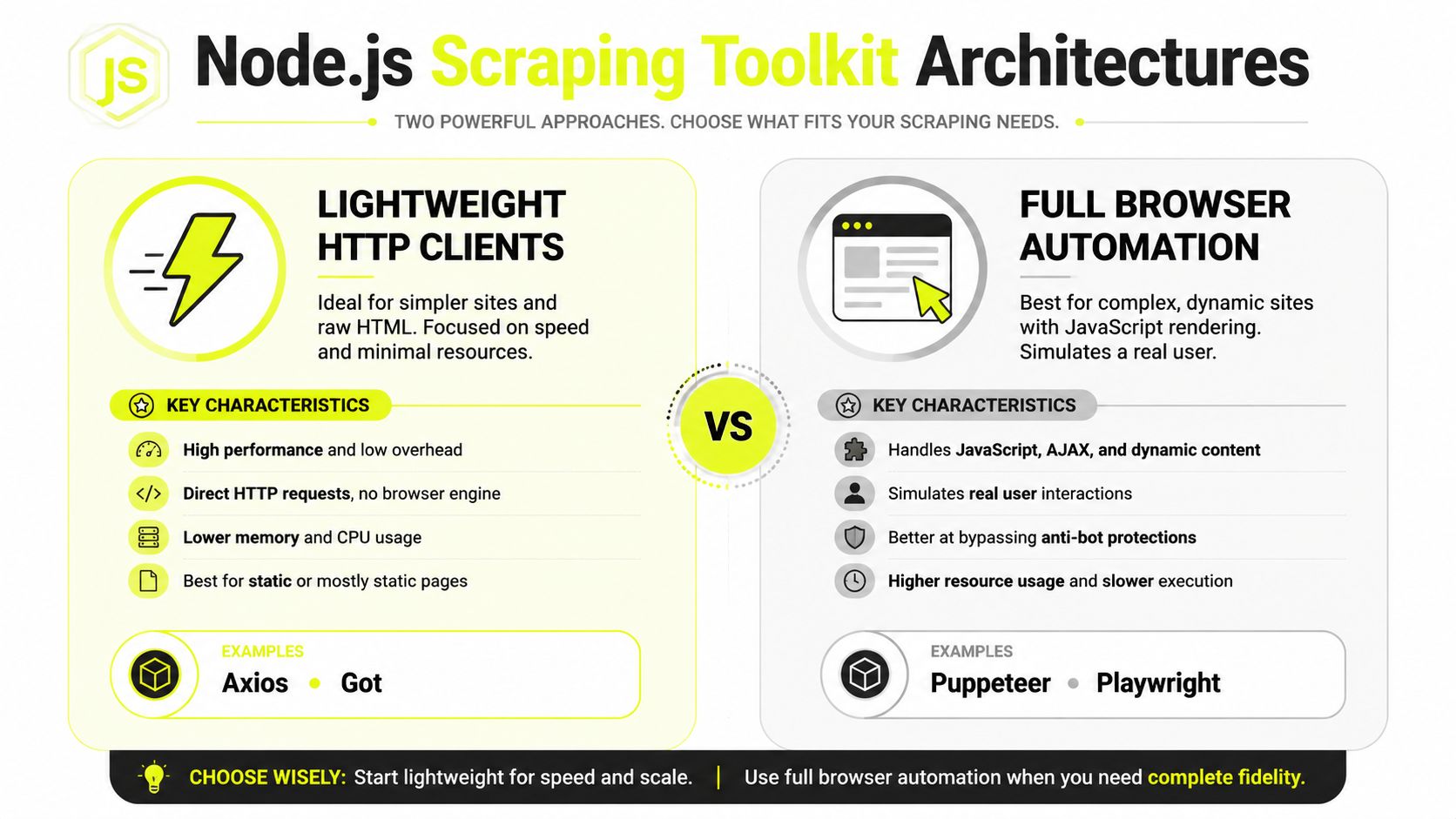
For static pages, internal APIs, and simple server-rendered targets, an HTTP client plus parser is still the best first move. In Node, that usually means Axios or Got for requests, then Cheerio for extraction.
That stack works well when you need raw speed and low RAM use. It's ideal for jobs like:
- Landing page checks across many geos
- Ad library collection where the data sits in predictable HTML or accessible APIs
- Price or offer monitoring for arbitrage comparisons
- Cloaking verification on simple redirect chains
The advantage is operational. You can run more workers per machine, keep request overhead low, and debug at the HTTP layer without browser noise. For traffic teams, that matters when you need many cheap checks instead of perfect rendering.
But this path has limits. It won't execute client-side JavaScript. It won't behave like a full browser. It won't carry realistic browser state unless you build a lot of that behavior yourself.
When browser automation stops being optional
Playwright and Puppeteer become necessary when the target is a JavaScript-heavy app or when page state only appears after rendering and interaction. Social platforms, ad dashboards, ecommerce SPAs, and anti-bot-heavy flows usually land here.
Many teams overestimate Puppeteer. Launching Chromium isn't the same as blending in. According to analysis of protected-site scraping tools and architectures, headless browsers like Puppeteer are often insufficient for modern targets using canvas fingerprinting and AI-driven bot detection, which account for 73% of enterprise scraping failures in 2025, while serverless browser automation can achieve 94% success rates against protected sites.
That doesn't make Playwright or Puppeteer useless. It means you need to treat them as execution engines, not stealth solutions.
A practical split looks like this:
- Axios or Got plus Cheerio for speed-first collection
- Playwright when you need stronger control over modern app flows
- Puppeteer when your stack depends on Chromium-specific tooling or existing stealth ecosystems
- Serverless browser automation when the overhead of browser fleet management starts eating team time
Where serverless browsers fit
Managed browser platforms make sense when your bottleneck isn't parsing. It's operations. Browser crashes, stale stealth patches, broken CAPTCHA flows, and proxy-browser mismatch bugs consume more time than the extraction logic itself.
For ad operations, the main value is consistency. A managed browser layer can keep Chrome versions, execution environments, proxy rotation, and challenge handling more stable than a custom fleet glued together under deadline pressure.
Headless automation is a rendering tool. Anti-detection still depends on fingerprint coherence, geo alignment, and proxy quality.
If you're building in-house, keep the stack modular. Use one request layer, one parser layer, one browser layer, and one session layer. Don't hardwire everything into a single script. That makes it easier to swap HTTP clients for browsers only where needed, and easier to connect your scraper with Node.js proxy-aware integrations built for automation workloads when request routing gets more complex.
Evading Blocks with Advanced Anti Detection
Basic tutorials still push user-agent rotation like it's enough. It isn't. Serious targets score a full fingerprint, not a single header.

User agents are the easy part
Changing User-Agent helps only when everything else around it makes sense. If your browser says one thing, your TLS handshake says another, and your proxy exits from a country that doesn't match browser timezone and language, the request looks fake before the page even finishes loading.
That matters a lot for operators using AdsPower, Dolphin Anty, GoLogin, Multilogin, or Hidemyacc. Those tools exist to keep a profile coherent. If your Node scraper feeds or mirrors activity around those profiles, it has to respect the same coherence rules.
The common misses are predictable:
- Header drift such as
accept-languagenot matching the geo - Timezone mismatch between browser profile and proxy exit
- Viewport and platform mismatch that doesn't line up with the claimed device
- TLS mismatch where a request stack exposes a non-browser handshake
- Session contamination when one proxy pool services tasks with different trust requirements
Match the profile not just the IP
A critical nuance missed by most guides is TLS and browser fingerprint mismatch. According to industry data on scraper failures tied to fingerprint inconsistency, 68% of failed scrapers are blocked due to TLS handshake inconsistencies or timezone mismatches between proxy and browser, and ignoring that leads to 30% to 40% higher block rates.
If you're scraping around ad account management, this isn't academic. Facebook and TikTok don't evaluate one signal. They correlate many. An account opened through a residential proxy in one region and then scraped through a Node client presenting mismatched locale and TLS traits creates avoidable risk.
The anti-bot system doesn't care that your CSS selector is correct. It cares whether your request stack looks like a real browser attached to a real user in a real place.
That changes implementation choices. Sometimes a raw HTTP request is safer because it doesn't expose broken headless artifacts. Sometimes a full browser is safer because the target expects browser behavior and scores TLS. The wrong choice isn't just less efficient. It gets you blocked faster.
How operators keep fingerprints coherent
For sensitive tasks, keep the stack aligned at these layers:
Network identity
Proxy geo, ASN type, and session duration should fit the target action. Account farming and repeated ad account access need stable sessions. Broad collection jobs need wider rotation.Browser identity
Match timezone, language, screen metrics, platform hints, and browser build to the profile. If an antidetect browser profile says Berlin, don't let your scraper announce Miami time.Request identity
Keep headers internally consistent.accept-language,sec-ch-uavalues, encoding behavior, and navigation patterns should match the browser family you're impersonating.Interaction identity
Don't fire perfect intervals, identical click paths, or impossible page sequences. Especially on review-sensitive workflows.
Often, many teams start using fingerprint-aware clients or managed browser layers instead of bolting more stealth plugins onto Puppeteer.
A short demo helps frame the difference between generic browser automation and traffic that resembles a stable browser session:
If IP bans are already hurting your jobs, practical IP ban avoidance tactics for automation stacks usually matter more than another parser rewrite. Blocks are often infrastructure failures wearing an application mask.
Integrating Proxies for Scalable Operations
Proxies aren't a commodity add-on. They define trust, session behavior, and unit economics. If you're scraping data for ad account management, account farming, cloaking checks, or geo-targeted campaigns, proxy choice changes what you can do safely.
As anti-scraping controls become standard, proxies have become table stakes for large-scale scraping, and web scraping market analysis from Mordor Intelligence reports that North America led with 34.08% of market share in 2025, while Asia-Pacific is forecast to post the fastest growth. That market expansion tracks what operators already see. Every serious stack now treats routing and IP strategy as core infrastructure.
Proxy choice changes the outcome
Datacenter, residential, mobile, and IPv6 proxies don't solve the same problem.
Datacenter proxies are fast and cheap. They're good for high-volume tasks on low-sensitivity targets. Think public pages, lightweight crawling, offer aggregation, or first-pass checks where individual request trust doesn't matter much. They're also the first to get flagged on stricter platforms.
Residential proxies route through consumer IP space. They cost more, but they blend better on platforms that care about reputation and behavioral consistency. They're usually the default for login-adjacent scraping, ad account checks, and repeated access tied to one session.
Mobile proxies are what teams reserve for harder surfaces. On sensitive social targets, mobile trust is useful because the traffic pattern resembles real carrier traffic and shared mobile network behavior. They're slower and more expensive, so wasting them on easy jobs is bad ops.
IPv6 proxies can be useful for scale and cost efficiency where the target accepts IPv6 traffic cleanly. They aren't a universal bypass. Some targets handle IPv6 poorly, some flag it faster, and many account-sensitive workflows still behave better on carefully chosen IPv4-based residential or mobile routes.
Proxy Type Comparison for Node.js Scraping
| Proxy Type | Best Use Case | Anonymity/Trust | Cost |
|---|---|---|---|
| Datacenter | High-volume collection on low-sensitivity targets, broad crawling, simple monitoring | Lower trust on protected platforms | Low |
| Residential | Facebook and TikTok account-linked scraping, geo checks, repeated sessions, cloaking validation | High trust for consumer-like traffic | Medium to high |
| Mobile | Hard social targets, account farming, review-sensitive actions, difficult geos | Very high trust | High |
| IPv6 | Cost-aware scale where target supports IPv6 well, broad distribution tasks | Varies by target and implementation | Low to medium |
A lot of failures come from using one proxy class for everything. That doesn't hold up in production. Datacenter for bulk. Residential for session continuity. Mobile for the difficult edge cases. IPv6 where the target tolerates it.
Cheap proxies get expensive when they burn warmed profiles or force manual recovery on ad accounts.
A practical Node.js proxy pattern
In Node.js, keep proxy handling outside your business logic. Your parser shouldn't care which pool served the request. Build a request factory that accepts a target profile, risk level, and session policy, then selects the right pool.
A minimal pattern looks like this:
import got from 'got';
import { HttpsProxyAgent } from 'https-proxy-agent';

function buildClient({ username, password, host, port }) {
  const proxyUrl = `http://${username}:${password}@${host}:${port}`;
  const agent = new HttpsProxyAgent(proxyUrl);

  return got.extend({
    agent: {
      http: agent,
      https: agent
    },
    timeout: {
      request: 30000
    },
    retry: {
      limit: 0
    },
    headers: {
      'accept-language': 'en-US,en;q=0.9'
    }
  });
}

const client = buildClient({
  username: process.env.PROXY_USER,
  password: process.env.PROXY_PASS,
  host: process.env.PROXY_HOST,
  port: process.env.PROXY_PORT
});

const html = await client.get('https://example.com').text();
console.log(html.slice(0, 200));
That example is simple on purpose. In production, add session tags, geo selection, per-target header sets, and logging for which pool served which request. That's how you trace failures without guessing.
For rotation control, teams usually separate policy by task:
- Rotating sessions for page-level collection where each request can come from a new IP
- Sticky sessions for login flows, multi-step forms, account farming actions, and browser sessions that must look continuous
- Geo-pinned sessions for ad preview checks and local landing page validation
- Pool isolation so TikTok account work doesn't share exit behavior with broad scraping jobs
Rotation and sticky sessions for account work
Rotation isn't always better. For Facebook and TikTok account operations, constant IP churn can look worse than a stable session. A warmed account often needs a believable, persistent network identity. For broad scraping, the opposite is true. Reusing the same IP too long increases bans and throttling.
That operational split is why teams map proxy policy to workflow, not to codebase. The same Node project may use one route for public collection, another for account-linked browser actions, and another for geo-targeted ad checks.
If you're managing setups for clients or other buyers, proxy infrastructure can also become part of your revenue stack. Some providers run partner programs. Sota Proxy, for example, offers a referral and affiliate program with up to 40% commission. That's relevant for agencies and operators who already advise clients on proxy selection and routing.
For the mechanics of rotating pools and session persistence, proxy IP rotation patterns for automation and scraping are more useful than generic "use a proxy" advice. The routing policy is the strategy.
Building a Resilient and Scalable Scraper
Production scrapers fail in small ways first. A few empty pages. A parser that silently returns zero rows. A retry loop that keeps hitting the same broken route. If you don't instrument that early, the job looks healthy while the data degrades.
Start slower than you want
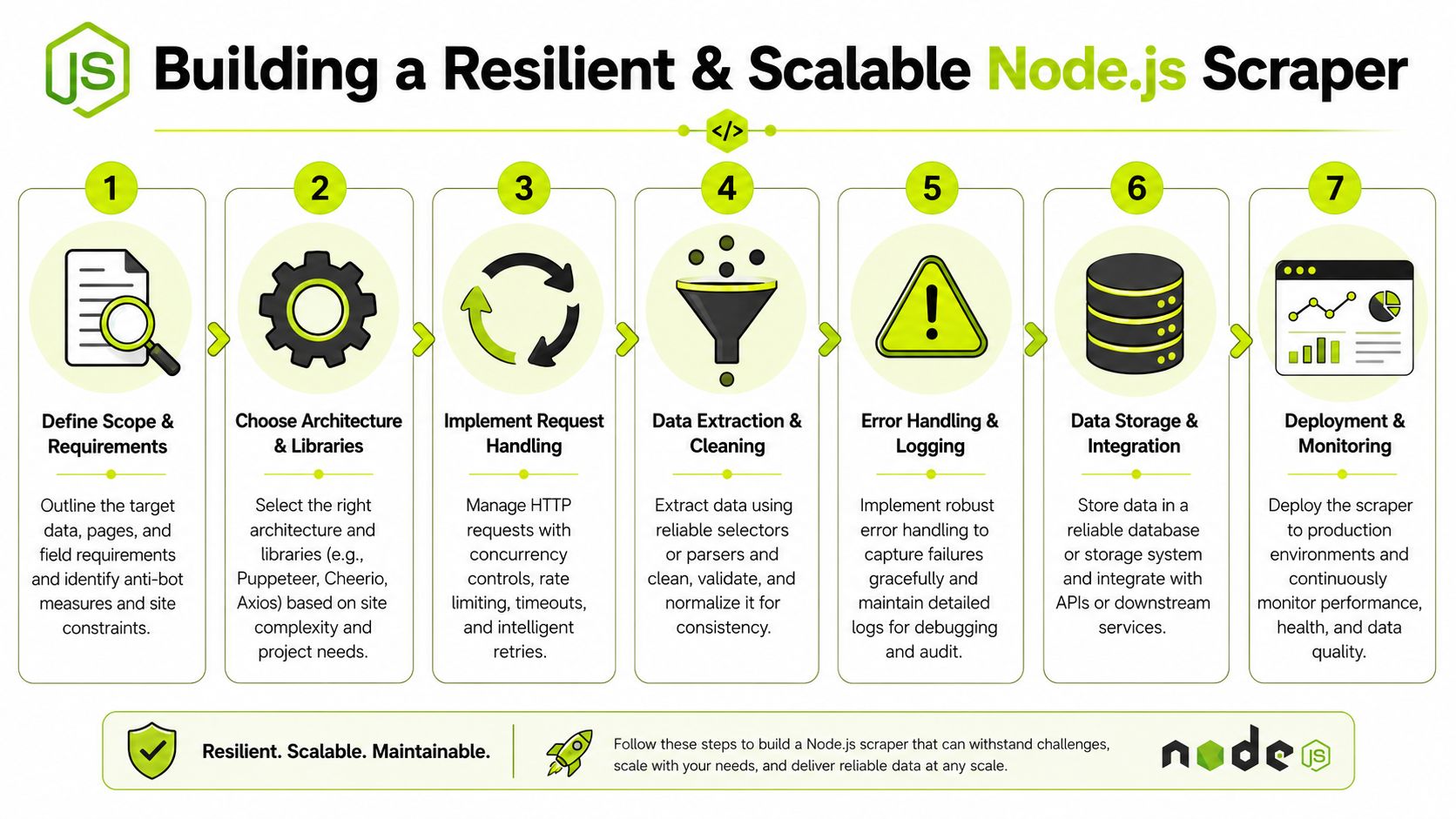
The most effective Node.js scraping methodology starts with low concurrency, measures fetch and parser success rates, and then increases load only after stability is confirmed, according to practical Node scraping guidance from Context. That's the right posture for high-stakes work because failure under load often hides whether the problem is parser drift, transport failure, or blocking.
Start with bounded concurrency per host. Not global concurrency. Per host. That's what keeps one noisy target from taking over the process.
Useful metrics include:
- Fetch success rate to see transport health
- Parser success rate to catch layout drift
- Records per page so partial failures don't look normal
- Duplicate rate to spot pagination or routing issues
- P95 fetch latency to identify degraded pools before they collapse
Save failure artifacts every time
When a scraper breaks, save the raw HTML before touching the parser. That one habit removes hours of guesswork. You can inspect whether the page changed, whether a challenge page appeared, or whether a proxy returned something unexpected.
A clean failure workflow looks like this:
- Request fails or parser returns zero records.
- Save raw response body with timestamp, target, proxy pool label, and session tag.
- Capture response headers and final URL after redirects.
- Alert on repeated zero-record pages before retrying at higher complexity.
- Only then decide whether to add browser rendering or a different proxy class.
Save the page that failed, not the assumption about why it failed.
Retries matter too, but they need intent. Use backoff. Bound attempts. Separate retryable errors from permanent ones. A 429, timeout, or transient gateway issue deserves another try. A broken selector doesn't.
Monitor what actually breaks
A resilient scraper acts more like a service than a script. It has queues, logs, metrics, and a persistence layer chosen for the job size.
For storage, keep it simple when the job is small. JSONL or CSV is fine for one-off collections and debugging. Move to PostgreSQL or MongoDB when you need dedupe, reprocessing, joins, or downstream reporting for media buyers.
A practical checklist for a Node web scraping deployment:
- Queue discipline so tasks don't burst beyond host limits
- Per-target config for headers, parser logic, and retry rules
- Structured logging with task ID, session ID, target, and proxy label
- Zero-record alerts because silent blocks are more dangerous than hard errors
- Fixture capture for failed pages
- Reprocessing path so parser fixes don't require full recollection
Use separate workers for browser jobs and plain HTTP jobs. Mix them and you'll create noisy latency, unstable memory use, and harder debugging. The browser side should be expensive and intentional. The HTTP side should be fast and disposable.
Navigating CAPTCHAs and Ethical Lines
CAPTCHAs are usually a symptom, not the root problem. If the target keeps challenging you, the first fix is better traffic quality. Cleaner residential or mobile routing, coherent fingerprints, and less aggressive behavior reduce challenge frequency more effectively than throwing solvers at every page.
When challenges still block a necessary flow, teams typically wire in solver services such as 2Captcha or Anti-CAPTCHA through API calls. That's a cost decision as much as a technical one. For account farming and ad account workflows, a solver can keep a job moving, but it won't repair a broken fingerprint or a dirty session.
On the data side, bad infrastructure can subtly corrupt output. According to reporting on scraping accuracy and infrastructure quality, over 27% of scraped data is duplicated, incomplete, or inaccurate because of poor request routing and untested proxy infrastructure. That is the actual business risk. You think the scraper worked. The dataset says otherwise.
Legal and ethical limits are operational concerns too. Check the target's Terms of Service. Read robots.txt even if it isn't the final legal authority. Keep concurrency low enough that you don't affect site performance. Pull only the public data you need. If your stack starts causing load spikes, challenge loops, or collateral damage for normal users, you're running a bad operation.
For teams that hit challenge pages often, it helps to keep a common vocabulary around CAPTCHA types and bypass workflow decisions so engineers, buyers, and account managers are discussing the same failure mode.
If you're running scraping jobs tied to ad ops, account farming, geo checks, or high-risk automation, Sota Proxy is built for that kind of workload. It gives teams access to residential, mobile, ISP, datacenter, and IPv6 pools across wide geo coverage, with rotation and sticky session controls that fit real operator workflows instead of toy scripts.
Related articles
What Is Sticky Session: A Technical Guide for Proxy Users
Learn what is sticky session, how session affinity works in load balancers and proxies, and when to use it for multi-accounting, scraping, and ad campaigns.

AdsPower Proxy Integration: The Complete Setup Guide
Step-by-step AdsPower proxy integration with SotaProxy. Covers setup, proxy types, rotation, troubleshooting, and best practices for multi-account workflows.

How to Build an Amazon Review Scraper That Actually Works
Build a reliable Amazon review scraper with proven proxy, anti-blocking, and parsing tactics. Step-by-step guide for technical operators and agencies.

How to Get Around an IP Ban: A Technical Guide for 2026
Facing an IP ban? Learn how to get around an IP ban with technical steps for diagnosing block types, choosing the right proxies, and configuring your stack.
Residential Backconnect Proxy: 2026 Guide & Best Practices
Master the residential backconnect proxy. A 2026 guide on how it works, its benefits over other proxies, and best practices for ad verification & account

Python Requests Headers: A Practical Guide for 2026
Master Python requests headers for web scraping and account automation. Learn to set User-Agent, Authorization, and use proxies to bypass blocks.