What Is Sticky Session: A Technical Guide for Proxy Users
Learn what is sticky session, how session affinity works in load balancers and proxies, and when to use it for multi-accounting, scraping, and ad campaigns.
A sticky session pins a client to the same backend server or exit IP for a defined time window, instead of rotating the route on every request. Common proxy sessions run from 10 to 60 minutes, while some providers support windows up to 72 hours.
You know the failure pattern. A Facebook or TikTok campaign starts normally, the antidetect browser keeps its cookies, and the account still looks healthy. Then the proxy rotates from one country to another, the ASN changes, the browser reconnects through a different network, and the account enters a review before the campaign has gathered useful data.
That's why “what is sticky session” matters beyond load-balancer theory. In practical proxy work, stickiness means preserving one network identity across a login, account-farming workflow, checkout, scrape, or geo-targeted campaign. It doesn't make an account safe by itself. It only removes one avoidable source of inconsistency.
Table of Contents
- Why Your Ad Accounts Get Flagged Without Sticky Sessions
- How Sticky Sessions Work Under the Hood
- Sticky Sessions Versus Stateless Approaches
- Implementing Session Affinity in Load Balancers and Proxies
- Hidden Pitfalls That Break Sticky Sessions in Production
- Sticky Session Workflows for Multi-Accounting and Scraping
- Choosing the Right Session Duration and Proxy Type
Why Your Ad Accounts Get Flagged Without Sticky Sessions
A media buyer launches a multi-geo campaign from an AdsPower profile. The profile starts through a residential route in one country, changes to a datacenter exit in another, then lands on a mobile carrier range somewhere else. The browser fingerprint may remain unchanged, but the network history no longer looks like one coherent user.
Platforms evaluate more than the visible IP address. They can observe session continuity, network ownership, location signals, cookies, device characteristics, and request behavior. A sudden country jump or ASN change can trigger an automated fraud review, especially when the account is logging in, creating campaigns, changing payment details, or managing several ad assets.
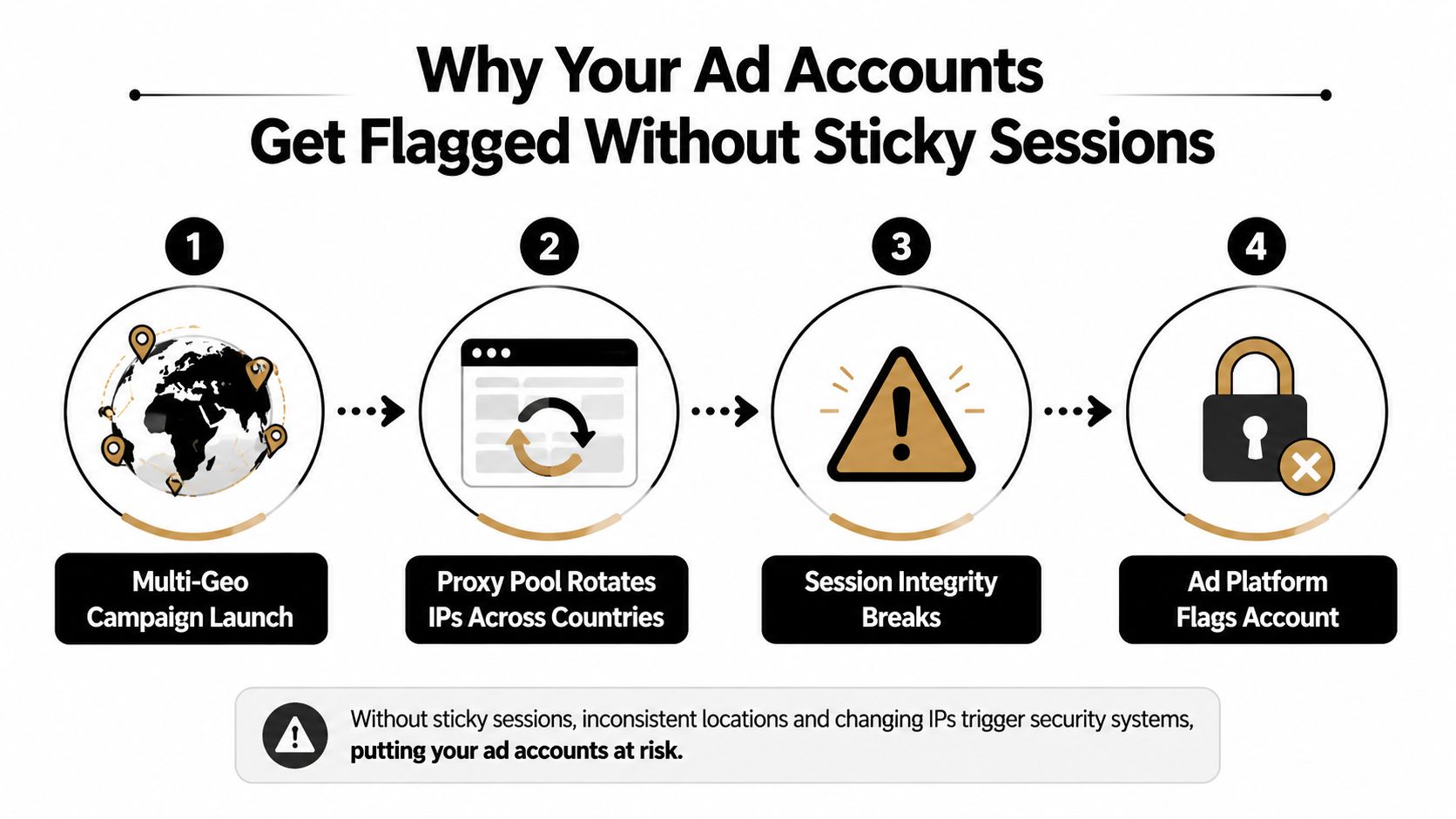
Sticky sessions address the routing problem by keeping consecutive requests tied to the same backend server or outbound IP during a configured window. In cloud infrastructure, that can mean session affinity between a client and an application server. In a proxy workflow, it usually means one browser profile keeps the same exit IP until the session expires.
Operational rule: Rotation is useful for separating requests. It's often harmful inside an authenticated user journey.
That distinction matters for Facebook and TikTok ad accounts, account farming, checkout flows, and cloaking operations. A rotating pool can distribute scraping requests across many addresses, but the same behavior can make an authenticated profile appear unstable. Use a sticky route for the identity-sensitive part of the workflow, then rotate between tasks when the workflow allows it.
Before assigning a proxy, check its reputation and geographic consistency with an IP reputation check. A sticky session preserves an exit route, but it can also preserve a poor route. If the IP has a bad history, keeping it longer won't improve the account.
How Sticky Sessions Work Under the Hood
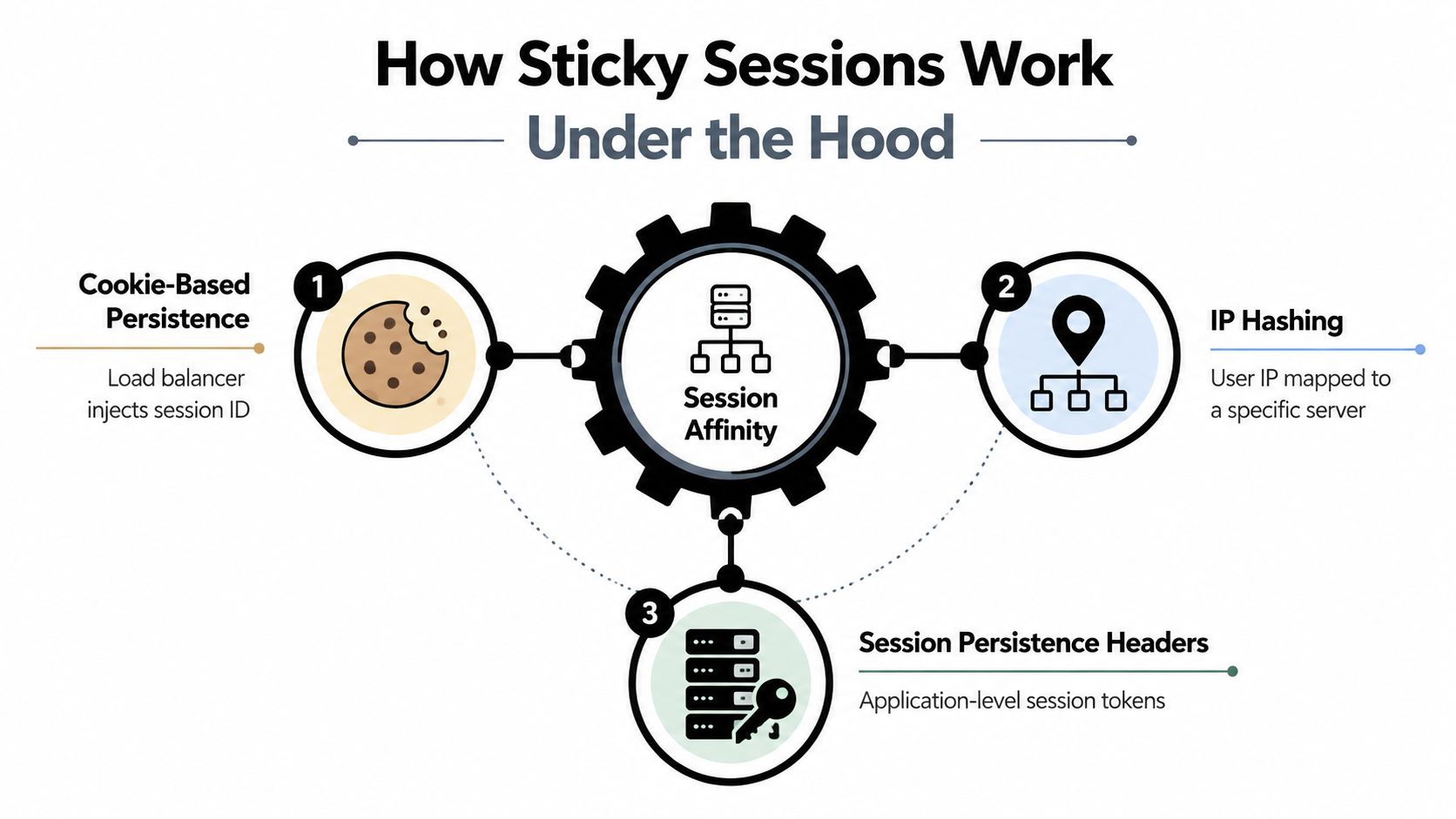
Session affinity has two separate meanings in a proxy stack. Server-side affinity keeps a client on one application backend. Proxy-side affinity keeps the client on one outbound exit IP. They can operate together, but one doesn't automatically provide the other.
Cookie-based persistence
A load balancer can set a cookie that identifies the selected backend. The first request reaches a healthy server, and the response includes a persistence cookie. Later requests carry that cookie back, allowing the balancer to route the browser to the same target.
HAProxy can insert a server identifier with a configuration pattern like this:
cookie SERVERID insert indirect nocache
Each backend server receives its own cookie value. The indirect behavior keeps the routing cookie away from the application, while nocache helps prevent an intermediary from reusing a response meant for another client. Application cookies can also participate when the application already owns the session token.
Nginx commonly uses ip_hash for source-based affinity. Cookie-based behavior may require an appropriate module or an application-level token. The important design choice is whether the routing layer trusts the browser cookie or derives affinity from the network address.
IP hashing
With IP hashing, the balancer runs the source address through a deterministic mapping. The same source address normally maps to the same backend while the server pool stays stable. Cloud documentation describes 2-tuple hashing, based on source and destination IP, and 3-tuple hashing, which adds the protocol type, as ways to route repeated requests consistently through a backend pool (Microsoft's load-balancer distribution modes).
This approach is simple and doesn't require a browser cookie. It also creates a serious NAT problem. Many users behind one corporate gateway or mobile carrier NAT can appear as one client, so the balancer may send unrelated sessions to the same server.
Provider-level session identifiers
Proxy networks use a different control plane. A provider assigns a session identifier through the username, password, API request, or dashboard. Requests carrying that identifier remain attached to one exit node until the provider's session policy expires or the node becomes unavailable.
For example, a proxy client might send a username containing a profile-specific session token. The provider maps that token to an exit IP, returns the same IP on later connections, and recycles the assignment when the token expires. The exact syntax varies by provider, so operators should confirm the session format rather than copy a username pattern blindly.
Provider documentation describes sticky sessions as holding one exit IP for a fixed window, with examples from 10 to 60 minutes and some services supporting sessions up to 72 hours (provider session-persistence guidance). A load balancer cookie keeps an application request on one server. A proxy session identifier keeps the browser's traffic on one outward-facing IP. For ad-account operations, the second behavior is usually the one that affects identity continuity.
Sticky Sessions Versus Stateless Approaches
Sticky sessions solve a narrow problem. They keep stateful traffic attached to one backend or one exit route. They don't remove the need to design session storage, handle failure, or control proxy identity.
A JWT takes a different approach. The token carries the session claims, so any healthy backend can validate it. A centralized store such as Redis or Memcached keeps session data outside individual application instances, allowing any backend to retrieve the same state. Both architectures reduce dependence on server-local memory.
Neither architecture pins a proxy exit IP. A stateless application can accept requests from different addresses, while Facebook, TikTok, an e-commerce site, or an account-management workflow may still see the network identity change. That's why a proxy user can need network-level stickiness even when the application itself uses JWTs or Redis.
| Dimension | Sticky Sessions | JWT (Stateless) | Centralized Store (Redis) |
|---|---|---|---|
| Infrastructure complexity | Easy to add to an existing stateful app, but requires affinity, expiry, and failover handling | Moves session state into signed tokens and simplifies backend routing | Adds a shared data service, connection management, and availability planning |
| Failure blast radius | A failed pinned server can break or reset local state | Any healthy backend can validate a valid token | Any healthy backend can retrieve shared session data while the store is available |
| Horizontal scaling behavior | New capacity may not receive existing sticky clients immediately | Requests can spread freely across healthy backends | Requests can spread while all backends share the same session source |
| Proxy compatibility | Keeps the application route stable, and can be paired with a sticky exit IP | Doesn't stop the proxy from rotating between requests | Doesn't stop the proxy from rotating between requests |
| Multi-accounting suitability | Strong fit when each profile needs stable server and network continuity | Useful for API authorization, but incomplete for profile identity | Useful for shared application state, but incomplete for outbound identity |
The rotating proxy server guide is relevant when the workflow benefits from changing addresses between independent requests. Don't apply that pattern inside a login or account-management sequence just because the pool makes rotation easy.
Implementing Session Affinity in Load Balancers and Proxies
Start by deciding what must remain stable. If the application stores session data in local memory, pin the client to an application server. If the target platform evaluates the browser's network identity, pin the outbound proxy session. Many production setups need both controls, but they should be monitored separately.
Nginx and HAProxy patterns
Nginx's ip_hash provides source-based affinity at the upstream layer. It works cleanly when the source address represents one meaningful client. It becomes unreliable behind shared NAT, where unrelated browsers inherit the same mapping.
HAProxy can use a cookie or a source-based stick table. A cookie pattern identifies the backend directly:
cookie SERVERID insert indirect nocache
A source-based table instead records the client key and its selected server for a defined expiry. Cookie affinity usually distinguishes browser sessions better. Source hashing remains useful when clients don't accept cookies, but you need to account for shared gateways.
HAProxy's failure behavior matters more than the happy path. An option such as redispatch allows the proxy to abandon a dead pinned server and select another healthy backend. That protects availability, but it can also expose a session to a server that doesn't have the original in-memory state.
Cloud and provider controls
Cloud load balancers expose native affinity settings through cookies, source-IP rules, or related session controls. AWS documentation gives a concrete example of a load-balancer-generated cookie with a 60-second expiration for Classic Load Balancer stickiness (Amazon's Classic Load Balancer stickiness documentation). This short window illustrates the design trade-off. Longer persistence preserves continuity, while shorter persistence lets traffic rebalance sooner.
Google Cloud describes affinity as a best-effort rule. The request can move when the backend becomes unhealthy or the pool topology changes, and hash-based fallback can preserve distribution without maintaining a separate sticky table (Google Cloud request distribution documentation).
| Method | Tool or Platform | Mechanism | Best For | Common Failure Mode |
|---|---|---|---|---|
| Cookie persistence | HAProxy, application load balancers | A cookie identifies the selected backend | Browser sessions that accept cookies | Cookie loss, cache interference, or dead backend |
| Source-IP hash | Nginx, HAProxy, cloud balancers | Source address maps deterministically to a backend | Clients with distinct, stable source addresses | NAT collisions and distribution skew |
| Stick table | HAProxy | A table stores a client key and affinity record | Expiring source or header-based persistence | Table expiry, memory pressure, or stale entries |
| Provider session ID | Residential and mobile proxy networks | A token maps a profile to an exit IP | Ad accounts, antidetect profiles, and authenticated flows | Provider node failure or IP recycling |
| Application cookie | Load balancer plus application | The app's token participates in routing | Existing stateful applications | Cookie lifetime mismatch or application logout |
For a broader infrastructure comparison, the 2026 load balancing solutions guide offers useful context on choosing between affinity and more distributed designs. Proxy operators should also separate the provider's session timeout from the site's cookie lifetime. A session can drift when either side expires first.
Hidden Pitfalls That Break Sticky Sessions in Production
Sticky routing fails because operators often test only consecutive successful requests. The browser stays on one IP during the test, so the setup looks correct. Production introduces dead peers, scaling events, shared NAT, expired cookies, and long-lived traffic that the simple test never exercises.
Failover and hot-server skew
A pinned backend can die during a login, checkout, or form submission. The load balancer then selects another healthy server, but that server may not have the original in-memory session. The user sees a logout, an empty cart, a rejected token, or a request that returns a generic server error.
The opposite problem is an overloaded healthy server. Long-lived sessions from bot traffic or active ad-management profiles can concentrate work on a small subset of nodes while other servers remain lightly used. Cloud guidance describes sticky routing as best effort and pairs it with health checks, expiration, and fallback because affinity can reduce distribution efficiency (Google Cloud's request distribution reference).
NAT collisions and session drift
Source-IP affinity treats the source address as the identity key. A corporate gateway or mobile carrier NAT can represent many independent users, so those users may share one backend mapping. The application must still isolate sessions with cookies or authorization tokens. Otherwise, poorly designed local state can leak across requests or produce confusing cross-account behavior.
Cookie expiration creates a different symptom. The load balancer may still consider a client sticky while the application has already removed its own session cookie. Or the application may retain a session after the affinity cookie expires. The next request reaches another node, and the user experiences intermittent authentication failures.
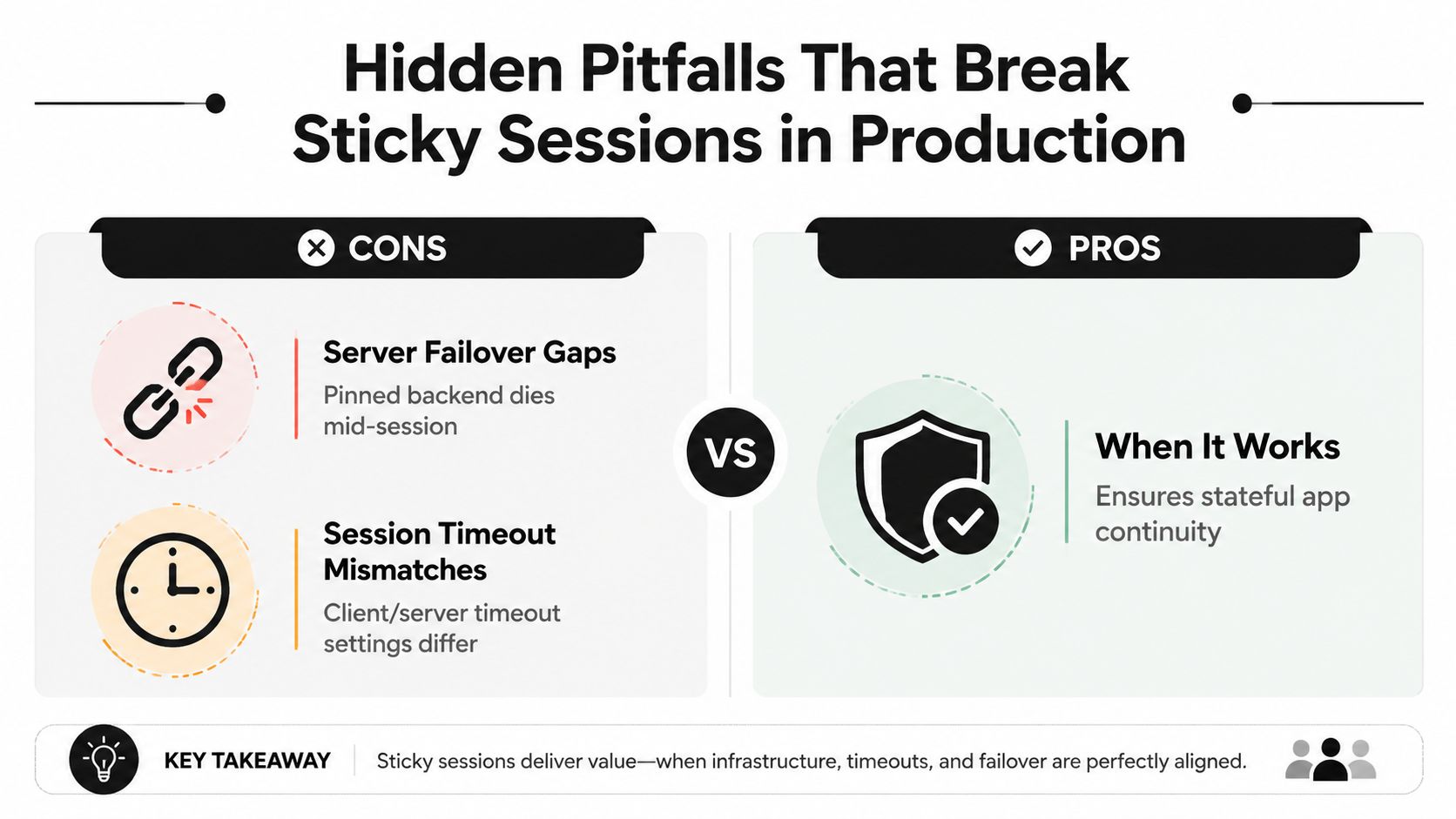
Proxy workflows add another layer of drift. A residential peer can disconnect, an ISP can recycle an address, or a geo-targeted route can return an IP from a different country after the session ends. Log the browser profile, session identifier, observed exit IP, country, ASN, backend identifier, cookie state, and failure reason together. That lets you distinguish a dead application node from a changed proxy route.
Monitoring signal: Alert on identity changes inside one authenticated task, not just on HTTP errors.
Sticky Session Workflows for Multi-Accounting and Scraping
For multi-accounting, the browser profile is the unit of identity. Create a separate profile in AdsPower, Dolphin Anty, GoLogin, Multilogin, or Hidemyacc, then assign that profile its own proxy session identifier. The profile's cookies, local storage, browser settings, and outbound IP should tell one consistent story.
That approach fits Facebook and TikTok account management, account farming, e-commerce logins, and geo-targeted campaigns. It doesn't guarantee approval or prevent enforcement. It avoids forcing one profile to appear in several unrelated networks during the same task.
Match stickiness to the task
A short session can suit a quick account check or a single verification flow. A longer session suits account warming, campaign editing, and extended authenticated work, provided the IP remains healthy and geographically appropriate. Don't keep a session alive merely because the dashboard allows it. A bad exit route becomes a persistent liability.
For scraping, sticky sessions preserve authentication across paginated requests and multi-step forms. Rotate the session identifier between independent target sites when you need isolation. Keep the same identifier within one site when changing the IP would force a login or invalidate a token.
Cloaking requires stricter separation. The reviewer path and user path should have controlled, auditable routing rules rather than accidental proxy rotation. Sticky sessions can preserve a consistent review or visitor route, but they don't make deceptive behavior compliant with platform policies. Treat the routing layer as an experiment boundary, not as a way to conceal prohibited activity.
A provider session API can assign, renew, and retire identifiers programmatically. In a mixed pipeline, operators may use sticky residential or mobile routes for account management and separate datacenter rotation for bulk scraping. The proxy category should follow the task, not the browser brand. More workflow detail is available in this guide to multiple account management.
Choosing the Right Session Duration and Proxy Type
Session duration should follow the longest uninterrupted action that needs one identity. A quick account check doesn't need the same persistence as campaign editing or an extended e-commerce workflow. Align the proxy TTL with the target site's cookies, then create a fallback for expiration in the middle of a task.
Residential proxies map to home ISP networks and generally fit account workflows, e-commerce activity, and geo-targeted browsing where a consumer-like network path matters. Mobile proxies use carrier networks and often sit behind carrier-grade NAT. That can provide familiar social-platform connectivity, but shared carrier addressing also makes IP-based identity less precise.
Datacenter proxies offer speed and predictable infrastructure for bulk scraping, testing, and high-volume requests where the target doesn't require a residential or mobile network. IPv6 proxies can provide a large address space and efficient routing, but compatibility depends on the target, application, and surrounding network stack. ISP proxies sit between datacenter infrastructure and ISP-associated addressing, making them useful when you need stable performance with an ISP-linked identity.
Sota Proxy provides controls for rotating and sticky sessions across residential, mobile, ISP, datacenter, IPv4, and IPv6 options. Its product material describes sticky sessions that can keep one IP through a user journey, while provider documentation generally frames persistence as a configurable, time-bounded assignment.
| Use Case | Proxy Type | Session Duration | Rotation Strategy |
|---|---|---|---|
| Ad account warming | Residential or mobile | Long enough to cover the planned authenticated work | Rotate only between separate tasks, not during one login flow |
| Multi-accounting | Residential, mobile, or ISP | Profile-specific TTL aligned with account activity | One session identifier per antidetect profile |
| Web scraping | Datacenter for bulk work, residential when geography or access requires it | Short or task-based | Rotate between targets, preserve stickiness within a paginated crawl |
| Geo-targeted campaigns | Residential or mobile in the required location | Campaign-task duration | Keep country and network type stable, replace a route when geography drifts |
| Checkout and form workflows | Residential or ISP | Through the complete transaction | Don't rotate until confirmation or controlled failure recovery |
Check the observed exit IP before starting sensitive work. Log when the session expires, what fallback route takes over, and whether the new route changes country or ASN. That discipline catches session drift before it becomes an account review.
Sota Proxy offers configurable sticky and rotating sessions across residential, mobile, ISP, datacenter, IPv4, and IPv6 proxy types, with location controls and session management for profile-based workflows. Visit Sota Proxy to match a stable exit route to your antidetect browser, ad-account, scraping, or geo-targeting workflow.
Related articles

How to Get Around an IP Ban: A Technical Guide for 2026
Facing an IP ban? Learn how to get around an IP ban with technical steps for diagnosing block types, choosing the right proxies, and configuring your stack.

AdsPower Proxy Integration: The Complete Setup Guide
Step-by-step AdsPower proxy integration with SotaProxy. Covers setup, proxy types, rotation, troubleshooting, and best practices for multi-account workflows.

How to Build an Amazon Review Scraper That Actually Works
Build a reliable Amazon review scraper with proven proxy, anti-blocking, and parsing tactics. Step-by-step guide for technical operators and agencies.

Residential Backconnect Proxy: 2026 Guide & Best Practices
Master the residential backconnect proxy. A 2026 guide on how it works, its benefits over other proxies, and best practices for ad verification & account

Python Requests Headers: A Practical Guide for 2026
Master Python requests headers for web scraping and account automation. Learn to set User-Agent, Authorization, and use proxies to bypass blocks.

Rotating Datacenter Proxies: A Technical Operator's Guide
A no-fluff guide to rotating datacenter proxies. Master rotation mechanics, configuration, and use cases for ad accounts, scraping, and antidetect browsers.