Proxy Servers Nederland: A Guide for Marketers & Farmers
A technical guide to using proxy servers nederland for performance marketing and account farming. Learn to choose, configure, and manage Dutch IPs.
You're usually not searching for proxy servers nederland because you need a random Dutch IP. You're searching because something already broke. A Facebook ad account got flagged after login. A TikTok profile lost trust after a location mismatch. A cloaking setup leaked the wrong region. Or your account farming stack looks clean inside AdsPower or Dolphin Anty, but the traffic path still screams automation.
That's where most teams waste time. They treat “Netherlands proxy” like a checkbox instead of an operational choice. In practice, Dutch proxies only help when the network type, session behavior, and app-level setup match the job. Otherwise you're just paying extra for an NL label.
Table of Contents
- Why a Netherlands Proxy is Your Strategic Asset
- Choosing Your Dutch Proxy Type for the Mission
- Evaluating Dutch Proxy Providers A Technical Checklist
- Configuration for Antidetect Browsers and Automation Tools
- Operational Security and Best Practices for 2026
- Frequently Asked Questions
Why a Netherlands Proxy is Your Strategic Asset
A Dutch proxy matters when the platform cares about local consistency, not just European geography. That includes Facebook and TikTok ad accounts, ecommerce logins, affiliate flows with country restrictions, and account recovery paths that cross-check network location against browser fingerprints, language, and user behavior.
The Netherlands, especially Amsterdam, is a major proxy hub. One Netherlands proxy-list provider shows its database is checked every 30 minutes and updated daily, with multiple Amsterdam endpoints and published latency and uptime figures tied to Microsoft infrastructure, including examples marked as “Nederland Amsterdam” with 100% uptime in the listed sample. That's a useful signal about why Dutch proxy inventory is so common in the market: concentrated cloud footprint, high-availability listings, and a major city cluster in Amsterdam (Amsterdam proxy inventory data).

That infrastructure advantage is useful, but it's also where teams get sloppy. A lot of “proxy servers nederland” traffic ends up on Amsterdam datacenter IPs sitting in large shared clouds. That's fine for some jobs. It's bad for others.
When Dutch routing gives you a real edge
Use a Netherlands IP when the campaign or account identity is supposed to be Dutch from the start.
- Local ad delivery workflows: If you're running Dutch creatives, Dutch landing pages, or NL-targeted offers, a matching NL exit reduces obvious region mismatch.
- Account farming with local personas: If a browser profile says Dutch locale, Dutch timezone, and NL browsing behavior, the IP should match.
- Platform trust checks: Some login and recovery flows care less about “EU” and more about whether the session looks locally coherent.
- Merchant and affiliate access: Some partner dashboards and funnels behave differently when the traffic origin matches the intended market.
If that's not your use case, any clean Western European IP may do the job.
Practical rule: Don't buy Dutch IPs because “Netherlands sounds premium.” Buy them when the account story, payment flow, or campaign geography specifically needs the Netherlands.
For teams that need Dutch inventory for browser profiles, automation, or geo-targeted traffic, Sota Proxy's server options are one route to source Netherlands IPs alongside other locations. The important part isn't the label. It's whether the IP type fits the task and whether the subnet is still usable.
Choosing Your Dutch Proxy Type for the Mission
Most account losses come from using the wrong proxy type, not from using no proxy at all. Operators running AdsPower, Dolphin Anty, GoLogin, Multilogin, Hidemyacc, or similar tools already know that “Netherlands” is just the geo tag. The actual variable is the network origin.
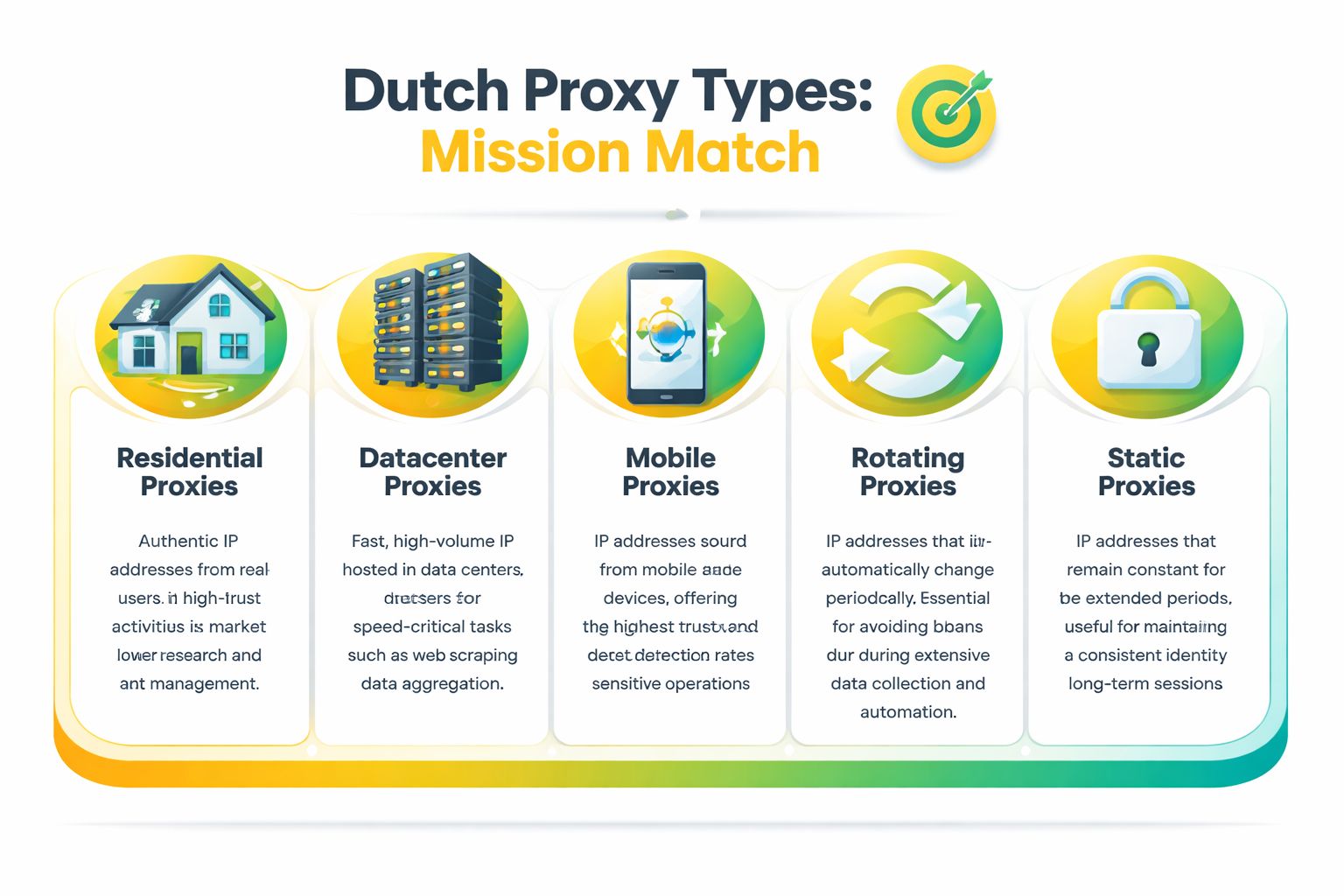
Residential and mobile proxies are commonly positioned as stronger for geo-targeting and avoiding detection on sensitive platforms, while rotating datacenter proxies fit speed-heavy work where reputation matters less (rotating proxy market guidance). That aligns with how most experienced media buyers structure their stack.
When a Dutch IP is actually required
If you're farming Facebook profiles for Dutch ecommerce pages, a Dutch residential or mobile proxy makes sense. If you're scraping ads libraries, checking local SERPs, or handling bulk pre-landing QA, Dutch datacenter can be enough.
The mistake is mixing those up:
- Residential proxies fit account creation, warm-up, and day-to-day use on platforms that score trust aggressively.
- Mobile proxies are useful when the platform leans hard on carrier-grade behavior and mobile reputation signals. TikTok workflows often fall into this bucket.
- Datacenter proxies belong in faster, lower-trust tasks like crawling, ad verification, cloaking support layers, and non-identity-critical automation.
- ISP proxies sit in the middle. They're static like datacenter in many setups, but can present a less obvious server feel depending on the provider.
- IPv6 proxies can work for volume tasks where the target supports IPv6 cleanly, but they're not the first choice for sensitive ad accounts. A lot of operator stacks still run smoother on more familiar IPv4-based paths.
Dutch Proxy Type Comparison
| Proxy Type | Trust Level | Relative Cost | Primary Use Case |
|---|---|---|---|
| Residential | High | Higher | Facebook account farming, ecommerce accounts, local browsing identities |
| Mobile | Very high | Highest | TikTok operations, sensitive mobile-like sessions, high-friction trust environments |
| Datacenter | Lower for sensitive platforms | Lower | Scraping, cloaking infrastructure, ad checks, bulk automation |
| ISP | Mid to high | Mid | Stable long sessions that still need better platform tolerance than basic datacenter |
A few blunt rules help.
- Use residential for account value. If the account is expensive to replace, don't save money on the proxy layer.
- Use mobile when behavior must look consumer-native. That matters more on TikTok than on many back-office tools.
- Use datacenter for throughput. Speed matters for parsing, monitoring, and broad campaign support tasks.
- Don't force one proxy class across the whole team. Buyers, farmers, scrapers, and cloakers don't need the same thing.
If the job is identity-sensitive, optimize for trust first. If the job is request-heavy, optimize for control and speed.
A lot of providers sell all categories through one dashboard. Sota Proxy's feature set is one example built around residential, mobile, and datacenter workflows for antidetect and multi-account use. That model is useful because users eventually need more than one proxy class, even if they start with a single Dutch use case.
Evaluating Dutch Proxy Providers A Technical Checklist
Provider selection gets people burned because they compare price sheets instead of operational details. A Dutch proxy can be technically correct and still fail in the field because the pool is stale, the rotation logic is wrong for the task, or the provider's subnets are already overfarmed.
What to check before you buy
Start with the pool itself. If the provider can't explain the difference between shared rotating Dutch inventory and cleaner long-session Dutch inventory, move on.
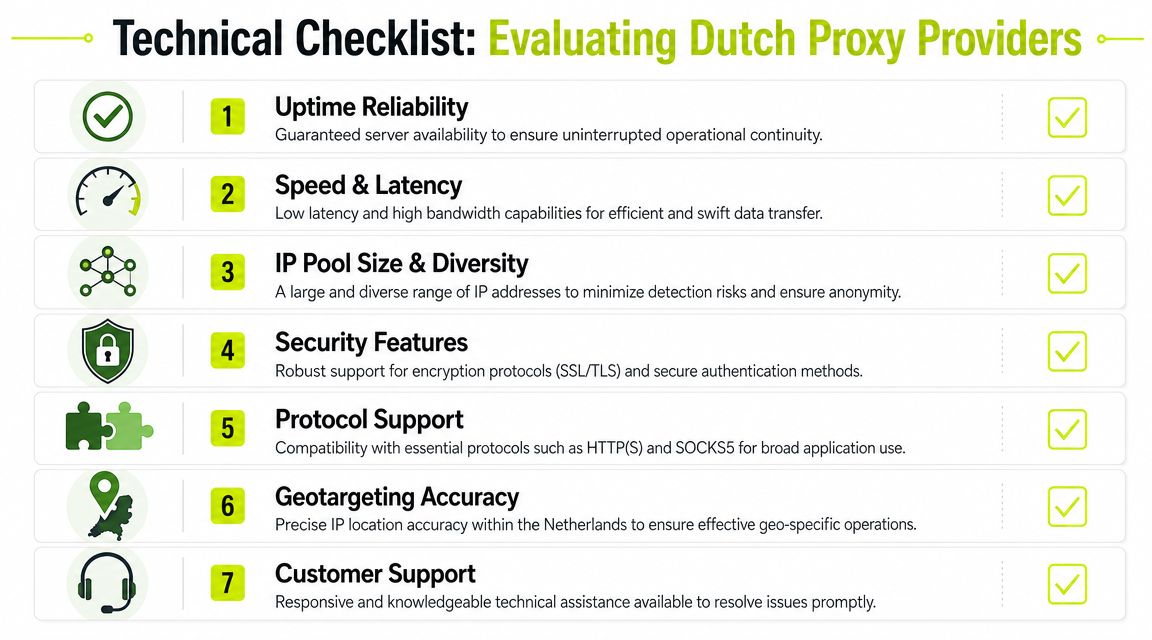
Use this checklist:
- Rotation control: You need both sticky sessions and rotation options. Per-request rotation helps with scraping and wide automation. Sticky sessions help with logins, account aging, carts, and ad account work.
- City targeting: Country-level targeting is often enough, but some campaigns and trust checks benefit from city consistency. Dutch inventory often centers around Amsterdam, and that concentration can be useful or risky depending on your workflow.
- Authentication method: Username and password is usually easier for distributed teams and cloud workers. IP whitelisting can work for fixed infrastructure but creates friction when operators move between machines.
- Pool hygiene: Ask how they handle abused subnets, recycled IPs, and replacement logic. A large pool isn't automatically a clean pool.
- Protocol support: HTTP(S) and SOCKS5 should both exist. Different tools behave better on different protocols.
- App compatibility: Check for clean import into AdsPower, Dolphin Anty, GoLogin, Multilogin, Hidemyacc, and your automation runners.
- Support quality: You're not buying customer service. You're buying time saved when a subnet starts failing mid-run.
Protocol and session rules that matter
A proxy isn't just an IP mask. In the Dutch technical description of proxy architecture, the proxy acts as an application-layer intermediary, mediating protocol-level communication at OSI layers 5, 6, and 7 rather than filtering raw packets at layer 3 (proxy architecture overview in Dutch). That matters because your controls, logging, and policy behavior depend on the application path, not just the network path.
That's one reason protocol choice matters in real operations.
- HTTP(S): Fine for many browser-based tasks and common in provider dashboards.
- SOCKS5: Usually the cleaner choice for mixed traffic, browser profiles, and apps that need broader protocol flexibility.
Don't judge a Dutch provider by “Netherlands available.” Judge them by whether they let you control session persistence, app compatibility, and failure recovery.
One more filter matters. Dutch proxy content often focuses on scraping and geo-targeting, but the harder question is whether the IP is useful for ad accounts, ecommerce, and platform trust, or whether it's just another heavily reused EU endpoint. Providers can offer rotation every request or on sticky windows, but if the subnet reputation is bad, that flexibility doesn't save you.
Configuration for Antidetect Browsers and Automation Tools
A clean proxy setup starts inside the actual tool doing the work. That means the antidetect profile, scraper, browser instance, or bot. It does not start and end at the operating system.
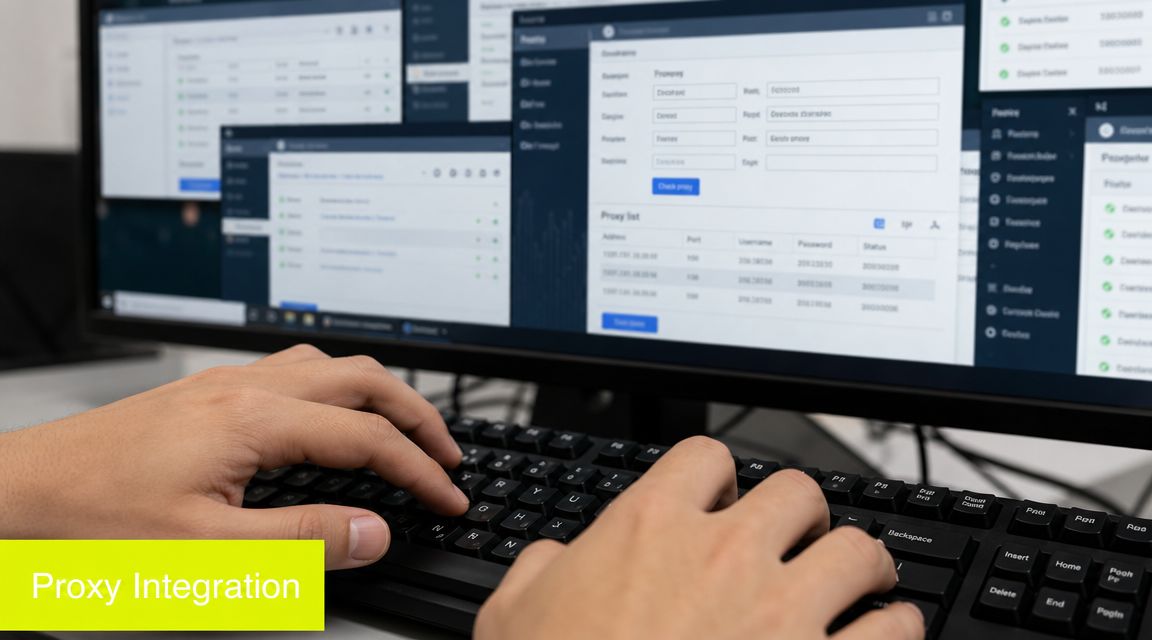
Microsoft's Windows documentation confirms proxy settings can be applied at the OS level or per VPN connection, with manual fields, auto-detection, and setup script support. It also implies the key operational point for multi-app workflows: if only one layer is configured, other tools may still go out directly. For farming and automation, that breaks isolation fast (Windows proxy setup guidance).
Profile level setup beats system level setup
If you run AdsPower or GoLogin with a Dutch proxy but your upload tool, cookie importer, or browser extension still exits through the local connection, you've created a split identity. Platforms don't need perfect detection to punish that.
For Facebook and TikTok ad accounts, use one profile, one proxy, one consistent identity path. The same rule applies to account farming inside Dolphin Anty, Multilogin, and Hidemyacc.
A practical setup checklist:
- Import the proxy into the browser profile. Use the provider's required format and run the built-in connection test.
- Match the fingerprint to the country. Timezone, language, and locale should align with the Dutch session.
- Control WebRTC behavior. Don't let it leak a path that contradicts the proxy.
- Keep session ownership stable. Don't move the same account between multiple Dutch IPs unless the workflow requires it.
- Check companion tools. Uploaders, automation scripts, and API clients need their own proxy path.
A clean integration workflow
For larger operations, assign proxies at profile creation, not after. That keeps naming, ownership, and replacement logic clean. Teams managing bulk profiles in AdsPower, GoLogin, or Dolphin Anty should map each Dutch proxy to a profile ID, account label, and use case such as farm, spend, recovery, or cloak check.
Use this video as a basic implementation reference before adapting it to your own stack:
For automation tools, apply the same discipline.
- Scrapers: Rotation can be aggressive.
- Warm-up browsers: Prefer sticky sessions.
- Cloaking checks: Match the proxy to the review geography you need.
- Account creators: Don't recycle a proxy immediately into another identity-sensitive task.
A proxy only protects the session that actually uses it. Everything else in the workflow can still leak.
Operational Security and Best Practices for 2026
The big mistake with Dutch proxies is assuming popularity equals safety. It often means the opposite. The Netherlands is attractive for infrastructure reasons, but that also means the same pools get hammered by scrapers, botters, ad reviewers, and account farmers.
Current proxy-market guidance raises the right concern for operators in 2026: Dutch IPs can be flagged because of overuse by automation, and large shared pools with rotation can create reputation issues if subnet hygiene is poor (Dutch proxy reputation risk).
How Dutch proxy pools get burned
You see the pattern after enough campaigns. A provider has great Dutch coverage. The first batch works. Then the same ASN ranges start failing on login checks, ad review flows, or checkout pages. The issue isn't always your browser fingerprint. Sometimes the pool is too exposed.
That hits hardest in three situations:
- Shared residential pools used by too many buyers
- Amsterdam datacenter ranges recycled across scraping and account work
- Aggressive rotation on sessions that should stay stable
The fix isn't complicated. You need stricter handling.
A simple SOP for risk control
Use a written rule set. Teams that improvise burn assets faster.
- Warm first: Pair a new proxy with low-risk browsing before you attach payment methods, launch spend, or trigger recovery flows.
- Separate tasks: Don't use the same Dutch endpoint for account creation, ad launching, scraping, and cloaking checks.
- Verify geo consistency: Confirm the IP resolves to the country you bought and that the profile matches it.
- Retire burned paths fast: If a proxy starts generating repeated friction, remove it from identity-sensitive work instead of testing your luck.
- Track by subnet, not just by IP: If several proxies from one slice of inventory start failing, treat the group as suspect.
- Stay inside platform rules where applicable: A proxy doesn't exempt you from Terms of Service or local compliance requirements.
There's also a cost angle. Teams that already recommend tooling to partners or sub-affiliates sometimes offset spend through partner programs. Sota Proxy, for example, has a referral program with up to 40% commission. That won't fix bad opsec, but it can reduce overhead for teams that already share their stack with clients or other buyers.
Clean proxy operations aren't about constant rotation. They're about reducing contradictions inside each account's identity.
Frequently Asked Questions
Are free Netherlands proxies usable for Facebook, TikTok, or account farming
No. Free lists are useful for testing connectivity or understanding what public inventory looks like. They are not a serious choice for farming, ad spend, or cloaking. Shared public endpoints are too exposed, too inconsistent, and too easy to correlate with abuse.
Should every account get its own Dutch proxy
For active, valuable accounts, yes. Don't stack multiple important Facebook or TikTok accounts onto one proxy and expect stable trust. If you need to economize, separate by risk level. Keep high-value accounts isolated and push lower-risk utility tasks to a different pool.
Is a Netherlands proxy always better than another EU proxy
No. A Dutch IP is better only when the workflow needs Dutch location signals. If the platform or offer only needs a clean European identity, a high-quality EU proxy from another country may perform just as well and sometimes better if the Dutch pool is overused.
What matters more, the proxy or the antidetect browser
Both matter. A clean proxy with a sloppy browser profile still leaks contradictions. A clean profile on a burned subnet still gets flagged. Use them as one identity system.
Do I configure the proxy in Windows only
No. System-level setup alone isn't enough for multi-account work. Put the proxy inside the antidetect browser profile and any companion tool that touches the account. If you need more setup detail, Sota keeps a practical proxy FAQ library that covers common workflow questions.
If you need Dutch residential, mobile, or datacenter IPs for AdsPower, Dolphin Anty, GoLogin, Multilogin, Hidemyacc, Facebook and TikTok ad accounts, or bulk farming workflows, Sota Proxy is built around those use cases. Pick the proxy type for the job, keep the profile consistent, and treat Dutch inventory like a trust resource, not a commodity.
Crafted with Outrank
Related articles
Residential Backconnect Proxy: 2026 Guide & Best Practices
Master the residential backconnect proxy. A 2026 guide on how it works, its benefits over other proxies, and best practices for ad verification & account
Rotating Proxy Server: Mastering Techniques for 2026
Master rotating proxy servers for farming, ad verification & scraping. Learn architecture, rotation, & anti-detection tactics.
Multiple Account Management a Secure Scalable Framework
Build a secure, scalable multiple account management system. This guide covers threat modeling, proxies, antidetect browsers, and automation for media buyers.
Dolphin Anty for Multi-Accounting: Features, Automation, and Proxy Integration
How to use Dolphin Anty for multi-accounting: browser profiles, Cookie Robot, scenarios, Synchronizer, API automation, and three ways to connect SotaProxy proxies. Promo code SOTA20 gives 20% off.

Fingerprint Spoofing: Methods, Detection, and Antidetect Use
Learn how fingerprint spoofing works, the methods used to bypass detection, and how antidetect browsers with proxies manage multi-account operations safely.
How to Avoid CAPTCHA on Automated Workflows
Learn how to avoid CAPTCHA on automated workflows with proxy tactics, antidetect browsers, request pacing, and solver fallbacks built for real operators.