Australia Proxy Server: A Guide for Marketers & Farmers
A technical guide to using an Australia proxy server for Facebook/TikTok ads, account farming, and cloaking. Compare residential vs. mobile IPs.

Most advice on an Australia proxy server is outdated. It still treats Australia like a simple geo checkbox. Buy an AU IP, plug it into a browser, done. That logic gets accounts flagged.
Facebook, TikTok, Google, and most anti-abuse systems care less about your country label than your identity consistency. For account farming, cloaking, and geo-targeted campaigns, the proxy has to match the rest of the session. City, ASN profile, proxy type, session length, browser fingerprint, and login pattern all need to make sense together. An Australian IP that looks wrong for the task is often worse than no Australian IP at all.
That matters even more in Australia because traffic is spread across distinct cities, platforms localize aggressively, and the difference between a clean residential session in Sydney and a cheap datacenter exit in the wrong region shows up fast in ad review, feed quality, login friction, and account trust. If you're running AdsPower, Dolphin Anty, GoLogin, Multilogin, or Hidemyacc with Facebook and TikTok assets, you already know the proxy isn't just transport. It's part of the account.
Table of Contents
- Why Your Australian Proxy Strategy Is Failing
- Matching Proxy Type to Your Australian Campaign
- Geo-Targeting Beyond the Country Code
- Proxy Integration for Multi-Account Workflows
- Evaluating and Selecting an Australia Proxy Provider
- Navigating Legal and Platform Compliance
- Frequently Asked Questions for Proxy Operators
- How many social media accounts can I safely run per Australian residential proxy?
- Are rotating or sticky sessions better for warming new Facebook accounts?
- Why are my datacenter proxies getting instantly flagged on TikTok?
- Should I use the same Australian city for all profiles?
- Do antidetect browsers fix bad proxies?
- Is an Australia proxy server enough for cloaking?
Why Your Australian Proxy Strategy Is Failing
The failure point usually isn't that you lack an Australian IP. It's that you're using the wrong kind of Australian identity for the job.
Recent coverage of the proxy market puts the emphasis on automatic rotation, sticky sessions, and city-level targeting, and frames the buying decision around identity stability and trust score, not just geography in Cybernews coverage of Australia proxies. That's exactly how operators should think about it. A generic AU endpoint doesn't solve login challenges, ad review friction, or account linking.
If you're running Facebook ad accounts in AdsPower or Multilogin, a random rotating endpoint can break continuity. If you're warming TikTok profiles in Dolphin Anty or GoLogin, a low-trust datacenter route can get you throttled before the account even ages. If you're cloaking, the mismatch between ad review path, offer path, and geo behavior creates its own footprint.
The real mismatch problem
Three mistakes cause most losses:
- Wrong proxy type: Residential and mobile sessions behave differently from datacenter exits. Platforms know that.
- Wrong session model: Some tasks need persistence. Others need churn. Operators often invert them.
- Wrong location depth: “Australia” is too broad when the target traffic profile is really Sydney, Melbourne, Brisbane, or Perth.
Practical rule: Treat the proxy as part of the account build, not as a last-minute add-on.
A clean browser profile with bad network identity still looks bad. The reverse is also true. That's why serious stacks pair antidetect browsers with carefully assigned proxies, not shared catch-all pools.
What doesn't work anymore
Cheap AU datacenter proxies still have a place. They're fine for some scraping, health checks, and low-friction tasks. They are not what I'd use first for account farming, ad-account recovery, or sensitive cloaking flows.
The popular advice says to start with the cheapest thing that passes an IP check. That's backwards. Start with the trust model of the target platform, then choose the proxy that fits it.
Matching Proxy Type to Your Australian Campaign
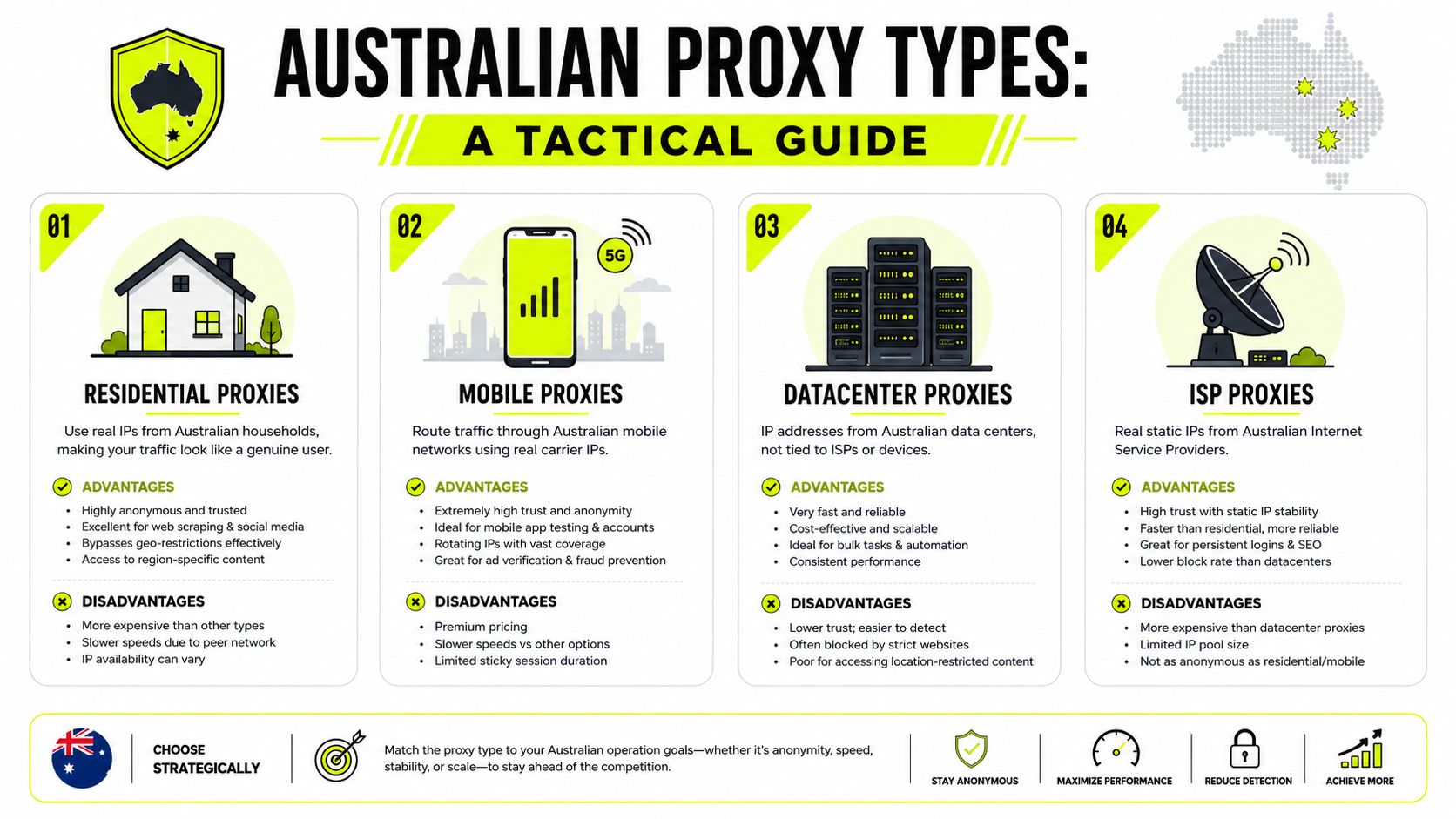
Australia proxy infrastructure is split across Residential, Mobile, ISP, and Datacenter options with city, state, and ZIP targeting, and the practical point is simple: for targets that penalize datacenter ranges, residential or mobile IPs are usually the better fit, while matching proxy type to the target's anti-abuse model matters more than raw speed, as described in Oxylabs' Australia proxy overview.
What actually works by task
Residential proxies are the default for most Facebook and TikTok account work in Australia. They fit ad account creation, warmed profiles, light moderation-sensitive actions, and geo-targeted browsing inside AdsPower, GoLogin, and Hidemyacc. They usually look closer to normal consumer traffic.
The trade-off is operational, not theoretical. Residential pools can vary in cleanliness and session stability. If the provider gives weak session control, your browser profile and your network identity stop lining up.
Mobile proxies are what I reserve for higher-friction flows. TikTok especially can be less forgiving when the session looks too synthetic. Mobile traffic often blends better for app-linked behavior, fresh account testing, and some cloaking paths where trust score matters more than speed. You pay for that trust and you don't waste it on tasks a residential line can handle.
Datacenter proxies are still useful. They're fast, predictable, and easy to scale for scraping, uptime checks, ad preview fetches, landing-page QA, and low-risk automation. But if you try to farm Facebook accounts or recover restricted assets on obvious datacenter space, you're asking the platform to inspect you harder.
ISP proxies sit in the middle. They're often the most practical compromise when you need more consistency than rotating residential and more trust than classic datacenter. For long-lived browser profiles in Multilogin or Dolphin Anty, ISP can be a solid fit when the target isn't at maximum sensitivity.
Australia Proxy Type Comparison for Marketers
| Proxy Type | Anonymity/Trust Score | Typical Cost | Best Use Case | Primary Drawback |
|---|---|---|---|---|
| Residential | High for most account operations | Higher than datacenter in practice | Facebook ad accounts, account farming, geo-targeted browsing, cloaking support paths | Session quality varies by pool |
| Mobile | Very high for tough moderation environments | Usually the most expensive option | TikTok-heavy workflows, fresh accounts, high-friction mobile-like sessions | Lower efficiency if you use it for basic tasks |
| Datacenter | Lowest trust for sensitive account work | Usually the cheapest | Scraping, QA, health checks, low-risk automation | Gets flagged faster on stricter platforms |
| ISP | Mid to high when the pool is clean | Mid-range in practice | Sticky browser profiles, long sessions, balanced account operations | Not as stealthy as strong residential or mobile lines |
A separate point that gets overlooked. IPv6 proxies are not a magic answer. They can be useful when your targets support them cleanly, but many ad and account workflows still care more about reputation and behavioral fit than protocol novelty. For social accounts, I choose based on trust and consistency first, not because the provider added an IPv6 label.
If you need features like rotation control, sticky sessions, and location handling inside one panel, review the available proxy platform features before you lock your stack. The point isn't the logo. It's whether the provider gives enough control to map proxy behavior to the workflow.
Cheap throughput wins benchmark screenshots. Clean identity wins actual campaigns.
Geo-Targeting Beyond the Country Code
Australia is too large for lazy geo settings. “AU” tells you less than people think.
WonderProxy notes only 6 server locations across Australia, and calls Perth an “uncommon point of presence” useful for GeoIP testing in its Perth proxy location page. That matters because Australia isn't a dense cluster of interchangeable exits. City choice changes routing, CDN behavior, local redirects, and the way the session looks to the target.

Why city matching changes outcomes
If you're verifying ads meant for Sydney traffic, use Sydney. If you're warming accounts that will spend against Melbourne audiences, anchor them there. If your offer is local and your proxy exits from the wrong side of the country, platforms and websites can serve different content, attach different risk scores, or route you to the wrong edge.
That creates practical problems:
- Ad verification errors: The ad you see may not be the ad local users see.
- Locale mismatch: Redirect logic and dynamic content can shift based on city-level assumptions.
- Trust friction: A browser profile claiming one environment while the IP resolves elsewhere can look stitched together.
A country match can pass an IP checker and still fail the real-world test.
For cloaking operations, this gets even more sensitive. Review flows, pre-landers, and final offers often behave differently by region. If you test through a generic AU endpoint, you can approve one path and deliver another.
Where operators get sloppy
Teams often buy a national pool and stop there. That's fine for broad scraping. It's weak for account work.
A better setup is to segment profiles by city and intent. One batch of Facebook profiles tied to Sydney. Another tied to Melbourne. TikTok testing in the city where the content and spend are supposed to land. You don't need perfection. You need fewer contradictions inside the same identity.
If your antidetect browser supports timezone, locale, and WebRTC controls, align them with the proxy city. Don't leave the browser on one region and the network on another. That mismatch leaks before your media buying logic even starts to matter.
Proxy Integration for Multi-Account Workflows
A proxy stack fails most often during setup, not purchase. The provider can give you a decent Australian pool and you'll still burn accounts if your browser profiles are messy.
Profile design before scale
In AdsPower, Dolphin Anty, GoLogin, Multilogin, and Hidemyacc, every profile should map to one clear network identity. Don't recycle one proxy across unrelated account groups. Don't swap cities on an aged asset. Don't share credentials loosely across operators.
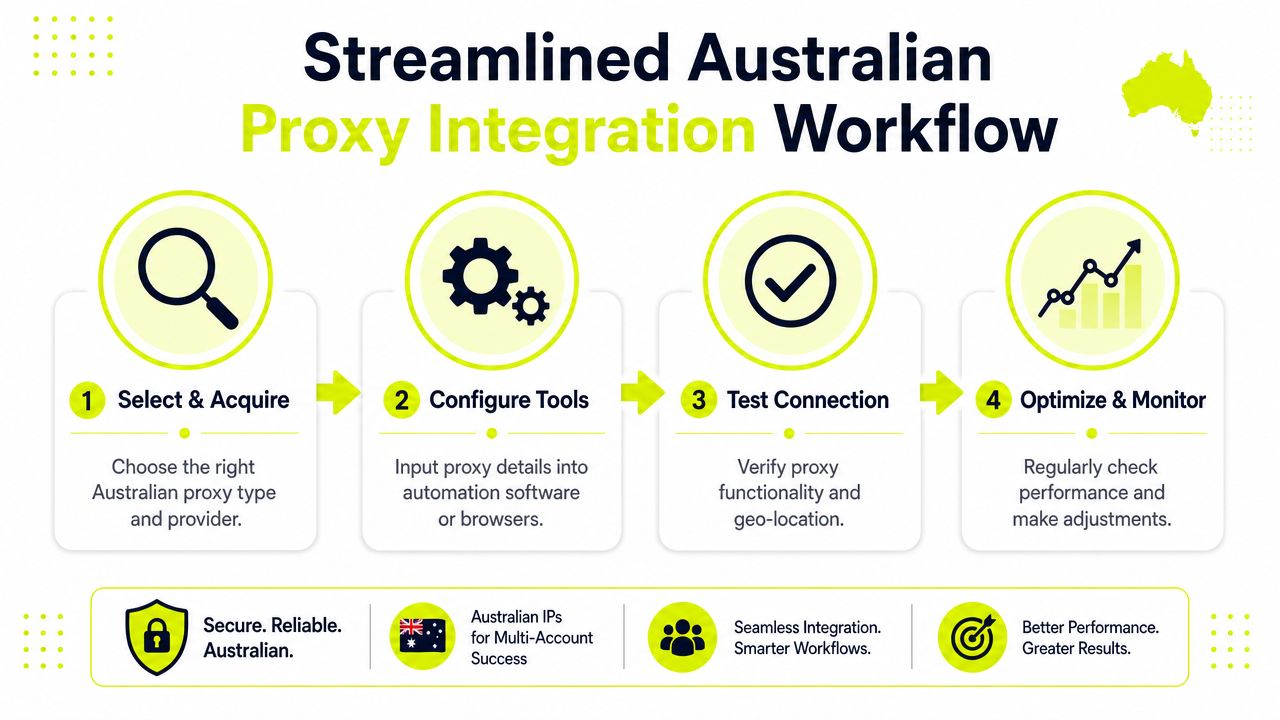
My baseline workflow looks like this:
- Create a profile with one intended purpose. Facebook farm, TikTok spend, cloaking review, or scraping. Don't mix them.
- Assign one matching Australian proxy. Pick city first, then proxy type.
- Lock the browser environment. Timezone, language, and other regional signals should support the proxy, not contradict it.
- Test before login. Check that the session resolves to the intended area and stays stable.
- Only then attach the asset. The account should be the last thing you add, not the first.
For teams comparing providers or tooling, a dedicated proxy integrations page is useful because the question isn't whether a proxy works in theory. It's whether it plugs cleanly into the exact browsers and automation tools your operators already use.
Here's a walkthrough if you want a visual reference before rolling it out to your team:
Sticky and rotating sessions in real operations
Sticky sessions are what I use for browser-based account work. If you're warming a Facebook profile, managing a TikTok ad account, or holding a login in GoLogin, the session should persist. Constant IP churn around authentication and billing events looks unnatural.
Rotating sessions are for collection and distribution tasks. Scraping public pages, checking localized landing pages, monitoring offers, and large-scale research work all benefit from controlled churn.
Use this split:
- Sticky for identity-bound tasks: account farming, ad account management, inbox checks, BM access, profile warm-up.
- Rotating for request-bound tasks: scraping, ad verification at scale, content checks, market research.
- Manual reassignment for compromised profiles: if a profile gets challenged, don't random-rotate and pray. Rebuild the environment properly.
Operator advice: Rotation is not stealth by itself. Bad rotation just creates a trail of inconsistent sessions.
Authentication choice matters too. User:pass is easier when operators work from different machines or VMs. IP whitelisting can be cleaner in fixed environments, but it becomes a hassle when your team shifts devices or uses cloud desktops. Pick the method that reduces configuration mistakes, because most “proxy issues” are really operator errors.
A final practical point. Keep browser profile ownership clear. One person, one profile set, one proxy mapping policy. Shared handling creates accidental overlap, and overlap creates bans.
Evaluating and Selecting an Australia Proxy Provider
The Australia market is not thin. Providers advertise national pools from about 52,588 active IPs to more than 618,600 Australian IPs, and another provider states its premium Australian pool is more than one million IP addresses, which shows Australia is a serious proxy geography with city-level targeting and multi-protocol support, not a niche location, according to SOAX's Australia proxy location page.
That scale is useful, but it doesn't answer the only question operators care about. Will the pool stay usable on your targets?
What to check before you buy
I don't pick an Australia proxy server provider by headline IP count. I check whether the service helps me maintain clean, stable identities.
Use this filter:
- Pool quality over pool size: Big numbers look good on landing pages. A smaller clean pool beats a huge dirty one for Facebook and TikTok.
- City availability: If you can't choose where the session exits, you can't model local traffic well.
- Session controls: Sticky options, rotation behavior, and protocol support matter more than marketing copy.
- Dashboard clarity: Operators need to see usage, assign resources fast, and avoid configuration mistakes.
- Support quality: When a batch starts failing, you need direct troubleshooting, not canned replies.
The cheapest provider usually costs more once account losses and review delays pile up. Proxy spend should be judged against asset survival, not invoice size.
The dashboard matters more than sales copy
It is often underestimated how much friction comes from bad management tooling. If the panel makes it hard to segment by city, type, or session behavior, your stack gets messy. Messy stacks create inconsistent identities. Inconsistent identities get flagged.
Pricing transparency also matters, especially if you're scaling mixed workloads across scraping, ad verification, and account ops. Review the proxy pricing structure for bandwidth model, proxy types, and location options before you commit to any provider.
One practical side note for agencies, private groups, and tool sellers. Sota Proxy has a referral program with up to 40% commission. If you're already placing proxy spend for clients or your own operator network, that can offset part of the infrastructure cost. That's not a reason to choose a provider by itself. It's just a real line item for teams that move volume.
Navigating Legal and Platform Compliance
Proxy quality has improved, and the market has moved away from the old mess of free public lists toward managed networks. Proxy5's Australia page shows how rough the free-list world can be, with sample Australian proxies showing latencies from 910 ms to 2,259 ms and uptime ranging from 77% to 100%, while commercial services market 99.9% reliability and enterprise controls, as shown on Proxy5's Australia proxy list page. That shift raised the baseline for what professional use looks like.
The important part isn't just performance. Better infrastructure means operators have fewer excuses for reckless behavior.
Legitimate automation and reckless abuse are not the same
There are legitimate uses for an Australia proxy server. Ad verification, regional QA, price checking, market research, localized testing, and multi-region browsing all fit into normal business operations.
The problems start when teams use better infrastructure to push obviously prohibited behavior harder. Cloaking sits in that gray zone. Some teams use it to protect funnels from competitor scraping or review mismatch. Others use it to deceive platforms outright. Those are not the same risk profile.
Better proxies don't change platform rules. They just remove the network as an excuse.
A workable risk framework
I look at compliance through three filters:
- Terms risk: Does the platform explicitly ban the behavior, even if the proxy itself is clean?
- Data risk: Are you collecting public information, or are you crossing into protected or abusive access patterns?
- Asset risk: If this workflow gets reviewed manually, can you defend the account history as coherent and business-related?
For media buyers and account farmers, the practical answer is simple. Use proxies to build stable, region-correct sessions. Don't use them as cover for sloppy abuse. The longer your operation needs to survive, the more conservative your choices should become.
Frequently Asked Questions for Proxy Operators
How many social media accounts can I safely run per Australian residential proxy?
There isn't a universal safe number. It depends on platform sensitivity, account age, activity pattern, and how consistent the browser fingerprint is. For Facebook and TikTok, I lean conservative. If an account matters, give it a dedicated or tightly controlled identity instead of packing multiple valuable assets onto one endpoint.
Are rotating or sticky sessions better for warming new Facebook accounts?
Sticky. Warm-up is identity work, not request work. The account should see a stable city, a stable network, and a stable browser profile over time. Save rotating sessions for scraping, ad checks, and broad research tasks.
Why are my datacenter proxies getting instantly flagged on TikTok?
Because TikTok often punishes obvious low-trust infrastructure faster than operators expect. If the account is fresh, the browser profile is new, and the IP sits in a known server environment, the whole session looks synthetic. Move the workflow to residential or mobile, slow the actions down, and make the rest of the fingerprint coherent.
Should I use the same Australian city for all profiles?
No. Match city to the campaign, asset history, or intended audience. If all your profiles land in one city regardless of use case, your stack becomes predictable and unrealistic.
Do antidetect browsers fix bad proxies?
No. AdsPower, Dolphin Anty, GoLogin, Multilogin, and Hidemyacc help isolate browser fingerprints. They don't turn a weak proxy into a trusted one. If the network identity is wrong, the browser shell won't save it.
Is an Australia proxy server enough for cloaking?
Not by itself. For cloaking, the review path, offer path, session persistence, city alignment, and account history all need to fit together. The proxy is one component. If the rest of the operation is inconsistent, the proxy won't rescue it.
If you're running Australian campaigns and need residential, mobile, ISP, or datacenter IPs that fit real operator workflows, Sota Proxy is one option to review. Check whether its location controls, session handling, and dashboard fit your stack before you deploy it across Facebook, TikTok, antidetect browsers, or scraping jobs.
Related articles
Multiple Account Management a Secure Scalable Framework
Build a secure, scalable multiple account management system. This guide covers threat modeling, proxies, antidetect browsers, and automation for media buyers.

Rotating Proxy Server: Mastering Techniques for 2026
Master rotating proxy servers for farming, ad verification & scraping. Learn architecture, rotation, & anti-detection tactics.
What Is a Proxy Used for: 2026 Arbitrage Guide
What is a proxy used for - Learn what a proxy is used for in 2026, from boosting security to managing multi-account operations for arbitrage teams

How to Change IP Location for Ad & Social Accounts
Learn how to change IP location using proxies, VPNs, and antidetect browsers. A guide for media buyers and account managers on avoiding blocks and bans.

How to Get Around an IP Ban: A Technical Guide for 2026
Facing an IP ban? Learn how to get around an IP ban with technical steps for diagnosing block types, choosing the right proxies, and configuring your stack.
Residential Backconnect Proxy: 2026 Guide & Best Practices
Master the residential backconnect proxy. A 2026 guide on how it works, its benefits over other proxies, and best practices for ad verification & account