What Is a Proxy Used for: 2026 Arbitrage Guide
What is a proxy used for - Learn what a proxy is used for in 2026, from boosting security to managing multi-account operations for arbitrage teams
You're staring at another account check, another CAPTCHA, and another campaign that looked fine an hour ago. The browser profile is clean, the creative is approved, but the platform still sees the same origin network coming back too often. That's usually where proxy infrastructure either saves the workflow or gets the whole stack flagged.
Table of Contents
- How Proxies Work in Real Campaign Operations
- Proxy Types and Platform Trust Scores
- High-Value Use Cases for Proxy Infrastructure
- Rotation Strategies and Antidetect Browser Configuration
- Common Proxy Misconceptions That Cost Money
- Provider Selection Checklist for Demanding Workloads
- Building Your Proxy Strategy for Scale
How Proxies Work in Real Campaign Operations
A media buying team doesn't usually notice a proxy until something starts failing. One minute the Facebook or TikTok ad account is live, the next minute the login flow stalls, the platform throws a verification wall, or a fresh profile gets flagged before the first spend even lands. That's when the network layer stops being abstract and starts deciding whether the campaign keeps moving.
A proxy changes the visible source of the traffic. Instead of the destination service seeing your origin IP, it sees the proxy's IP, because the proxy sits between the client and the target service and forwards the request on your behalf, which is exactly how proxy web scraping tools describe the mechanism too, an intermediary gateway that replaces the client's visible IP with the proxy's IP. In campaign work, that matters because the platform is no longer correlating every profile, browser fingerprint, and login attempt to the same origin network.
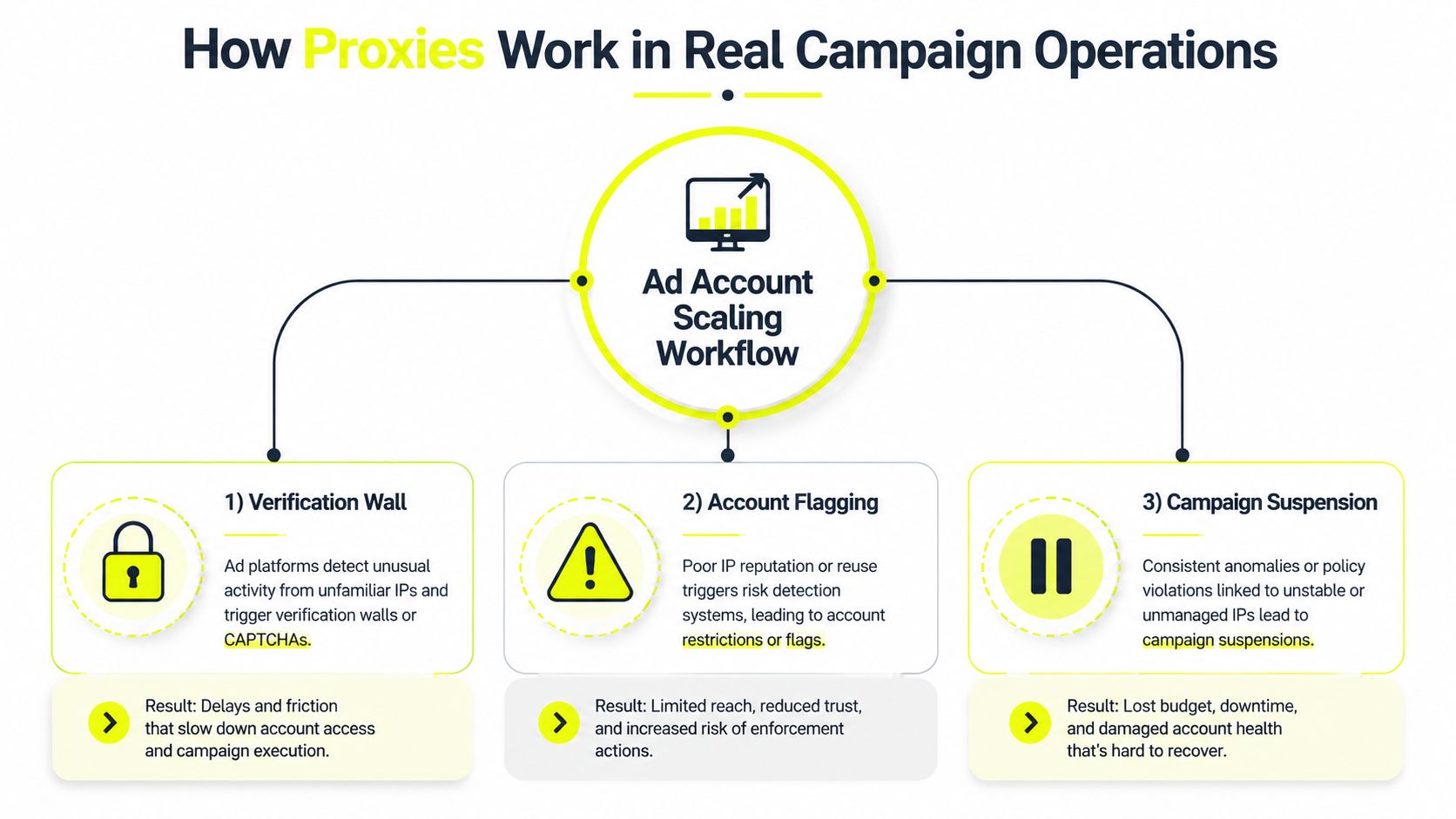
Practical rule: if the origin IP keeps surfacing across multiple accounts, the proxy stack isn't doing its job, no matter how polished the browser profile looks.
Why operators treat proxies as infrastructure
In account farming, cloaking, and geo-targeted campaigns, the proxy isn't there just to “hide” traffic. It becomes a control point that separates identities, regions, and workflows so one source network doesn't tie everything together. That's why the same core idea shows up in enterprise settings too, where Microsoft describes proxies as a place for monitoring, filtering, logging, and policy enforcement on outbound traffic, not just anonymity.
That operational role is easy to miss when people talk about proxies like they're a single-purpose privacy tool. They're closer to routing and policy gear. In a managed environment, you can use them to decide what leaves a profile, where it exits, and how repeatable that exit path stays across sessions.
If you want a deeper systems view on how proxy-style routing sits inside a broader tooling stack, the MCP server hosting guide is a useful reference point, because it shows how controlled traffic paths and service orchestration fit together in real deployments.
For teams already tracking inventory, session state, or product availability, the operational shape is the same as what's described in inventory monitoring, only the target is a platform instead of a warehouse feed.
Proxy Types and Platform Trust Scores
Not every proxy type gets treated the same way by Facebook, TikTok, or e-commerce systems that score incoming traffic. The platform isn't reading your marketing intention, it's reading the network characteristics around the request. That's why the wrong proxy class can torpedo a good workflow even when the browser fingerprint looks solid.
Residential proxies use IP space associated with consumer ISPs. In practice, that makes them blend better with normal user traffic than datacenter ranges. Mobile proxies run through carrier networks, and they usually carry the strongest trust signals on social platforms because carrier traffic looks like real device activity. Datacenter proxies come from hosting providers, which gives you speed and scale, but platforms can classify them as non-residential more easily. IPv6 is just a newer address space, not a free trust upgrade. Reputation still depends on the network behind it and the way the platform filters it.
The simplest way to think about it is this, trust is a mix of source network, traffic pattern, and session behavior. If you hammer a social account with a fast, clean datacenter IP and a noisy rotation pattern, the platform can still flag it. If you use a residential or mobile exit with stable behavior, you usually buy yourself a more believable connection profile.
| Proxy Type | Platform Trust | Speed | Best Use Case |
|---|---|---|---|
| Residential | High relative trust | Moderate | Social accounts, geo-targeted campaigns, ad verification |
| Mobile | Very high relative trust | Variable | High-risk logins, TikTok workflows, sensitive account ops |
| Datacenter | Lower trust on major platforms | High | Scraping, bulk checking, low-friction tasks |
| IPv6 | Depends on network reputation | Varies | Niche deployments, mixed infrastructure, platform-specific testing |
Assign the right proxy to the right job
For Facebook ad accounts, mobile and residential exits usually make more sense than cheap datacenter space. For TikTok ad accounts, the same logic applies, with even more emphasis on stable session behavior and believable source geography. For cloaking and geo-targeted campaigns, the exit has to match the audience signal, or the platform and the user-facing content stop lining up.
For mixed fleets in antidetect browsers like AdsPower, Dolphin Anty, GoLogin, Multilogin, and Hidemyacc, the mistake is running the same proxy class across every profile. That creates a repeating pattern. Rotate proxy types across the fleet where the workflow allows it, and keep the most sensitive accounts on the most trusted exits.
If you want a quick operational check on source reputation before placing accounts on a pool, the ip reputation check guide is the right place to sanity-check the signal you're sending.
High-Value Use Cases for Proxy Infrastructure
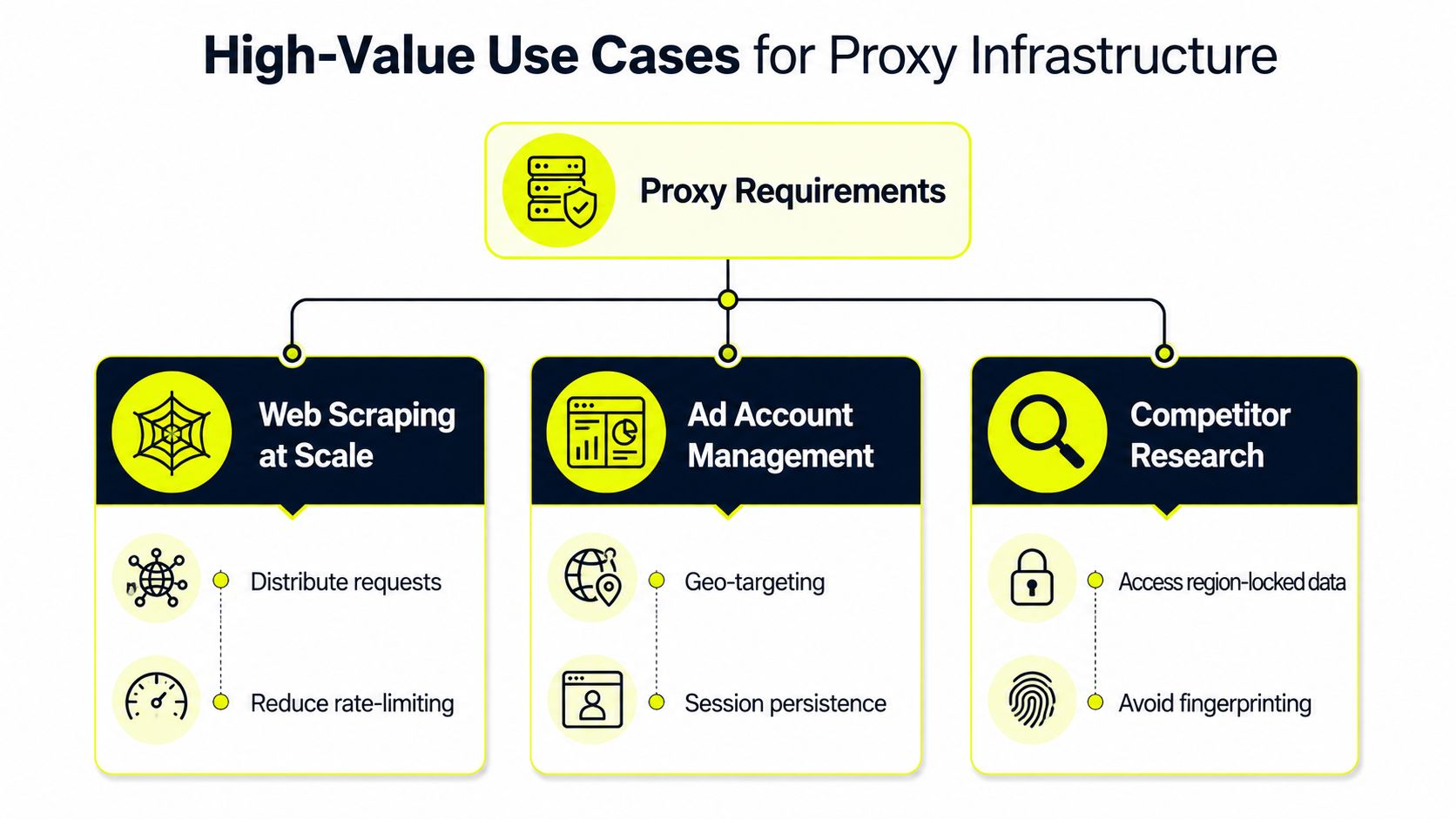
Proxy infrastructure only earns its keep when the workflow needs it. That usually means three things, distributed collection, controlled identity separation, or region-specific access. Anything else is just overhead with nicer branding.
Web scraping and ad verification need different settings
A scraper at scale has to spread requests across multiple addresses so one source IP doesn't become a bot signal. That's why proxy web scraping is built around distributing requests across different users or regions. It's useful for geo-specific content, but the key value is keeping one source from looking like a flood.
Ad verification is different. You're not trying to look like a scraper, you're trying to look like a normal viewer in a target market. That usually points to residential or mobile exits in the target geography, because the platform and the site both need to render the experience the way a real user would see it. If the geo signal is wrong, the creative check becomes noise.
A proxy setup that works for scraping can fail for ad verification, because the trust requirement is different even when the traffic technically reaches the same page.
For a practical look at shopping-related automation and market-facing tooling, browse HiveHQ's bots for shopping gives a good sense of how location and session control affect operational results in retail-adjacent flows.
Account farming, cloaking, and geo-targeted campaigns
Account farming across Facebook and TikTok needs sticky sessions plus antidetect browser profiles. The IP should stay consistent long enough for the account to look lived-in, not freshly shuffled every few requests. That's where the proxy has to work with the browser, not against it.
Cloaking adds another constraint, because the proxy has to support the location signal you want the platform to see while the final destination behaves the way your campaign logic expects. Geo-targeted campaigns need the same discipline. If the exit location doesn't line up with the audience, the mismatch shows up quickly.
Sneaker bot operators usually care less about trust and more about speed plus rotation. They want high churn, retry logic, and aggressive handling after failures. That's a different profile entirely from account management, and mixing those two behaviors in the same pool burns good IPs fast.
For a broader breakdown of workflow categories, the use cases page helps map proxy type to task without mixing up scraping, monitoring, and account operations.
The same pattern applies to social media account management, price monitoring, and competitor research. The right proxy isn't the one with the prettiest label. It's the one that fits the platform's trust model for that specific job.
Rotation Strategies and Antidetect Browser Configuration
Choosing the proxy type is only half the setup. The other half is deciding how the session behaves over time. If the IP changes too often, you look automated. If it never changes in the wrong workflow, you create a stable but suspicious trail. The difference comes down to whether the task needs rotation or stickiness.
Use rotating proxies only where churn helps
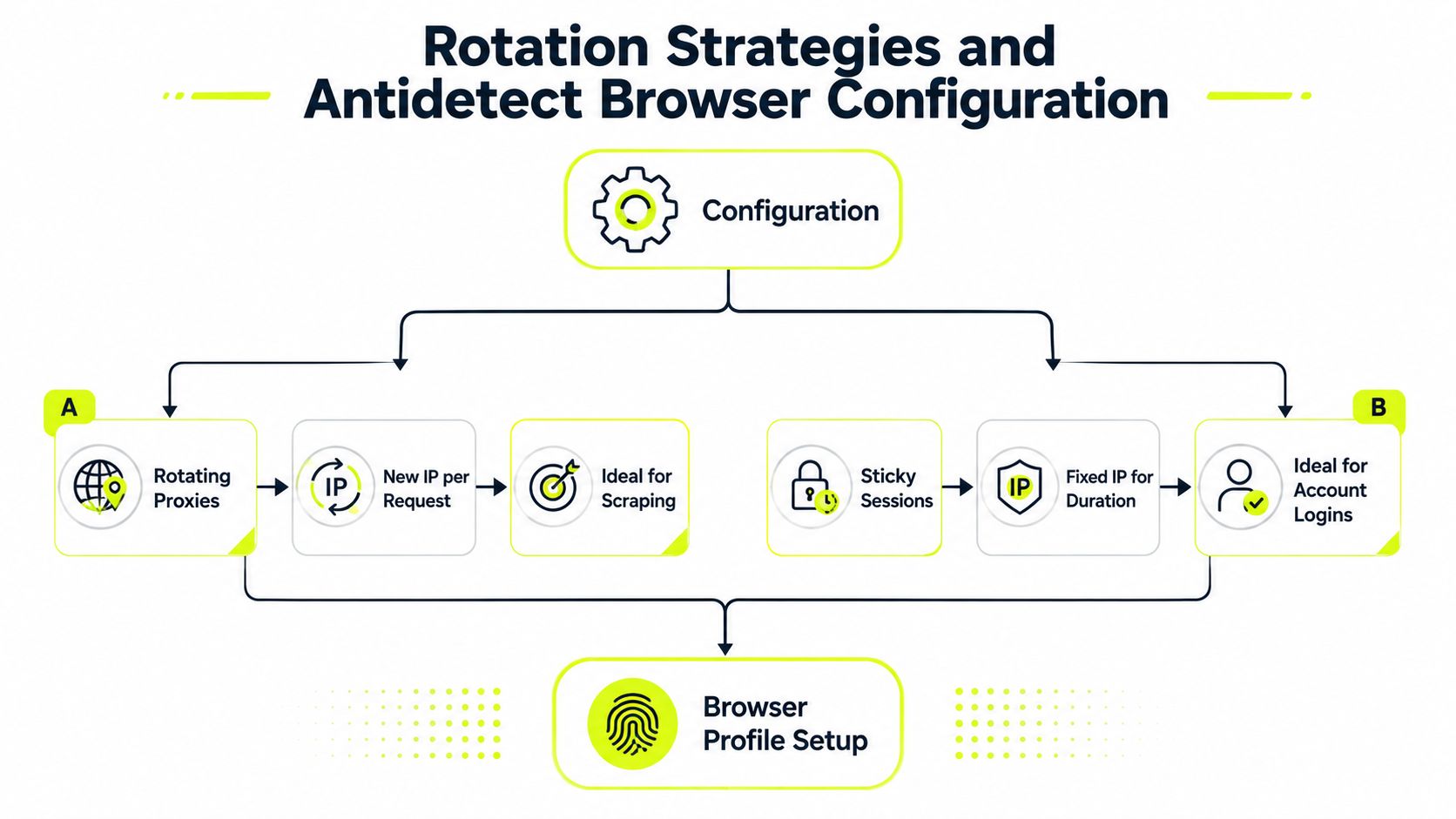
Rotating proxies swap outbound IPs per request or on a set interval. That lowers the correlation between repeated requests and helps pipelines stay alive when they're collecting large volumes. This is the right model for scraping, especially when you pair it with retry logic and backoff after 403 responses.
It's the wrong model for logged-in social profiles. A Facebook ad account that sees a different IP every time it wakes up doesn't look secure, it looks compromised. TikTok account workflows behave the same way. For those, rotation belongs at the pool level, not inside the live session.
Keep browser profiles pinned to one exit
For AdsPower, Dolphin Anty, GoLogin, Multilogin, and Hidemyacc, the cleanest pattern is one proxy per profile. That gives each browser identity a stable network story. If the profile manages a sensitive account, keep the exit consistent across that account's login sessions.
The operational habit that saves the most accounts is simple. Warm a new profile slowly, keep its proxy stable, and avoid aggressive switching right after creation. That matters even more when you're pairing the browser with server-side tracking or server-side event collection, because the network story and the event story need to line up.
For a deeper technical note on how rotation mechanics are described in practice, the proxy IP rotation guide is a solid companion read for teams building repeatable pipelines.
Match session behavior to the job
Practical rule: if the task depends on login continuity, keep the IP fixed for the duration of that session. If the task depends on volume, rotate at the request layer and back off after blocks.
That distinction sounds obvious, but teams still mix it up. They use rotating exits on account profiles, then wonder why logins keep failing. Or they pin a datacenter IP to a scraper and then complain when the source gets singled out. The browser config has to follow the workload, not the other way around.
For teams connecting browser activity to offsite analytics or postback logic, a guide to server-side tracking is useful because it shows why request identity and event integrity have to stay aligned.
Common Proxy Misconceptions That Cost Money
The most expensive proxy mistakes usually come from treating it like a single-purpose privacy tool. That's how budgets get burned on the wrong inventory, and that's how accounts die even when the team thinks the setup looks “advanced.”
Proxies are not VPNs
A proxy can hide or replace the client IP from the destination service, but it does not encrypt traffic by default. That means it gives access control and visibility, not end-to-end privacy. A VPN and a proxy solve different problems, and they're not interchangeable.
That difference matters in production. If you need encrypted transport, you need that handled elsewhere in the stack. If you need a controllable egress point for account identity, a proxy fits. Mixing the two ideas causes teams to overestimate what the proxy is protecting.
Cheap datacenter IPs aren't a shortcut
A low-cost datacenter pool can look attractive because it's fast and easy to deploy. On Facebook ad accounts, that usually turns into wasted setup time and blocks, because platforms can classify datacenter space as non-residential traffic. The IP may be clean in a generic sense, but it still doesn't match the trust profile of the account you're running.
The same logic applies to aggressive rotation. More switching is not automatically better. Real users don't change IPs every request, so excessive churn on social accounts creates a pattern the platform can read as automation or compromise.
IPv6 doesn't fix trust by itself
IPv6 often gets treated like a fresh start. It isn't. It's just another address format, and the network behind it still determines how the platform reacts. If the provider's underlying reputation is weak, IPv6 won't save the session.
Proxies also aren't only for hiding activity. In enterprise and developer environments, they're used for monitoring, filtering, logging, and policy enforcement, which is why the best proxy explanation is always operational, not cosmetic. If you only think about anonymity, you end up using the wrong tool for the job.
For teams comparing options before buying another pool, the free rotating proxy article is a useful reality check on why “free” usually costs more later.
Provider Selection Checklist for Demanding Workloads
A proxy provider can look fine on the surface and still fail under real load. The checks that matter are boring, but they're the ones that keep arbitrage teams alive when the account count climbs and the workflow gets sensitive.
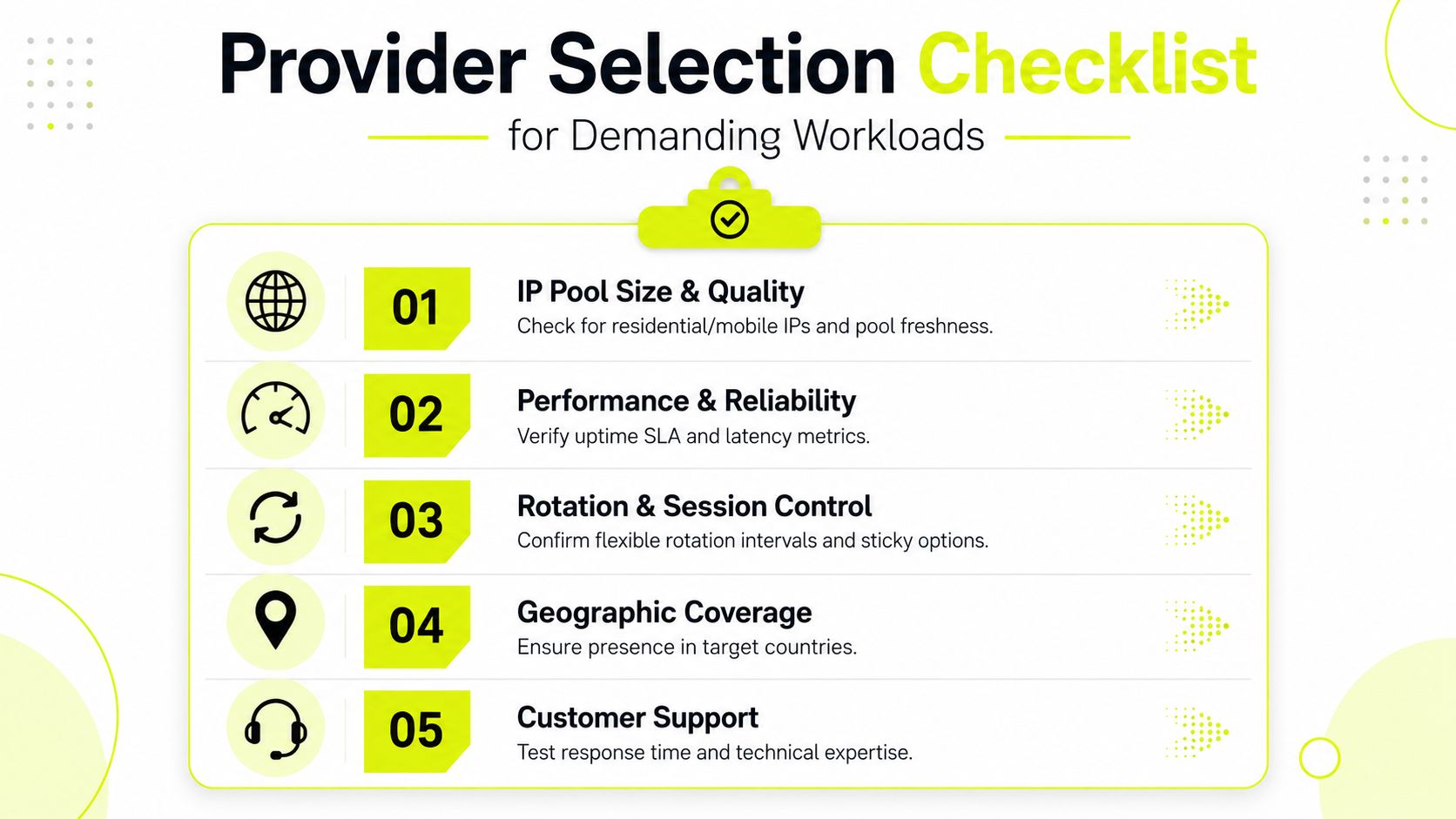
Start with IP pool quality. You want fresh, clean inventory, not recycled exits that trip reputation checks on arrival. Then test geographic granularity, because city-level targeting is the difference between a believable campaign signal and a sloppy one. For Facebook, TikTok, and ad verification work, that granularity matters more than many realize.
What to verify before you spend
- Reliability: Check uptime behavior and how often sessions die under sustained use.
- Rotation and sticky control: Make sure the provider supports both, because your scraping stack and your account stack won't use the same settings.
- Support quality: Test whether a real person can help when the browser config, pool, or auth flow breaks.
- Dashboard usability: The better interfaces let you sign up quickly, choose type and location cleanly, and top up without friction.
- Payment and access control: Encrypted payment handling and balance visibility matter when several operators share the same pool.
You also want a provider that can handle dedicated IPs for high-trust workflows and large enough coverage to separate campaigns cleanly. If you're scaling through partnerships, SotaProxy also runs a referral program with up to 40% commission, which is relevant for agencies and operators who route multiple clients through the same infrastructure.
The provider itself should not force awkward compromises. If you need residential, mobile, ISP, and datacenter options in one place, with rotation, sticky sessions, and city-level targeting, that's the kind of setup worth testing before you move critical campaigns onto it.
Building Your Proxy Strategy for Scale
Start by sorting every workflow into one of four buckets. Use residential for high-trust social accounts, mobile for TikTok campaigns and other sensitive logins, datacenter for high-volume scraping, and ISP proxies when you need a middle ground between speed and trust. Then separate the browser fleet so each profile has one job and one identity story.
Watch the signals that matter, not vanity labels. If success rates fall, if blocks climb, or if logins start bouncing, the proxy plan needs adjustment before the campaign does. Scale from shared pools to dedicated IPs only when the workflow justifies the tighter control.
Keep the operational separation clean too. Don't let a scraping run contaminate account-management exits. Don't reuse the same session logic across every platform. The teams that stay alive longest are the ones that match proxy type, browser profile, and campaign risk instead of forcing one setup to do everything.
If you need proxy infrastructure that's built for account work, scraping, and geo-targeted campaigns, Sota Proxy gives you a single place to choose residential, mobile, ISP, and datacenter exits with rotation, sticky sessions, and city-level targeting. Set up a pool that matches your actual workflows, then test it against the platforms you run every day.
Related articles
What Is Forward Proxy: A Complete Guide for 2026
Learn what is forward proxy, how it works for outbound traffic, and why teams use it with antidetect browsers for Facebook, TikTok, and scraping.
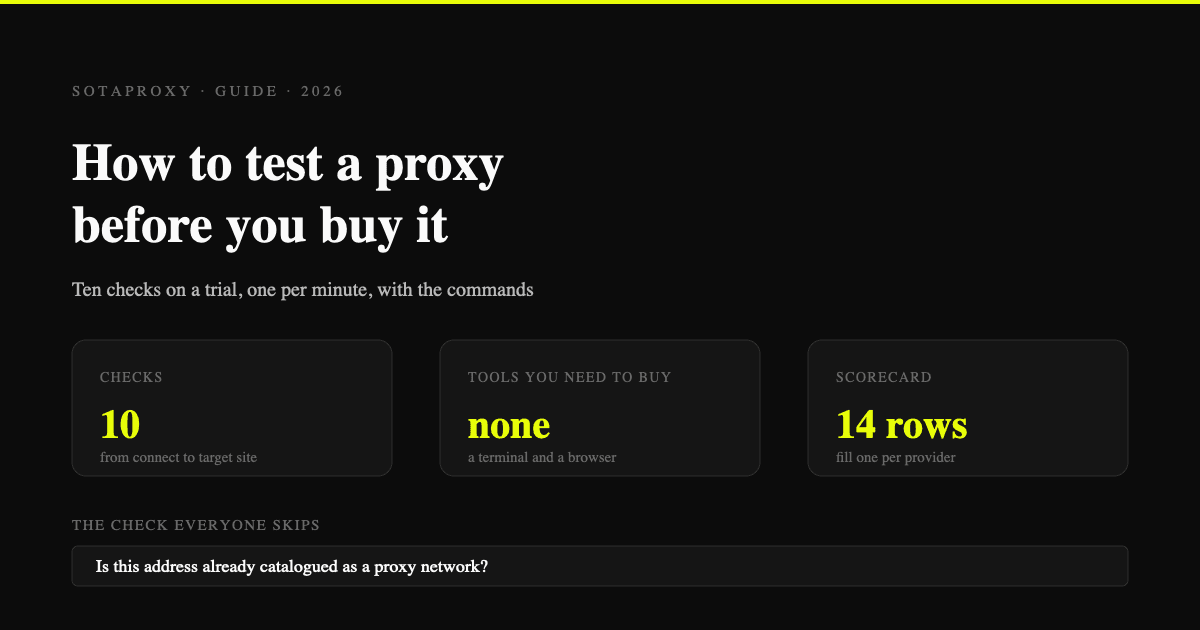
How to Test a Proxy Before You Buy It: A 10-Minute Checklist
Ten checks that tell you whether a proxy trial is worth paying for: exit ASN, hosting flags, rotation behaviour, subnet spread, DNS and WebRTC leaks, and success rate on your own target.

How to Make Money With Web Scraping in 2026: Five Models, Priced
Five ways scrapers get paid, what each one charges, and what a scrape actually costs to run, measured on real pages: HTML-only against a full browser render.

Fingerprint Spoofing: Methods, Detection, and Antidetect Use
Learn how fingerprint spoofing works, the methods used to bypass detection, and how antidetect browsers with proxies manage multi-account operations safely.

10 Smartproxy Alternatives for Technical Teams
Compare 10 smartproxy alternatives by proxy type, IP quality, targeting, rotation, speed, pricing, and use case for technical teams.
10 IPRoyal Alternatives for Serious Proxy Workloads
Compare 10 IPRoyal alternatives for scraping, ad verification, account farming, antidetect browsers, geo campaigns, pricing, rotation, and support.