Rotating Proxy Server: Mastering Techniques for 2026
Master rotating proxy servers for farming, ad verification & scraping. Learn architecture, rotation, & anti-detection tactics.

You're probably dealing with one of two failures right now. A Facebook ad account got flagged after a login from the wrong network fingerprint, or a scraper that worked yesterday started eating bans because too many requests came from the same IP range. In both cases, the visible error is only the last symptom. The issue is usually operational sloppiness around IP handling, session design, and fingerprint consistency.
A rotating proxy server fixes part of that problem, not all of it. Used correctly, it lets you spread requests, separate account clusters, localize traffic for geo-targeted campaigns, and keep cloaking checks from exposing the wrong landing page. Used badly, it creates a false sense of safety while your real leaks come from browser headers, DNS, WebRTC, timezone mismatch, or a rotation pattern that looks more automated than a static IP ever did.
Teams running AdsPower, Dolphin Anty, GoLogin, Multilogin, and Hidemyacc already know the basics. The hard part is choosing the right pool, the right rotation mode, and the right browser behavior for Facebook and TikTok ad accounts, account farming, scraping, and cloaking workflows without burning assets.
Table of Contents
- Why Static IPs Fail in Modern Operations
- Rotating Proxy Architecture and IP Pool Types
- Rotation Modes Per-Request vs Sticky Sessions
- Core Use Cases for Technical Operators
- Integration with Antidetect Browsers and Bots
- Anti-Detection Best Practices and Troubleshooting
- Selecting a Provider and Managing Costs
Why Static IPs Fail in Modern Operations
A static IP works until it doesn't. One media buyer logs into a Facebook profile from the same address all week, pushes too many account actions through one subnet, then sees a checkpoint or suspension at the exact moment spend starts to scale. An account farmer warms a batch of TikTok profiles on a fixed proxy set, and the cluster gets tied together because the network pattern never changes enough to look organic.
That failure mode is common because platforms don't only watch credentials. They watch request pacing, subnet reputation, repeated origin patterns, and whether multiple identities keep touching the platform from infrastructure that looks machine-issued. Once a static IP gets burned, every profile tied to it inherits the damage.
Rotating proxies automatically switch IP addresses per request or at set intervals, making traffic appear to originate from a diverse pool of users across separate subnets, which is critical for large-scale web scraping and avoiding detection on platforms like Facebook and TikTok ad systems (technical breakdown of static vs rotating proxies).
Static IPs create predictable failure patterns
For operators, the problem isn't just “same IP bad.” It's that static setups create patterns that are easy to cluster:
- Repeated session origin: The same account keeps showing up from one address or a narrow subnet.
- Cross-account contamination: Multiple ad accounts, BM logins, or warmed profiles share infrastructure traces.
- Poor ban recovery: Once the IP reputation drops, your recovery path is weak because the route never changes.
- Bad fit for scraping: Crawlers hammer target sites from a small address footprint and hit rate limits fast.
Practical rule: If the task involves many requests, many accounts, or many geos, static IPs stop being “stable” and start being identifiable.
Static IPs still have a place. They can work for low-risk admin access, internal dashboards, or single-session tasks where continuity matters more than diversity. They're the wrong default for account farming, cloaking checks, geo-targeted campaigns, and scraping pipelines that need to stay alive under pressure.
Rotating Proxy Architecture and IP Pool Types
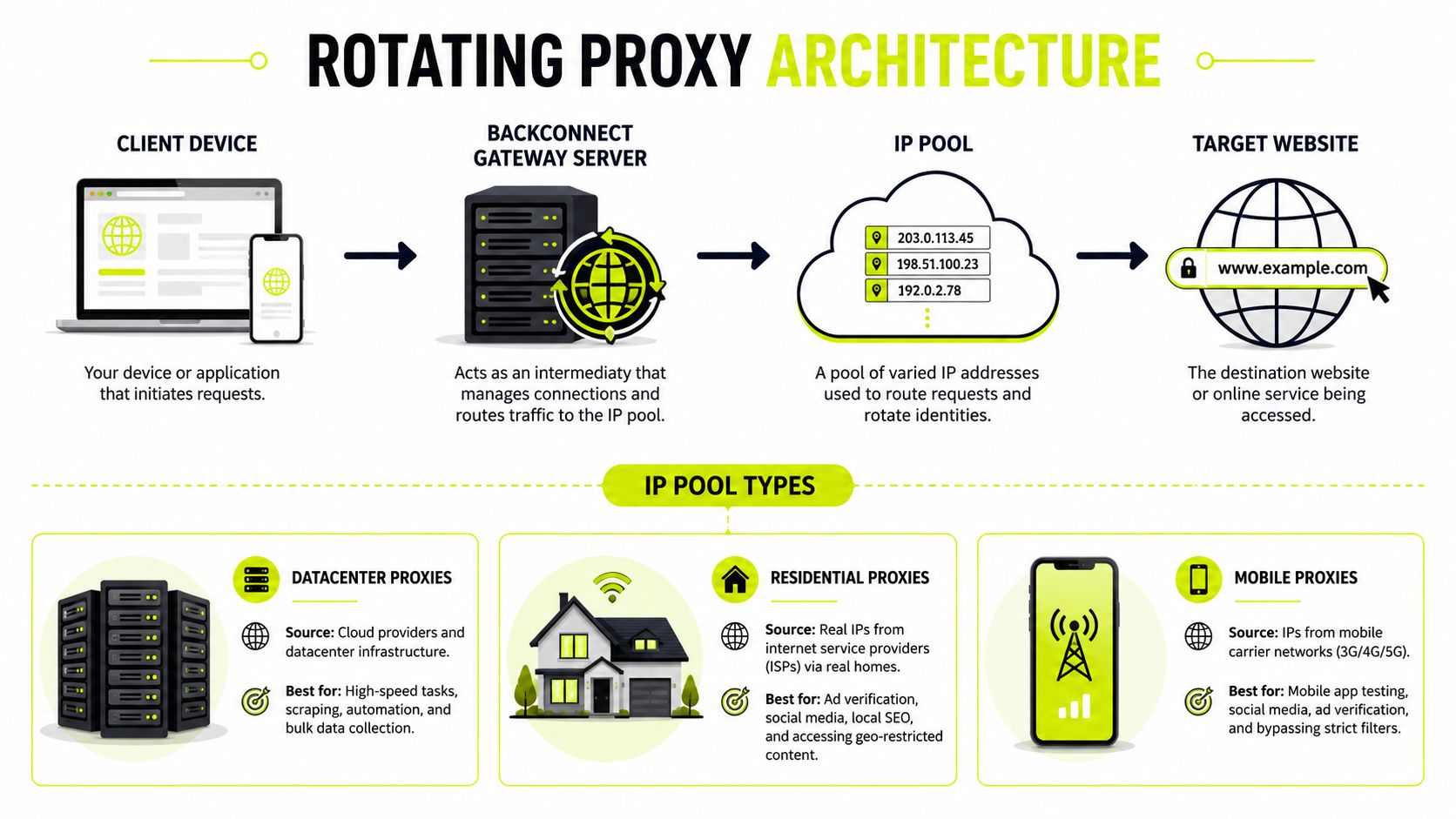
A rotating proxy server is usually fronted by a backconnect gateway. You connect your browser, bot, or script to one endpoint. The gateway decides which exit IP from the provider's pool handles each request or each session window. That design is what makes large-scale operations manageable. You don't manually juggle hundreds of endpoints. The gateway abstracts the pool and applies the rotation policy.
How the backconnect layer actually works
A rotating proxy server operates via a backconnect gateway that dynamically assigns IPs from a large pool, often exceeding 175M residential addresses globally, and rotation is usually triggered either per-request or through timed sticky sessions such as 10 to 30 minutes (backconnect gateway model and rotation windows).
That architecture matters because it changes how you build workflows:
| Component | What you care about operationally |
|---|---|
| Client side | Your antidetect browser or bot should only see one clean proxy endpoint |
| Gateway | Handles assignment logic, session persistence, and failover |
| IP pool | Determines trust level, geo quality, and block resistance |
| Exit behavior | Must match the task, either frequent refresh or stable session continuity |
If you need a broader comparison of categories, this proxy types overview is a useful reference point.
Which IP pool fits which job
The pool type decides whether the platform sees your traffic as ordinary, suspicious, or outright synthetic.
Residential proxies are the default choice for Facebook and TikTok ad accounts, account farming, and geo-targeted creatives. Residential proxies derive IP addresses directly from real ISP-assigned home networks, making them appear more authentic and significantly harder to block compared to datacenter proxies, which are server-generated and lack physical location ties (residential vs datacenter behavior in practice). If you're handling warmed profiles in AdsPower or Multilogin, this is usually where you start.
Mobile proxies sit in a strong position for apps and mobile-first platforms. They route through real 3G or 4G devices and fit workflows where mobile trust signals matter, especially on TikTok and Instagram. They cost more, but they're useful when desktop-like traffic gets challenged too easily.
Datacenter proxies are cheaper and faster. They're useful for certain scraping jobs, bulk URL checks, and low-trust tasks where burn rate is acceptable. They're usually not what you want for long-lived ad account identity work because the IP ranges look like infrastructure, not users.
IPv6 proxies can be useful where targets support IPv6 cleanly and where you need broad addressing at low cost. In practice, many anti-fraud and ad workflows still lean heavily on IPv4 norms. That makes IPv6 a niche option for technical operators, not the safe default for account work.
Use trust-heavy IPs for identity. Use cheap fast IPs for expendable collection. Don't mix those workloads in the same cluster.
Rotation Modes Per-Request vs Sticky Sessions
Most bans blamed on “bad proxies” are really mode-selection mistakes. The pool was fine. The operator chose the wrong rotation behavior for the workflow.
When per-request wins
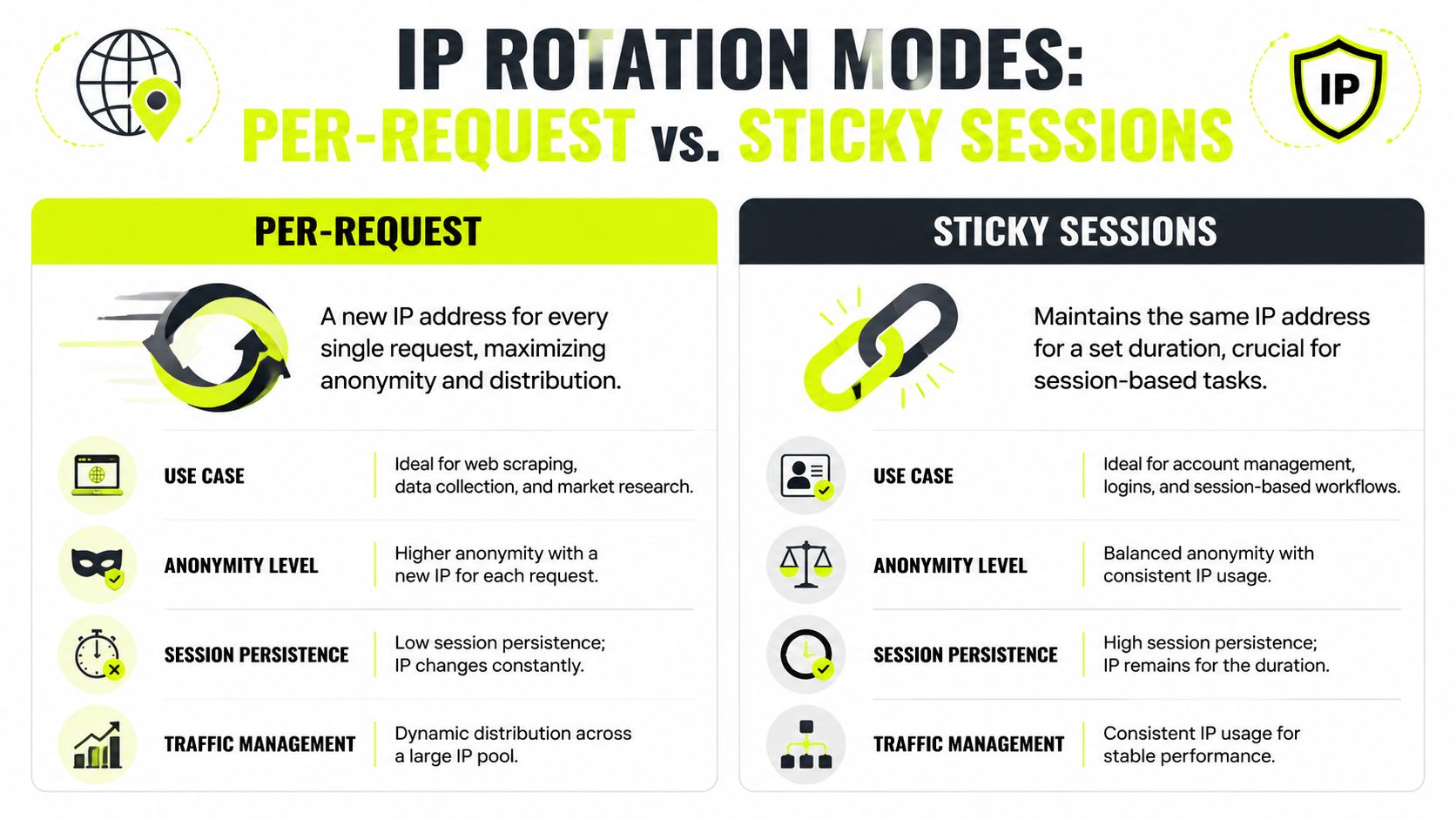
Per-request rotation gives you a fresh IP on every outbound call. That's what you want for high-volume scraping, wide SERP collection, public ad library extraction, and large verification jobs where session continuity doesn't matter.
Per-request rotation is critical for high-volume web scraping because it ensures no single IP exceeds anti-bot thresholds. One practical rule is that “100 IPs each making one request” prevents any individual IP from triggering blocks. The same source notes that strong setups rely on large pools of 32M+, 99%+ uptime, and granular targeting at the country, city, and ASN level (rotation modes and sticky session reference).
That's why per-request works well for:
- Scrapers pulling public data: Product pages, ad creatives, pricing, SEO checks.
- Distributed validation jobs: Many lightweight checks across many targets.
- Burnable traffic lanes: Tasks where any one request can fail without killing the run.
When sticky sessions are the safer choice
Sticky sessions hold the same IP for a fixed window. That's the right move when the platform expects continuity. Logging into Facebook Ads Manager, editing a TikTok campaign, warming an account in GoLogin, or checking out a multi-step funnel all need state stability.
Use sticky mode when you need:
- Session persistence: The account should look like it stayed on one network long enough to behave like a person.
- Consistent cookie relationship: Cookies, local storage, and network origin need to line up.
- Geo coherence: Browser language, timezone, and IP location need to stay aligned for the whole task.
A quick decision table helps:
| Task | Better mode | Why |
|---|---|---|
| Large-scale scraping | Per-request | Spreads load and reduces repeat-source detection |
| Facebook ad account management | Sticky | Keeps login and post-login actions on the same network identity |
| TikTok account warm-up | Sticky | Reduces abrupt environment changes |
| Ad verification across many regions | Either | Sticky for page flow, per-request for broad spot checks |
| Cloaking checks | Depends | Sticky for full funnel review, per-request for wide regional sampling |
If you're building session-based flows, this sticky session glossary entry is worth bookmarking.
If a human would keep the same connection while finishing the task, your bot or browser should probably do the same.
Core Use Cases for Technical Operators
The value of a rotating proxy server shows up in the ugly parts of the workflow. Not in the dashboard screenshot. In the moment when one bad network choice links accounts that should never have touched each other.
Running ad accounts without linking them
A buyer running several Facebook and TikTok ad accounts through AdsPower or Dolphin Anty needs each profile to look self-contained. That means separate cookies, separate browser fingerprints, and a network identity that fits the profile's geo and usage pattern.
Rotating residential or mobile IPs help isolate profiles, especially when you split account groups by country or campaign type. What doesn't work is reusing the same proxy pool carelessly across unrelated business managers, then logging multiple profiles in back to back with identical automation pacing. Rotation helps. Lazy cluster hygiene destroys the benefit.
Account farming and warm-up
Account farming fails when operators treat new profiles like finished assets. Fresh Instagram, Amazon, Facebook, or TikTok accounts need boring behavior first. Read feeds. Scroll. Watch delays. Keep session length realistic. Use sticky sessions, not aggressive per-request rotation, because farming is about continuity and trust accumulation.
Good operators also separate stages:
- Creation lane: One pool and one behavior profile.
- Warm-up lane: Different session cadence, cleaner IP quality.
- Spend lane: Highest-trust routing, least cross-account overlap.
That separation matters more than any single proxy feature. You can review broader applications in these proxy use cases for operational teams.
Cloaking and geo-targeted verification
Affiliate teams using cloaking need to see what moderators, users, and bots see in different regions. A static proxy from the wrong place gives false confidence. A properly targeted rotating setup lets you verify landers, redirects, and ad-to-page consistency from the same countries your campaigns target.
Operators often make a costly mistake. They test a route from one geo, approve it, then the live campaign serves to users on completely different IP reputations and local settings. If your browser locale says one country and your exit IP says another, your own QA becomes unreliable.
The proxy isn't just a transport choice. It's part of the story your environment tells the platform.
Scraping that survives contact with anti-bot systems
For scraping teams, rotating proxies keep collection distributed. They let you pull pricing, ad intel, listing changes, and SEO data without stacking all request pressure on one source. But scraping durability doesn't come from rotation alone. It comes from sane concurrency, header consistency, user-agent handling, retry logic, and geo-aware routing.
Datacenter IPs can work for broad, cheap collection. Residential or mobile pools usually perform better when targets are stricter or when the data sits behind systems that score trust by network origin.
Integration with Antidetect Browsers and Bots
Implementation is where most setups fall apart. The proxy itself is fine. The profile is wrong, the auth format is wrong, or the browser fingerprint doesn't match the exit geography.
Profile-level setup
In AdsPower, Dolphin Anty, GoLogin, Multilogin, and Hidemyacc, the pattern is the same. Create the profile first. Then attach the proxy endpoint with host, port, username, and password. After that, make the browser fingerprint match the proxy, not the other way around.
For account work, check these items before first login:
- Geo alignment: IP country, browser timezone, language, and WebRTC handling should agree.
- Device logic: Don't pair a mobile-leaning campaign flow with an obviously desktop-only fingerprint if your behavior says otherwise.
- Session plan: Use sticky sessions for ad account work and warm-up. Reserve fast rotation for non-session tasks.
- DNS behavior: Test before launch. If DNS leaves through your local network, the setup is already compromised.
Multilogin users usually benefit from keeping one proxy policy per profile template rather than editing live profiles ad hoc. If you're managing that stack, this Multilogin integration reference is relevant.
Bot and API workflows
Bots need a stricter separation between transport logic and identity logic. The clean way is to let the proxy layer handle IP assignment while your bot handles pacing, retries, and session storage. Don't make the bot randomly switch every parameter on every request. That creates synthetic chaos, not human variance.
A solid bot setup usually includes:
- A session manager that knows which tasks require sticky continuity.
- A proxy allocator that pins or rotates according to task type.
- A fingerprint policy for browser automation jobs.
- A ban monitor that retires failing routes instead of hammering them harder.
For teams training new operators, a visual walkthrough helps more than another checklist:
If your bot touches Facebook or TikTok surfaces, add cooldown logic after sensitive actions. Fast retries after a challenge page are one of the easiest ways to turn a recoverable warning into a hard block.
Anti-Detection Best Practices and Troubleshooting
A rotating proxy server is not privacy by default. It's a routing component. If the rest of the stack leaks, rotation won't save you.
Rotation alone doesn't protect you
Most proxy content oversimplifies privacy by claiming rotating proxies automatically hide your real IP, but security experts confirm that without end-to-end encryption and proper network-layer masking such as TLS and DNS over HTTPS, rotation alone does nothing if your real IP leaks via headers or side channels (security discussion of rotating proxy privacy limits).
That hits ad operators hard because Facebook and TikTok don't need a dramatic leak to get suspicious. Small mismatches stack up. A profile says Berlin. The proxy exits in Warsaw. DNS resolves locally. WebRTC exposes another route. The account survives for a while, then gets reviewed after a payment event or budget change.
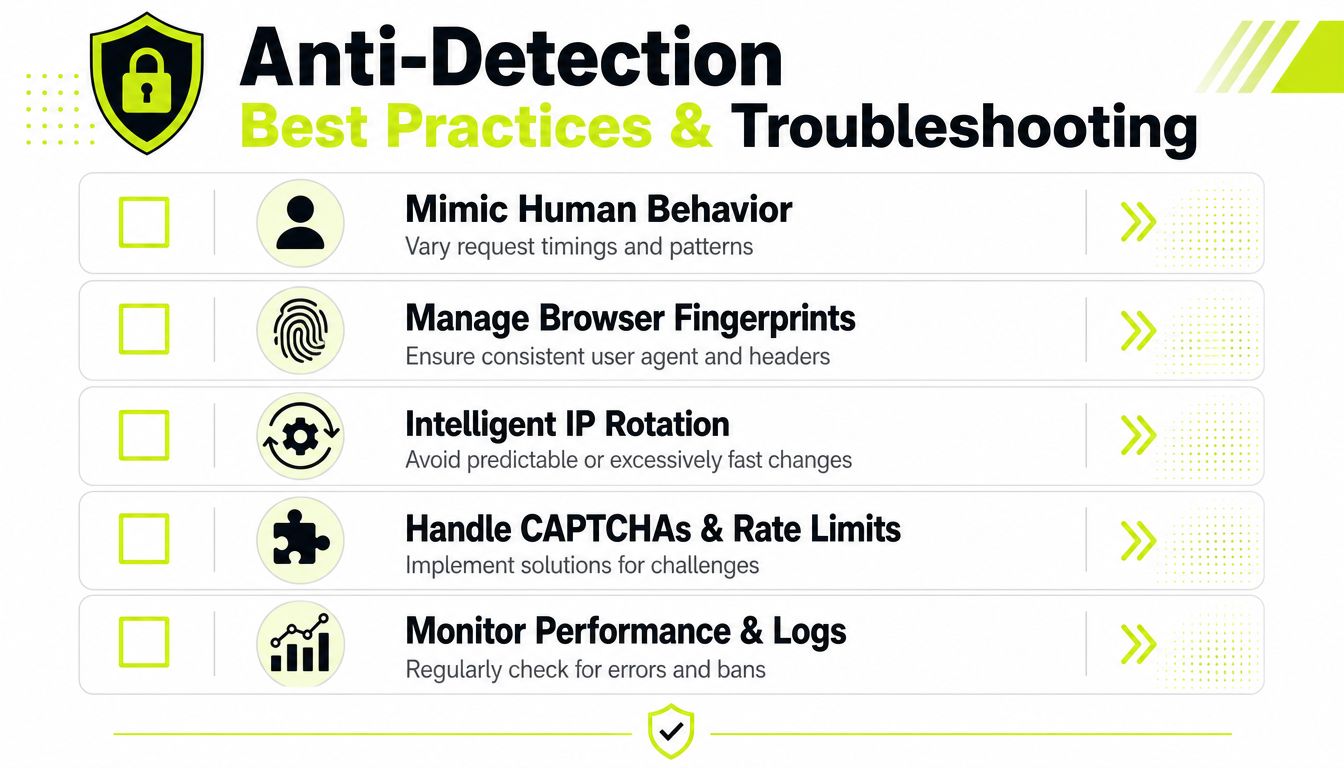
Three practices matter more than people admit:
- Fingerprint coherence: Timezone, locale, fonts, device class, screen size, and IP geo should tell the same story.
- Leak control: WebRTC, DNS, headers, and browser extensions can expose routes you didn't intend to reveal.
- Behavior shaping: Random noise isn't human behavior. Consistent but imperfect pacing is better than chaos.
A bad proxy setup often looks “random.” Real users usually look consistent.
A troubleshooting checklist that actually helps
When a setup starts failing, don't swap providers first. Audit the workflow.
| Symptom | Likely cause | First check |
|---|---|---|
| Connection failed | Bad auth, unsupported protocol, dead session | Credentials, endpoint type, app-level proxy test |
| High block rate | Wrong pool type or too much concurrency | IP quality, request pacing, geo targeting |
| Account checkpoints | Session instability or fingerprint mismatch | Sticky mode, timezone, language, WebRTC |
| IP not rotating | Session pinning still active | Rotation mode and session token settings |
| Wrong geo result | Exit node mismatch or cached profile state | City/country target, DNS path, fresh profile test |
A shorter field checklist helps when the team is under pressure:
- Test with a clean profile: Old cookies hide setup errors.
- Reduce concurrency first: Too much parallelism can make a good pool look bad.
- Stop reusing burned sessions: Carrying poisoned cookies into a new IP wastes the new IP.
- Separate scraping and account work: One lane gets optimized for resilience, the other for trust.
If the task is account farming or cloaking, always test the full environment, not just the proxy endpoint in isolation.
Selecting a Provider and Managing Costs
Provider selection gets framed the wrong way. Teams compare headline price, then act surprised when the cheap option burns accounts or collapses under load. The right question isn't “How much per GB?” It's “What does this provider let me do safely and predictably?”
What matters more than the sales page
A usable provider gives you a backconnect gateway, stable auth, real geo control, and session behavior you can trust. A rotating proxy server should let you pull from a large pool while controlling whether the IP changes per-request or sticks for a 10 to 30 minute window through the gateway model described in this best rotating proxies breakdown.
For technical buyers, these checks matter:
- Pool quality: Residential for account trust, mobile for mobile-first platforms, datacenter for cheaper high-volume collection, IPv6 only where targets support it cleanly.
- Geo granularity: Country is basic. City-level targeting is better for local ad verification and geo-targeted campaigns.
- Session control: You need both rotating and sticky behavior, not one or the other.
- Support quality: When a platform starts challenging traffic, you need a real answer fast, not canned documentation.
Cost control for teams
The market for rotating proxy services is projected to reach $16,337.5 million by 2030, growing at a 24.6% CAGR, which tells you demand is moving deeper into mainstream operations rather than staying a niche tool (rotating proxy service market projection).
That doesn't mean you should overbuy. Teams often waste money in three places:
- Using premium IPs for disposable tasks
- Letting idle sticky sessions sit open
- Running unrelated workloads through the same pool
Split spend by workload. Put scraping, account management, ad verification, and cloaking checks into separate budgets and route classes. That gives you cleaner reporting and fewer avoidable bans.
There's also a practical side business angle here. If your agency, farm, or arbitrage team already refers tools to partners, Sota Proxy's referral program offers up to 40% commission, which can offset proxy spend or create a separate revenue line for operators who already influence purchasing decisions.
If you need residential, mobile, ISP, datacenter, or IPv6 infrastructure for scraping, ad verification, account management, and geo-targeted campaigns, Sota Proxy is built for that kind of workload. The platform supports rotating and sticky sessions, city-level targeting, and operational control that matters when bans are expensive. If your team also refers infrastructure to clients or partner buyers, the affiliate program with up to 40% commission can help cover your own proxy costs while you scale.
Related articles

What Is a Proxy Used for: 2026 Arbitrage Guide
What is a proxy used for - Learn what a proxy is used for in 2026, from boosting security to managing multi-account operations for arbitrage teams
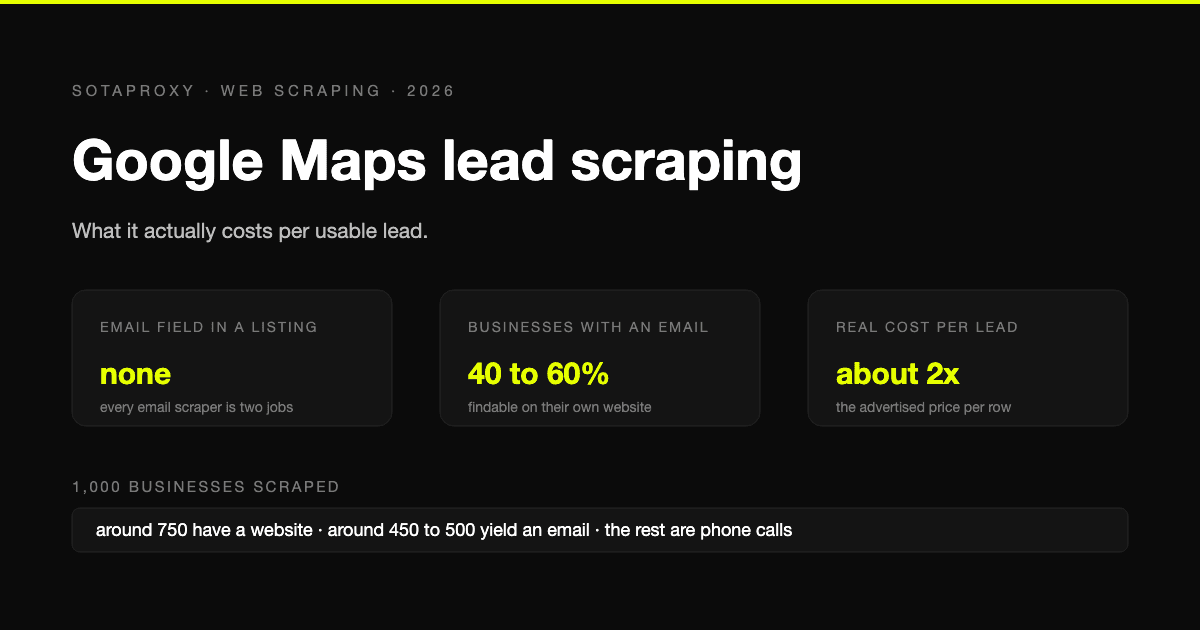
Google Maps Lead Scraping: What It Actually Costs Per Usable Lead
Google Maps has no email field, so every email scraper is a two-stage pipeline and only about half of businesses yield an address. What a thousand listings really costs per usable lead, the businesses-without-websites play, and where the law stands after the SerpApi ruling.
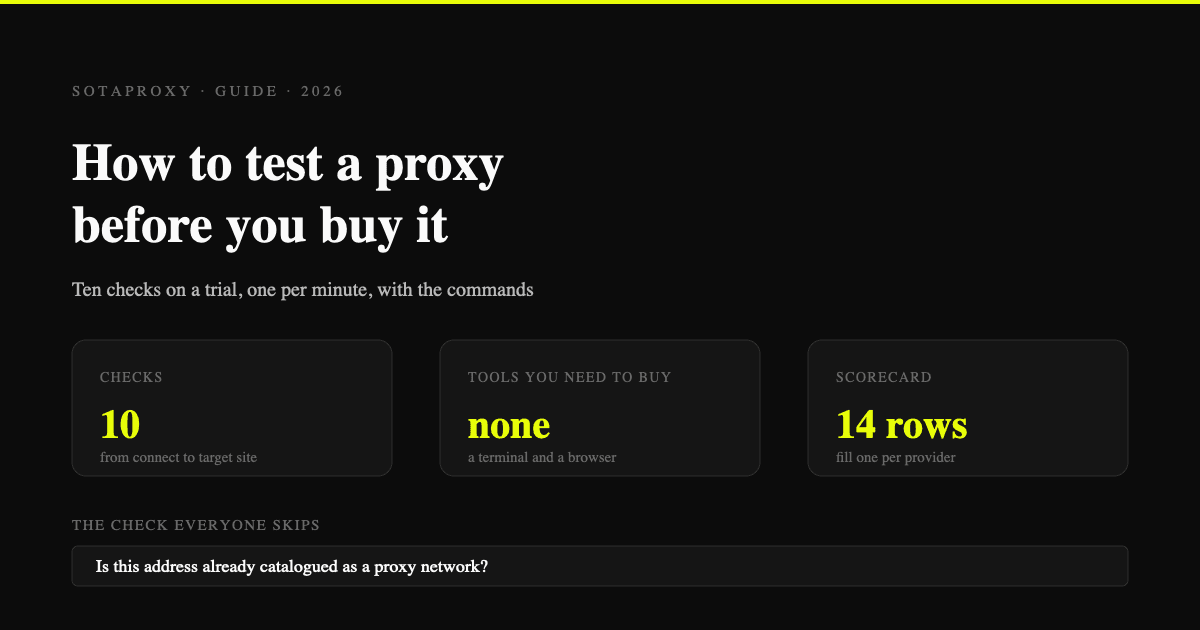
How to Test a Proxy Before You Buy It: A 10-Minute Checklist
Ten checks that tell you whether a proxy trial is worth paying for: exit ASN, hosting flags, rotation behaviour, subnet spread, DNS and WebRTC leaks, and success rate on your own target.

How to Make Money With Web Scraping in 2026: Five Models, Priced
Five ways scrapers get paid, what each one charges, and what a scrape actually costs to run, measured on real pages: HTML-only against a full browser render.

10 Smartproxy Alternatives for Technical Teams
Compare 10 smartproxy alternatives by proxy type, IP quality, targeting, rotation, speed, pricing, and use case for technical teams.
10 IPRoyal Alternatives for Serious Proxy Workloads
Compare 10 IPRoyal alternatives for scraping, ad verification, account farming, antidetect browsers, geo campaigns, pricing, rotation, and support.