Bots for Sneakers: A Technical Guide for Operators
A technical guide to bots for sneakers. Learn how they work, the required tech stack, and how to use proxies for optimized performance and avoiding bans.

You're staring at a drop timer with profiles loaded, tasks staged, proxies assigned, and checkout windows measured in seconds. That setup probably feels familiar if you run Facebook ad accounts at scale, farm TikTok profiles, or manage cloaked landing pages across antidetect browsers. The mechanics are different, but the operating mindset is the same. You're competing in a compressed window where latency, identity quality, and traffic distribution decide who gets through.
That's why bots for sneakers make more sense when you stop treating them like a retail gimmick and start treating them like a high-frequency execution problem. The bot itself matters, but it's only one part of the system. The edge comes from how you combine task orchestration, proxies, server placement, browser identity, account pools, and failure controls under pressure.
Operators who come from traffic arbitrage usually understand this fast. You already know that one clean ad account is useful, but a managed fleet is what scales. You know that an AdsPower or Multilogin profile with a bad proxy is still a bad profile. Sneaker botting works the same way. A fast bot on weak infra burns money. A slower bot on clean infra can still print because it survives filters long enough to reach cart and checkout.
F5 Labs documented just how industrial this gets. In one observed shoe drop, bot traffic hit 2,163 times the level of human traffic, and the operation used 1,400 different IPs, 466 autonomous system numbers, and 125 user-agent strings. F5 also saw more than 2,600 fake accounts created over three weeks, along with 41,000 shipping address changes and 278,000 checkout transactions in the same operation, which shows how far modern operators push account and checkout automation at scale (F5 Labs analysis of a sneaker bot operation).
Table of Contents
- Introduction The 90-Second War
- Deconstructing the Sneaker Bot Stack
- The Proxy Infrastructure Imperative
- Optimizing Your Operational Environment
- Execution Strategy and Risk Management
- Building a Performance-Optimized Setup
Introduction The 90-Second War
A hyped release rarely fails because your bot clicked too slowly. It fails because the whole stack drifted out of alignment. The monitor fired late. The proxies were fast but dirty. The checkout tasks shared too much identity. The accounts weren't warmed. The server sat too far from the target edge. Or the anti-bot layer decided your browser behavior looked synthetic before you even reached payment.
That's the part newcomers miss. Bots for sneakers aren't just automation scripts smashing refresh. They're coordinated systems built for a very short inventory window where every request has to look plausible enough to survive and fast enough to convert. Wallarm describes sneaker bots as a modular automation stack with functions like page scraping, task scheduling, add-to-cart, checkout, proxy rotation, and CAPTCHA solving. The practical effect is simple. Lower manual latency and parallel checkout attempts increase fill probability when inventory is scarce (Wallarm on sneaker bot structure).
The bot is a workflow engine, not a magic app
Think of the stack the way a media buyer thinks about launch infrastructure.
You don't judge a campaign by the ad alone. You judge the account quality, pixel health, cloaking logic, proxy hygiene, geo routing, and how quickly the team responds when a lane degrades. Sneaker operators deal with the same layered dependencies.
A workable setup usually includes:
- A monitoring layer that watches product pages, feeds, or endpoints for release signals.
- A task layer that starts, stops, retries, and routes attempts based on timing and target behavior.
- An identity layer made up of profiles, accounts, shipping details, payment instruments, cookies, and browser fingerprints.
- A network layer using residential, ISP, mobile, datacenter, or IPv6 proxies based on stage and target.
- An execution layer for add-to-cart, queue handling, CAPTCHA solving, and checkout submission.
Practical rule: If your identity layer is weak, scaling task count just scales failure.
Where most operators actually lose
They overvalue raw speed and undervalue session credibility.
That mistake is common among technical users crossing over from scraping or growth automation. They assume the winning move is more threads, more retries, more concurrency. That can still help on weak targets, but mature launch platforms don't lose to blunt-force traffic anymore. They score request timing, IP distribution, browser traits, cookie continuity, and interaction patterns as a system.
The right mindset is closer to campaign arbitrage than to stress testing. You distribute risk. You separate monitors from checkout traffic. You split accounts by proxy class and geography. You decide where to spend expensive IPs and where cheap speed is enough. And you build for cancellation resistance, not just cart speed.
Deconstructing the Sneaker Bot Stack
A sneaker bot is really a chain of cooperating modules. If one module underperforms, the rest inherit the damage.
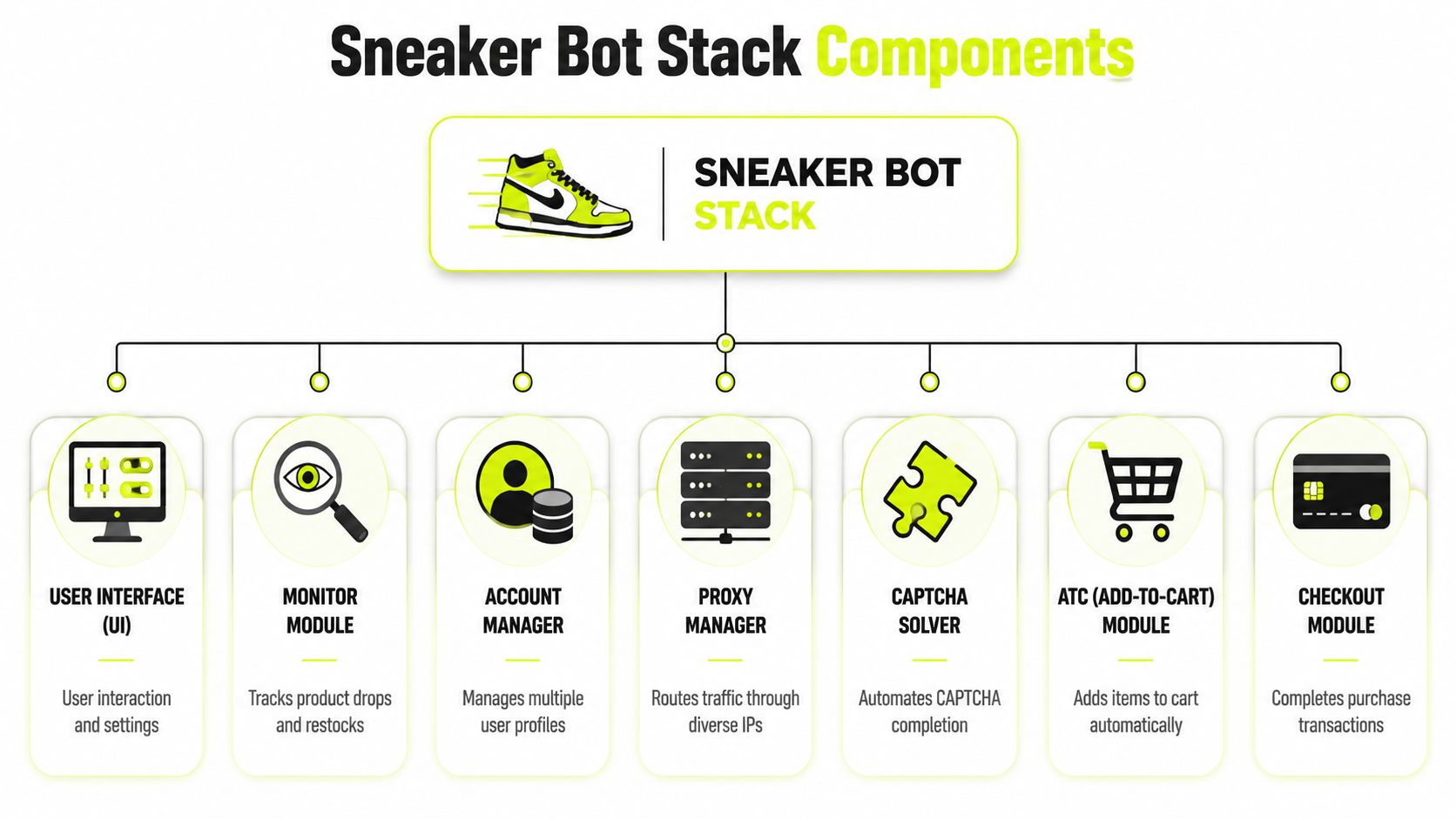
The bot is a workflow engine, not a magic app
At the top sits the task scheduler. This is the traffic controller. It decides when profiles start, how retries fire, which proxy pool each task uses, and how tasks react to queue states, errors, or stock changes. Good scheduling isn't just about early execution. It's about avoiding synchronized behavior that makes your fleet look fake.
Then you have the monitor module. This piece watches for product publication, stock status, or variant changes. For practical operators, monitors need two things: speed and separation. You usually don't want the same IP pool handling both heavy monitoring and checkout because it creates noisy patterns and burns your purchase lanes before the product goes live.
The ATC module handles add-to-cart. This phase looks simple until the site changes cart endpoints, embeds queue tokens, or requires state carried from earlier page interactions. Operators lose here when they assume a cart request is enough. On stronger targets, ATC works only if the full session already looks coherent.
Where most operators actually lose
The checkout module closes the loop. It submits shipping, payment, and confirmation in a sequence the retailer will accept. This module matters, but it's downstream from identity quality. If your profile, payment path, shipping logic, and session state don't match, checkout speed won't save you.
Then there's the proxy manager. This isn't a checkbox. It decides how each task appears on the network, whether sessions stay sticky, and how traffic spreads across subnets and geos. Proxy policy often determines whether the site sees a distributed user base or a clustered farm.
The account manager keeps profiles separated. Serious operators treat accounts the way account farmers treat Facebook or TikTok assets. Each profile carries its own history, cookies, browser fingerprint, and often its own usage lane. Blending them carelessly causes cross-contamination. That's how one dirty batch turns into mass cancellations.
A clean stack usually behaves like this:
- Monitor with cheap speed first. Use fast lanes to detect movement early.
- Promote qualified tasks. Only move selected tasks into premium proxy and account lanes.
- Preserve session continuity. Don't swap identity components mid-flow unless the target tolerates it.
- Spend expensive resources late. Save cleaner residential or mobile capacity for the moments that matter.
- Log failure reasons by stage. Don't label everything “declined” or “failed.” Separate queue drops, bans, CAPTCHA loops, cart errors, and payment friction.
A sneaker bot doesn't beat a release by being fast everywhere. It wins by being fast only where speed still matters.
That distinction matters if you already run geo-targeted campaigns, cloaking flows, or account farms. In those environments, you already know the operational truth. Precision beats volume when the platform scores quality before delivery.
The Proxy Infrastructure Imperative
Proxies decide which parts of your operation can stay aggressive and which parts need to look ordinary. If the bot is the engine, the proxy layer is the road surface, the traffic pattern, and the license plate.
How each proxy type behaves under drop pressure
Datacenter proxies are the speed play. They're useful for monitoring, preloading public pages, or testing target behavior. They're cheap relative to cleaner consumer IPs and they respond fast. The trade-off is obvious. Retail anti-bot systems often distrust them quickly, especially in checkout or account-heavy flows.
Residential proxies are the workhorse for purchase traffic because they map back to consumer devices and household networks. They cost more, and quality varies hard by provider, but they fit targets that care about authenticity more than raw throughput. For bots for sneakers, residential traffic is often the difference between “request accepted” and “session devalued.”
Mobile proxies sit at the expensive end of the trust spectrum. They're useful when a target heavily favors mobile network reputation or when repeated rotations through carrier pools help break correlation. They aren't a universal fix. Latency and pricing can make them a poor choice for broad task counts. They're better reserved for specific sites or high-friction account actions.
ISP proxies sit in a useful middle lane. They're typically more stable than rotating residential sessions and cleaner-looking than datacenter ranges for many targets. For queue-based flows or sticky checkout sessions, that stability matters. Many operators use ISP lanes where they need consistent identity over time without taking the full performance hit of mobile.
IPv6 proxies are situational. They can work well where the target accepts IPv6 traffic cleanly and where you need scale at low cost. They're less useful when the site's anti-bot stack or upstream services normalize toward IPv4 behavior, or when your tooling and payment flows are clearly tuned around more standard consumer traffic patterns.
Proxy Type Comparison for Sneaker Botting
| Proxy Type | Primary Use Case | Speed | Ban Risk | Cost |
|---|---|---|---|---|
| Residential | Checkout, account actions, queue participation | Moderate | Lower when quality is good | Higher |
| Mobile | High-friction targets, identity-sensitive flows | Variable | Lower in some environments | Highest |
| Datacenter | Monitoring, testing, public page scraping | Fast | Higher on purchase flows | Lower |
| ISP | Sticky sessions, queues, stable checkout lanes | Fast to moderate | Moderate | Mid to high |
| IPv6 | Scale testing, compatible targets, broad distribution | Variable | Target-dependent | Lower to moderate |
Sticky sessions, rotation, and subnet risk
Rotation policy matters as much as proxy type.
Use rotating sessions when you're monitoring, scraping lightweight endpoints, or distributing early-stage requests that don't need continuity. Use sticky sessions when the target expects one user journey to come from one stable source, especially in queues, account logins, and cart-to-checkout flows.
Operators with media buying experience usually adapt fast to these types of dynamics. You already know that a Facebook ad account doesn't like a shifting device and IP story. Sneaker sites apply the same logic. If a session enters a queue on one identity and exits on another, you're asking the platform to re-score you at the worst possible moment.
Practical proxy policy often looks like this:
- Monitoring traffic goes through datacenter or cheaper rotating lanes.
- Account logins and warm-up go through sticky residential, mobile, or ISP sessions.
- Checkout attempts use the cleanest pool you can justify financially.
- Geo-targeted campaigns and region-locked drops get country or city matched IPs, just like localized ad verification or localized storefront testing.
- High-value account farms stay mapped to stable browser profiles in tools like AdsPower, Dolphin Anty, GoLogin, Multilogin, or Hidemyacc.
If you're comparing providers or planning your own pool design, this breakdown of how a proxy server is built and behaves in practice is useful because it frames the technical side of routing, allocation, and session handling in operator terms.
There's also a business angle for community operators. If you publish setups, run private groups, or advise other buyers, referral economics matter. Some proxy vendors pay recurring commissions. Sota Proxy, for example, offers an affiliate program with up to 40% commission. That's relevant if your setup recommendations already drive spend across botting, account farming, ad verification, or cloaking workflows.
Optimizing Your Operational Environment
Most failed drops come from environment mismatch, not from one bad task. The server is too far away. The browser profile is clean in the antidetect panel but dirty at the target. The proxy is fine for browsing but wrong for checkout. The account exists, but it has no believable history.
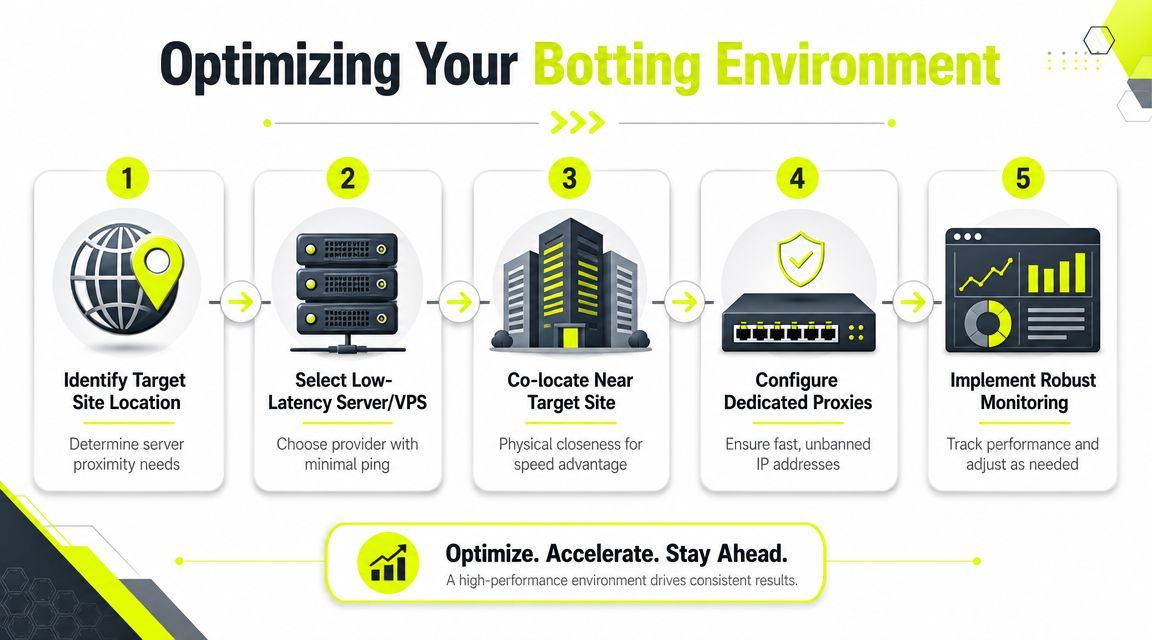
Servers, browsers, and account state have to match
Run performance-sensitive bots close to the target's infrastructure. A local home machine can work for smaller plays, but once you're operating at scale, a low-latency VPS or dedicated server usually makes more sense. You want predictable network behavior, stable resources, and less local noise from desktop activity.
The browser side matters just as much. If you're used to scaling Facebook and TikTok ad accounts, you already understand why antidetect tools exist. AdsPower, Dolphin Anty, GoLogin, Multilogin, and Hidemyacc let you keep browser identities segmented, persist cookies, and avoid profile collisions across account farms. The same discipline applies to sneaker accounts.
A profile should have a coherent story:
- Consistent fingerprinting that doesn't shift every session.
- Matching geo signals between proxy location, account region, and target market.
- Cookie age and browsing history that make the account look used, not minted for the drop.
- Controlled reuse rules so one profile doesn't touch too many targets too quickly.
Clean browser identity beats brute-force concurrency on sites that score behavior before checkout.
If you need to map proxy use correctly inside browser workflows, this Firefox browser proxy setup guide is a practical reference point for session handling and configuration logic.
CAPTCHA, queues, and browser realism
CAPTCHA solving splits into two worlds. One is manual harvesting, where a human solves challenges in advance or on demand inside a browser flow. The other is API-driven solving, where external services process the challenge. Manual methods can preserve better continuity on some targets. API methods scale better, but they can also create timing and quality issues if the target is sensitive to challenge context.
Queue handling is similar. The mistake is trying to overpower the queue with retries. That often makes your session look worse, not better. A stronger approach is to keep queue sessions stable, maintain IP continuity where needed, and avoid noisy restarts unless you know the target's queue implementation tolerates them.
Operators coming from cloaking or geo-targeted ad delivery should think of this as session preservation. Once a lane starts getting trust, don't break it casually.
Execution Strategy and Risk Management
Bad releases are expensive long after the drop ends. A cooked proxy subnet, a cluster of linked accounts, or a payment pattern that starts triggering review can hurt the next five drops, not just the current one. Good operators protect future throughput first, then chase short-term volume.
That changes how execution gets planned. The goal is not maximum task count. The goal is clean throughput under pressure, with enough separation between assets that one failure does not poison the rest of the stack.
Pre-drop controls that prevent expensive mistakes
Treat every asset by replacement cost and blast radius. Accounts with age, stable billing paths, and browser profiles with believable history take time to build back. Disposable monitors do not. The stack should reflect that difference before release day, not after the first bans show up.
Before a drop, verify:
- Accounts are warmed with believable browsing, login cadence, and low-risk activity.
- Profiles are isolated so one bad cookie jar doesn't contaminate a larger pool.
- Proxies are grouped by purpose instead of dumped into one mixed list.
- Payment and shipping data are mapped in a way that avoids obvious clustering.
- Tasks are tiered so not every profile hits the same target the same way at the same time.
Operators from Facebook or TikTok account farms already know the pattern. Age, history, geo consistency, and controlled behavior usually beat fresh assets pushed at full volume. Sneaker platforms score different signals, but the operating logic is close.

What mature anti-bot systems actually punish
Mature defenses score sessions, timing, network reputation, and checkout relationships together. Request speed still matters, but speed without trust usually just gets you blocked faster. Imperva describes sneaker bot detection as a behavioral classification problem, and Nike states that it removes large volumes of bot activity from SNKRS releases (Imperva on sneaker bot detection and SNKRS bot removal).
In practice, the main failure modes usually land in four buckets.
IP and subnet bans
Too many related requests from the same ranges can burn an entire lane. Proxy count helps less than range quality and diversification.Account suspension or quiet scoring
Some targets do not hard-ban immediately. They lower queue priority, inject friction, or let you reach checkout and lose later.Payment and order review
Passing cart means little if billing, shipping, device, and network signals do not line up at review time.Cross-account correlation
Reused browser fingerprints, repeated order structure, and synchronized task behavior can connect accounts that looked separate on paper.
The mitigations are operational, not glamorous. Split monitor traffic from account traffic and from checkout traffic. Stagger starts so the fleet does not act like a script. Limit reuse across cards, addresses, browsers, and IP groups. Log post-checkout outcomes by retailer so you can tell the difference between a true hit and a delayed cancel.
Root-cause discipline matters here. If a run fails, identify whether the issue came from proxy reputation, account health, browser identity, or payment review. Replacing the wrong layer wastes money and teaches you nothing.
For a practical reference on network-side controls, this guide on avoiding IP bans covers common trigger patterns and mitigation steps in usable detail.
Building a Performance-Optimized Setup
A good setup is built like an execution system under load. The drop window is short, the target adapts in real time, and weak links show up fast. Operators who keep swapping bots without fixing identity, network policy, and compute placement usually get inconsistent results because the bottleneck sits below the bot.
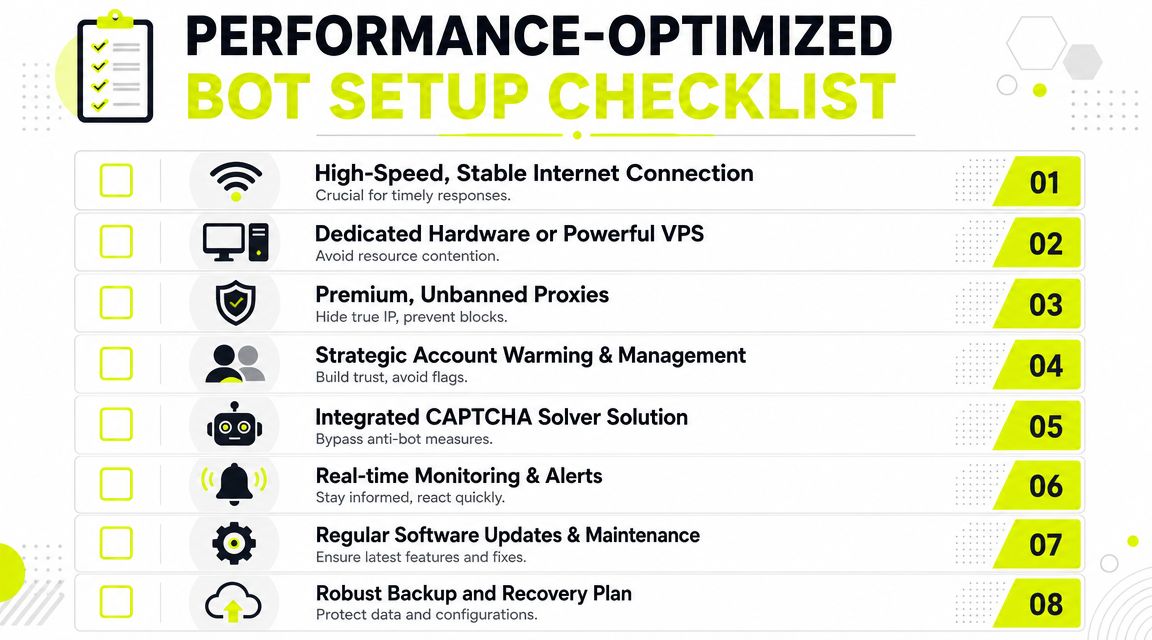
A practical build for fast commerce targets
For fast targets with lighter account checks, run a split-lane stack.
Put monitors on low-cost datacenter proxies and treat them as disposable sensors. Their job is to detect product state changes, stock movement, queue behavior, and endpoint health without wasting expensive trust inventory. Reserve checkout for sticky ISP or residential sessions tied to warmed profiles. That separation keeps your cost per attempt under control and protects higher-trust IPs from noisy traffic.
Server placement matters more than many operators admit. A low-latency VPS near the retailer's edge reduces delay on monitor hits, cart requests, and checkout submissions. The gain is not magic, but in a release decided by narrow timing margins, shaving network distance helps. Use antidetect browsers only on flows where browser state and persistence improve outcomes. On simpler endpoints, full browser overhead can slow the stack without adding much trust.
This setup maps well to teams that already run performance infrastructure elsewhere. The model is familiar. Cheap lanes collect signal. Premium lanes execute.
A practical build for identity-heavy launches
For launches where account history carries more weight than raw speed, center the build on identity continuity and session quality.
Use residential or mobile proxies for account actions, raffle entries, and any flow where the platform scores user history over burst behavior. Keep each account tied to one persistent browser profile in AdsPower, Dolphin Anty, GoLogin, Multilogin, or Hidemyacc. Warm the account over time, keep geography consistent, and avoid rotating sessions just because the dashboard allows it. Rotation solves one problem and creates another if the target expects a stable user.
For teams that want one vendor across residential, mobile, ISP, datacenter, and IPv6 traffic, Sota Proxy is one option. The practical advantage is operational simplicity. One dashboard for sticky sessions, geo targeting, and rotation policy is easier to manage than stitching together several proxy providers across sneaker tasks, scraping, ad account work, and market-specific testing.
Use this checklist:
- Separate monitor traffic from execution traffic
- Use sticky sessions where session continuity affects trust
- Warm accounts before high-value actions
- Keep browser fingerprints stable per account
- Place compute close to the target region
- Spend premium proxy inventory only on scored steps
- Track cancellations separately from passed checkouts
- Treat bots for sneakers as infrastructure, not software alone
Related articles

Your Best Proxy for Sneaker Bot Success in 2026
A technical guide to selecting the right proxy for sneaker bot operations. Learn to configure residential, ISP, and datacenter proxies for drops and avoid bans.
How to Buy Proxies for the First Time: A 30-Minute Checklist
A first purchase goes wrong in predictable places: the wrong proxy type, a headline price nobody pays, an identity check nobody mentioned, a refund that does not apply to how you paid. The checklist, with prices and policies from the vendors' own pages.
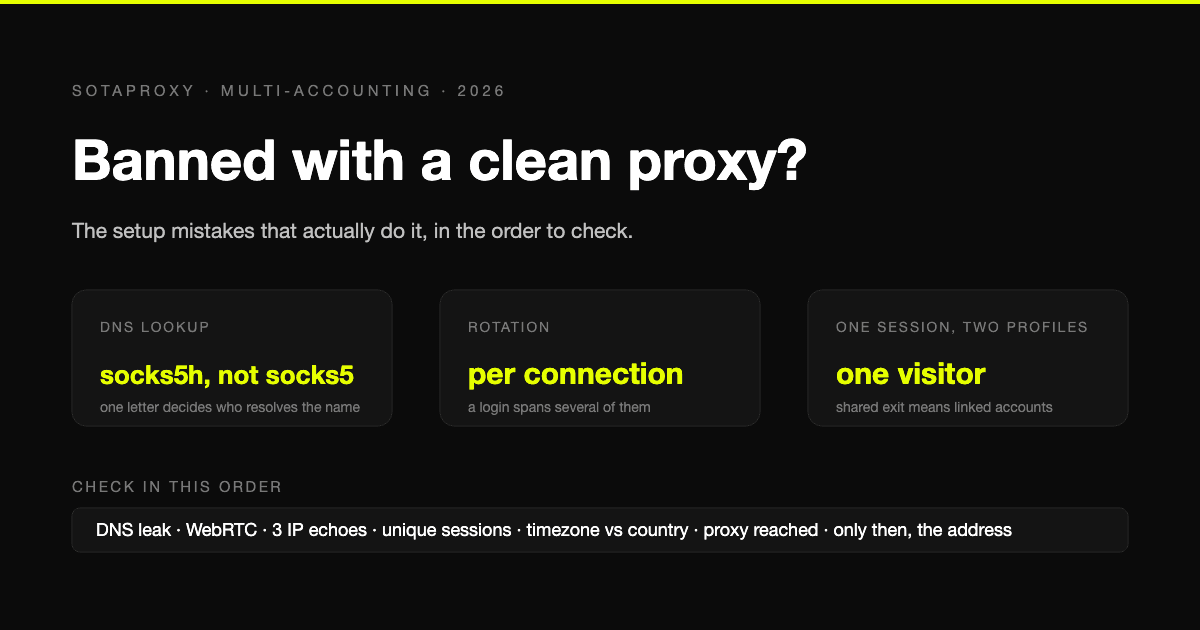
Banned With a Clean Proxy? The Setup Mistakes That Actually Do It
The proxy was clean, the address was residential, and the account still died. In most cases we see, the address was never the problem. Seven setup faults, each one checkable in a minute, in the order they usually turn out to be the cause.
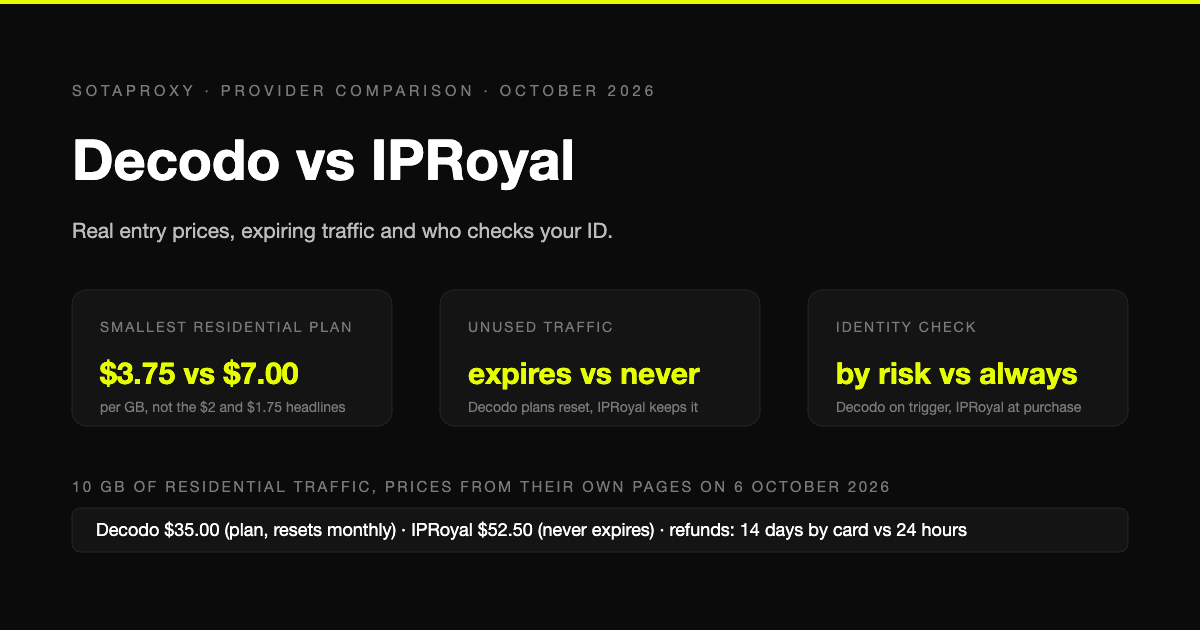
Decodo vs IPRoyal in 2026: Real Entry Prices, Expiring Traffic and Who Checks Your ID
Both are mid-market proxy vendors that take cards and crypto and sell by the gigabyte. The prices on their own pages on 6 October 2026, why neither headline rate is an entry price, whose traffic expires, who checks your identity before you can buy, and who gives money back.
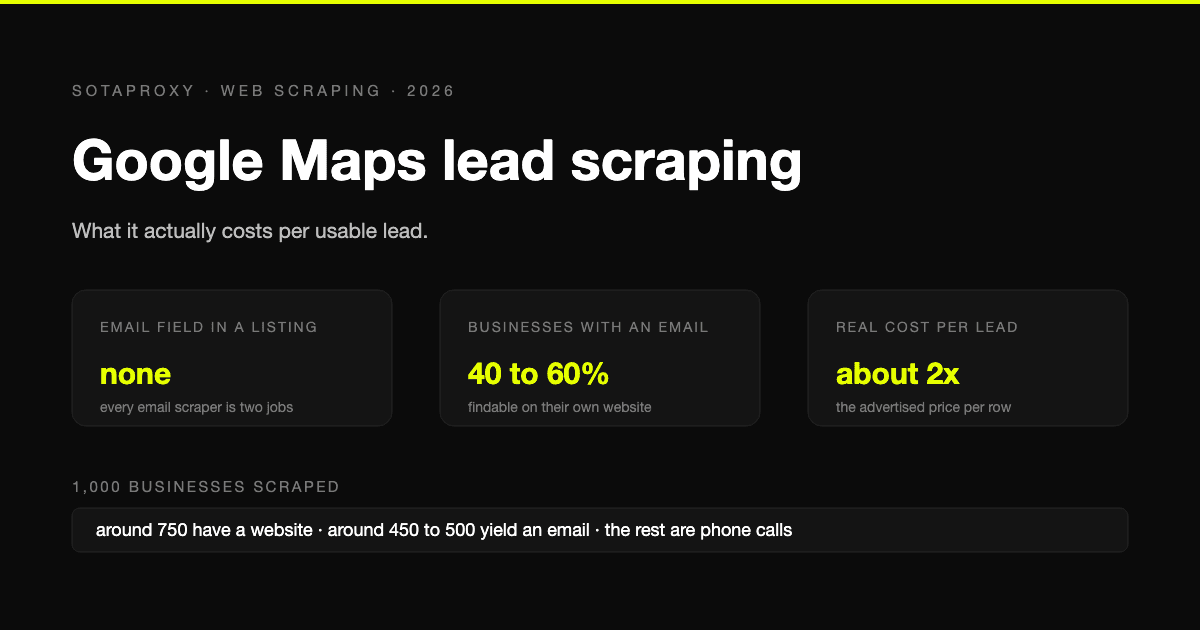
Google Maps Lead Scraping: What It Actually Costs Per Usable Lead
Google Maps has no email field, so every email scraper is a two-stage pipeline and only about half of businesses yield an address. What a thousand listings really costs per usable lead, the businesses-without-websites play, and where the law stands after the SerpApi ruling.
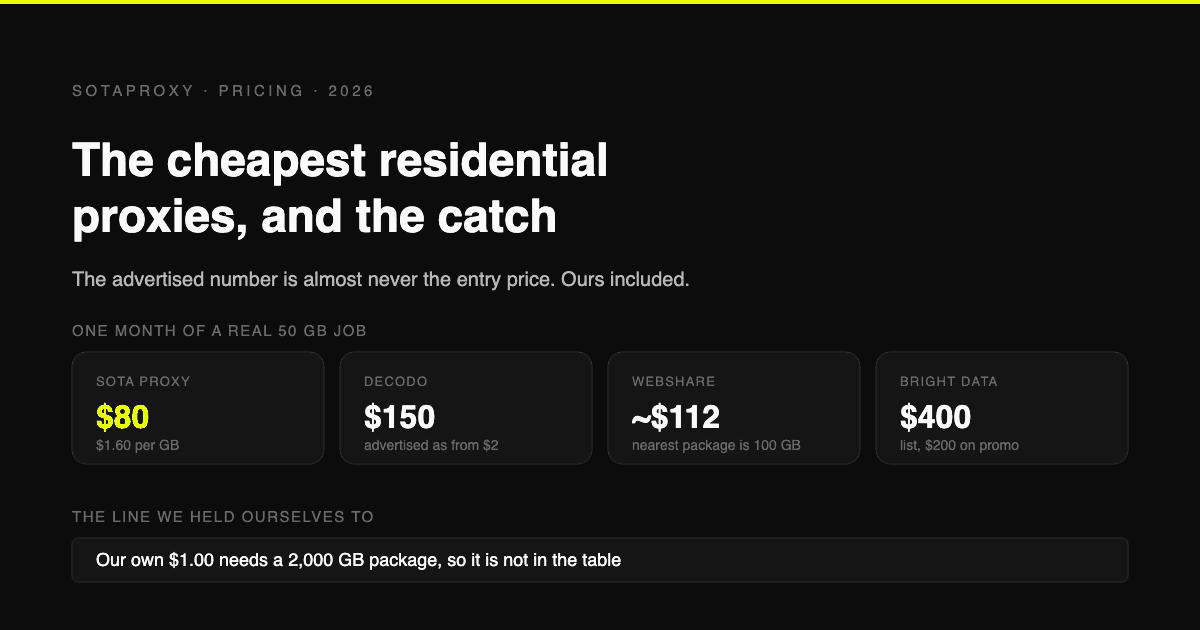
The Cheapest Residential Proxies in 2026, With the Catch Each One Hides
Verified per-gigabyte prices from five vendors' own pages, not from last year's blog posts. Why the advertised number is almost never the entry price, which providers put a monthly floor under your bill, and how to work out your real cost per gigabyte.