Bright Data vs Oxylabs in 2026: Prices, Commitments and the KYC Nobody Mentions
Both are enterprise platforms with minimum monthly commitments and a compliance check before you can touch residential traffic. Current prices from both vendors' own pages, what the commitment actually costs if you underuse it, and who each one is genuinely for.
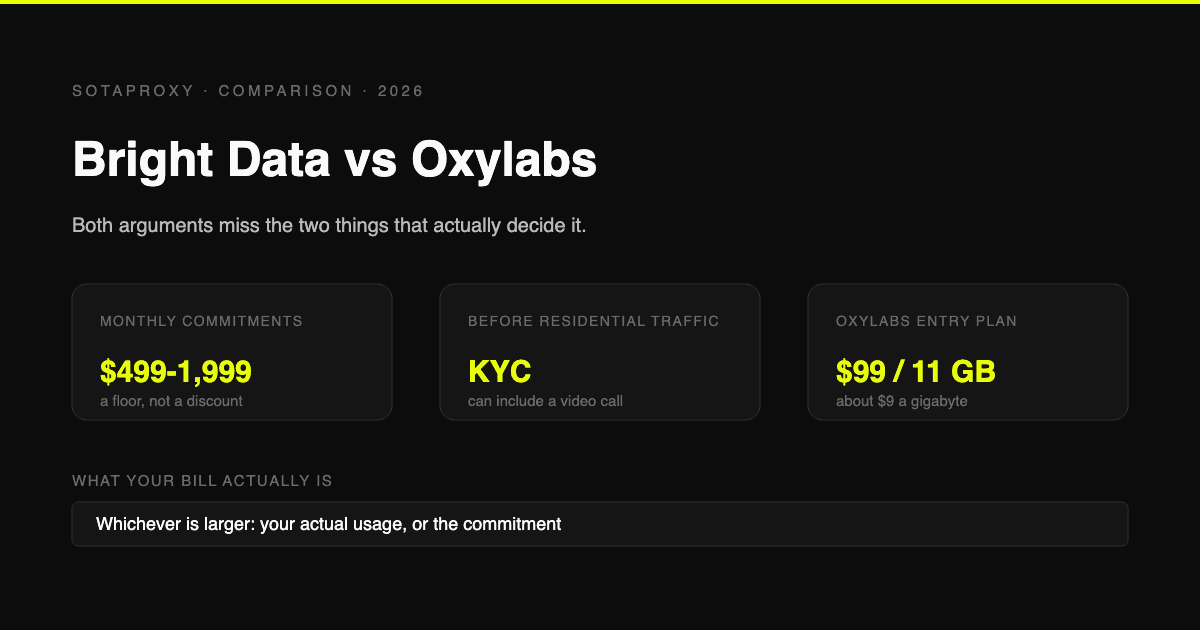
Most comparisons of these two argue about success rates and quote prices from whenever the article was first written. The numbers below were taken from each vendor's own pricing pages on 25 September 2026, and the two things that actually decide this for most buyers are not in the usual comparison at all: minimum monthly commitments and a compliance check before you can use residential traffic.
We sell proxies too, and we are not in this weight class. That makes it easy to say the useful thing: for a large share of people searching this, the answer is neither.
The short version
| Bright Data | Oxylabs | |
|---|---|---|
| Residential, list price | $8 per GB pay as you go | From $6 per GB |
| Entry without commitment | Yes, pay as you go | Plans start at $99 per month for 11 GB |
| Monthly commitment tiers | $499, $999, $1,999 | $100, $500, $2,500 and up |
| Best residential rate shown | $5 per GB at $1,999 a month | $6 per GB at the top of the published range |
| Residential pool claimed | 400M+ monthly IPs | 175M+ IPs |
| Compliance check | Required for residential and mobile, can include a video call | KYC policy applies |
| Scraping layer | Web Unlocker, Scraper IDE, Scraper APIs, SERP API, datasets | Web Unblocker, Web Scraper API from $49 a month |
Bright Data is currently running a promotion that halves the residential rates shown above. Promotions move; the list prices are what you should plan against, and the promotional rate is what you might actually pay in month one.
The commitment is the real decision
This is the part that changes the answer for small and mid-size buyers, and it is missing from almost every comparison.
A minimum monthly commitment is not a discount tier. It is a floor on your bill. Bright Data's own documentation walks through it plainly: on a $500 minimum plan, if your usage costs less than the minimum, you are invoiced the minimum anyway, and your balance is topped back up to it at the start of each month. Start mid-month and the first commitment is prorated, then it is the full amount every month after.
So the effective price is not the per-gigabyte figure. It is:
whichever is larger, your actual usage or the commitment
For a team pulling 400 GB a month, a $999 commitment at $6 per GB is a real discount. For someone pulling 30 GB a month, the same plan means paying $999 for roughly $180 of traffic, and the headline per-gigabyte rate is fiction.
Oxylabs structures the entry differently: plans start at $99 a month with an 11 GB allowance, which works out near $9 a gigabyte at the bottom. That is a much smaller floor to step over, and for a buyer testing the water it is the friendlier shape even though the unit price looks worse.
The practical rule: divide the commitment by your realistic monthly volume before comparing anything. Most people discover their effective rate is nowhere near the advertised one.
The compliance check is the other one
Neither vendor lets you sign up and immediately pipe residential traffic.
Bright Data states that before using the residential or mobile networks, a representative will take you through a compliance process, and that this can include a short intro video call plus verification of your company or personal details. Oxylabs maintains a KYC policy of its own.
This is not a criticism of either. Residential traffic runs through other people's connections and the industry has earned its compliance layer. But it has three consequences worth knowing before you pick:
- There is a delay between deciding and working. If you needed data this afternoon, this is the wrong shelf.
- You will be identifying yourself and probably your company. Anonymity is not on the menu at this end of the market.
- Some use cases will not pass. The check exists to filter, and it does.
Notably, Bright Data says the Web Unlocker route does not require going through KYC, which is a real distinction if what you need is unblocking rather than raw residential addresses.
Where they genuinely differ
Once past price and paperwork, the split is about what sits on top of the proxy network.
Bright Data is the broader catalogue. Web Unlocker, a Scraper IDE, prebuilt Scraper APIs, a SERP API and ready-made datasets, plus the largest claimed residential pool at 400M+ monthly IPs and four network types including a dedicated ISP product. If your problem is "get me this data" rather than "give me addresses", there is more here that answers it directly.
Oxylabs is the tighter proxy product with a Web Unblocker and a general Web Scraper API from $49 a month, positioned on quality of pool and unblocking rather than breadth of catalogue. Its entry plan is smaller, which makes it easier to start with, and independent benchmarks have generally rated its unblocking strongly.
Both publish city-level targeting, both cover essentially every country, and both sell ISP and mobile alongside residential. At the level most buyers operate, the network difference between them is smaller than the difference between either one and their own bill.
Who should pick which
Bright Data if: you need the managed scraping layer, prebuilt scrapers or datasets; you have volume that clears a four-figure monthly commitment; or you want Web Unlocker specifically, which also skips the KYC step.
Oxylabs if: you want to start smaller without a large floor; your need is proxies and unblocking rather than a data catalogue; or you are testing before committing to a platform.
Neither if: any of these describe you.
- You need a handful of static addresses for accounts. Both sell ISP products, and both are priced and structured for a different buyer. A static address for one account is a $2 to $3 a month purchase, not a platform decision, and the reasoning is in ISP vs residential vs datacenter.
- Your monthly volume is under about 50 GB. The commitment structure will eat the discount and then some.
- You cannot or will not complete a compliance check.
- You want to pay in crypto and stay out of an account-management relationship. That is a different product category, and we are transparently one of the vendors in it.
For completeness on the rest of the market: Decodo sits below both on residential cost with a smaller catalogue, and Webshare sits an order of magnitude below everyone on static addresses with the trade-offs that implies.
How to actually decide, in an afternoon
- Write down your realistic monthly gigabytes. Not your hoped-for volume, last month's.
- Divide each commitment tier by that number. That is your true per-gigabyte rate at each vendor. Compare those, not the headlines.
- Check whether you need the layer above proxies. If yes, the comparison is really about unblockers and scraper APIs, where Bright Data's catalogue is wider and Oxylabs' is cheaper to enter.
- Start the compliance process before you plan around either. It is the step most likely to move your timeline.
- Run the same target through both trials and compare on your own sites rather than on anyone's published benchmark, including the ones in this article's competitors. The checks worth running are in how to test a proxy before you buy it.
FAQ
Is Bright Data or Oxylabs cheaper?
On list prices, Oxylabs starts lower per gigabyte and Bright Data goes lower at volume: Bright Data publishes $8 per gigabyte pay as you go falling to $5 at a $1,999 monthly commitment, while Oxylabs advertises from $6 per gigabyte with plans starting at $99 a month for 11 GB. Your effective price depends far more on whether you clear the commitment than on the headline rate.
What is a minimum monthly commitment?
A floor on your invoice. If your usage costs less than the commitment, you are billed the commitment anyway. Bright Data's documentation describes prorating it for a partial first month and topping your balance back up each month after. It is the single biggest reason an advertised per-gigabyte rate can be misleading.
Do Bright Data and Oxylabs require KYC?
Both have compliance requirements. Bright Data states that a representative takes you through a compliance process before you use residential or mobile, and that it can include a short video call and verification of your details; it also notes that Web Unlocker does not require KYC. Oxylabs maintains its own KYC policy. Neither is an anonymous sign-up.
Which has more residential IPs?
Bright Data claims 400M+ monthly residential IPs against 175M+ at Oxylabs. Pool size matters less than it sounds for most workloads: what decides success is whether the specific addresses you get are clean for your specific targets, which only a trial on your own sites tells you.
Are Bright Data and Oxylabs worth it for a small operation?
Usually not. Both are built for volume, both put a monthly floor under your bill, and both require a compliance process before residential traffic. If you need a few static addresses for accounts, or under about 50 GB a month, the economics point somewhere else entirely.
What is the difference between Web Unlocker and Web Unblocker?
They are the two vendors' names for the same category: a managed service that takes your request, handles anti-bot challenges, CAPTCHAs and retries, and returns the page. Bright Data calls its version Web Unlocker, Oxylabs calls its version Web Unblocker. You pay per successful request rather than per gigabyte, and you stop maintaining unblocking logic yourself.
Related articles
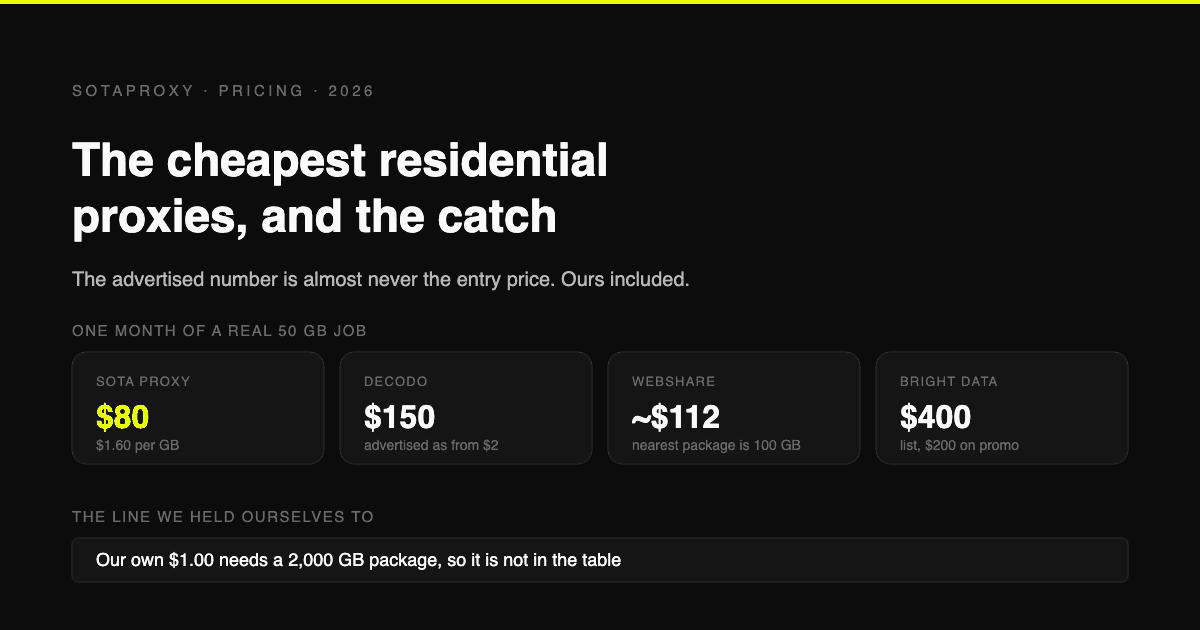
The Cheapest Residential Proxies in 2026, With the Catch Each One Hides
Verified per-gigabyte prices from five vendors' own pages, not from last year's blog posts. Why the advertised number is almost never the entry price, which providers put a monthly floor under your bill, and how to work out your real cost per gigabyte.
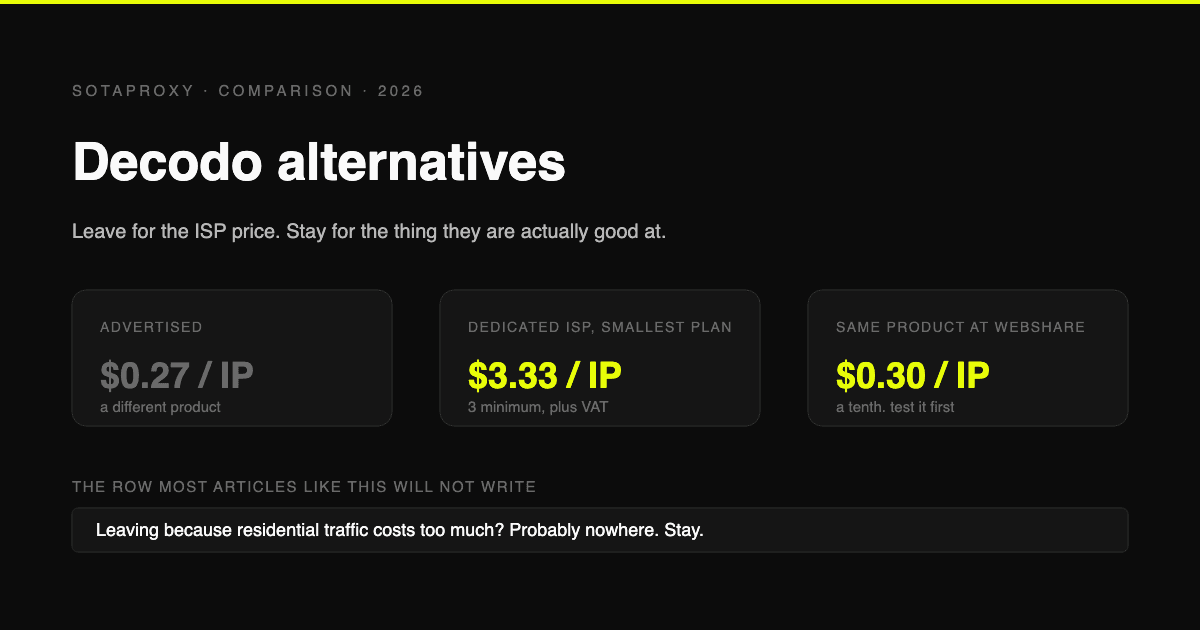
Decodo Alternatives in 2026: Who to Move to, and Who Not to Bother
Decodo is the cost leader on rotating residential and one of the pricier options on dedicated ISP. Verified prices for both, the reasons people actually leave, and which alternative fits each one.
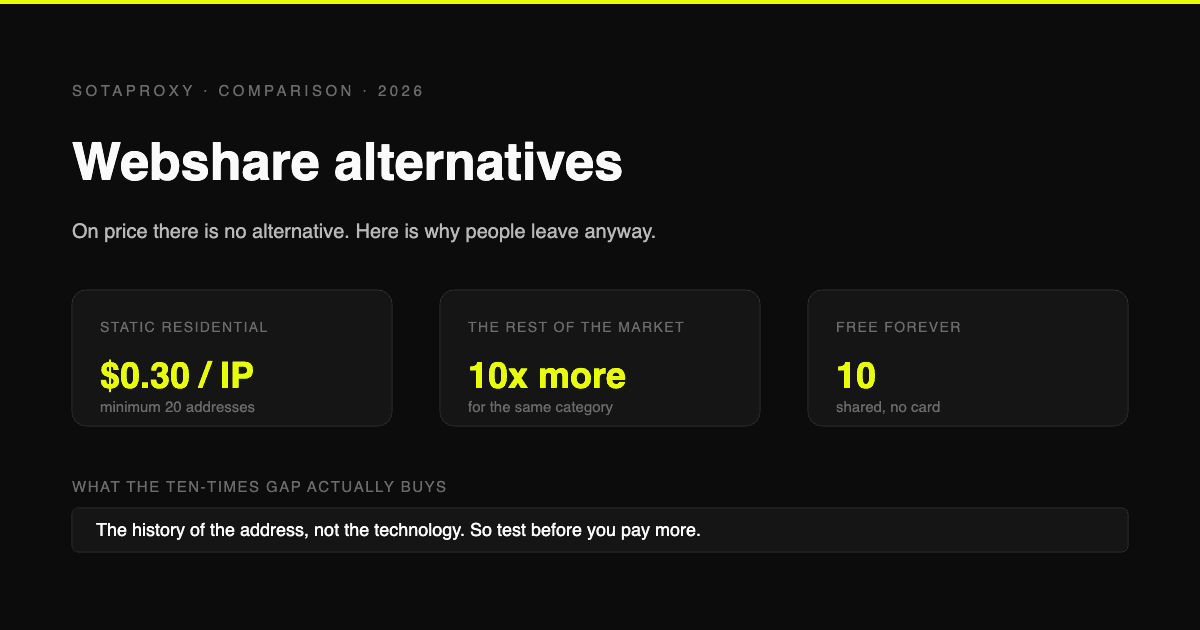
Webshare Alternatives in 2026: When the Cheapest Proxies Stop Being Cheap
Webshare gives away 10 proxies and sells static residential at $0.30 an IP, a tenth of what most vendors charge. Verified prices, the four reasons people still leave, and the one reason to stay.
ISP vs Residential vs Datacenter vs Mobile Proxies: Which One You Actually Need
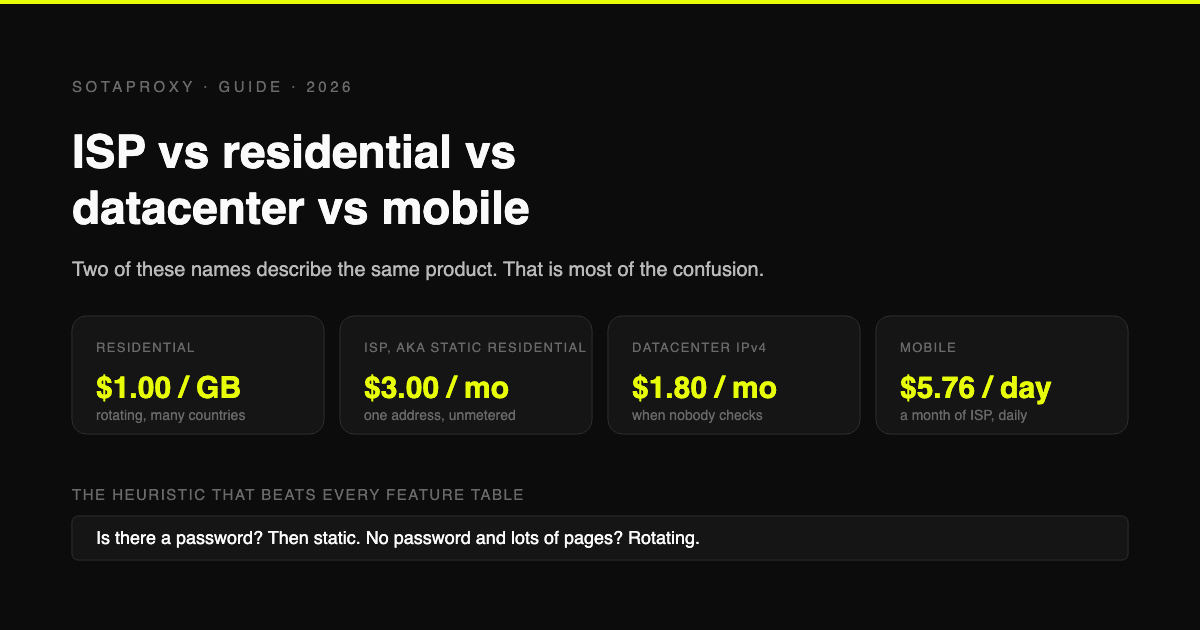
Static residential and ISP are the same product under two names, which is why half these comparisons compare a thing to itself. What each type is, what it costs per unit, and the one task each is genuinely best at.

Buy Proxies for Geo Surfing That Actually Work
Learn how to buy proxies for geo surfing the right way - choose types, target cities, configure antidetect browsers and validate geo results.

How to Build an Advertising Traffic Protection Infrastructure with CloakingHouse and SotaProxy
Learn how to build a reliable ad traffic stack with proxies, browser profiles and cloaking for GEO testing, filtering and campaign troubleshooting.