10 Best Proxy Services for Ads, Scraping, and Automation
Compare the best proxy services for ad verification, scraping, account operations, and geo-targeting by IP type, price, uptime, and controls.

The largest IP pool isn't automatically the best proxy choice. A huge inventory can still fail if sessions break, locations resolve incorrectly, or the same residential addresses circulate through several networks. For traffic arbitrage, media buying, and multi-account operations, the decision sits closer to the target: platform sensitivity, session persistence, geo precision, throughput, account risk, and total operating cost.
A Facebook or TikTok ad account needs a different setup from a bulk scraper. Account farming needs stable identity signals. Cloaking and geo-targeted campaigns need accurate location control. Price monitoring may favor rotating residential access, while high-volume parsing can run efficiently on datacenter or IPv6 infrastructure when the target tolerates it. The right provider should also fit your browser stack, whether you use AdsPower, Dolphin Anty, GoLogin, Multilogin, or Hidemyacc.
This ranking weighs those operational details rather than pool size alone. It separates residential, mobile, ISP, datacenter, and IPv6 use cases, then compares targeting, rotation, sticky sessions, uptime, billing, integrations, and support. If you're also evaluating campaign software, this Keywordme review of 2025 PPC tools provides useful context for the media-buying side of the workflow.
Table of Contents
- 1. Sota Proxy
- 2. Oxylabs
- 3. Bright Data
- 4. Decodo
- 5. SOAX
- 6. IPRoyal
- 7. Rayobyte
- 8. Webshare
- 9. PacketStream
- 10. Zyte API
- Top 10 Proxy Services Comparison
- Choose by Workflow, Then Validate at Target Level
1. Sota Proxy
Sota Proxy fits teams that need several proxy types without stitching together separate vendors. Its portfolio covers residential, mobile, ISP, datacenter, IPv4, and IPv6 access across 220+ geolocations, with city-level targeting, rotating sessions, and sticky sessions. That mix supports different workflows, from geo-targeted campaign checks to multi-account operations, better than a service limited to one IP category.
Provisioning takes about 60 seconds for credentials. Billing is pay-as-you-go by gigabyte or IP, with card and crypto payments, instant top-ups, and no subscription or KYC requirement. The published terms include a 99.9% uptime SLA, and 24/7/365 human support gives operators a direct escalation path when a Facebook account, TikTok campaign, or scraper starts failing. These details are listed on Sota Proxy's platform documentation.
Where Sota Proxy fits best
The IP options map to distinct deployment needs:
- Residential rotation: Suitable for scraping, ad verification, price monitoring, SEO checks, and validating geo-targeted campaigns.
- Mobile IPs: 4G and LTE routes suit social media management, account farming, and sensitive Facebook or TikTok workflows.
- ISP and static residential: Useful when a profile needs a stable address with more speed than a rotating residential route.
- Datacenter and IPv6: Better for throughput-heavy scraping, QA, automation, and lower-cost tasks where residential trust is unnecessary.
An AI-powered pool manager is designed to remove flagged addresses. Sota Proxy also advertises self-healing clusters and route optimization to reduce latency. The dashboard combines usage monitoring, balance controls, pool activity, and rotation settings. It lists around 2.85 million active IPs, but operators should test performance against each target instead of treating pool size as a reliability guarantee.
Practical rule: Bind one stable proxy to each long-term profile, then rotate only when the workflow requires it. Frequent identity changes can create more risk than a smaller, consistent pool.
Cost is the main trade-off. Mobile proxies are priced per day, so large mobile-only deployments can become expensive. Enterprises with formal procurement requirements may also need extra vendor checks because public certification or compliance attestations are not prominently listed. For teams prioritizing quick setup, flexible billing, city-level control, multiple IP types, and active support, Sota Proxy is a practical all-round option.
2. Oxylabs
Oxylabs is a strong fit for enterprise media intelligence, localized ad verification, SERP collection, and retail monitoring. Its portfolio includes residential, ISP, mobile, and datacenter proxies, plus Web Unblocker and SERP APIs. The service supports HTTP(S) and SOCKS5, rotating connections, and sticky sessions, so teams can choose between fresh IPs and persistent sessions without building separate infrastructure.
The standout feature is geo control. Country, state, city, ZIP, ASN, and coordinate targeting support localized campaign checks that basic country selection can't handle. That matters when a media buyer needs to verify a Facebook or TikTok landing flow from a particular market, or when an SEO team needs to compare results at a local level. Oxylabs lists coverage of 177 million-plus IPs across 195 countries on its official platform, but operational success still depends on the target, route, and session design.
Operational trade-offs
Oxylabs makes more sense when the team can use enterprise support, SLAs, APIs, and granular controls. It may be excessive for a small account-farming operation that only needs a few dedicated residential sessions. Business verification can also be required for trials, and entry pricing is higher than budget-focused alternatives.
For scraping agencies, Web Unblocker and the SERP API can reduce the engineering burden. For direct browser work in AdsPower, Dolphin Anty, GoLogin, Multilogin, or Hidemyacc, the raw proxy endpoints remain the relevant component. Teams comparing this provider against a more flexible deployment model can also review Oxylabs alternatives.
3. Bright Data
Bright Data suits organizations that need more than proxy endpoints. Its ecosystem combines residential, ISP, and datacenter access with specialized tools, SERP and scraper APIs, datasets, dashboards, automation tooling, and enterprise audit features. That makes it particularly useful for large data-collection programs where proxy management, extraction, and governance sit inside the same procurement decision.
The platform supports pay-as-you-go and monthly commitment models across proxy types. Rotation and session controls are available for workflows such as retail monitoring, ad verification, price intelligence, and geo-targeted campaign checks. Its mature tooling can help a scraping agency avoid writing every retry and unblocking rule internally, although teams should validate the actual economics against their target mix.
Who should choose it
Bright Data is best for buyers with predictable volume, compliance review, and engineering resources. The broader ecosystem adds value when the team needs APIs or datasets. It adds less value when the requirement is just a small pool of residential IPs for a few antidetect browser profiles.
Onboarding and KYC can be stricter than with SMB-focused providers. Pricing can also become steep for small buyers, and volume discounts matter. For teams comparing the platform with less complex alternatives, this guide to Bright Data alternatives offers a useful comparison path.
4. Decodo
Decodo, formerly Smartproxy, offers a practical middle ground for small and midsize scraping teams, media buyers, and multi-account operators. Its portfolio covers residential, ISP, mobile, and datacenter proxies, with rotating and sticky modes over HTTP(S) and SOCKS5. City targeting and quick proxy-list generation reduce setup friction, especially when the same endpoint format must work across several browser profiles.
The service also includes Site Unblocker and a Scraping API. Those products can handle more of the anti-bot workflow for data teams, while direct proxy access remains available for AdsPower, Dolphin Anty, GoLogin, Multilogin, and Hidemyacc. Decodo lists 125 million-plus residential IPs, as shown on its official website, but pool size should still be checked against the exact social, retail, or search targets in production.
Value and limitations
Decodo's main advantage is ease of use. A team can generate endpoints quickly, bind them to profiles, and test sticky or rotating behavior without a long infrastructure project. It offers ISO/IEC 27001:2022 certification, according to its platform materials, which may help buyers with formal vendor review.
The trade-off is product separation. Site Unblocker and API features cost extra, and pool quality can vary by target. For account farming, use dedicated residential or mobile sessions and keep the profile's timezone, language, and target market aligned with the proxy. For teams moving from the former Smartproxy product, this overview of Smartproxy alternatives can help frame the choice.
5. SOAX
SOAX works well when a team wants residential, mobile, ISP, and datacenter access under a unified credit model. That structure can simplify experimentation. An operator might test a residential route for ad verification, move a less sensitive scraper to datacenter access, and keep the same general account and dashboard workflow.
The service supports HTTP(S) and SOCKS5, rotating and sticky sessions, country and city selection, API controls, and dashboard management. SOAX presents a compliance-forward position with GDPR and CCPA emphasis. Its site lists 155 million-plus residential IPs and 2.6 million-plus ISP IPs, figures available through SOAX.
Best operational fit
SOAX is a sensible choice for mainstream scraping, retail checks, ad verification, and geo-targeted campaign review. Cross-product crediting is convenient when workloads change, although the effective per-gigabyte cost depends on the selected bundle. Buyers should calculate the cost using their actual mix of bandwidth, sticky duration, retries, and proxy type rather than relying on the headline plan.
The main limitation is targeting depth. Country and city controls cover common needs, but teams requiring highly specific ASN or coordinate logic may prefer an enterprise provider. SOAX also fits browser-based account workflows, but platform-sensitive Facebook and TikTok operations still need disciplined profile isolation. A good dashboard can't compensate for shared identities, mismatched locations, or uncontrolled rotation.
6. IPRoyal
IPRoyal is built for buyers who want simple onboarding and aggressive entry pricing. It provides residential, ISP, mobile, and datacenter proxies with rotating and sticky modes over HTTP(S) and SOCKS5. Pay-as-you-go bandwidth doesn't expire, and subscription discounts give frequent users another billing option.
That model suits smaller scraping shops, experimental campaigns, and account-farming teams that don't want to commit to a large monthly contract. The dashboard and setup guides are straightforward, and many locations support city-level targeting. IPRoyal lists 64 million-plus residential IPs on its official site.
Where it works, and where it doesn't
Use IPRoyal when the target tolerates some variability and the cost model matters. It can support browser profiles in AdsPower, Dolphin Anty, GoLogin, Multilogin, and Hidemyacc, provided each account receives its own proxy and stable session policy. Residential routes remain the safer default for long-term Facebook and TikTok accounts, while datacenter access makes more sense for bulk scraping or QA.
The limitation appears on heavily protected targets. Pool quality and performance can vary, and some advanced controls sit behind higher tiers. Test login stability, page-load success, location accuracy, and session persistence before moving spend or a large account inventory. Teams assessing the service against other budget options can read this comparison of IPRoyal alternatives.
7. Rayobyte
Rayobyte is a good match for buyers who prioritize US coverage, ISP and datacenter stability, and a clear abuse-prevention posture. The provider offers residential, static ISP, mobile, and datacenter options, alongside a scraping API. Its ethical sourcing and abuse-control materials give compliance-minded teams more documentation to review before deployment.
Static ISP proxies are useful when a retail check, ad review, or account workflow needs a consistent network identity without the variability of a rotating residential pool. Datacenter routes can handle throughput-heavy jobs where the target accepts hosting-provider addresses. Residential and mobile options remain available for more sensitive traffic, but Rayobyte's residential pool is smaller than the largest enterprise providers.
Cost and deployment considerations
Rayobyte can offer strong value at high volume, especially when a team needs a substantial US footprint. The best pricing often requires a subscription or commitment, so bursty operators should compare expected usage against unused capacity. Higher service tiers may include business support and SLAs, which can matter for production campaigns.
For Facebook and TikTok ad accounts, use static or residential routes only after target-level testing. For scraping, combine Rayobyte's API with controlled concurrency and explicit retry rules. Account farming and cloaking require additional care, including documented permission and compliance with platform policies. A proxy that performs well for retail collection isn't automatically suitable for a long-lived social profile.
8. Webshare
Webshare is strongest when datacenter or ISP IPs are acceptable and the team wants programmatic control. Its API supports fine-grained proxy-list customization, bulk downloads, location filters, quick rotation, and automation. That makes it convenient for developers building a proxy layer into parsers, QA systems, and high-volume collection jobs.
The price-to-performance profile is attractive for scale-out scraping against targets with higher tolerance for datacenter traffic. A free tier supports integration testing, while per-IP and per-gigabyte plans keep costs predictable for basic deployments. Details on those workflows are available from Webshare.
Keep residential expectations realistic
Webshare isn't a residential specialist. Datacenter and ISP addresses can be flagged by platforms that expect home or mobile traffic, which limits its role in Facebook and TikTok account management, account farming, and sensitive cloaking workflows. Private static residential offerings also receive mixed community feedback, so buyers should test before assigning them to valuable profiles.
For developers, the API is the main advantage. Generate separate lists for scrapers, QA workers, and geo-targeted checks instead of sharing one undifferentiated pool. Teams comparing Webshare with a provider offering broader residential and mobile coverage can review Webshare comparisons.
9. PacketStream
PacketStream keeps the model simple. It sells residential bandwidth through a peer network with a flat per-gigabyte structure, country targeting, a rotating gateway, and self-serve setup. Balances don't expire, and there's no subscription requirement, which makes the service useful for bursty experiments, overflow traffic, and budget-constrained scraping.
The low commitment changes the evaluation process. PacketStream is easier to trial than a contract-heavy enterprise platform, but the team needs to watch target-level success closely. A peer-supplied network can show more variation in reputation, availability, and route quality than a tightly managed premium pool.
Sensible use cases
PacketStream fits pilots and non-critical scraping where a failed request can be retried without damaging an account or campaign. It can also provide overflow capacity when a primary provider reaches a concurrency or geographic limit. It isn't the first choice for long-term Facebook or TikTok profiles, high-value account farming, or workflows that require strict session continuity.
The supply model uses bandwidth sharing and resale, so buyers should document what traffic is permitted and confirm that their use complies with the target's terms. Fewer enterprise controls also mean more responsibility for monitoring, retries, and pool hygiene. Treat the service as a cost-focused tool, not a universal replacement for dedicated residential or mobile infrastructure.
10. Zyte API
Zyte API is different from the other entries because it manages much of the scraping problem instead of exposing a raw pool for manual orchestration. It consolidates Smart Proxy Manager functionality into a managed service with proxy mode, automatic rotation, retries, CAPTCHA handling, and JavaScript rendering. REST and proxy-mode interfaces integrate with Scrapy and other clients.
That abstraction works well for difficult retail, travel, and classifieds targets. The team can focus on extraction logic while Zyte handles more of the proxy selection and anti-bot complexity. Usage-based billing through the Zyte API pricing calculator makes the cost model tied to requests and processing rather than only to raw bandwidth.
When managed access beats raw proxies
Choose Zyte when API reliability matters more than selecting the exact underlying IP mix. It can reduce engineering work for teams that don't want to maintain rotation, rendering, retry, and quality-control layers. It isn't as attractive for a pure proxy buyer who needs direct control inside AdsPower, Dolphin Anty, GoLogin, Multilogin, or Hidemyacc.
Zyte also isn't the natural choice for social account management, account farming, or Facebook and TikTok ad-account sessions. Those workflows usually need a predictable, profile-bound proxy rather than an abstract scraping API. For cloaking and geo-targeted campaigns, confirm that the intended use is permitted, then test location handling and request behavior before deployment. Visit Zyte for the managed API options.
Top 10 Proxy Services Comparison
| Provider | Core types & coverage | Key strengths (USPs) | Target use cases | Pricing & billing | Reliability & support |
|---|---|---|---|---|---|
| Sota Proxy (Recommended) | Residential, mobile, ISP, datacenter, 220+ geos, ~2.85M IPs | AI-powered pool manager, route optimizer, instant provisioning, city-level rotation/sticky | Large-scale scraping, ad/price/SEO verification, social media/account mgmt, mission-critical automation | Pay-as-you-go (per GB or per IP), crypto & card, examples: res ~$2/GB, mobile ~$6.72/day; no KYC | 99.9% SLA, self-healing clusters, real-time monitoring, 24/7/365 human support |
| Oxylabs | Residential, ISP (static), mobile, datacenter, 177M+ IPs | Granular geo targeting (ZIP/ASN/coords), SERP APIs, Web Unblocker | Localized ads, SEO, retail checks, enterprise scraping | Higher entry pricing; business verification common; volume discounts | SLAs, 24/7 support, high success rates & low latency |
| Bright Data | Residential, ISP, datacenter, very large global pool | Datasets & APIs, advanced rotation, enterprise compliance & tooling | Enterprise-scale data collection, complex scraping, regulated environments | PAYG & monthly commitments; can be expensive for small buyers | Mature tooling, enterprise audit/compliance features, reliable |
| Decodo (formerly Smartproxy) | Residential, ISP, mobile, datacenter, 125M+ IPs | SMB-friendly UX, Site Unblocker, city targeting, ISO/IEC 27001:2022 | Multi-accounting, antidetect browsers, mid-market scraping | Competitive mid-market pricing; some features billed separately | 24/7 support, easy setup, good concurrency support |
| SOAX | Residential (155M+), ISP (2.6M+), mobile, datacenter | Unified credit system, compliance-forward (GDPR/CCPA), broad GEOs | Ads, retail checks, general scraping with compliance focus | Credit bundles affect effective per-GB; flexible cross-product credits | Good docs, API/dashboard controls, mainstream compatibility |
| IPRoyal | Residential (64M+), ISP, mobile, datacenter | Very competitive pricing, PAYG with no expiry, simple onboarding | SMB scraping, account farms, budget workflows | Low entry cost, PAYG + subscriptions, subscription discounts | Responsive SMB support; pool quality can vary on protected targets |
| Rayobyte | Residential, ISP (static), mobile, datacenter, strong US footprint | Ethical sourcing, abuse controls, transparent enterprise posture | Compliance-minded enterprises, retail/ads, high-volume buyers | Best pricing often with subscription/commitment | Business support and SLAs for higher tiers; transparent policies |
| Webshare | Datacenter & ISP (some residential/private) | Strong developer API, fine-grained proxy list customization, low cost | Scale-out scraping tolerant of DC/ISP IPs, dev automation | Low per-IP / per-GB costs, free tier for testing | Excellent automation tooling; not a residential specialist |
| PacketStream | Residential peer-network (metered bandwidth) | Flat $/GB pricing, no-expiry balances, simple setup | Pilots, overflow, budget-constrained scraping | Very low $/GB, simple forecasting, no subscriptions | Smaller pool, variable quality; basic controls and docs |
| Zyte API | Managed scraping/unblocking service (proxy mode) | Auto rotation, CAPTCHA handling, JS rendering, managed retries | Difficult targets where anti-bot handling is required | Usage-based billing; may cost more than raw proxies for easy targets | Strong managed anti-bot reliability; less control over IP mix |
Choose by Workflow, Then Validate at Target Level
There isn't one universal winner among the best proxy services. The right provider depends on what must stay stable, what can rotate, how sensitive the target is, and whether your team needs raw IP access or a managed extraction layer.
Choose Sota Proxy when one platform must cover residential, mobile, ISP, datacenter, IPv4, and IPv6 workloads. Its city-level targeting, rotating and sticky sessions, pay-as-you-go billing, fast credential delivery, and human support suit traffic arbitrage teams that switch between Facebook and TikTok ad verification, account management, scraping, price monitoring, and geo-targeted campaigns. The published 99.9% uptime SLA and multi-type dashboard also make it practical for teams that don't want to split operations across several vendors.
Oxylabs and Bright Data fit larger enterprise programs that need granular geo controls, APIs, compliance processes, SLAs, datasets, or managed unblocking. Decodo and SOAX offer balanced tooling for mainstream scraping and multi-account operations. IPRoyal and PacketStream make more sense when budget and low commitment matter. Rayobyte is attractive for US-focused ISP and datacenter work, Webshare for developer-led datacenter automation, and Zyte API for teams that want to outsource scraping complexity.
Proxy type should follow platform sensitivity:
- Residential: Best default for long-term social accounts, localized ad checks, and targets that distinguish hosting traffic from home ISP traffic.
- Mobile: Use when Facebook, TikTok, or another platform applies stricter network scrutiny and the workflow can support higher operating costs.
- ISP or static residential: Choose when a profile needs stable identity and reasonable speed.
- Datacenter: Use for bulk, low-risk scraping, QA, and throughput-heavy tasks when detection tolerance is higher.
- IPv6: Treat it as a different address format, not a different trust model. Residential IPv6 still comes from ISPs, while datacenter IPv6 still comes from hosting providers.
For browser deployment, configure AdsPower, Dolphin Anty, GoLogin, Multilogin, and Hidemyacc with one stable session per account. Match the proxy's geography to the profile's timezone, language, and target market. Control rotation instead of changing endpoints on every request, monitor spend by campaign and account, and test success rate, latency distribution, packet loss, concurrency, and session persistence against each target before scaling.
Document permission for scraping, Facebook and TikTok ad-account work, account farming, cloaking, and geo-targeted campaigns. Respect platform rules, privacy obligations, consent requirements, and local law. A clean proxy cannot make an unauthorized workflow acceptable, and a provider's support team can't troubleshoot a deployment whose permissions and traffic assumptions remain undocumented.
Teams that recommend or deploy proxy infrastructure commercially can also consider Sota Proxy's referral and affiliate program, which offers up to 40% commission according to its partner materials. Use it as a secondary business consideration, not as a reason to skip technical validation. For additional vendor research, you can browse scraping proxies, then run a controlled test on the actual domains, accounts, regions, and browser profiles that matter to your operation.
Sota Proxy brings residential, mobile, ISP, datacenter, IPv4, and IPv6 access into one dashboard with city-level targeting, rotating or sticky sessions, flexible billing, and rapid provisioning. If your team is building Facebook or TikTok campaigns, account-farming workflows, cloaking tests, or geo-targeted scraping operations, visit Sota Proxy and validate the routes against your real targets before scaling.
Related articles
7 Top Proxy Providers for Arbitrage and Scraping
Compare 7 top proxy providers by IP types, targeting, rotation, uptime, pricing signals, and fit for scraping, ad accounts, farming, and arbitrage.
10 Oxylabs Alternatives for Scraping and Ad Operations
Compare 10 oxylabs alternatives by proxy type, geo coverage, uptime, rotation, pricing, and use case for scraping, ad verification, and account farming.
Top Brightdata Alternatives for Proxy Teams in 2026
Explore the best brightdata alternatives for scraping, ad verification, and geo-targeted campaigns in 2026, plus migration tips.
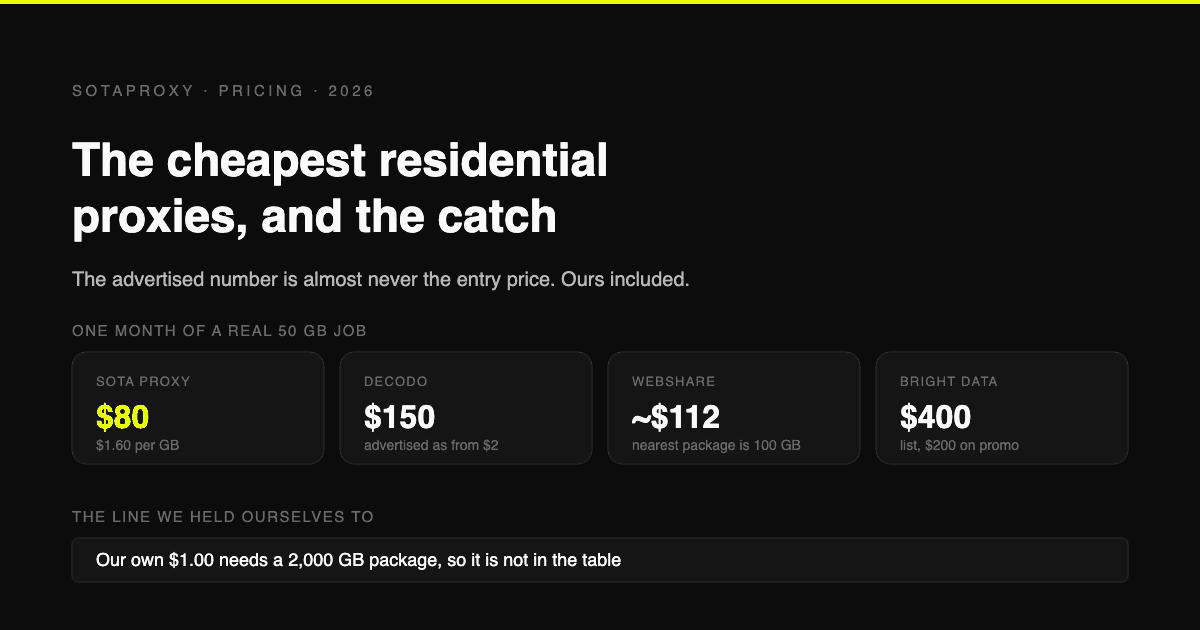
The Cheapest Residential Proxies in 2026, With the Catch Each One Hides
Verified per-gigabyte prices from five vendors' own pages, not from last year's blog posts. Why the advertised number is almost never the entry price, which providers put a monthly floor under your bill, and how to work out your real cost per gigabyte.
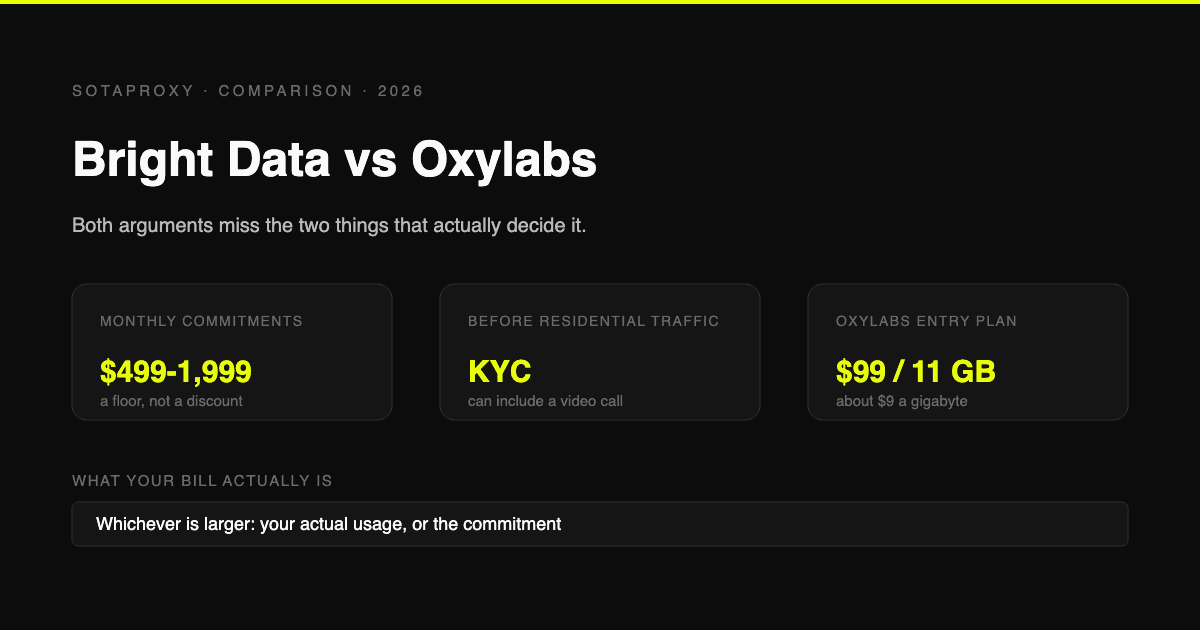
Bright Data vs Oxylabs in 2026: Prices, Commitments and the KYC Nobody Mentions
Both are enterprise platforms with minimum monthly commitments and a compliance check before you can touch residential traffic. Current prices from both vendors' own pages, what the commitment actually costs if you underuse it, and who each one is genuinely for.
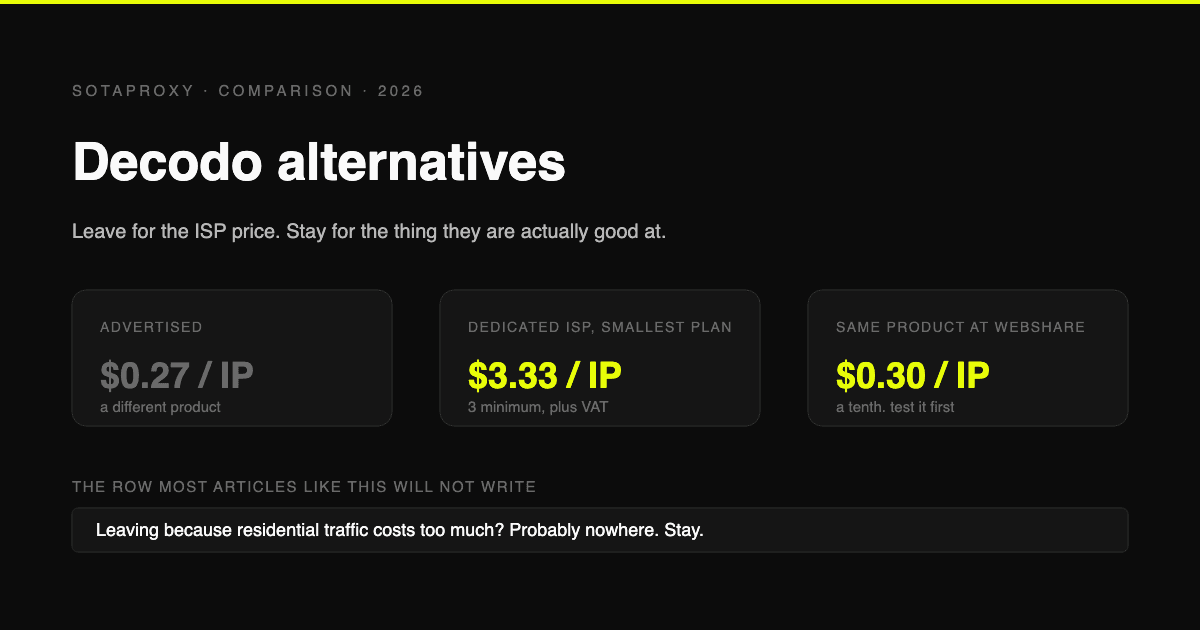
Decodo Alternatives in 2026: Who to Move to, and Who Not to Bother
Decodo is the cost leader on rotating residential and one of the pricier options on dedicated ISP. Verified prices for both, the reasons people actually leave, and which alternative fits each one.