Oxylabs vs Decodo in 2026: One Shared Balance Against Per-Product Plans
Oxylabs switched to a single prepaid balance across all its products on 21 October 2026, and none of the comparisons in search have caught up. Prices from both sites on 2 November, what the new model means for a small buyer, who makes every customer pass a questionnaire, and why one refunds and the other never does.
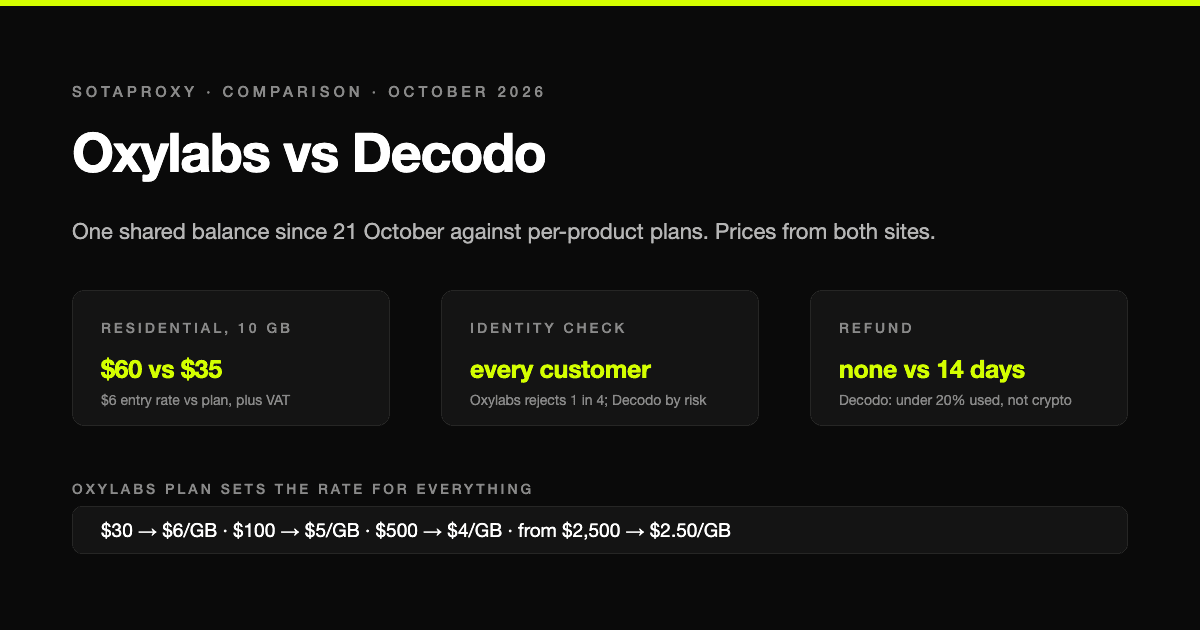
Oxylabs and Decodo are the two names people weigh when they want an established provider without Bright Data's commitments. The comparisons in search answer with pool sizes and prices from whenever they were written. One of the two changed its whole billing model in late October, so most of those answers are now about a product that no longer exists in that form.
On 21 October 2026 Oxylabs moved to what it calls credits: "a single subscription with one shared balance that works across all Oxylabs products, replacing separate plans for each." Decodo still sells a separate plan per product. The prices below are from both sites on 2 November 2026, and the model difference matters more than any single number in them.
We sell proxies too, and say so at the end rather than pretending to be a neutral reviewer.
The short version
| Oxylabs | Decodo | |
|---|---|---|
| Billing model | One monthly balance spent across all products: $30, $100, $500, or from $2,500 | A separate plan per product |
| Residential, entry | $6 per GB on the $30 plan; $5 on the $100 plan, $4 on $500 | $4 per GB pay as you go; $3.75 at 3 GB, $3.50 at 10 GB |
| Residential, at volume | $2.50 per GB from about 1 TB | $2.00 per GB at 1 TB |
| Dedicated ISP | $3 per address, $2.78 on the $100 plan | $3.33 per address at the minimum of 3, $2.90 at 10 |
| Shared ISP | $1.50 per address | From $0.27 per address |
| Datacenter per GB | $0.60, falling to $0.40 | $0.60 at 10 GB, falling to $0.38 |
| Free start | $5 welcome credit toward any product | 100 MB of residential for 3 days |
| Identity check | A KYC questionnaire for every customer; at least a quarter of enquiries rejected | Not by default; triggered by risk or restricted targets |
| Refunds | Self-service purchases non-refundable | 14 days on a first purchase, under 20 percent or 1 GB used, not for crypto |
| Crypto | Not accepted | Accepted, without the refund |
What changed at Oxylabs, and what it means
Until October Oxylabs worked like most providers: a residential plan, a datacenter plan, an ISP plan, each billed on its own. Now you buy one monthly balance and every product draws from it at a rate set by the size of the plan:
| Oxylabs plan | Residential | Mobile | Dedicated ISP | Datacenter per address |
|---|---|---|---|---|
| Welcome credit, $5 | $6 per GB | $7.50 per GB | $3 | $1 |
| Starter, $30 a month | $6 per GB, about 5 GB | $7.50 per GB | $3 | $1 |
| Basic, $100 a month | $5 per GB, about 20 GB | $6.67 per GB | $2.78 | $0.90 |
| Flexible, $500 a month | $4 per GB, about 125 GB | $5 per GB | $2.60 | $0.80 |
| Enterprise, from $2,500 | $2.50 per GB | $3.50 per GB | $2.20 | $0.60 |
Two things follow.
The shared balance is genuinely useful if you use more than one product. A team that runs residential for scraping, a few ISP addresses for accounts and the occasional unblocker job used to need three plans at Oxylabs and still needs three at Decodo. At Oxylabs it is now one $100 balance spent wherever the work is that month.
The plan size now sets the rate for everything. On the $30 plan, residential costs $6 a gigabyte. The first plan that brings it to $5 is $100 a month, and $4 needs $500. So a buyer who needs 10 GB a month either tops up a $30 plan at $6, or commits $100 to get a better rate on 20 GB they may not use.
What Oxylabs' announcement does not say is what happens to paid balance left at the end of a month. It says unused free credits "do not roll into later cycles" and is silent on the rest. Ask before you size the plan, because the answer decides whether the $100 plan is a discount or a bet.
Residential, priced out
At the sizes a small buyer actually uses, Decodo is cheaper on residential:
| Monthly need | Oxylabs | Decodo |
|---|---|---|
| 3 GB | $18 at $6 on the $30 plan | $11.25 plus VAT |
| 10 GB | $60 at $6, or the $100 plan at $5 | $35 plus VAT |
| 100 GB | $500 either way: the $500 plan at $4 covers 125 GB | $275 plus VAT |
| 1 TB | About $2,500 at $2.50 | $2,000 plus VAT |
Both add VAT where it applies. Decodo also sells residential pay as you go at $4 a gigabyte from 1 GB, which has no Oxylabs equivalent below the $30 plan except the $5 welcome credit.
On pool size, Oxylabs claims 175 million residential addresses against Decodo's 115 million across 195 or more locations. Neither number tells you how a given target treats the addresses; only a test does, and the checks worth running are in how to test a proxy before you buy. How much traffic a test or a job will actually burn depends far more on the method than on the provider, which is the subject of how much bandwidth web scraping uses.
Static addresses and datacenter
Both providers sell two kinds of static ISP address, and the names hide the difference.
Dedicated ISP, an address only you use: Oxylabs from $3, $2.78 on the $100 plan; Decodo from $3.33 at its minimum of three addresses, $2.90 at ten, $2.50 at two hundred, plus VAT.
Shared ISP, an address other customers also use: Oxylabs $1.50; Decodo from $0.27 an address or $1.30 a gigabyte. Shared addresses are fine for collection and wrong for accounts, where an address shared with strangers is a history you did not create.
On datacenter by the gigabyte the two start at exactly the same $0.60 and end close, $0.40 at Oxylabs and $0.38 at Decodo at the top tiers.
Who checks your identity
This is the sharpest difference between the two, and Oxylabs states it on its own page.
Oxylabs: "Every customer has to answer a KYC questionnaire to get access to our solutions." The same page adds that "at least quarter of all customer enquires are rejected", and that only 75 percent of customers are approved. That is not a formality; one prospective customer in four does not get in.
Decodo: no identity check by default. The procedure is triggered when an account looks risky or when you want access to restricted targets, and most buyers never see it.
If you run a legitimate business and can describe your use case in a sentence, Oxylabs' questionnaire is a short delay. If your use case is hard to describe, or you need to start today, Decodo is the one that lets you.
Refunds and payment
Oxylabs: "All purchases made through self-service are non-refundable." The $5 welcome credit is what Oxylabs offers instead of a refund window. It accepts cards, wire transfers in dollars and euros, AliPay and PayPal, and says plainly "We do not accept Bitcoins."
Decodo: a refund within 14 days of a first purchase of a service type, if you used under 20 percent of the plan's traffic or 1 GB, whichever comes first; not for free trials, not for enterprise plans, and not for cryptocurrency payments. It does accept crypto, so the practical rule is the one from our other comparisons: if you might want the refund, pay by card.
Who should pick which
Oxylabs if: you use two or more products and want one balance across them; your monthly spend is $100 or more, where the rates start to drop; you can pass a business questionnaire; you pay by card, PayPal or wire.
Decodo if: you need under about 25 GB of residential a month; you want to start today without a questionnaire; you want a refund window; you pay in crypto, or you want a single shared ISP address for cents.
Neither if:
- You need crypto and a refund. Oxylabs takes no crypto; Decodo refunds no crypto.
- You need one dedicated ISP address. Oxylabs sells one from its $30 plan; Decodo's minimum is three.
- You need the cheapest residential gigabyte at small volume. Then look wider, starting with the cheapest residential proxies.
For transparency, our place in this: residential from $1.00 per GB at volume with a $2.00 entry package, ISP addresses from one at $3.00 a month, crypto only, 34 coins from $1, no identity check to buy. If either of these two fits your shape of demand better, buy it.
The other pairs in this family are Bright Data vs Oxylabs, Decodo vs IPRoyal and Webshare vs Decodo, and the sizing question that comes before any of them is in how many proxies do I need.
FAQ
Is Oxylabs or Decodo cheaper?
Decodo, at small and medium volume, on prices from both sites on 2 November 2026: 10 GB of residential is $35 plus VAT at Decodo against $60 at Oxylabs' $6 entry rate. At about 1 TB the gap narrows to $2.00 against $2.50 a gigabyte. Oxylabs is the cheaper choice only when one shared balance replaces several separate plans.
What is the new Oxylabs pricing model?
Since 21 October 2026, one monthly balance of $30, $100, $500 or from $2,500 is spent across all Oxylabs products, and the plan size sets the per-unit rate: residential is $6 a gigabyte on the $30 plan, $5 on $100, $4 on $500 and $2.50 at enterprise level.
Does Oxylabs require KYC?
Yes. Every customer answers a KYC questionnaire before getting access, and Oxylabs says at least a quarter of enquiries are rejected. Decodo does not require KYC by default.
Can I get a refund from Oxylabs or Decodo?
Oxylabs: self-service purchases are non-refundable; the $5 welcome credit is the trial. Decodo: within 14 days of a first purchase, under 20 percent of the traffic or 1 GB used, and never for crypto payments.
Do Oxylabs and Decodo accept crypto?
Oxylabs does not. Decodo does, and excludes crypto payments from its refund policy.
Related articles
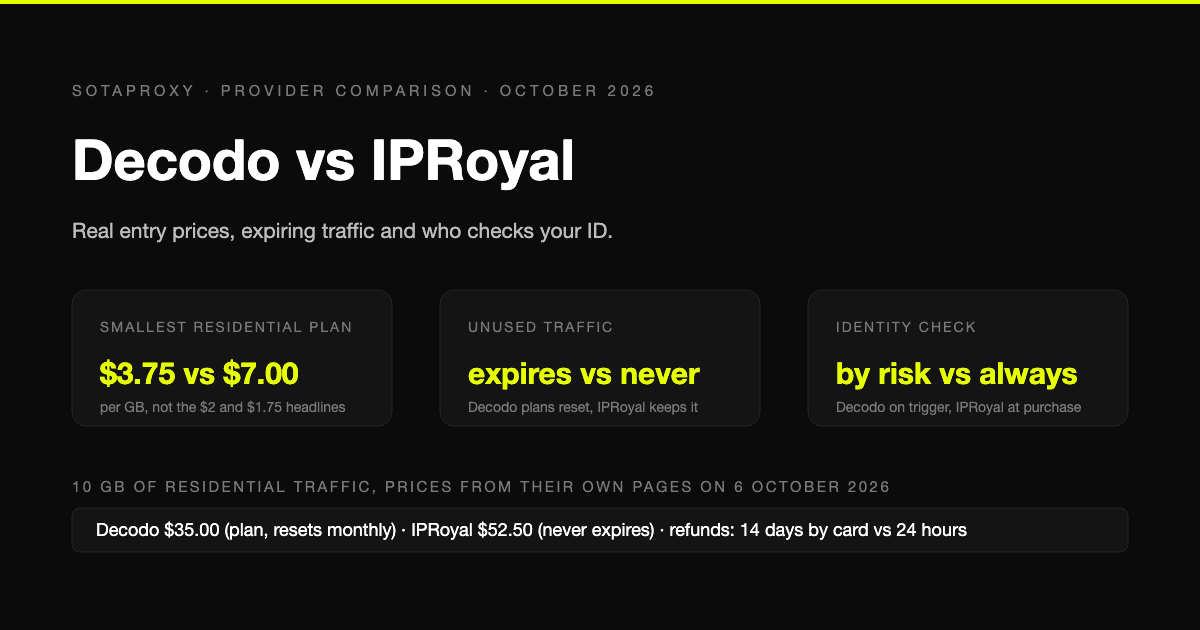
Decodo vs IPRoyal in 2026: Real Entry Prices, Expiring Traffic and Who Checks Your ID
Both are mid-market proxy vendors that take cards and crypto and sell by the gigabyte. The prices on their own pages on 6 October 2026, why neither headline rate is an entry price, whose traffic expires, who checks your identity before you can buy, and who gives money back.
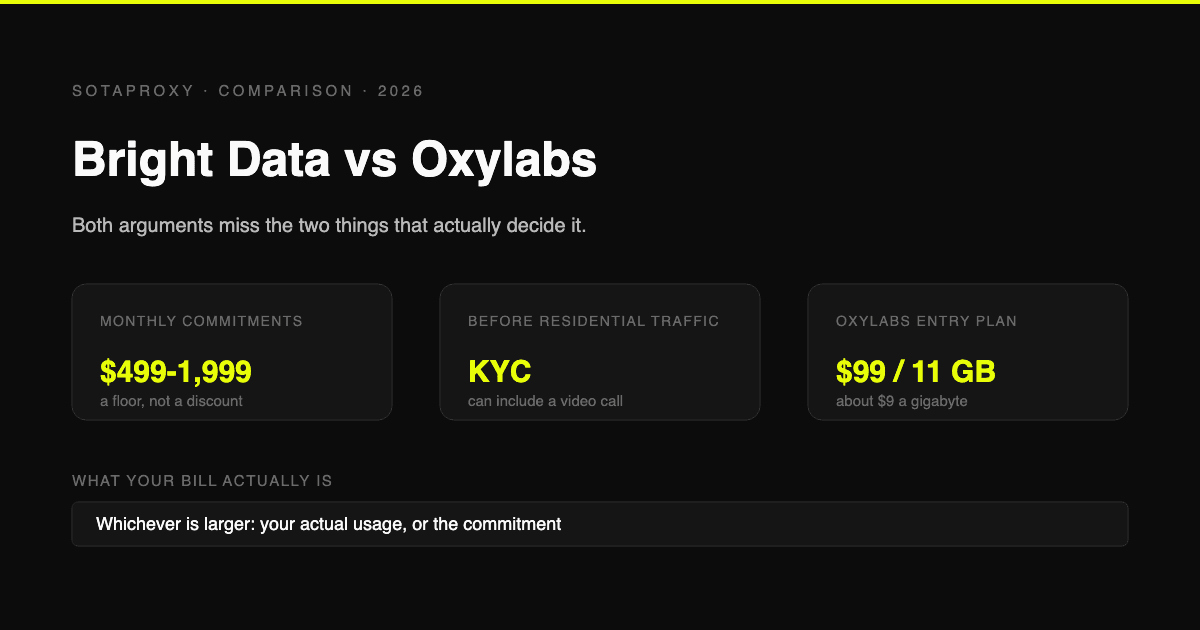
Bright Data vs Oxylabs in 2026: Prices, Commitments and the KYC Nobody Mentions
Both are enterprise platforms with minimum monthly commitments and a compliance check before you can touch residential traffic. Current prices from both vendors' own pages, what the commitment actually costs if you underuse it, and who each one is genuinely for.
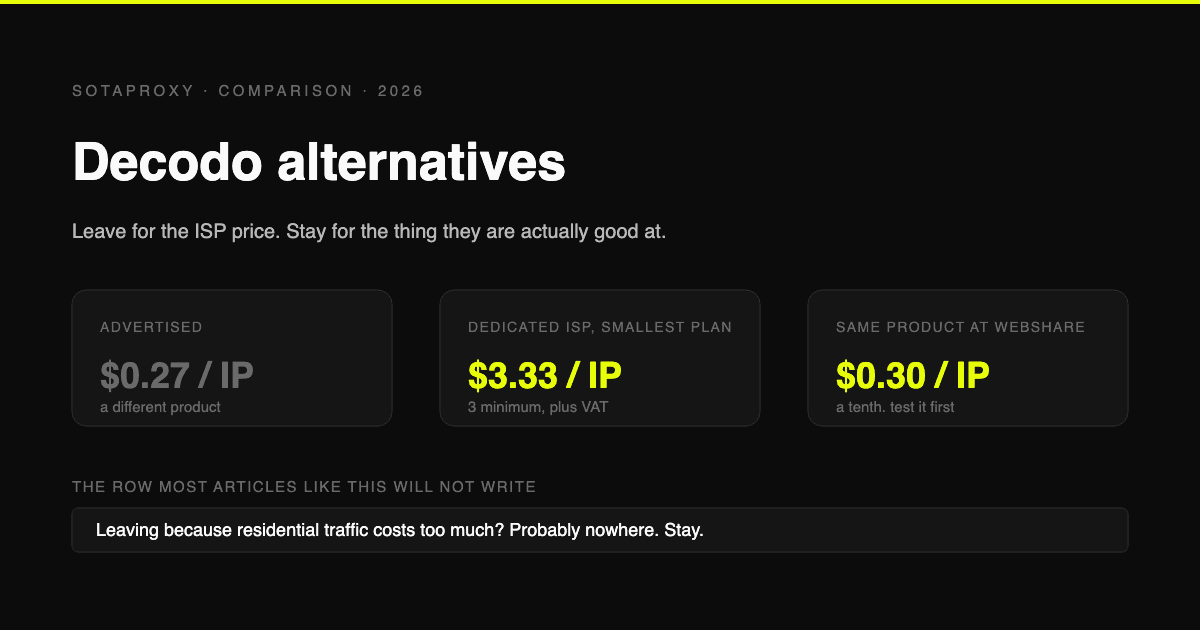
Decodo Alternatives in 2026: Who to Move to, and Who Not to Bother
Decodo is the cost leader on rotating residential and one of the pricier options on dedicated ISP. Verified prices for both, the reasons people actually leave, and which alternative fits each one.
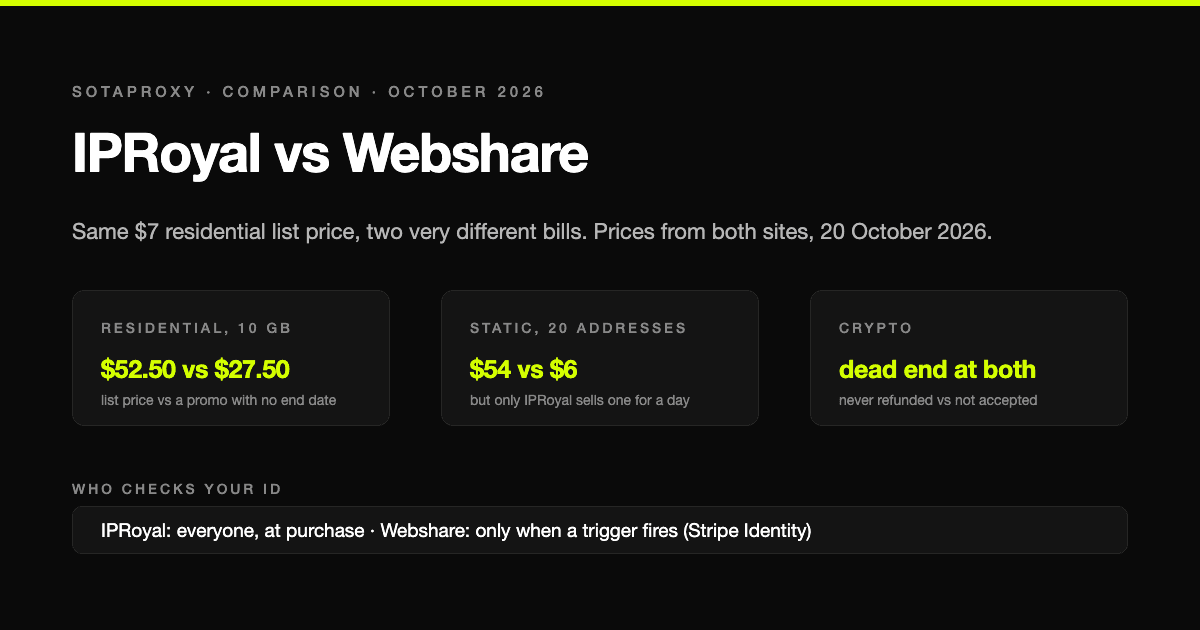
IPRoyal vs Webshare in 2026: Same List Price, Half the Bill, and Who Checks Your ID
IPRoyal and Webshare print the same $7 per gigabyte on their residential pages and charge very different money for it. Prices from both sites on 20 October 2026, whose traffic expires, static addresses at a tenth of the price, who verifies identity before you can buy, and why crypto is a dead end at both for different reasons.
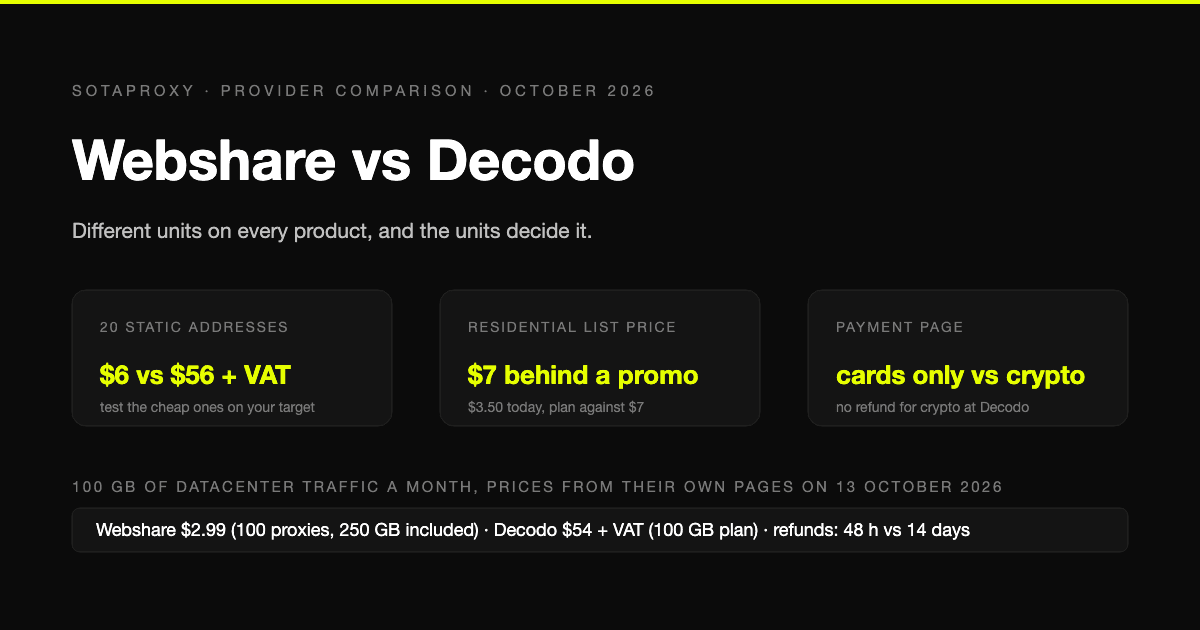
Webshare vs Decodo in 2026: Datacenter Value, a $7 Residential List Price, and Cards Only
Webshare and Decodo sell the same three products in different units, and the units decide the comparison. Datacenter by the address against by the gigabyte, static addresses at $0.30 against $3.33, a residential list price of $7 that nobody pays, and a payment page with no crypto on one side and no refund for crypto on the other.
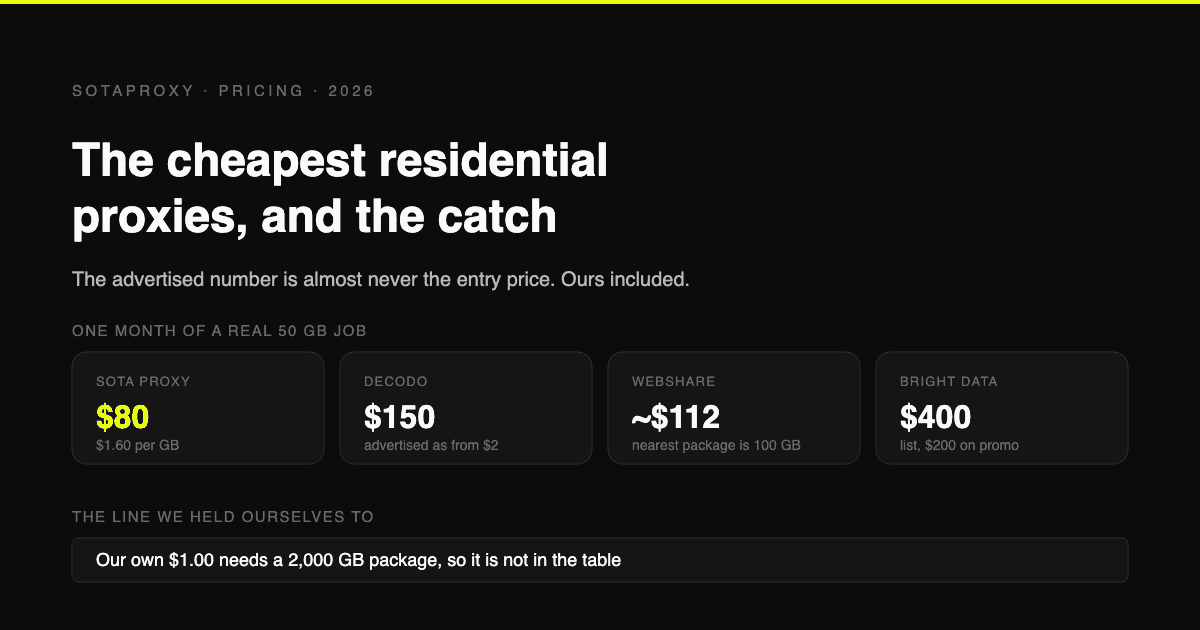
The Cheapest Residential Proxies in 2026, With the Catch Each One Hides
Verified per-gigabyte prices from five vendors' own pages, not from last year's blog posts. Why the advertised number is almost never the entry price, which providers put a monthly floor under your bill, and how to work out your real cost per gigabyte.