How Many Facebook Accounts Can You Have in 2026 (Profiles, Portfolios, Ad Accounts)
One personal account, four additional profiles that share its enforcement, two business portfolios per person, and an ad account limit that grows with trust. What actually gets restricted and in what order.
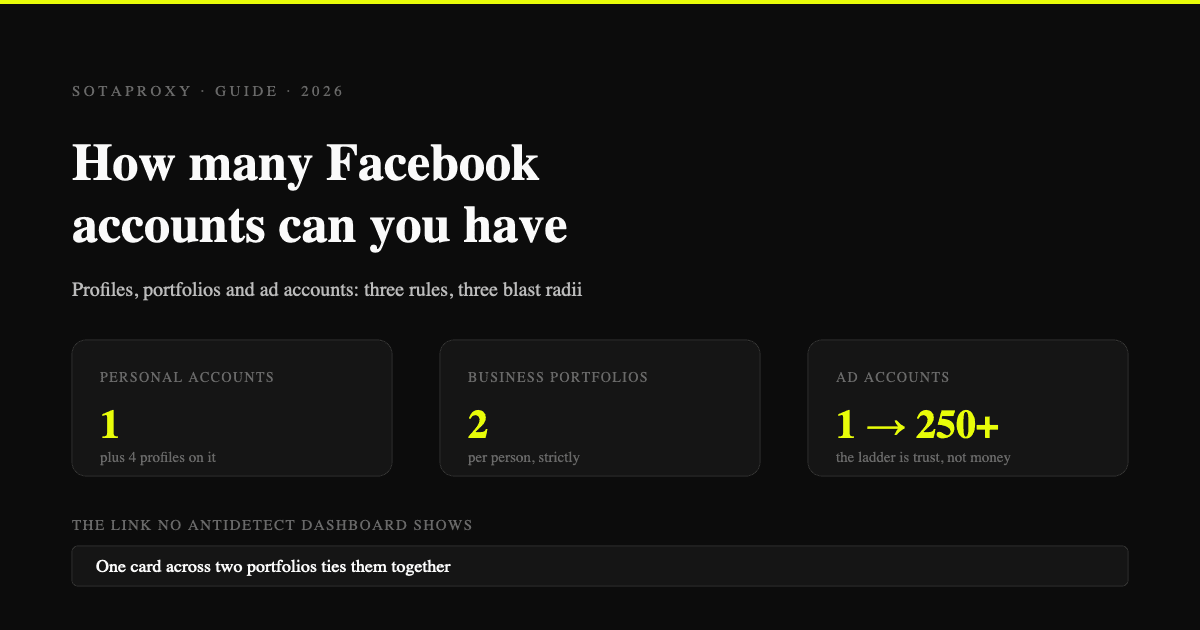
Facebook is the one platform in this series that says one account per person and means it. It is also the platform with the most generous asset structure on top of that single account, which is why the honest answer is layered rather than a number.
One personal account. Up to four additional profiles under it. Two business portfolios per person. An ad account limit that starts near one and grows into the hundreds with spending history. Each layer has a different rule and a different blast radius, and mixing them up is how media buyers lose a profile along with the assets attached to it.
How many Facebook accounts can you have?
One. Meta's terms require one personal account per person for personal purposes, and maintaining separate personal accounts is prohibited. This is regime four from how many accounts you can have on each platform: the count is genuinely capped, unlike almost everywhere else.
Since September 2023 there is a documented exception that reads like a workaround and is not one: up to four additional profiles attached to your main account. Each gets its own name and feed, and unlike the main profile they do not need your everyday name, as long as the name is unique and free of numbers and special characters.
Why are additional profiles not multi-accounting?
Because they are profiles on one account, and enforcement lands on the account.
Meta states it plainly: a violation on an additional profile affects the account as a whole. That single sentence turns the feature from an isolation tool into a shared-fate arrangement. Four additional profiles are four faces on one identity, not four identities.
Read against the linkage logic in the rest of this series, additional profiles share everything at once: the account, the login, the device, the payment methods, the recovery contacts. If you wanted a deliberate way to make five personas inseparable, this would be it.
They are genuinely useful for separating interests, keeping a hobby feed away from colleagues, or running a public-facing persona without exposing a legal name. They are not useful for anything where one profile being restricted must not touch the others.
What can you actually have many of?
Here is the asset hierarchy, which is where Facebook is permissive:
| Asset | How many | Notes |
|---|---|---|
| Personal account | 1 | Hard rule, everyday name required |
| Additional profiles | up to 4 | Same account, shared enforcement |
| Pages | effectively unlimited | Rate-limited if created in bursts |
| Business portfolios, formerly Business Manager | 2 per person | Strict, and the ceiling agencies hit first |
| Ad accounts per portfolio | starts at 1 to 5 | Grows with verification and spend history |
| People with access to a portfolio | many | Roles and permissions per person |
The pattern: identities are capped, assets are not. The sanctioned way to run more is to add assets under one identity, or to bring in more identities with their own portfolios and share access. Everything else is the route Meta polices.
How does the ad account limit actually grow?
This is the number media buyers care about, and it is dynamic rather than fixed.
| Stage | Typical ad account ceiling |
|---|---|
| New portfolio, unverified, no payment history | 1 to 5 |
| Business verification done, first payments cleared | around 25 |
| Sustained clean spend over months | around 75 |
| Established operation with long history | 250 or more |
Three things move you up that ladder: business verification, a clean payment history with no failed charges or disputes, and sustained spend rather than spikes. Nothing moves you up faster than time, and nothing drops you back faster than a payment problem or a policy strike.
The practical consequence for anyone planning a launch: the limit you will have in month three is not the limit you have on day one. Build the calendar around the ladder rather than around the number you eventually want.
How do agencies scale past two portfolios?
The two-portfolio cap per person is real and not negotiable. The supported answer is not more portfolios per person, it is more people: team members own their own portfolios, and access is shared across them through partner access rather than by sharing logins.
That structure is worth understanding because it is also the safest one:
- Each portfolio has one owner identity, which is how Meta expects it.
- Access is granted, not shared. Nobody hands over a password, which removes the most common cause of a profile restriction spreading to a team.
- Removing a person removes their access, not the assets.
The anti-pattern is one person creating profiles to own extra portfolios. That is multi-accounting on the one platform that caps accounts, and it puts the real profile, the one with the payment methods attached, in the blast radius.
What gets restricted, and in what order?
Facebook enforcement moves up the stack, and the direction matters because each step has a different recovery cost:
- Ad rejected. Creative-level, cheap, informative. Fix and resubmit.
- Ad account restricted. Spend stops. Usually appealable, often reinstated, and the most common event in a buyer's life.
- Payment method flagged. Quietly the worst of the middle steps, because the same card or account across several portfolios links them all.
- Portfolio restricted. Every ad account under it stops at once.
- Personal profile restricted. The nuclear option, because the profile is the identity that owns the portfolios. Recovery involves identity verification, and until it completes the assets are unreachable.
- Assets lost. Pages and accounts can survive a profile loss if other admins exist, which is the entire argument for never being the only admin of anything that matters.
The step people underrate is the third. A shared payment instrument is the strongest business-level link Facebook has, and it is invisible in every antidetect browser dashboard ever built.
Why does Facebook flag setups that look fine?
Because it correlates business-level signals, not just technical ones. In rough order of strength:
- Payment instruments. The same card, bank account or PayPal across portfolios is a hard link.
- Legal entity and verification documents. Same entity, same cluster.
- Admin overlap. One person as admin across unrelated portfolios.
- Device and browser fingerprint.
- IP address, especially several portfolios logging in from one connection within minutes.
- Spend pattern. A brand-new portfolio pushing high daily budgets on day one is the profile of a burner, not a business.
Note how many of those are commercial rather than technical. Two of the top three cannot be fixed with any tool, which is why the agency guide puts payout and identity data in the "keep genuinely separate" column rather than the "infrastructure solves it" one.
How do you warm up a new ad account?
There is no published ramp, and the shape below is what buyers converge on. Numbers are relative to your eventual target, not absolute:
| Days | Daily spend | What you are building |
|---|---|---|
| 1 to 3 | 10 to 20% of target | payment history, first delivery |
| 4 to 7 | 25 to 40% | stable delivery, no rejections |
| 8 to 14 | 50 to 70% | data for optimisation |
| 15 onward | full target, then scale in 20 to 30% steps | trust that survives a scale-up |
Two rules around it:
- Never jump a fresh account to full budget. The spend curve itself is a signal, and a flat line from zero to maximum is the one pattern every platform in this series treats as inorganic.
- Get business verification done before you need the headroom, not on the day the ad account limit blocks a launch.
What does a proxy fix here, and what does it not?
It fixes the connection layer: one static address per identity, so two portfolios are not logging in from the same place, and no session jumps countries mid-flight. On a platform this good at correlation, that is table stakes rather than protection, and a static address is the right shape for it because a rotating exit inside an ads session is its own alarm.
It does not fix a shared card, a shared entity, an admin who sits on two portfolios, or a day-one budget that looks like a burner. On Facebook specifically, the commercial links are stronger than the technical ones, and no tool touches them.
Before the first login on a new identity, check what the address actually looks like from outside: how to test a proxy before you buy it. The whole cost of the isolation layer, per account, is in what a multi-accounting stack actually costs.
FAQ
Can I have two Facebook accounts?
No. Meta's terms allow one personal account per person. What you can have is up to four additional profiles attached to that one account, plus unlimited pages and business assets.
Do additional profiles protect my main account?
No, the opposite. A violation on an additional profile affects the account as a whole, so the four profiles share one fate. Use them to separate interests, not to separate risk.
How many Business Managers can one person have?
Two business portfolios per person. Agencies scale by having other team members own portfolios and sharing access through partner permissions rather than passwords.
How many ad accounts can I create?
A new portfolio starts at roughly one to five. The ceiling grows with business verification, clean payment history and sustained spend: around 25, then 75, then into the hundreds for established operations.
Why did Facebook restrict my ad account when the ads were fine?
Most often a business-level link or a spend pattern rather than the creative: a payment method shared with another portfolio, an admin overlap, or a new account jumping straight to a high daily budget.
Can a proxy stop Facebook from linking my accounts?
It removes one link, the IP address. The strongest links on this platform are the payment instrument, the legal entity and admin overlap, and none of those are network problems.
What is the safest structure for running ads at scale?
One identity per portfolio, two portfolios per person at most, partner access instead of shared logins, a separate payment instrument per portfolio, never being the sole admin of an asset you cannot lose, and a spend ramp on every new ad account.
Related articles
How Many Instagram Accounts Can You Have in 2026 (And What Gets Them Banned)
The five-account switcher is a device limit, not a policy. Instagram's action limits by account age, how it links accounts, the enforcement ladder, and how to recover a restricted account.
How Many Accounts Can You Have on Each Platform in 2026
Published limits for eleven platforms side by side, the four different rule regimes behind them, and why the number in the app is never the real constraint.

What a Multi-Accounting Stack Actually Costs in 2026
Real monthly numbers for 10, 50 and 200 accounts: antidetect profiles, proxies, numbers, cloud phones and card fees, with the one line item that eats three quarters of the budget.
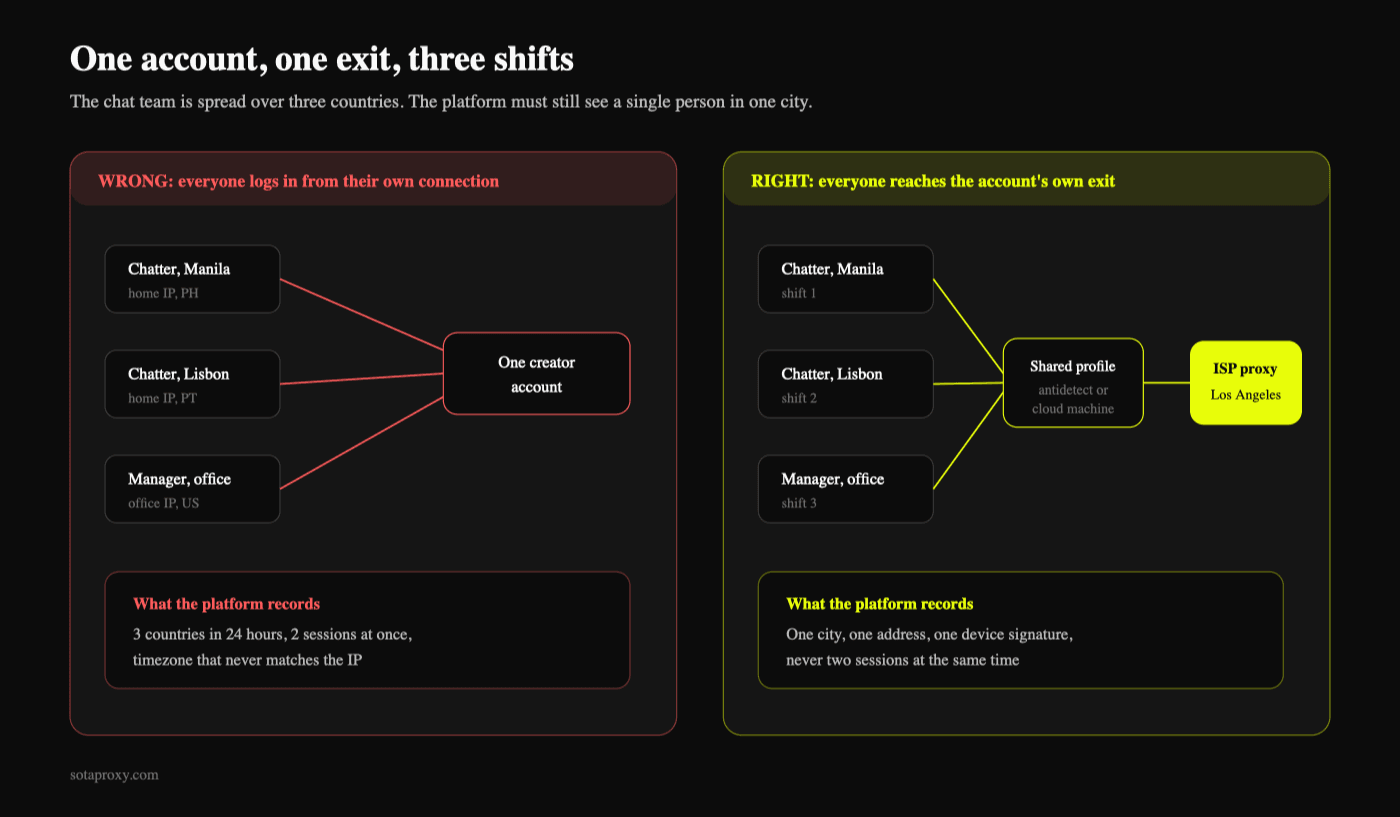
How OnlyFans Agencies Run 20 Creator Accounts Without Linking Them
What actually links creator accounts, which proxy type each one needs, how chatters in three countries share a single login, and what the isolation layer costs next to a 20 to 50 percent agency share.
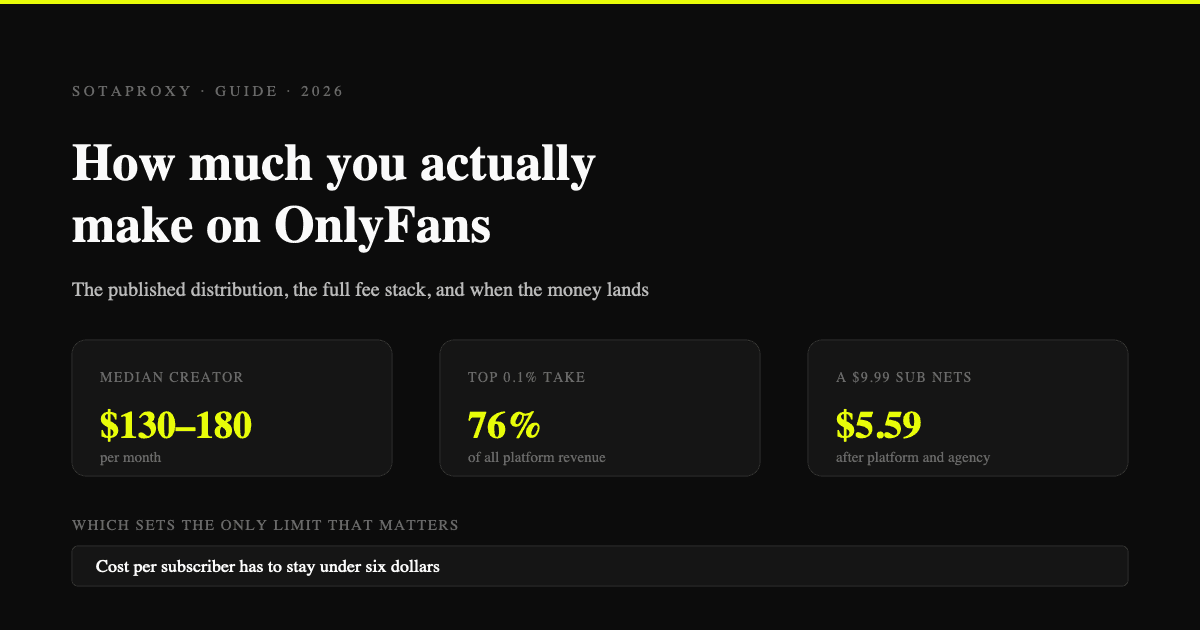
How Much You Actually Make on OnlyFans in 2026: The Full Fee Stack
The published earnings distribution, every cut between a fan's dollar and your bank account, when the money actually lands, and the one metric that decides whether promotion works.
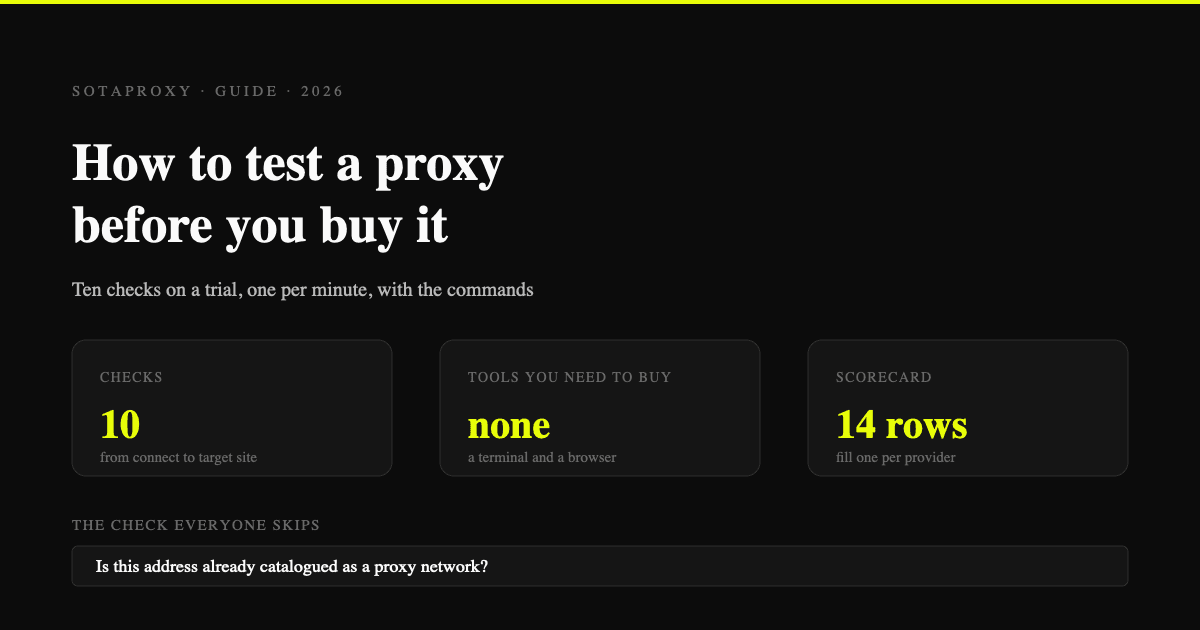
How to Test a Proxy Before You Buy It: A 10-Minute Checklist
Ten checks that tell you whether a proxy trial is worth paying for: exit ASN, hosting flags, rotation behaviour, subnet spread, DNS and WebRTC leaks, and success rate on your own target.