Proxies for SEO in 2026: What Google Actually Sends a Scraper, and What Rankings Really Cost
Most SEO work needs no proxy. Rank tracking on Google needs more than one. What Google, Bing and DuckDuckGo sent our scraper, three ways to get rankings with real prices, and which proxy fits the rest of SEO.
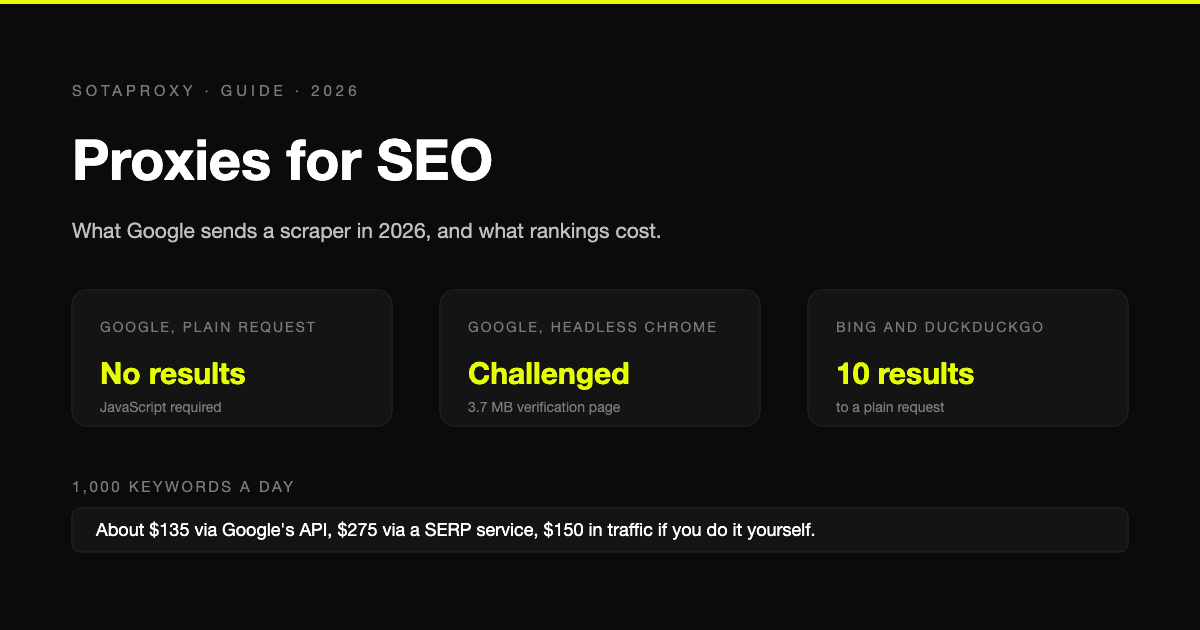
"SEO proxies" is a shopping phrase, not a product. Most SEO work needs no proxy at all, one part of it needs proxies badly, and that part has changed in the last two years in a way most guides have not caught up with. So this one starts with a test we ran on 30 September 2026, and puts prices on every option.
Which SEO jobs need a proxy
| Job | Proxy? | Which type |
|---|---|---|
| Reading Search Console, analytics, logs | No | |
| Crawling your own site | No | |
| Crawling competitors' sites, checking backlinks across many domains | Yes, at volume | Datacenter, a few dedicated addresses |
| Rank checks on Bing or DuckDuckGo | Only at volume | Datacenter |
| Rank checks on Google | Yes, and it is the hard case | Residential, or none, see below |
| Local results by city, local packs, ads | Yes | Residential with city targeting, in a browser |
The first two rows are the ones people forget to say. If your SEO work is about your own site, the proxy budget is zero.
What the search engines send a scraper
We requested the same query from a home connection, with no proxy, the way a scraper would.
| Engine | Plain HTTP request (curl) | Headless Chrome |
|---|---|---|
| 92 KB page with no results, "click here if you are not redirected" | "Our systems have detected unusual traffic", a verification page, 3.7 MB transferred | |
| Bing | 10 results, 126 KB | not needed |
| DuckDuckGo (html endpoint) | 12 results including ads, 47 KB | not needed |
Two things follow.
Google no longer returns results to anything that does not run JavaScript. A scraper built on plain requests, which is how most SEO proxy guides still describe it, gets an empty shell from every address, residential or not. To see results you need a real browser, and each rendered page weighs megabytes instead of kilobytes.
Google checks the browser as well as the address. Our headless Chrome was challenged from an ordinary home connection on its first request. A residential proxy gives you a home address; it does not give you a browser Google trusts. That is a separate problem, and it is why "just use rotating residential" is no longer a complete answer.
Bing and DuckDuckGo are still plain HTML. If your rankings there matter, they are cheap to collect.
Three ways to get Google rankings, priced
Take a realistic job: 1,000 keywords checked once a day, 30,000 result pages a month.
| Method | What it costs for 30,000 pages a month | What you get |
|---|---|---|
| Google's Custom Search JSON API | 100 queries a day free, then $5 per 1,000: about $135 | Ten results per query from a Programmable Search Engine, not the live results page. No local pack, no ads |
| A SERP API service | SerpApi: $150 a month for 15,000, $275 for 30,000 | The parsed live page, with features. Blocks are their problem |
| Your own browser and residential proxies | Traffic alone: 30,000 pages at roughly 3 MB each is about 90 GB, $150 with us at $1.50 per GB, before servers and failures | The raw page, on your terms |
Read the last row honestly. At this volume, doing it yourself costs about the same in traffic as a SERP service costs in total, and then you still run the browsers and absorb every challenge page. It wins when you need the actual page (screenshots of a local pack, ad positions, layout), when the volume is far larger, or when you already run the browsers for something else.
Prices were taken from Google's and SerpApi's pages on 30 September 2026. The 3 MB figure is what our single challenged request transferred. We could not measure a page with results without being challenged, so treat it as an estimate rather than a measurement.
If you do scrape Google yourself
The parameters that make results comparable from run to run:
| Parameter | Meaning | Example |
|---|---|---|
hl | Interface language | hl=en |
gl | Country of the results | gl=us |
num | Results per page | num=10 |
pws=0 | Turn off personalisation | pws=0 |
uule | Encoded location for local results | see below |
uule is how a rank tracker asks Google to behave as if the searcher stood in a specific place. It is a prefix, a length character and the place name in base64:
import base64

def uule(canonical_name):
    key = "ABCDEFGHIJKLMNOPQRSTUVWXYZabcdefghijklmnopqrstuvwxyz0123456789-_"
    b64 = base64.b64encode(canonical_name.encode()).decode().rstrip("=")
    return "w+CAIQICI" + key[len(canonical_name)] + b64

uule("New York,New York,United States")
# w+CAIQICIfTmV3IFlvcmssTmV3IFlvcmssVW5pdGVkIFN0YXRlcw
The place name must be Google's canonical form, "City,Region,Country". Combine it with a proxy address in the same country: uule sets the place, the address has to make the place believable.
Three habits from running this:
- One address per results session. Page two must come from the same address as page one, or you are stitching two searchers together. On our gateway that is a session suffix,
login_c_US_s_42_ttl_15m. - Slow down per address, not overall. Google's limits are per address. More addresses at a slower pace each survive longer than few addresses at speed.
- Expect the verification page and log it. Count challenged pages as failures, retry from a different address, and watch the rate. When it climbs, the fix is pace, not more traffic.
Dedicated proxies for SEO tools
A lot of the search traffic here is for "dedicated proxies for SEO ranking": static addresses for tools that run their own queries. Two different tools hide behind that phrase.
Rank trackers that query Google themselves ask for proxies because Google limits each address. Give them residential sessions rather than hosting addresses, one per concurrent thread, and run them at the slowest pace the tool allows. Google's automated checks are widely reported to fall hardest on hosting ranges, and a tracker that burns through datacenter addresses on Google is spending money to collect challenge pages.
Crawlers and link checkers fetch ordinary websites, not Google. A site audit tool crawling a competitor, or a backlink checker visiting a thousand referring pages, works fine from a few dedicated datacenter addresses. Ours are $1.80 a month for one and $1.35 each from ten, with traffic not metered, and most tools take them as address:port:login:password, one per line. Keep the crawl polite: one address hitting a small site at full speed is how a crawl gets blocked, and it is the site's right to block it.
For everything else in that list, best proxies for web scraping has the test that tells you whether a target needs residential addresses at all.
Local SEO checks
Local results depend on three things that all have to agree: the country of the address, the gl parameter, and the uule place. A German address with gl=us and a New York uule returns something no real searcher sees.
For city-level work, residential with a city suffix is the right tool, and the city is a preference rather than a guarantee: login_c_US_city_New-York gives you New York when a device there is online and the country otherwise. The syntax is in the connection string reference.
FAQ
What are SEO proxies?
Ordinary proxies bought for SEO tasks, mostly rank tracking and competitor crawling. There is no special SEO type. The choice is between residential addresses for Google and datacenter addresses for everything else.
Do I need proxies for rank tracking?
If you check rankings by scraping Google yourself, yes, and a browser too, because Google returns nothing to a plain request. If you use Google's API or a SERP service, no. For a few hundred keywords the API or the service is usually cheaper than the proxies.
What is the best proxy type for SEO?
Residential with city targeting for anything on Google. Dedicated datacenter addresses for crawling sites and checking backlinks. Nothing at all for work on your own site.
How many proxies do I need for rank tracking?
Enough that each address stays under Google's limit at your pace. The number depends on the tool and the pace, so start with a few sessions, watch the rate of challenge pages, and add addresses when it rises rather than guessing up front.
Can I use free proxies for SEO?
For Google, no: they are hosting addresses shared with everyone who found the same list, and Google challenges them first. For crawling a public site, they are unreliable but not dangerous.
Is scraping Google allowed?
Google's terms prohibit automated queries, and Google enforces that technically rather than legally for ordinary rank tracking. The compliant route is the Custom Search API. This is not legal advice.
Related articles
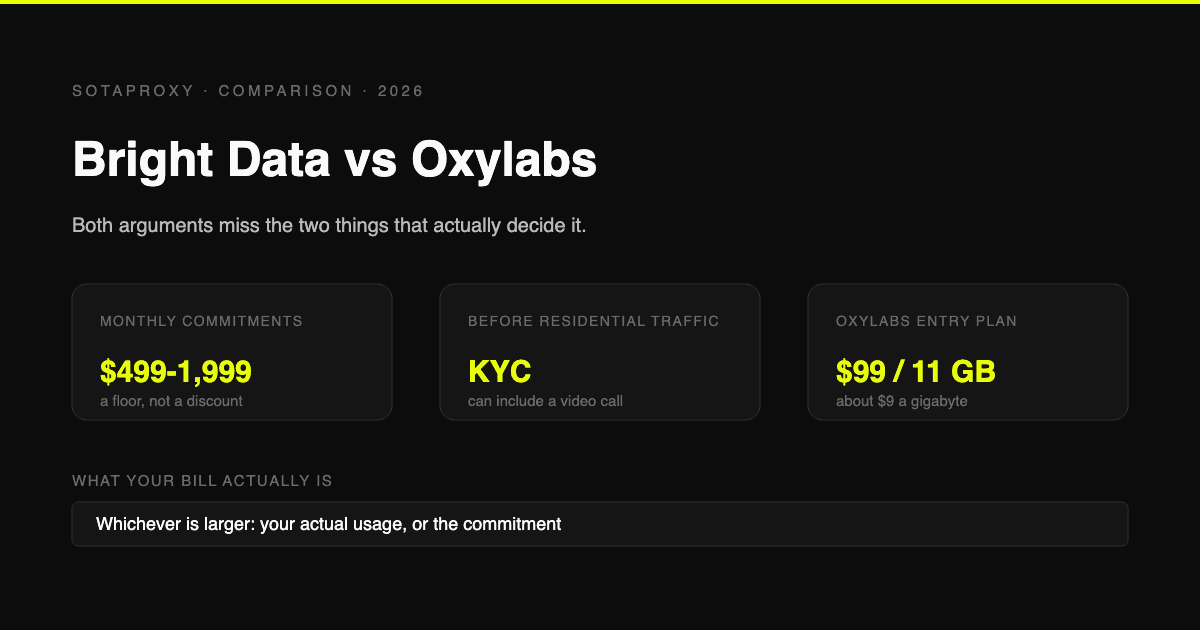
Bright Data vs Oxylabs in 2026: Prices, Commitments and the KYC Nobody Mentions
Both are enterprise platforms with minimum monthly commitments and a compliance check before you can touch residential traffic. Current prices from both vendors' own pages, what the commitment actually costs if you underuse it, and who each one is genuinely for.
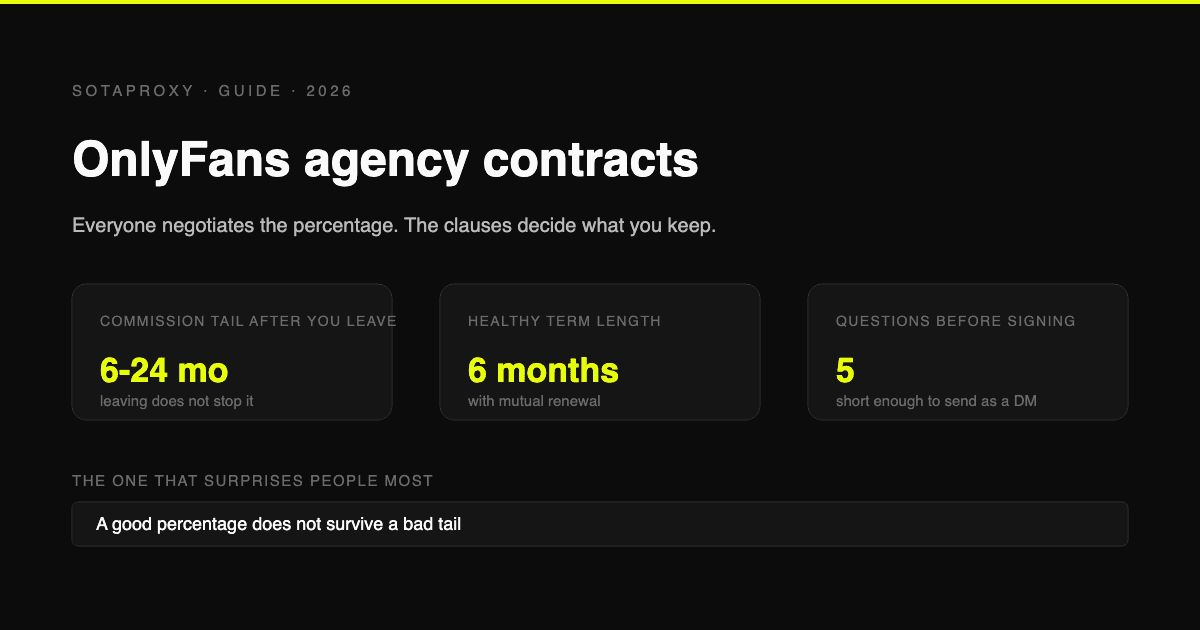
OnlyFans Agency Contracts: The Clauses That Decide What You Keep
The split is the part everyone negotiates and the part that matters least. Commission tails, clawbacks, perpetual subscriber commission, exclusivity and content ownership are what decide whether leaving costs you anything.
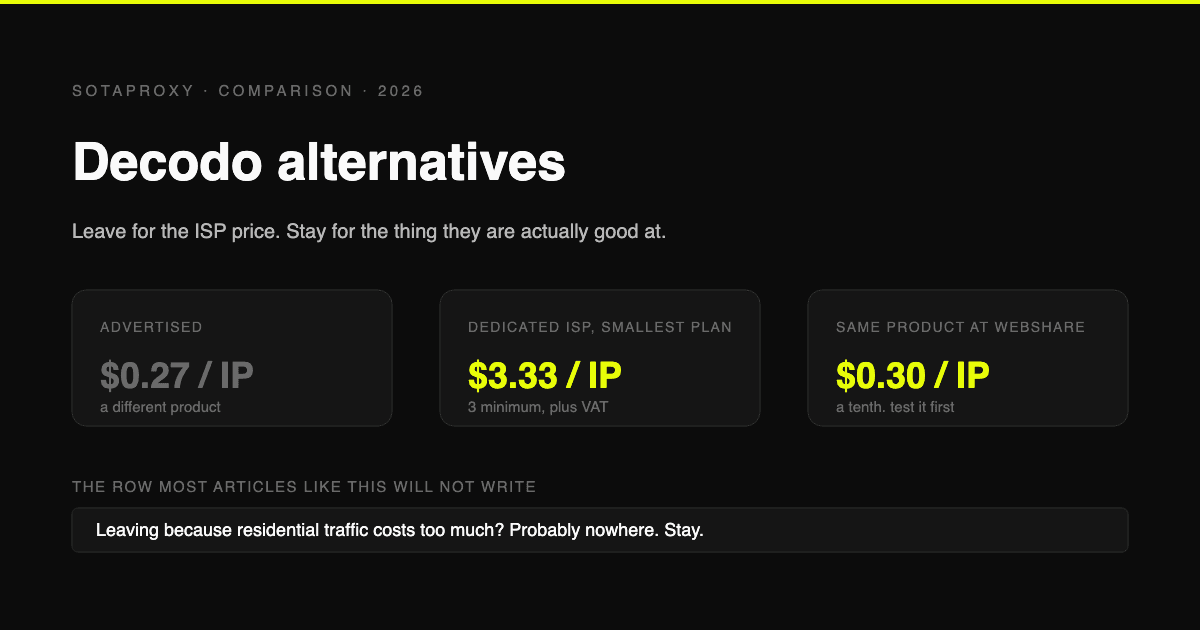
Decodo Alternatives in 2026: Who to Move to, and Who Not to Bother
Decodo is the cost leader on rotating residential and one of the pricier options on dedicated ISP. Verified prices for both, the reasons people actually leave, and which alternative fits each one.
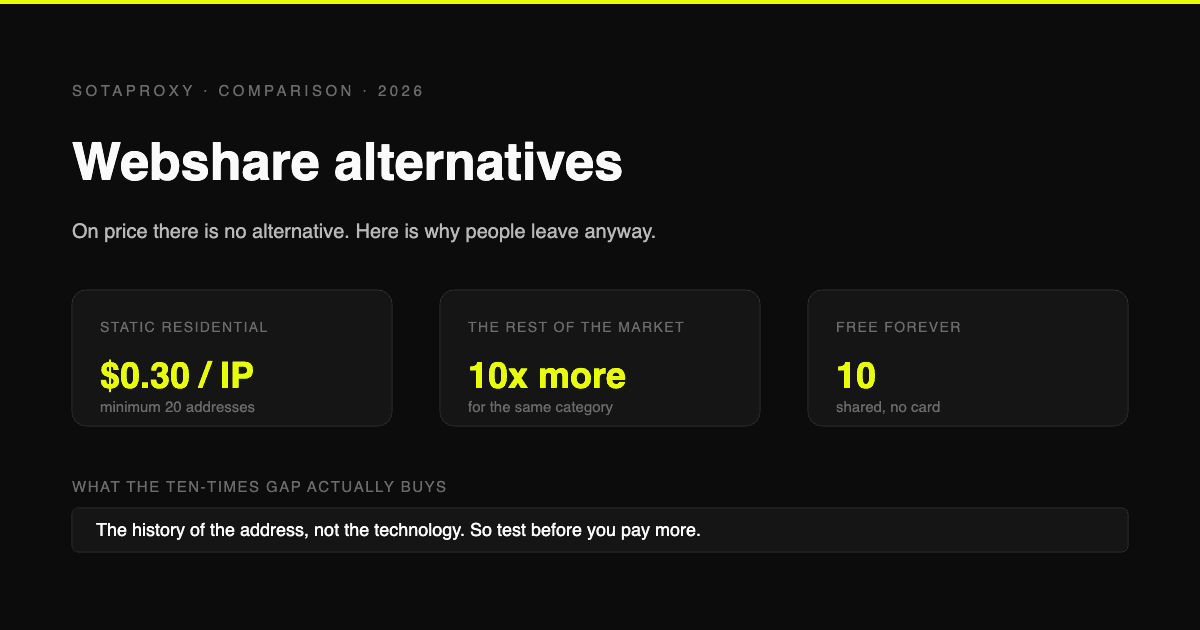
Webshare Alternatives in 2026: When the Cheapest Proxies Stop Being Cheap
Webshare gives away 10 proxies and sells static residential at $0.30 an IP, a tenth of what most vendors charge. Verified prices, the four reasons people still leave, and the one reason to stay.
Dolphin Anty for Multi-Accounting: Features, Automation, and Proxy Integration
How to use Dolphin Anty for multi-accounting: browser profiles, Cookie Robot, scenarios, Synchronizer, API automation, and three ways to connect SotaProxy proxies. Promo code SOTA20 gives 20% off.
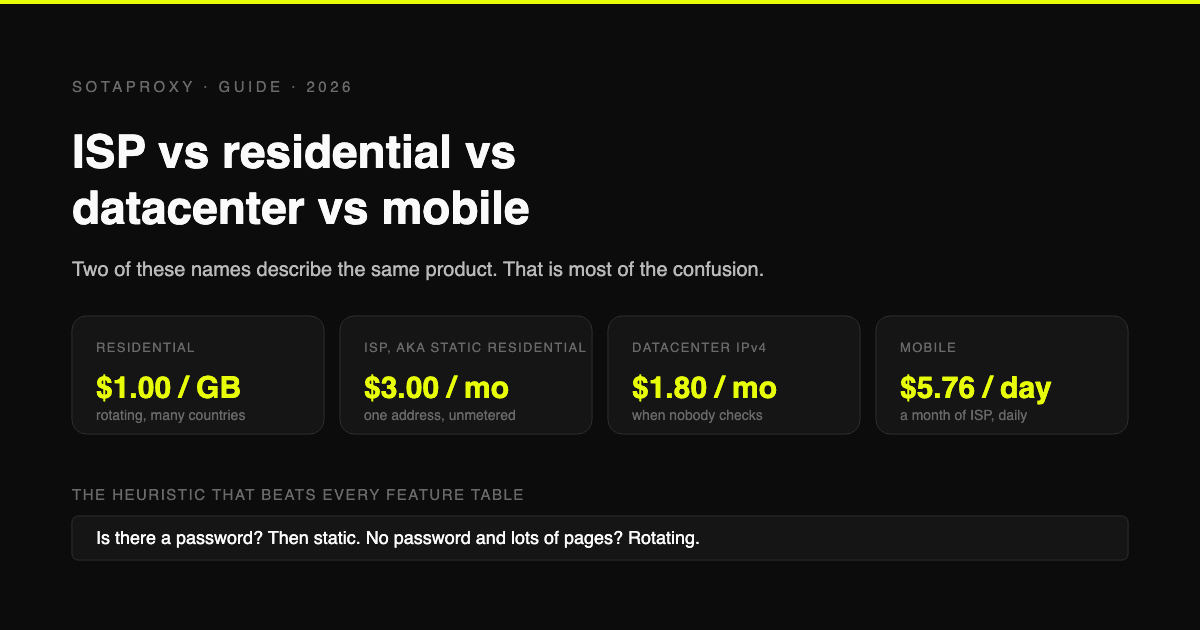
ISP vs Residential vs Datacenter vs Mobile Proxies: Which One You Actually Need
Static residential and ISP are the same product under two names, which is why half these comparisons compare a thing to itself. What each type is, what it costs per unit, and the one task each is genuinely best at.