Decodo Alternatives in 2026: Who to Move to, and Who Not to Bother
Decodo is the cost leader on rotating residential and one of the pricier options on dedicated ISP. Verified prices for both, the reasons people actually leave, and which alternative fits each one.
Decodo is the provider formerly called Smartproxy, renamed in April 2025. It is also the one most independent benchmarks put at the top for cost efficiency on rotating residential traffic, which makes "Decodo alternatives" an unusual search: most people arrive here not because the product is bad but because one specific part of it stopped fitting.
So this is organised by the reason you are leaving, because the right replacement is completely different for each. All prices below were checked on the vendors' own pricing pages on 23 September 2026, and where a vendor advertises a number that requires volume, that is noted.
First, the number that confuses everyone
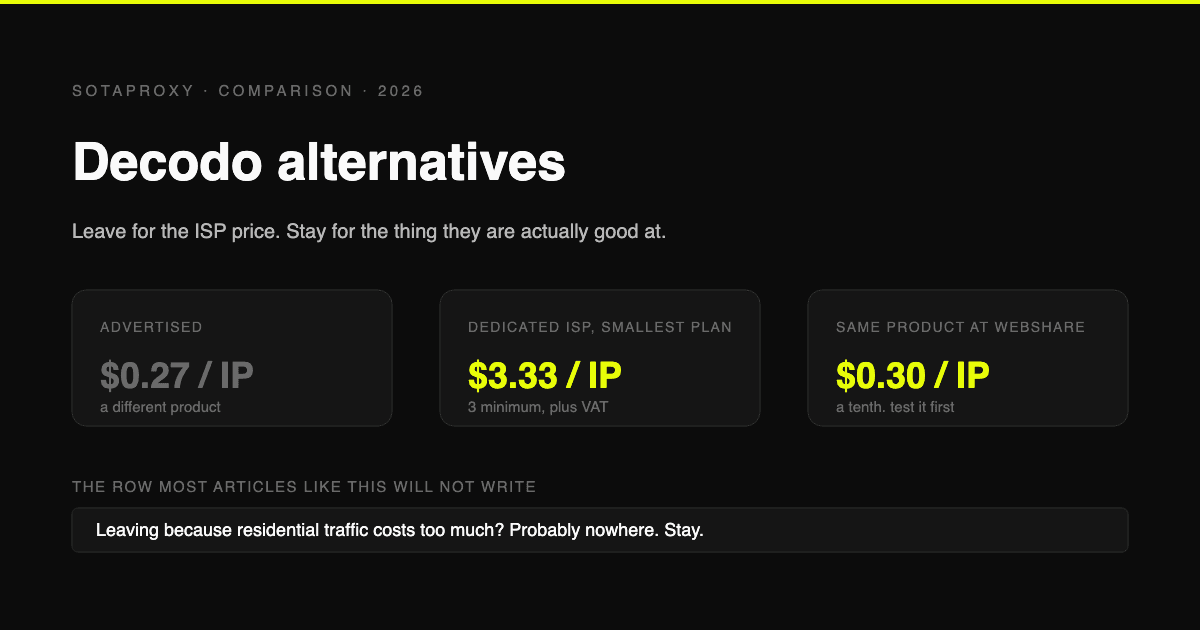
Decodo's navigation advertises static residential proxies "from $0.27 / IP". The dedicated ISP pricing page charges $3.33 per IP for the smallest plan of three addresses, $9.99 a month plus VAT.
Both numbers are real; they describe different products. The cheap one is not the dedicated static address most people mean when they say ISP proxy. This is worth knowing before you compare anyone to anyone, because almost every vendor in this market advertises the floor of a volume ladder as an entry price, and the comparison you make from the headlines is not the comparison you will pay.
Here is the actual dedicated ISP ladder, from their page:
| Addresses | Price per IP | Monthly total |
|---|---|---|
| 3 | $3.33 | $9.99 plus VAT |
| 10 | $2.90 | $29 plus VAT |
| 20 | $2.80 | $56 plus VAT |
| 50 | $2.70 | $135 plus VAT |
| 100 | $2.60 | $260 plus VAT |
| 200 | $2.50 | $500 plus VAT |
Two structural details matter as much as the numbers. The minimum order is three addresses, so there is no way to buy one. And VAT is added on top, which for EU buyers is a real 20-something percent that never appears in a comparison table.
Reason 1: you need fixed addresses and the ISP price hurts
This is the most common reason, and it is arithmetic rather than opinion. If you run accounts, you need one static address each, and at $2.50 to $3.33 per address a roster of twenty costs $56 a month plus VAT before anything else in the stack.
What to compare, per address per month, dedicated static addresses only:
| Provider | Entry price | At 200 addresses | Smallest order |
|---|---|---|---|
| Decodo | $3.33 at 3 IPs, plus VAT | $2.50, plus VAT | 3 |
| Sota Proxy | $3.00 for one | $1.90 | 1 |
| IPRoyal | about $2.00 | lower at volume | 1 |
| Webshare | $0.30 at 20 IPs | $0.225 at 10,000 | 20 |
That Webshare row is not a typo, and it is the single most important thing on this page. Nominally identical products in this market differ in price by a factor of ten. A static residential address is a datacenter-hosted address on a range registered to an internet provider, and what you are actually buying is the reputation of that specific range. At $0.30 an address, something in that chain is different from the $3.00 version, and the usual difference is how many people used the address before you and what they did with it.
Which means the only sane way to choose here is not a price table, it is a test. Take the smallest possible order from two vendors, run the same checks on both, and buy the cheaper one only if it passes. Ten minutes of checks are laid out in how to test a proxy before you buy it, and the reason to bother is in the honest version of what ISP proxies are.
For what it is worth on our own behalf: our ISP ladder runs $3.00 for a single address down to $1.90 from 200, no VAT added, and we sell one address at a time. That is cheaper than Decodo at every comparable tier and far more expensive than Webshare, and both of those facts are the point.
Reason 2: you want to pay in crypto, or you got caught by the refund policy
A recurring complaint in Decodo reviews is that crypto payments are non-refundable. That is not unique to them, it is how nearly every provider treats crypto, but it surprises people who assumed the card refund policy applied.
If crypto is a preference, most large providers accept it alongside cards, and the refund asymmetry usually comes with it. If crypto is a requirement, because of where you are or how you prefer to operate, the field narrows sharply and you should check the refund terms before the first payment rather than after.
We are crypto-only ourselves, so treat the following as disclosure rather than advice: paying in crypto almost always means weaker refund rights than paying by card, at every vendor including us. If that matters more than the payment method does, a card-accepting provider is the correct choice and Decodo is one of the better ones.
Reason 3: you need the scraping layer, not just addresses
Worth being clear about, because it cuts the other way. Decodo sells more than proxies: a Site Unblocker from $0.95 per thousand requests, a Web Scraping API from $0.09 per thousand, a Fast Search API, datacenter addresses from $0.02, and a free trial on most of it.
If that is what you use, most "alternatives" are not alternatives. A provider selling only addresses does not replace an unblocker that solves the anti-bot problem for you. The real comparison set there is Bright Data, Oxylabs, Apify, Firecrawl, ScrapingBee and similar, which we cover from the other direction in Bright Data alternatives and Oxylabs alternatives.
Moving from a managed unblocker to raw proxies means taking on the part it was doing for you. Sometimes that is right, because the margin on managed unblocking is large. Often it is not, because reimplementing it costs more engineering time than the price difference.
Reason 4: rotating residential, where leaving usually makes it worse
Said plainly: on per-gigabyte rotating residential, Decodo is hard to beat and independent benchmarks keep saying so. Their residential starts around $2 a gigabyte at volume, with near-perfect measured success rates in Proxyway's testing.
If you are leaving because of traffic cost alone, the honest options are a smaller provider at lower price and unproven reliability, or restructuring the job so it needs less traffic. Our own residential is $1.00 a gigabyte with no monthly minimum, which is cheaper per unit; we are not going to pretend we have published third-party benchmarks to match theirs, because we do not.
The cases where moving genuinely helps:
- Low or irregular volume. Subscription tiers punish you for not using them. Pay-as-you-go pricing with no minimum is cheaper for a few gigabytes a month.
- You only needed one country. Paying for a 195-country pool to scrape one German site is waste.
- Your work is actually static. A lot of per-gigabyte spend is people using rotating addresses for logged-in accounts, which is both more expensive and worse, per static versus rotating.
The alternatives, briefly
Enough detail to shortlist. Prices are per the vendors' own pages where we checked them on 23 September 2026, and marked as unverified where we did not.
Sota Proxy, us. ISP addresses from $3.00 for one, down to $1.90 from 200, no VAT, sold one at a time. Residential at $1.00 per gigabyte with no monthly minimum. Crypto-only payment, 34 coins from $1. No scraping APIs, no unblocker, no datasets, no card payments, and no third-party benchmark to point at. Right if you want cheap dedicated addresses in small quantities and crypto suits you. Wrong if you need a managed scraping layer or want to pay by card.
IPRoyal. Static residential around $2.00 an address, sold individually, plus rotating residential and datacenter. Price unverified on their site, taken from public listings. Sits between us and Decodo on price with a broader catalogue than ours. A reasonable default if you want one vendor for both static and rotating without a three-address minimum.
Webshare. Static residential at $0.30 an address on a 20-address minimum, shared datacenter from $2.99 a month for 100, ten proxies free permanently. A tenth of Decodo's dedicated ISP price, which is either the bargain of the market or a reputation problem depending on your targets. Test it before you scale it. Full breakdown in Webshare alternatives.
Oxylabs and Bright Data. The premium end, with monthly commitments and a compliance check before residential traffic, compared head to head in Bright Data vs Oxylabs. Roughly $4 a gigabyte on residential at volume, with the deepest catalogues: unblockers, scraper APIs, datasets, city-level targeting nearly everywhere. You move here for capability and compliance paperwork, never for price. Covered in Oxylabs alternatives and Bright Data alternatives.
SOAX and NetNut. Mid-market, both with large residential pools and both positioned against Decodo on similar ground. Worth a trial if Decodo's reliability is what you valued and price is what you are trying to move; we have not measured either and will not pretend otherwise.
Apify, Firecrawl, ScrapingBee. Not proxy vendors. They sell the scraping outcome per request, and they are the honest comparison if what you actually use at Decodo is the Web Scraping API rather than the addresses. Cost per request is higher; engineering time is lower.
The short version
| If you are leaving because | Look at |
|---|---|
| ISP addresses cost too much | Sota Proxy, IPRoyal, or Webshare if you will test it first |
| You need to buy one or two addresses | Anyone selling without a 3-address minimum |
| You need crypto-only payment | The narrow set that supports it, and read the refund terms first |
| You need scraping APIs or an unblocker | Bright Data, Oxylabs, Apify, Firecrawl |
| Residential traffic costs too much | Per-gigabyte pricing with no minimum, or use less traffic |
| You want better residential reliability | Probably nowhere. Stay |
That last row is the one most articles of this genre will not write. Decodo's weak spot is dedicated ISP pricing and the three-address minimum, not the product people mainly buy from them.
FAQ
What is Decodo?
The provider previously called Smartproxy, renamed in April 2025. It sells rotating residential, static residential or ISP, mobile and datacenter proxies plus scraping APIs and an unblocker, and it is one of the cost leaders on residential traffic.
Why is Decodo advertised at $0.27 per IP but costs $3.33?
Because those are different products. The $0.27 figure is the floor of a cheaper static residential tier; dedicated ISP addresses start at $3.33 each on a three-address minimum, plus VAT. Nearly every vendor in this market advertises a volume floor as an entry price, so compare the plan you would actually buy.
Is Decodo expensive?
It depends entirely on which product. On rotating residential traffic it is among the cheapest of the large providers. On dedicated ISP addresses it sits at the higher end, and the added VAT and three-address minimum widen the gap for small orders.
What is the cheapest Decodo alternative?
By list price on static addresses, Webshare at $0.30 per IP on a 20-address minimum, roughly a tenth of Decodo's dedicated ISP price. Whether it is equivalent is a question you answer by testing the addresses, not by reading prices. On residential traffic, per-gigabyte pricing without a monthly minimum beats subscription tiers for light use.
Does Decodo refund crypto payments?
Reviews consistently report that crypto payments are non-refundable, which is standard across the industry rather than unusual. Check the current terms before paying, and expect weaker refund rights with crypto at any vendor.
Should I switch from Decodo?
Switch if you buy dedicated ISP addresses, need fewer than three, or pay for a residential subscription you do not fully use. Stay if you rely on the scraping APIs or the unblocker, or if your workload is high-volume rotating residential where their measured reliability is the thing you are paying for.
Related articles
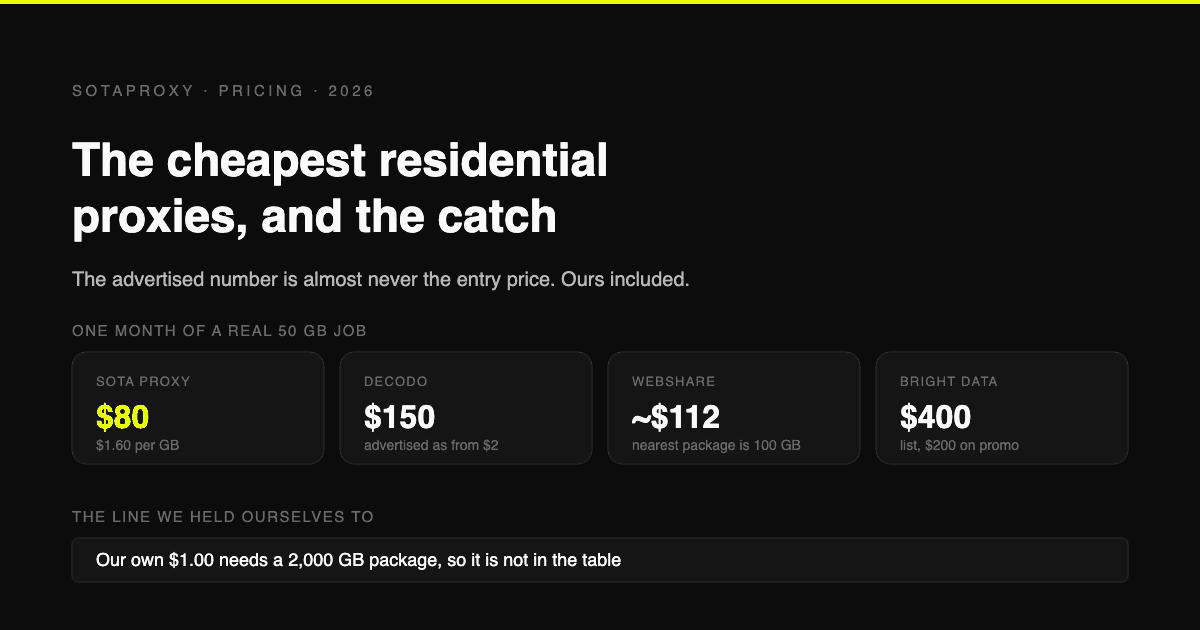
The Cheapest Residential Proxies in 2026, With the Catch Each One Hides
Verified per-gigabyte prices from five vendors' own pages, not from last year's blog posts. Why the advertised number is almost never the entry price, which providers put a monthly floor under your bill, and how to work out your real cost per gigabyte.
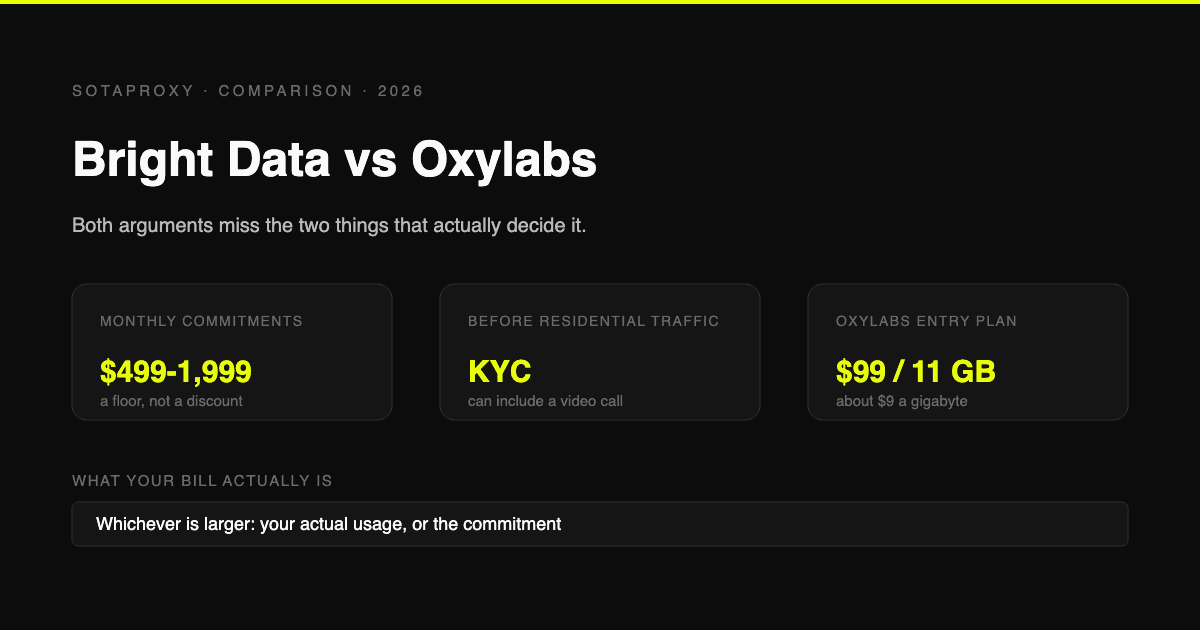
Bright Data vs Oxylabs in 2026: Prices, Commitments and the KYC Nobody Mentions
Both are enterprise platforms with minimum monthly commitments and a compliance check before you can touch residential traffic. Current prices from both vendors' own pages, what the commitment actually costs if you underuse it, and who each one is genuinely for.
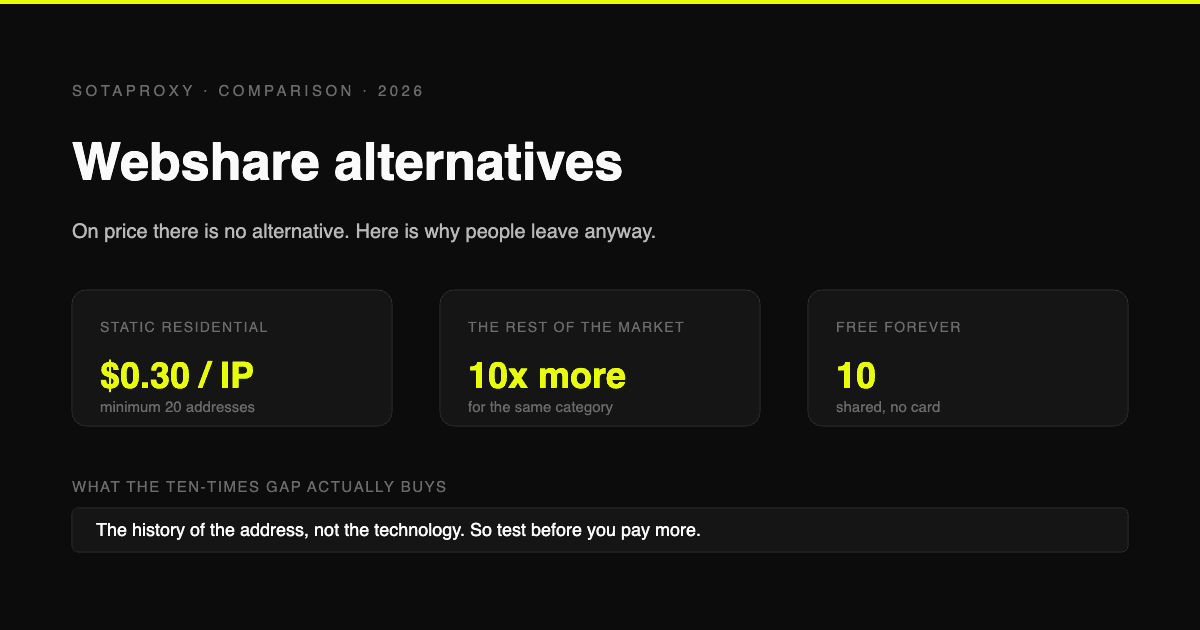
Webshare Alternatives in 2026: When the Cheapest Proxies Stop Being Cheap
Webshare gives away 10 proxies and sells static residential at $0.30 an IP, a tenth of what most vendors charge. Verified prices, the four reasons people still leave, and the one reason to stay.
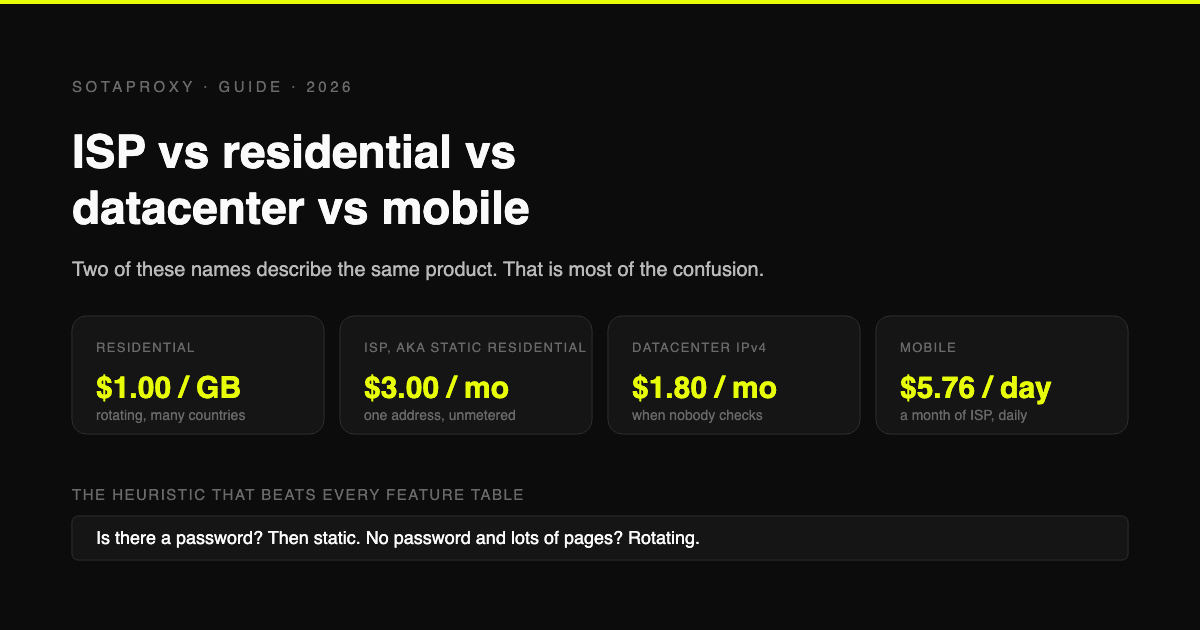
ISP vs Residential vs Datacenter vs Mobile Proxies: Which One You Actually Need
Static residential and ISP are the same product under two names, which is why half these comparisons compare a thing to itself. What each type is, what it costs per unit, and the one task each is genuinely best at.
7 Top Proxy Providers for Arbitrage and Scraping
Compare 7 top proxy providers by IP types, targeting, rotation, uptime, pricing signals, and fit for scraping, ad accounts, farming, and arbitrage.

10 Best Proxy Services for Ads, Scraping, and Automation
Compare the best proxy services for ad verification, scraping, account operations, and geo-targeting by IP type, price, uptime, and controls.