Webshare Alternatives in 2026: When the Cheapest Proxies Stop Being Cheap
Webshare gives away 10 proxies and sells static residential at $0.30 an IP, a tenth of what most vendors charge. Verified prices, the four reasons people still leave, and the one reason to stay.
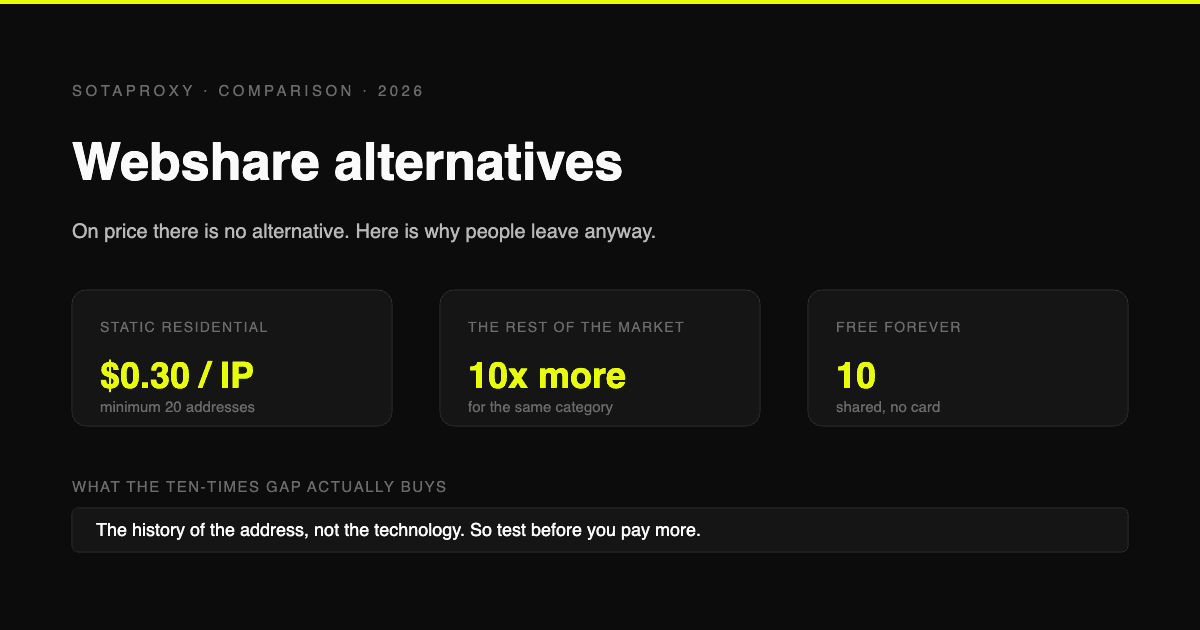
Webshare occupies a specific position in this market: it is the cheap one, and it is not close. Ten free proxies permanently with no card, shared datacenter addresses at three cents a month each at volume, and static residential at $0.30 per address when most of the market charges between $2 and $3.30 for the nominally same thing.
That makes "Webshare alternatives" a strange search, because on price there is no alternative. So this page is about the four reasons people leave anyway, and the one large case where leaving is a mistake. Prices verified on webshare.io on 23 September 2026.
What you are actually comparing against
| Product | Entry | At volume |
|---|---|---|
| Shared datacenter | 10 free, then $2.99 a month for 100 | $0.0179 each at 60,000 |
| Static residential, their ISP product | $0.30 each, minimum 20, so $6 a month | $0.225 each at 10,000 |
| Rotating residential | $7.00 per GB list, $3.50 on the current promotion at 1 GB | $1.40 per GB at 3,000 GB |
Annual billing takes about 30% off. Note the two structural points that do most of the work in the decisions below: the datacenter proxies are shared, and static residential has a 20-address minimum.
Reason 1: shared is the actual product, and sharing is the problem
The headline cheapness is on shared datacenter addresses. Shared means other customers are using the same address for their own purposes, and you inherit whatever they did with it. For scraping targets that do not care, this is a bargain and nothing else competes.
For anything with a login, it is unusable, and not because the product is bad. An account whose address is simultaneously being used by strangers is an account sitting on a reputation you do not control and cannot repair. That is the entire reason dedicated addresses cost more: you are buying exclusivity, not bandwidth.
So the first fork is simple. If you need dedicated, you were never in Webshare's cheap tier to begin with, and the comparison you want is between dedicated products:
| Provider | Dedicated static address, per month | Smallest order |
|---|---|---|
| Webshare static residential | $0.30 | 20 |
| Sota Proxy ISP | $3.00, down to $1.90 at 200 | 1 |
| Decodo dedicated ISP | $3.33 at 3 IPs, plus VAT | 3 |
| IPRoyal | about $2.00 | 1 |
We are ten times Webshare's price on that line. That is not a typo and we are not going to explain it away, because the honest explanation is the next section.
Reason 2: the ten-times price gap is a reputation gap
A static residential or ISP address is a datacenter-hosted address on a range registered to an internet provider. What differs between a $0.30 address and a $3.00 one is not the technology, it is the history: how many customers used it before you, what they did with it, and how many blocklists remember.
This is the most common complaint against cheap ISP inventory across the whole market, not just Webshare, and it is a fair one. It also means the price comparison above tells you almost nothing on its own. The only thing that resolves it is a test on the specific addresses you would be buying:
- Does the range resolve to a consumer provider or to a hosting company?
- Is it on the blocklists your targets actually consult?
- Does your target load, log in and stay logged in?
That is ten minutes of work and it is the difference between a genuine bargain and an expensive month of debugging. The checklist is in how to test a proxy before you buy it, and the reason ISP addresses vary this much is in the honest version of what they are.
If Webshare's addresses pass your tests, buy them. Paying ten times more for an address that does the same job on your targets is not diligence, it is waste.
Reason 3: the 20-address minimum
Small but decisive for a certain buyer. Static residential starts at twenty addresses, so a person who needs three accounts isolated cannot buy three addresses. They buy twenty and use three, at $6 a month, which is still cheap in absolute terms but stops being the bargain the per-address price implies.
If you need one, two or five dedicated addresses, look for vendors that sell them individually. We sell from one, IPRoyal sells from one, Decodo starts at three.
Reason 4: you need something that is not addresses
Webshare sells proxies. It does not sell the managed layer above them: no unblocker that solves anti-bot challenges for you, no ready-made scraping APIs for specific sites, no datasets.
If your problem is "this site blocks my scraper", more addresses may not be the answer, and the comparison set is Bright Data, Oxylabs, Decodo's unblocker, Apify or Firecrawl. We cover that direction in Bright Data alternatives and Oxylabs alternatives. Those cost dramatically more per request, and the trade is engineering time against margin.
The one reason to stay
Worth stating plainly because most pages in this genre will not: if price is your binding constraint and your targets do not check address class, Webshare is the correct choice and nothing here beats it.
Ten free proxies with no card is a genuinely useful thing to exist. Learning, prototyping, a hobby scraper, checking whether a job is viable before spending anything: start there. Migrate when you hit a wall you can name, not because a comparison article implied you should.
The alternatives, briefly
Everything here is more expensive than Webshare. The question each time is what the extra money buys.
Sota Proxy, us. ISP addresses from $3.00 for one, $2.10 from ten, $1.90 from 200, sold from a single address with no VAT. Residential at $1.00 per gigabyte, no minimum. Ten times Webshare's list price on static addresses; what you get for it is dedicated inventory in small quantities and no 20-address floor. Crypto-only payment, which is either convenient or disqualifying. No free tier, no unblocker, no scraping APIs.
IPRoyal. Static residential around $2.00 an address, sold individually, price taken from public listings rather than verified on their site. Broader catalogue than ours, cheaper than Decodo, and no minimum order. The straightforward mid-market pick when the cheap addresses failed your tests.
Decodo. Dedicated ISP at $3.33 an address on a three-address minimum plus VAT, residential from $2 a gigabyte, and the piece Webshare has no answer to: a Site Unblocker from $0.95 per thousand requests and a Web Scraping API from $0.09 per thousand. Independent benchmarks rate its residential reliability highly. Expensive per address, and the reason to go there is usually the managed layer. See Decodo alternatives.
Oxylabs and Bright Data. The premium tier, around $4 a gigabyte on residential at volume, and both put a monthly floor under your bill: see Bright Data vs Oxylabs. Unblockers, prebuilt scrapers for specific sites, datasets, compliance documentation. Roughly an order of magnitude above Webshare per unit, bought for capability rather than addresses.
Mobile providers. Worth naming because it is the one thing no cheap tier substitutes for: if your target specifically checks for carrier ranges, no static address at any price passes, and mobile starts around $5.76 a day. See the type comparison.
Which alternative fits which reason
| Leaving because | Look at |
|---|---|
| You need dedicated, not shared | Any dedicated ISP product, then test it |
| Cheap addresses failed your targets | Mid-priced ISP from IPRoyal, us, or Decodo |
| You need fewer than 20 addresses | Vendors selling single addresses |
| You need many countries on demand | Rotating residential, billed per GB |
| You need an unblocker or scraping API | Bright Data, Oxylabs, Decodo, Apify, Firecrawl |
| Price is the whole constraint | Stay |
And the ordering rule that matters more than the table: test before you pay a premium. The entire justification for spending more than $0.30 an address is that the cheap one failed a check you actually ran. If you have not run it, you are guessing in the expensive direction.
FAQ
Is Webshare really free?
Yes, ten shared datacenter proxies with no card and no time limit. They are shared, so they suit learning, prototyping and targets that do not check address reputation, not accounts.
How much does Webshare cost?
Verified on their pricing page on 23 September 2026: shared datacenter from $2.99 a month for 100 addresses, dropping to under two cents each at very high volume; static residential at $0.30 an address with a 20-address minimum, so $6 a month; rotating residential at a $7.00 per gigabyte list price, currently discounted to $3.50 at 1 GB and falling to $1.40 at 3,000 GB. Annual billing takes off about 30% on the proxy plans.
Why is Webshare so much cheaper than other ISP proxies?
Because the price of a static residential address is mostly the reputation of its range, not the hardware. At a tenth of the market price, expect a different history behind the address. Sometimes that is irrelevant to your targets, which is when it is a bargain, and sometimes it is the whole problem.
What is the best Webshare alternative?
There is no single answer because people leave for opposite reasons. For dedicated addresses in small quantities, a vendor that sells from one address. For many countries on demand, rotating residential per gigabyte. For sites that block scrapers, a managed unblocker rather than more addresses.
Are Webshare proxies good for social media accounts?
The shared datacenter ones, no: a shared address means an account sitting on a reputation you do not control. The static residential ones, possibly, and it is worth testing since they are cheap enough to try. Test with one account before committing a roster.
Should I pay more than $0.30 per proxy?
Only if the cheap one failed a test you ran on your own targets. That is the whole decision. A more expensive address that behaves identically on your sites is money spent on reassurance.
Related articles
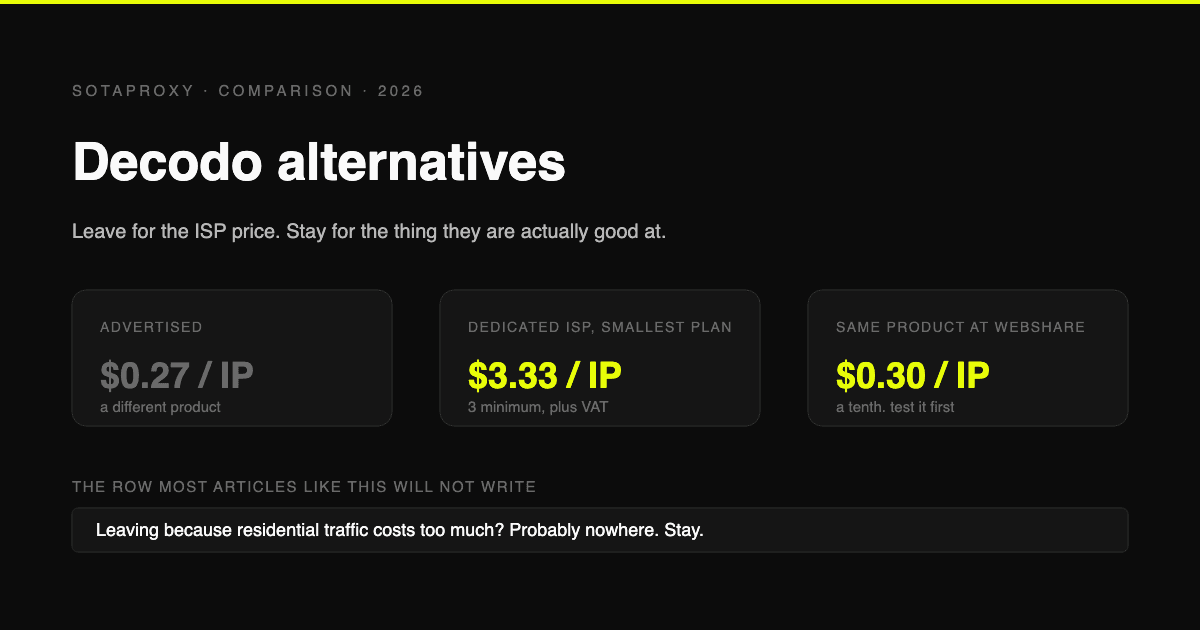
Decodo Alternatives in 2026: Who to Move to, and Who Not to Bother
Decodo is the cost leader on rotating residential and one of the pricier options on dedicated ISP. Verified prices for both, the reasons people actually leave, and which alternative fits each one.
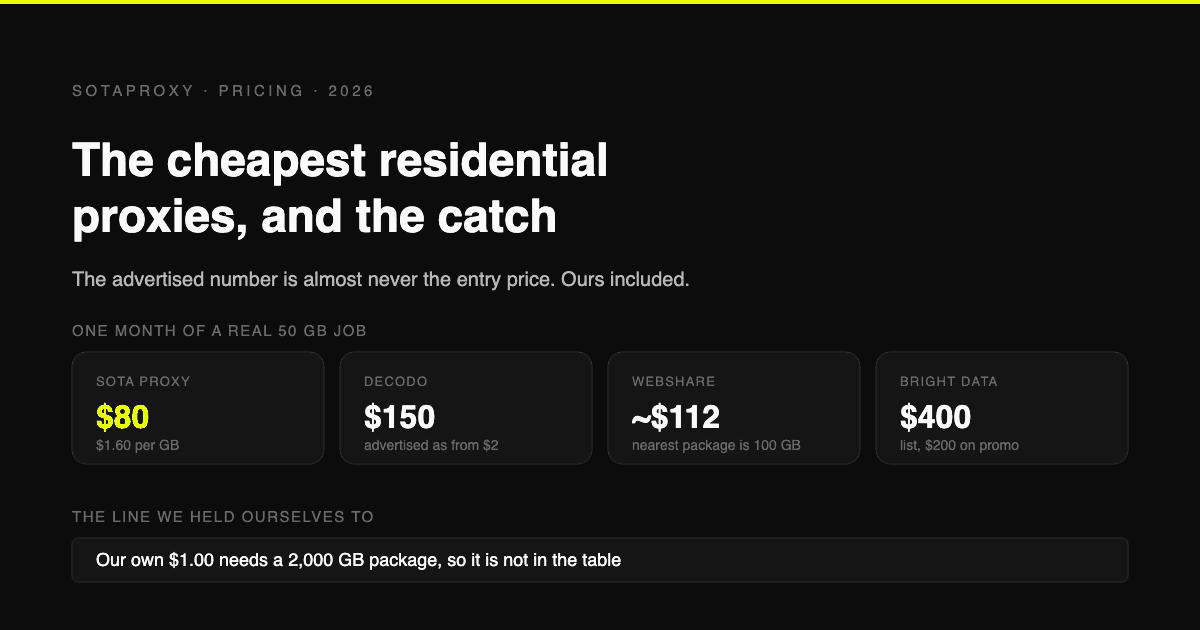
The Cheapest Residential Proxies in 2026, With the Catch Each One Hides
Verified per-gigabyte prices from five vendors' own pages, not from last year's blog posts. Why the advertised number is almost never the entry price, which providers put a monthly floor under your bill, and how to work out your real cost per gigabyte.
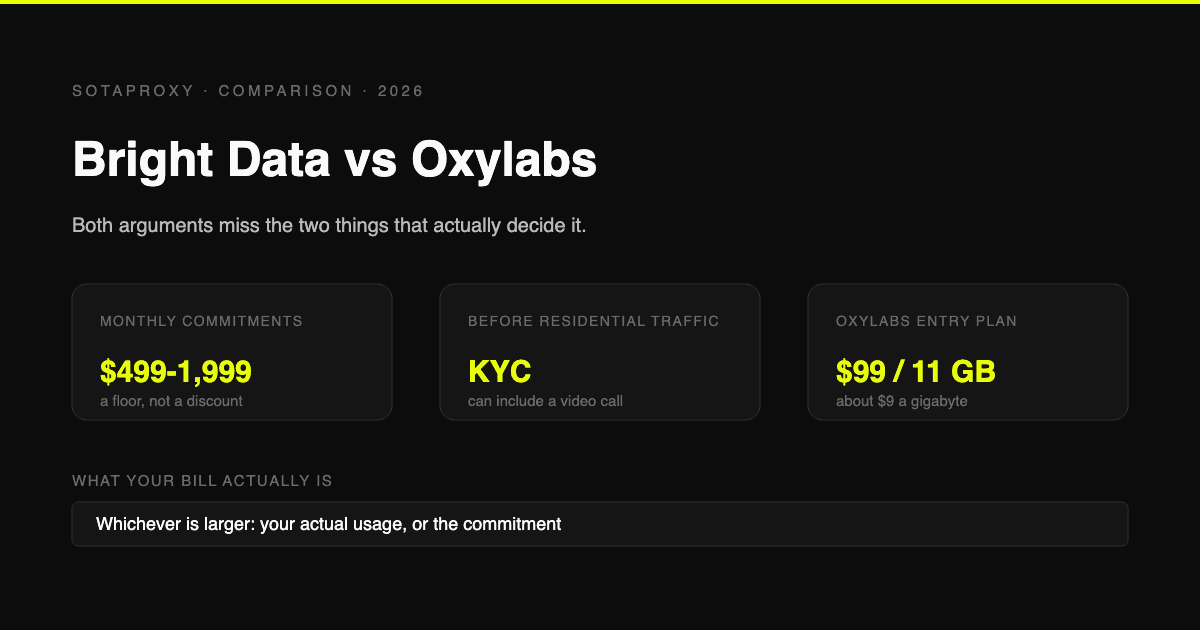
Bright Data vs Oxylabs in 2026: Prices, Commitments and the KYC Nobody Mentions
Both are enterprise platforms with minimum monthly commitments and a compliance check before you can touch residential traffic. Current prices from both vendors' own pages, what the commitment actually costs if you underuse it, and who each one is genuinely for.
ISP vs Residential vs Datacenter vs Mobile Proxies: Which One You Actually Need
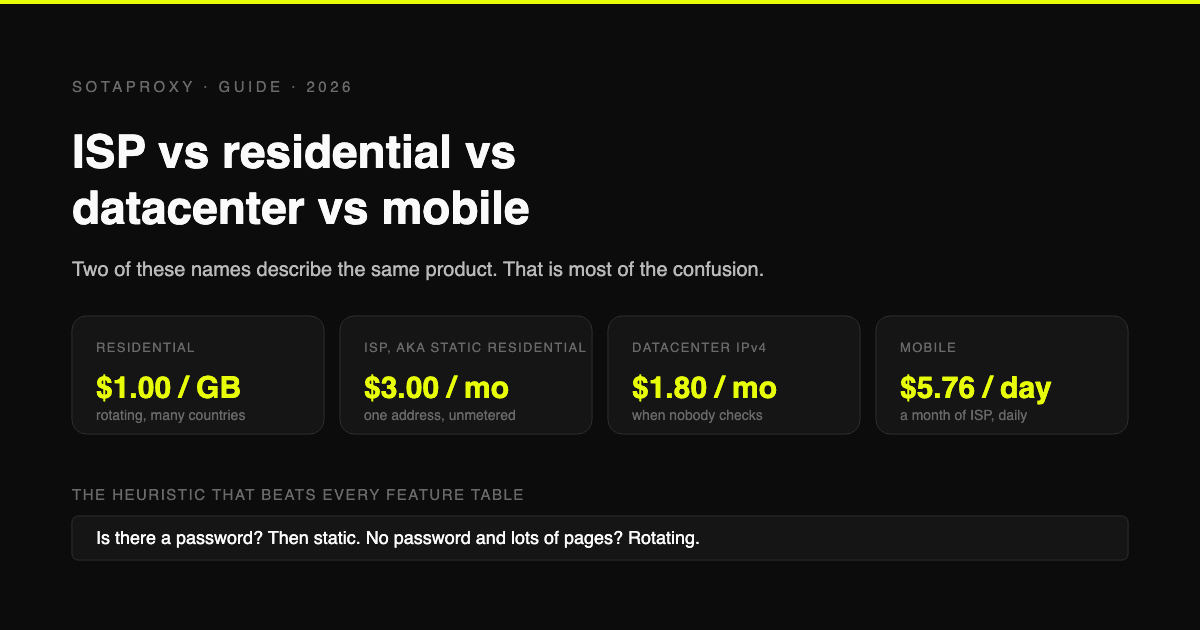
Static residential and ISP are the same product under two names, which is why half these comparisons compare a thing to itself. What each type is, what it costs per unit, and the one task each is genuinely best at.
7 Top Proxy Providers for Arbitrage and Scraping
Compare 7 top proxy providers by IP types, targeting, rotation, uptime, pricing signals, and fit for scraping, ad accounts, farming, and arbitrage.

10 Best Proxy Services for Ads, Scraping, and Automation
Compare the best proxy services for ad verification, scraping, account operations, and geo-targeting by IP type, price, uptime, and controls.