Rotating Datacenter Proxies: A Technical Operator's Guide
A no-fluff guide to rotating datacenter proxies. Master rotation mechanics, configuration, and use cases for ad accounts, scraping, and antidetect browsers.

You're probably dealing with one of two situations right now.
Either your scraper stack is burning through IPs and still getting blocked, or your media buying setup is trying to run Facebook and TikTok accounts on fast cheap proxies that looked fine in a dashboard and died the moment the platforms checked the ASN. That's the real story with rotating datacenter proxies. They're excellent in the right lane, and a bad idea in the wrong one.
Operators get into trouble when they treat rotation as a magic shield. It isn't. A rotating gateway can spread requests across a large pool and keep throughput high, but it can't change where those IPs come from or how your traffic looks. If you're running account farming in AdsPower, Dolphin Anty, GoLogin, Multilogin, or Hidemyacc, or pushing cloaking flows and geo-targeted campaigns, the proxy type has to match the job. Speed alone won't save you.
Table of Contents
- Defining Rotating Datacenter Proxies
- Datacenter vs Residential vs Mobile A Technical Breakdown
- Mastering Rotation Mechanics and Strategy
- Configuration Best Practices for High Success Rates
- Operational Use Cases and Their Limitations
- Provider Selection and Affiliate Opportunities
- Frequently Asked Questions
Defining Rotating Datacenter Proxies
A rotating datacenter proxy is a backconnect endpoint that routes each connection, or each timed session, through IPs that come from datacenter infrastructure rather than home users or mobile carriers. The rotating part is the traffic management layer. The datacenter part is the IP origin.
That distinction matters because teams often buy “rotating” and assume they bought “trusted.” They didn't. They bought automation-friendly routing on top of server-hosted IPs.
The practical advantage is obvious. You don't manage a static list by hand, remove dead entries, or write your own rotation logic around a pile of host:port pairs. You hit one gateway, define the rotation behavior, and let the provider cycle the pool through backconnect logic over HTTP or SOCKS5. If your workload is stateless and volume-heavy, that setup is cleaner than juggling static endpoints or manually replacing burned IPs from a spreadsheet.
The broader market exists because these workloads are common. The global rotating proxy market was valued at approximately $0.7 billion in 2026, driven by high-speed web scraping, ad verification, and price monitoring, with rotating datacenter proxies as a key segment that distributes traffic and lowers blacklisting risk according to Business Research Insights on the rotating proxy market.
Static lists versus managed rotation
With a static list, you assign one IP to one task until it degrades. That's workable for stable sessions but bad for broad collection jobs. Rotating datacenter proxies invert that model. The gateway owns the pool and decides which exit node handles each request.
That changes operations in three ways:
- Less manual replacement: You stop babysitting dead IP lists.
- Better traffic spread: Requests fan out across multiple addresses instead of hammering one subnet.
- Cleaner scaling: Adding more workers doesn't mean hand-assigning more endpoints.
For a quick baseline on the underlying IP class, this datacenter proxy glossary entry captures the server-side nature of datacenter IPs well.
Practical rule: Buy rotating datacenter proxies for speed and operational simplicity. Don't buy them because you think rotation alone makes hostile platforms trust you.
Datacenter vs Residential vs Mobile A Technical Breakdown
If you run cloaking checks, scrape landing pages, test geo-targeted campaigns, and manage account farms in the same stack, you can't lump proxy types together. The difference isn't cosmetic. It's in the ASN, the trust score that target platforms infer from it, and the detection pattern that follows.
What rotation changes and what it doesn't
Rotation changes how often your visible IP changes. It does not change the fact that a datacenter IP still exits through hosting infrastructure. That's why a rotating datacenter proxy can be perfect for one workload and toxic for another.
Datacenter proxies route through cloud hosting environments, deliver the fastest speeds, and are easy for sites to detect. Residential proxies use IPs from home users' ISPs and usually carry higher trust with lower block rates on protected targets, as explained in this datacenter versus residential proxy breakdown.
Mobile sits in a different category. Mobile proxies use carrier-assigned IPs from telecom networks, so traffic looks like it came from real phones on 3G, 4G, or 5G networks. For social environments and app-centric flows, that trust model is very different from either home ISP or datacenter traffic.
IPv6 also needs a reality check. It can be useful where targets fully support IPv6 and don't apply the same aggressive filtering, but many ad platforms, account systems, and anti-fraud pipelines still care more about network reputation and browser identity consistency than about whether the address is IPv4 or IPv6. IPv6 isn't a bypass. It's just another transport option.
Proxy Type Technical Comparison
| Attribute | Datacenter | Residential | Mobile |
|---|---|---|---|
| IP origin | Cloud or leased server environments | Consumer ISP connections | Cellular carrier networks |
| Trust on protected targets | Low to moderate | Higher | Highest for mobile-native trust scenarios |
| Speed and latency | Best raw performance | Slower and less consistent | Usually slower than datacenter |
| Best fit | Scraping, SERP tracking, price monitoring, ad verification on easier targets | Protected scraping, account work, geo-sensitive browsing | Social, app flows, high-trust mobile behavior |
| Main risk | ASN detection | Higher cost and variable quality | Higher cost, narrower supply, session complexity |
For operators comparing classes side by side, this residential vs datacenter explainer is a useful shorthand.
- Datacenter: Use them when speed, low latency, and concurrency matter more than trust. Think public product pages, SERP collection, ad checks on softer targets.
- Residential: Use them when the target inspects user legitimacy. Facebook Business Manager, TikTok account work, and account farming fit here.
- Mobile: Use them when platform heuristics lean heavily on carrier reputation and device realism, especially for mobile-first surfaces.
If the target cares about who you look like, datacenter is usually the wrong first choice. If the target cares about how fast you can fetch a public page, datacenter is usually the cheapest good choice.
Mastering Rotation Mechanics and Strategy
The common advice is too simple. People say per-request rotation for scraping, sticky sessions for logins, and stop there. That misses the actual failure mode. Modern anti-bot systems don't just count requests. They inspect how your rotation pattern itself behaves.
Start with the visual model commonly used internally when training juniors:

Per-request rotation
Per-request rotation assigns a fresh IP to nearly every request. That's useful when requests are independent and the target doesn't need to see continuity. Public search result collection is the classic case. So is broad price monitoring where each fetch stands alone.
What breaks is continuity. If a checkout flow, login sequence, or account profile action jumps IPs constantly, the target sees a fractured user. That's bad inside antidetect browsers like AdsPower, Dolphin Anty, GoLogin, Multilogin, and Hidemyacc because the browser fingerprint says one thing and the network behavior says another.
This walkthrough on proxy IP rotation patterns is useful if you want the implementation angle.
A short demo helps when you need to explain sticky versus rotating behavior to a team:
Sticky sessions
Sticky rotation keeps the same IP for a defined session window. That's what you want for account actions, review states, cart flows, and geo-targeted ad checks that require a stable identity.
Sticky doesn't mean static forever. It means stable long enough for the target to accept the interaction as one user journey. If you farm accounts, warm ad profiles, or review localized creatives through browser profiles, you need that persistence.
Rotation entropy matters
The deeper issue is rotation entropy. If your stack rotates with machine-perfect regularity or changes IPs more aggressively than a human path would ever require, the pattern itself becomes a signal.
Emerging data from 2025 to 2026 shows that 15% to 30% of failed scraping jobs on protected sites come from overly aggressive per-request rotation triggering scripted-behavior fingerprints, and timed rotation with 2 to 4 minute windows achieves 22% higher success rates on high-trust sites according to LiveProxies research on rotating proxy strategy.
That lines up with field behavior. Protected targets don't just punish volume. They punish nonsense movement.
Treat rotation like identity choreography, not a randomizer. If the target expects a user session, give it a believable session.
Configuration Best Practices for High Success Rates
Fast proxies don't fix sloppy setup. Rotating datacenter proxies can deliver 10 to 100ms response times, 10 to 50 Mbps speeds, and uptime above 99.5% for automation workloads according to Bright Data's static vs rotating proxy benchmarks. That performance headroom is useful only if your browser identity, concurrency, and session handling are aligned.
Browser and identity alignment
Start with the browser profile.
- Match locale to exit region: If the proxy exits in Germany, don't run a browser profile with a US timezone, Russian keyboard hints, and English Australia locale. In AdsPower, GoLogin, and Multilogin, align language, timezone, WebRTC behavior, and geolocation with the proxy region.
- Keep cookies consistent: For sticky account work, preserve cookies and local storage inside one browser profile. For scraping, isolate sessions when you need clean state.
- Sync device story: If the account looks like a mobile-first user, don't pair it with a datacenter IP plus a desktop fingerprint and expect TikTok to ignore it.
If you build scraping jobs instead of browser flows, this Scrapy integration page is the right kind of implementation reference.
Traffic shaping and pool hygiene
Most bans come from traffic shape before they come from bandwidth.
- Cap concurrency per identity: One browser profile or session should behave like one user, not a botnet. Split workers across sessions instead of flooding one sticky exit.
- Separate workloads by target sensitivity: Don't use the same rotating gateway for low-value crawling and high-risk account interactions.
- Ask for subnet diversity: If your provider recycles the same small cluster of datacenter ranges, target systems can burn the whole block fast.
- Retry intelligently: Don't hammer immediate retries through the same pattern. Change timing, headers, or route class when blocks appear.
- Audit headers: User-Agent, Accept-Language, and related browser signals need to make sense for the profile and the geo.
A lot of teams overfocus on “clean IPs” and ignore workflow contamination. A clean IP attached to a dirty browser profile still gets flagged.
Good proxy performance gets you to the door. Good identity hygiene gets you through it.
Operational Use Cases and Their Limitations
The outcome for teams is either saving money or burning it.

Where they work
For ad verification, rotating datacenter proxies are useful when you need fast checks across multiple regions and the target page isn't heavily protected. If a buyer wants to confirm whether a landing page, redirect chain, or creative swap appears correctly by country or city, datacenter rotation gives you cheap coverage at speed.
For scraping and monitoring, they fit price collection, SERP tracking, product availability checks, and broad market scans. These tasks are usually stateless enough that you can spread requests aggressively without needing a stable identity.
For cloaking QA, they can help test what the filtering layer serves to different regions or request paths. But that's only the QA side. Running the full cloaking and account stack on datacenter IPs is where people get sloppy.
Where they fail hard
For Facebook and TikTok ad accounts, rotating datacenter proxies are usually a bad bet. The issue isn't whether the IP rotates. The issue is that the platform sees datacenter ASN lineage.
Data from 2026 shows that 68% of ad arbitrage teams using rotating datacenter IPs for TikTok and Facebook campaigns face IP bans within 3 days, because ASN type is the main ban trigger on social platforms, not rotation mode, according to Olostep's review of residential and rotating proxy use.
That's the line new hires need to remember. If you're doing:
- Account farming
- Business Manager access
- Pixel and ad account maintenance
- Warm-up inside AdsPower, Dolphin Anty, GoLogin, Multilogin, or Hidemyacc
- Persistent cloaking admin panels
- Long-lived geo-targeted campaign operations
use residential, mobile, or in some cases static ISP proxies. Datacenter rotation won't fix a trust problem.
Here's the practical split:
- Good fit: scraping, ad checks on easier targets, large-volume fetches, public page collection.
- Borderline fit: temporary QA on login-light flows where the target doesn't thoroughly inspect network reputation.
- Bad fit: social media account management, high-value account farms, protected commerce dashboards.
The mistake isn't buying datacenter. The mistake is forcing it into trust-sensitive jobs because it's cheaper.
Provider Selection and Affiliate Opportunities
Provider choice matters less on the sales page and more in failure analysis. You want to know how the pool behaves when your campaign is under load, how granular the geo controls are, and whether the dashboard gives you enough visibility to isolate a bad route fast.

What to check before you buy
Use a short checklist.
- Pool diversity: Ask about pool breadth and subnet spread, not just headline size.
- Geo control: Country is table stakes. City and state targeting matter for local ad verification and geo-targeted campaigns.
- Rotation control: You need both per-request and sticky options, with enough control to shape sessions around the workload.
- Protocols and automation: HTTP and SOCKS5 support are standard. API access matters if you rotate at scale inside your own systems.
- Support quality: When a target starts blocking a route class, you need real troubleshooting, not canned replies.
For teams evaluating offers in the market, this roundup of best rotating proxies is a practical starting point.
Cost control outside pure performance
There's also the operator-side business angle. If your team spends heavily on infrastructure and you routinely refer other buyers, proxy affiliate programs can offset part of that cost. Sota Proxy, for example, offers a referral and affiliate program with up to 40% commission. For agencies, traffic arbitrage teams, and account operators who already influence tooling decisions, that can turn recommendations into a small but useful revenue stream.
That shouldn't drive provider selection. Reliability comes first. But if two providers cover the same technical needs, affiliate structure can matter for margin.
Pick the provider for route quality and controls. Treat affiliate revenue as a bonus, not a reason to tolerate bad traffic.
Frequently Asked Questions
Can I use rotating datacenter proxies for Facebook or TikTok accounts
You can. You probably shouldn't.
For account farming, ad account access, and profile persistence, the main issue is trust. Facebook and TikTok inspect network origin, browser identity, and behavioral consistency together. Rotating datacenter proxies fail the network-origin part too often. Use residential or mobile for valuable accounts. Use static ISP when you need longer-lived sessions with better trust than pure datacenter.
Are they good for sneaker bots and limited drops
Sometimes. It depends on the target.
If the site values low latency and the anti-bot layer is lighter, rotating datacenter proxies can help with speed. If the drop site inspects IP reputation hard, residential or ISP often hold up better. Don't run one proxy class across all stores. Split by target behavior and monitor which stores punish datacenter ASNs quickly.
What do I do when a site blocks whole datacenter ASNs
Stop trying to brute-force through the same class.
Move the blocked workflow to residential, mobile, or static ISP proxies. If you still need datacenter for cost reasons, diversify providers and route classes so your requests don't all sit in one obvious network cluster. Also lower predictability. Change timing, session length, and request cadence instead of only changing IPs.
Should I warm up a new proxy pool
Yes, especially on sensitive targets.
Don't point a fresh pool at a high-value workflow at full concurrency on day one. Start with lighter traffic, simpler pages, and lower session pressure. Watch for CAPTCHAs, login friction, and unusual session invalidation. Then step up traffic in stages. Warming isn't superstition. It gives you time to spot bad ranges and unnatural behavior before the target labels the whole route pattern as hostile.
Are IPv6 proxies a shortcut around bans
No. IPv6 can be useful where support is solid and filtering is weaker, but it doesn't replace trust. A bad identity stack on IPv6 is still a bad identity stack. Use IPv6 because the target and your tools support it well, not because you expect it to bypass platform scrutiny by itself.
If you need a proxy stack that covers datacenter, residential, mobile, and ISP traffic in one place, Sota Proxy is built for operators who care about routing control, geo targeting, sticky sessions, and stable performance under real automation load. It's a practical fit for scraping, ad verification, geo-targeted campaign testing, and higher-trust account workflows when you need to switch proxy classes instead of forcing one type into every job.
Related articles
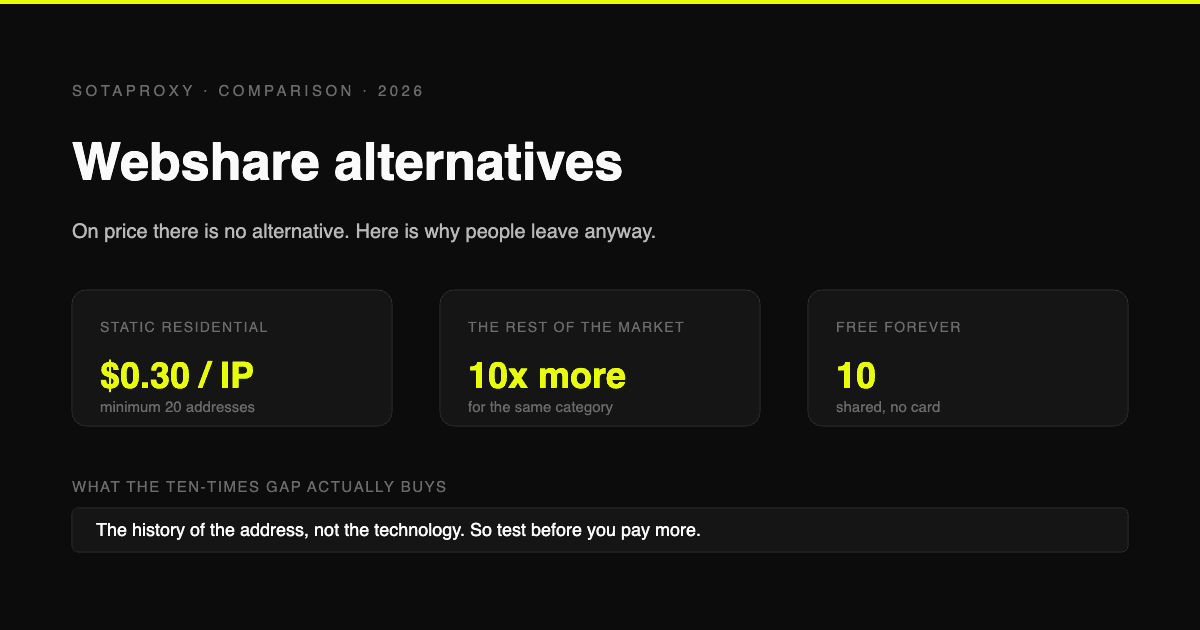
Webshare Alternatives in 2026: When the Cheapest Proxies Stop Being Cheap
Webshare gives away 10 proxies and sells static residential at $0.30 an IP, a tenth of what most vendors charge. Verified prices, the four reasons people still leave, and the one reason to stay.

How to Make Money With Web Scraping in 2026: Five Models, Priced
Five ways scrapers get paid, what each one charges, and what a scrape actually costs to run, measured on real pages: HTML-only against a full browser render.
What Is Sticky Session: A Technical Guide for Proxy Users
Learn what is sticky session, how session affinity works in load balancers and proxies, and when to use it for multi-accounting, scraping, and ad campaigns.
AdsPower Proxy Integration: The Complete Setup Guide
Step-by-step AdsPower proxy integration with SotaProxy. Covers setup, proxy types, rotation, troubleshooting, and best practices for multi-account workflows.

How to Build an Amazon Review Scraper That Actually Works
Build a reliable Amazon review scraper with proven proxy, anti-blocking, and parsing tactics. Step-by-step guide for technical operators and agencies.

How to Get Around an IP Ban: A Technical Guide for 2026
Facing an IP ban? Learn how to get around an IP ban with technical steps for diagnosing block types, choosing the right proxies, and configuring your stack.