Webshare vs Decodo in 2026: Datacenter Value, a $7 Residential List Price, and Cards Only
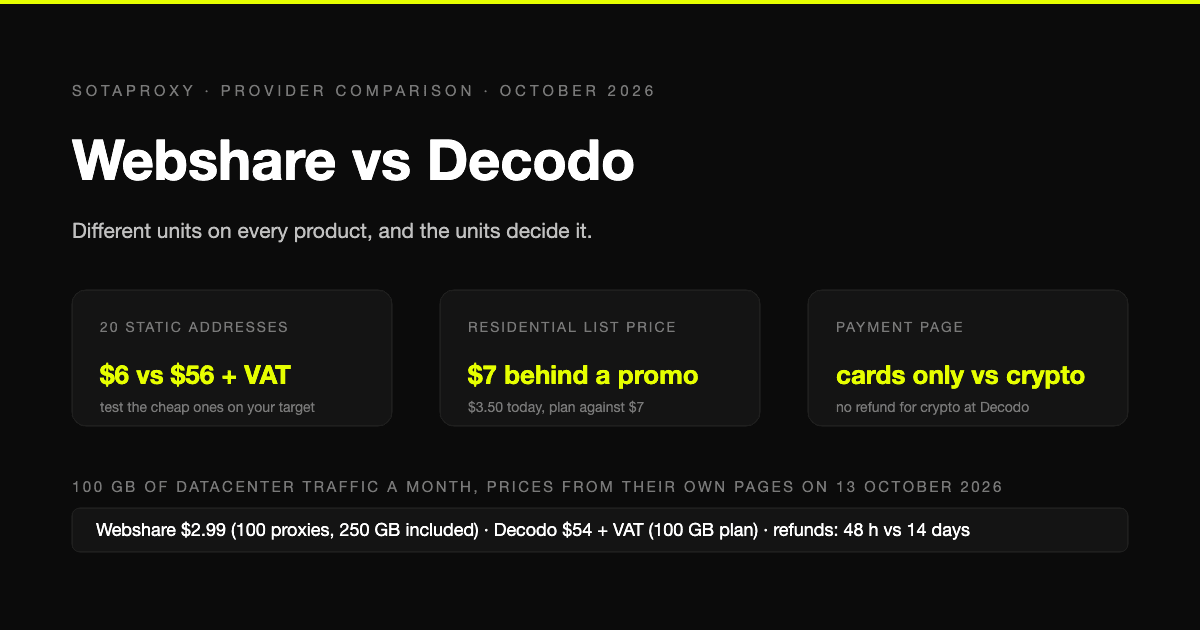
Webshare and Decodo sell the same three products in different units, and the units decide the comparison. Datacenter by the address against by the gigabyte, static addresses at $0.30 against $3.33, a residential list price of $7 that nobody pays, and a payment page with no crypto on one side and no refund for crypto on the other.
Webshare and Decodo get compared because they sit in the same band: cheaper than the enterprise platforms, bigger than the small shops, both selling datacenter, static residential and rotating residential from a self-service dashboard. The comparison usually ends with "Webshare is cheaper", which is true on two of the three products and misses why.
The prices below are from each vendor's own pages on 13 October 2026. The useful part is not the per-unit numbers but the units themselves, which are different on every product, plus three things that are not on either pricing page: how each one handles identity checks, refunds and the ways you are allowed to pay. We sell proxies too, and say so at the end.
The short version
| Webshare | Decodo | |
|---|---|---|
| Datacenter, how it is sold | Per proxy per month, with a bandwidth allowance | Per gigabyte on shared addresses, or per address |
| Datacenter, entry | 10 shared proxies free with 1 GB a month; 100 proxies $2.99 a month with 250 GB | Pay per GB from $0.60 (10 GB, $6 plus VAT); shared addresses from $0.10, dedicated from $2.50 |
| Static residential (ISP), entry | $0.30 per address, minimum 20, $6 a month | $3.33 per address, minimum 3, $9.99 a month plus VAT |
| Rotating residential, list | $7.00 per GB | $4.00 per GB pay as you go |
| Rotating residential, what you actually pay today | Promotion: $3.50 at 1 GB, $2.75 at 10 GB, $2.25 at 100 GB, $1.40 at 3 TB | $3.75 at 3 GB, $3.50 at 10 GB, $2.75 at 100 GB, $2.00 at 1 TB |
| Residential pool claimed | 80M+ IPs, 195 countries | 115M+ IPs, 195+ locations |
| Identity check | Not for all users; triggered by payment checks, large volumes to rate-limited sites, or the affiliate programme; handled by Stripe Identity | Not by default; triggered by risk signals or restricted targets |
| Refunds | Within 48 hours, under 1 GB used on datacenter or static, under 0.1 GB on residential, under 1,000 proxies; account credits never refunded | 14 days on a first purchase, under 20 percent of traffic or 1 GB, not for crypto |
| Payment | Cards, Google Pay, Apple Pay only; no PayPal, no crypto, and their help centre says none planned | Cards, PayPal, Alipay, Google Pay, Apple Pay, crypto (not for pay-per-IP) |
Datacenter: the units decide it
This is where the two are furthest apart, and the reason is not price, it is what the price buys.
Webshare sells datacenter proxies by the proxy. A plan is a number of shared addresses with a bandwidth allowance and a thread limit: 100 proxies with 250 GB for $2.99 a month, 1,000 for $26.91, 2,500 for $63.54, 10,000 for $224.25, allowances rising towards unlimited under a fair use policy, 30 percent off on yearly billing. Ten proxies with 1 GB a month are free, with no card. Private addresses start at $0.429 and dedicated at $0.825 per proxy.
Decodo sells shared datacenter by the gigabyte, from $0.60 per GB at 10 GB down to $0.45 at 1,000 GB, plus VAT, with pay-per-address options from $0.10 shared and $2.50 dedicated.
Put a workload through both. A crawler pulling 100 GB a month from sites that do not filter hosting ranges costs $2.99 at Webshare on the entry plan, which includes 250 GB, and $54 plus VAT at Decodo on the 100 GB plan. At 1 TB the gap narrows in ratio but not in dollars: Webshare's larger plans carry unlimited bandwidth under fair use, Decodo's 1,000 GB plan is $450 plus VAT.
If your targets accept datacenter addresses, Webshare is the cheaper tool by an order of magnitude, and the free tier is the cheapest possible way to find out whether they do. That test is worth running before buying anything from anyone, and it is step six in how to buy proxies for the first time.
Static addresses: $0.30 against $3.33, and what the gap is
Both sell dedicated ISP addresses, static and registered to consumer providers.
Webshare: $0.30 per address with a minimum of 20, so $6 a month, falling to $0.27 at 1,000 and $0.225 at 10,000. The page lists US carriers (AT&T, Comcast, Cox, Lumen and others), unlimited bandwidth under fair use, HTTP and SOCKS5, IP authorisation.
Decodo: $3.33 per address with a minimum of 3, so $9.99 a month plus VAT, falling to $2.90 at 10, $2.80 at 20 and $2.50 at 200, across 19 countries.
Twenty addresses for a month: $6 against $56 plus VAT. That is not a rounding difference, and it is the number behind most "Webshare vs Decodo" searches.
The honest thing to say about a tenfold gap in the same product category is that it is a difference in what the addresses have been through. An ISP address is valuable precisely because of its history with the platforms you will use it on, and history is what a cheap pool at scale cannot guarantee. That is not an accusation, Webshare's addresses may be perfectly clean for your target; it is a reason to buy 20 and test them on that target before buying 200, rather than to assume the expensive ones are better or the cheap ones are worse. The test is in how to test a proxy before you buy it.
Two structural notes. Webshare's smallest static purchase is 20 addresses, Decodo's is 3, and for a single account neither is the natural fit. And Webshare's listed ISPs are American; if you need a static address in Germany or Japan, Decodo's 19 countries are the relevant comparison, not the price.
Residential: a $7 list price nobody pays
Webshare's rotating residential page shows a list price of $7.00 per GB at every tier, struck through, with a promotion underneath: $3.50 at 1 GB, $2.75 at 10 GB, $2.60 at 25 GB, $2.45 at 50 GB, $2.25 at 100 GB, $2.00 at 250 GB, $1.75 at 500 GB, $1.50 at 1 TB and $1.40 at 3 TB. The pool is stated as 80M+ addresses in 195 countries.
Decodo's residential ladder is $3.75 at 3 GB, $3.50 at 10 GB, $3.25 at 25 GB, $3.00 at 50 GB, $2.75 at 100 GB, $2.50 to $2.00 on enterprise tiers from 250 GB to 1 TB, and $4.00 per GB pay as you go. The pool is stated as 115M+.
On today's numbers Webshare is cheaper at every tier from 10 GB up, by 20 to 25 percent, and Decodo is cheaper only at the very bottom, $3.75 for 3 GB against $3.50 for a single gigabyte. But the comparison has a catch that the tables do not show.
Webshare's residential price is a promotion against a $7 list. It has been running for weeks, and its numbers moved between our two checks: in mid-September the page advertised residential from $2.99 per GB, in mid-October the 1 GB tier is $3.50 and the 10 GB tier $2.75. A promotion that changes shape is not a price you can plan a quarter around. Decodo's ladder is its list price, with promotions on top from time to time, and it has not moved between our checks on 6 and 13 October.
The practical reading: if you buy residential today, Webshare is cheaper today. If you are budgeting for six months, plan against $7 at Webshare and the ladder at Decodo, and treat anything better as a bonus. The same logic applies to Bright Data's halved promotional rates, covered in Bright Data vs Oxylabs.
One more difference worth knowing before volume: Decodo's monthly plan traffic expires at renewal, with pay-as-you-go traffic valid for 12 months. Webshare's residential page does not state a rollover or expiry rule, which means the answer is in the terms rather than on the page, and worth asking support before buying a large tier.
Who checks your identity, and when
Neither vendor runs the enterprise-style compliance call, and both reserve the right to ask.
Webshare states that ID verification is not required for all users, but may be requested to confirm a payment method, when activity exceeds limits on rate-limited websites, or on joining its affiliate programme. The check runs through Stripe Identity, and an account that does not complete a requested verification may be suspended until it does.
Decodo does not require KYC by default; its stated position is that the procedure can be triggered by risk signals or by requesting access to restricted targets.
In practice both are "sign up and go until something trips a check", with Webshare's triggers spelled out more precisely. If your work involves high request volumes to sites that rate-limit, assume Webshare will ask, and have the documents ready rather than discovering it mid-project.
Refunds and the payment page
The two vendors are mirror images here.
Webshare's help centre says plainly that it does not offer a money-back guarantee, only a conditional refund: within 48 hours of purchase, with under 1 GB used on a datacenter or static plan or under 0.1 GB on a residential plan, and under 1,000 proxies used. Account credits are never refunded. That is a test window, not a safety net.
Decodo offers a 14-day money-back guarantee on a first purchase, if you used under 20 percent of the traffic or 1 GB, did not use a free trial first, and did not pay in cryptocurrency.
Then the payment page. Webshare takes cards, Google Pay and Apple Pay, and nothing else. No PayPal, no cryptocurrency, and its help centre states it does not plan to add either. Decodo takes cards, PayPal, Alipay, Google Pay, Apple Pay and crypto, with crypto excluded from pay-per-address ISP and datacenter checkout and from the refund guarantee.
So: if you need to pay in crypto, Webshare is not an option at all. If you pay Decodo in crypto, you give up the 14-day window. The only combination that gets both a real refund window and a non-card payment is PayPal at Decodo.
Who should pick which
Webshare if: your targets accept datacenter addresses and you want the cheapest working volume on the market; you want to test hosting-range acceptance for free before spending anything; you need many static US addresses and will test them on your target; or you are buying residential this month and are happy to re-check the price next month.
Decodo if: you need static addresses outside the US; you want a real refund window on a first purchase and will pay by card; you want to pay in crypto, PayPal or Alipay; or you expect to grow into a scraping API and unblocker from the same account.
Neither if:
- You need one or two static addresses for accounts. Webshare's minimum is 20 and Decodo's is 3, both priced for buyers of tens. Which address type an account actually needs is in ISP vs residential vs datacenter.
- You need crypto and a refund. Webshare has no crypto, Decodo has no refund for it.
- Residential per-gigabyte cost at steady volume is the whole decision. Then the question is wider than these two, and it is answered in the cheapest residential proxies.
For transparency, our place in this: we sell residential from $1.00 per GB at volume with a $2.00 entry package, ISP addresses from one address at $3.00 a month, and datacenter addresses from $1.80, crypto only, 34 coins from $1, no identity check to buy. Against Webshare's datacenter and static prices we are not the cheap option and do not claim to be; what we sell is a single address without a minimum, paid in crypto, for people who need exactly that. If Webshare's $6 for 20 addresses passes your test, buy it.
The wider fields around each vendor are in Webshare alternatives and Decodo alternatives, and Decodo against its other usual rival in Decodo vs IPRoyal.
How to decide in an afternoon
- Take Webshare's ten free proxies and hit your real target 200 times. If it serves them, you have found your datacenter vendor and skipped the rest of this article.
- If it refuses, price your monthly gigabytes on both residential ladders, using Webshare's $7 list for anything beyond this month.
- For static addresses, buy the minimum at both if the budget allows, $6 and $9.99, and run the same test on each. The result on your target is the only benchmark that matters.
- Decide how you will pay before you buy. Card for the Decodo refund window; crypto rules Webshare out entirely.
- Ask Webshare support whether residential bandwidth rolls over before buying a tier larger than you will use this month.
FAQ
Is Webshare cheaper than Decodo?
On datacenter and static addresses, by a wide margin: 100 shared datacenter proxies with 250 GB cost $2.99 a month against Decodo's $54 plus VAT for 100 GB, and a static address is $0.30 against $3.33. On rotating residential Webshare is 20 to 25 percent cheaper on today's promotion, against a $7 list price; Decodo's ladder is its list price. Prices from both sites, 13 October 2026.
Does Webshare accept crypto?
No. Webshare accepts cards, Google Pay and Apple Pay, and its help centre states it does not plan to add PayPal or cryptocurrency. Decodo accepts crypto, PayPal and Alipay alongside cards, but excludes crypto from its money-back guarantee and from pay-per-address checkout.
Does Webshare have a money-back guarantee?
Its help centre says it does not, only a conditional refund within 48 hours if you used under 1 GB on datacenter or static plans, under 0.1 GB on residential, and under 1,000 proxies. Account credits are never refunded. Decodo offers 14 days on a first purchase, under 20 percent of traffic, not for crypto.
Why are Webshare static proxies so much cheaper?
The gap, $0.30 against $3.33 per address, is a difference in what the addresses have been through rather than in the product category. Cheap static pools at scale cannot guarantee a clean history on your specific platform; expensive ones often can. Neither is automatically right: buy the minimum and test on your target before scaling.
Do Webshare and Decodo require KYC?
Neither does by default. Webshare may request ID verification, through Stripe Identity, to confirm a payment method, when activity exceeds limits on rate-limited websites, or for its affiliate programme, and may suspend an account that does not complete it. Decodo says a check can be triggered by risk signals or restricted targets.
Related articles
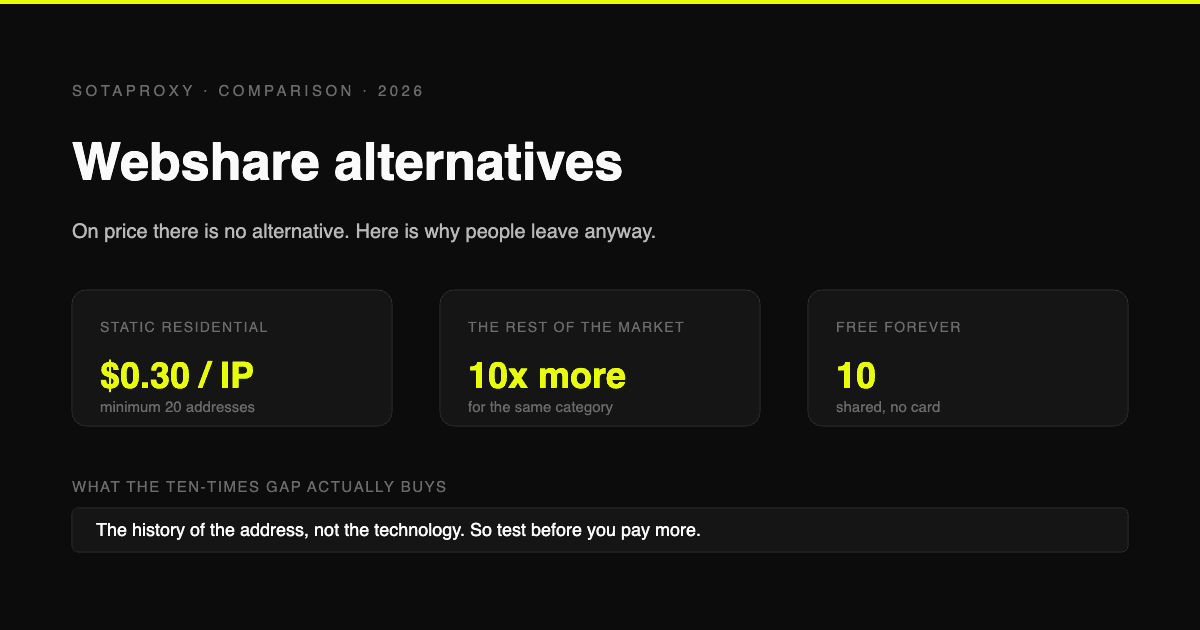
Webshare Alternatives in 2026: When the Cheapest Proxies Stop Being Cheap
Webshare gives away 10 proxies and sells static residential at $0.30 an IP, a tenth of what most vendors charge. Verified prices, the four reasons people still leave, and the one reason to stay.
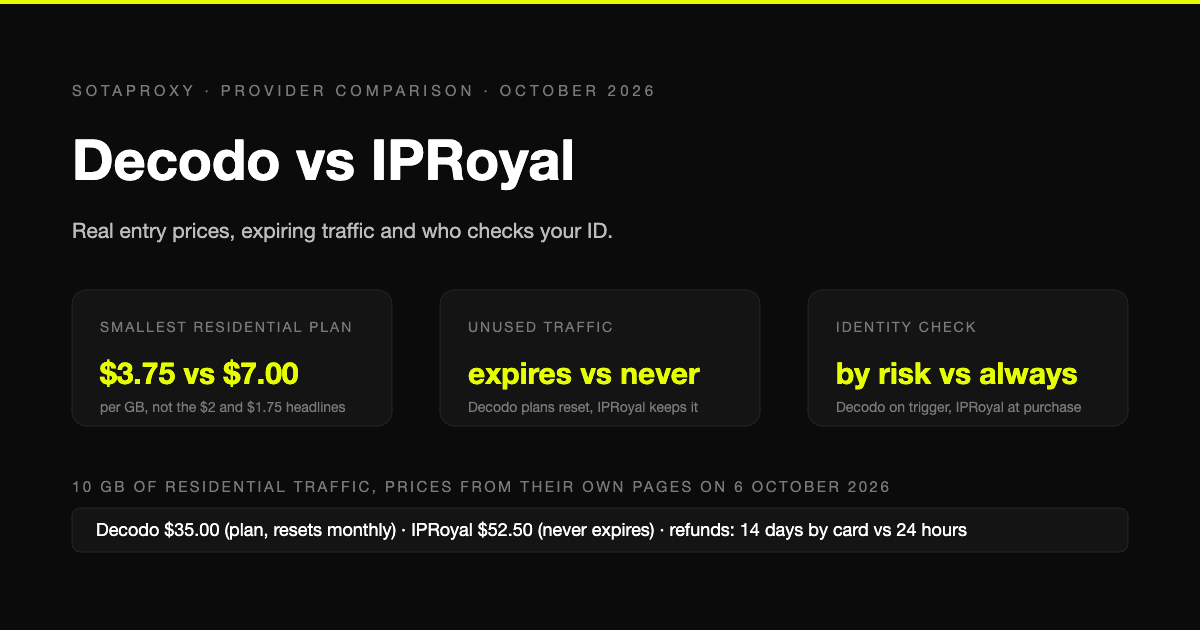
Decodo vs IPRoyal in 2026: Real Entry Prices, Expiring Traffic and Who Checks Your ID
Both are mid-market proxy vendors that take cards and crypto and sell by the gigabyte. The prices on their own pages on 6 October 2026, why neither headline rate is an entry price, whose traffic expires, who checks your identity before you can buy, and who gives money back.
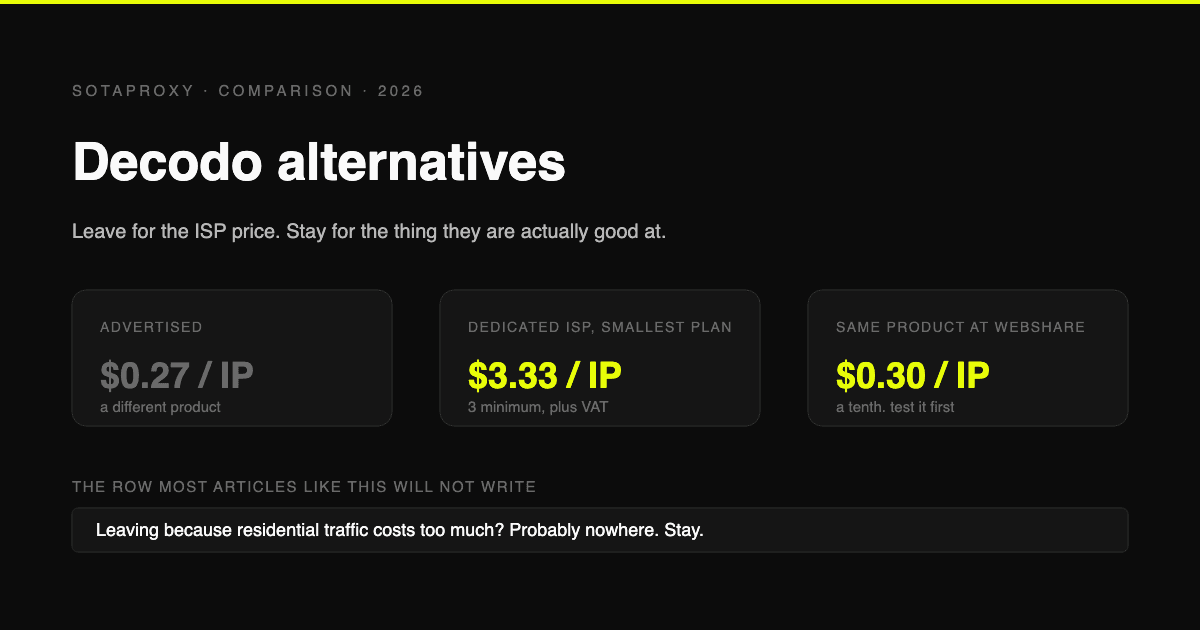
Decodo Alternatives in 2026: Who to Move to, and Who Not to Bother
Decodo is the cost leader on rotating residential and one of the pricier options on dedicated ISP. Verified prices for both, the reasons people actually leave, and which alternative fits each one.
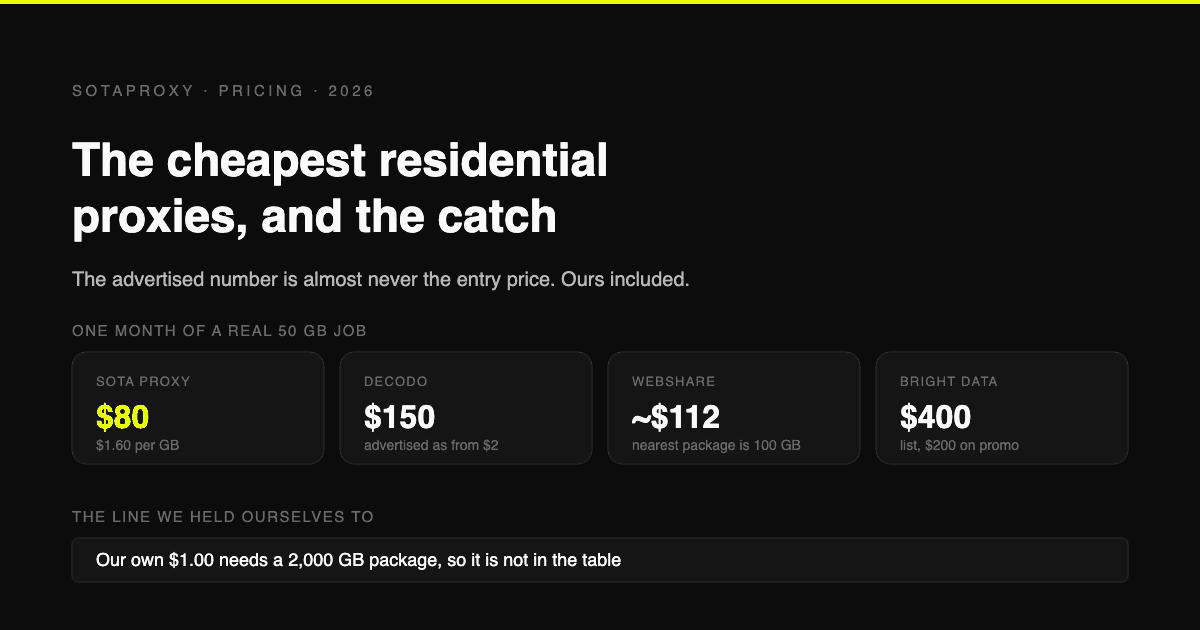
The Cheapest Residential Proxies in 2026, With the Catch Each One Hides
Verified per-gigabyte prices from five vendors' own pages, not from last year's blog posts. Why the advertised number is almost never the entry price, which providers put a monthly floor under your bill, and how to work out your real cost per gigabyte.
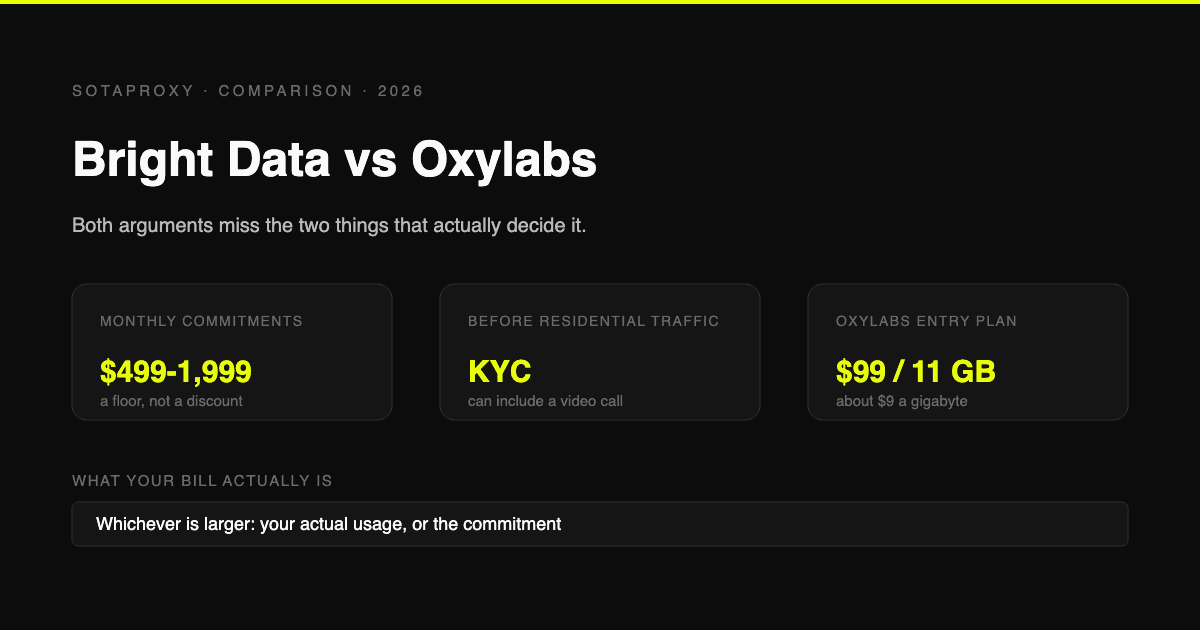
Bright Data vs Oxylabs in 2026: Prices, Commitments and the KYC Nobody Mentions
Both are enterprise platforms with minimum monthly commitments and a compliance check before you can touch residential traffic. Current prices from both vendors' own pages, what the commitment actually costs if you underuse it, and who each one is genuinely for.
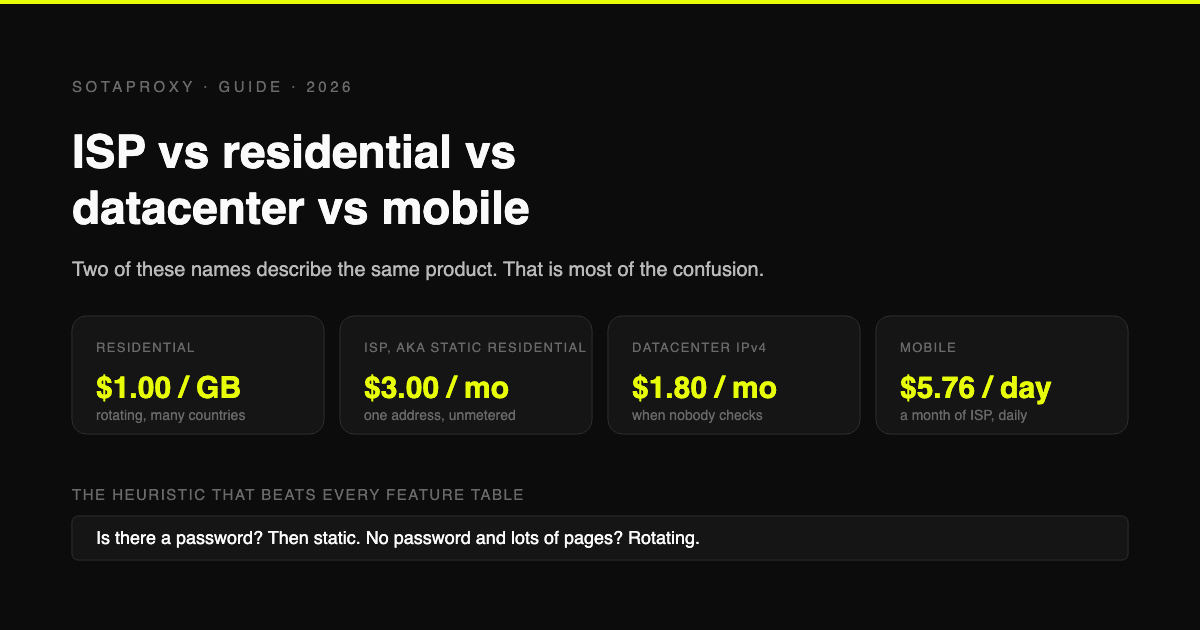
ISP vs Residential vs Datacenter vs Mobile Proxies: Which One You Actually Need
Static residential and ISP are the same product under two names, which is why half these comparisons compare a thing to itself. What each type is, what it costs per unit, and the one task each is genuinely best at.