10 Best Rotating Proxies for 2026: A Technical Review
Find the best rotating proxies for scraping, ad arbitrage, and account farming. Compare 10 top providers on speed, reliability, and pricing for 2026.

Constant bans usually don't come from "bad proxies" alone. They come from bad matching between IP type, rotation window, session behavior, and the target you're hitting. If you're running Facebook and TikTok ad accounts inside AdsPower or Multilogin, farming accounts in Dolphin Anty or Hidemyacc, testing cloaks, or pushing geo-targeted campaigns across multiple regions, the wrong rotation strategy burns accounts fast.
The market growth tells you this isn't a niche tooling layer anymore. The global rotating residential proxies market was valued at $1.47 billion in 2025 and is projected to reach $5.0 billion by 2035, with a 13.1% CAGR, according to Wise Guy Reports on the rotating residential proxies market. Operators are buying more proxy infrastructure because anti-bot systems, ad platforms, and regional content controls keep getting stricter.
Residential, mobile, datacenter, and IPv6 each solve different problems. Residential proxies use consumer ISP IPs and hold trust better on strict targets. Mobile proxies can help when mobile carrier reputation matters. Datacenter proxies are usually cheaper and faster for blunt-force scraping, but many targets flag them faster. IPv6 can be useful where targets accept it cleanly, but it won't save weak browser fingerprints or poor session design.
This guide gets to the list fast. It also stays practical. The focus is what works for ad arbitrage, account farming, cloaking, and scraping workflows. Rotation control matters. Sticky sessions matter. AdsPower and GoLogin compatibility matters. So does how clean the pool feels when you're pushing Facebook Business Manager, TikTok Ads, ecommerce logins, and geo-locked landing pages.
Table of Contents
- 1. Sota Proxy
- 2. Bright Data
- 3. Oxylabs
- 4. Decodo formerly Smartproxy
- 5. SOAX
- 6. NetNut
- 7. Rayobyte
- 8. PacketStream
- 9. IPRoyal
- 10. Live Proxies
- Top 10 Rotating Proxies Comparison
- Your Proxy Stack Is a Strategic Asset
1. Sota Proxy
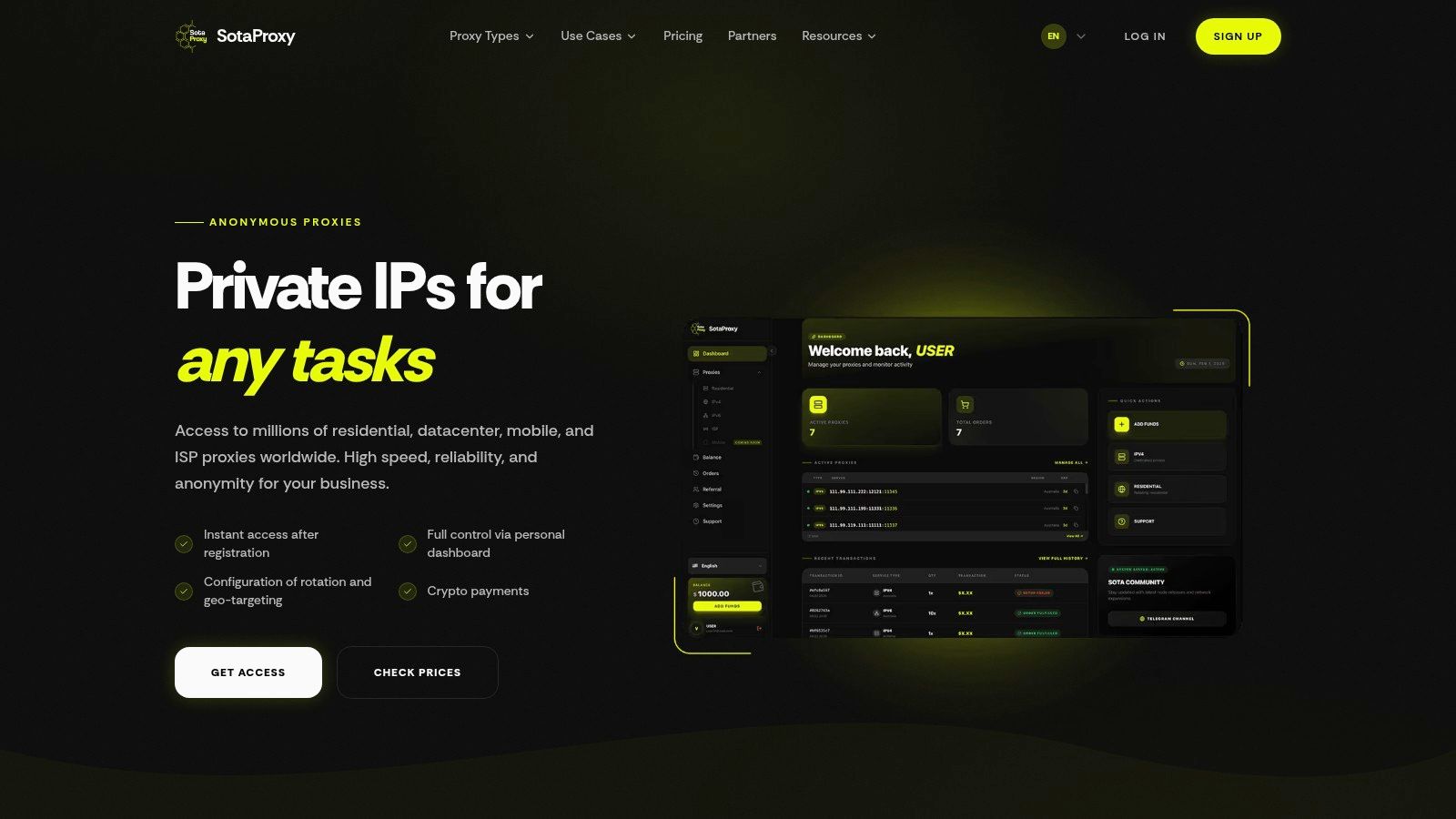
A media buyer launches a fresh batch of profiles in Multilogin, pushes traffic to region-matched landing pages, and starts seeing logins fail on one country pool before spend even ramps. That is the true test for a rotating proxy provider. Pool trust, session stability, and geo accuracy matter more than dashboard polish.
Sota Proxy is built for that kind of workload. It covers residential, mobile, ISP, and datacenter proxies across a wide location spread, which gives operators room to separate account groups by traffic source, offer, and target market. For AdsPower, GoLogin, Dolphin Anty, and Multilogin setups, that means you can keep one proxy class per profile cluster instead of improvising account by account.
The useful part is the control surface. You can choose proxy type, city targeting, rotating or sticky sessions, IPv4 or IPv6, unlimited bandwidth plans, and dedicated IPs. Those options affect outcome directly. A long-lived ISP session behaves differently from a mobile rotation on ad review flows, and a residential pool for warm-up is rarely the same pool you want for high-frequency scraping.
Why operators pick it
Operators pick Sota Proxy because it fits mixed-use stacks without forcing one traffic model across everything. Social account teams can assign cleaner residential or mobile IPs to login-sensitive profiles, while scraping or monitoring jobs can sit on cheaper pools with different rotation rules. That separation reduces collateral damage when one workload gets noisy.
I also like that the platform is easy to fund and monitor. Fast top-ups matter when a buyer needs to restore capacity mid-run. Real-time usage visibility matters when one team is burning traffic on cloaked page checks and another is using the same balance for SERP collection or ad verification.
A practical rule applies here. Standardize one proxy type per account group. If a Facebook farm starts on residential, keep it on residential unless the target flow clearly rewards mobile behavior.
For teams comparing premium providers before they scale, the Sota Proxy vs Oxylabs comparison is a useful reference point because the split usually comes down to control, pricing friction, and how much hand-holding your operation needs.
Where it fits best
Sota Proxy fits best in operations that do not run one clean use case. Ad arbitrage teams often need residential pools for account work, mobile IPs for stricter mobile-facing checks, ISP proxies for longer sessions, and datacenter capacity for lower-risk collection jobs. Keeping those under one vendor can simplify browser profile management and reduce configuration mistakes.
The glossary page on how a rotating proxy works is also useful for newer team members who need to align session rotation with browser persistence and cookie strategy.
The trade-offs are clear.
- Best strengths: Broad proxy mix, city targeting, sticky and rotating sessions, IPv4 and IPv6 support, unlimited bandwidth options, dedicated IP availability, and round-the-clock support.
- Main drawback: Public pricing lacks enough detail to model exact regional costs or bulk economics before talking to sales.
- Real-world caution: Fair-use controls usually help preserve pool quality, but high-intensity cloaking, sneaker traffic, or aggressive automation may need prior approval before you scale volume.
There is also a business-side angle for agencies and consultants. If you build browser and proxy stacks for clients, the affiliate program can offset part of your infrastructure cost. That matters less for solo buyers and more for operators managing repeat deployments.
2. Bright Data
A campaign starts burning at 2 a.m. Country targeting looks right, the browser fingerprints are clean, and account warmup was handled properly. The problem is the proxy layer. Rotation is too aggressive for one flow, not aggressive enough for another, and the provider gives you little control over how traffic is routed. Bright Data is built for operators who want to tune that layer instead of working around it.
Bright Data covers residential, mobile, ISP, and datacenter proxies through Bright Data. The main reason experienced teams keep it in the shortlist is Proxy Manager. It gives technical operators a local control point for session persistence, routing rules, retries, and traffic segmentation. That matters when the same stack has to support ad verification, account creation, localized storefront checks, and scraping jobs with different tolerance for blocks.
It also fits well with AdsPower and Multilogin setups. Teams can keep browser profiles stable while handling more of the rotation logic outside the browser, which reduces profile-level rework when session behavior needs to change. For multi-account farming and cloaking flows, that separation is useful.
The trade-off is operational and financial. Bright Data is rarely the provider I would hand to a small team that just needs a simple rotating endpoint and predictable billing. It makes more sense when your operation is large enough to use the controls, split traffic by use case, and justify the extra setup overhead. Otherwise, the dashboard, packaging, and pricing model can feel heavier than the job requires.
If you are weighing control against simplicity, this Bright Data vs Smartproxy comparison is a practical reference point.
Bright Data is a strong technical option for high-stakes campaigns. The question is whether your team will use the extra control, or just pay for it.
3. Oxylabs
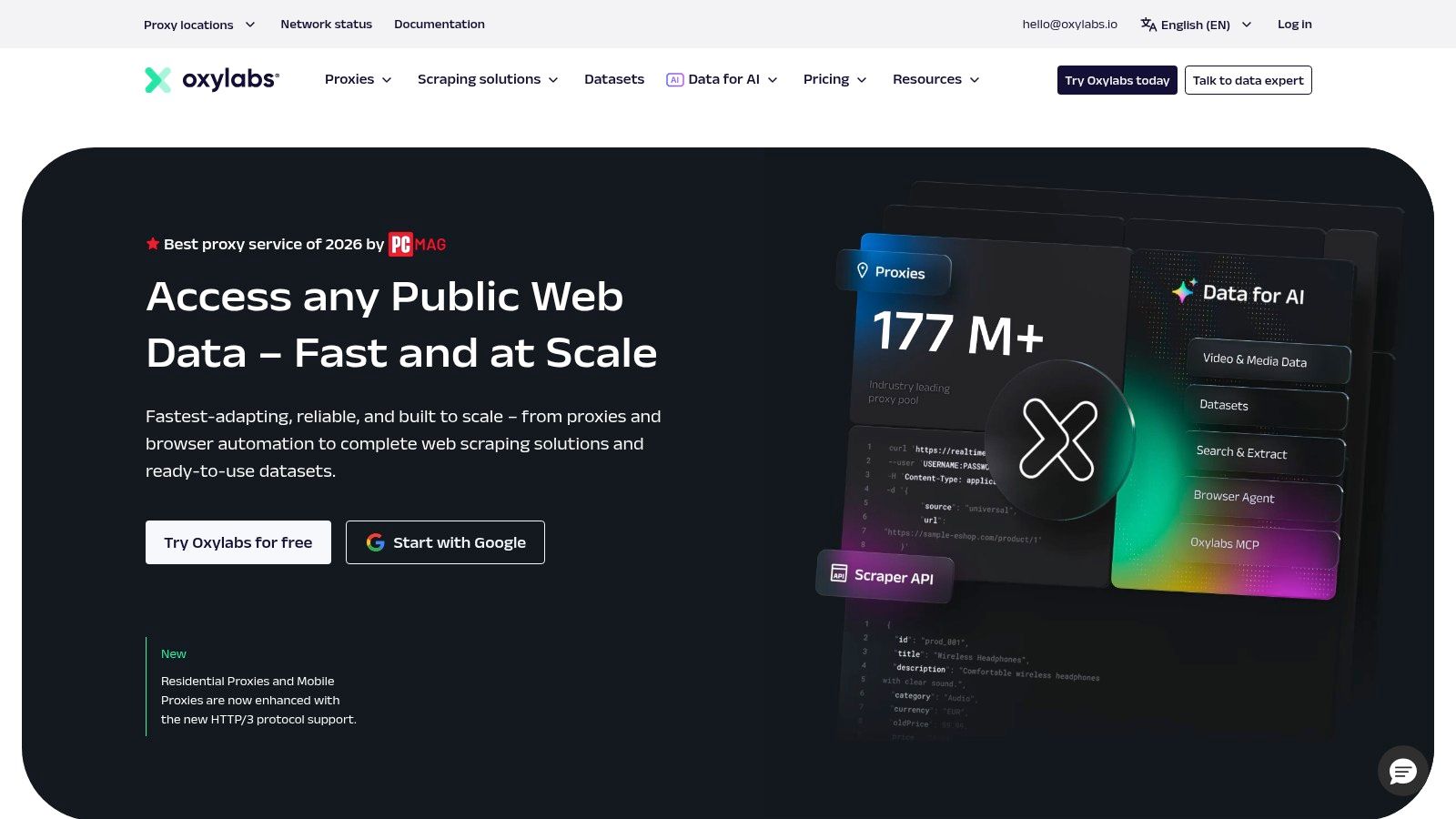
Oxylabs stays near the top of any serious best rotating proxies list because the network is built for scale and precision. Top-tier enterprise rotating proxy providers like Oxylabs support over 175 million rotating residential IPs worldwide, with per-request rotation and sticky sessions up to 10 minutes, plus country, city, ZIP, and ASN targeting, according to IPRoyal's review of rotating proxy providers. That mix is strong for ad verification, market monitoring, and regional testing where broad country targeting isn't enough.
For operators, the primary value isn't the headline pool size. It's the fact that Oxylabs combines request-level rotation, session stability, and detailed targeting without forcing workarounds. If you're assigning separate city-level pools to TikTok accounts in GoLogin or testing regional ad delivery paths through Multilogin, that control is useful.
Rotation control that matters
Oxylabs works best when your team can use the extra granularity. Smaller buyers often overpay for capability they won't touch. Larger teams benefit more because they can split traffic by target, workflow, and browser profile instead of buying one generic residential endpoint and hoping it holds.
There is one operational caveat that deserves attention. The sticky-session-versus-rotation problem is real in ad arbitrage and account farming. NetDash's rotating proxies analysis points out that modern anti-bot systems often push teams toward a hybrid model where some continuity is preserved inside a short session window, rather than choosing pure static behavior or pure per-request rotation.
That matches what many operators already see on Facebook and TikTok. Full rotation can break continuity. Long static sessions can create pattern risk.
For direct vendor comparison, Sota Proxy compared with Oxylabs is a useful reference when you're deciding between enterprise depth and a more direct infrastructure play.
4. Decodo formerly Smartproxy
Decodo, formerly Smartproxy, stays popular because it doesn't make basic deployment harder than it needs to be. Through Decodo, you get rotating residential and mobile proxies with self-serve setup, clear plan structure, and enough session control for common media buying and scraping jobs. That's why it shows up in a lot of agency stacks and solo buyer setups using AdsPower or Dolphin Anty.
You don't buy Decodo for prestige. You buy it because onboarding is fast, the dashboard is approachable, and the product is easier to trial than some enterprise-first competitors.
Why it stays popular
The strongest fit is mid-market work. That includes geo-targeted campaign checks, account creation batches, ecommerce monitoring, and lighter cloaking operations where you still need a clean pool but don't want a heavyweight procurement process. Request-based rotation and sticky sessions are there, which is enough for many Facebook and TikTok account flows.
The main trade-off is economic, not functional. Lower-volume usage can still get expensive if you're not careful with bandwidth. Teams that scale aggressively usually need to watch plan thresholds and route the easiest traffic to cheaper pools.
If you're weighing it against a leaner alternative, Sota Proxy compared with Smartproxy is the useful angle. Decodo wins on familiar self-serve polish. Sota Proxy is more compelling if you want broader proxy types and a more infra-oriented setup.
5. SOAX
SOAX is one of the better options when fixed defaults keep getting in your way. Through SOAX, you can switch between residential, mobile, ISP, and datacenter proxies while keeping a shared wallet and rotation-focused workflow. That modularity is useful if you're juggling ad account operations, local SERP checks, and target reconnaissance from one account.
For technical users, custom interval control is the draw. Some workflows need per-request rotation. Others need a short sticky window. Others need longer continuity because the browser session, cookie age, and page path matter more than raw IP freshness.
When custom intervals matter
SOAX's approach allows it to separate itself from providers with rigid timing. The cost of rotation speed isn't talked about enough. DesignRush's rotating proxies trends analysis notes that per-request rotation can increase latency compared with time-based rotation, while newer trends lean toward customizable TTL windows. That trade-off matters for high-frequency scraping, ad verification, and account operations where speed and continuity fight each other.
If you're logging into Facebook or TikTok ad accounts through Multilogin or GoLogin, a too-aggressive rotation schedule can create more suspicion, not less. If you're scraping broad product catalogs, the same aggressive rotation might be exactly what you need. SOAX gives useful room in the middle.
Use custom intervals when the target punishes both repetition and abrupt identity changes. That's common in cloaking checks and account warming, not just scraping.
6. NetNut
NetNut is usually considered when teams want residential and mobile coverage but care a lot about routing stability. Through NetNut, the pitch centers on ISP-backbone delivery, state and city targeting, dashboard analytics, and unlimited concurrency across multiple product lines. For larger scraping jobs and distributed browser farms, that can be attractive.
It also fits operators who don't want to maintain separate vendors for rotating residential, static residential, and datacenter. One account can cover most of the stack.
Operational trade-off
NetNut tends to make more sense once your traffic is already substantial. If you're running a few Facebook profiles, a few TikTok ad accounts, and some light geo-targeted checks, it's often more infrastructure than you need. If you're splitting traffic across multiple antidetect browsers and account cohorts, the product is easier to justify.
One broader market point matters here. The global rotating proxy solution market stood at $0.56 billion in 2024 and expanded to $0.62 billion in 2025, according to Business Research Insights on rotating proxy solutions. That steady growth tracks with what operators already see. More teams now treat rotating proxies as a core operating layer, not a side purchase.
NetNut fits that maturing buyer. It isn't the simplest starting point, but it can be a strong consolidation choice once workflows spread across scraping, ad verification, and multi-account management.
7. Rayobyte
Rayobyte is the reminder that residential isn't always the right answer. Through Rayobyte, rotating datacenter proxies remain a practical option for fast, cost-sensitive scraping where trust pressure is moderate and throughput matters more than stealth. If you're pulling public pages, indexing broad result sets, or testing parsers, datacenter still has a place.
That distinction matters because operators often overuse residential pools on jobs that don't need them. Then they complain about cost before they fix the workflow.
Where datacenter still wins
Rotating residential proxies use consumer ISP addresses, which helps with trust and geo restrictions, while rotating datacenter proxies come from server infrastructure and are manually rotated through provider pools. Live Proxies' explanation of rotating proxy types makes that distinction clearly. In practice, residential wins on difficult targets. Datacenter wins on speed and budget when the target isn't aggressively reputation-based.
For account farming, Facebook ad accounts, TikTok profiles, and cloaking checks, I wouldn't default to datacenter. For broad reconnaissance, feed collection, and lower-risk scraping, it can be the efficient choice. That's where Rayobyte makes sense.
The biggest weakness is control granularity. Some operators want finer rotation tuning than a simpler datacenter-oriented setup provides. If your browser sessions need tightly managed continuity, residential or ISP options usually fit better.
8. PacketStream
PacketStream is the budget choice people try when cost pressure is stronger than control requirements. Through PacketStream, you get a peer-to-peer residential network with automatic rotation, simple usage tracking, and an easy entry point for non-sensitive jobs. If you're doing basic price tracking, low-intensity scraping, or rough geo checks, that can be enough.
That said, cheap residential usually comes with more variance. The pool can feel uneven across regions and targets, which matters if you're pushing fragile account workflows.
Cheap has a cost
PacketStream works best when the target is forgiving and the operation doesn't depend on highly curated IP reputation. I wouldn't make it the core layer for Facebook or TikTok ad account fleets inside AdsPower or Hidemyacc. I also wouldn't lean on it for account farming where consistency matters over long runs.
Rotating proxies route traffic through a backconnect server that handles dynamic IP assignment and load balancing, and they're often billed by bandwidth rather than per IP, as explained in Byteful's comparison of static, sticky, and rotating proxies. PacketStream is a straightforward example of that model. You get easy rotation. You give up some control and curation.
If price is the first filter, isolate PacketStream to disposable tasks. Don't make it responsible for account health.
9. IPRoyal
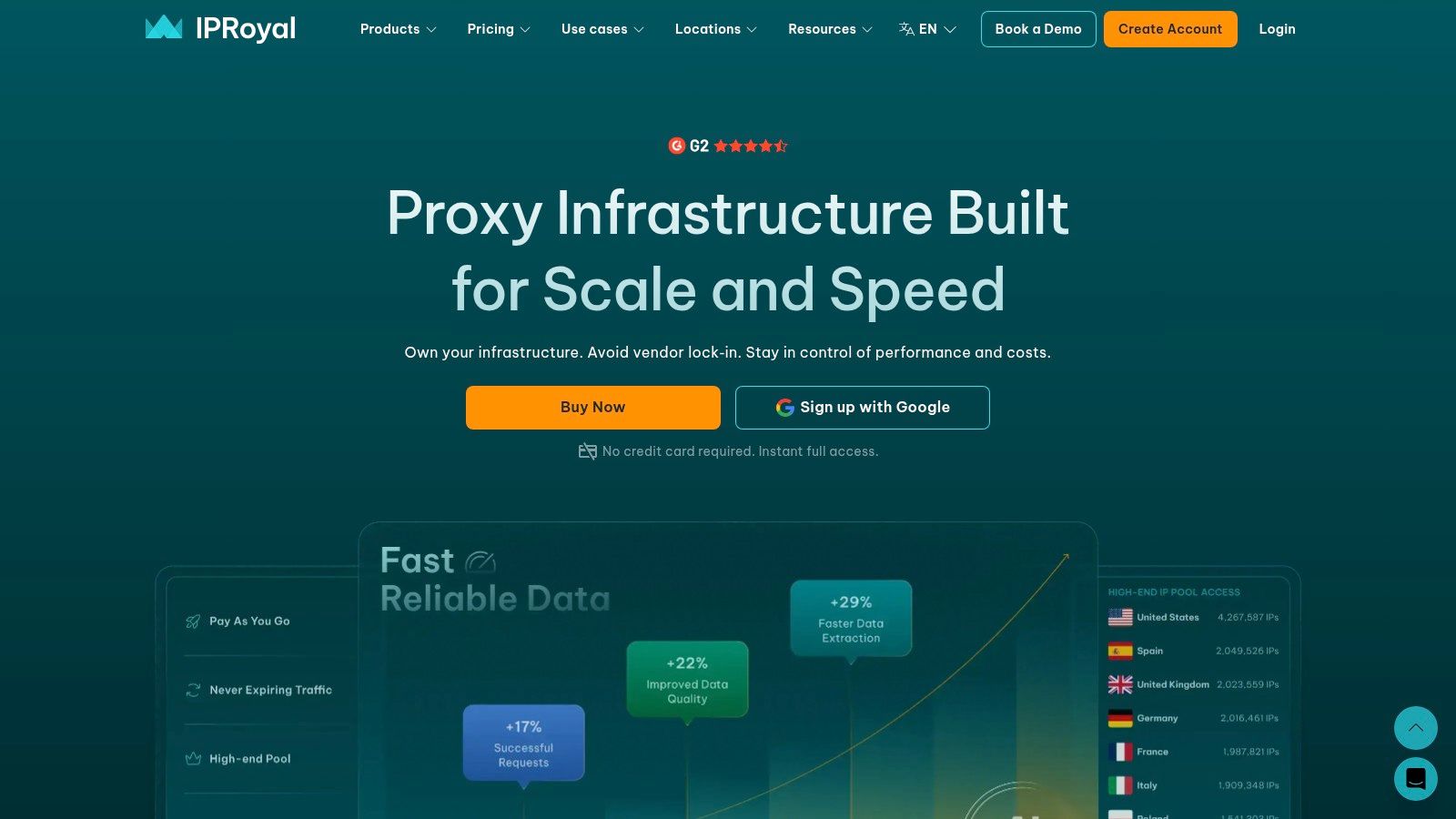
IPRoyal is a flexible middle-ground provider. Through IPRoyal, you can buy residential, mobile, ISP, and datacenter proxies from one account, use sticky sessions, and set timed auto-rotation. That's useful when you want one vendor for scraping, social automation, geo checks, and browser-based account work without going fully enterprise.
The product also does a decent job speaking to sourcing and ethics, which isn't just branding. Cleaner sourcing usually shows up downstream as fewer ugly surprises on difficult targets.
Best fit
IPRoyal makes the most sense for smaller teams and independent operators who still need real control. If you're managing Facebook and TikTok accounts in GoLogin or Multilogin, timed auto-rotation and sticky sessions are usually more important than oversized enterprise tooling. It also helps that you can move between proxy types without rebuilding your whole stack.
The market backdrop reinforces why providers like this keep gaining traction. The global rotating Proxy Service Market is projected to reach $16,337.5 million by 2030 with a 24.6% CAGR, according to MetaStat Insight's rotating proxy service market report. Demand is rising because operators need anonymous browsing, ad verification, and price scraping at scale.
For side-by-side buying decisions, Sota Proxy compared with IPRoyal is a practical comparison. IPRoyal is often a good entry point. Sota Proxy is stronger when you want a broader operator-centric infrastructure layer with city-level routing and mixed proxy inventory.
10. Live Proxies
Live Proxies is focused and practical. Through Live Proxies, the product centers on rotating residential and rotating mobile proxies, plus a dashboard that's easier to deploy quickly than many bulkier alternatives. If you need to bring up mobile and residential traffic fast for account workflows, that's a real advantage.
This is especially relevant for operators handling account farming, mobile-facing offers, and geo-targeted ad delivery where carrier or consumer-network appearance matters more than broad enterprise tooling.
What stands out
Live Proxies also highlights the key technical distinction many buyers blur. Residential IPs come from real consumer devices on ISP networks, while datacenter IPs come from data center servers. OloStep's explanation of residential and rotating proxies also clarifies that "rotating" refers to routing behavior, while "residential" refers to IP origin. That's the right mental model when you're deciding between residential, mobile, datacenter, or IPv6 options.
Use mobile when mobile reputation or carrier identity matters. Use residential for high-trust browser workflows and geo-locked checks. Use datacenter when speed and cost matter more than reputation. Use IPv6 only where the target and tooling support it cleanly.
One more practical note comes from earlier provider coverage. Some vendors now offer longer sticky windows and broad protocol support for persistent tasks, which is helpful for testing and account management. Live Proxies fits well when you specifically need rotating mobile alongside residential and don't want extra product sprawl.
Top 10 Rotating Proxies Comparison
| Provider | Core features | Performance & reliability | Target audience | Pricing & value | Unique selling points |
|---|---|---|---|---|---|
| 🏆 Sota Proxy | Residential, mobile, ISP, DC; 220+ geolocations; IPv4/IPv6; rotation & sticky; dashboard | 99.9% uptime; redundant clusters; clean pools ★★★★★ | 👥 Enterprises, automation & scraping teams | 💰 Pay‑as‑you‑go; unlimited bandwidth; contact for rates | ✨ Clean IP pools, crypto top‑ups, 24/7 human support; predictable performance |
| Bright Data | Rotating resi/mobile/ISP/DC; Proxy Manager; fine geo/ASN targeting | Enterprise tooling & high success rates ★★★★★ | 👥 Large enterprises, complex geo targeting | 💰 High cost; enterprise pricing | ✨ Mature SDKs, deep geo/ASN targeting |
| Oxylabs | Large pools; city/ZIP targeting; Scraper APIs & rotation modes | Strong performance & targeting ★★★★★ | 👥 Data teams & large orgs | 💰 Premium; best value at scale | ✨ Scraper API with anti‑bot handling |
| Decodo (Smartproxy) | 100M+ resi IPs; rotation/sticky; clear plan tiers & API | Reliable mid‑market performance ★★★★ | 👥 SMBs, agencies, trials | 💰 Competitive tiers; GB commitments for best discounts | ✨ Fast onboarding, easy self‑serve plans |
| SOAX | Rotating resi/mobile/ISP/DC; custom rotation intervals; SOCKS5/HTTPS | Solid mid‑tier reliability ★★★★ | 👥 SEO, ad verification, researchers | 💰 Modular & transparent pricing | ✨ Flexible rotation timing and easy type switching |
| NetNut | ISP‑backbone routing; rotating/static resi; mobile products | High success rates; unlimited concurrency ★★★★ | 👥 Volume buyers, enterprises | 💰 Competitive at higher tiers | ✨ ISP‑backbone + unlimited connections |
| Rayobyte | Rotating datacenter + resi/ISP mix; request‑level rotation | Very fast datacenter performance ★★★ | 👥 Cost‑sensitive scrapers & high‑speed tasks | 💰 Competitive for DC; pricing can be complex | ✨ High‑speed DC pools for load‑heavy scraping |
| PacketStream | Peer‑to‑peer residential; flat per‑GB; auto rotation | Budget option; variable pool quality ★★★ | 👥 Small teams, basic scraping & tracking | 💰 Very low per‑GB; easy entry | ✨ Simple metered pricing and full‑network access |
| IPRoyal | Resi/mobile/ISP/DC; auto‑rotation timers; sticky sessions | Flexible entry; variable consistency ★★★★ | 👥 SMBs, social/account workflows | 💰 Aggressive pricing for small plans | ✨ Public sourcing/ethics docs; flexible pay‑as‑you‑go |
| Live Proxies | Rotating resi & mobile; dashboard analytics; rotation policies | Easy, quick setup; mid performance ★★★ | 👥 Users needing rapid deployment & mobile | 💰 Mid‑tier; inventory can sell out | ✨ Streamlined plans for fast deployment |
Your Proxy Stack Is a Strategic Asset
A proxy failure rarely starts with a hard outage. It starts when moderation rates climb, logins get challenged, a warm account loses trust after an IP swap, or a scraper that worked yesterday suddenly burns through retries. In ad arbitrage, account farming, and cloaking workflows, the proxy layer sits close to the money. It affects block rates, account survival, geo fidelity, and how much manual cleanup your team does after a bad run.
Operators still make the same purchasing mistake. They buy on pool size, advertised coverage, or the cheapest entry plan, then discover the important variables under load. Session stability. IP reputation by region. Routing consistency across sticky windows. Authentication reliability inside AdsPower, Multilogin, and similar browsers. Whether the proxy geography matches the browser profile, timezone, language, and account history.
Proxy type should map to the job.
Residential usually holds up best for trust-sensitive browser sessions, account creation, and local ad verification. Mobile earns its keep when carrier ASN and mobile traffic patterns affect review outcomes or access. Datacenter still has a clear role for high-throughput collection where speed matters more than trust. IPv6 can work, but only on targets that accept it and only when the rest of the fingerprint stack is configured to match.
Rotation policy decides whether a good pool performs well or falls apart in practice. Per-request rotation fits broad scraping and single-hit fetches. Sticky sessions fit login flows, cart actions, and account maintenance. Many operators need something between those two modes. Enough continuity for cookies, session tokens, and browser state to stay coherent, but enough movement to avoid repetitive patterns that trigger reviews.
That is why provider comparisons should focus on field performance, not brochure language. A large network means little if one target blocks half the pool, if city targeting is inconsistent, or if sticky sessions drift mid-task. For high-risk use cases, the benchmark is simple. Lower block rates, stable sessions, predictable geo behavior, and fewer workarounds in the browser stack.
Browser setup matters just as much. Keep one proxy logic per account cohort. Match locale, timezone, DNS behavior, and WebRTC posture to the IP region. Do not warm a Facebook profile on residential in one city, then run spend through mobile in another state and expect stable review behavior. The same rule applies in AdsPower, Multilogin, GoLogin, and Dolphin Anty. Consistency preserves trust longer than constant IP movement.
Single-vendor setups are easy to manage, but mixed stacks usually perform better. A primary residential provider, a fallback pool for target-specific failures, and a separate datacenter source for lower-risk collection gives you room to reroute traffic without rewriting the whole workflow. It also makes testing cleaner. You can compare block rates by target and use case instead of relying on provider claims.
Sota Proxy is a practical fit for teams that want fewer moving parts without giving up control. Having residential, mobile, ISP, and datacenter options in one dashboard is useful when the same operation runs browser automation, geo checks, and scraping side by side. City-level targeting, sticky controls, and rotation options matter more than raw inventory counts once you are optimizing for account longevity and clean session behavior. Support also matters at this stage. Technical teams notice the difference when a provider can help diagnose a bad region or a failing auth pattern instead of pointing back to generic docs.
There is also a business case for consultants and infrastructure resellers. If you already recommend proxy and antidetect setups to buyers, agencies, or account operators, Sota Proxy's affiliate program can add revenue to work you are already doing. That is relevant for service operators, not casual users, but it can make sense if proxy selection is already part of your delivery.
Keep testing against your own targets and workflows. The providers above can all fit somewhere. The better choice is the one that holds session integrity, keeps block rates under control, and integrates cleanly with the browser and automation stack you already run.
If you're building a proxy stack for ad arbitrage, account farming, cloaking, or multi-account browser automation, start with Sota Proxy. It gives you residential, mobile, ISP, and datacenter options in one place, supports city-level targeting and sticky or rotating sessions, and fits cleanly into AdsPower, Multilogin, GoLogin, Dolphin Anty, and Hidemyacc workflows.
Related articles

10 Smartproxy Alternatives for Technical Teams
Compare 10 smartproxy alternatives by proxy type, IP quality, targeting, rotation, speed, pricing, and use case for technical teams.
10 IPRoyal Alternatives for Serious Proxy Workloads
Compare 10 IPRoyal alternatives for scraping, ad verification, account farming, antidetect browsers, geo campaigns, pricing, rotation, and support.
10 Oxylabs Alternatives for Scraping and Ad Operations
Compare 10 oxylabs alternatives by proxy type, geo coverage, uptime, rotation, pricing, and use case for scraping, ad verification, and account farming.
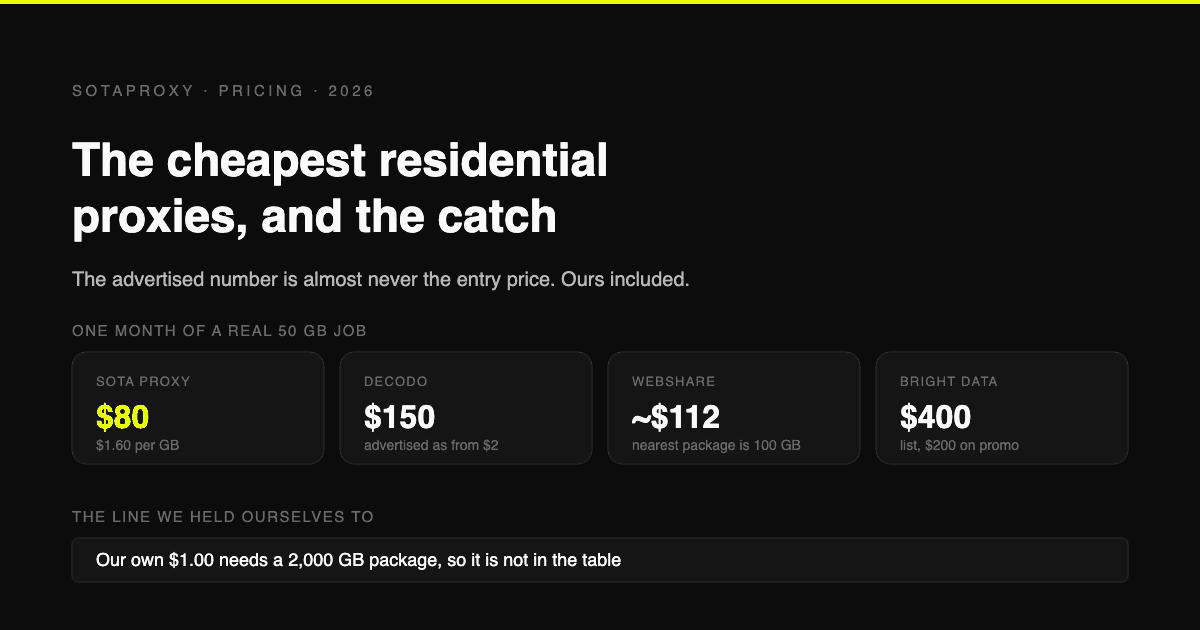
The Cheapest Residential Proxies in 2026, With the Catch Each One Hides
Verified per-gigabyte prices from five vendors' own pages, not from last year's blog posts. Why the advertised number is almost never the entry price, which providers put a monthly floor under your bill, and how to work out your real cost per gigabyte.
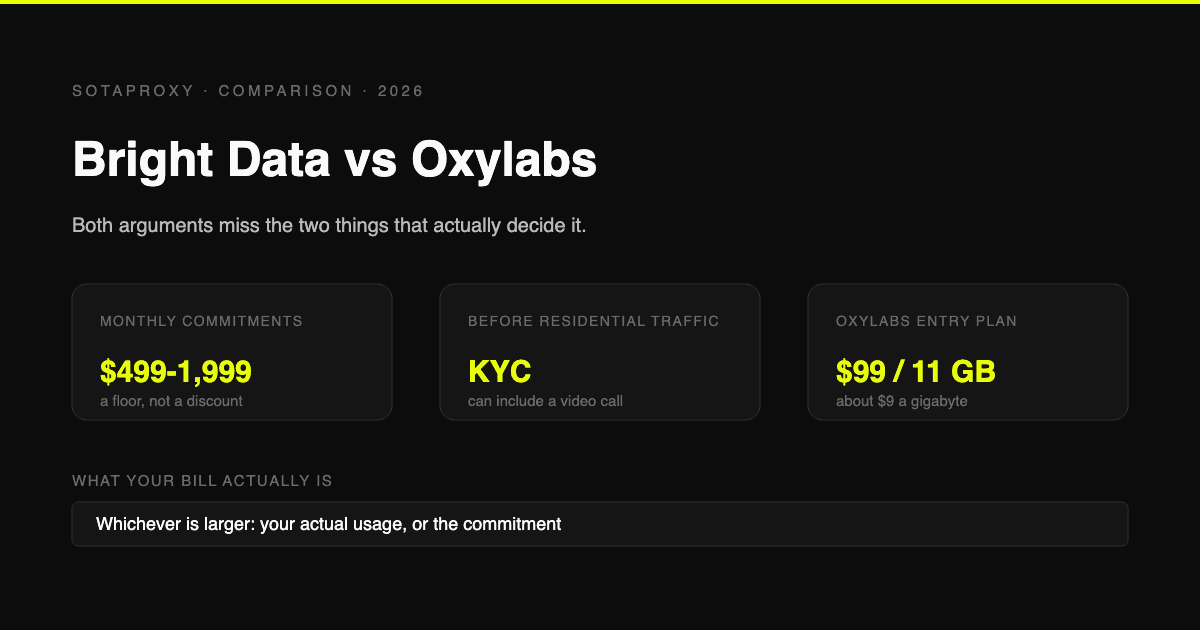
Bright Data vs Oxylabs in 2026: Prices, Commitments and the KYC Nobody Mentions
Both are enterprise platforms with minimum monthly commitments and a compliance check before you can touch residential traffic. Current prices from both vendors' own pages, what the commitment actually costs if you underuse it, and who each one is genuinely for.
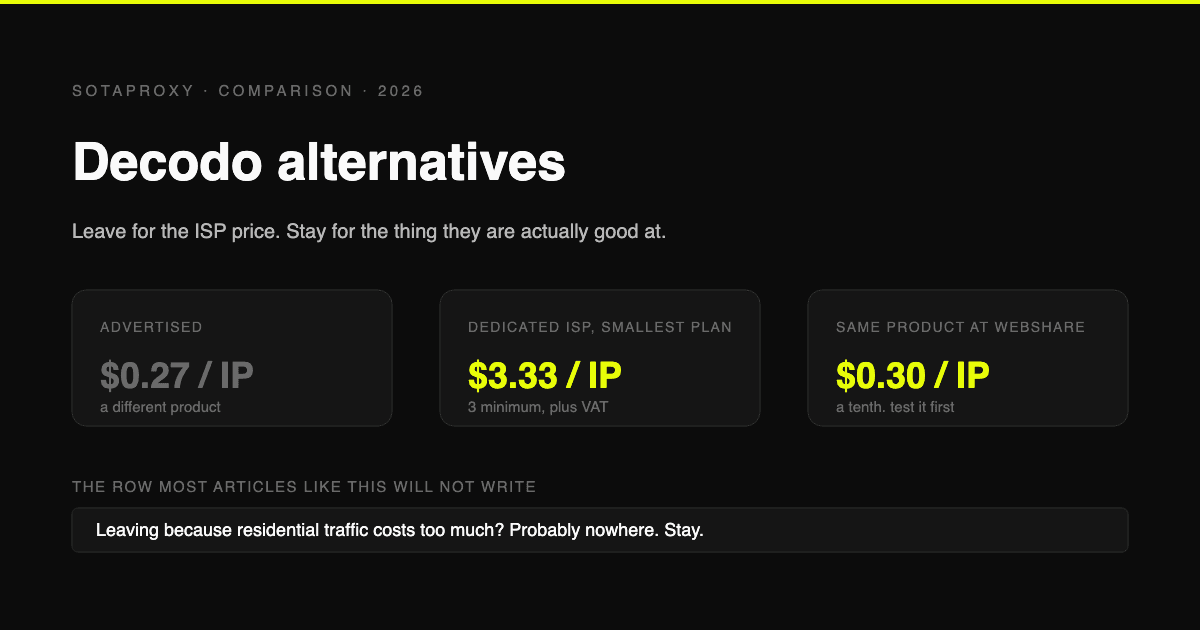
Decodo Alternatives in 2026: Who to Move to, and Who Not to Bother
Decodo is the cost leader on rotating residential and one of the pricier options on dedicated ISP. Verified prices for both, the reasons people actually leave, and which alternative fits each one.