The Cheapest Residential Proxies in 2026, With the Catch Each One Hides
Verified per-gigabyte prices from five vendors' own pages, not from last year's blog posts. Why the advertised number is almost never the entry price, which providers put a monthly floor under your bill, and how to work out your real cost per gigabyte.
Every comparison of cheap residential proxies has the same problem: it quotes numbers the vendors advertise, and the advertised number is almost never what you would pay. The habit across this entire market is to publish the floor of a volume ladder as if it were the entry price.
So before any table, the one skill that saves you money: read a per-gigabyte price as a question, not an answer. The question is "at what volume, and is there a monthly minimum?"
Prices below were taken from each vendor's own pricing pages on 27 September 2026, and where a number requires volume or a commitment, that is stated.
What a gigabyte actually costs
| Provider | Entry price per GB | Best published price | Monthly minimum |
|---|---|---|---|
| Sota Proxy | $2.00 on the 1 GB package | $1.00, but only on the 2,000 GB package | None |
| Decodo | $4.00 pay as you go, $3.75 on the smallest subscription | $2.75 at 100 GB, and a $2.00 floor advertised for larger tiers | Subscription tiers |
| Webshare | $7.00 list, $3.50 on current promotion at 1 GB | $1.40 at 3,000 GB | None on the promo tiers |
| Oxylabs | about $9 effective, plans from $99 for 11 GB | from $6 advertised | Yes, plan-based |
| Bright Data | $8 list pay as you go, $4 on current promotion | $5 list at a $1,999 monthly commitment | Yes, on commitment plans |
Two of those rows carry promotions that will move. The list prices are what to plan against; the promotional price is what you might pay in month one.
We are the cheapest line in that table on the best-price column, and we are going to spend the rest of this article explaining why that alone should not decide it.
What 50 gigabytes actually costs
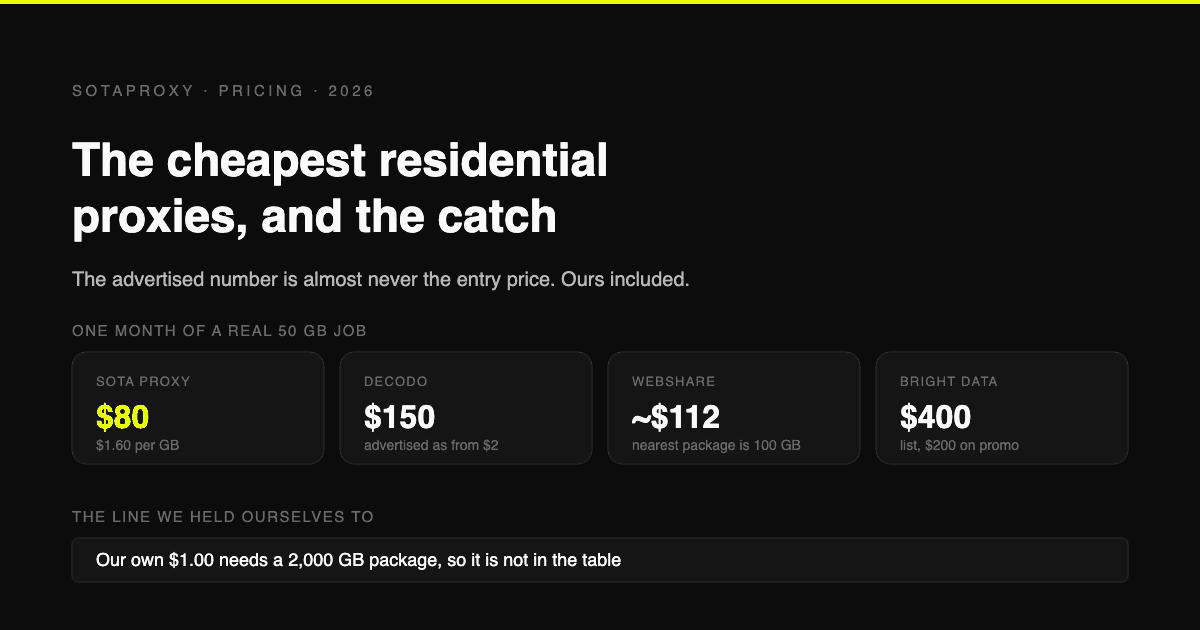
Rate cards are abstract, so here is one month of a realistic scraping job priced at every vendor. Fifty gigabytes is a working number: enough to be a real job, small enough that most people are somewhere near it.
| Provider | What you buy | Month one |
|---|---|---|
| Sota Proxy | 50 GB package at $1.60 per GB | $80 |
| Decodo | 50 GB subscription tier at $3.00 per GB | $150 |
| Webshare | promotional tier near $2.25 per GB at 100 GB | about $112 for 100 GB, the nearest package |
| Oxylabs | plan-based, $99 covers only 11 GB | several hundred, depending on the plan you must take |
| Bright Data | $8 list pay as you go, $4 on promotion | $400 list, $200 on the current promotion |
Note what changed between this table and the rate cards. Our own cheapest number, $1.00 per gigabyte, does not appear here at all, because it requires a two-thousand-gigabyte package. At fifty gigabytes we charge $1.60, and quoting you $1.00 would be exactly the thing this article is complaining about.
The same correction applies to everyone else in the table. Decodo advertises "from $2 per GB" in its navigation, and the fifty-gigabyte subscription tier is $3.00, which is the same trick from the other side of the market. Price the basket you would actually buy, at every vendor, including this one.
The three things that make a cheap price expensive
A monthly minimum turns the per-gigabyte rate into fiction. If a plan has a $99 or $499 floor and you use 10 GB, your real cost is the floor divided by 10, not the advertised rate. This is the single biggest gap between what people expect to pay and what they pay, and it is covered in detail for the two enterprise vendors in Bright Data vs Oxylabs.
A volume floor is not an entry price. "From $1.40 per GB" may require three thousand gigabytes. "From $6" may require a plan you would not buy. Divide the plan you would actually purchase by the traffic it includes.
Traffic is metered in both directions, everywhere. Your request and the response both count, headers included. A scraper pulling images and video burns the budget several times faster than one pulling HTML, which means the cheapest provider for you may be decided by what you fetch rather than by the rate card.
Work out your own number in two minutes
- Take last month's real traffic. Not the plan you hope to grow into.
- For each vendor, price the plan you would actually buy, including the monthly minimum if there is one.
- Divide by your gigabytes. That is your true rate.
- Add the cost of failures. A cheaper gigabyte that fails 20% of the time costs 25% more than its rate card says, because you pay for the retries too.
That fourth line is where price comparisons quietly stop being about price. A vendor with published third-party benchmarks is selling you a measured failure rate; a vendor without them, including us, is asking you to test it yourself.
Where cheap residential is the wrong product entirely
A large share of people searching for cheap residential traffic do not need residential traffic at all.
- If your work involves a login, you want one static address, not a rotating pool, and the economics invert: a single ISP address with unmetered traffic costs a few dollars a month, which beats per-gigabyte pricing the moment that account uses more than about two gigabytes.
- If the target does not check address class, datacenter addresses do the same job for a fraction of the price.
- If you need one country only, you are paying for a 200-country pool you will not touch.
The full decision is in ISP vs residential vs datacenter vs mobile. It is the most common way to overpay in this market, and switching product type saves more than switching vendor ever will.
The honest positions
Cheapest per gigabyte with no minimum: us, at $1.60 for a fifty-gigabyte package and $2.00 if you only buy a gigabyte to try. The $1.00 figure exists but needs a two-thousand-gigabyte package, so treat it as the bottom of the ladder rather than the price. No subscription, no monthly floor, and traffic stays on the package while it is active. What we do not have is a published third-party benchmark, a free tier, an unblocker or card payment, and those are real gaps rather than modest ones.
Cheapest at very high volume: Webshare at $1.40 per gigabyte on the three-thousand-gigabyte tier, which is a real price if you genuinely use that much and irrelevant if you do not. Their trade-offs are in Webshare alternatives.
Best measured reliability per dollar: Decodo, which independent benchmarks have repeatedly put at the top for cost efficiency on residential traffic. If your workload is large and failures are expensive, paying slightly more there is rational. See Decodo alternatives.
Not cheap, and not trying to be: Bright Data and Oxylabs. You go there for unblockers, prebuilt scrapers and datasets, and you accept a monthly commitment and a compliance check to get them.
What "unlimited bandwidth" means
It appears in this category often enough to address directly: unlimited residential bandwidth is not a thing anyone sells at a residential price.
Where you do see unmetered traffic, it is attached to a fixed address rather than a pool: ISP and datacenter proxies are billed per address per month with traffic unmetered, because one address doing heavy volume is a problem the vendor can see and cap. Rotating residential is billed per gigabyte because the traffic is bought from real connections, and that cost is real.
So if unlimited is what you are looking for, the honest answer is that you want a static address, not cheap residential.
FAQ
What is the cheapest residential proxy per GB?
It depends on the volume, which is the whole point. Our ladder runs $2.00 per gigabyte on the smallest package, $1.60 at fifty gigabytes and $1.00 only at two thousand, and Webshare reaches $1.40 at three thousand. At a realistic fifty gigabytes a month we are the cheapest of the five providers compared here at $80, but the headline floor prices you see advertised, ours included, apply to volumes most buyers never reach.
How much do residential proxies cost?
Entry prices across the market run from about $2 to $8 per gigabyte, falling to roughly $1 to $3 at volume. As a concrete example, at fifty gigabytes a month you would pay $80 with us, $150 at Decodo and $400 at Bright Data list price. The spread is wide because vendors advertise different points on their ladders: some quote the entry package, most quote the volume floor.
Why is residential traffic billed per gigabyte instead of per month?
Because the traffic runs through real consumer connections that the provider pays for. Fixed addresses like ISP and datacenter proxies are billed per address with traffic unmetered, which is why they are the cheaper choice for anything that lives on one address.
Are cheap residential proxies worth it?
It depends entirely on failure rate. A gigabyte that fails a fifth of your requests costs a quarter more than its rate card, because you pay for retries. Test on your own targets before buying volume, using the checks in how to test a proxy before you buy it.
Is there such a thing as unlimited residential bandwidth?
Not at a residential price. Unmetered traffic is sold with fixed addresses, not with rotating residential pools, because the provider is paying for that bandwidth from real connections.
What is the cheapest proxy overall?
Datacenter IPv6, at about $0.20 per address per month, but it only works on targets that accept IPv6 traffic, which many still do not. For general use, datacenter IPv4 from under $2 an address is the cheapest thing that works everywhere, provided the target does not check address class.
Схожі статті
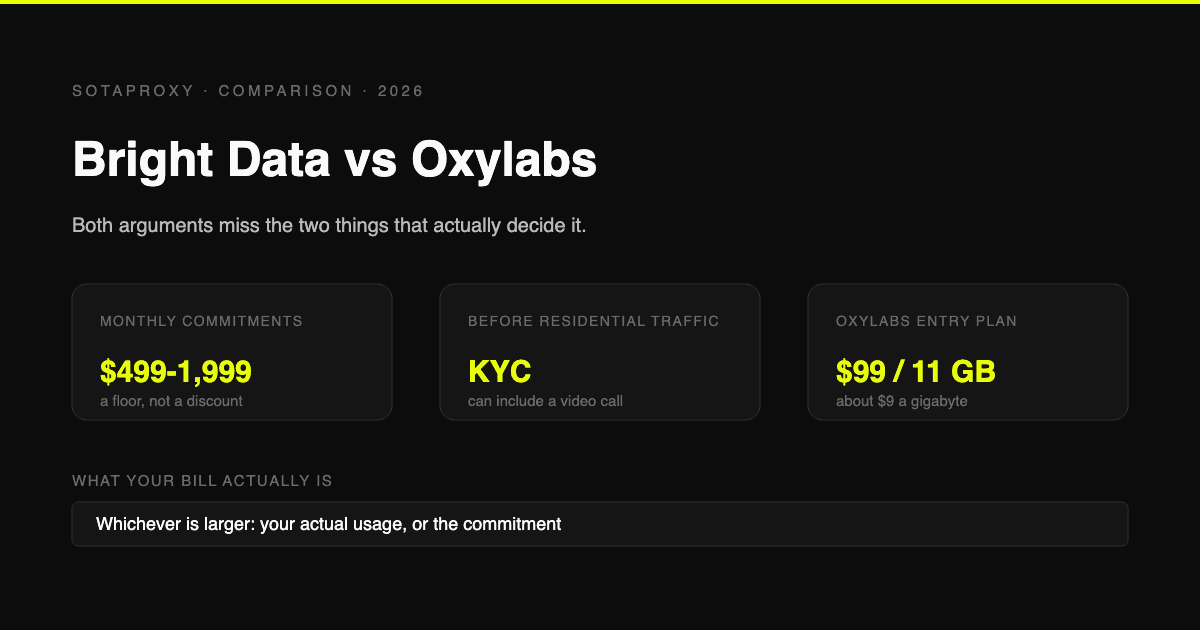
Bright Data проти Oxylabs у 2026 році: ціни, мінімальні зобов'язання та перевірка KYC, про яку мовчать
Обидві платформи орієнтовані на бізнес, вимагають мінімальних щомісячних витрат і проходження комплаєнс-перевірки перед доступом до резидентського трафіку. Актуальні ціни з офіційних сторінок провайдерів, реальна вартість зобов'язань при неповному використанні та для кого насправді підходить кожен сервіс.
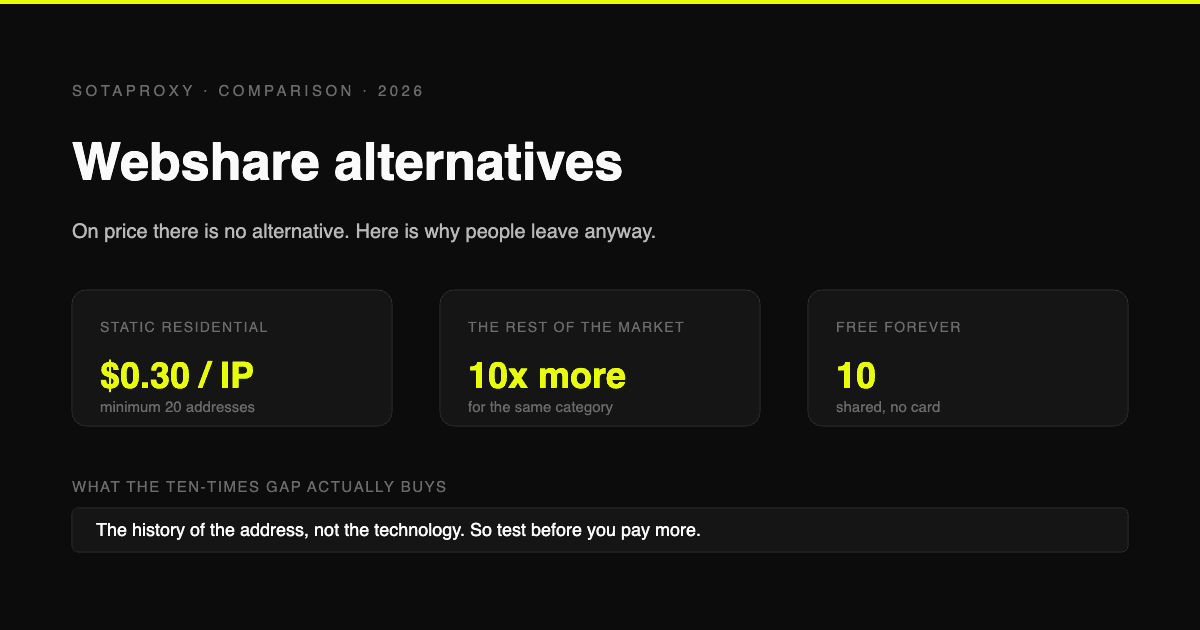
Альтернативи Webshare у 2026: коли найдешевші проксі перестають бути вигідними
Webshare роздає 10 проксі безкоштовно та продає статичні резидентські за $0,30 за IP - в десять разів дешевше більшості постачальників. Перевірені ціни, чотири причини, чому клієнти все одно йдуть, і одна вагома причина залишитися.
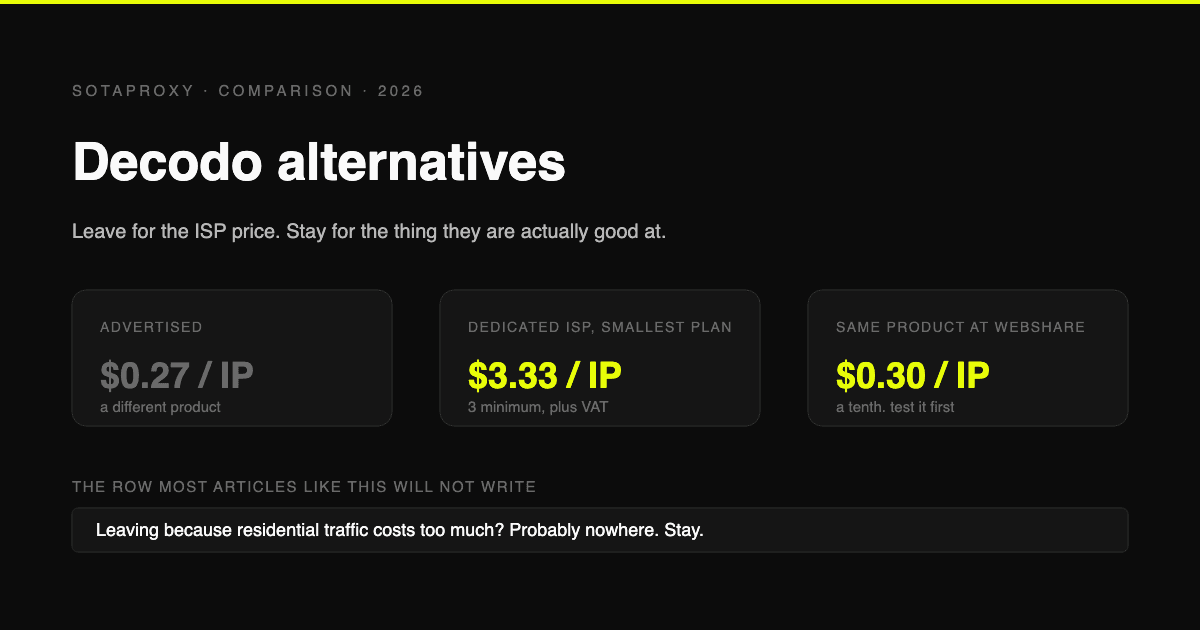
Альтернативи Decodo у 2026 році: куди переходити, а про що не варто й думати
Decodo пропонує найнижчі ціни на ротаційні residential проксі та одні з найвищих на виділені ISP. Перевірені розцінки на обидва типи, реальні причини переходу на інших провайдерів і який варіант підходить у кожному випадку.
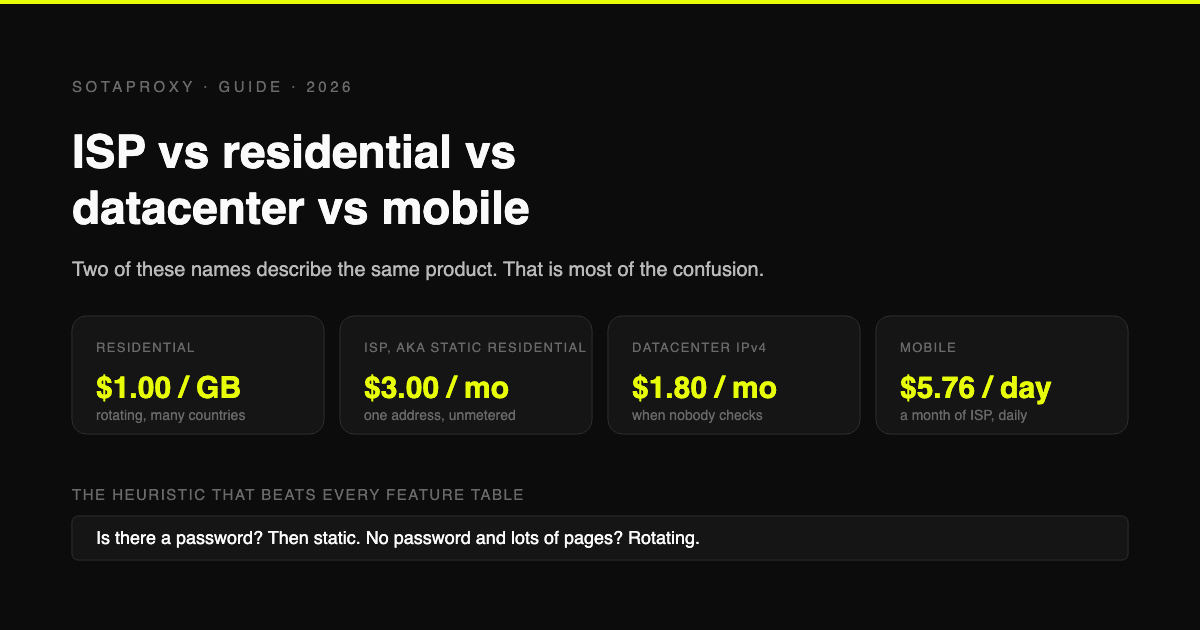
ISP, резидентні, дата-центр і мобільні проксі: який тип вам насправді потрібен
Статичні резидентні та ISP проксі - це один продукт під двома назвами, тому половина порівнянь зводиться до порівняння речі із самою собою. Розбираємо, що насправді являє собою кожен тип, скільки коштує одиниця трафіку і для якого завдання кожен із них найкраще підходить.
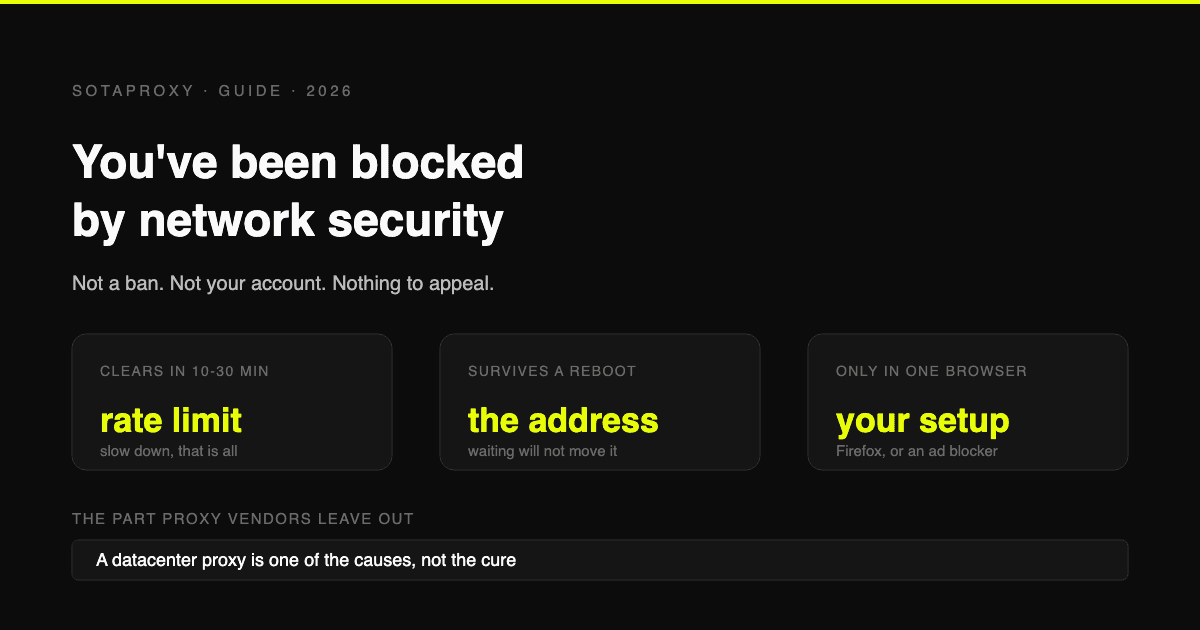
Reddit "You've Been Blocked by Network Security": кожна причина та виправлення для кожної
Це не бан, і нема чого оскаржувати. Це походить від edge-сервера Reddit, застосовується до вашого з'єднання і має шість причин. Ось як визначити, яка саме у вас, і скільки триває кожна.
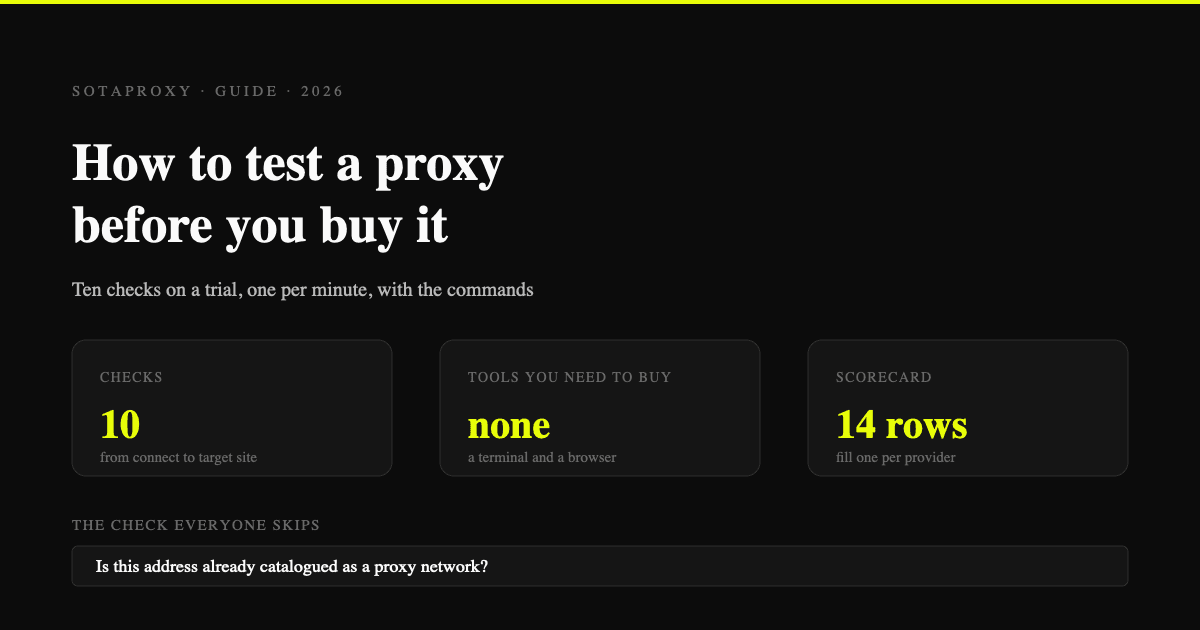
Як протестувати проксі перед покупкою: 10-хвилинний чек-лист
Десять перевірок, які підкажуть, чи варто платити за пробний період проксі: вихідний ASN, ознаки хостингу, поведінка ротації, розподіл підмереж, витоки DNS і WebRTC та показник успішності на вашій цільовій платформі.