Competitor Price Tracking: Technical Guide 2026
Build a robust competitor price tracking system. This guide covers scraping architecture, residential proxies, anti-bot evasion, and data pipelines.

You already know the pattern. A competitor changes a price on a key offer while your Facebook ad accounts and TikTok ad accounts are still pushing yesterday's angle. Your geo-targeted campaigns keep buying traffic into a page that's no longer competitive. By the time someone spots it in a report, the damage is done.
For traffic arbitrage teams, media buyers, account farmers, and multi-account operators, competitor price tracking isn't market research. It's operational telemetry. It sits next to cloaking logic, account warmup schedules, browser fingerprints in AdsPower or GoLogin, and proxy routing rules. If your stack can't observe competitor prices reliably across regions and storefront variants, you're flying blind.
Table of Contents
- Beyond Manual Checks Why You Need an Automated System
- Designing Your Price Tracking Architecture
- Proxy Infrastructure for Uninterrupted Scraping
- Scraping Logic and Advanced Anti-Bot Evasion
- Data Processing Storage and Change Detection
- Actionable Alerts Workflows and Ethical Lines
Beyond Manual Checks Why You Need an Automated System
Manual checking fails for the same reason manual account review fails. It doesn't keep up with real conditions. One person with a spreadsheet can't track dozens of SKUs, multiple storefronts, region-specific prices, promo badges, stock state, and seller changes without gaps.
That matters more when you run paid traffic aggressively. If you're farming accounts, rotating creatives, and testing cloaked flows across geos, you need current competitor data feeding those decisions. A stale price check can wreck a profitable segment faster than a weak creative.
The market has already moved past periodic checks. The e-commerce side of competitor monitoring now relies on systems that deliver daily updates and historical data so teams can benchmark against current conditions, and automated tools handle real-time collection that manual checks miss, as described by PriceShape's overview of competitor price monitoring. If you want a practical reference for that operating model, this price monitoring workflow example shows the kind of always-on setup teams deploy.
Practical rule: if a competitor can change faster than your team can recheck, manual monitoring is already broken.
Manual checks also hide regional variance. A buyer sitting in one country, one browser profile, one session state, may never see the same price your landing page visitors see. That's a serious issue for geo-targeted campaigns, ad verification, and cloaking setups where the visible storefront depends on location or browsing context.
Teams that run Facebook and TikTok at scale usually learn this the hard way. They optimize the ad funnel, ignore the competitor feed, and then wonder why a once-stable angle starts leaking.
Designing Your Price Tracking Architecture
A production-grade tracker needs a clear shape before you start coding. If you skip the design step, you end up with a scraper that sort of works, a database full of half-parsed price strings, and alerting nobody trusts.
Pick targets before you pick tools
Start with a target matrix, not a framework choice. List the domains, product pages, category pages, marketplaces, currencies, and regions you care about. Separate them by fetch mode.
Some targets support lightweight HTTP collection. Others need full browser rendering because prices appear after JavaScript execution, region selection, or session initialization. Some pages look static until anti-bot logic starts serving alternate markup. That split determines almost everything downstream.
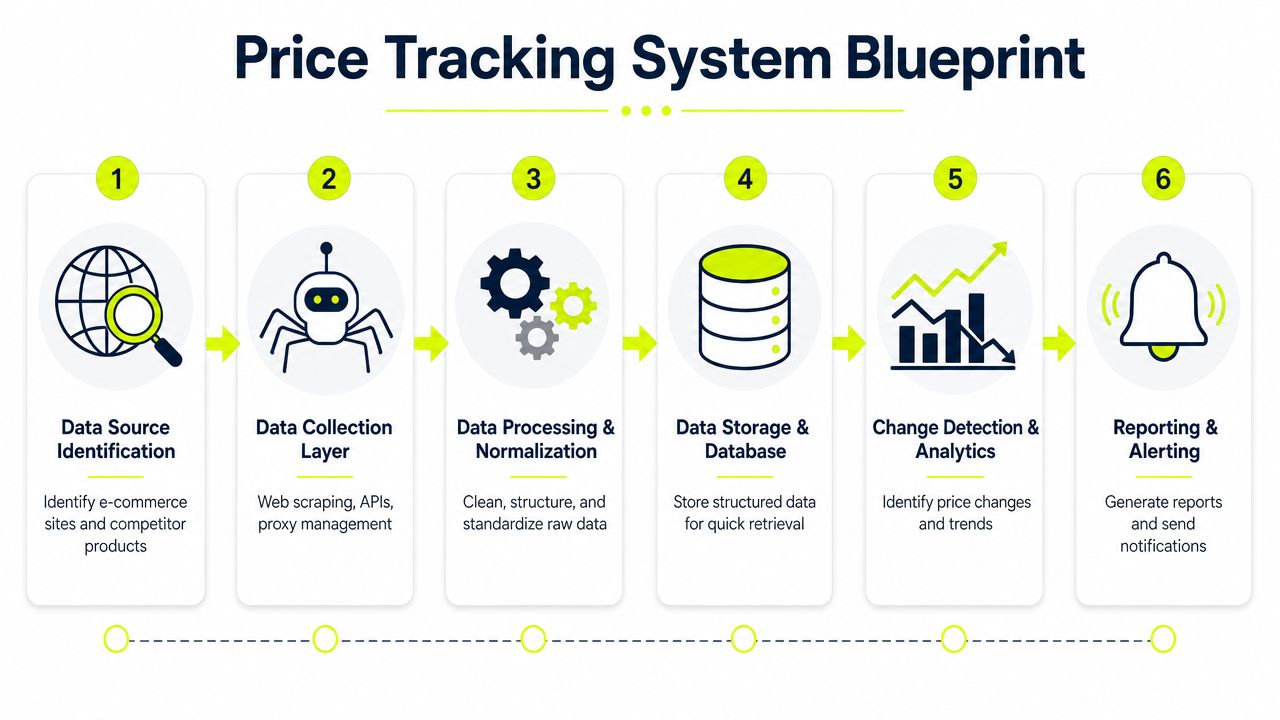
A clean architecture usually has these parts:
- Target registry. Canonical list of URLs, regions, expected selectors, parser version, and priority.
- Acquisition layer. HTTP clients, browser workers, retry policy, session handling, and proxy assignment.
- Normalization layer. Price extraction, currency cleanup, stock parsing, seller parsing, and unit normalization.
- Storage layer. Raw payload archive plus structured event tables.
- Detection layer. Diffing, thresholding, anomaly suppression, and alert generation.
- Operator layer. Slack, Telegram, webhook, dashboard, and exports into bidding or campaign systems.
If you scrape Amazon or Amazon-like retail surfaces, you'll want to think in terms of a constrained extraction service rather than a single generic crawler. This Amazon scraping API guide is useful because it mirrors the way serious teams separate collection from parsing and downstream decisions.
Split the system into hard boundaries
Most failures come from coupling. Don't let your parser know how the proxy pool works. Don't let your alerting service parse HTML. Don't let browser workers write directly into reporting tables.
Use queues between layers. Raw fetchers should emit snapshots plus metadata. Parsers should consume snapshots and produce structured records. Change detectors should compare structured records, not scrape outputs. That separation lets you reparse old pages when markup changes without refetching the target.
A raw HTML archive saves you when a selector breaks and finance asks what the competitor showed three hours ago.
For teams running multi-account operations, this separation also helps with environment control. You can fetch one region through a browser profile that mimics a TikTok landing page reviewer and another through a plain scraper session, then normalize both into the same schema.
Monolith first or services first
A monolith is fine when the target set is small and the operator is one team. It's easier to debug, easier to deploy, and harder to overengineer.
Move to services when one of these becomes true:
- Different fetch classes diverge. Browser jobs and HTTP jobs need different scaling and failure handling.
- Parser churn is high. Retailers change markup often and you need independent parser releases.
- Consumers multiply. Pricing, media buying, cloaking, and account ops all want the same data in different forms.
- Auditability matters. You need deterministic event logs and replayable jobs.
The architecture doesn't need to be fancy. It needs to be debuggable at 3 a.m. when one retailer flips markup, another starts rate-limiting, and your alert channel fills up with false price drops.
Proxy Infrastructure for Uninterrupted Scraping
Your parser can be perfect and still useless if the target stops serving you real pages. In competitor price tracking, proxy design isn't a support detail. It's part of data quality.
A common approach is to pick proxies by price first and detection profile second. That's backward. The wrong IP class gives you fake availability, alternate markup, captcha loops, or personalized prices that don't match the customer journey you're trying to observe.
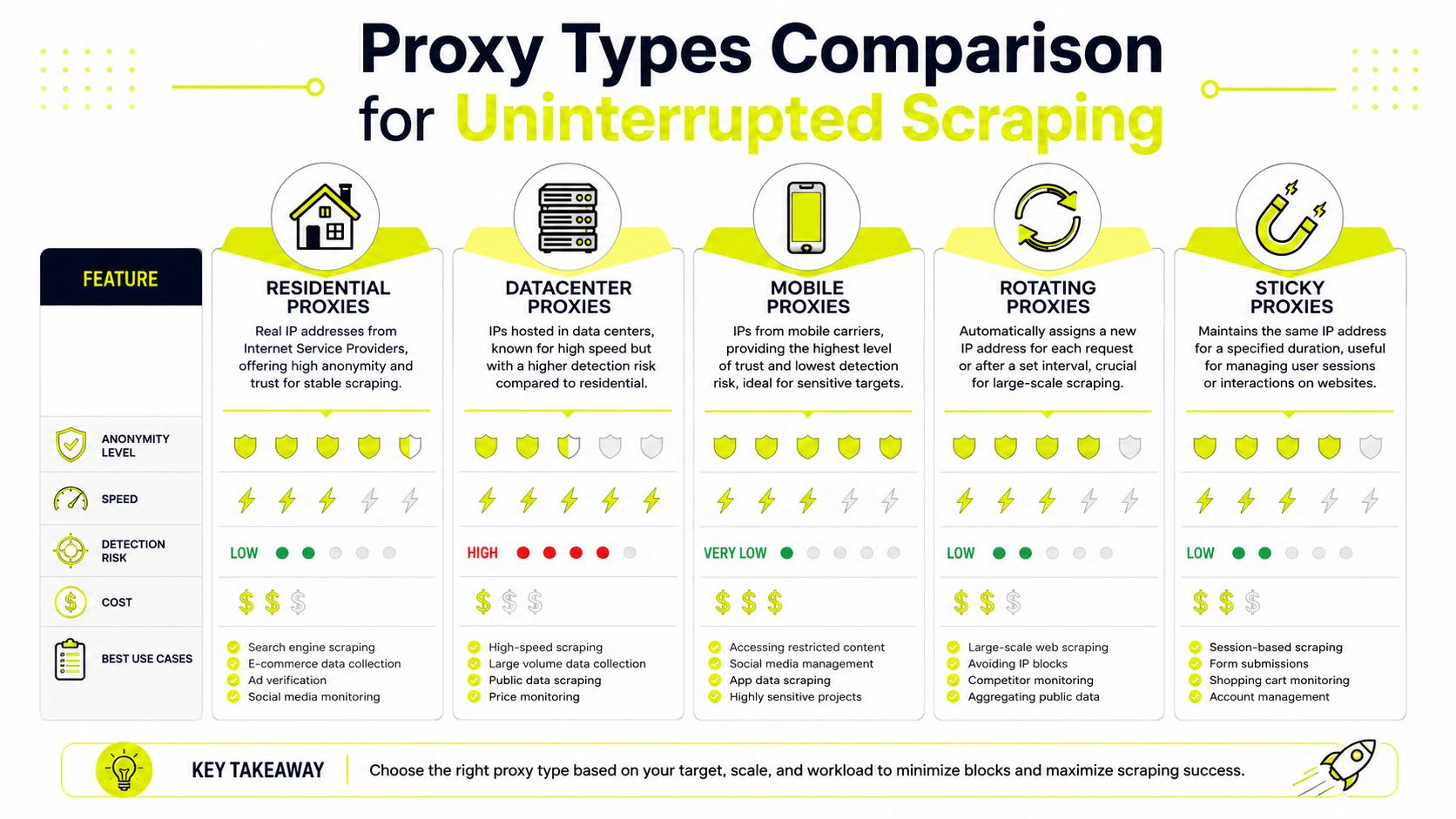
What each proxy type is actually good at
Datacenter proxies are fast, cheap, and useful for low-friction targets. They work well for broad discovery, category crawling, and retry capacity when a site doesn't aggressively score IP reputation. They fail on tougher retail properties because those networks are easy to classify as non-consumer traffic.
Residential proxies come from consumer ISP ranges. They're the default choice for price tracking on stores that care about location, trust score, or behavioral consistency. If you need to verify what a user in a city sees before launching a geo-targeted campaign, residential is usually the practical baseline.
Mobile proxies have the highest trust profile on many targets because the traffic sits behind carrier networks. They're expensive and slower to scale cleanly, but they're often the right tool for difficult surfaces, ad verification, app-adjacent flows, and sensitive price checks that overlap with Facebook or TikTok review paths.
IPv6 proxies are not a stealth upgrade by themselves. They're useful when the target accepts IPv6 broadly and when address space economics help your crawl design. But many retail anti-bot stacks don't suddenly trust you because you arrived over IPv6. Treat IPv6 as a routing option, not a magic bypass.
For account farming and antidetect browser work in AdsPower, Dolphin Anty, GoLogin, Multilogin, or Hidemyacc, sticky residential or sticky mobile sessions often make more sense than high-churn rotation. Those environments care about session continuity, fingerprint consistency, and geography matching. Scraping-only jobs often want the opposite.
Rotation strategy matters more than people admit
Rotating and sticky sessions solve different problems.
Use rotating sessions when you fan out across many product pages and don't need continuity. That reduces per-IP request concentration and helps with broad catalog coverage.
Use sticky sessions when the page flow has state. Common examples include location selection, cookie-based shipping estimates, language variants, session-bound discount banners, and browser-based checks inside antidetect profiles. If you rotate too aggressively there, you generate your own inconsistency and then blame the target.
A lot of operators make the same mistake on social-linked commerce surfaces. They use a fresh IP every request, then open the same store in a GoLogin profile tied to a different region, and then wonder why the scraped price doesn't match what the account sees. Your scraper path and verification path have to align.
This proxy setup walkthrough is useful when you're standardizing session rules across scraper workers and browser profiles, especially if one team handles account ops and another handles data collection.
Proxy Type Comparison for Price Tracking
| Proxy Type | Primary Use Case | Stealth Level | Cost | Best For |
|---|---|---|---|---|
| Residential | Region-accurate retail checks | High | Higher | E-commerce product pages, geo validation, marketplace monitoring |
| Mobile | Sensitive targets and ad-linked verification | Very high | Highest | Hard targets, review-path checks, account-linked browsing |
| Datacenter | High-volume low-friction crawling | Lower | Lower | Discovery crawls, simple retailers, parser testing |
| IPv6 | Specialized routing and broad address availability | Varies by target | Lower to moderate | Targets with strong IPv6 support and low reputation sensitivity |
Don't standardize on one proxy type for every target. Standardize on a decision rule for when each type gets used.
One more practical point for agencies and infrastructure resellers. If you already manage environments for clients, proxy sourcing becomes part of your margin stack. Some providers also run partner programs. Sota Proxy, for example, offers a referral and affiliate program with up to 40% commission. That only matters if you're already the one provisioning proxy infrastructure for client scraping, ad verification, or account fleets. It shouldn't drive your technical choice, but it can offset operational overhead.
Scraping Logic and Advanced Anti-Bot Evasion
A successful fetch is not the same as a valid observation. Plenty of targets will return a page, a status code, and even a visible price while still serving alternate content meant for low-trust visitors.

Start with the lightest fetch that works
Don't open a browser for every request unless the target forces you to. Start with layered fetch modes:
- Mode 1 HTTP fetch for static pages and embedded structured data
- Mode 2 rendered HTML when prices arrive after script execution
- Mode 3 full browser flow when region, consent, or anti-bot state matters
- Mode 4 session-aware browser flow for the ugliest targets
That keeps costs down and reduces moving parts. It also makes failure analysis easier. If Mode 1 breaks while Mode 2 still works, you know the site changed delivery rather than the parser logic alone.
Use header sets that match the browser family you claim to be. Rotate user-agents sensibly, but don't stop there. Inconsistent accept-language, viewport, timezone, and TLS-level patterns create fingerprint mismatches that scream automation.
If you want practical Node patterns for fetch orchestration and extraction, this Node web scraping guide is a solid starting point for wiring requests, browser execution, and parser steps together.
import { chromium } from 'playwright';

const browser = await chromium.launch({
  headless: true,
  proxy: {
    server: 'http://proxy-host:port',
    username: 'user',
    password: 'pass'
  }
});

const context = await browser.newContext({
  locale: 'en-US'
});

const page = await context.newPage();
await page.goto('https://target-store.example/product', { waitUntil: 'networkidle' });
const price = await page.locator('[data-price], .price, .product-price').first().textContent();
console.log(price);
await browser.close();
Browser automation needs fingerprint discipline
If you run Playwright or Puppeteer against serious retail targets, stock settings won't hold for long. The browser itself becomes part of the detection surface. That matters even more when your operators already use antidetect browsers for Facebook and TikTok account management.
The cleanest pattern is to separate concerns:
- Use plain automation for simple stores.
- Use hardened browser contexts for medium-difficulty targets.
- Use antidetect-managed profiles only when you need parity with account-side verification.
AdsPower, Dolphin Anty, GoLogin, Multilogin, and Hidemyacc all help when the verification path has to resemble a real operator session. That's useful for checking region-specific landing pages, ad-linked storefronts, and cloaked variants where the visible price may depend on profile history or geo. It's overkill for basic extraction.
The goal isn't to look human in some vague sense. The goal is to look internally consistent.
CAPTCHAs need a policy, not improvisation. Some teams auto-solve every challenge. That gets expensive and can degrade throughput. Better approach: detect the challenge, classify the target, then decide whether to retry with a better session, escalate to a browser path, or pay to solve.
Here's a simple Python request example for lightweight targets:
import requests

proxies = {
    "http": "http://user:pass@proxy-host:port",
    "https": "http://user:pass@proxy-host:port"
}

headers = {
    "User-Agent": "Mozilla/5.0",
    "Accept-Language": "en-US,en;q=0.9"
}

resp = requests.get("https://target-store.example/product", headers=headers, proxies=proxies, timeout=30)
print(resp.status_code)
print(resp.text[:500])
Scheduling without poisoning your own dataset
Cadence should match the business problem. For flash sale detection, checks every 5 to 15 minutes are appropriate, while routine daily competitive tracking usually runs every 1 to 6 hours, based on Visualping's guidance on automated price monitoring frequency. That same source warns about dynamic pricing and A/B testing noise, and the practical fix is to monitor from a consistent geographic region and apply thresholds that ignore minor variations.
That point gets missed all the time. If one worker hits from one country and another from a different region, you're not measuring price movement. You're measuring your own routing inconsistency.
Use a scheduler that understands priority queues, cooldown windows, and failure budgets. High-value SKUs should get tighter intervals and more expensive fetch modes. Long-tail catalog pages can tolerate looser polling and cheaper paths. Turning that trade into a price per thousand pages, and into a feed someone pays for, is covered in making money with web scraping.
After you establish stable collection, this walkthrough helps visualize browser-driven monitoring flows and where anti-bot friction usually appears:
Data Processing Storage and Change Detection
Raw HTML is evidence. It's not usable intelligence. The value shows up when you convert page snapshots into consistent records that analysts, media buyers, and automation jobs can trust.
Parse less and validate more
The first parsing mistake is overfitting selectors to today's markup. The second is trusting a parsed value just because the selector returned text.
Use multiple extraction paths where possible. Pull from visible DOM, structured data, embedded JSON, and nearby labels. Then validate.
Good validation checks include:
- Type checks. Can the string become a normalized price value?
- Currency checks. Does the symbol or code match the expected region?
- Range checks. Is the value plausible for this SKU?
- Context checks. Did you scrape the actual sell price or a crossed-out old price?
A parser built with BeautifulSoup, lxml, or Cheerio should output more than price. Capture seller name, stock state, shipping notes, promo badge text, and extraction confidence. Those fields help you explain why a price changed or why it only appeared to change.
Matching products without lying to yourself
Product matching is where weak systems poison their own analytics. Enterprise teams that do this well use a three-stage pipeline: accurate product matching with image and attribute analysis, near-real-time collection to flag material moves such as a price drop greater than 5%, and a decision layer that turns those observations into guarded actions, according to ProfitMind's breakdown of competitive price monitoring for enterprise retailers.
UPC-only matching breaks the moment a retailer uses a private label variant, bundle, or slightly altered pack size. The same problem shows up in gray-hat commerce and affiliate funnels. The product may be economically equivalent while the title and SKU string differ enough to break exact joins.
Use a hierarchy:
- Exact identifiers if available.
- Attribute similarity across brand, model, size, color, and pack.
- Image similarity for edge cases.
- Human review queue for uncertain matches.
If your matching layer is weak, every downstream price alert becomes suspect.
Store events not just current state
Use a relational database when you care about strong querying across products, regions, sellers, and time. Use a document store for raw snapshots and flexible payloads. Most serious systems end up with both.
A practical schema usually separates:
- Products as your internal canonical entities
- Competitor listings as external observations
- Price events as append-only changes
- Availability events as stock transitions
- Raw fetch artifacts for replay and debugging
Append-only event storage beats overwriting the current row. It gives you history, supports reprocessing, and helps detect weird patterns like oscillating sale prices or region-specific experiments. Your change detector should compare the latest accepted state to the new validated event, then decide whether to emit a signal or suppress noise.
Actionable Alerts Workflows and Ethical Lines
Most price trackers fail at the last mile. They collect data, store it neatly, and then dump low-quality alerts into a channel nobody wants to read.
Alert on decisions not on raw noise
An alert should answer one question: what should someone do now?
Don't send “price changed” for every fluctuation. Send alerts that combine context:
- Competitor undercut on target SKU
- Promo badge appeared in a monitored geo
- Out-of-stock event on a competing listing
- Seller switched on a marketplace listing
- Price change detected on a landing page tied to an active ad set
For media buyers, that can mean pausing a weak angle, changing ad copy, or shifting budget to a different geo. For cloaking operations, it can mean updating the money page variant after a competitor launches a visible discount. For account farming teams, it may trigger a manual verification pass inside a clean browser profile before pushing scale.
A practical workflow often looks like this:
- Slack or Telegram for urgent events. Good for campaign-impacting changes.
- Webhooks for machine actions. Push changes into bidding logic, dashboards, or rule engines.
- Email digests for trend review. Better for category-level movement and weekly planning.
Fast alerts are useless if they arrive without enough context to trust them.
Connect price changes to operator workflows
Competitor price tracking expands its role beyond typical e-commerce monitoring. Arbitrage teams can tie price signals to geo-targeted landing page swaps. TikTok and Facebook operators can use the same feed to verify whether advertised claims still hold against competitor offers in each region.
Some teams keep a manual approval step. That's smart when a price change could trigger a campaign-wide edit or a cloaking rule change. Others automate more aggressively and let a webhook update internal recommendation tables first, then send a human-readable notice.
Use different channels for different trust levels:
- High-confidence events go straight to operator chat.
- Ambiguous events go to review queues.
- Parser anomalies go to engineering, not marketing.
If you mix those together, the alert stream dies fast.
Know where the line is
Scraping publicly visible prices is common. That doesn't remove risk. Terms of service still matter. So do access controls, rate limits, and the difference between observing public pages and trying to break into gated systems.
A practical standard is simple:
- Respect site stability. Don't hammer targets.
- Avoid bypassing authentication you're not entitled to use.
- Keep robots.txt in mind as one signal, not your only policy input.
- Store only what you need for the business purpose.
- Have legal review if the target set or collection method gets aggressive.
For practitioners in cloaking, account farming, and multi-account environments, the ethical line gets blurry fast because the tooling overlaps. The same browser automation stack can verify public prices or abuse protected workflows. The responsibility sits with the operator, not the framework.
If you need proxy infrastructure for competitor price tracking, ad verification, account farming, or geo-targeted campaign checks, Sota Proxy is built for that kind of workload. You can choose residential, mobile, ISP, datacenter, or IPv6 IPs, control rotation or sticky sessions, and align browser profiles with the regions you need to observe. Teams managing client infrastructure can also look at Sota Proxy's affiliate program, which offers up to 40% commission.
Related articles
Amazon Scrape API: Build a Scalable Data Pipeline
Build a robust Amazon Scrape API. This guide covers proxy architecture, request engineering, CAPTCHA handling, and data parsing for technical operators.

Effective Proxy IP Rotation: Avoid Blocks in 2026
Master proxy IP rotation for web scraping, arbitrage, and account farming. Learn strategies, implementation, and best practices to avoid blocks in 2026.
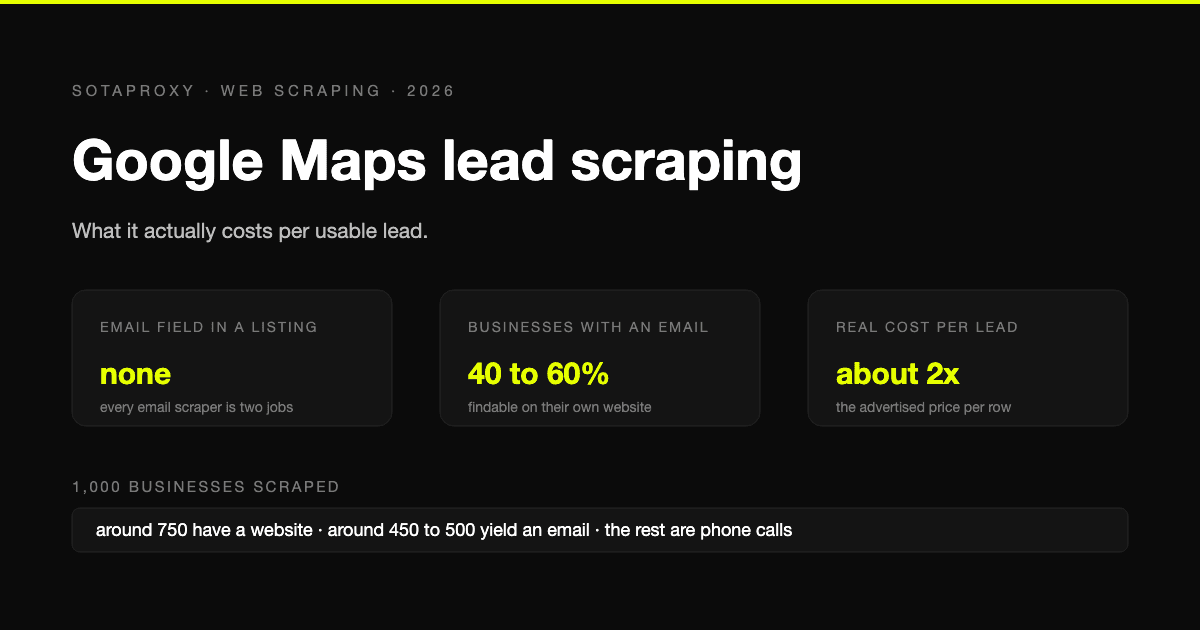
Google Maps Lead Scraping: What It Actually Costs Per Usable Lead
Google Maps has no email field, so every email scraper is a two-stage pipeline and only about half of businesses yield an address. What a thousand listings really costs per usable lead, the businesses-without-websites play, and where the law stands after the SerpApi ruling.
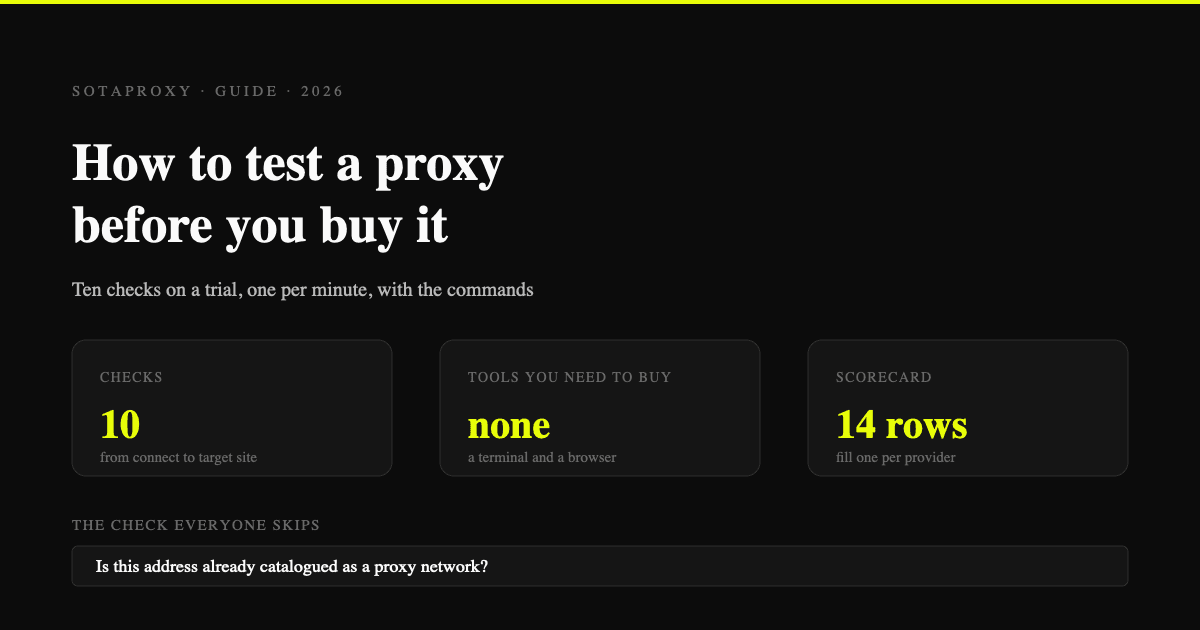
How to Test a Proxy Before You Buy It: A 10-Minute Checklist
Ten checks that tell you whether a proxy trial is worth paying for: exit ASN, hosting flags, rotation behaviour, subnet spread, DNS and WebRTC leaks, and success rate on your own target.

How to Make Money With Web Scraping in 2026: Five Models, Priced
Five ways scrapers get paid, what each one charges, and what a scrape actually costs to run, measured on real pages: HTML-only against a full browser render.

10 Smartproxy Alternatives for Technical Teams
Compare 10 smartproxy alternatives by proxy type, IP quality, targeting, rotation, speed, pricing, and use case for technical teams.