Amazon Scrape API: Build a Scalable Data Pipeline
Build a robust Amazon Scrape API. This guide covers proxy architecture, request engineering, CAPTCHA handling, and data parsing for technical operators.

Your Amazon scraper probably worked on ten URLs in a local test. Then you pushed it into production, aimed it at real volume, and Amazon answered with 503s, CAPTCHA pages, broken sessions, and dead IPs. That failure pattern is normal.
It hits hardest when scraping feeds a money path. Traffic arbitrage teams need fresh product and pricing data for geo-targeted campaigns. Media buyers need to verify localized offers before pushing spend to Facebook and TikTok ad accounts. Multi-account operators running AdsPower, Dolphin Anty, GoLogin, Multilogin, or Hidemyacc need stable data collection without poisoning the same proxy layer they use for account farming, cloaking, and verification.
A working Amazon scrape API setup isn't a script. It's infrastructure. The teams that scale treat proxies, request engineering, parsing, and delivery as one production system. If you still treat proxy choice as a checkbox at the end, you'll keep rebuilding the same broken stack.
Table of Contents
- Beyond a Simple Script
- Designing a Resilient Scraping Architecture
- Executing a Strategic Proxy Plan
- Engineering Undetectable Requests
- Neutralizing CAPTCHAs and Bot Detection
- Parsing Data and Guaranteeing Delivery
- Operational Monitoring and Compliance
Beyond a Simple Script
The first bad assumption is thinking Amazon blocks only aggressive scrapers. It doesn't. It blocks inconsistent behavior. A script that fetches a handful of product pages with one header set, one cookie jar, and one proxy can look fine in staging and still fail the moment you add concurrency.
I've seen the same pattern across ad verification stacks and account farms. One team scrapes localized Amazon pricing to align cloaked landers with the region shown in a Facebook ad account. Another team checks seller offers before launching a TikTok campaign tied to a narrow delivery area. Both start with a simple Python worker. Both eventually learn that the script isn't the product. The system around it is.
Practical rule: If your Amazon scraper depends on one process doing fetching, parsing, retries, and storage in sequence, it will fail noisily and it will fail often.
Amazon scraping gets harder when it's attached to other operational systems. If the same operators also manage profiles in AdsPower or GoLogin, or run account farming flows in Dolphin Anty and Multilogin, bad proxy hygiene spills across workflows. Burn a subnet in scraping, then reuse it for logins, and you create your own trust problem.
That's why a serious Amazon scrape API build starts with separation of concerns. Scraping runs on its own request policy, proxy pool, cookie policy, and data pipeline. Account management runs on a different one.
If you're still in the script phase, this is the point where you stop adding patches and start rebuilding with cleaner boundaries. A solid primer on crawler fundamentals is this Python web crawling guide, but the key shift is operational. Stop thinking like a script author. Start thinking like the person who has to keep this pipeline alive during a campaign launch.
Designing a Resilient Scraping Architecture
A stable Amazon scrape API stack is modular. Not because it looks cleaner in a diagram. Because Amazon will break one part of your system before it breaks all of it, and you need to isolate the damage.
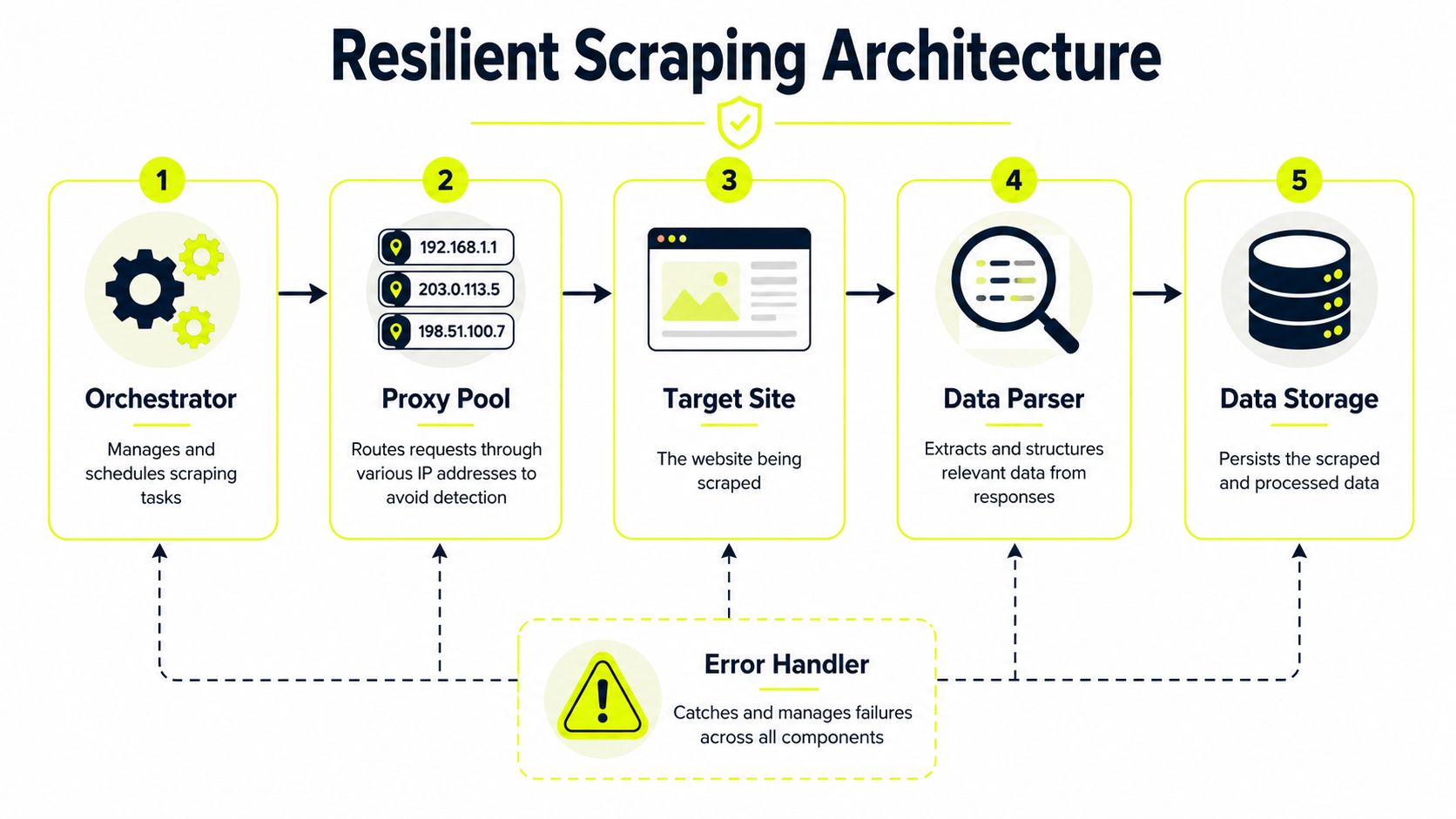
What the production flow should look like
Think in five moving parts plus a shared error path.
Orchestrator
This is your control plane. It creates jobs, assigns priority, selects marketplace and region, and decides whether a request should go through direct HTML capture or a managed scraper endpoint.Request scheduler
This layer should own queueing, pacing, retry timing, and concurrency caps. Don't let workers make retry decisions in isolation. They will hammer the same target pattern and get you blocked faster.Proxy management layer
Most weak builds collapse at this point. The layer needs to select proxy type by task, enforce rotation policy, preserve sticky sessions when needed, and expose geolocation as an actual request parameter.Parser and validator
Parse only after the response passes basic checks. Detect empty templates, CAPTCHA pages, partial content, and region mismatch before you write anything downstream.Storage and delivery
Store raw response metadata, parsed payload, and job status separately. That separation makes replay possible when a parser breaks.
A central error handler should watch every stage. If a request fails because of a bad proxy region, the scheduler needs that signal. If the parser starts returning nulls for ratings or offer blocks, the orchestrator needs to downgrade that route or switch collection mode.
Most scraper outages aren't caused by one blocked request. They come from a queue that keeps feeding a broken configuration.
Zip-code targeting has to be native
This is the piece most tutorials skip, and it's a big miss for arbitrage and ad operations.
If you're verifying localized pricing, shipping eligibility, or product availability for geo-targeted campaigns, country-level geolocation isn't enough. You need programmatic zip-code execution. That means your job model should carry marketplace, target zip code, session policy, and proxy policy together, not as ad hoc parameters scattered across workers.
Only 2 of the top 9 Amazon scraping APIs explicitly support zip-code-level targeting with residential proxies, and that became more important after Amazon's 2025 anti-bot updates enforced stricter IP-based location validation, as noted in this discussion of Amazon location-based scraping. If your system can't switch geolocation in code without manual session resets, you'll collect inconsistent location data and won't know which responses are wrong.
A practical architecture flow looks like this:
- Job intake: keyword, ASIN, seller URL, or category URL enters the queue.
- Location binding: the orchestrator attaches the target zip code and marketplace.
- Proxy resolution: the proxy layer selects a city-level residential endpoint that matches the job.
- Fetch and verify: the worker confirms the returned page reflects the expected delivery context.
- Parse and publish: only validated records reach your webhook, object storage, or database.
If you're building your own infrastructure pieces, a useful reference for the underlying plumbing is this proxy server implementation walkthrough. Even if you don't build the proxy tier yourself, it helps to understand where session logic should live.
Executing a Strategic Proxy Plan
Proxy policy is where Amazon scraping programs usually break.
A worker can have clean parsing logic, retries, and decent headers, then still fail because the proxy layer was treated like a commodity pool. On Amazon, proxy selection controls three things that matter to operators: whether requests get served, whether location-dependent data is trustworthy, and whether the cost per usable page stays predictable across accounts and campaigns.
Proxy Type Selection Matrix for Amazon Scraping
| Proxy Type | Primary Use Case | Stealth Level | Relative Cost | Amazon Fit |
|---|---|---|---|---|
| Residential | Product pages, search results, seller pages, localized pricing, delivery-sensitive offers | High | Medium to high | Primary pool for production scraping |
| Mobile | Sensitive account actions, verification flows, account warm-up, high-friction trust checks | Very high | High | Best reserved for account operations, not bulk catalog collection |
| Datacenter | Low-value fetches, internal QA, support jobs where failures are acceptable | Low | Low | Useful only on isolated workloads |
| ISP | Mixed workloads that need lower latency with better trust than standard datacenter ranges | High | Medium | Good secondary pool for targeted jobs |
| IPv6 | Supplemental pool expansion where the target accepts it cleanly | Variable | Usually low | Test in isolation before using at scale |
For Amazon scraping, residential proxies carry the main load. They are the only practical default if you need consistent access to search, offers, seller pages, and zip-code-specific delivery views. Datacenter proxies still have a place, but only where a block does not damage the downstream system. That means preflight checks, low-priority discovery jobs, internal monitoring, or retry paths you can afford to lose.
The infrastructure decision is not just "which proxy is better." It is how to segment traffic so bad IP reputation in one lane does not contaminate another. Scraping traffic, account logins, ad account operations, and checkout-adjacent verification should not share the same pool, the same session length, or the same rotation rules.
Split proxy workloads by risk, not by convenience
A workable production model looks like this:
- Residential pool for Amazon collection: use it for search pages, product detail pages, seller storefronts, reviews, and any workflow that depends on delivery context.
- Mobile pool for account-sensitive actions: keep this for login-heavy flows, trust-gated account steps, and platform combinations where anti-fraud systems correlate IP reputation aggressively across sessions.
- ISP pool for latency-sensitive secondary jobs: useful for selective endpoints where response time matters and you still need cleaner reputation than a standard datacenter range.
- Datacenter pool for disposable support traffic: use it for health checks, endpoint validation, and experiments that should never touch your core collection budget.
That split matters even more for multi-account management and traffic arbitrage. If one business unit is validating Amazon pricing by zip code while another is warming browser profiles for ad accounts, a shared proxy pool creates cross-contamination. Session history, ASN patterns, and rate spikes bleed together. Keep each lane isolated at the proxy gateway and enforce that separation in code, not in runbook notes.
Rotation policy should match the job shape
Rotation strategy is where teams waste a lot of good residential inventory. Amazon does not need the same session model for every request.
Use short sticky sessions for paginated search flows, longer sessions for offer and seller paths that benefit from cookie continuity, and aggressive rotation for broad keyword discovery where each request is effectively independent. If your workers rotate too fast, you lose continuity and trigger extra challenge pages. If they hold sessions too long, block rates creep up and one poisoned identity burns an entire batch. A practical reference on setting proxy IP rotation policies is useful if you are formalizing this logic in the gateway layer.
The key is to make rotation deterministic. Tie it to job type, marketplace, zip code, and account boundary. Do not let workers improvise.
Geolocation targeting needs its own proxy policy
Zip-code targeting is not a checkbox feature. It is an infrastructure requirement.
If the job says 10001, the proxy layer needs to return an endpoint that can hold a consistent New York delivery context long enough for the worker to load the page, persist cookies, verify the location state, and collect the HTML. The same is true for 94105, 60601, or any other delivery zone that changes availability, buy box behavior, shipping promises, or sponsored placement visibility. Generic "US residential" routing is often too coarse for that.
In practice, the proxy selector should resolve on at least these fields:
- marketplace
- country
- state or city, when supported
- zip code target
- session duration
- account or tenant ID
- job class, such as search, PDP, seller, reviews, or offers
That gives you something you can audit later. If the wrong delivery estimate shows up in the page, you can trace whether the issue came from bad proxy geography, a stale session, or Amazon resetting the location during the flow.
IPv6 and cheap capacity
IPv6 can expand the pool for low-risk jobs, but it should stay outside the main Amazon collection path until it proves stable in your own tests. Acceptance varies by route quality and by the exact pages you hit. Treat it as a supplemental lane. Do not mix it into high-value collection where you need predictable delivery-context validation.
Cheap proxies also carry an operational tax. They increase retries, create more partial responses, and raise the number of records that need validation before they can be trusted. That cost shows up later as parser exceptions, false inventory changes, and bad campaign decisions.
Proxy spend is easy to measure. Bad location data is not. That is why the proxy plan needs to be designed before the crawl scales.
Engineering Undetectable Requests
A clean proxy route is not enough. Amazon scores the full request chain: TLS behavior, headers, cookies, navigation order, and timing. If those pieces do not fit together, the request gets challenged long before your parser sees a product page.

Build browser-like request fingerprints
Amazon traffic fails when teams mix one browser claim with another browser's behavior. A Chrome user agent paired with incomplete client hints, stateless cookies, and a generic HTTP library pattern is easy to classify. The fix is consistency across the whole session, not randomization.
Keep each browser profile internally coherent:
- User-Agent family: match the browser and version you intend to simulate.
- Accept-Language: match marketplace, account locale, and delivery context.
- Accept-Encoding: send values your client can handle.
- Client hints: include headers such as
Sec-CH-UAonly if the rest of the fingerprint supports them. - Cookie continuity: persist cookies across related steps like search, PDP, offers, and pagination. Reset them between unrelated jobs or tenants.
If you are shaping requests at the client layer, this guide to request headers in Python is useful for building header sets that stay consistent under load.
The infrastructure angle matters here. Teams running multi-account scraping and traffic arbitrage often poison their own environment by reusing the same browser profile rules across very different jobs. A seller-offer crawl, an ad verification check, and a location-specific buy box request should not all inherit the same cookie jar or header template. Isolate profiles by job class and account group, then log the exact fingerprint assigned to each request. That is how you debug a drop in success rate without guessing.
Pace requests like a scheduler, not a script
Timing is part of the fingerprint. Fixed intervals, identical retry gaps, and worker-local retry loops create a pattern Amazon can classify even if the headers look fine.
Use scheduler-level pacing rules:
- Add jitter to every dispatch window.
- Reserve sticky sessions for flows that need continuity, such as cart, location confirmation, or paginated offer traversal.
- Back off on 429, 503, and soft block responses with increasing delays.
- Cap retries per route and return failed work to a central queue.
- Quarantine weak routes instead of letting workers hammer them.
This is one of the clearest differences between a script and an operation that scales. A script retries because it wants the page. An engineered scheduler protects the IP, the session, and the rest of the batch.
I use a simple rule in production. If the same worker sees repeated soft blocks from one route, it loses authority to continue. The scheduler decides whether to swap the fingerprint, cool down the session, switch geography, or drop the job into a lower-priority lane. That prevents retry storms, which are expensive and easy to detect.
For a visual walk-through of anti-block request handling, this clip is useful:
The shift is operational. High success rates come from matching request identity, session state, and pacing to the exact job being executed, especially when you are rotating across accounts and zip-code-targeted collection flows at scale.
Neutralizing CAPTCHAs and Bot Detection
CAPTCHAs are a lagging indicator. If you keep seeing them, the problem usually started earlier with proxy trust, request fingerprints, or pacing.

Avoidance beats solving
The most reliable CAPTCHA strategy is reducing how often Amazon serves one in the first place.
Dedicated Amazon scraping APIs that use massive proxy pools of 110+ million IPs consistently achieve success rates above 98%, according to Nimbleway's Amazon scraping API benchmark. That matters because clean IP infrastructure is the primary defense against both CAPTCHAs and straight blocks.
This is also why low-end proxy pools poison serious operations. Overused IPs get challenged more often. Challenged sessions create more retries. More retries make your traffic look worse. Then operators waste time wiring CAPTCHA solvers into a stack that should have been fixed upstream.
Frequent CAPTCHAs usually mean your stack is leaking intent long before the challenge page appears.
For teams running both scraping and ad operations, keep CAPTCHA exposure isolated. Don't let the same browser profile or proxy group handle Amazon scraping and Facebook account actions interchangeably. If a proxy pool starts drawing repeated challenge traffic from Amazon, quarantine it from your antidetect browser workflows.
When you still hit a CAPTCHA wall
You still need a reactive path.
There are two practical options:
- Fully automated solving: integrate a third-party CAPTCHA-solving service through API. Your worker detects the challenge, submits it, waits for the token, then retries the session with the right state.
- Semi-manual resolution: for workflows in Dolphin Anty, AdsPower, GoLogin, Multilogin, or Hidemyacc, hand the session to an operator when the scrape is tied to a broader verification task.
Automated solving fits always-on data pipelines. Manual solving fits edge cases where a human is already checking a geo-targeted flow, cloaked page variant, or ad-to-landing path.
The trap is over-investing in solving while ignoring root cause. If your Amazon scrape API stack burns through challenges every hour, don't celebrate that your solver integration works. Fix the route selection, cookie handling, and proxy hygiene.
If you're working in JavaScript-heavy stacks, this Node scraping reference is a useful companion for designing cleaner detection and retry handling around browser-driven workflows.
Parsing Data and Guaranteeing Delivery
A scrape isn't done when you get a response. It's done when structured, validated data lands where the rest of your system can use it.
Raw HTML breaks first
A lot of Amazon scraping pipelines still depend on brittle CSS selectors and XPath chains. They work until Amazon adjusts page layout, moves an element behind a new wrapper, or changes the rendering path for a localized offer block. Then your scraper keeps returning output, but the output is wrong.
That silent failure is worse than a hard block.
Managed scraper APIs solve part of this by returning structured output instead of raw HTML. Enterprise-grade scraper APIs can return JSON-formatted outputs with fields like ASINs, pricing, and ratings, and they can deliver results asynchronously via webhooks or external storage like S3 for high-volume jobs, as described in this Amazon scraper API comparison.
That doesn't mean raw HTML is useless. It means you should decide where parsing risk belongs.
Use raw HTML when:
- You need full control: custom extraction logic, audits, or experimental fields.
- You can maintain parsers actively: your team expects layout drift and has tests around selectors.
- You want replay capability: keeping raw snapshots helps when parsers break.
Use structured JSON when:
- You need stable delivery: downstream systems care about data, not markup.
- You run high volume: parser maintenance becomes operational drag.
- You care about turnaround: ad ops and arbitrage workflows usually need fields now, not parser work later.
Delivery paths that don't lose data
Don't let your workers print records to stdout and call that a pipeline.
Use a delivery model that matches the workflow:
| Delivery Path | Best Fit | Why it works |
|---|---|---|
| Webhook | Near real-time campaign logic | Pushes validated results directly into verification or bidding systems |
| Object storage | Batch analytics and replay | Keeps large result sets and raw payloads available for reprocessing |
| Database insert | Searchable operational data | Good for dashboards, joins, and downstream alerting |
| Queue-based handoff | Multi-stage processing | Decouples fetch, parse, enrich, and publish |
My rule is simple. Store three things separately: request metadata, parsed fields, and failure reason. That separation saves you when Amazon changes page structure or when a proxy route starts returning incomplete localized pages.
If you can't replay yesterday's failed jobs against today's parser, your pipeline is fragile by design.
For arbitrage teams, this also protects campaign quality. If a geo-targeted campaign depends on local price parity and your parser inadvertently drops the localized offer block, you'll make spending decisions on bad data.
Operational Monitoring and Compliance
Once your Amazon scrape API stack is live, treat it like any other production service. Watch success rate, latency, parser health, delivery lag, and cost drift. The exact thresholds depend on your stack, but the principle doesn't. Alert on change, not just outage.
The biggest operational mistake is waiting for business users to report bad data. Your scheduler should already know when one region starts failing more than others. Your parser should already know when expected fields disappear. Your delivery layer should already know when webhook pushes back up.
A lightweight monitoring setup works if it fires. A heavier stack with dashboards works if someone owns it. What matters is catching layout shifts, bad proxy batches, and region mismatch before they spread into campaign decisions, account actions, or reporting.
Compliance matters too. Ignore it and you'll create unnecessary risk. Avoid collecting personal data. Review robots.txt and terms so you understand which paths are sensitive, even if your collection logic doesn't rely on them for permissioning. Keep request behavior disciplined. Operational restraint reduces your risk profile and usually improves scraper stability anyway.
The teams that last in this space don't treat scraping like a one-off hack. They run it like infrastructure.
If your operation depends on stable proxies for Amazon scraping, geo-targeted verification, Facebook and TikTok ad accounts, account farming, or antidetect browser workflows, Sota Proxy is built for that kind of load. It gives operators residential, mobile, ISP, datacenter, and IPv6 options with city-level targeting, rotation control, and infrastructure that fits real production workflows instead of demo scripts.
Related articles
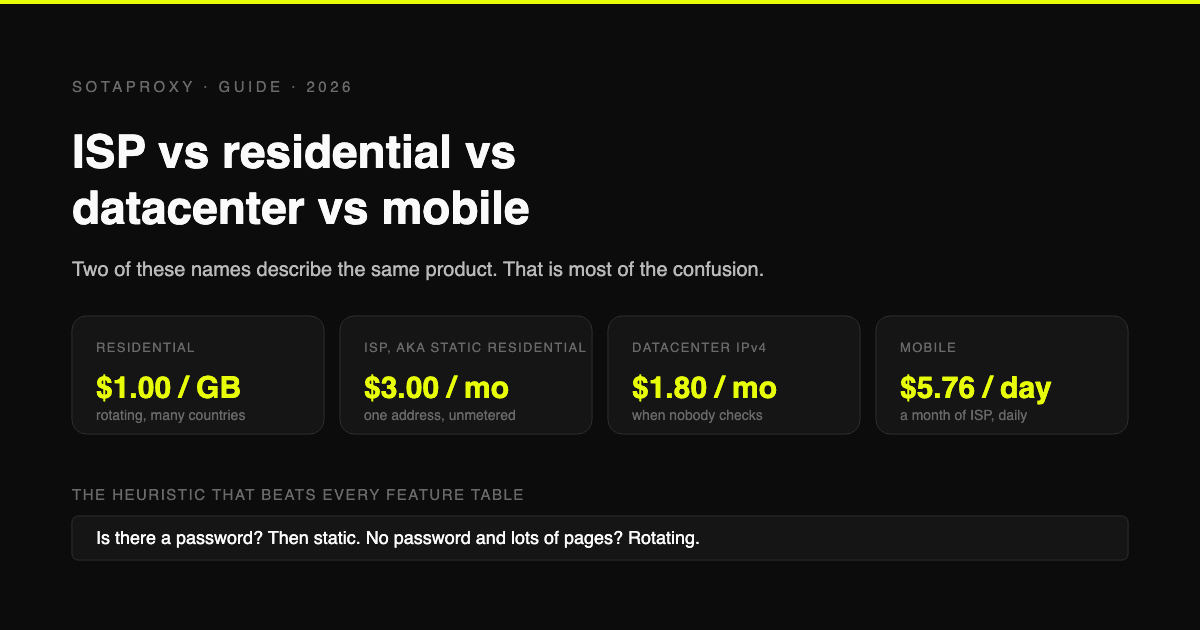
ISP vs Residential vs Datacenter vs Mobile Proxies: Which One You Actually Need
Static residential and ISP are the same product under two names, which is why half these comparisons compare a thing to itself. What each type is, what it costs per unit, and the one task each is genuinely best at.

Why a Working Proxy Isn't Enough: A ToDetect Pre-Launch Checklist
A working proxy doesn't guarantee a consistent browser environment. Learn how ToDetect checks IP, DNS, WebRTC, and browser fingerprint signals before launch.

How Many X (Twitter) Accounts Can You Have in 2026 (The 10 Is a Phone Limit, Not an Account Limit)
X publishes no cap on accounts per person. The 10 everyone quotes is the number of accounts one phone number can cover. The real constraints are 50 posts a day on a free account, duplicative use cases, and accounts that interact with each other.
Reddit "You've Been Blocked by Network Security": Every Cause, and the Fix for Each
It is not a ban and there is nothing to appeal. It comes from Reddit's edge, applies to your connection, and has six causes. Here is how to tell which one you have, and how long each lasts.

How Many Discord Accounts Can You Have in 2026 (Per Email, Per Phone, Per Device)
Discord publishes no cap on accounts. The real limits are one per email, one phone number at a time with no VOIP, and five in the Account Switcher, which Discord says it may enforce across.

Telegram Automation with Telegram Expert: What to Do If a Task Stops Midway
When a Telegram task over thousands of records fails, the failures have different causes and need different answers. How to tell a limit from a lost connection, and when to retry, change the route, wait or finish the record.