India Proxy Server: Best for Arbitrage & Farming 2026
Find the best India proxy server for traffic arbitrage & account farming. Compare types, selection criteria, and integrate with antidetect browsers.

You launch a Facebook or TikTok campaign for India, budgets are live, CTR looks fine, but the user path is broken. The landing page loads a fallback variant. The app store page shows a different offer. The ad creative you approved from your office IP isn't the one users in Mumbai or Bengaluru see. Then you open the account in AdsPower or Dolphin Anty through a random proxy and trigger another review flag.
That's the point where a generic proxy stops being useful.
For arbitrage teams, account farmers, cloaking setups, and anyone managing Indian ad assets at scale, an India proxy server is part of the account environment itself. It affects ad review patterns, login trust, geo checks, storefront validation, and whether your browser fingerprint makes sense to the platform. If the IP quality is wrong, the rest of the stack won't save you.
Table of Contents
- Why India Proxies Are Critical for Media Buyers
- Datacenter vs Residential vs Mobile Proxies for India
- Key Selection Criteria for Your India Proxy Provider
- Advanced Use Cases for Traffic Arbitrage and Account Farming
- Integrating and Testing Your India Proxy Setup
- Operational Best Practices and Final Buying Advice
Why India Proxies Are Critical for Media Buyers
If you buy traffic in India with a non-Indian exit IP, you're often making decisions on the wrong version of reality. Platforms cache differently by region. Offers localize differently by city and device context. Some ad accounts get reviewed against network patterns that don't match the target market at all.
India is too large and too operationally important to treat as a checkbox geo. India had ~900 million internet users in 2024 according to Oxylabs' India location proxy page. For teams running Facebook pages, TikTok profiles, affiliate landers, or app-install funnels, that means one thing. You need local visibility, not a generic “Asia” route.
The proxy side reflects that scale. In 2023, residential proxies accounted for about 44% of total proxy traffic, with over 5.5 million residential IPs in active circulation. For India specifically, over 70 million web scraping and data requests were processed through proxy servers each month according to Market Growth Reports on the proxy server service market. That doesn't just describe scraping. It tells you India is already a high-pressure proxy geography where rotation, trust, and IP freshness matter.
Practical rule: If the account is valuable, the IP must match the story your browser fingerprint tells.
That's why serious buyers split their stack by task. They don't use the same India proxy server for ad verification, TikTok warm-up, Facebook Business Manager access, and bulk page scraping. They isolate use cases, keep sessions stable where needed, and switch proxy type based on platform sensitivity.
If you manage Meta assets, this matters even more when you're pairing proxy choice with browser isolation. A lot of account issues blamed on “bad cookies” are really IP reputation problems layered on top of poor profile hygiene. If you need a deeper Meta-specific setup, Sota's guide on proxy use for Facebook workflows is a useful reference.
Datacenter vs Residential vs Mobile Proxies for India
The right proxy type depends on what you're trying to protect. Speed, trust, cost, and session behavior don't move together. You always trade one for another.
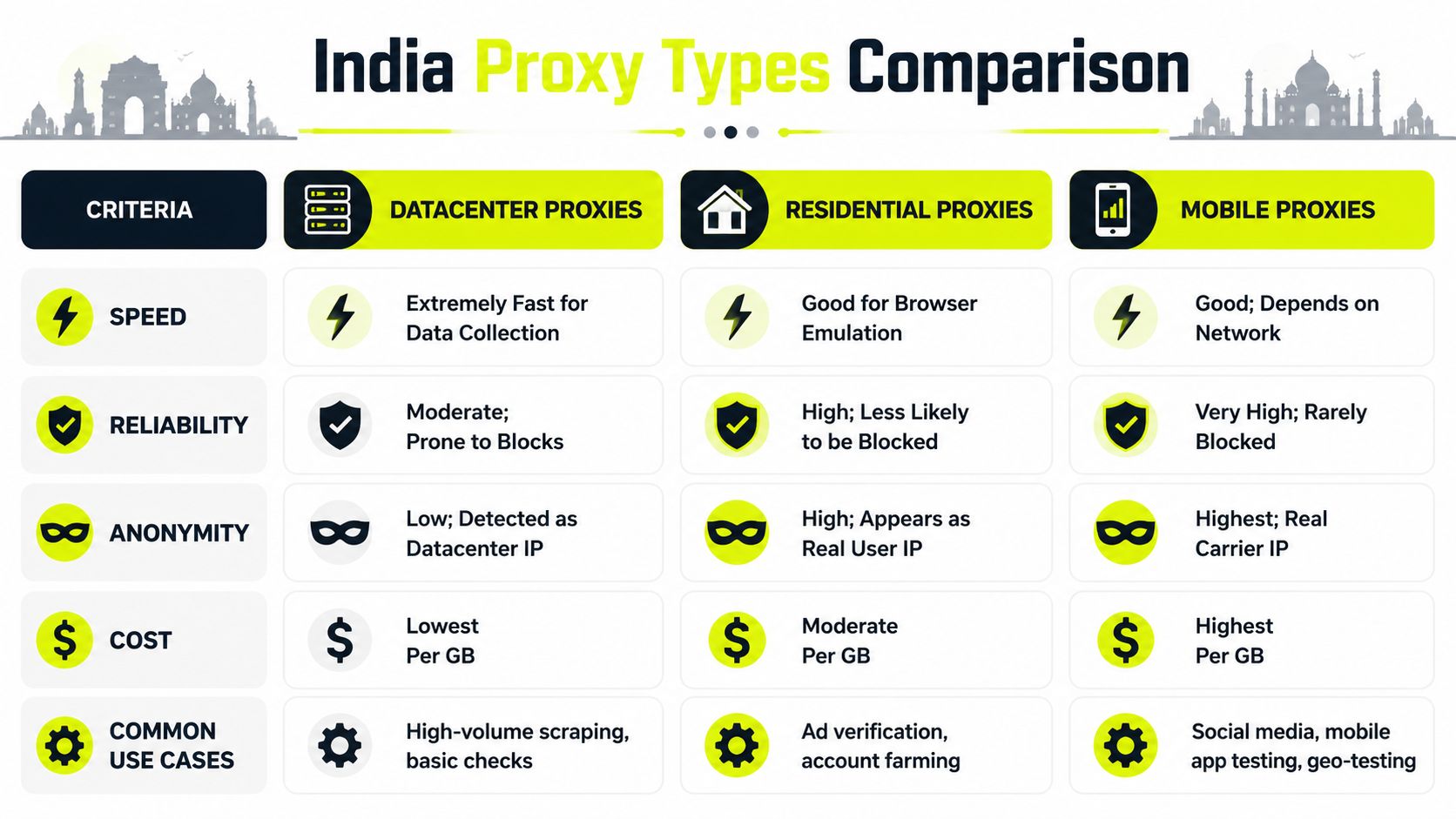
Datacenter proxies
Datacenter IPs are the blunt instrument. They're good when you need clean throughput for scraping, page checks, QA runs, or non-sensitive automation. They're usually the easiest to deploy, the cheapest to scale, and the first to get challenged by stricter platforms.
That trade-off is visible in how India datacenter nodes are built. In a documented setup, a builder selected Bangalore on DigitalOcean and configured 1,000 concurrent connections for a single proxy, shown in this documented YouTube setup. That tells you a lot. Throughput comes from cloud infrastructure and account limits, not from some magic inside the proxy software.
For media buyers, that means datacenter proxies fit these tasks:
- Bulk page checks for ad landers, redirect chains, and basic rendering
- Scraping public pages where some block rate is acceptable
- Low-risk research on marketplaces, search results, and public ad surfaces
- Backup routing when you need speed more than trust
What they don't handle well is long-lived identity. Facebook, TikTok, Google, and some ecommerce platforms can classify datacenter traffic fast. If you try to farm accounts on cheap datacenter IPs in AdsPower or GoLogin, you'll spend more time replacing profiles than building them.
A lot of teams still keep a datacenter layer in the stack. That's fine. Just don't confuse “works technically” with “works operationally.”
A quick video walkthrough helps if you want another view of proxy selection for marketing workflows:
Residential proxies
Residential proxies are the default choice for account work in India. The IPs come from consumer ISP ranges, so the traffic pattern usually looks closer to a normal user session. That doesn't make them invisible. It makes them more believable.
This is what most arbitrage teams use for:
- Facebook ad account access
- TikTok profile management
- Account farming in AdsPower, Dolphin Anty, GoLogin, Multilogin, or Hidemyacc
- Ad verification where the page must render like a local user sees it
- Cloaking checks where you need to compare review-path and user-path behavior carefully
The practical difference is session safety. With residential IPs, you can assign one sticky session per browser profile and keep the environment consistent. That's what lowers needless risk. Change the IP every login, and you create your own trust problem. Keep a stable residential session tied to one profile, and your browser setup starts to look coherent.
Use rotating residential when you're collecting data or checking lots of endpoints. Use sticky residential when a human identity sits behind the profile. That single distinction prevents a lot of self-inflicted bans.
For teams comparing operational setups, Sota's article on how residential proxies are used in real workflows is worth reviewing.
Mobile proxies
Mobile proxies sit at the premium end. For sensitive mobile-first flows, they're often the cleanest option. The IPs come through mobile carrier networks, which can carry stronger trust on some platforms because lots of users share that environment.
They make the most sense when:
- You're managing high-value TikTok accounts
- You need a mobile-looking login path
- The platform is unusually aggressive about challenges
- You're validating mobile app offers, app-store content, or mobile-only ad delivery
The downside is obvious. They cost more, they can be slower in real use than people expect, and they're overkill for jobs that don't need that level of trust. If all you need is fast product-page scraping in India, mobile proxies are wasted budget.
India Proxy Type Comparison for Marketers
| Proxy Type | Primary Use Case | Trust Score / Block Rate | Relative Cost | Example Scenario |
|---|---|---|---|---|
| Datacenter | Bulk checks, scraping, QA | Lower trust, more likely to get flagged on strict ad platforms | Lower | Checking many landing pages across Indian routes before launch |
| Residential | Ad verification, account management, farming | Better trust for browser sessions | Medium | Assigning one sticky IP to each Facebook profile in Multilogin |
| Mobile | Sensitive mobile-first account work | Highest practical trust in many mobile workflows | Higher | Running TikTok account warm-up with a mobile-looking session |
| IPv6 | Special-purpose routing where targets support it | Depends on target platform support | Varies | Niche automation where IPv6 is accepted and cheaper routing helps |
A note on IPv6 proxies. They can be useful for certain automation tasks and cost control, but support is target-dependent. Some platforms, tools, and internal anti-fraud systems still behave inconsistently with IPv6 traffic. For mainstream Facebook and TikTok account work, practitioners typically stick to residential or mobile unless they've already tested the exact flow.
Don't choose proxy type by price first. Choose by replacement cost. A cheap IP is expensive when it burns a warmed profile.
Key Selection Criteria for Your India Proxy Provider
Most providers look similar until you run volume through them. The differences show up in latency, session behavior, subnet quality, and how much control you get over location and authentication.
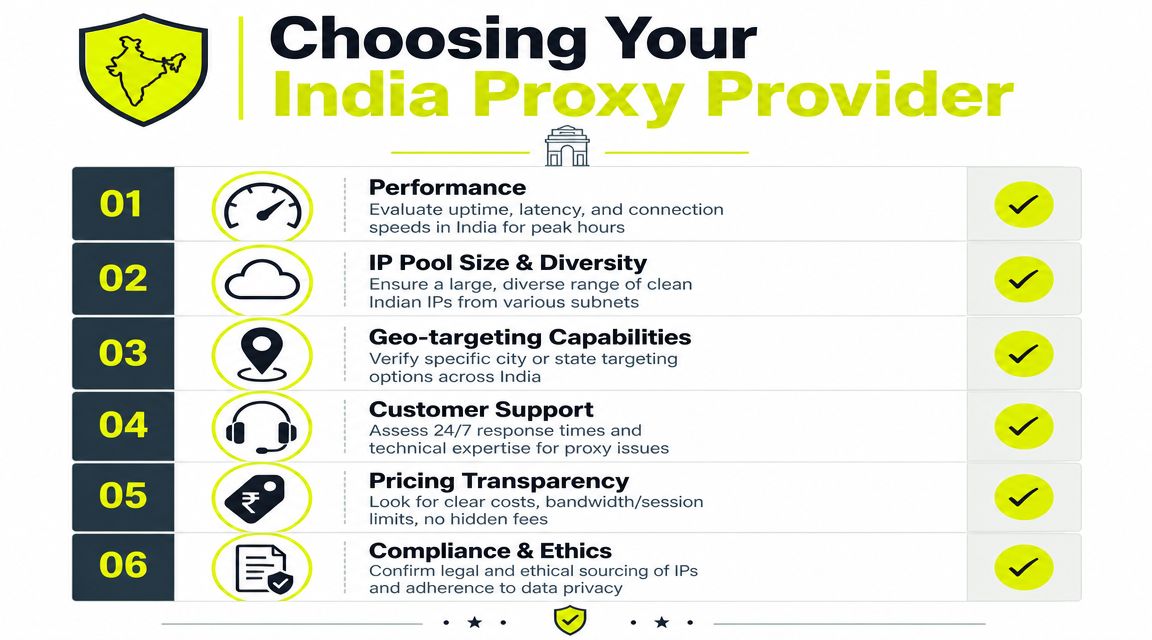
Location beats country-only routing
A provider that only offers “India” as a country bucket is already limiting you. Indian endpoints are concentrated in major hubs, and performance varies a lot between them. One proxy directory lists active endpoints across Bengaluru, Agra, Gurugram, Nalgonda, Panipat, Mumbai, Salem, and Pune, with sampled response times from 938 ms to 2,532 ms and uptime readings from 90% to 100%. The same source notes that Asia-Pacific accounted for nearly 33% of global proxy traffic in 2024, which reinforces how crowded and competitive routing can be in the region. That data appears on Proxy5's India proxy listing.
If you're verifying localized offers or campaign delivery, that variation matters. Mumbai isn't the same as Pune. Bengaluru isn't the same as Delhi. City targeting gives you cleaner QA and better troubleshooting when a campaign underdelivers in one pocket of traffic.
Session control matters more than dashboards
A polished dashboard doesn't matter if session logic is bad.
For media buying work, check these points first:
- Sticky session support: You need this for Facebook, TikTok, and aged social accounts. One browser profile should keep one stable identity.
- Rotation control: For scraping, ad checks, or marketplace monitoring, forced rotation can help. For account work, forced rotation can wreck trust.
- Auth options: User:pass works well for distributed teams and antidetect browser imports. IP whitelisting works when your ops environment is fixed. It is common for both to be needed.
- Subnet diversity: If too many IPs come from the same narrow range, one platform sweep can damage a whole batch of profiles.
If a provider can't explain how sessions persist, how rotation triggers, and how geo selection works, don't put real accounts on it.
What I check before buying
I treat provider selection like risk control, not procurement. The checklist is simple.
- Start with one real workflow: Test an actual Facebook login, TikTok warm-up, or cloaked lander review path. Synthetic speed tests don't tell you enough.
- Check city availability: Country-level India routing isn't enough for serious ad verification.
- Inspect profile compatibility: The proxy should import cleanly into AdsPower, Dolphin Anty, GoLogin, Multilogin, and Hidemyacc without weird auth failures.
- Watch support quality: You don't need marketing replies. You need someone who can tell you whether the issue is session stickiness, endpoint health, auth config, or target-side blocking.
If you want a benchmark for what features to compare, Sota's write-up on what makes a strong residential proxy service is a decent buying checklist.
Advanced Use Cases for Traffic Arbitrage and Account Farming
A campaign looks clean from your office IP, then starts throwing complaints from the India team within hours. The ad served, but the wrong prelander loaded in Chennai. The Play Store page was unavailable on one carrier route. The cloaked review path looked fine to compliance, while the live path showed a different offer. This is the part of media buying where India proxies stop being a checkbox and start acting like risk control.
Ad verification and geo-targeted campaign checks
For arbitrage, local verification is about catching expensive mismatches before the platform catches them for you.
Open the full flow through an India profile and check what renders after the click, not just whether the page loads. I usually verify four things first:
- Creative delivery on Facebook, TikTok, or the native network you are buying from
- Prelander language and variant selection
- Redirect behavior on moderation paths versus user paths
- Store or app page availability from the same route family as the traffic
This matters even more on cloaked offers. If the review path and the monetized path are not being checked from the same country and session type, you can approve a funnel that later fails moderation, under-delivers, or starts throwing policy flags because the platform saw something different from what your QA saw.
Account farming with antidetect browsers
For account farming, stable identity mapping beats raw proxy volume.
The setup is simple on paper. One browser profile in AdsPower, Dolphin Anty, GoLogin, Multilogin, or Hidemyacc. One sticky India residential session assigned to that profile. One account family tied to that environment for its full life unless something gets burned.
The mistakes that trigger checks are usually operational. A buyer clones profiles too aggressively, rotates the IP between warm-up sessions, changes billing details right after first login, or shares one asset across profiles that should never touch each other. Then the proxy gets blamed, even though the core issue is that the account history, browser fingerprint, and network identity stopped matching.
Warm-up should look dull. Scroll feeds. Visit normal pages. Let cookies build. Delay high-risk actions such as card changes, BM invites, page creation, or launching spend-heavy campaigns. If you need a practical reference for reducing bans during automation and high-frequency account work, this guide on how to avoid IP bans in automation-heavy workflows matches the way experienced ops teams handle exposure.
Localization, pricing checks, and route-sensitive QA
India traffic is fragmented enough that city and route checks often change what you find.
For ecommerce, app installs, travel, and lead gen, I use India proxies to test whether users in different locations receive different versions of the same offer. Oxylabs notes city-level targeting options for India on its India proxy page, which is the practical requirement here. Country-level routing is often too broad if you are checking ad delivery, localized pricing, or app availability.
Useful checks include:
- Travel fares and booking offers
- Install promos and app store visibility
- Lead form incentives and payout pages
- Language or pricing changes across cities
- Carrier-specific load issues on mobile flows
The point is not curiosity. It is margin protection. If Mumbai users see a higher price, if Bengaluru routes hit a different app listing, or if a payment step fails only on one local path, your EPC drops before the dashboard tells you why.
One more operational note. Teams that manage proxy-backed account setups for clients often fold infrastructure into their service margin. Some providers, including Sota Proxy, also offer a referral program. That only matters if you are already standardizing stacks across buyers or onboarding new account operators. It should never drive the proxy decision. Session quality, location accuracy, and profile stability come first.
Integrating and Testing Your India Proxy Setup
A good proxy still fails if you load it into the browser profile the wrong way. Most problems come from bad profile hygiene, not from the IP itself.
Add the proxy to the browser profile correctly
In AdsPower, Dolphin Anty, GoLogin, Multilogin, or Hidemyacc, import the proxy exactly as issued by the provider. Usually that means host, port, username, and password. Pick the right protocol. Save it to a dedicated profile, not a shared template you clone blindly.
Then match the rest of the browser profile to the use case:
- For Facebook and TikTok account work: use sticky sessions and keep timezone, language, and device logic coherent.
- For scraping or QA: rotating sessions are usually fine.
- For mobile-first flows: don't pair a mobile-looking use case with a desktop-heavy, sloppy fingerprint.
If you need a browser-level reference for manual proxy setup outside antidetect tools, Sota has a plain guide to proxy settings in Firefox.
Run a clean verification pass before logins
Don't log into anything important until the proxy passes a basic check inside the actual browser profile that will be used.
I check four things:
- Location consistency: The profile should resolve to the intended Indian location, not just “somewhere in Asia.”
- Session stability: Refresh a few times and confirm the IP behaves the way you configured it.
- Leak sanity: DNS, WebRTC, and general browser signals shouldn't contradict the proxy route.
- Target access: Open the actual destination, whether that's Facebook, TikTok Ads, a payment flow, or an app-store page.
A proxy that passes a dashboard test but fails inside the antidetect profile is not tested.
Run this before cookies, before account import, and before any warm-up actions. That order saves accounts.
Fix the three failures that waste the most time
1. Connection failed
This is usually boring. Wrong credentials, wrong protocol, expired IP authorization, or a dead endpoint. Re-enter the credentials manually once. If it still fails, test another endpoint before touching the browser fingerprint.
2. The IP works but the platform challenges the account
That's often a trust mismatch, not a dead proxy. The profile may have a bad fingerprint, the session may be rotating when it shouldn't, or the account may already be under review pressure. Swap only one variable at a time. Don't rotate IP, replace cookies, and clone a new profile all at once or you lose the signal.
3. The route is too slow
Slow doesn't always mean unusable. It depends on the job. A slower residential route can still be the right choice for a valuable Facebook asset if the session remains believable. For scraping or large QA batches, move that workload to a datacenter or rotating residential pool and keep account sessions on cleaner sticky IPs.
One more thing. Keep separate proxy groups by mission:
- Account management pool
- Ad verification pool
- Scraping and parsing pool
- Backup replacements for burned sessions
That separation prevents a problem in one workflow from contaminating the rest.
Operational Best Practices and Final Buying Advice
Cheap proxies look efficient until they start burning accounts, delaying launches, and corrupting your test data. For serious operators, proxy spend is a control layer. It protects ad accounts, warmed profiles, and time.
The best buying decision usually isn't the lowest rate. It's the provider whose routing, session logic, city targeting, and support fit your exact workflow. If you run Facebook and TikTok accounts through antidetect browsers, stable residential or mobile sessions matter more than raw speed. If you scrape public pages at volume, datacenter capacity may matter more than trust. Keep those jobs separate.
I'd also stay disciplined about platform risk. Proxies are useful for verification, localization checks, account isolation, and data collection. They don't cancel platform rules, and they don't fix reckless account behavior. Most bans come from stacked signals. Bad IP choice is just one of them.
If you're testing vendors, start small. Run one campaign QA flow, one farming batch, and one city-level localization check. Judge the result by account stability, login friction, and how much manual cleanup your team has to do after a week.
If you need one platform to cover residential, mobile, ISP, and datacenter proxies for India-focused account management, ad verification, scraping, and city-level targeting, Sota Proxy is one option to evaluate. It supports rotation and sticky sessions, works with common antidetect browser workflows, and fits teams that want one dashboard for testing, scaling, and replacing IPs without rebuilding the whole stack.
Related articles
Proxy Servers Nederland: A Guide for Marketers & Farmers
A technical guide to using proxy servers nederland for performance marketing and account farming. Learn to choose, configure, and manage Dutch IPs.

Secure Your Ads: Avoid a Free Rotating Proxy in 2026
A free rotating proxy poses major risks to Facebook/TikTok ads and antidetect browsers. Understand the security dangers and why paid proxies are essential for
Effective Proxy IP Rotation: Avoid Blocks in 2026
Master proxy IP rotation for web scraping, arbitrage, and account farming. Learn strategies, implementation, and best practices to avoid blocks in 2026.

Proxy for Google Ads: The Technical Operator's Guide
A technical guide to using a proxy for Google Ads. Learn to choose IPs, manage sessions in AdsPower/GoLogin, and run multi-account campaigns without detection.
White Page in Affiliate Marketing: Why You Need It and How It Works with Cloaking
What a White Page, an Offer Page and a cloaker are, how the cloaking setup works, and why it can end with a banned ad account. Plus a checklist of what to verify on your white page before launch.

Rotating Datacenter Proxies: A Technical Operator's Guide
A no-fluff guide to rotating datacenter proxies. Master rotation mechanics, configuration, and use cases for ad accounts, scraping, and antidetect browsers.