Indonesia Proxy Server: A Technical Guide for Ad Ops
A technical guide to using an Indonesia proxy server for ad verification, account farming, and scraping. Compare residential, mobile, and datacenter IPs.

You're probably dealing with one of two problems right now. Either your Indonesia-targeted Facebook or TikTok setup keeps burning accounts because the IP footprint looks wrong, or your ad verification stack says one thing while users in Jakarta see something else.
That's where an Indonesia proxy server stops being a generic infra purchase and becomes an operational control point. For traffic arbitrage teams, account farmers, cloaking setups, and geo-targeted campaigns running through AdsPower, Dolphin Anty, GoLogin, Multilogin, or Hidemyacc, proxy quality decides whether the browser profile survives, whether the ad account stays warm, and whether your checks reflect the actual market.
Table of Contents
- Why Indonesia Proxies are Mission-Critical for Automation
- Choosing Your IP Type Residential vs Mobile vs Datacenter
- Performance and Geotargeting Considerations
- Core Use Cases for Indonesia Proxies
- Proxy Configuration Best Practices for Technical Teams
- Evaluating Indonesia Proxy Providers
- Troubleshooting Common Connection and Block Issues
Why Indonesia Proxies are Mission-Critical for Automation
Indonesia isn't a niche geo anymore. It's a serious operating zone for ad ops, social scaling, and regional automation. The Indonesia proxy market has at least 3.2 million unique IP addresses, and Jakarta alone has over 1,000 IPs reported by some providers, which tells you two things fast. First, supply is deep enough for serious rotation. Second, Jakarta is the center of gravity for proxy-driven arbitrage and social account operations in the region.
That matters because high-stakes workflows fail in very specific ways. Facebook ad accounts trigger risk reviews when a login comes from an IP that doesn't fit the browser profile. TikTok creative checks break when the IP says one place and the delivery environment behaves like another. Account farming burns faster when multiple profiles share the same weak subnet pattern or low-trust proxy source.
Operational problems an Indonesia proxy server solves
For practitioners, the job isn't “hide my IP.” It's closer to this:
- Keep account identity stable: One browser profile in AdsPower or Multilogin needs one believable network identity.
- Verify what users see: Media buyers checking Indonesian ad delivery need local routing that matches the target city.
- Scale account creation carefully: Farming operations need enough IP depth to avoid linking clusters of Facebook and TikTok accounts.
- Support cloaking checks: Review-path testing only works when the proxy path resembles the audience path.
Practical rule: If your proxy layer can't support the same geography, session logic, and trust level your browser fingerprint claims, the platform will usually find the mismatch before your campaign gets stable.
A lot of teams overfocus on speed. Speed matters, but trust is what keeps the operation alive. A clean Indonesia proxy server gives you room to separate accounts, localize ad checks, and run geo-targeted campaigns without forcing every workflow through the same noisy infrastructure.
Choosing Your IP Type Residential vs Mobile vs Datacenter
If you're running Facebook and TikTok ad accounts, the wrong IP type costs more than the right one. It costs accounts, warmup time, and analyst hours. The practical choice isn't about theory. It's about what each IP type survives.

What each proxy type is actually good at
The cleanest comparison for operators is detection risk versus speed.
According to this residential vs datacenter proxy comparison, datacenter proxies average 180ms response times but are flagged 42% of the time, while residential proxies average 420ms and are flagged only 3.8% of the time. The same source states that mobile proxies are even harder to detect, making them highly suited to ad verification and affiliate workflows on Instagram, TikTok, and Facebook.
That maps cleanly to real usage:
| Proxy type | Best fit | Main upside | Main downside |
|---|---|---|---|
| Residential | Account management, warm accounts, scraping defended targets | Better trust profile | Slower than datacenter |
| Mobile | TikTok checks, Facebook recovery flows, strict social tasks | Hardest to detect | Higher cost and less inventory |
| Datacenter | Bulk fetches, low-risk automation, support tasks | Fastest response | Gets flagged more often |
| IPv6 | Targets that accept it cleanly | Large address space | Uneven support across platforms |
Use residential when the account has history you want to preserve. Use mobile when the platform is especially sensitive, or when carrier-level behavior matters for geo-targeted creatives. Use datacenter when the task is disposable, low-trust, or throughput-heavy.
If you want a broader operator-level breakdown of categories, this guide to proxy types for different workloads is a useful reference.
Where IPv6 and ISP proxies fit
IPv6 proxies get overhyped in social ops. They can work for certain scraping or lower-friction targets, but they're not a default answer for Facebook and TikTok account longevity. Platform support, routing behavior, and anti-abuse systems aren't always consistent. If your stack includes antidetect browsers and account farming, IPv6 is usually a test lane, not your main lane.
ISP proxies sit somewhere between datacenter and residential in practical use. They can be stable and fast, which makes them attractive for longer sessions. But for high-risk social actions, residential or mobile proxies are still preferred because the trust model is easier to defend.
Don't pick proxy type by price first. Pick by failure cost. Losing one aged ad account usually hurts more than overpaying for the IP that would've kept it alive.
Performance and Geotargeting Considerations
Most proxy failures in Indonesia-targeted campaigns aren't raw connection failures. They're mismatch failures. The page loads, but the wrong creative appears. The account logs in, but trust drops. The cloaked page resolves, but not the same way a local user would see it.
Latency matters less than match quality
For social and verification work, the important question is whether the IP behaves like a believable local user. Indonesia residential proxies use IPs assigned by local ISPs, support city-level targeting such as Jakarta and Surabaya, and their rotating mechanism can reduce block rates by 60–70% on Facebook and TikTok by mimicking real user behavior.
That block-rate reduction matters more than shaving a bit of response time off a request. On paper, a faster proxy looks attractive. In production, an IP that gets challenged or flagged burns more time than a slightly slower one that clears checks cleanly.
City targeting changes what you actually verify
Indonesia isn't one audience bucket. Jakarta traffic doesn't always mirror Surabaya or Medan in ad delivery, landing page behavior, or local offers. If you're testing geo-targeted campaigns, your verification environment has to match the campaign environment closely enough to expose real issues.
That's where city selection inside a geo-targeting workflow for localized testing becomes practical, not cosmetic.
A workable setup often looks like this:
- Facebook ad review checks: Use a sticky local session that holds long enough to inspect account state, ad rendering, and destination flow.
- TikTok creative validation: Use local mobile or residential exits when the creative or offer changes by carrier behavior or city.
- Cloaking tests: Separate reviewer-path checks from user-path checks. Don't test both from the same IP logic.
- Marketplace scraping: Rotate across local residential exits so product pages and pricing resolve in the same context local shoppers get.
A proxy that lands in the right country but the wrong city can still give you the wrong answer.
For technical teams, performance should be evaluated as a stack. IP quality, city accuracy, session control, and browser fingerprint consistency all shape the result. Looking at speed alone is how teams end up with fast logs and bad data.
Core Use Cases for Indonesia Proxies
The fastest way to judge an Indonesia proxy server is to map it to a workflow you already run. If it doesn't improve that workflow, it's noise.

Multi-account operations in antidetect browsers
For account farming and account management, each browser profile needs its own consistent identity. That means one proxy assignment per profile in AdsPower, Dolphin Anty, GoLogin, Multilogin, or Hidemyacc. Reusing the same exit across multiple Facebook or TikTok ad accounts creates correlation risk even when the fingerprints look separate.
A durable pattern looks like this:
- Warm profiles on sticky sessions: Keep the same IP while you log in, browse, interact, and stabilize the account.
- Separate account tiers: Don't put farmed accounts, spend-heavy ad accounts, and recovery accounts on the same proxy pool.
- Match device logic: A mobile-looking browser profile should not route through an obviously mismatched desktop-style network path.
- Control concurrency: Even good residential pools can look wrong if too many accounts hit the same target in the same pattern.
For ad account teams, this is less about stealth theater and more about reducing obvious linkage. The cleaner the identity bundle, the longer the profile lasts.
Ad verification and cloaking checks
Ad verification is where cheap proxies expose themselves quickly. A buyer wants to know what an Indonesian user sees. That includes the ad, the landing page, the redirect path, and any location-specific variation. For that, teams often use local mobile or residential exits and review the flow inside the same kind of browser environment they use for campaign QA.
If ad verification is a core workflow, this overview of proxy-backed ad verification setups is relevant.
Cloaking adds another layer. You usually need distinct paths for reviewer simulation and user simulation. One profile may test a conservative route. Another may check the money path. If both use the same weak IP source, your test environment contaminates the result.
Here's a walkthrough that fits this use case:
If the proxy path isn't trustworthy enough for the platform, your cloaking logic may never get tested the way you think it is.
Scraping and market monitoring
Scraping Indonesia-facing commerce or publisher properties is a different job. You don't need the same persistence as account farming, but you do need believable request distribution. Rotating residential proxies are usually the safer fit when the target has anti-bot controls, dynamic content, or localized pricing.
A practical scraping stack usually does three things well:
- It rotates often enough to avoid repetitive patterns.
- It keeps headers, browser behavior, and proxy geography aligned.
- It slows down before the target forces a block wave.
Datacenter proxies still have a place here for support tasks. Teams use them for queue workers, non-sensitive fetches, and pre-processing jobs where getting flagged doesn't threaten an asset like an ad account.
Proxy Configuration Best Practices for Technical Teams
Organizations often don't lose accounts because they bought the wrong proxy category. They lose them because the configuration is sloppy. Good infrastructure with bad session logic still fails.

Session strategy by task
Start with the session model. Don't use one rotation rule for everything.
- Sticky sessions for accounts: Use them for Facebook logins, TikTok account nurturing, checkout flows, and any multi-step sequence where identity consistency matters.
- Rotating sessions for collection tasks: Use them for scraping, broad ad checks, and repetitive fetch jobs where fresh IPs lower exposure.
- Short stickiness for verification: If you're checking a campaign path and then moving on, keep the session long enough to finish the flow, then drop it.
- Error-based rotation for brittle targets: When a target starts returning challenges or unusual page states, rotate on failure rather than waiting on a timer.
Teams that want a hands-on reference can use this guide on how to set up proxy sessions and auth flows.
Fingerprint alignment and failure handling
Proxy setup doesn't stop at the endpoint. It has to match the browser profile.
If you're using Dolphin Anty or GoLogin, line up the browser environment with the network story you're telling. A mobile campaign check should look mobile end to end. A local desktop shopping session should not carry weird timezone, language, or transport mismatches. The proxy doesn't create trust by itself. It supports trust when everything else is coherent.
Use this short checklist:
- Authentication choice: User and password is easier when the team works from changing locations. IP whitelisting is cleaner in fixed server environments.
- Protocol selection: Use the protocol your tool handles reliably. Don't force a browser or bot framework into a mode it handles poorly.
- Header discipline: Keep user-agent, language, and related browser-level signals consistent with the task and device model.
- Retry logic: Retry with intent, not panic. A loop that hammers the same failing target usually escalates blocks.
- Rate control: Respect limits. Even strong Indonesian IPs will get burned if the request pattern is robotic enough.
Field note: Most “bad proxy” complaints are really “bad proxy plus bad fingerprint plus bad retry behavior.”
For technical teams, the best practice isn't complexity. It's clean separation. Separate account classes, separate session policies, separate testing goals.
Evaluating Indonesia Proxy Providers
When you evaluate providers, don't start with the homepage promise. Start with the failure modes you can't tolerate. For media buyers and account operators, that usually means inaccurate geo, unstable sessions, poor session controls, and support that disappears when something breaks.

What to check before you buy
A provider is usable when it gives you enough control to run your workflow without hacks.
Look for these criteria:
- Indonesia pool depth: You need enough local inventory to avoid crowding the same subnet patterns.
- Proxy mix: Residential, mobile, datacenter, and ideally ISP options should exist if your workflow spans social, scraping, and QA.
- Session controls: Sticky and rotating modes should be easy to select without support tickets.
- Protocol support: HTTP and SOCKS5 flexibility matters because different tools behave differently.
- Geo granularity: City-level targeting matters if you verify localized creatives or offers.
- Dashboard clarity: Usage visibility, credential management, and quick replacement flows save operator time.
A rotating-focused benchmark to compare against is this guide to evaluating the best rotating proxies.
Why free proxies fail in production
Free Indonesia proxies look cheap until you put them into a real operation. Then they become labor costs.
According to this free Indonesia proxy data page, free Indonesia proxies average 2630ms latency and expire within 11 minutes on average, which makes them a bad fit for traffic arbitrage, account management, and any workload that depends on stable response times and continuous operation.
That failure shows up in familiar ways:
- Ad checks time out: The page loads too late or breaks mid-flow.
- Antidetect sessions die: The proxy disappears and the account sees a sudden network shift.
- Operators babysit infra: Someone keeps swapping endpoints instead of managing spend or creatives.
- Cloaking tests become noisy: You can't trust the result if the network path keeps collapsing.
If you recommend tooling to other buyers or teams, referral economics can matter too. Some providers build partner programs into that motion. For example, Sota Proxy offers a referral and affiliate program with up to 40% commission, which can make sense for agencies, team leads, or community operators who already send proxy recommendations to their network.
Troubleshooting Common Connection and Block Issues
A broken proxy workflow usually leaves clues fast. The mistake is treating every failure like the same problem.
When authentication or routing breaks
If you hit a 407 authentication error, check credentials first, then confirm the tool is using the expected auth method. Antidetect browsers and bot frameworks sometimes cache old settings, so the profile may still be trying stale credentials even after you update the proxy entry.
If requests connect but the target sees the wrong location, test the proxy in the exact environment you use for the task. Browser-level settings, profile timezone, and language setup can all distort what looks like a geo problem.
Use this sequence:
- Validate the proxy in isolation: Confirm the endpoint works before blaming the browser profile.
- Test inside the actual tool: AdsPower, GoLogin, or Multilogin may introduce mismatches the raw endpoint test won't show.
- Compare session behavior: Sticky sessions that unexpectedly rotate often point to a provider-side setting or a profile misconfig.
- Lower concurrency: If multiple workers fail at once, the issue may be rate pressure rather than a dead proxy.
When the platform starts flagging sessions
If Facebook or TikTok starts pushing checkpoints, CAPTCHAs, or unusual verification flows, don't just swap to another proxy and repeat the same behavior. Check whether the browser fingerprint, account age, and action pattern still make sense together.
The fastest recovery pattern is usually simple:
- Pause risky actions: Stop bulk edits, launches, or farm actions on the affected profiles.
- Move to cleaner session logic: Keep the IP stable for recovery attempts.
- Reduce automation noise: Lower action speed and remove repetitive sequences.
- Split the pool: Don't send healthy accounts through the same exits that just got flagged.
A solid Indonesia proxy server helps, but it won't rescue a bad operating pattern by itself. Teams that keep accounts alive usually do one thing well. They treat proxy choice, browser identity, and action pacing as one system, not three separate tools.
If you need infrastructure for Indonesia-focused ad verification, account management, scraping, or geo-targeted campaign checks, Sota Proxy is built for that kind of workload. It offers residential, mobile, ISP, and datacenter proxies, city-level targeting, rotation and sticky session controls, plus support for teams running antidetect browsers and high-volume automation.
Related articles

What a Multi-Accounting Stack Actually Costs in 2026
Real monthly numbers for 10, 50 and 200 accounts: antidetect profiles, proxies, numbers, cloud phones and card fees, with the one line item that eats three quarters of the budget.
How OnlyFans Agencies Run 20 Creator Accounts Without Linking Them
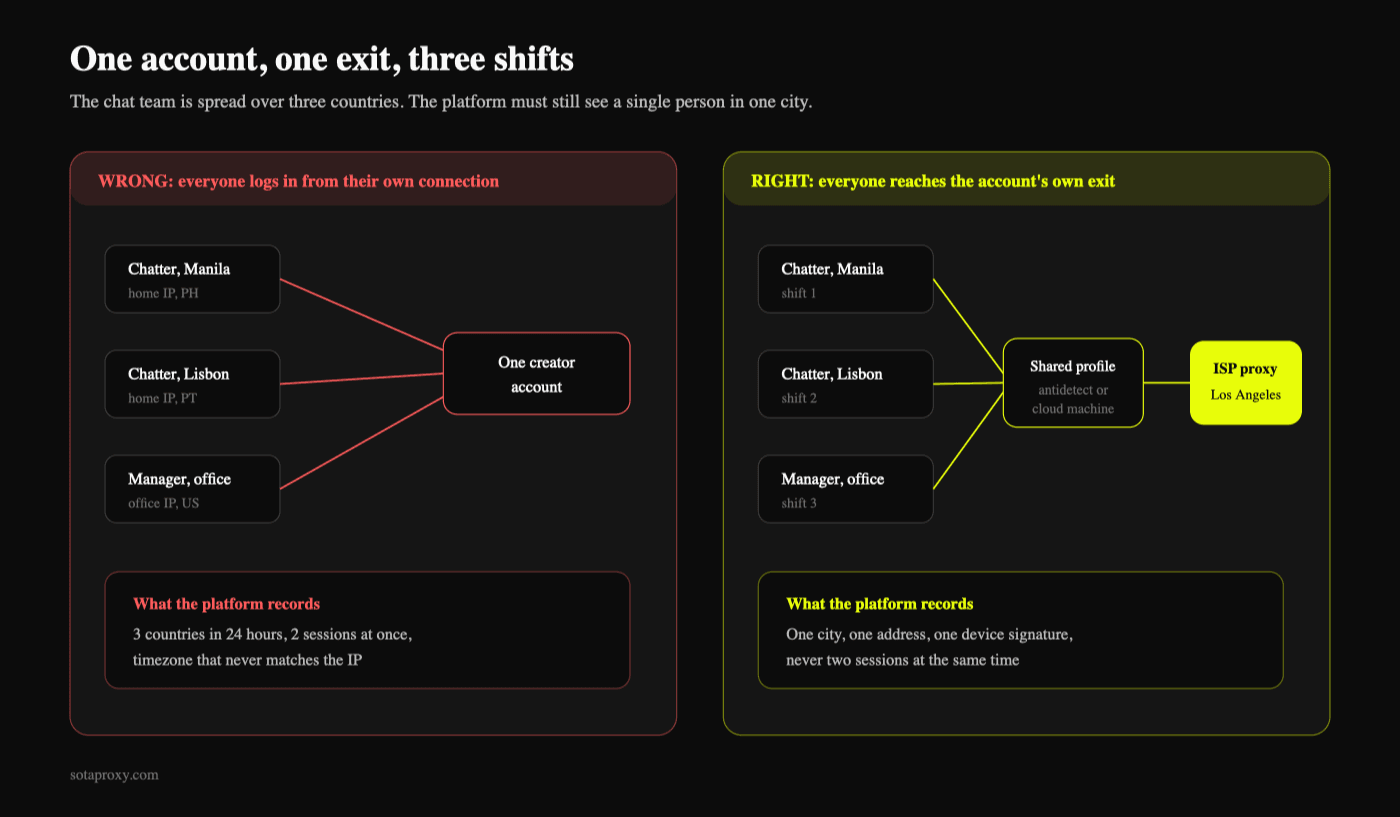
What actually links creator accounts, which proxy type each one needs, how chatters in three countries share a single login, and what the isolation layer costs next to a 20 to 50 percent agency share.

Buy Proxies for Geo Surfing That Actually Work
Learn how to buy proxies for geo surfing the right way - choose types, target cities, configure antidetect browsers and validate geo results.

How to Build an Advertising Traffic Protection Infrastructure with CloakingHouse and SotaProxy
Learn how to build a reliable ad traffic stack with proxies, browser profiles and cloaking for GEO testing, filtering and campaign troubleshooting.

Fingerprint Spoofing: Methods, Detection, and Antidetect Use
Learn how fingerprint spoofing works, the methods used to bypass detection, and how antidetect browsers with proxies manage multi-account operations safely.
What Is Sticky Session: A Technical Guide for Proxy Users
Learn what is sticky session, how session affinity works in load balancers and proxies, and when to use it for multi-accounting, scraping, and ad campaigns.