Refer a friend: you earn 15% of every order, they get 10% off

Proxy Server to China: The Media Buyer's Setup Guide

Set up a proxy server to China for traffic arbitrage and account farming. This guide covers proxy types, antidetect browsers, and performance optimization.

June 1, 2026
17 min read
Proxy Server to China: The Media Buyer's Setup Guide

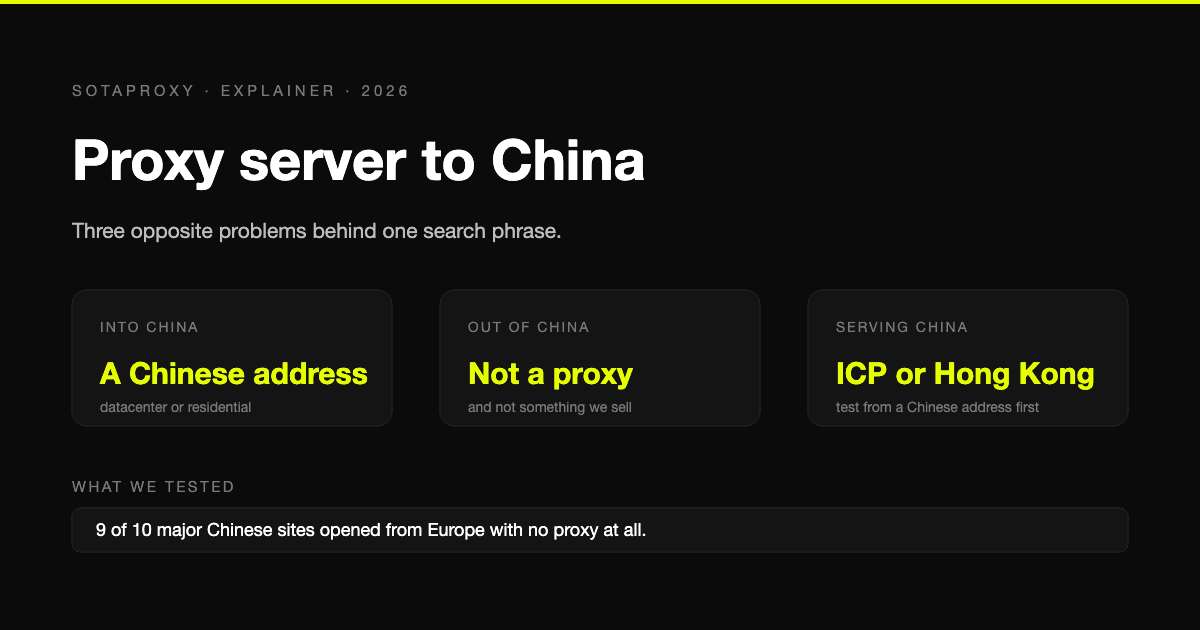
Your campaigns look fine in the dashboard, then the China-facing side starts falling apart. Logins turn unstable. TikTok or Facebook ad accounts ask for extra checks. Scrapers slow down for no obvious reason. Browser sessions that were clean yesterday start failing today. Often, the proxy is the first component blamed. Sometimes that's right. Most of the time, the problem is the whole stack.

A proxy server to China isn't just a country switch. If you're running geo-targeted campaigns, ad verification, account farming, cloaking flows, or multi-account operations in AdsPower, Dolphin Anty, GoLogin, Multilogin, or Hidemyacc, you need four things lined up: the right IP type, a browser profile that matches it, a protocol that survives the Great Firewall, and a testing routine that catches failures before platforms do.

Teams that skip one layer usually get the same result. Sessions work briefly, then decay under review traffic, automation load, or repeated logins.

Table of Contents

Why Standard Proxy Setups Fail in China

A common failure pattern looks like this. The account logs in on day one from a China IP, warms without trouble, then starts throwing review prompts, partial page loads, or broken sessions after a browser restart. The proxy did its small part. The rest of the stack did not match it.

Standard setups fail in China because they treat geolocation as the main requirement. In practice, stable delivery depends on four layers lining up at the same time: the IP class, the browser fingerprint, the transport protocol, and the account behavior attached to that identity. If one layer drifts, the setup may still connect, but it stops holding trust.

For operators running Facebook, TikTok, e-commerce accounts, or collection jobs against China-facing properties, the symptoms are usually inconsistent rather than cleanly broken. A login succeeds but the session does not survive revisit. The target site opens, but action pages stall or load unevenly. A scrape starts with acceptable speed, then throughput falls off after a short burst. In our experience, teams that skip browser-proxy matching or route weak traffic through the wrong protocol see these patterns within the first few days of use.

The problem isn't only the IP

A proxy server to China has to clear two different checks.

First, the route has to stay usable through China's network conditions. Second, the identity presented to the platform has to make sense. Those failures look similar from the outside, which is why many operators waste time changing IPs when the actual issue is fingerprint mismatch, protocol choice, or session handling.

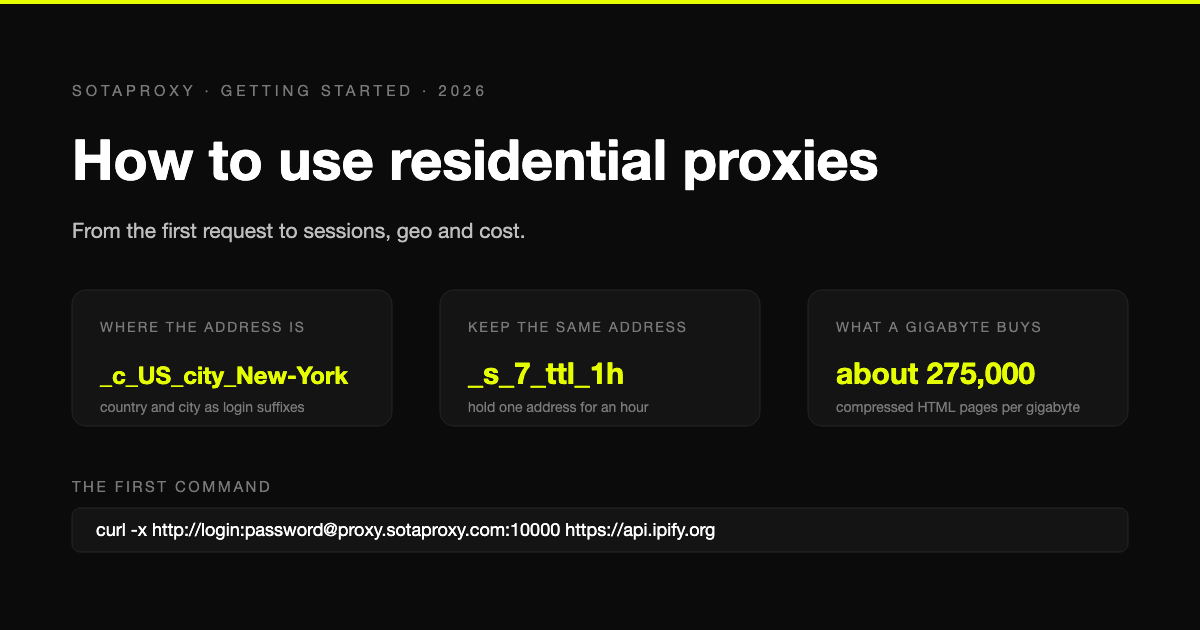
This is also why public or low-control endpoints disappoint so often. They may satisfy the location check once, then collapse under repeat logins, reviewer traffic, or concurrent requests. If the workflow depends on stable cookies, durable sessions, or repeat access from the same profile, a generic list-based setup usually burns more accounts than it saves. For a baseline on how residential routing fits these workflows, see this guide to using residential proxies for session-based operations.

Practical rule: If the setup only solves for region, expect the next failure to come from platform trust or route stability.

What holds up

The setups that last are built as a stack, not a single proxy purchase. The IP has to match the job. The browser profile has to match the IP's device and region story. The protocol has to fit the route, especially on traffic that needs to stay quiet and consistent. Testing has to separate network failure from platform rejection.

That trade-off changes by workflow. For account farming and ad account maintenance, session durability matters more than raw speed. For cloaked or geo-targeted review paths, the reviewer route, visible content path, and browser identity must agree. For scraping, concurrency has to be capped to what the route can survive, because weak China paths often fail from pressure long before they fail from blocks.

A setup that works once is not useful. The standard is repeatable survival through logins, retries, browser restarts, spend changes, reviewer visits, and controlled rotation. That is the difference between a proxy that connects and an operating stack you can trust for long-running China campaigns.

Selecting the Right China Proxy Type for Your Workflow

Picking the wrong proxy type causes downstream problems you can't clean up with browser tweaks. If the IP class doesn't fit the job, AdsPower or GoLogin won't save it.

The China market makes this harder because the residential supply side is broad and messy. A major academic study identified 9,077,278 residential proxy IPs, with 4,661,934 located in China across 399 proxy services, and reported that 96.70% of those IPs weren't covered by public residential-proxy datasets at the time. That tells you two things. The market is huge, and public visibility into it is poor academic study of residential proxies in China.

What operators actually need from the IP

Media buyers and account operators care about a few practical outcomes:

  • Platform trust: Can the IP pass normal login, spend, and review flows on Facebook, TikTok, and e-commerce platforms?
  • Session durability: Does the session survive over time, or does the identity fall apart on revisit?
  • Rotation control: Can you decide when to rotate, instead of losing sessions unexpectedly?
  • Cost per usable account: Cheap IPs get expensive when they burn profiles.

China Proxy Type Use Case Matrix

Proxy Type Primary Use Case Trust Score Session Stability Cost
Residential Ad verification, scraping, geo-targeted campaigns, moderate-risk account work High when the IP quality is good Good with sticky sessions, weaker on frequent rotation Medium to high
Mobile Account farming, warm-up flows, high-trust social activity, sensitive login paths Very high for many social workflows Strong for long sessions when managed carefully High
Datacenter Low-risk automation, tooling access, non-sensitive routing tasks Low for major social platforms Stable technically, weak on trust Low
IPv6 proxies Niche scraping and network-specific tasks Context-dependent and often weak for social trust Varies heavily by target Usually low to medium

Where each proxy type fits

Residential proxies are the default starting point for most China-facing operations. They fit ad verification, localized scraping, regional storefront checks, and some account actions where you still need believable consumer traffic. If you want a deeper operational primer on sticky versus rotating pools, this guide to using residential proxies covers the practical mechanics.

Mobile proxies make more sense when account trust matters more than volume. For account farming, aged profile maintenance, and repeated app-like behavior, mobile traffic patterns often hold up better. They're not magic. Bad behavior still gets caught. But if you're building TikTok or Facebook account inventories, mobile usually gives you more room than cheap datacenter stock.

Datacenter IPs can be technically clean and still fail the only test that matters, whether the platform believes the session.

Datacenter proxies are fine for support roles. Use them for internal tools, content checks, non-sensitive crawling, or staging. Don't build a serious China account farm on them unless you already know the target platform tolerates that footprint.

IPv6 proxies are situational. They can work for some scraping paths and lower-friction targets, but they often create compatibility and trust issues in social workflows. If your monetization depends on account survival, IPv6-only thinking usually adds noise you don't need.

The simple rule is this. Use mobile for trust-heavy account work, residential for broad operational coverage, datacenter for cheap utility traffic, and IPv6 only when the target workflow clearly supports it.

Configuring Proxies with Antidetect Browsers

A common mistake leads to trust being lost at the browser layer, not the proxy layer. Users who import a China proxy into AdsPower, Dolphin Anty, GoLogin, Multilogin, or Hidemyacc often leave timezone, language, WebRTC, and profile history in a generic state. That creates a split identity. The IP says one thing. The browser says another.

A person using a laptop with six browser profiles displaying different IP addresses and locations worldwide.

Antidetect vendors themselves make this point clearly. A proxy only spoofs the IP. It doesn't spoof the whole browser fingerprint or user behavior, so platforms can still correlate device signals and login patterns if the rest of the profile doesn't match antidetect browser guidance on China proxies and fingerprinting.

Match the browser profile to the proxy

If you're using a Shanghai exit, don't build a profile that looks like a generic English-language desktop from somewhere else. That mismatch gets obvious fast.

The profile needs internal consistency across:

  • Timezone: Match the proxy's region. Don't leave auto-detect disabled with a conflicting value.
  • Language stack: Browser language, OS language preference, and content locale should fit the account story.
  • WebRTC handling: Don't leak a different network path than the proxy path.
  • User agent and hardware profile: Keep them believable for the device type you're simulating.
  • Cookie history and session reuse: New IP plus old behavioral residue is a common kill switch.

A workable profile setup flow

In AdsPower, Dolphin Anty, or GoLogin, a repeatable flow looks like this:

  1. Bind one clean proxy to one browser profile. Don't hot-swap proxies into a warmed profile unless the account already has a reason to travel.
  2. Set region signals before first login. Timezone, language, geolocation handling, and fonts should match the intended story.
  3. Run a warm-up path. Open region-consistent sites, let the browser settle, then touch the target platform.
  4. Log the session result. Note whether failures happen on connect, login, challenge, review, or later spend activity.
  5. Keep sticky sessions for trust-heavy work. Rotation is useful for scraping. It often hurts account maintenance.

For teams training new operators, the short video below gives a good visual reference for profile handling and browser workflow.

What breaks trust fast

Some mistakes burn profiles even when the proxy itself is fine.

  • Frequent IP swaps inside one profile: That looks like account sharing or session theft.
  • Mismatch between ad account market and device signals: A Chinese IP with an unrelated locale stack can trigger reviews.
  • Over-automation on first touch: Fresh profile, fresh IP, instant bulk actions. That's a bad sequence.
  • Shared browser templates across many accounts: Reused fingerprints create linkability.

A clean proxy with a bad profile is still a bad setup.

For cloaking operations, this matters even more. The reviewer session has to see a coherent environment. If the browser profile is messy, your page logic can be perfect and the account still gets pulled into review trouble.

Optimizing Protocols and Cloaking for China

The transport layer decides whether your setup survives long enough to matter. China-facing traffic isn't just about speed. Detectability matters more.

Recent censorship research shows the Great Firewall can passively detect and block fully encrypted proxy traffic in real time. The same study reported forged DNS responses using 1,781 IPv4 and 1,799 IPv6 addresses, and found that only 41,000 of 311,000 domains matching blocking regexes were innocuous. The practical takeaway is simple: naive endpoints, fixed signatures, and static DNS assumptions break at scale USENIX research on passive proxy detection and DNS forgery.

The protocol decision that matters

For connectivity into mainland China, the most practical pattern is a TCP-based, heavily obfuscated tunnel on port 443. Keep protocol rotation in reserve. Don't rotate just because you can. Rotate when detection or path degradation tells you the current signature is aging out.

That's where protocol choice stops being theory and starts affecting account survival.

A scenic view of a rushing stream flowing into a large, calm lake under a clear sky.

How to map protocol choice to workload

A protocol benchmark from April 2026 across Shanghai, Beijing, and Shenzhen reported VLESS-Reality-Vision at 160–210 ms latency with 9/10 stealth and 95% uptime, while Hysteria2 showed 110–150 ms latency with 7/10 stealth and moderate resistance to filtering China protocol matrix benchmark.

That tradeoff maps cleanly to real operator tasks:

  • Use VLESS-Reality-Vision for long-lived browser sessions, account farming, login-heavy workflows, and blackouts when the environment is tightening.
  • Use Hysteria2 for interactive work where latency matters more, such as fast tooling access, some live debugging, or time-sensitive content checks.
  • Be careful with UDP-oriented options when conditions tighten. They can perform well on some networks, then degrade when filtering becomes stricter.

If you're evaluating transport options, a practical reference on SSL proxy server setups helps frame why HTTPS-like traffic patterns still matter operationally.

Higher speed is useless if the route gets identified before the session matures.

Cloaking rules that don't sabotage the route

Cloaking teams often over-focus on the page logic and under-focus on the route quality. That's a mistake. If your reviewer path arrives through a weak protocol or a noisy IP class, you create extra review pressure before the landing page even loads.

For Facebook and TikTok campaigns, keep these rules tight:

  • Separate account survival from campaign delivery. Don't run the same protocol profile for farmed assets and high-churn review traffic.
  • Keep region logic coherent. The proxy region, browser locale, and offer targeting should tell the same story.
  • Avoid fixed connection signatures. Reused signatures make repeated reviewer hits easier to correlate.
  • Watch probe-induced failures. Some routes fail only after attention lands on them.

One practical cost angle matters here. Running multiple premium routes across account pools adds overhead. Some teams offset part of that by using provider partner programs. Sota Proxy, for example, offers a referral program with up to 40% commission, which can help finance higher-stealth routing for larger operations.

Performance Testing and Troubleshooting

When a China setup breaks, random changes make it worse. You need to identify whether the problem is the IP, the route, the protocol signature, DNS tampering, or the platform itself.

Check the failure in the right order

Start with reachability, then move upward. If you reverse that order, you'll mislabel network failures as platform flags and burn good accounts during testing.

A useful first pass looks like this:

  • Latency and route quality: Check whether the path is merely slow or truly unstable. High delay by itself isn't the same as blocking.
  • Session consistency: Compare the same workflow in the same browser profile across repeated attempts. If the result changes wildly, suspect the route first.
  • Platform challenge behavior: If the site loads cleanly but login or spend actions trigger friction, the issue may sit at the trust layer.

A simple troubleshooting runbook

  1. Test the proxy outside the target platform. Confirm the endpoint is reachable and not just technically alive.
  2. Re-run on port 443. China-facing traffic often behaves better when the transport blends into expected HTTPS patterns.
  3. Change the protocol before changing the account. If a profile suddenly degrades across multiple clean accounts, the route may have become detectable.
  4. Check for DNS weirdness. Static assumptions break badly in this environment, especially when tampering appears mid-session.
  5. Only then rotate the IP. Rotating too early can hide the actual cause and contaminate more profiles.

Don't call it a bad proxy until you've ruled out protocol detection and DNS interference.

If you're running scraping or ad verification, keep a small canary pool. Use it to test route health before you push production jobs. For account farming, maintain a separate canary set of low-value profiles. That gives you a way to test browser, proxy, and protocol changes without risking core assets.

The goal isn't to eliminate failure. China-facing routes will fail sometimes. The goal is to fail in a way you can classify quickly.

Navigating Legal and Platform Compliance

For most operators, the immediate risk isn't a courtroom problem. It's an account, balance, or campaign continuity problem. Facebook, TikTok, marketplaces, and affiliate networks care about Terms of Service, trust signals, payment behavior, and review outcomes. That's where most losses happen.

The real operational risk

Account farming, cloaking, and aggressive multi-account use create platform risk first. If your infrastructure creates mismatched sessions, strange geography shifts, or repetitive fingerprints, you can lose ad accounts, business managers, stores, or warmed assets long before any broader compliance issue appears.

That changes how you should think about risk. Don't ask only whether a proxy server to China works. Ask whether the setup leaves an audit trail of unstable identity signals. That's what usually kills monetization.

Provider rules matter too

Proxy providers also enforce their own acceptable-use and fair-usage policies. Ignore those and you can lose access to the infrastructure you depend on. That matters for teams running large scraper fleets, bursty campaign checks, or recycled account operations.

The practical move is simple. Separate workloads by risk. Keep social account maintenance, cloaking review paths, scraping, and utility traffic on different pools. That protects both your operation and your vendor relationship.

Building a Scalable Operation for the China Market

A team launches ten new ad accounts for the mainland market on Monday, scales budget on Tuesday, and spends the rest of the week chasing logouts, review holds, and dead sessions. That pattern is common. The failure usually starts long before spend goes up. It starts with infrastructure that was never built for long-running work inside China's network conditions.

Scale comes from consistency. In practice, that means standardizing the full stack before adding more accounts, more spend, or more operators. Proxy selection is only one part of it. Browser fingerprints, session policy, protocol choice, fallback routing, and workload separation decide whether the operation holds together after day 30.

Build the stack in the right order

Start with identity control. A clean antidetect profile tied to the right proxy class will save more accounts than buying a larger pool of random China IPs. After that, lock down transport and routing. Only then does it make sense to expand account volume or campaign budgets.

A diagram outlining a five-step scalable China operation strategy including secure access, routing, and management solutions.

Weak setups create fake scale. They look fine during account creation, then fail under repeated logins, ad reviews, bulk edits, crawler checks, or team handoffs. China-focused operations expose those cracks faster because latency shifts, packet loss, and route instability turn small fingerprint mistakes into repeated trust resets.

Standardize the boring systems

The teams that last treat operations like manufacturing. They use fixed profile templates, fixed naming rules, fixed proxy-to-workload mapping, and fixed recovery steps when a route degrades. Farm traffic should not share the same pool as spend traffic. Scraping should not ride the same identities used for payments, business managers, or store administration.

Keep a runbook. Record which browser build, timezone, language pack, WebRTC policy, and proxy type belong to each account class. Define what happens when a session starts soft failing. Switch route, hold login activity, preserve cookies, and retest from the same browser profile before anyone starts improvising.

If you need a starting point for the infrastructure side, this guide to making a proxy server gives a useful baseline for how teams structure proxy layers before they connect them to browser environments.

Plan for operational slack

Stable China operations need spare capacity. Keep backup routes in reserve. Keep unused warmed profiles. Keep a separate testing pool for landing page checks, QA, and moderation review paths. Without that slack, every outage hits production traffic first.

Cost control matters here. Splitting pools by function raises spend, but it also reduces account loss, review friction, and rework. For media buying teams and automation shops, that trade-off is usually worth it because replacement cost is higher than infrastructure cost once campaigns are live.

If you need a provider for residential, mobile, ISP, or datacenter infrastructure that can fit China-focused automation workflows, Sota Proxy is one option to evaluate. It gives teams centralized proxy management, rotation control, city-level targeting where available, and support for the kind of segmented setups that account farming, ad verification, scraping, and geo-targeted campaign operations usually require.

Related articles