7 Top Proxy Providers for Arbitrage and Scraping
Compare 7 top proxy providers by IP types, targeting, rotation, uptime, pricing signals, and fit for scraping, ad accounts, farming, and arbitrage.
The popular advice is to find one “best” proxy provider and route every workflow through it. That approach fails quickly. Facebook and TikTok ad accounts, account farming, cloaking, scraping, traffic arbitrage, and geo-targeted campaigns stress IP reputation, session duration, rotation, and bandwidth in different ways. The right choice depends on the deployment, not the provider's feature count.
Compare residential, mobile, datacenter, ISP, and IPv6 availability, then check city and ASN targeting, uptime, rotation controls, sticky sessions, billing, support, and compatibility with AdsPower, Dolphin Anty, GoLogin, Multilogin, and Hidemyacc. Residential routes resemble home connections and usually offer stronger trust. Mobile proxies present a carrier network identity. Datacenter proxies usually deliver speed, scale, and lower cost. ISP proxies sit between those models, combining server infrastructure with addresses associated with internet service providers. IPv6 can reduce address costs where targets support it, but availability and compatibility vary.
The seven top proxy providers below are ranked by real deployment scenarios. Sota Proxy leads for mixed automation and fast provisioning. Bright Data and Oxylabs suit enterprise data acquisition. Decodo and SOAX target flexible mixed workloads. IPRoyal focuses on accessible pricing, while Rayobyte makes a practical case for datacenter-heavy operations.
Table of Contents
- 1. Sota Proxy
- 2. Bright Data
- 3. Oxylabs
- 4. Decodo, formerly Smartproxy
- 5. SOAX
- 6. IPRoyal
- 7. Rayobyte, formerly Blazing SEO
- Top 7 Proxy Providers, Feature & Pricing Comparison
- Choose by Risk, Scale, and Session Control
1. Sota Proxy
Sota Proxy fits teams that need several proxy types without dividing work across separate dashboards. Its offering includes residential, mobile, ISP, and datacenter IPs across 220+ geolocations, with country and city targeting for local ad delivery, search results, pricing checks, and account-origin requirements. The platform also advertises 99.9% uptime, redundant clusters, route optimization, and monitored pools. Current availability and routing conditions should still be checked on its platform.
The operational advantage is control over different workloads in one account. Rotating and sticky sessions can be selected per task, credentials can be provisioned quickly, and residential traffic can remain separate from faster datacenter jobs. That setup suits scraping, ad verification, price monitoring, SEO checks, affiliate traffic arbitrage, and social account management. It also supports profile-based workflows in AdsPower, Dolphin Anty, GoLogin, Multilogin, and Hidemyacc, where each browser profile may require its own route and session behavior.
Best deployment fit
Residential IPs are appropriate when Facebook or TikTok ad accounts need a consumer ISP context, or when a scraper encounters strict reputation checks. Mobile proxies fit targets that weigh carrier identity heavily. Datacenter IPs are better for high-concurrency collection, internal testing, and other jobs where throughput matters more than consumer trust. ISP proxies provide a steadier route than rotating residential traffic when a campaign needs session continuity.
Billing follows the workload. Residential traffic is offered on a pay-per-GB basis, while several other products use per-IP billing. Displayed examples include residential pricing from about $2.00 per GB, IPv6 from about $0.20 per month, dedicated IPv4 from about $1.80 per month, ISP from about $3.00 per month, and mobile from about $6.72 per day. These are starting signals shown in the product interface, not a replacement for checking the current quote, location, and selected pool.
Practical rule: Keep account-management sessions sticky and isolate profiles. Use rotation for scraping or verification only when the target and application can tolerate an address change.
Mobile billing is the main cost concern. Day-based charges can rise during long campaigns, particularly when profiles remain active continuously. Teams with formal audit requirements should conduct their own vendor review because the supplied product information does not list public ISO or SOC certifications.
Sota Proxy also describes a referral and affiliate program. Referrer earnings are presented in the 15% to 20% range, while the wider partner offer can reach up to 40% commission. Partners should confirm the applicable tier before promotion. Teams evaluating rotating residential IPs, quick setup, city-level targeting, and multiple proxy types can consult this guide to proxy services before configuring a deployment.
2. Bright Data
Bright Data is the enterprise choice for difficult targets where a basic proxy endpoint isn't enough. Its catalog covers residential, ISP, and datacenter proxies, while Web Unlocker, scraping IDEs, APIs, and enterprise controls address the work around anti-bot systems. Granular country, city, and ASN targeting helps media buyers validate localized Facebook or TikTok delivery and helps data teams collect region-specific pages through a controlled workflow. Visit the Bright Data platform for the current product and commercial configuration.
The main advantage is tooling breadth. A team can combine proxy access with managed handling for complex sites rather than building every retry, CAPTCHA, rendering, and failure path internally. That matters for enterprise scraping, brand monitoring, ad verification, and data pipelines where a failed request costs more than the proxy byte itself.
Where it earns the premium
Bright Data fits organizations that need documentation, compliance materials, support, and API-level governance. Its rotation and sticky-session controls can support both short scraping sessions and longer browser sessions. City and ASN filters are especially useful when a geo-targeted campaign must reproduce what users see through a particular network context.
The downside is cost and complexity. Pay-as-you-go residential access is commonly presented around $8 per GB in the supplied product notes, so smaller arbitrage teams should model actual consumption before committing. The dashboard and product catalog can also feel excessive when the task is to create a stable proxy for one antidetect profile.
Mobile availability deserves a direct check before purchase. Community reports in the supplied notes indicate that mobile proxies may have been sunset for new customers, so teams running mobile-first Facebook or TikTok account operations shouldn't assume that a mobile plan is available. Confirm the current offer, pool type, and target coverage with Bright Data before designing the workflow around it.
Bright Data is best when success on protected targets, granular controls, and enterprise support outweigh onboarding speed and budget. It isn't the obvious pick for a small account-farming operation that needs a handful of sticky routes and simple billing. For a detailed side-by-side evaluation, compare its current offer with Sota Proxy's Bright Data comparison.
3. Oxylabs
Oxylabs belongs near the top for large, structured data-acquisition programs. It offers residential, mobile, ISP, and datacenter proxies, plus Web Unblocker and scraping APIs. The product mix suits teams collecting from protected sources, running large SEO or price-monitoring programs, or supporting enterprise market research through repeatable APIs. Review the current catalog on the Oxylabs website.
The provider's strongest use case isn't casual browser automation. It's a managed engineering environment where reliability, documentation, support, and predictable integration matter. A development team can keep custom scraping logic separate from the proxy and unblocker layer, while operations teams can define rotation and session behavior around the target rather than improvising it inside a browser.
Choose it for protected data workflows
Oxylabs supports the full proxy stack, so a team can use residential routes for reputation-sensitive collection, mobile routes for carrier-specific checks, ISP routes for stable sessions, and datacenter routes for speed-oriented workloads. That separation is valuable when one project includes ad verification, public-data scraping, and geo-targeted campaign validation.
For Facebook and TikTok ad operations, the practical question is whether the provider's enterprise controls justify the higher entry point. A media buyer managing a large portfolio may value stable sessions, location controls, and support when an account environment behaves differently across regions. An account farmer operating on a tight budget may not use enough infrastructure to recover that premium.
Oxylabs publishes pricing cards and supports multiple billing approaches, but the supplied product notes place entry tiers above budget providers. The best value appears at scale, particularly when the team needs APIs or managed tools rather than isolated proxy addresses. Small buyers should test a real target first, because a broad catalog doesn't guarantee that every location performs equally for every site.
Its Oxylabs comparison with Sota Proxy is useful for separating enterprise tooling from simpler pay-as-you-go deployment. Choose Oxylabs when engineering support and difficult-target reliability drive the decision. Choose something leaner when the workload is mainly sticky profile management or modest scraping.
4. Decodo, formerly Smartproxy
Decodo is the practical middle ground for teams that want a broad proxy catalog without adopting a heavily enterprise-oriented workflow. Formerly known as Smartproxy, it offers residential, mobile, ISP and static ISP, datacenter proxies, Site Unblocker, and scraping APIs. The current product range is available on the Decodo website.
The dashboard and onboarding model suit operators who need to move quickly. Residential rotation can handle scraping and market research, while sticky sessions support social account management, ad operations, and antidetect-browser profiles. A team can also add mobile or ISP routes when a Facebook or TikTok campaign needs a different network identity instead of rebuilding the entire account structure elsewhere.
Watch the billing mode
Decodo supports billing by bandwidth, IP, or request depending on the product. That flexibility helps, but it also creates room for bad comparisons. A low promotional entry point may not represent the renewal rate, and a per-request product doesn't behave like a per-GB residential pool when a scraper loads pages with many assets. Confirm the trial, refund, renewal, and usage terms before you assign a production workflow to the account.
Decodo fits mixed workloads particularly well. Use rotating residential proxies for public-data collection and ad verification. Use sticky residential or mobile sessions for account profiles in AdsPower, Dolphin Anty, GoLogin, Multilogin, or Hidemyacc. Use datacenter or ISP routes for faster internal checks and jobs that don't require consumer IP reputation.
The compromise is consistency across products and locations. Promotional pricing varies, and the effective cost depends on the billing mode and traffic pattern. Buyers should test the exact country, city, session length, and target rather than judging the whole platform from a general pool.
Decodo is a good choice for growing arbitrage teams, agencies, and operators who value a simple dashboard and multiple proxy types. The Sota Proxy comparison with Smartproxy can help when deciding whether you need Decodo's data products or a more direct proxy-only setup.
5. SOAX
SOAX makes sense when targeting precision matters more than the simplest possible setup. Its unified allowance model can cover residential, mobile, US ISP, and datacenter pools, with HTTP(S) and SOCKS5 support. The platform also provides rotation, sticky sessions, and granular location controls through its dashboard. See the available products on the SOAX website.
That cross-type allowance is useful for a campaign that changes shape during the month. A team might use residential IPs for ad verification, ISP routes for stable account sessions, mobile proxies for social checks, and datacenter addresses for scraping support. Keeping those workloads inside one commercial model makes budgeting easier when usage shifts.
Use SOAX for location-sensitive work
SOAX is a strong candidate for geo-targeted campaigns that need detailed location or provider selection. Media buyers can validate Facebook and TikTok ads against regional routes, while SEO teams can compare local search results and pricing. Social operators can use sticky sessions for account management, provided the selected route matches the account's intended origin and the profile stays isolated.
The cost calculation needs care. Heavy mobile usage can consume the allowance faster than residential or datacenter traffic, and the effective value depends on the exact mix. A team that buys a unified plan but uses mobile routes for every browser profile may spend more than expected.
Setup quality matters too. SOCKS5, DNS handling, browser fingerprinting, and WebRTC behavior must be checked inside the actual antidetect environment. Don't assume that choosing a city in the dashboard automatically makes every browser signal consistent. Verify the resulting IP, DNS path, timezone, language, and account region before launching a campaign.
SOAX is best for technically capable teams that need flexible targeting across several proxy types. It's less attractive when the priority is the lowest possible entry cost or a minimal configuration path. The unified model helps mixed workloads, but it doesn't remove the need to monitor traffic consumption by type.
6. IPRoyal
IPRoyal targets buyers who want clear entry pricing and a relatively direct path from signup to working proxy. Its catalog includes residential, mobile, ISP, and datacenter products, with per-GB cards and per-IP options. City-level targeting and broad geographic availability support common scraping, social-management, and account workflows. Check current offers on the IPRoyal website.
The provider is particularly useful for freelancers, small agencies, and mid-size teams testing a new target. Public pricing cards make it easier to estimate a first experiment, while per-GB and per-IP billing allow the buyer to match the commercial model to the workload. That's helpful for a scraper that runs intermittently or an operator who needs dedicated routes for a small set of Facebook or TikTok accounts.
Keep expectations realistic
IPRoyal doesn't present the same enterprise extras as Bright Data or Oxylabs. Buyers working against highly protected targets should validate pool quality, failure handling, and location depth before scaling. A provider can be excellent for ordinary collection and still require more testing for a difficult login, checkout, or ad-management environment.
For antidetect browsers, the basic operating rule remains the same. Assign a dedicated residential or mobile proxy to each profile, align the proxy country and city with the account's origin or target market, and check for WebRTC and DNS leaks inside AdsPower, Dolphin Anty, GoLogin, Multilogin, or Hidemyacc. One route shared across unrelated profiles can create a correlation problem even if the IP itself is clean.
IPRoyal suits cost-conscious account management, modest scraping, and controlled trials. It can also work for account farming when the operator values predictable billing and doesn't need a large enterprise control plane. Mobile usage may raise the total cost, so compare the per-IP and bandwidth options against the expected session behavior instead of selecting solely by headline price.
Use the Sota Proxy comparison with IPRoyal to evaluate whether a broader proxy catalog, city-level controls, or support coverage changes the economics for your operation.
7. Rayobyte, formerly Blazing SEO
Rayobyte is a sensible option for teams that want strong datacenter availability, accessible provisioning, and a stated focus on ethically sourced residential inventory. Formerly known as Blazing SEO, the provider offers residential, mobile, ISP, and datacenter proxies alongside scraping tools. Its current product range is listed on the Rayobyte website.
The practical fit is clear for datacenter-heavy work. Datacenter routes can support high-volume internal checks, SEO monitoring, controlled scraping, and technical automation where speed and cost matter more than a consumer connection. ISP and residential products provide alternatives when a target evaluates network reputation more aggressively.
Where Rayobyte fits best
Rayobyte's public positioning around sourcing and acceptable-use practices gives compliance-conscious buyers more to investigate than a provider that only publishes endpoint details. That doesn't replace vendor due diligence, but it gives procurement teams a starting point for reviewing sourcing, usage restrictions, and the intended workflow.
The provider has also positioned recent mobile pricing reductions as a competitive advantage and offers a non-peer-to-peer mobile network according to the supplied product notes. Teams should still test availability in the countries and cities they need. Mobile performance and geographic depth can vary significantly by location, and a broad product label doesn't guarantee equivalent coverage everywhere.
Rayobyte works well for scraping agencies, SEO operators, traffic teams with datacenter requirements, and buyers who value responsive support. It may be less suitable for the hardest geo-specific targets if its residential pool or location depth doesn't match larger incumbents. Account farmers should test sticky behavior and profile isolation before assigning long-lived Facebook or TikTok accounts.
The decision is straightforward. Pick Rayobyte when datacenter value, sourcing transparency, and quick provisioning lead the brief. Pick a larger enterprise provider when your target requires maximum geographic depth, managed unblocker tooling, or extensive procurement documentation.
Top 7 Proxy Providers, Feature & Pricing Comparison
| Provider | Implementation complexity | Resource requirements | Expected outcomes | Ideal use cases | Key advantages |
|---|---|---|---|---|---|
| Sota Proxy | Low–Medium, quick dashboard setup, instant credentials | Pay‑per‑GB or per‑IP; mobile costly for long runs | Predictable performance, self‑healing pools, low latency | Large‑scale scraping, geo ad verification, account farming | Wide proxy mix, AI pool health, flexible billing, 24/7 support |
| Bright Data | Medium–High, enterprise integrations and tooling | High cost (enterprise pricing/PAYG residential expensive) | Very high success on protected targets; granular control | Complex targets, enterprise data acquisition, compliance needs | Vast pools, Web Unlocker/managed tools, strong compliance/support |
| Oxylabs | Medium–High, enterprise APIs and Unblocker features | Higher entry cost; transparent pricing for scale | Stable performance on hard sites; reliable scraping APIs | Enterprise scraping, protected sites, large workflows | Broad proxy catalog, solid docs/support, dependable stability |
| Decodo (Smartproxy) | Low–Medium, simple onboarding and dashboard | Competitive entry pricing; trials and multiple billing modes | Fast setup, good success for common targets, flexible billing | Mid‑market scraping, social/account management, trials | Easy UI, affordable entry, good rotation/sticky controls |
| SOAX | Low–Medium, unified allowance model, standard protocols | Subscription/allowance; cost varies by traffic mix | Flexible cross‑type usage; budgeting simplicity for mixed loads | Mixed workloads (ad verification, social, scraping) | Unified allowance, protocol compatibility, granular targeting |
| IPRoyal | Low, straightforward trials and pricing | Cost‑conscious per‑GB/per‑IP options; predictable entry cost | Good value for SMBs; reliable for typical targets (may struggle on hardest) | Small/mid buyers, budget scraping, social/account tasks | Transparent pricing, easy scaling, practical documentation |
| Rayobyte | Low–Medium, quick provisioning and responsive support | Competitive pricing (datacenter/mobile); variable residential depth | Good value and fast provisioning; ethical sourcing emphasis | Cost‑sensitive scraping, datacenter‑heavy workflows, ethical buyers | Competitive pricing, transparency on sourcing, responsive support |
Choose by Risk, Scale, and Session Control
Proxy selection should start with the target and session model, not a provider ranking. Write down the required IP type, countries, cities, ASN or carrier needs, and whether the workflow needs rotation or a long-lived sticky session. Then define concurrency, uptime expectations, bandwidth or per-IP billing, mobile availability, and the support response you need when a route fails.
For Facebook and TikTok ad accounts, consistency usually matters more than constant rotation. Match each antidetect profile to a dedicated residential or mobile route, keep the country and city aligned with the account's operating context, and verify the result inside AdsPower, Dolphin Anty, GoLogin, Multilogin, or Hidemyacc. Check WebRTC and DNS behavior before the profile touches an account. A proxy change can't correct a contradictory browser fingerprint or careless profile reuse.
Use the following matching guide to narrow the shortlist:
- Antidetect browser profiles: Choose residential or mobile proxies with sticky-session controls and per-profile isolation. Sota Proxy, Decodo, SOAX, and IPRoyal are practical starting points, while Bright Data and Oxylabs fit larger managed operations.
- Account farming: Prioritize clean reputation, stable sessions, matching geography, and support. Avoid rotating an account unnecessarily. Mobile may help when carrier identity matters, but test the actual platform and account type.
- Cloaking and geo-targeted campaigns: Use city or ASN targeting, validate the served page from the target region, and document fair-use limits. Residential, ISP, and mobile routes can serve different validation stages.
- Traffic arbitrage: Select the route that keeps ad previews, landing pages, and tracking checks consistent. Sota Proxy and Decodo suit mixed operational teams, while enterprise providers fit larger validation pipelines.
- Scraping: Use datacenter or ISP routes for speed-oriented collection when reputation allows. Move to residential or managed unblocker products for protected targets, and configure retries around rotation failures.
Proxy type still controls the trade-off. Residential routes generally provide stronger trust and lower block rates, but they can cost more and deliver less predictable speed. Mobile routes present a carrier identity and often suit social workflows, though availability and billing need confirmation. Datacenter proxies offer speed, scale, and lower cost, while ISP proxies can provide stable addresses with a more familiar network classification. IPv6 proxies deserve a separate test. Residential IPv6 is better when the target supports IPv6 and consumer ISP reputation matters, while datacenter IPv6 is more suitable when speed, regional support, and private address allocation matter more, as explained in this IPv6 proxy buyer's guide.
Performance claims need context. A Q1 2026 benchmark recorded residential proxies at a 94.6% overall success rate with a 1,140 ms median response time, while ISP proxies recorded 96.1% success and 12.4 Mbps median throughput. The same benchmark found that geographic proximity mattered more than proxy type for raw speed, which is why a nearby ISP route can outperform a theoretically faster proxy type in a real ad-verification or scraping workflow. Review the Q1 2026 proxy speed benchmark and then run your own test against the actual target.
The market is expanding, but that doesn't make every pool interchangeable. One estimate values the proxy market at about $8.2 billion in 2025 and projects $15.6 billion by 2030, implying a 13.8% CAGR. The same report attributes 34% of use to web scraping and 11% of total traffic to AI data collection, evidence that provider selection now affects enterprise data workflows as much as anonymity. See the proxy market report for that market context.
Compliance and provenance belong in the buying checklist. Detection systems increasingly combine IP, device, and behavior signals, while the supplied market commentary says 47 countries now have extensive data-protection laws. Ask how residential addresses are sourced, what fair-use rules prohibit, how abuse is handled, and what documentation the provider can share. A cheaper route that damages account health or creates legal exposure isn't cheap.
Finally, buy a small test allocation and run the actual workload. Test login, page rendering, ad preview, session persistence, rotation, DNS, WebRTC, retries, and target-specific block behavior. Partners recommending proxy infrastructure can also review Sota Proxy's referral and affiliate program, which offers up to 40% commission under the applicable program terms.
Sota Proxy combines residential, mobile, ISP, datacenter, and IPv6 options across 220+ geolocations with city-level targeting, rotation and sticky sessions, and pay-as-you-go billing. Visit Sota Proxy to test the proxy type and session model that match your Facebook, TikTok, arbitrage, antidetect, or scraping workflow before scaling.
Related articles

10 Best Proxy Services for Ads, Scraping, and Automation
Compare the best proxy services for ad verification, scraping, account operations, and geo-targeting by IP type, price, uptime, and controls.
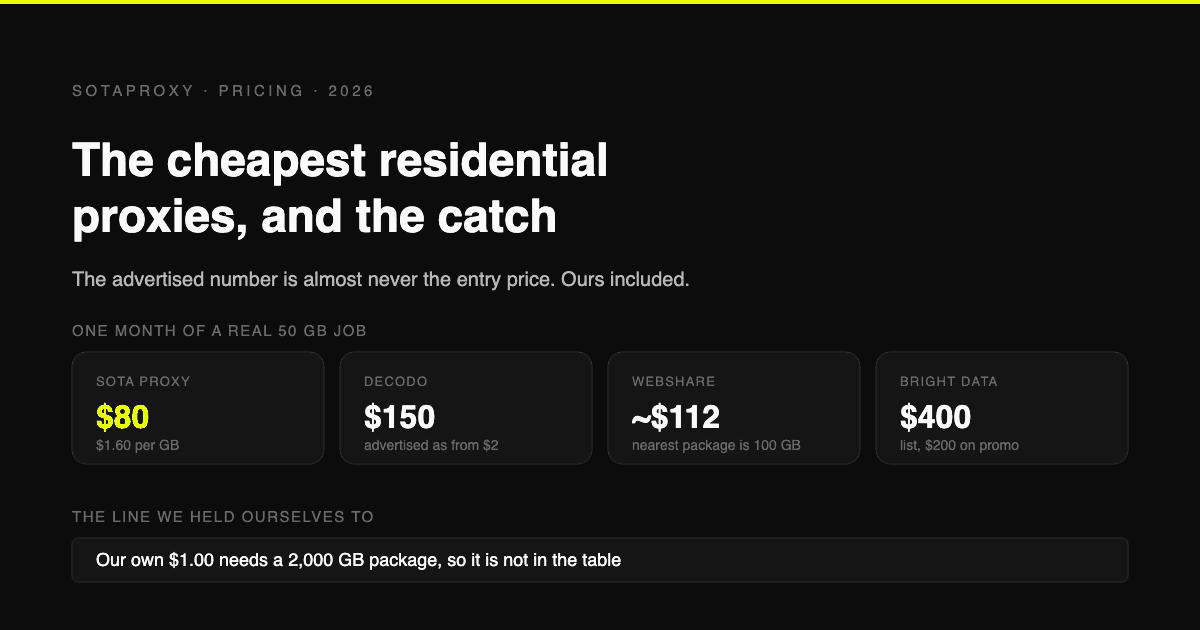
The Cheapest Residential Proxies in 2026, With the Catch Each One Hides
Verified per-gigabyte prices from five vendors' own pages, not from last year's blog posts. Why the advertised number is almost never the entry price, which providers put a monthly floor under your bill, and how to work out your real cost per gigabyte.
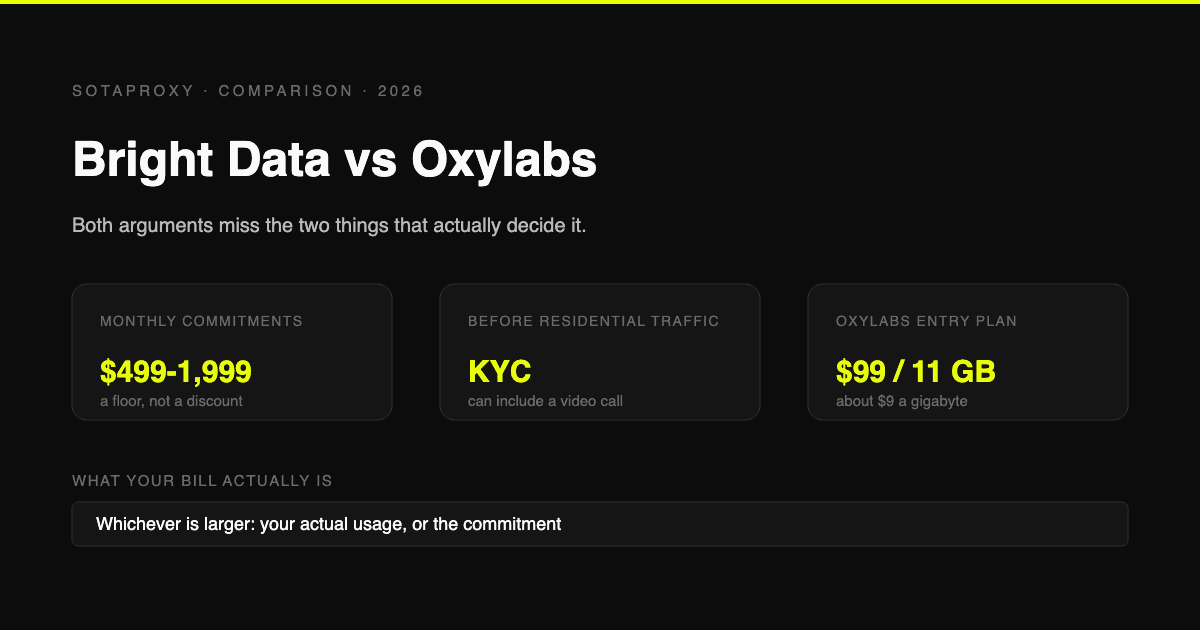
Bright Data vs Oxylabs in 2026: Prices, Commitments and the KYC Nobody Mentions
Both are enterprise platforms with minimum monthly commitments and a compliance check before you can touch residential traffic. Current prices from both vendors' own pages, what the commitment actually costs if you underuse it, and who each one is genuinely for.
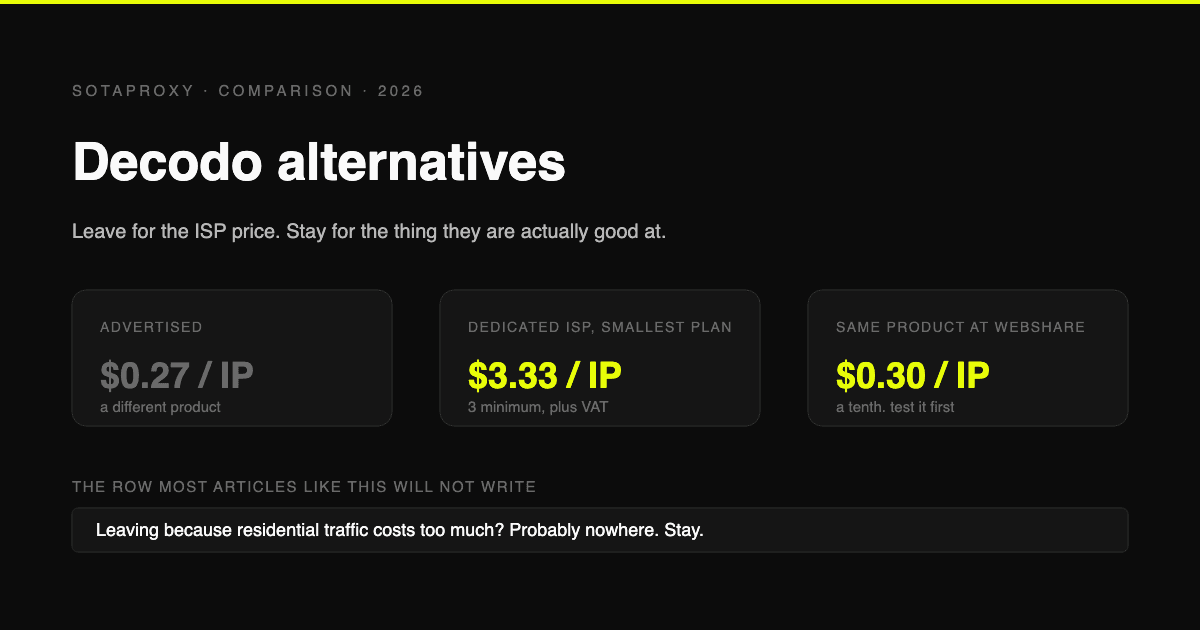
Decodo Alternatives in 2026: Who to Move to, and Who Not to Bother
Decodo is the cost leader on rotating residential and one of the pricier options on dedicated ISP. Verified prices for both, the reasons people actually leave, and which alternative fits each one.
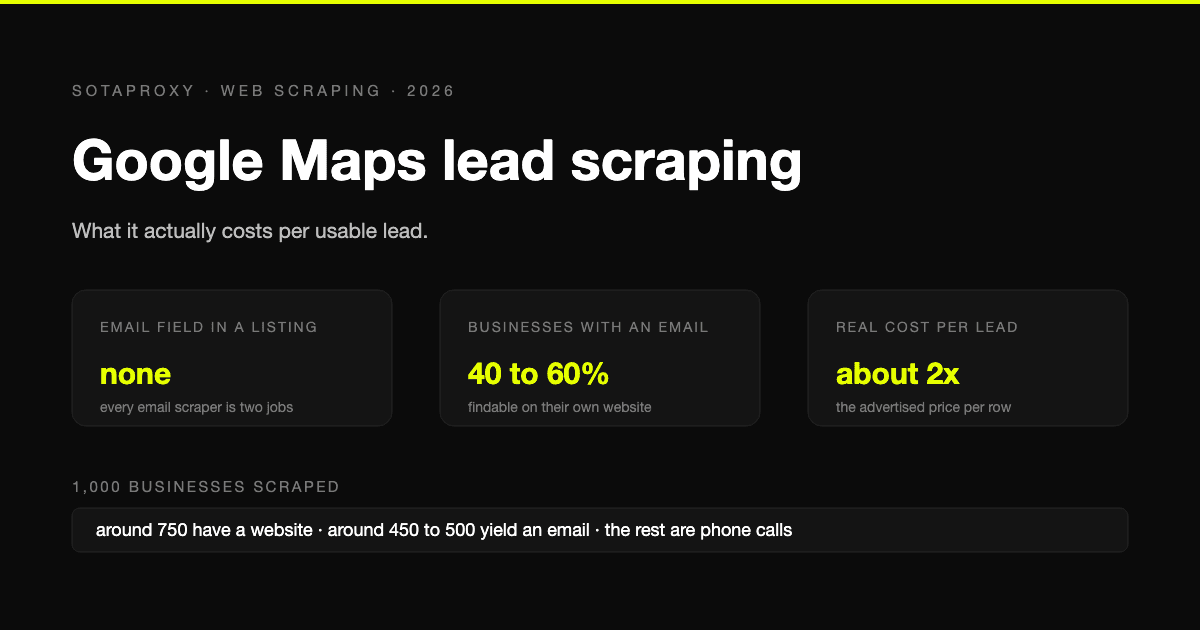
Google Maps Lead Scraping: What It Actually Costs Per Usable Lead
Google Maps has no email field, so every email scraper is a two-stage pipeline and only about half of businesses yield an address. What a thousand listings really costs per usable lead, the businesses-without-websites play, and where the law stands after the SerpApi ruling.
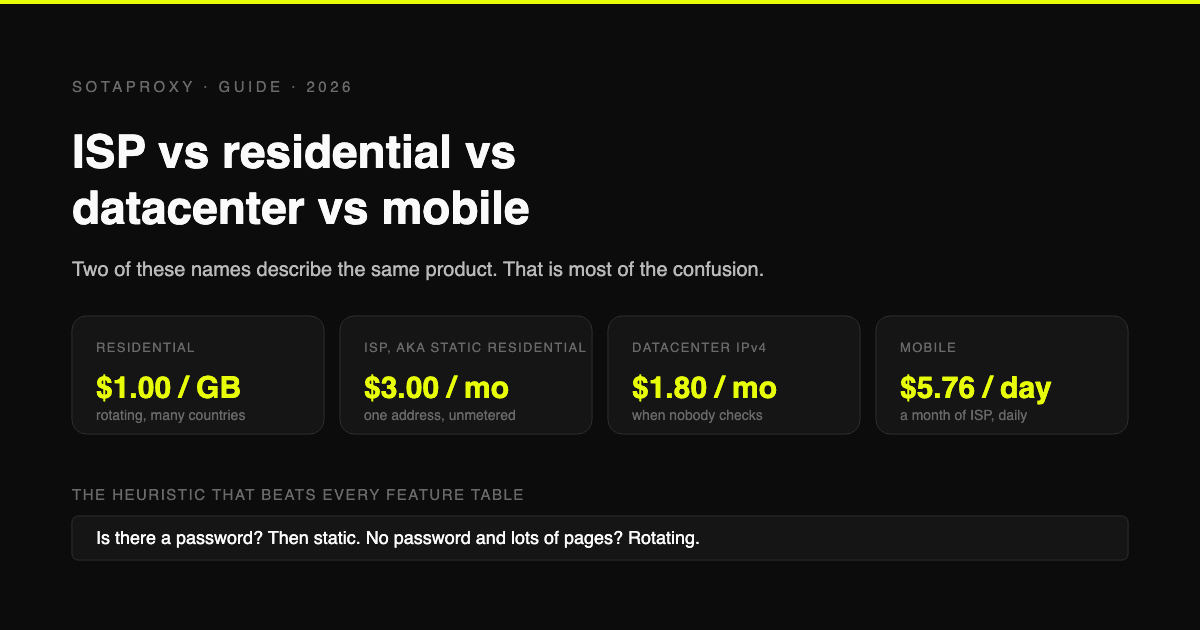
ISP vs Residential vs Datacenter vs Mobile Proxies: Which One You Actually Need
Static residential and ISP are the same product under two names, which is why half these comparisons compare a thing to itself. What each type is, what it costs per unit, and the one task each is genuinely best at.