What Is an SSL Proxy? What It Can See, What It Cannot, and How to Check
The term covers an HTTPS-capable proxy, a proxy you reach over TLS, an inspection proxy and a reverse proxy. What each can see in your traffic, with captures from our own tests.
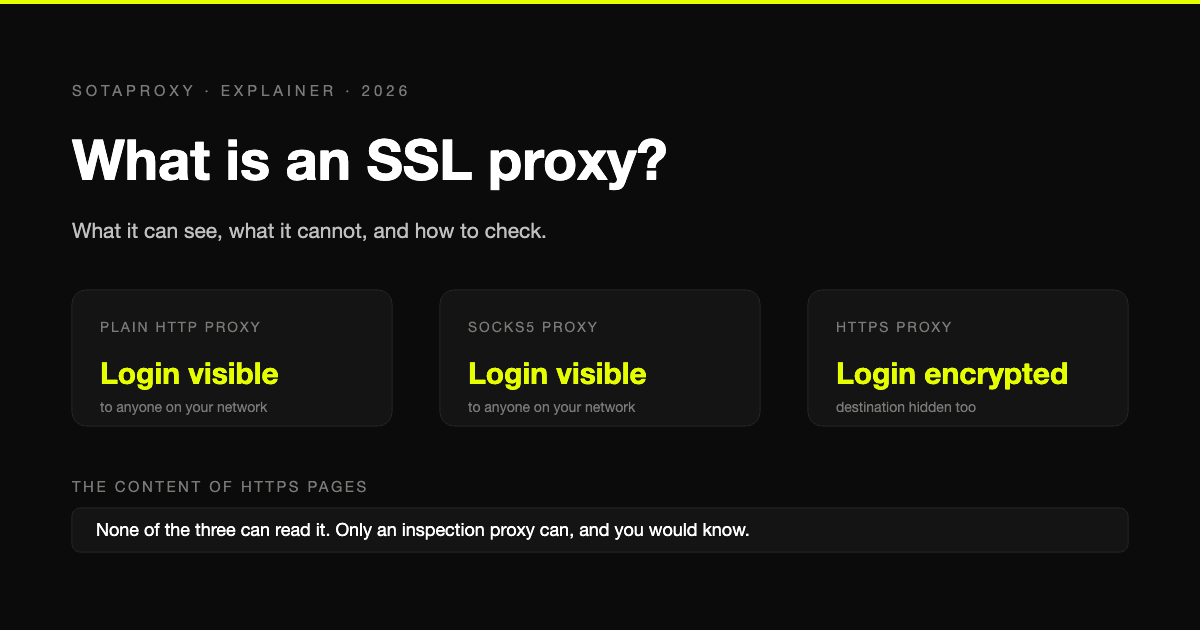
"SSL proxy" is a loose term. Depending on who is speaking, it means a proxy that can carry HTTPS traffic, a proxy you connect to over an encrypted link, a proxy that decrypts your traffic to inspect it, or a server that sits in front of a website. These are very different things, and the difference that matters is simple: what can the proxy read?
This guide goes through each meaning with that question, using captures from tests we ran on 30 September 2026. One note on words: SSL is the old name for what is now TLS. Nobody has used actual SSL for years, but the name stuck.
The four meanings
| What people mean | What it does | Can it read your HTTPS traffic? |
|---|---|---|
| A proxy that supports HTTPS sites | Passes encrypted traffic through untouched | No |
| An HTTPS proxy, or secure proxy | Encrypts the link between you and the proxy as well | No |
| An SSL inspection proxy | Decrypts, reads and re-encrypts your traffic | Yes, that is its purpose |
| An SSL-terminating reverse proxy | Handles encryption in front of a website | It is part of the website |
Paid proxies, ours included, are the first kind. Company firewalls are usually the third.
Meaning 1: a proxy that carries HTTPS
When you open an HTTPS site through an ordinary proxy, your client asks the proxy to open a tunnel to the site and then talks to the site through it. We pointed curl at a logging proxy to see exactly what that request looks like:
CONNECT example.com:443 HTTP/1.1
Host: example.com:443
User-Agent: curl/8.7.1
Proxy-Connection: Keep-Alive
That is everything the proxy learns. After it answers, all it sees is encrypted bytes going both ways.
| The proxy sees | The proxy does not see |
|---|---|
| The hostname and port | The page address after the hostname |
| When you connect and how much data moves | Page content |
| Your own address | Passwords, cookies, form data |
On free proxy lists, a "yes" in the HTTPS or SSL column means only this: the proxy accepts CONNECT. A listing sold as an "SSL private proxy" is an ordinary private proxy that supports it, which every current one does. SOCKS5 proxies behave the same way for this purpose. They relay the encrypted connection without reading it. Which side looks up the hostname is a separate question, covered in what is a DNS proxy.
Plain HTTP sites are the exception. There is no tunnel for them, so the proxy receives the full address and can read and change the page. Very little of the web is still plain HTTP, but for that part a proxy sees everything.
Meaning 2: a proxy you reach over TLS
Meaning 1 protects the traffic between you and the website. It does not protect the conversation between you and the proxy. That first request, including your proxy login, normally travels unencrypted.
We captured the first bytes three clients send to a proxy. With a plain HTTP proxy and a username and password:
CONNECT example.com:443 HTTP/1.1
Host: example.com:443
Proxy-Authorization: Basic bXl1c2VyOnNlY3JldHBhc3M=
That last line is not encryption. It is base64, and it decodes straight back to myuser:secretpass. SOCKS5 is no better: its login packet carried the username and password as plain text.
With the same request sent to an https:// proxy, the first bytes were a TLS handshake, and neither the password nor the site's hostname appeared anywhere in them.
| Anyone on your local network can see | Plain HTTP proxy | SOCKS5 proxy | HTTPS proxy |
|---|---|---|---|
| Your proxy username and password | Yes | Yes | No |
| Which site you are connecting to | Yes | Yes | No |
| The content of HTTPS pages | No | No | No |
So an HTTPS proxy closes a real gap, and it matters most on networks you do not control, such as public Wi-Fi.
Client support is wider than most people assume. In our test curl, Chrome 154 and Python requests all opened a TLS connection when given a proxy address beginning with https://. In curl it looks like this:
curl -x https://login:password@proxy.example.com:443 https://example.comThe limit is on the provider side. Most commercial proxies, ours included, are sold as plain HTTP and SOCKS5 endpoints. The practical consequences are small but worth knowing: treat the proxy password as something a local network can read, do not reuse it anywhere else, and on untrusted networks prefer address whitelisting where your provider offers it.
Meaning 3: a proxy that decrypts your traffic
An inspection proxy does what the first two cannot. It ends your encrypted connection itself, reads the contents, and opens a second encrypted connection to the real site. To your browser it pretends to be the site.
That only works if your device trusts the proxy's own certificate authority. We ran the standard tool for this, mitmproxy, and looked at the certificate curl received for example.com in three situations:
| Connection | Certificate issuer the client saw |
|---|---|
| Direct | Cloudflare TLS Issuing ECC CA 3 |
| Through a proxy that only tunnels | Cloudflare TLS Issuing ECC CA 3 |
| Through mitmproxy, its certificate installed | mitmproxy |
And when the intercepting proxy's certificate was not installed, the request failed outright:
SSL certificate problem: unable to get local issuer certificateThat failure is the safety mechanism. A proxy cannot read HTTPS traffic silently. Either your device has been set up to trust it, or every site shows a certificate error.
Where you meet inspection proxies:
- Company networks. The employer installs its certificate on managed devices and inspects traffic for security and compliance.
- Antivirus web protection. Some products do the same thing on your own machine.
- Debugging tools. mitmproxy, Charles and Fiddler exist so developers can read their own applications' traffic.
A proxy you rent to change your address has no business being one of these.
How to check whether a proxy is intercepting
Compare the certificate issuer with and without the proxy:
curl -sv -o /dev/null https://example.com 2>&1 | grep issuer
curl -sv -o /dev/null -x http://login:password@proxy.sotaproxy.com:10000 https://example.com 2>&1 | grep issuer
The two lines should name the same issuer. A certificate error through the proxy, or an issuer that is the proxy's own name and not a public certificate authority, means the proxy is putting itself inside your encrypted traffic.
Two rules follow. Never install a root certificate because a proxy provider asks you to. And never click through a certificate warning while you are on a proxy.
Meaning 4: SSL termination in front of a website
The last meaning is on the other side of the connection. A reverse proxy such as nginx, HAProxy or Cloudflare receives visitors' HTTPS connections, handles the encryption, and passes plain requests to the application behind it. The standard nginx form is:
server {
    listen 443 ssl;
    server_name example.com;
    ssl_certificate     /etc/letsencrypt/live/example.com/fullchain.pem;
    ssl_certificate_key /etc/letsencrypt/live/example.com/privkey.pem;

    location / {
        proxy_pass http://127.0.0.1:8080;
    }
}
This is about running a site, not about browsing one. If you arrived here from nginx's proxy_ssl settings, those control the opposite direction: how nginx itself connects to a backend over HTTPS.
What about an SSL web proxy?
A web proxy is a website with an address bar. You type the page you want, and the site fetches it and shows it to you. "SSL" there means only that the web proxy's own site uses HTTPS.
It is an inspection proxy by design. The service fetches the page for you, so it sees everything on it and everything you type into it, passwords included. Use one to read a public page if you must. Do not log in to anything through it.
Which one you need
| You want to | You need |
|---|---|
| Change the address sites see, on HTTPS sites | Any current HTTP or SOCKS5 proxy |
| Hide your proxy login and destinations from a local network | An HTTPS proxy, or a VPN around the proxy |
| Read and debug your own application's traffic | An inspection proxy such as mitmproxy |
| Put HTTPS in front of your own site | A reverse proxy |
FAQ
What is an SSL proxy?
Most often, a proxy that can relay HTTPS traffic without reading it. The phrase is also used for a proxy reached over an encrypted link, for an inspection proxy that decrypts traffic, and for a reverse proxy that handles HTTPS for a website.
Can a proxy see my passwords on HTTPS sites?
Not an ordinary one. It sees the hostname you connect to and encrypted data. Only an inspection proxy can read the contents, and only if its certificate is installed on your device. Without that, you would get a certificate error on every site.
Is an SSL proxy the same as an HTTPS proxy?
Loosely, yes, and that is the confusion. "Supports HTTPS" means it tunnels encrypted sites. "HTTPS proxy" strictly means the connection to the proxy is itself encrypted. A proxy can do the first without the second, and most do.
Is a SOCKS5 proxy less secure than an SSL proxy?
For HTTPS sites they protect the page content equally, because both relay the encrypted connection untouched. Neither encrypts your proxy login on the way to the proxy.
Are SSL and TLS different?
TLS is the current protocol and SSL is its retired predecessor. When people say SSL today they almost always mean TLS.
Are free SSL proxies safe?
They cannot read your HTTPS pages, for the reasons above. They can see which sites you visit, they can read and alter plain HTTP pages, and nobody is accountable for running them. Do not send anything through one that you would mind a stranger logging.
Related articles

AdsPower Proxy Integration: The Complete Setup Guide
Step-by-step AdsPower proxy integration with SotaProxy. Covers setup, proxy types, rotation, troubleshooting, and best practices for multi-account workflows.
7 Top Proxy Providers for Arbitrage and Scraping
Compare 7 top proxy providers by IP types, targeting, rotation, uptime, pricing signals, and fit for scraping, ad accounts, farming, and arbitrage.

10 Best Proxy Services for Ads, Scraping, and Automation
Compare the best proxy services for ad verification, scraping, account operations, and geo-targeting by IP type, price, uptime, and controls.

10 Smartproxy Alternatives for Technical Teams
Compare 10 smartproxy alternatives by proxy type, IP quality, targeting, rotation, speed, pricing, and use case for technical teams.

10 IPRoyal Alternatives for Serious Proxy Workloads
Compare 10 IPRoyal alternatives for scraping, ad verification, account farming, antidetect browsers, geo campaigns, pricing, rotation, and support.
10 Oxylabs Alternatives for Scraping and Ad Operations
Compare 10 oxylabs alternatives by proxy type, geo coverage, uptime, rotation, pricing, and use case for scraping, ad verification, and account farming.