10 Oxylabs Alternatives for Scraping and Ad Operations
Compare 10 oxylabs alternatives by proxy type, geo coverage, uptime, rotation, pricing, and use case for scraping, ad verification, and account farming.
The largest proxy pool doesn't automatically make the best Oxylabs alternative. A scraping agency may need broad rotation, while a media buyer needs clean, stable sessions that match a Facebook or TikTok ad account. An account-farming team may value sticky sessions and city-level targeting more than raw throughput. Billing can matter just as much as latency when retries, browser traffic, and geo-targeted campaigns run continuously.
This comparison ranks providers by practical operating fit, not headline pool size. It covers residential, mobile, ISP, datacenter, and IPv6 behavior, alongside geolocation, uptime, IP cleanliness, rotation, session control, concurrency, support, and billing. The use cases include scraping, ad verification, cloaking, account farming, sneaker bots, Facebook and TikTok ad accounts, and antidetect browser setups using AdsPower, Dolphin Anty, GoLogin, Multilogin, and Hidemyacc.
The market is also broader than raw proxy infrastructure. The web scraping market was valued at USD 1.34 billion in 2025, estimated at USD 1.56 billion in 2026, and projected to reach USD 3.49 billion by 2031, according to Mordor Intelligence's web scraping market analysis. Buyers increasingly compare proxies with managed scraping APIs and data-extraction tools. Teams building repeatable pipelines should also review AutoSEO's scraping workflow.
Table of Contents
- 1. Sota Proxy
- 2. Bright Data
- 3. Decodo
- 4. SOAX
- 5. NetNut
- 6. Rayobyte
- 7. IPRoyal
- 8. Webshare
- 9. Infatica
- 10. ProxyRack
- Top 10 Oxylabs Alternatives Comparison
- Choose, Test, and Migrate Without Guesswork
1. Sota Proxy
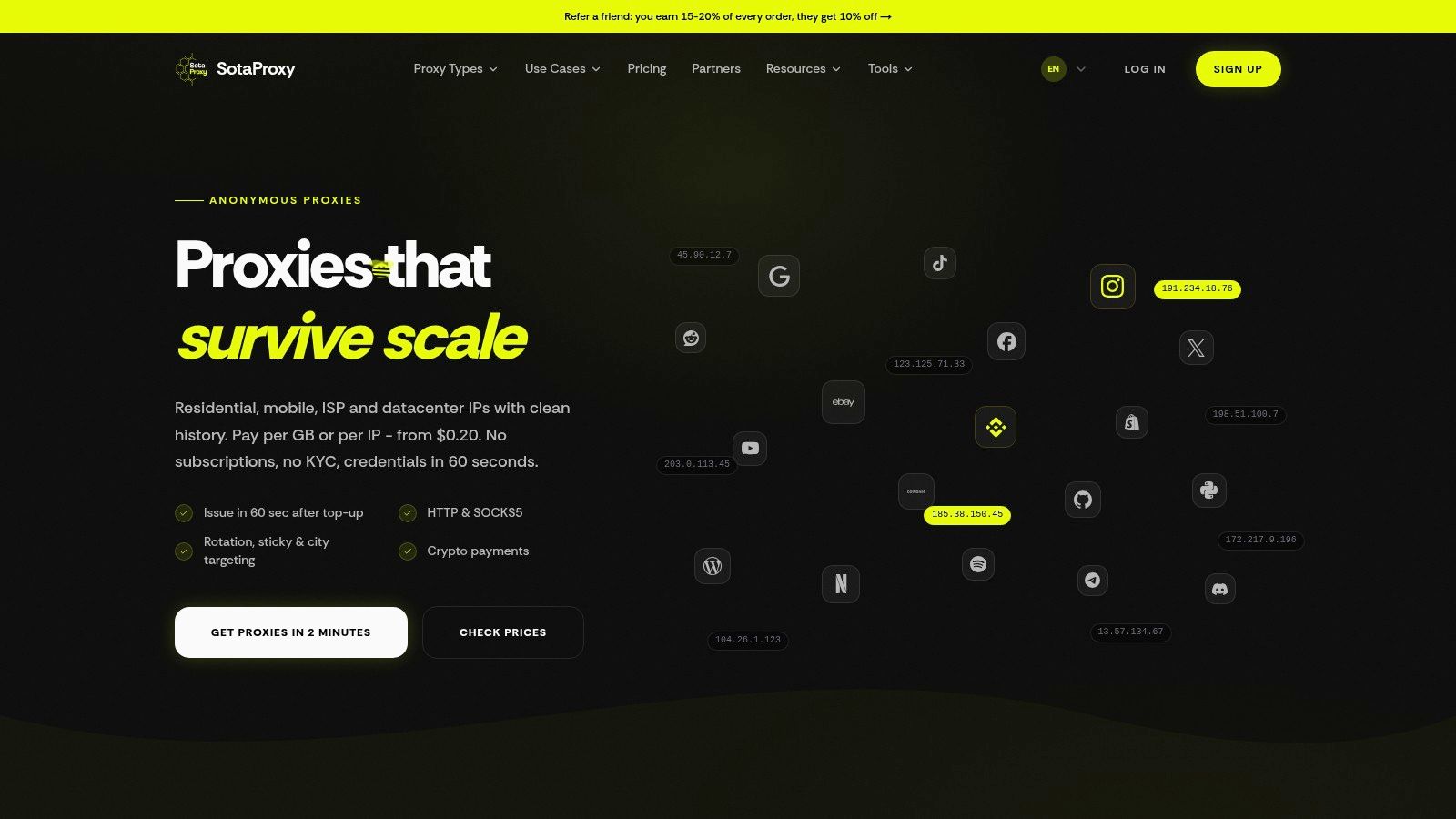
Sota Proxy fits teams that need one dashboard for scraping, ad verification, social account operations, and traffic arbitrage. Its inventory covers residential, mobile, ISP, datacenter, and IPv6 proxies across 220+ geolocations. City targeting, rotation settings, and sticky sessions support different operating patterns. The vendor states 99.9% uptime, with redundant clusters and real-time usage monitoring.
Its main strength is traffic-type flexibility. Residential IPs suit sensitive geo-targeted campaigns and account workflows. Mobile proxies can present a stronger trust profile for TikTok operations, though day-based billing can become costly for continuous traffic. ISP proxies are better for persistent sessions. Datacenter and IPv6 proxies fit speed-focused tasks where server-origin traffic is accepted. IPv6 may lower infrastructure costs, but it does not replace residential or mobile coverage for every target.
Sota Proxy describes its pool as AI-assisted and self-healing. Automated address removal and route optimization are intended to limit failed connections and improve path selection. The vendor also states that its network includes 2.8M+ active IPs and an 18% route-optimizer speed gain, based on its product materials. Fair-usage policies are designed to support cleaner pools, which matters when cookies, browser fingerprints, and proxy reputation need to stay consistent.
Why it fits mixed operations
Provisioning is straightforward. Select the proxy type, location, rotation, and session behavior in one dashboard, then track balance and usage. Pay-as-you-go billing, card or crypto top-ups, dedicated IP availability, and no subscription or KYC requirement make short validation runs easier.
Practical rule: Use residential or mobile IPs for sensitive account and location workflows. Reserve datacenter and IPv6 traffic for targets where speed matters more than residential appearance.
The service supports antidetect browser setups in AdsPower, Dolphin Anty, GoLogin, Multilogin, and Hidemyacc. That suits isolated Facebook and TikTok accounts, affiliate campaigns, ad verification, account management, and sneaker bot traffic. Cloaking and account farming still need platform-compliant controls. Meta may restrict a wider Business Account structure when related assets appear to evade earlier enforcement, as described in Meta enforcement coverage.
The trade-off is buyer diligence. Sota Proxy does not prominently show third-party security certifications or customer testimonials on its site, so regulated teams should conduct their own review. Its referral and affiliate program offers up to 40% commission, which may matter to agencies referring other operators. Current product and billing details are available on the Sota Proxy platform.
2. Bright Data
Bright Data is the safer enterprise choice when a team needs proxy infrastructure, scraping APIs, unblocking tools, and compliance controls under one vendor. Its portfolio covers residential, ISP or static residential, datacenter, and mobile networks. Web Unlocker and scraper APIs reduce the amount of retry and rendering logic your team must maintain.
Targeting is granular. Buyers can select country, state, city, ZIP, and ASN. The platform also offers SOCKS5 access through Proxy Manager, usage limits, spend controls, tiered commitments, and enterprise SLAs. That combination works well for complex price monitoring, ad verification, and scraping projects where procurement needs visibility into spend and access policies.
Bright Data is less convenient for a quick anonymous test. KYC and compliance checks create onboarding friction, especially for small media-buying teams that need to validate a target before committing. PAYG residential pricing also tends to sit above mid-market options, so retries and large page payloads can affect budget predictability.
For Facebook and TikTok ad accounts, use separate sessions and validate geo-reporting rather than assuming the proxy location equals the platform's reported location. TikTok documents that platforms can use different signals to determine user location in its location FAQ. Bright Data fits teams that need formal controls around those tests, not operators seeking the fastest setup.
For a direct product comparison, review Sota Proxy's Bright Data comparison.
3. Decodo
Decodo, formerly Smartproxy, is a strong mid-market replacement for teams that want quick onboarding, clear documentation, and a broad proxy mix without adopting a heavy enterprise workflow. It offers residential, ISP, mobile, and datacenter proxies, plus a Site Unblocker and scraping APIs.
The service supports rotating and sticky sessions over HTTP(S) and SOCKS5. Its residential network covers 115M+ IPs across 195+ locations, with city, state, and ASN targeting listed in the product information. That makes it practical for localized SEO monitoring, ad verification, e-commerce scraping, and social account workflows that need repeatable location parameters.
Independent benchmark-style coverage published by Apify reported Decodo at about 99.86% average success with roughly 0.63-second response time. Those figures are test results from a public comparison, not a universal guarantee. They still illustrate why Decodo often ranks well for teams prioritizing successful requests and consistent latency over the largest possible pool. See the Apify proxy comparison for the benchmark context.
Decodo works cleanly with browser-based workflows and offers extensions, SDKs, and self-service controls. AdsPower, Dolphin Anty, GoLogin, Multilogin, and Hidemyacc users can test sticky sessions against Facebook and TikTok ad accounts without building a custom management layer.
Use Decodo when: You need a balanced residential and mobile deployment for mid-volume operations, with simple billing and fast configuration.
The main limitation appears at very large volume. Enterprise discounts and account terms may not match the most aggressive large-provider contracts. For agencies running many clients, test concurrency, pool freshness, and location density before moving production traffic. A second evaluation is available in Sota Proxy's Decodo comparison.
4. SOAX
SOAX suits buyers who care about granular targeting and session control. Its network includes residential, mobile, ISP, and datacenter proxies, with region, city, and ISP selection. Rotating and sticky sessions can be configured with customizable refresh behavior, which helps when a workflow must preserve cookies while still replacing a degraded IP.
Protocol support is broader than many basic proxy plans. SOAX lists HTTP, SOCKS5, UDP, and QUIC support, along with a dashboard, API, and Web Data API access. That makes it a reasonable option for scraping systems that need more than browser traffic, although each protocol should be tested against the target application and client library.
Public benchmark coverage reported about 99.73% success and 0.90-second response time for SOAX. The same comparison placed it among the strongest alternatives for runtime efficiency, but benchmark conditions don't replicate every Facebook, TikTok, e-commerce, or SERP workflow. Treat the numbers as a screening signal, then run target-specific tests.
SOAX is particularly useful for geo-targeted campaigns and ad verification where city and ISP matching affect the result. It can also support antidetect browser profiles, but session duration and account-level behavior matter more than proxy selection alone. A clean residential IP won't fix an inconsistent browser profile or mismatched timezone.
The cost trade-off is straightforward. Entry and small-bundle pricing can be higher than budget vendors, so SOAX makes more sense when targeting precision and bundled scraping support justify the spend. It isn't the first pick for a tiny test or a low-stakes datacenter scraper.
5. NetNut
NetNut is built for straightforward deployment. Its rotating and static residential, mobile, ISP, and datacenter products connect through a backconnect gateway. Country, state, and city parameters use username-based targeting, which keeps endpoint generation simple for scripts and browser profiles.
The residential network lists 50M+ IPs across 180 countries, with HTTP, HTTPS, and SOCKS5 support. The dashboard includes an endpoint generator, analytics, and sub-user management. Those controls fit agencies running separate clients, media buyers maintaining isolated Facebook and TikTok ad accounts, and scraping teams that need predictable credential patterns.
NetNut's main strength is syntax and workflow clarity. Teams can assign one endpoint pattern to a profile, preserve sticky behavior where required, and rotate traffic for collection jobs. ISP and static residential options are useful for persistent login sessions, while residential rotation is better for broad scraping and ad verification.
Persistent sessions need more than a sticky flag. Match the proxy location, browser profile, cookies, timezone, and account history before judging the provider.
The provider offers city and state selection, IP whitelisting, API access, annual discounts, and higher-tier account management. Those features can help a growing operation standardize deployment. The downside is that its pool and third-party audit footprint are smaller than some top incumbents. Trial tough targets before using it for high-value cloaking infrastructure, account farming, or heavily protected scraping.
For teams comparing connection architecture, Sota Proxy's residential backconnect guide provides useful context on how gateway-based routing differs from manually managed endpoints.
6. Rayobyte
Rayobyte, formerly Blazing SEO, is a practical choice for teams that prioritize sourcing documentation, high-volume terms, and flexible bandwidth handling. It offers rotating residential proxies, ISP or static residential proxies, datacenter ranges, a Web Unblocker, and a Scraping API.
Its residential pool lists 40M+ IPs, with sticky and rotating modes plus city and state targeting. Datacenter infrastructure suits speed-sensitive scraping, sneaker bots, and low-friction automation where the target doesn't require a residential origin. ISP proxies sit between those choices when the workflow needs a persistent address with a more residential presentation.
Rayobyte's non-expiring bandwidth option can simplify planning for enterprise operations. Unlimited threads are available on some plans, which helps parallel scraping and broad price or SEO monitoring. The model becomes more attractive as traffic rises, while entry-level users may find the per-GB cost less compelling than mid-market providers.
The provider emphasizes ethical sourcing. That matters for platform reviews, procurement, and compliance discussions, especially when a team operates Facebook or TikTok advertising infrastructure across multiple clients. It doesn't remove the need to review the actual use case. Cloaking, account farming, and multi-account operations can trigger platform enforcement when they attempt to bypass policy or conceal prohibited behavior.
Rayobyte works with custom scripts and browser tools, including antidetect environments. Test profile isolation in AdsPower, Dolphin Anty, GoLogin, Multilogin, or Hidemyacc before scaling. A proxy can be technically reachable and still fail because the target flags the range, the session changes too often, or the account's geography conflicts with other signals.
7. IPRoyal
IPRoyal is one of the more accessible Oxylabs alternatives for short projects and budget-controlled operations. It offers residential, ISP, datacenter, and mobile proxies, along with a Web Unblocker and specialized scrapers. PAYG access is useful when a team doesn't want a large commitment before testing a target.
The residential network lists 64M+ IPs across 195+ countries, with instant IP changes, automatic rotation, and sticky sessions lasting up to 7 days. The platform also supports unlimited concurrent sessions, browser extensions, proxy testing tools, several payment methods including crypto, and public KYC documentation.
Independent benchmark coverage reported about 98.22% success and 1.36-second response time. That places IPRoyal below the faster alternatives in the referenced test, but raw speed isn't always the deciding factor. For ordinary e-commerce scraping, basic geo checks, and lower-risk account workflows, the lower entry barrier can matter more than sub-second consistency.
IPRoyal's sticky controls are useful for social account management and antidetect browser profiles. Assign a stable session to an isolated Facebook or TikTok account, then rotate only when the workflow calls for it. Don't use a long sticky session as a substitute for consistent account behavior.
The main caution is scale. A smaller enterprise footprint means teams should validate concurrency, pool freshness, and success on heavily protected targets. Sota Proxy's IPRoyal comparison offers another angle for buyers comparing budget and infrastructure trade-offs.
8. Webshare
Webshare is best suited to basic geo tasks, low-stakes automation, and teams that need many inexpensive static addresses. It sells static residential products marketed as ISP, rotating residential access, and datacenter proxies, with self-service checkout and clear location listings.
The billing experience is simple. Monthly and annual plans, volume discounts, and promotional rotating residential packages make initial testing easy. Static residential addresses can support browser profiles, account administration, and recurring access where a stable endpoint matters more than broad rotation.
Webshare requires more validation on sensitive targets. Community reports have questioned whether some static residential ranges map to hosting or datacenter subnets. That doesn't establish how every range behaves, so test the exact locations and targets you care about. A range that works for price checks may fail on a Facebook login or TikTok Ads Manager session.
Don't classify an IP by the label alone. Check ASN, reverse DNS, target response, session stability, and account-level behavior before deployment.
Webshare can fit AdsPower, Dolphin Anty, GoLogin, Multilogin, and Hidemyacc when the profile workload is ordinary and the selected range passes testing. It is less attractive for heavily blocked scraping, aggressive cloaking, or high-value account farming without prior validation.
Use it when fast self-service and low cost outweigh maximum reputation control. If your operation needs mobile trust, city-level precision, or continuous high-success scraping, compare the total retry cost rather than the advertised IP price. Sota Proxy's Webshare comparison provides a focused alternative view.
9. Infatica
Infatica offers residential IPv4 and IPv6, ISP, mobile, and datacenter proxies with PAYG and tiered bundles. It targets buyers who want flexible billing and enterprise-oriented onboarding without limiting the product range to one proxy type.
The platform lists city and state targeting, a public management API, transparent plan tables, and enterprise plans beginning at 1 TB. It also offers a stated Best Price Guarantee for enterprise buyers. The combination works for agencies that need to forecast spend across several clients and then negotiate terms as traffic grows.
IPv4 and IPv6 residential SKUs give technical teams more routing choices. IPv6 can be useful when a target supports it and the workflow benefits from a larger address space. It isn't a drop-in replacement for residential IPv4, mobile, or ISP traffic. Some major services support only limited IPv6 behavior, so validate login, checkout, ad review, and tracking flows separately.
Infatica fits web scraping, geo-targeted campaign checks, and account operations where the buyer wants a formal business relationship. It can connect to antidetect browser profiles, but session persistence still depends on the endpoint type and account design. Use ISP or static residential for longer-lived sessions, and rotating residential or mobile traffic when location and reputation carry more weight.
The residential pool is smaller than some major incumbents. That makes a trial essential for difficult targets, especially Facebook, TikTok, SERP systems, and anti-bot e-commerce sites. Don't choose it solely because the plan table looks predictable. Measure usable requests, retry behavior, and location accuracy under your own workload.
10. ProxyRack
ProxyRack takes a different approach to cost control. Its residential plans use uncapped data billed by concurrent threads, with rotating and sticky sessions. HTTP and SOCKS support, country, city, and ISP targeting, a public status page, and a knowledge base keep the deployment model easy to understand.
This model suits heavy traffic when per-GB billing becomes difficult to forecast. Instead of watching every page payload, the team plans around concurrency. That can work for scraping, broad market monitoring, and automation with stable parallelism. It also makes ProxyRack interesting for sneaker bot operations where burst behavior matters, provided the target accepts the selected IP type.
The limitation is capacity planning. Plans range from 100 to 5,000 concurrent threads, so the team must estimate parallel workers, browser sessions, retries, and burst traffic before selecting a tier. A scraper that opens too many sessions can hit the plan ceiling even when bandwidth itself isn't the problem.
Sticky and rotating modes support different workflows. Sticky sessions can preserve a browser profile for Facebook or TikTok account management. Rotation is better for broad collection and ad verification. Mobile proxies may offer stronger trust for TikTok-focused campaigns, while datacenter traffic remains preferable for speed when the target tolerates it.
ProxyRack includes a 3-day money-back policy, plus a public peer program and community forum. Review the terms before purchase and test the exact concurrency pattern you expect in production. The provider won't suit teams that insist on strict per-GB accounting, but it can be a strong fit when predictable thread-based costs matter more.
Top 10 Oxylabs Alternatives Comparison
| Provider | Core features | Performance & UX | Pricing & value | Best for / Use cases | USPs |
|---|---|---|---|---|---|
| Sota Proxy (Recommended) | Residential, mobile, ISP, datacenter; ~2.8M IPs; AI self-healing pool; city targeting; rotation/sticky | 99.9% uptime, redundant clusters, real-time monitoring, instant provisioning, 24/7 support | PAYG, no KYC; residential ≈ $2/GB (corp from $1/GB); IPv4 $1.80/mo; mobile ~$6.72/day; volume discounts | Large-scale scraping, geo ad verification, price/SEO monitoring, social account management, mission-critical automation | AI route optimizer, self-healing IP pool, crypto payments, fast onboarding |
| Bright Data | Residential/ISP/datacenter/mobile; 400M+ IPs; scraper & unblocking APIs | Mature dashboard, enterprise SLAs, strong unblocking; KYC/compliance controls | PAYG & tiered commitments; generally higher per-GB; enterprise pricing | Complex scraping, regulated enterprise workflows, difficult targets | Largest footprint, strong compliance & unblocking tooling |
| Decodo (Smartproxy) | Residential/ISP/mobile/datacenter; 115M+ IPs; sticky & rotating | Quick onboarding, strong docs, browser extensions & SDKs | Transparent PAYG & tiered plans; SMB-friendly | SMBs and mid-volume automation, quick trials | Clear pricing, easy start, good docs |
| SOAX | 155M–191M+ residential IPs; rotating & sticky; multi-protocol (HTTP/SOCKS5/UDP/QUIC) | Good response times, bundled Web Data API, helpful support | Mid-to-high per-GB; competitive for mid–high volumes | Granular targeting, session-controlled scraping | UDP/QUIC support, customizable session refresh |
| NetNut | 50M+ residential; backconnect gateway; username targeting | Straightforward integration, dashboard analytics, sub-user mgmt | Annual discounts; account management on higher tiers | Quick deployments, predictable targeting syntax | Endpoint generator, simple targeting parameters |
| Rayobyte | 40M+ residential; ISP/static; Web Unblocker; non-expiring bandwidth | Documented ethical sourcing, enterprise-focused docs | Aggressive high-volume pricing; better value at scale | High-volume scraping, buyers prioritizing sourcing/ethics | Non-expiring bandwidth, sourcing transparency |
| IPRoyal | 64M+ residential; sticky up to 7 days; auto-rotate; scrapers | Budget-friendly, instant IP change, bundled tools/extensions | Accessible PAYG entry pricing, crypto payments | Short projects, social/account workflows, low-cost trials | Low entry cost, public KYC/sourcing docs, specialized scrapers |
| Webshare | Static & rotating residential, datacenter; location lists visible | Fast self-service checkout, easy billing, transparent listings | Very competitive static residential & rotating GB pricing | Teams needing many static IPs cheaply, low-stakes geo tasks | Cheap static residential pools, fast onboarding |
| Infatica | Residential IPv4/IPv6, PAYG & GB bundles, enterprise plans | Business-friendly onboarding, clear plan tables | Flexible bundles; Best Price Guarantee for large buyers | Enterprises needing flexible billing and large volumes | IPv6 residential SKUs, enterprise pricing guarantees |
| ProxyRack | Residential rotating/sticky; concurrency/thread-based plans; unmetered options | Predictable cost model for heavy traffic; public status/API | Thread/concurrency pricing (100–5,000 threads); bandwidth often unmetered | High-traffic, concurrency-focused scrapers needing predictable cost | Unmetered bandwidth options, thread-based plans |
Choose, Test, and Migrate Without Guesswork
The right Oxylabs alternative depends on the traffic pattern, not the provider's largest pool claim. Start by defining the target and the failure cost. Facebook and TikTok ad accounts, account farming, geo-targeted campaigns, and sensitive social workflows generally need clean residential or mobile traffic with stable sessions. Datacenter and IPv6 proxies can work well for speed-sensitive scraping, sneaker bots, and internal automation when the target accepts server-origin traffic. ISP or static residential proxies fit persistent sessions and repeated access from one location.
Review the operational details before comparing price:
- Proxy type: Confirm whether the workflow needs residential, mobile, ISP, datacenter, or IPv6 traffic.
- Geography: Test country, city, state, ASN, and ISP targeting against the actual platform.
- IP cleanliness: Check reputation and target response instead of trusting product labels.
- Reliability: Measure uptime, failed requests, retries, and latency consistency under load.
- Session control: Confirm rotation behavior, sticky-session duration, refresh rules, and credential syntax.
- Concurrency: Match browser profiles, workers, retries, and burst traffic to the plan limit.
- Protocols: Validate HTTP(S), SOCKS5, UDP, or QUIC support with your client and browser stack.
- Billing: Compare per-GB, per-IP, per-day, thread-based, non-expiring, and subscription models.
- Commercial terms: Check refund handling, top-ups, account limits, support coverage, and compliance review.
The market data supports taking this comparison seriously. Independent coverage places the proxy services market at about $4.2 billion in 2026, with a projection to $8.7 billion by 2030, while residential proxies account for about 42% of the cited market and mobile proxies show 22% year-over-year growth in that analysis. See the proxy market statistics review for the source context. Those figures describe a broad market, and category definitions vary, but they reflect why buyers now have more workflow-specific choices.
Migration should happen in a controlled sequence. Export current endpoint, port, username, password, whitelist, and authentication settings. Map each country and city parameter to the new provider. Preserve rotation and sticky-session logic rather than replacing every endpoint with a generic rotating URL. Then run isolated tests for Facebook and TikTok ad accounts.
Validate AdsPower, Dolphin Anty, GoLogin, Multilogin, and Hidemyacc one profile at a time. Check browser timezone, language, WebRTC behavior, cookies, account history, and proxy geography. TikTok itself warns that location reporting can differ across platforms because each platform uses different signals, so compare reported location with the proxy location instead of treating one result as definitive.
Run the same target set through the old and new providers. Track successful page loads, valid content, login stability, retry volume, latency, CAPTCHA frequency, and total spend. Don't move production traffic until the alternative performs consistently under the concurrency and session duration your operation uses.
For practical selection, Sota Proxy is the strongest centralized option when one dashboard must cover residential, mobile, ISP, datacenter, and IPv6 workflows. Its 220+ geolocations, city-level targeting, clean pools, pay-as-you-go options, and stated 99.9% uptime suit mixed scraping and ad operations. Teams that refer clients or partners can also use its referral or affiliate program, which offers up to 40% commission. Bright Data fits formal enterprise procurement. Decodo fits mid-market teams. SOAX fits granular targeting. ProxyRack fits thread-based heavy traffic. IPRoyal and Webshare fit lower-friction testing, while Rayobyte and Infatica deserve consideration when sourcing and business terms carry more weight.
Choose based on measurable success under your own targets. A smaller, cleaner, better-matched pool can outperform a larger network when session behavior, geography, and billing align with the workflow.
Sota Proxy combines residential, mobile, ISP, datacenter, and IPv6 access across 220+ geolocations with city targeting, rotation, sticky sessions, clean pools, and stated 99.9% uptime. Visit Sota Proxy to test a centralized alternative for scraping, ad verification, geo-targeted campaigns, and antidetect browser operations, with pay-as-you-go options and an affiliate program offering up to 40% commission.
Related articles

10 Best Proxy Services for Ads, Scraping, and Automation
Compare the best proxy services for ad verification, scraping, account operations, and geo-targeting by IP type, price, uptime, and controls.

10 Smartproxy Alternatives for Technical Teams
Compare 10 smartproxy alternatives by proxy type, IP quality, targeting, rotation, speed, pricing, and use case for technical teams.
10 IPRoyal Alternatives for Serious Proxy Workloads
Compare 10 IPRoyal alternatives for scraping, ad verification, account farming, antidetect browsers, geo campaigns, pricing, rotation, and support.
Top Brightdata Alternatives for Proxy Teams in 2026
Explore the best brightdata alternatives for scraping, ad verification, and geo-targeted campaigns in 2026, plus migration tips.
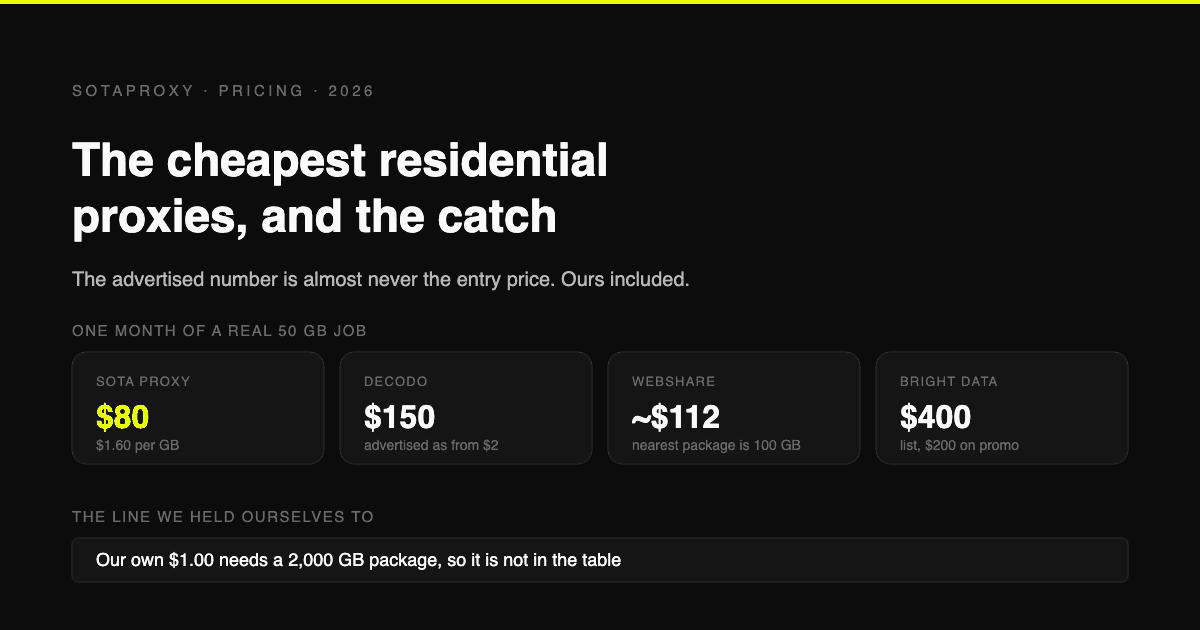
The Cheapest Residential Proxies in 2026, With the Catch Each One Hides
Verified per-gigabyte prices from five vendors' own pages, not from last year's blog posts. Why the advertised number is almost never the entry price, which providers put a monthly floor under your bill, and how to work out your real cost per gigabyte.
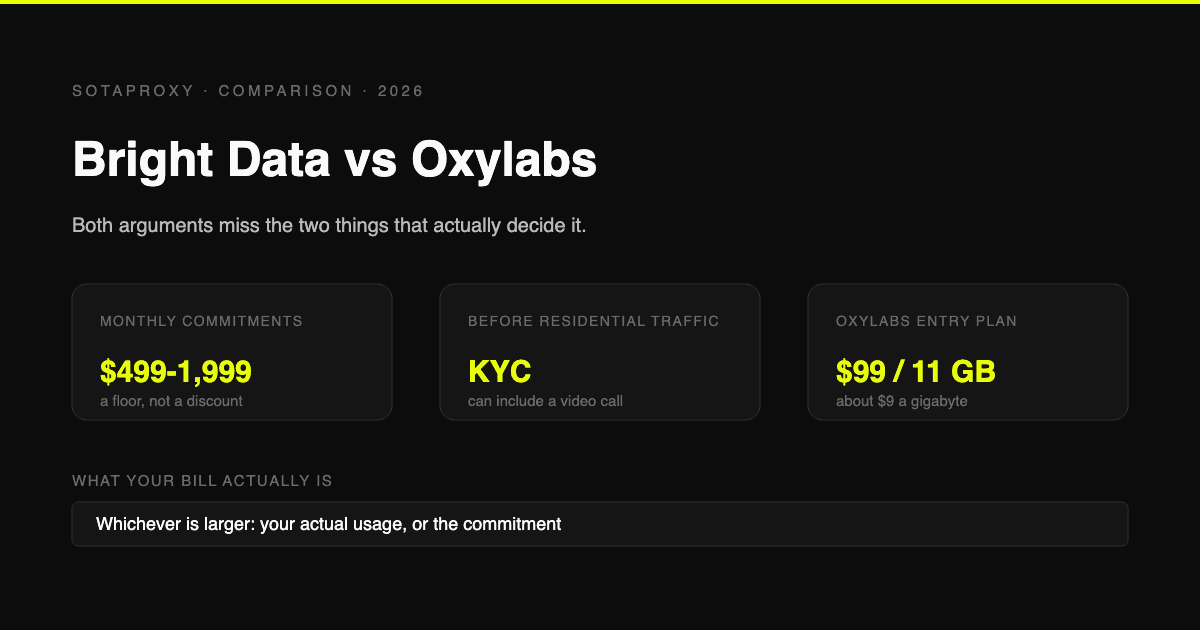
Bright Data vs Oxylabs in 2026: Prices, Commitments and the KYC Nobody Mentions
Both are enterprise platforms with minimum monthly commitments and a compliance check before you can touch residential traffic. Current prices from both vendors' own pages, what the commitment actually costs if you underuse it, and who each one is genuinely for.