Understanding Market Research: Media Buyer's Playbook
Master understanding market research for media buyers & arbitrage. Learn data collection with proxies, campaign analysis, & pitfalls to avoid in 2026.

You launch a geo-targeted Facebook campaign into a market that looked cheap on paper. CPMs spike, approval quality drops, and the accounts start aging badly. Or you farm a clean batch of TikTok profiles in AdsPower, only to watch trust collapse after the platform shifts detection rules. Such an outcome is frequently viewed as bad luck.
It usually isn't.
For operators, understanding market research has nothing to do with academic reports or polished decks. It's the discipline of learning what a market, platform, or audience will do before you burn budget, lose accounts, or scale into a dead angle. In traffic arbitrage, market research sits inside daily ops. It affects what geo you test, which proxy pool you trust, how you validate cloaking flows, and whether your scraped data reflects real users or just your own infrastructure bias.
Table of Contents
- Why Market Research Matters for Arbitrage and Account Ops
- Redefining Research Goals for Technical Teams
- Core Methodologies for Digital Data Acquisition
- Automating Data Collection with Proxies and Scrapers
- Analyzing Data for Actionable Campaign Insights
- Navigating Technical Pitfalls and Data Bias
- Legal and Ethical Lines in Data Driven Operations
Why Market Research Matters for Arbitrage and Account Ops
A lot of failed campaigns get blamed on creatives, tracking, or media buying discipline. Sometimes that's true. But plenty of losses start earlier, at the research layer.
If your team doesn't know how a funnel looks in a target geo, what local competitors are pushing, how ad approvals behave by account type, or how users see the page from a residential connection, you're buying blind. The same applies to account farming. When farmed assets die quickly, operators often tweak warmup routines or browser fingerprints in Dolphin Anty, GoLogin, Multilogin, or Hidemyacc. They should also ask whether the initial market assumptions were wrong.
Research is an ops function
Market research matters because it protects margin and asset quality. It tells you where saturation is rising, which angles are already overused, where cloaking paths break, and whether your geo-targeted campaigns look normal from the audience side.
Roughly 80% of businesses worldwide conduct market research to gather insight into performance, customers, trends, and competitors, which shows how standard this practice has become across digital operations, not just traditional business teams (Salesforce on conducting market research). In arbitrage, that same habit applies to offer validation, ad verification, pricing checks, SERP pulls, and local competitor monitoring.
If you're mapping workflows around market research proxy use cases, the point isn't to collect more data. The point is to collect data that changes the next decision.
Practical rule: If a research step doesn't reduce spend waste, improve account survival, or sharpen geo targeting, it's probably noise.
What bad research looks like in practice
Bad market research inside a buying team usually shows up like this:
- The wrong geo gets scaled: You saw low competition from a narrow scrape set, but local ad pressure was already heavy.
- Ad verification lies to you: You checked the page through the wrong IP type, so the user path looked clean when the actual audience saw something else.
- Account ops get misread: A TikTok or Facebook issue gets blamed on browser setup, while the actual problem is inconsistent market-side behavior across regions.
- Cloaking gets tested in a vacuum: The cloaker works against one inspection path, then fails under different regional conditions.
Good operators don't separate research from execution. They treat it as the first part of execution.
Redefining Research Goals for Technical Teams
Most market research advice talks about awareness, sentiment, and buyer personas. That's too soft for teams managing Facebook ad accounts, TikTok spend, scraper fleets, and account farming.
Technical teams need research goals that can drive a direct action. Not broad questions. Specific ones.
Start with an operational question
A useful research goal starts with a production problem. If a campaign stalls in Germany, the goal isn't “understand the market better.” It's more like this:
- Which three VSL hooks appear most often in live competitor funnels for this offer category?
- Which landing page elements change between a clean residential visit and a datacenter visit?
- Does TikTok approval behavior shift when the browser profile in AdsPower doesn't match the proxy environment?
- Which geo sees the least saturation for this angle while still supporting stable account health?
- Does cloaking hold under repeated verification from mixed residential and mobile paths?
Those questions are narrow enough to answer. They also produce something your team can act on today.
Translate business language into operator KPIs
Traditional goal language still has value, but operators should rewrite it into measurable tasks.
| Generic goal | Operator version |
|---|---|
| Understand competitors | Scrape active landers, identify repeated claims, compare localized CTA structure |
| Improve targeting | Validate geo-targeted campaign delivery by city and IP type |
| Reduce compliance risk | Check cloaking behavior against multiple device and location profiles |
| Improve account performance | Track account health by browser setup, session length, and IP consistency |
The point is to tie every research brief to one of three outputs: launch, block, or change.
Build questions around constraints
Strong teams don't define goals in the abstract. They define them around what they can collect.
For example, if you're running ad verification across Facebook and TikTok, you may already have browser containers in Dolphin Anty or GoLogin, a rotation policy, scraper logs, approval notes, and local screenshots. That's enough to ask better questions than many other teams do.
Use a simple filter:
- Can we collect it cleanly?
- Can we compare it across geos or account groups?
- Will the answer change budget allocation, account handling, or funnel setup?
If the answer to the third question is no, drop it.
Research gets expensive when teams collect because they can, not because the result changes buying or ops.
Good goals for real operator use cases
For technical teams, these are the kinds of goals worth keeping:
- Competitor funnel analysis: Compare visible ad angles, prelander structures, and offer framing by country.
- Platform detection mapping: Track where Facebook and TikTok start flagging inconsistency across account, browser, and IP setup.
- Cloaking validation: Test what reviewers, users, and automation paths each see under different conditions.
- Account farming quality control: Observe how assets behave under different session timing and identity setups.
- Geo-targeted campaign verification: Confirm that local users receive the ad, page, and localized experience you think you're serving.
Weak research goals create pretty dashboards. Strong ones stop you from scaling garbage.
Core Methodologies for Digital Data Acquisition
A buyer checks a competitor funnel from Berlin on one setup, then checks the same funnel from Madrid on another. The page version changes, the pricing block moves, and the ad comments look cleaner than they did an hour earlier. If the proxy mix, browser identity, and collection method are inconsistent, the team is not researching the market. It is researching its own setup errors.
That is the difference technical teams need to care about. For arbitrage and account farming, the problem is not only data accuracy. It is data representativeness. If your collection path does not match the user, reviewer, or platform state you want to observe, your research sample is already distorted before analysis starts.
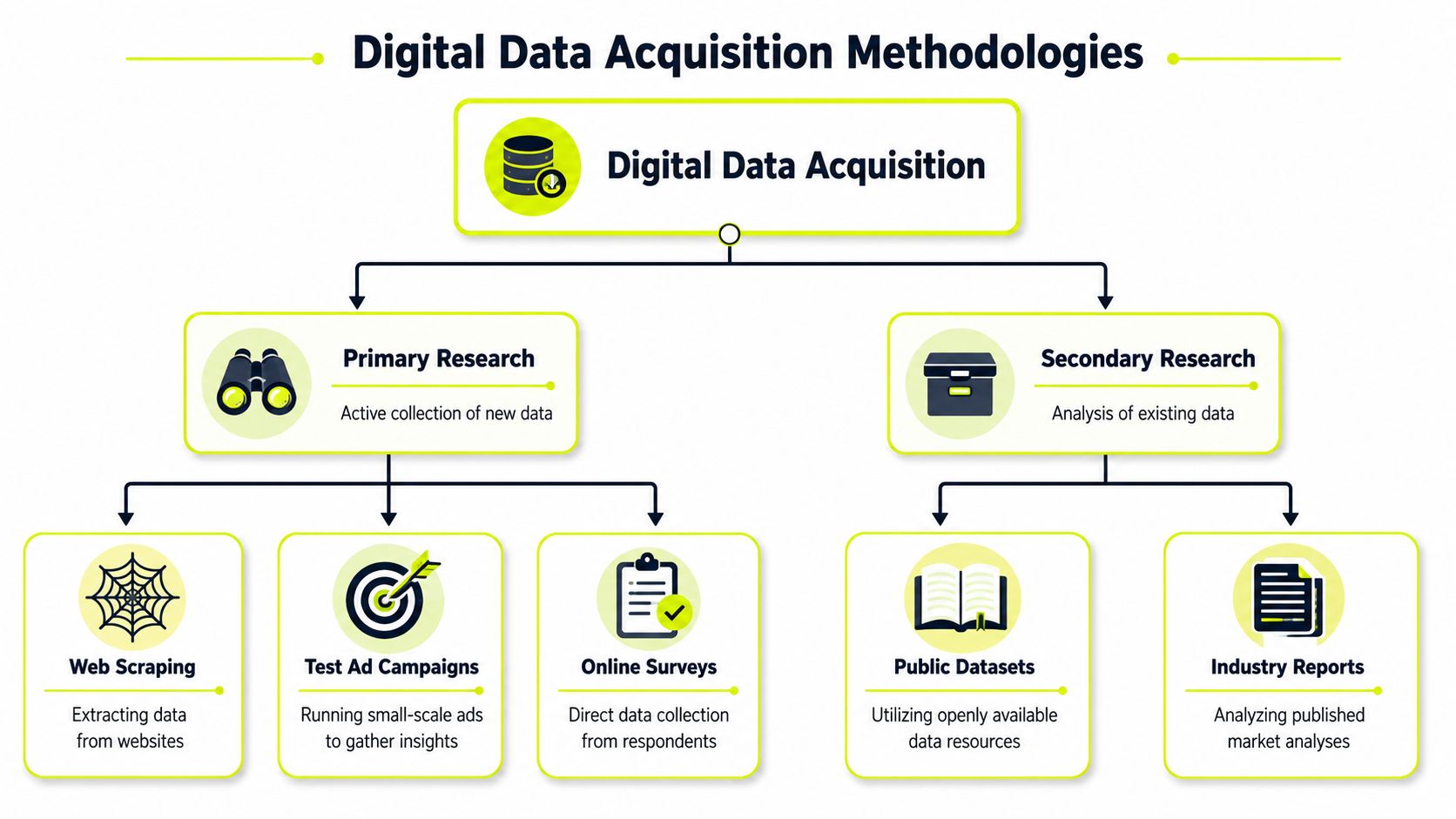
Primary methods in operator workflows
Primary research means creating fresh observations under controlled conditions. In practice, that usually means running checks through the same environments your campaigns depend on. Teams use live ad previews, low-budget probe campaigns, controlled page visits by geo, repeated competitor captures, and reviewer-path tests.
This work costs time and money. It also gives the cleanest signal when platform behavior shifts fast.
A media buying team might launch a limited test to compare approval rates across account clusters. An account ops team might open the same destination through different residential exits to confirm whether local users get the same lander, translation layer, and checkout flow. A cloaking team might test timing, device class, and referral path to map which version appears under each condition.
Common primary methods include:
- Web scraping: Pulling landers, pricing pages, review pages, SERP placements, or ad library records on a schedule.
- Test ad campaigns: Running small-budget probes to observe approval patterns, delivery behavior, comment quality, and local rendering.
- Direct feedback loops: Collecting post-click feedback, support logs, or owned-audience responses when you control the traffic source.
Teams that build around APIs often make better collection decisions because they define entities, fields, and refresh logic before they start scraping. A practical reference is this guide to a social media API workflow for structured data collection.
Secondary methods that save time
Secondary research starts with material you already have or can access without generating new traffic. That includes campaign logs, rejection notes, browser session history, archived screenshots, public ad libraries, competitor pages captured earlier, affiliate network notes, and any internal record tied to spend or account quality.
Here, disciplined teams cut waste.
Good secondary work narrows the questions before anyone spends money on fresh tests. If six months of logs show approval drops only on one account batch, there is no reason to start with a broad market study. Check the account provenance, browser profile consistency, proxy assignment, and warm-up sequence first. If archived competitor captures show the same pricing cadence across three geos, the next step is to verify whether the visible differences come from local inventory strategy or from your collection path.
The same rule applies to statistical claims. Large historical datasets and pooled studies can strengthen decision-making, but only when the source is documented and the sample matches the environment you operate in. Without attribution, specific numbers about sample size, error reduction, correlation strength, or predictive lift should not drive campaign decisions.
How to choose between them
Use primary collection when the answer depends on live delivery, platform enforcement, localized rendering, or session-specific behavior. Use secondary analysis when you need to narrow the field, confirm that a pattern repeats, or decide whether a fresh test is worth the account risk.
A practical split looks like this:
- Start with primary for ad delivery checks, reviewer-path validation, cloaking tests, and local page rendering.
- Start with secondary for recurring approval issues, category saturation, creative trend mapping, and funnel comparison over time.
- Use both together for anything that changes budget allocation, account rotation, or infrastructure policy.
The method matters, but the environment matters just as much. A scrape from the wrong IP class, a check from an overused browser profile, or a probe campaign from a weak farm can turn clean methodology into bad research. Strong operators choose the method and the collection context together.
Automating Data Collection with Proxies and Scrapers
A manual check says a competitor is pushing a soft advertorial in Germany. The scrape from your server says the page is clean. The account team logs in from a reused datacenter IP and gets a third version with a dead link. Same funnel, three different observations. The problem is not volume. The problem is collection context.
That is why automation for arbitrage research starts with representativeness, not speed. If the proxy layer, browser identity, and request pattern do not match the audience or account state you are trying to measure, the scraper will collect a lot of data and still answer the wrong question.
The working stack usually has three layers. Antidetect browsers hold stable identities. Proxies define the network path and geography. Scrapers handle repeated fetches, parsing, retries, and logs.
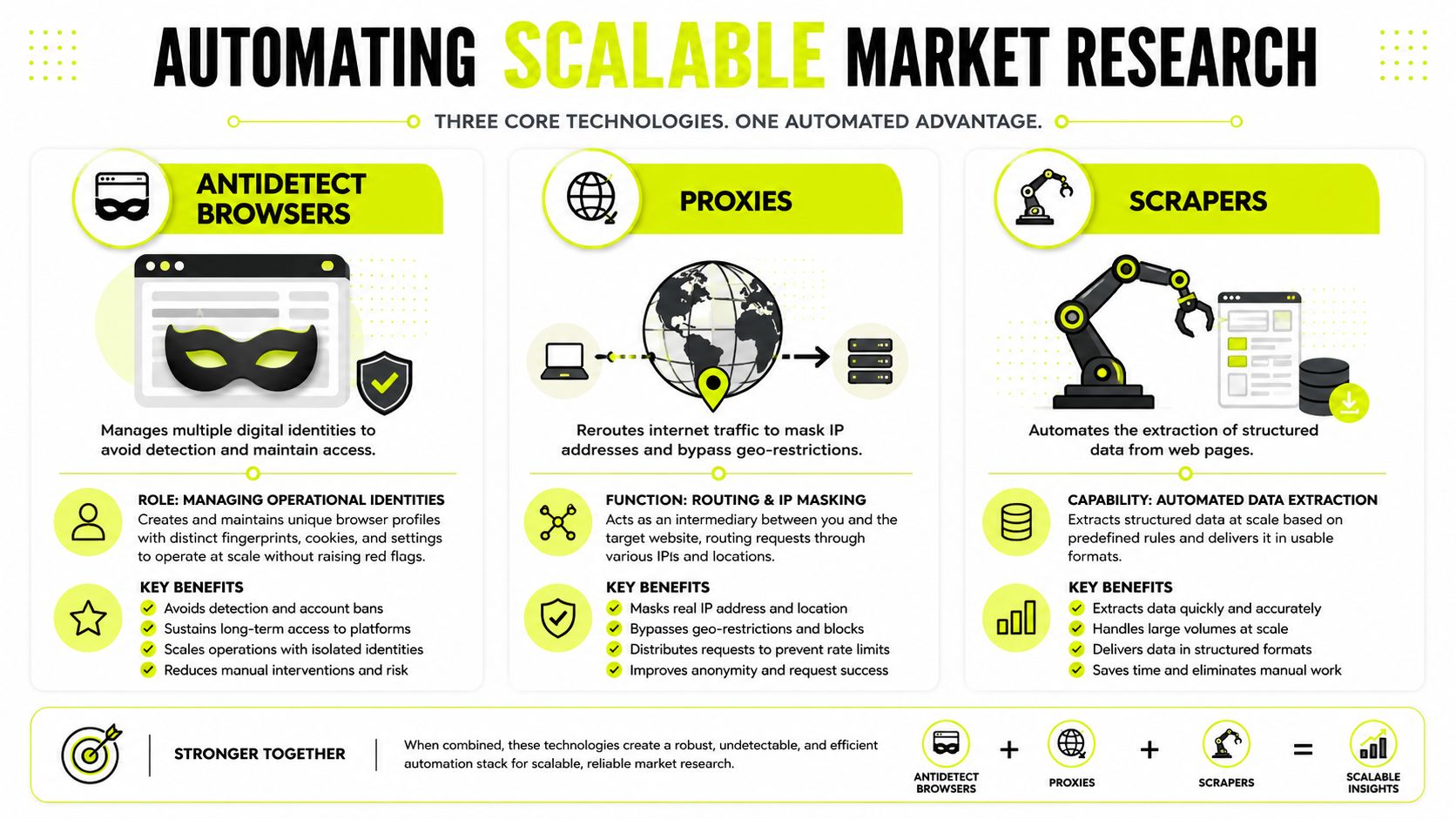
What each layer actually does
Tools like AdsPower, Dolphin Anty, GoLogin, Multilogin, and Hidemyacc do one job well. They preserve browser fingerprints, cookies, local storage, and session continuity so each account or research path stays isolated.
Proxies answer a different question. They determine how the target platform classifies the visit. Residential, mobile, datacenter, and IPv6 traffic do not get treated the same, and that difference changes what your research sample represents. A proxy is not just an access tool. It is part of the methodology.
Scrapers sit on top of that foundation. They pull pages on schedule, capture HTML or screenshots, extract fields, and retry failed requests. For larger web scraping operations, the useful setup is the one that ties every fetch to its environment: proxy class, geo, browser profile, timestamp, and response quality.
After the stack is in place, this walkthrough is a useful visual reference for the workflow side of automation:
Choosing the right proxy type for the job
Proxy selection changes the result set, especially in arbitrage work where platforms personalize by region, device, session history, and trust signals.
| Proxy type | Best use | Strength | Limitation |
|---|---|---|---|
| Residential | Ad verification, local user-path checks, account work | Closest to normal consumer traffic | Higher cost and slower throughput in large scrape jobs |
| Mobile | Mobile-first app checks, social platform validation, app-store paths | Useful where carrier context affects delivery or trust | Expensive and inefficient for broad extraction |
| Datacenter | Bulk scraping, fast parsing, low-cost monitoring | High speed and low unit cost | More likely to be classified as automation traffic |
| IPv6 | Selected regional tasks and lower-cost scale in compatible environments | Large address pools | Results vary by target platform and setup quality |
A practical rule helps here. Use datacenter for monitoring tasks where you care about coverage and speed. Use residential or mobile when you need to know how delivery looks to a real user or how an account behaves under realistic conditions. IPv6 can work well in narrow setups, but only after validating that the platform treats that traffic the way your target audience would be treated.
Session design for account farming and verification
Session policy matters as much as IP type. Account farms fail when the browser identity says one user and the network behavior says ten operators and a script.
In day-to-day account work, stable sessions usually outperform aggressive rotation. A farmed Facebook profile logging in through the same city, same device profile, and same sticky IP has a coherent history to build on. If that same profile jumps networks too often, trust drops, checkpoints increase, and review friction shows up faster. The exact tolerance varies by platform, account age, and action pattern, so hard numeric rules are risky unless the source is documented and matches your environment.
That is the problem with borrowed benchmarks. A broad market research explainer like Hanover Research on market research is useful for methodology framing, but it is not a source for operational proxy thresholds in account farming. In practice, teams should validate session length, rotation rules, and failure rates inside their own farms and log the result by platform, geo, and account cohort.
The split I use is straightforward:
- Account farming: sticky sessions, one browser profile per account, slow login rhythm, no unnecessary IP changes
- Ad verification: controlled sessions with the right geo, device context, and enough persistence to reproduce delivery
- Public-page scraping: rotation based on target sensitivity, request limits, and parser failure patterns
- Cloaking checks: multiple session types from multiple IP classes, because one clean path proves very little
At scale, the edge comes from matching the collection environment to the decision you need to make. If the goal is to estimate what users in a target geo experience, representative traffic matters more than raw fetch count. If the goal is broad competitor monitoring, lower-cost traffic can be enough as long as the team labels that dataset correctly and does not treat it like user-representative evidence.
Analyzing Data for Actionable Campaign Insights
A team runs approval checks across five geos, sees a spike in green statuses, and scales spend by noon. By evening, conversion quality is down, two account batches are unstable, and the winning creative only worked in the exact collection setup used for research. The miss was not a lack of data. The miss was weak analysis tied to an unrepresentative environment.

How to structure raw inputs
Actionable analysis starts with a record format that matches the decisions your team makes. If the goal is to choose a creative, cut a bad browser stack, or verify whether a funnel is stable by geo, each record needs enough context to explain the result later.
Use a spreadsheet, Airtable base, or a lightweight SQL table. The tool matters less than the schema.
Every row should answer five questions:
- What did you observe
- Where did you observe it
- When did it happen
- Which collection environment produced it
- What action did the team take
For campaign and account operations, the useful fields are usually geo, device type, browser profile, proxy class, session persistence, account age bucket, ad angle, lander variant, approval result, visible CTA, and notes on redirects or cloaking behavior. For scraper output, add response status, parser success, retries, DOM changes, and whether the fetch came from a user-representative path or a lower-cost monitoring path.
That distinction matters in practice. Teams running affiliate campaigns often get better decisions when they map creatives, prelanders, and conversion behavior against geo and traffic conditions the same way they map operational inputs in an affiliate marketing campaign workflow. Aggregate numbers hide too much.
How to find signals that survive scale
Once the records are clean, analyze them the way an operator reviews live campaign risk. Look across segments, over time, and across repeated pattern groups.
- Segment: Break results out by geo, device, proxy type, account cohort, and browser setup.
- Time: Check what changed after a platform update, budget push, rotation rule change, or new farm batch.
- Cluster: Group creatives and landers by claim type, visual structure, CTA language, or compliance risk.
Formal research methods still help here, as explained in Forbes Advisor's guide to market research, which includes an example of multivariate regression on 50,000 consumer responses. In that cited example, the analysis isolated brand perception as a driver of purchase intent, with a coefficient of 0.42 and p < 0.005, and a 10% improvement in brand perception corresponded to a 4.2% increase in purchase intent. The practical lesson for arbitrage teams is simple. Do not treat a surface win as proof. Check whether the result still holds after you control for geo, inventory quality, account condition, and collection environment.
A creative can look strong because the accounts were fresh, the approvals were easier in one region, or the research traffic was cleaner than the traffic your campaign will face.
A practical review loop
The review process should end in an operating decision, not another dashboard tab.
I use a five-step loop:
- Normalize labels so geos, devices, proxy classes, and approval states are named the same way across sources.
- Tag repeatable patterns in copy, visuals, claims, funnel steps, and moderation outcomes.
- Compare representative versus convenience data to see whether the finding came from real user-like conditions or just the easiest collection path.
- Flag anomalies fast such as render mismatches, sudden approval drops, parser failures, or local offer changes.
- Assign one concrete action with an owner and deadline.
That final step is where research becomes useful. Launch the angle in one geo first. Pause the browser stack that only performs under datacenter traffic. Re-run cloaking checks through a residential session. Split account batches before pushing budget.
Analysis is what turns collection into edge. In arbitrage and account farming, the edge usually comes from identifying which results are portable and which only exist inside the setup that produced them.
Navigating Technical Pitfalls and Data Bias
A team pulls competitor ads, landers, and pricing across five geos overnight. By morning, the dashboard is clean, the tags are normalized, and the trend looks obvious. Then the campaign goes live on real traffic and misses. The issue was not messy data. The issue was that the research stack sampled the wrong version of the market.
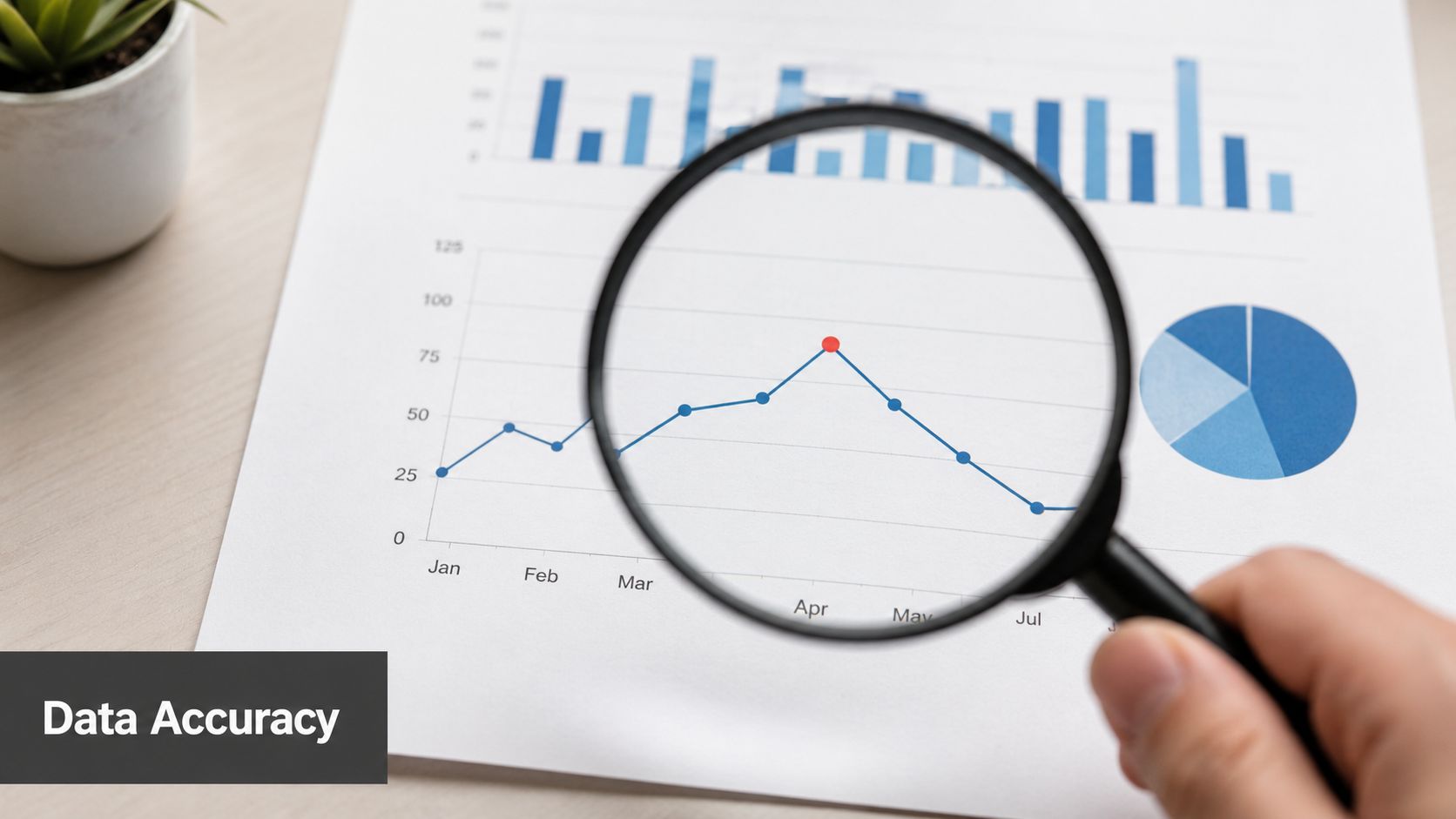
Accuracy is not representativeness
Technical teams usually focus on collection accuracy first. That makes sense. Parsers need stable HTML, timestamps need to line up, and duplicate records need to be stripped before anyone can trust the output.
But in arbitrage and account ops, the bigger risk is representativeness. A scraper can capture a page perfectly and still capture the wrong experience.
That happens all the time with proxy selection. Datacenter IPs are cheaper, faster, and easier to scale. They are also more likely to hit alternate page versions, challenge flows, stripped assets, or traffic that gets scored as suspicious before the content fully loads. Residential sessions cost more and are harder to manage cleanly, but they often produce a version of the market that is closer to what real users, reviewers, or platform systems see.
I treat proxy class as a sampling decision, not just an infrastructure decision.
Where proxy-driven research goes wrong
The common failures are operational, not academic.
- Challenge pages recorded as successful fetches: The scraper stores a 200 response, but the browser was served a bot check, consent wall, or partial render.
- Fingerprint and network mismatch: The IP geolocates to Madrid, the browser locale is Polish, the timezone is UTC, and the platform responds with a fallback experience.
- Rate patterns that no user would produce: Requests arrive every few seconds from the same subnet, so pricing, inventory, or ad delivery logic shifts.
- Geo bleed across sessions: A rotation pool says one country, but DNS, CDN edge selection, or account history points somewhere else.
- Proxy class bias: Research collected only through one traffic source reflects how platforms treat that source, not how the market behaves overall.
For teams dealing with blocking pressure, practical controls from avoiding IP bans during automation can improve stability. Stability alone is not enough. A stable collection setup can still produce biased research if the traffic profile does not match the audience, reviewer, or moderation path you need to understand.
What good teams check before trusting the output
I look for environment drift before I look at the chart. If the same landing page converts, renders, or gets reviewed differently across proxy classes, I assume the research setup is part of the result until proven otherwise.
A usable validation pass usually includes three checks. First, compare key pages across at least two traffic environments. Second, load the same targets through the browser stack used in live operations, not just raw requests. Third, review a sample manually for asset load order, local pricing, moderation prompts, redirects, and consent behavior.
This matters most in account farming and ad verification. Approval rates, ad visibility, and even what copy is shown can change based on the network footprint behind the session. Standard market research guides frame this as a data accuracy problem. In practice, it is a representativeness problem. If your collection environment does not resemble the environment where budgets, approvals, and user clicks happen, the analysis will drift.
The trade-off is simple. Fast, cheap collection increases volume. Representative collection protects decisions. At scale, the second one saves more money.
Legal and Ethical Lines in Data Driven Operations
A team pulls competitor ads through one proxy pool, verifies delivery through another, then logs into warmed accounts from a third environment. The reports look clean. The accounts do not. That gap is where legal exposure, policy violations, and bad research decisions start to overlap.
For arbitrage and account ops, the real question is not whether data collection is allowed in the abstract. The question is whether the workflow matches the use case, the platform rules, and the identity signals attached to the session. Public-page collection, logged-in scraping, ad verification, account warming, and cloaking do not carry the same risk. Treating them as one bucket is how teams end up with weak controls and misleading research.
Platform rules you can't ignore
Meta and TikTok enforce around automation, identity consistency, deceptive behavior, and account integrity. Those checks hit the exact stack operators use every day in AdsPower, Dolphin Anty, GoLogin, Multilogin, and Hidemyacc. Browser profile quality matters. IP class matters. Session history matters. So does whether the action only observes a page or actively changes account state.
One boundary is clear. Meta prohibits cloaking and other methods that show reviewers different content from what users see, as stated in Meta's advertising standards and policy materials. That matters operationally because research environments often bleed into production habits. A setup built to inspect ads across geos can drift into behavior that platforms read as misrepresentation if the identity layer, destination behavior, and session routing stop lining up.
The practical takeaway is simple. Infrastructure choices are part of compliance. They also shape research validity. If the proxy layer changes how platforms classify the session, then your findings may describe the lab environment, not the market you plan to buy traffic in.
Risk management in real workflows
I use a basic review before approving any collection or account workflow:
- Is the target public, or does it require login or membership?
- Are we observing content, collecting data at scale, or changing account state?
- Does the setup alter identity signals in a way a platform could treat as deceptive?
- Can the data include personal information, comments, usernames, or other identifiers?
- If platform logs or legal counsel reviewed this workflow, would the intent and controls hold up?
That filter changes decisions fast.
| Workflow | Main risk |
|---|---|
| Scraping public competitor pages | Terms enforcement, rate limits, jurisdiction-specific legal issues |
| Scraping behind authenticated access | Higher contractual exposure and stronger legal risk |
| Ad verification across geos | Lower content risk, but session consistency and proxy reputation still matter |
| Account farming | Direct account integrity and enforcement exposure |
| Cloaking | Explicit policy violation and high suspension risk |
The operational mistake is assuming legal risk and platform risk are the same thing. They are related, but they break in different places. A workflow can be legal in a narrow sense and still get accounts restricted because the platform reads the identity pattern as abusive. A workflow can also stay inside platform rules and still create privacy issues if the collection pipeline stores personal data without a clear basis or retention policy.
Good teams document intent, isolate research from production, log who ran what, and keep retention rules tight. GDPR and CCPA become relevant fast when scraped content includes usernames, comments, emails, location clues, or anything that can tie activity back to a person.
Operators who stay in this field for years do not treat ethics as PR language. They treat it as system design. If the method depends on hidden identity switching, inconsistent destinations, or collecting data you cannot justify storing, the workflow is weak before the campaign even launches.
If your team runs large-scale scraping, geo-targeted ad verification, Facebook and TikTok account ops, or market research that depends on realistic IP coverage, Sota Proxy is built for that workload. It gives technical teams residential, mobile, ISP, and datacenter proxy options across 220+ geolocations, with sticky and rotating session control that fits both research and account workflows. For operators who need stable infrastructure instead of trial-and-error networking, it's a practical stack to evaluate.
Related articles
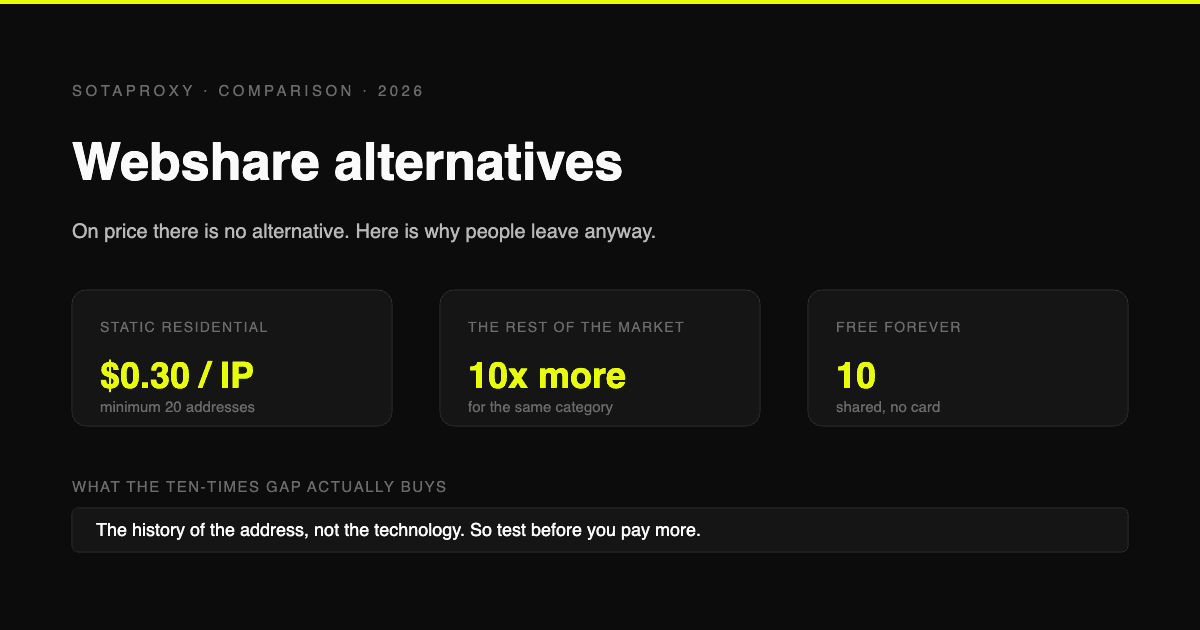
Webshare Alternatives in 2026: When the Cheapest Proxies Stop Being Cheap
Webshare gives away 10 proxies and sells static residential at $0.30 an IP, a tenth of what most vendors charge. Verified prices, the four reasons people still leave, and the one reason to stay.
Dolphin Anty for Multi-Accounting: Features, Automation, and Proxy Integration
How to use Dolphin Anty for multi-accounting: browser profiles, Cookie Robot, scenarios, Synchronizer, API automation, and three ways to connect SotaProxy proxies. Promo code SOTA20 gives 20% off.
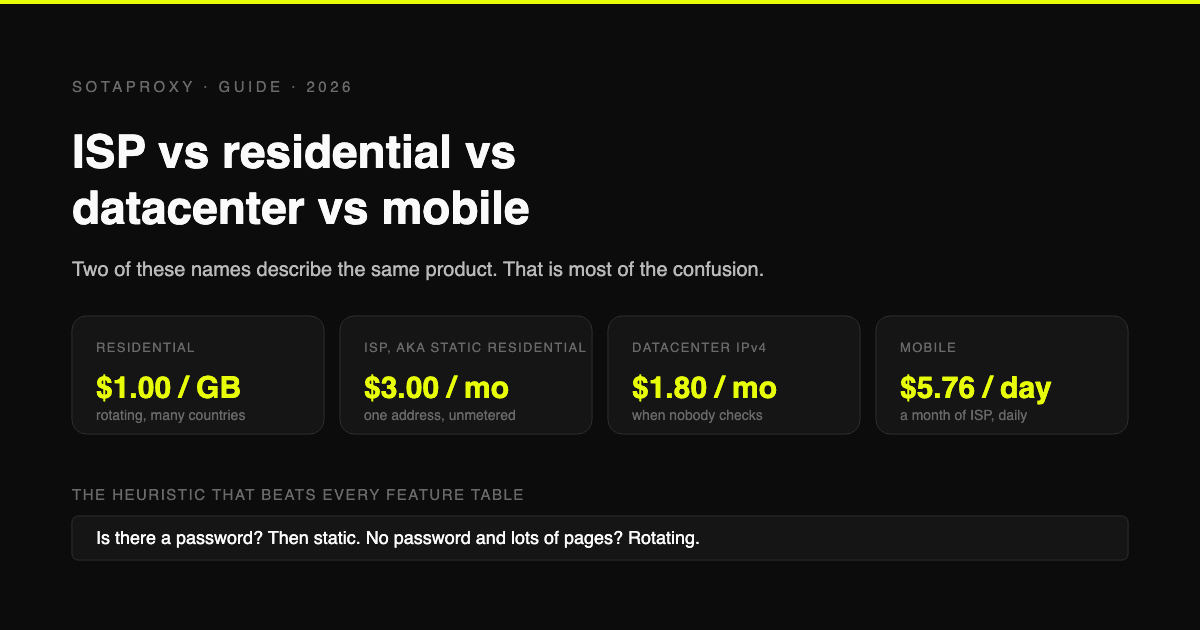
ISP vs Residential vs Datacenter vs Mobile Proxies: Which One You Actually Need
Static residential and ISP are the same product under two names, which is why half these comparisons compare a thing to itself. What each type is, what it costs per unit, and the one task each is genuinely best at.
Why a Working Proxy Isn't Enough: A ToDetect Pre-Launch Checklist
A working proxy doesn't guarantee a consistent browser environment. Learn how ToDetect checks IP, DNS, WebRTC, and browser fingerprint signals before launch.
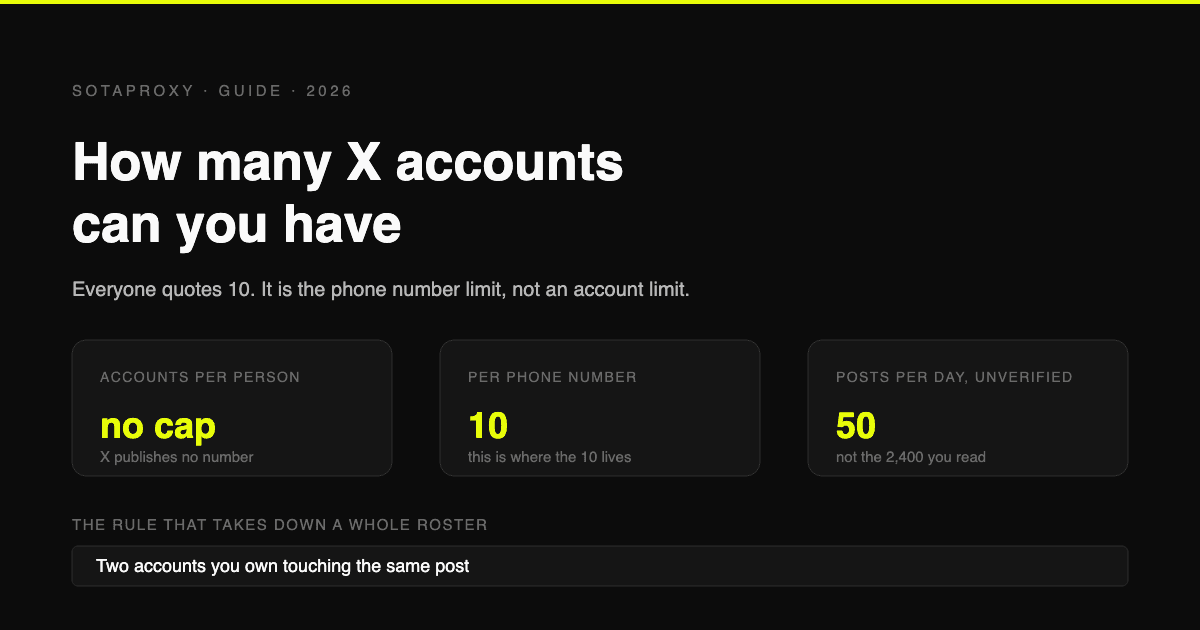
How Many X (Twitter) Accounts Can You Have in 2026 (The 10 Is a Phone Limit, Not an Account Limit)
X publishes no cap on accounts per person. The 10 everyone quotes is the number of accounts one phone number can cover. The real constraints are 50 posts a day on a free account, duplicative use cases, and accounts that interact with each other.
Reddit "You've Been Blocked by Network Security": Every Cause, and the Fix for Each
It is not a ban and there is nothing to appeal. It comes from Reddit's edge, applies to your connection, and has six causes. Here is how to tell which one you have, and how long each lasts.