API for Social Media: A Guide for Operators & Developers
A technical guide to the API for social media. Learn to use official, unofficial, and scraping APIs for account management, automation, and ad campaigns.
You already know the failure mode. One buyer runs Facebook ads in AdsPower. Another launches TikTok campaigns from Dolphin Anty. Someone else warms backup accounts in GoLogin. The farm team rotates cookies, creatives, proxies, and landing pages across dozens of profiles. Everything works until volume shows up.
At that point, manual ops stop being annoying and start becoming the bottleneck. People miss comments, duplicate uploads, burn ad accounts by logging in from the wrong environment, and lose track of which geo-targeted creative went live where. The issue isn't effort. It's control.
That's where an API for social media stops being a developer abstraction and becomes operating infrastructure. Social media APIs became central to third-party automation as platforms standardized developer access to posts, profiles, comments, likes, and engagement metrics, which is why modern management systems can unify scheduling, reporting, and message routing across networks from one interface, as outlined by Data365's overview of social media APIs.
Table of Contents
- Scaling Social Media Operations Beyond Manual Clicks
- Official vs Unofficial vs Scraping API Strategies
- Navigating Authentication and Platform Rate Limits
- Core API Endpoints for Automation and Management
- Best Practices for Building Reliable Automation
- The Role of Proxies and Anti-Blocking Solutions
- Legal Constraints and Platform Terms of Service
Scaling Social Media Operations Beyond Manual Clicks
Five ad accounts are manageable. Fifty aren't.
A traffic arbitrage team can brute-force early growth by assigning people to browser profiles, ad accounts, and social pages. One operator handles Facebook pages in Multilogin. Another rotates TikTok posting accounts in Hidemyacc. A third checks whether cloaked pages render correctly for each target country. That setup works for a week. Then the mistakes pile up.
The first break usually isn't technical. It's procedural. Teams publish the wrong creative from the wrong session, reuse a warm browser profile for a cold account, or miss inbox events that should have triggered a response or pause. When you're juggling account farming, ad verification, geo-targeted campaigns, and content distribution, manual clicks don't scale cleanly.
Why manual ops collapse
A few patterns show up every time:
- Session confusion: An operator opens the wrong AdsPower or GoLogin profile and performs a sensitive action on the wrong Facebook or TikTok account.
- No central state: Nobody has a reliable view of what was posted, edited, appealed, paused, or replied to.
- Linear staffing: Every batch of new accounts needs more people. That's not a system. It's a headcount problem.
Practical rule: If the task has to be repeated across many accounts, many geos, or many creative variants, it belongs in code.
An API for social media gives you programmatic control over the repetitive layer. You can standardize publishing, collect engagement signals, route messages, tag failures, and trigger alerts without relying on humans to remember every step. That doesn't remove antidetect browsers from the stack. It narrows their job to the actions that still need a full browser session.
Where APIs fit in a real operator stack
For most media teams, the workable split looks like this:
- Use browser automation for fragile actions: account creation, warm-up, appeal flows, payment setup, and anything that depends on live rendering or JS-heavy behavior.
- Use APIs for repeatable actions: publishing, pulling metrics, syncing statuses, and handling inbox or moderation workflows.
- Use scraping sparingly: mostly for external verification, competitor monitoring, or coverage where official surfaces are missing. If your team does that, this guide on Python web crawling for scalable data collection is a useful companion.
The point isn't to replace everything with an API. The point is to stop wasting good operators on work that software should own.
Official vs Unofficial vs Scraping API Strategies
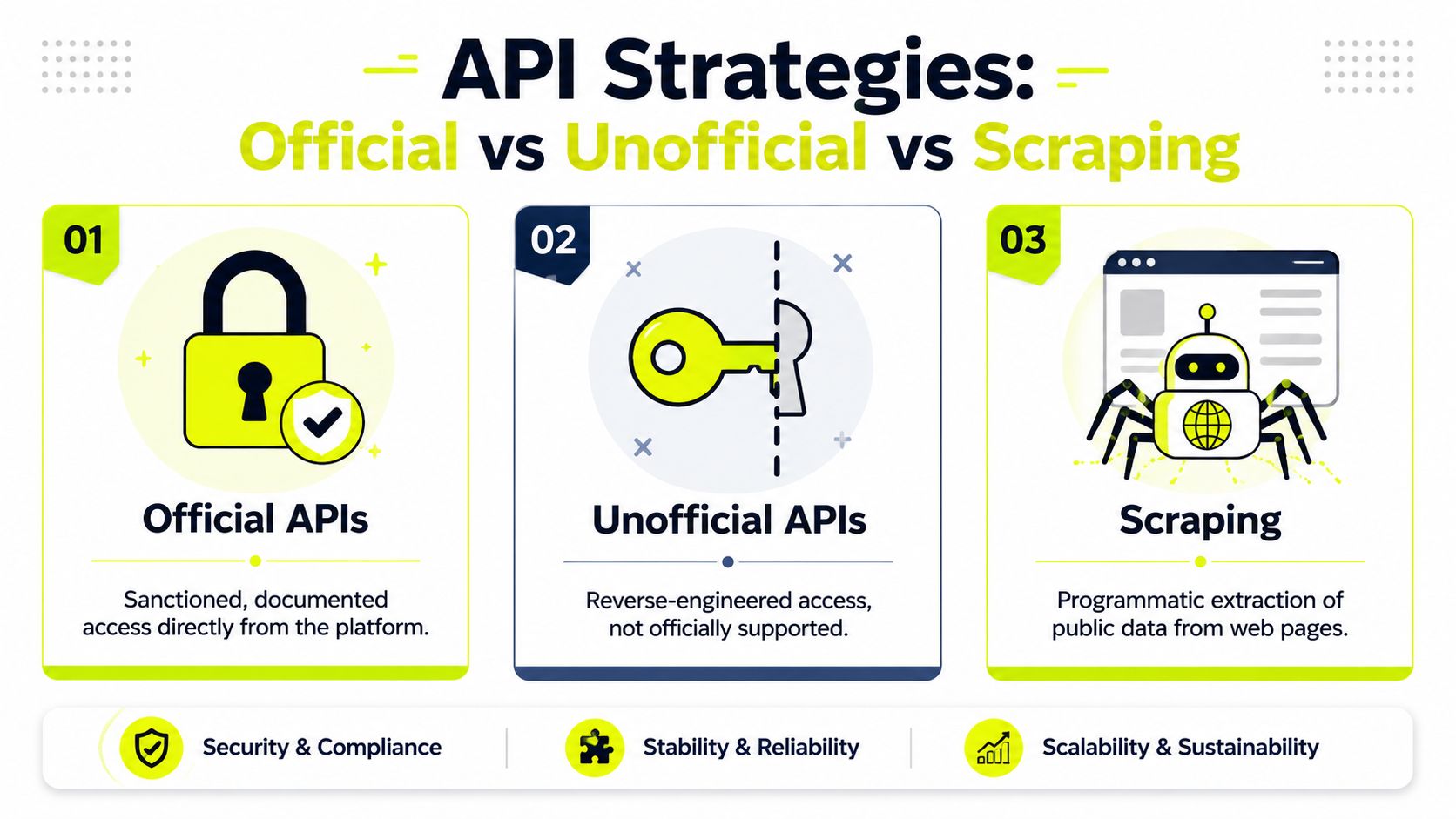
Teams typically don't choose one access method forever. They choose a primary method, then bolt on exceptions when coverage gaps or scaling pressure force it.
Official APIs for survivability
Official APIs are the least exciting option and usually the best foundation. They exist for a reason. Platforms want to expose controlled access to posts, media, analytics, comments, and selected account surfaces without giving you unlimited reach into their systems.
The upside is stability. The docs exist. Auth flows are documented. Failure modes are predictable. If you're managing branded Facebook pages, TikTok content publishing, YouTube uploads, or pulling performance data into internal dashboards, official APIs are the cleanest path.
The downside is access control and quota pressure. You don't get everything. You often won't get the full historical depth you want. Approval can be slow, and some endpoints are locked behind reviews, business verification, or product restrictions.
Unified APIs for speed
Unified API vendors sit between your app and each platform. That middle layer can save a lot of engineering pain. Unified social media APIs reduce integration complexity by exposing one REST endpoint that normalizes platform-specific formats and handles per-platform authentication. An application sends one request while the unified layer maps it to each platform's native rules, which is highly efficient for cross-platform publishing, as explained in Zernio's guide to social media APIs.
That model helps when your team needs one scheduler, one campaign manager, or one reporting backend for multiple networks. It also helps if you're building internal tooling fast and don't want separate integrations for Instagram, LinkedIn, X, Pinterest, and YouTube.
Use the video below if you want a quick visual walk-through before evaluating implementation details.
What doesn't work well is assuming a unified layer gives you full feature parity. It won't. The abstraction is strongest for standard publishing and common reads. It gets weaker when you need platform-specific ad features, odd media workflows, or edge-case moderation logic.
Unofficial APIs and scraping for edge access
Unofficial APIs and direct scraping exist because operators want access the official layer doesn't provide. That's the truth behind most large-scale account farming, ad verification, and competitor monitoring setups.
Here's the trade-off in plain terms:
| Method | Best for | What works | What breaks |
|---|---|---|---|
| Official API | Long-term account safety | Stable auth, documented endpoints, platform compliance | Limited coverage, approval friction |
| Unified API | Faster multi-platform builds | One schema, less maintenance, cross-posting | Vendor dependency, incomplete edge features |
| Unofficial or scraping | Data gaps and hidden surfaces | Broader visibility, custom extraction, looser workflows | Blocks, false data, fingerprint pressure, ToS risk |
If you're scraping public surfaces or reverse-engineering private calls, your anti-blocking layer matters as much as your parser. Browser fingerprints, request timing, geo consistency, cookie state, and IP trust all affect outcomes. For teams testing extraction pipelines, this piece on web scraping with PHP under real-world blocking conditions is relevant.
The more valuable the hidden data is, the more aggressively platforms defend the path to it.
For ad ops, the usual pattern is simple. Build your backbone on official access. Add unified abstractions where they save engineering time. Touch unofficial methods only when you can afford the operational and policy risk.
Navigating Authentication and Platform Rate Limits
Teams rarely lose API access because they can't write a request. They lose it because token handling is sloppy and request budgets aren't modeled.
Auth breaks in boring ways
Most production issues around authentication are self-inflicted. Tokens expire. Refresh flows fail undetected. One service stores credentials correctly while another writes them to the wrong environment. A worker retries with an old bearer token until the account gets flagged.
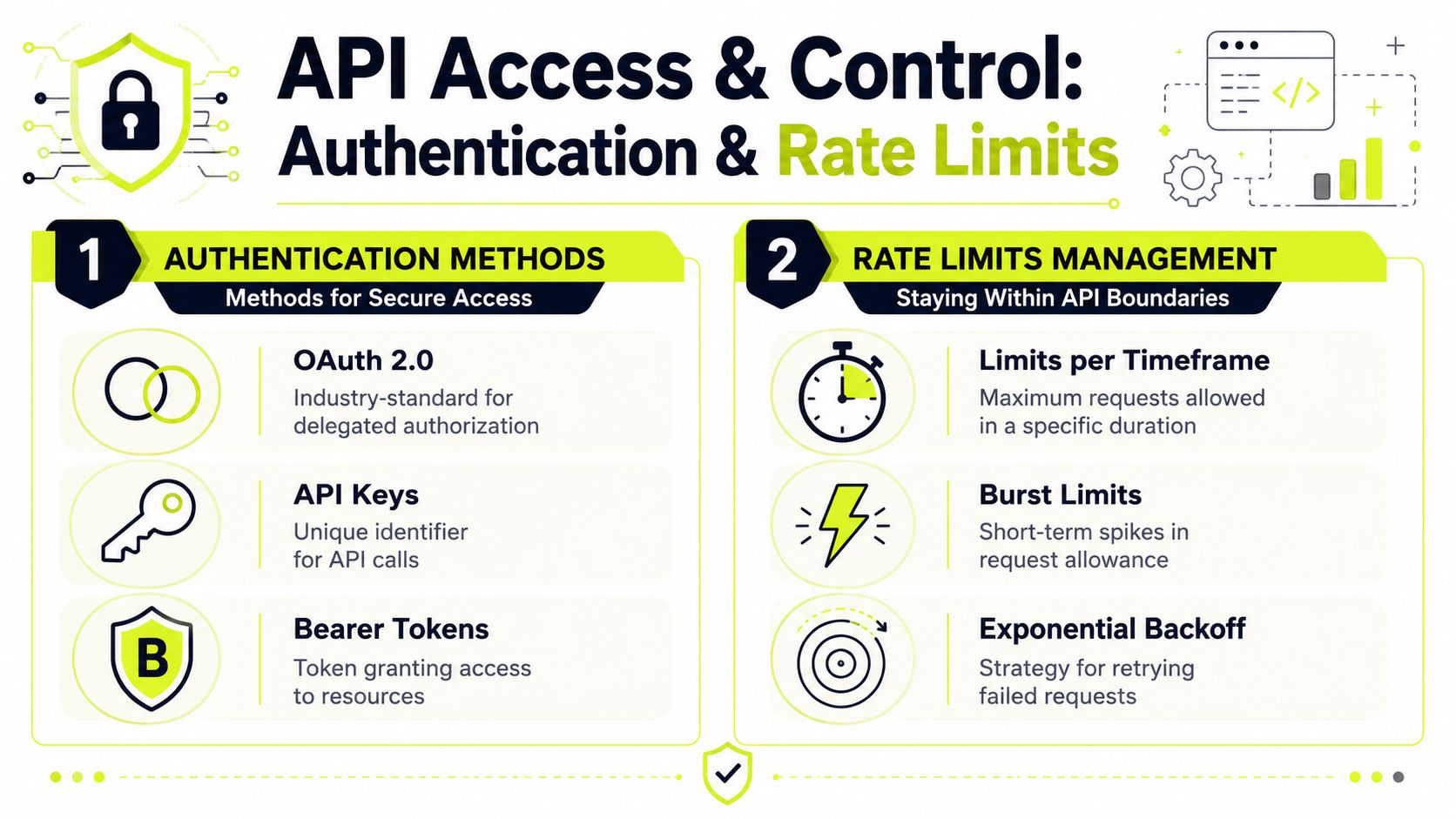
You'll see the same building blocks over and over:
- OAuth 2.0: common when users connect accounts and grant delegated access.
- API keys: useful for app-level identification, but usually not enough for protected user actions.
- Bearer tokens: standard for authenticated requests after the handshake.
For arbitrage teams, the practical concern is mapping tokens to the right account entity. If your internal system doesn't clearly separate user, workspace, ad account, page, browser profile, and geo assignment, you'll eventually post from the wrong asset or pull data into the wrong client bucket.
A second problem shows up when teams mix browser sessions and API auth carelessly. An operator logs into a TikTok or Facebook asset in Dolphin Anty, while a backend job uses a disconnected token state for the same asset. That mismatch creates messy debugging and can look suspicious when actions don't line up.
Rate limits decide throughput
Social media APIs are governed by strict limits. Meta's Graph API uses a dynamic model, with examples such as roughly 200 × number of users and 4,800 × number of impressions for some Instagram endpoints. X commonly applies endpoint-based caps over 15-minute windows, with many read endpoints around 300 to 900 requests per window. YouTube's Data API uses a default quota of 10,000 units per day. Pinterest has documented 1,000 requests per day for trial access and up to 100 requests per second per user app for standard access, according to GetStream's breakdown of social media API limits.
That means the script that works on one page can fall apart when you run it across many accounts, many creatives, and many reporting jobs at once.
Operational advice: Treat rate limits like budget allocation, not as random errors.
A workable control loop includes:
- Read limit headers when available. Store remaining budget and reset timing centrally.
- Queue by endpoint family. Posting, analytics, comments, and media upload shouldn't all compete in the same lane.
- Back off before hard failure. If remaining calls are low, slow the workers instead of letting them hammer into 429s.
- Separate urgent from bulk tasks. Comment moderation and campaign pauses need priority over historical sync jobs.
Teams building monitoring or parsers alongside social APIs often benefit from the same discipline used in structured extraction pipelines. This guide on XML and Python workflows for controlled parsing jobs is useful if you're designing budget-aware workers.
What usually works
The stable pattern is boring and reliable. Use short-lived access where the platform expects it. Refresh early. Log every auth failure with account context. Build per-platform throttlers, not one global retry switch.
What doesn't work is pretending limits don't matter because you have more servers. Platform caps don't care how many workers you spin up.
Core API Endpoints for Automation and Management
Once auth and quotas are handled, the next question is simpler. Which endpoints matter for operators?

Publishing endpoints
Publishing endpoints are the obvious starting point. These are the routes that create posts, upload media, schedule content, and sometimes update or delete previously published items.
For traffic teams, publishing isn't just social scheduling. It's support infrastructure for:
- Geo-targeted campaign distribution: push localized creatives to region-specific pages or profiles.
- Ad support pages: keep Facebook pages active so ad accounts don't point to dead-looking assets.
- TikTok organic seeding: feed content into warm accounts tied to paid funnels.
In practice, you'll usually send JSON payloads containing text, media references, target account IDs, and scheduling instructions. The important part isn't the payload itself. It's building a mapper so each account gets the right language, landing-page variant, and compliance-safe creative.
Read and analytics endpoints
Read endpoints pull profile data, post state, comments, follower surfaces, and selected metrics. Analytics endpoints add engagement data, delivery state, and campaign-related signals where the platform exposes them.
That layer is useful for several real jobs:
- Post verification: confirm that the asset published and didn't fail in processing.
- Moderation routing: ingest comments or messages and forward them to internal queues.
- Creative triage: compare post-level response patterns before reusing content on new accounts.
Don't expect complete universality. Each platform exposes a different slice of reality. Some return rich objects. Others return only the minimum needed for simple dashboards.
Webhooks beat constant polling
Polling works at small scale. Then it becomes wasteful.
If the platform supports webhooks, use them for events like new comments, inbound messages, and post-status updates. A webhook-first design cuts noise, reduces wasted requests, and gives your team faster reaction windows.
Poll when you must. Subscribe when you can.
That matters when one moderation queue supports many Facebook pages, TikTok profiles, and auxiliary brand assets. If your system waits for polling cycles to discover problems, operators react late and accounts absorb unnecessary risk.
Best Practices for Building Reliable Automation
Most broken automation wasn't ambitious. It was underbuilt.
A lot of teams write the happy path, test it on one account, then point it at a fleet. That's when they discover pagination gaps, retry storms, duplicate posts, and concurrency that turns minor throttling into broad account disruption.
Pagination first
If an endpoint returns lists, assume the first response is incomplete. Comments, post histories, analytics rows, inbox threads, and account inventories almost always paginate.
Build pagination handling before you care about speed.
- Cursor-based flows: follow the next token exactly as returned.
- Offset-limit flows: protect against skipped or duplicated rows if records change between requests.
- Checkpointing: store progress so long-running syncs can resume instead of restarting.
This matters for arbitrage teams that audit many support pages or many funnel assets at once. A partial dataset can lead to wrong decisions, like thinking a moderation queue is empty or a batch publish failed when the later pages were never fetched.
Retry logic that doesn't cause more damage
Retries need judgment. A temporary network timeout and a hard permission error aren't the same thing.
Use a simple classification model:
| Error type | Correct response |
|---|---|
| Temporary network issue | Retry with delay |
| Rate limit response | Back off and requeue |
| Invalid auth | refresh token or require reauth |
| Permission denial | stop and escalate |
| Validation failure | fix payload, don't retry blindly |
Exponential backoff is still the safest general rule. Add jitter so large worker pools don't retry in lockstep. Cap the retry count for write actions. A duplicated analytics read is annoying. A duplicated publish can create visible mess on live assets.
For teams fighting blocks on adjacent crawling and verification workloads, the thinking overlaps with standard anti-ban practice. This article on how to avoid IP bans during automated activity pairs well with API retry design because both depend on pacing and clean failure handling.
Concurrency with restraint
Concurrency is useful until it stops looking like normal behavior.
A few practical limits help:
- Shard by account or workspace: don't let one noisy client starve everyone else.
- Separate reads from writes: reading metrics and publishing media create different risk profiles.
- Use idempotency keys where possible: especially for publish and update calls.
- Throttle sensitive actions harder: message sends, comment actions, and repeated edits trigger attention faster than plain reads.
What works is measured throughput. What breaks is trying to force social platforms to behave like internal microservices. They aren't built for your convenience. They're built to protect the platform first.
The Role of Proxies and Anti-Blocking Solutions
If you're operating many accounts, the API layer is only part of the picture. The other part is whether platforms believe the surrounding activity is consistent.
That's why serious teams separate API automation from identity management. APIs handle the repeatable machine work. Antidetect browsers handle the actions that still need full browser context. Proxies glue the identity layer together so Facebook pages, TikTok ad accounts, warm profiles, and support assets don't all collapse into one visible network pattern.
What each proxy type is actually good for
Different proxy types solve different problems. Treating them as interchangeable is one of the fastest ways to burn accounts.
| Proxy Type | Primary Use Case | Trust Score | Cost | Key Weakness |
|---|---|---|---|---|
| Residential | Account creation, account management, login consistency, ad account access | High | Higher | More expensive for heavy bulk jobs |
| Mobile | Sensitive actions on Instagram, TikTok, and high-friction warm-up flows | Very high | Highest | Cost and lower throughput control |
| Datacenter | Fast scraping, low-sensitivity checks, internal tooling, bulk fetches | Lower | Low | Easier for platforms to classify |
| IPv6 | Cheap bulk collection on targets that support it | Lower to medium | Low | Many platforms and services still treat it inconsistently |
Residential proxies are the default for serious account work because the IPs look like real-user traffic. If you're managing Facebook ad accounts, aging TikTok identities, or logging into assets through AdsPower or Multilogin, residential is usually the safer baseline.
Mobile proxies are stronger for fragile actions. Platforms often treat mobile carrier traffic as normal consumer behavior. That's why teams use them for warm-up, recovery, or actions that repeatedly fail on weaker IP classes.
Datacenter proxies are still useful. They're fast, cheap, and easy to scale for non-sensitive tasks like public-page checks, QA, or collecting non-account-bound data. They're the wrong tool for most account farming or high-value account management.
IPv6 has a place in bulk work where the target supports it well. It can be cost-effective for scraping and wide coverage tasks. It's rarely the first choice for sensitive social account operations.
A good proxy isn't the one with the best marketing. It's the one that matches the trust requirements of the action.
Fingerprinting and session isolation
A proxy alone won't save a bad setup. If the browser fingerprint, timezone, language, WebRTC behavior, cookie history, and IP geography all disagree, the account still looks wrong.
That's why operators pair proxies with antidetect browsers like AdsPower, Dolphin Anty, GoLogin, Multilogin, and Hidemyacc. Each account gets its own browser profile, local storage, cookies, canvas behavior, and hardware-style fingerprint. Done correctly, that creates isolated environments for:
- Facebook ad accounts tied to specific business managers
- TikTok ad accounts attached to distinct creative pipelines
- Farmed support pages used in cloaking or approval paths
- Geo-targeted campaigns that need country-accurate rendering and review
The key is consistency. Keep IP geography aligned with account history. Don't bounce a warmed account across unrelated countries. Don't open the same asset from API-driven workflows that imply one region and browser sessions that imply another. Don't mix clean support-page management with aggressive scraping from the same identity pool.
Rotation strategy matters too. Sticky sessions help when account continuity matters. Frequent rotation helps when you're collecting public data at scale. If your team is tuning those trade-offs, this guide on proxy IP rotation for automation workloads is worth reading.
Some operators also offset proxy costs by referring other teams once they settle on a provider stack. If that matters in your business model, programs that offer up to 40% commission can turn infrastructure referrals into a side revenue line. It won't fix bad ops, but it can reduce tooling cost pressure.
Legal Constraints and Platform Terms of Service
A lot of operators think the only real question is whether a method works. That mindset is expensive.
The better question is whether the method works long enough, under the right risk envelope, without taking down the accounts, clients, or infrastructure attached to it. Account farming, cloaking, multi-account management, and aggressive data extraction all sit on a spectrum of platform tolerance. Some tactics are merely fragile. Others are direct terms violations.
The fastest scaling method can be the shortest-lived
The hardest trade-off in API for social media work isn't technical. It's access versus compliance.
Recent guidance warns that sourcing data outside official API channels can enter legal grey areas and may violate platform terms, and that teams increasingly face a choice between compliant but limited official APIs and broader coverage that comes with policy and reliability constraints, according to the University of Bath's note on API restrictions and research access.
That matters well beyond academic research. It hits commercial operators directly when they scrape public feeds, reverse-engineer private endpoints, or build automation that impersonates standard user behavior to bypass published restrictions.
What gets teams suspended
Most long-term damage comes from pattern stacking. One aggressive tactic might survive on its own. Several together create a clear signal.
Common triggers include:
- Account farming without isolation: many accounts created or managed with overlapping device and network signals.
- Cloaking with inconsistent review paths: reviewers see one experience while users from paid traffic see another.
- Unapproved automation of restricted actions: especially messaging, engagement inflation, or repeated edits at scale.
- Commercial scraping that ignores platform boundaries: even when the front-end data looks public.
If you're running geo-targeted campaigns, take special care with local privacy rules and consent handling. Social automation often touches user data, comments, messages, and profile metadata. Your code doesn't become compliant just because the endpoint returns a payload.
If losing the asset would damage revenue, don't test legal boundaries on that asset.
Smart teams isolate risk by purpose. They keep core ad operations cleaner than experimental data collection. They separate support-page management from scraping infrastructure. They avoid tying their most valuable Facebook and TikTok ad accounts to the same environments used for gray-zone collection or cloaked review flows.
The teams that last aren't the ones that automate the most. They're the ones that know where automation stops being effective and starts becoming evidence.
If your stack depends on stable IPs, clean geo-targeting, and isolated sessions across antidetect browsers, Sota Proxy is built for that kind of workload. It supports account management, ad verification, scraping, and multi-account operations with residential, mobile, ISP, datacenter, and IPv6 options. If you already work with other buyers or farm teams, Sota Proxy also has an affiliate program with up to 40% commission for referrals.
Related articles

7 Best Items to Resell for Profit in 2026
Discover the 7 best items to resell for profit in 2026. This guide covers sneakers, LEGO, and more for high-margin flipping with actionable sourcing tips.

Session Persistence for Proxy Operators and Antidetect
Master session persistence for proxy rotation and antidetect browsers. Learn sticky session types, TTL strategies, and SotaProxy setups.

What Is Geo Targeting: The Complete Guide for 2026
Learn what is geo targeting and how IP, GPS, and Wi-Fi signals shape it. Residential, mobile, and ISP proxies power real geo-targeted campaigns.
Reddit "You've Been Blocked by Network Security": Every Cause, and the Fix for Each
It is not a ban and there is nothing to appeal. It comes from Reddit's edge, applies to your connection, and has six causes. Here is how to tell which one you have, and how long each lasts.
How Many Discord Accounts Can You Have in 2026 (Per Email, Per Phone, Per Device)
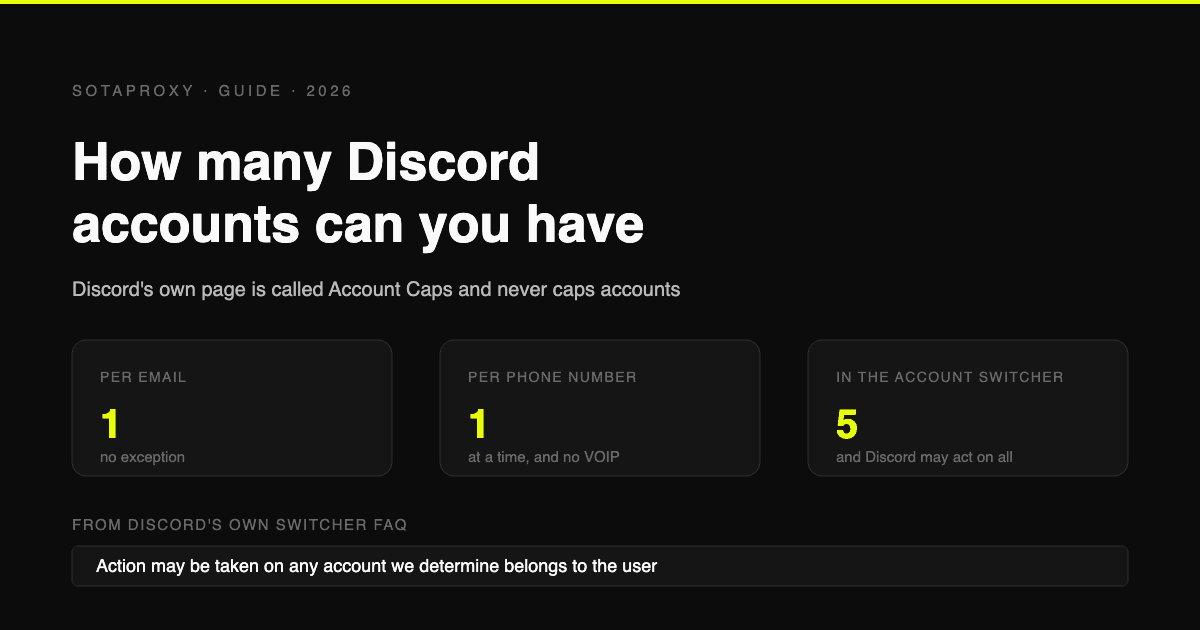
Discord publishes no cap on accounts. The real limits are one per email, one phone number at a time with no VOIP, and five in the Account Switcher, which Discord says it may enforce across.