What Is Forward Proxy: A Complete Guide for 2026
Learn what is forward proxy, how it works for outbound traffic, and why teams use it with antidetect browsers for Facebook, TikTok, and scraping.
A forward proxy is a client-side intermediary that sends outbound requests on the user's behalf, so the destination sees the proxy's IP instead of the user's. For traffic teams running Facebook and TikTok ad accounts, that one property is the difference between a clean browser profile and a stack that gets linked, flagged, or rate-limited fast.
You can think of it as the request layer your browser or scraper hits before it reaches the open internet. In practice, that makes forward proxies useful anywhere you need policy control, IP separation, request logging, or caching, especially in antidetect browser workflows, account farming, cloaking, and geo-targeted campaigns.
Table of Contents
- What a Forward Proxy Does
- How the Request Flow Works
- Forward Proxy vs Reverse Proxy and Other Proxy Types
- Where Forward Proxies Earn Their Keep in 2026
- Configuration Snippets for Common Setups
- Do Forward Proxies Still Matter in a Zero-Trust World
- Troubleshooting and Best Practices at Scale
What a Forward Proxy Does
An arbitrage team spins up a new Facebook ad account, opens an antidetect browser profile, and wants each login to present as a separate, stable client. A forward proxy sits in that path and sends outbound traffic through its own IP before the request reaches the target site, so the site sees the proxy address instead of the operator's machine.
A forward proxy is the client-side intermediary that receives outbound requests, checks them against policy, opens its own connection to the destination, and returns the response to the user. The practical operator view is straightforward, the browser sends the request to the proxy, the proxy relays it to the site, and the response comes back through the same path. That setup changes the visible source IP, which is why it matters for multi-account work, traffic routing, and any workflow that depends on keeping the outbound identity consistent. Sota Proxy glossary note
A forward proxy is the piece you use when the target only needs to see a stable exit IP. If the target needs your server to appear as the content source, the job belongs to a reverse proxy.
Forward proxies protect the client side of the connection, while reverse proxies protect the server side. For media buyers, that difference shows up in account separation, scraping, ad verification, and cloaking flows where the outgoing identity has to stay clean. Reverse proxies solve a different problem, usually in front of your own infrastructure, where you want to hide or manage the origin server.
The choice of proxy pool changes the result in real campaigns. Residential proxies are easier to blend into consumer traffic, mobile pools often hold up better when platform checks get stricter, datacenter pools are faster and cheaper but easier to flag, and IPv6 pools can be useful in high-volume automation if the target and tooling handle them well. Forward proxies do not fix bad browser fingerprints, weak session hygiene, or sloppy rotation on their own, so the proxy has to fit the account strategy instead of carrying it.
The rest of the stack follows from that. Once the request path is clear, trust boundaries, HTTPS behavior, caching, and the point where a proxy helps or just adds complexity become easier to judge.
How the Request Flow Works
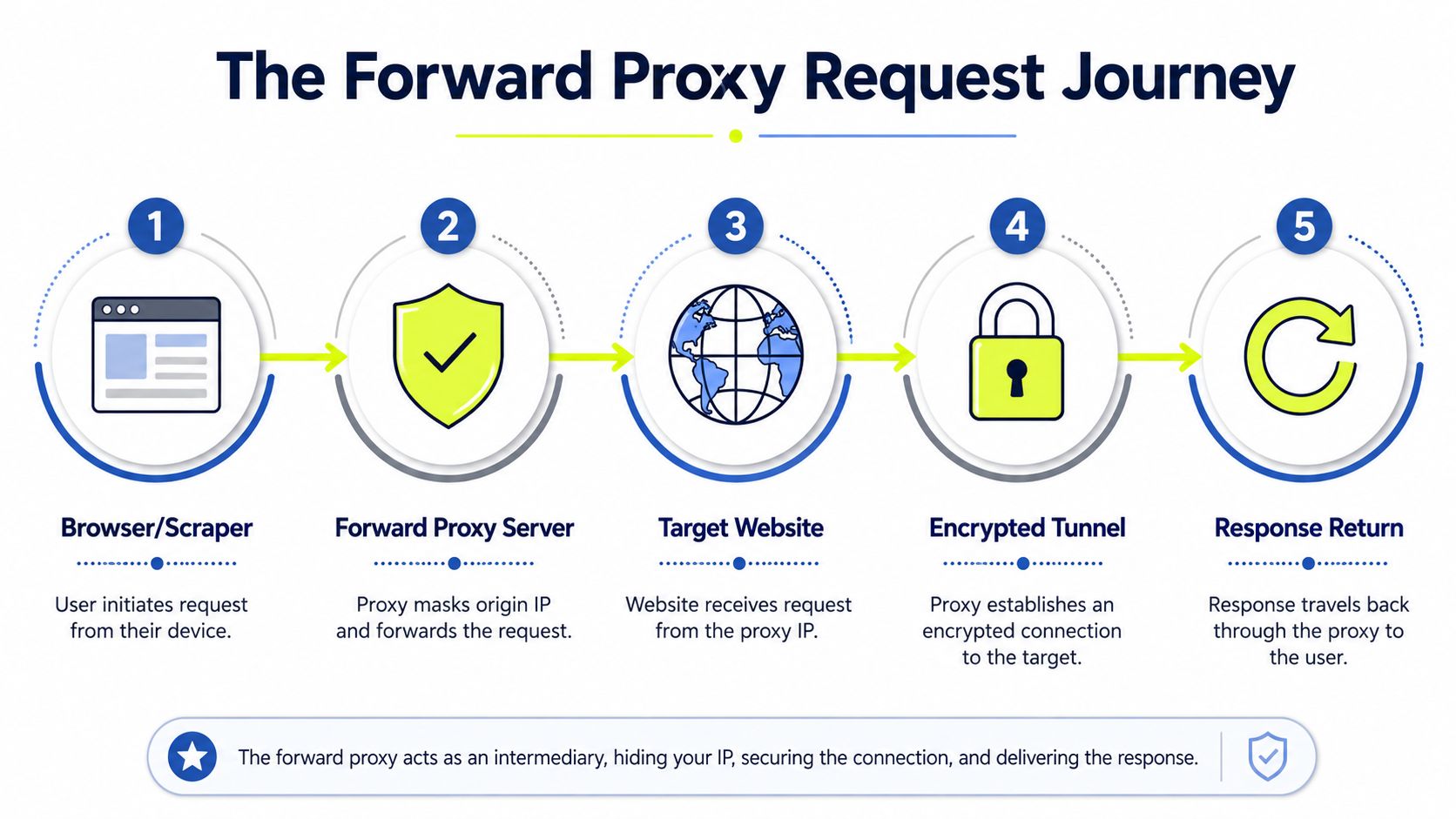
When your antidetect browser sends a request to Facebook, TikTok, or a scraper target, it hits the proxy first. The target never sees your client as the direct source, it sees the proxy's outbound connection after the proxy decides whether the request is allowed, logged, filtered, or forwarded. That shift matters in ad ops because the handoff changes the trust boundary before traffic leaves your stack. Request header behavior in proxy flows
The five-hop path
- Client initiates the request. Your antidetect profile, browser, or scraper asks for a page, asset, or API response.
- Proxy receives it on your behalf. The proxy checks authentication, policy, and destination rules before it touches the origin.
- Proxy opens its own connection. The destination sees the proxy's IP, not the client's.
- HTTPS rides through CONNECT tunneling. For encrypted traffic, the proxy forwards the TCP stream through a CONNECT tunnel instead of reading payload content.
- Response returns through the same path. The proxy can log, cache, or pass the response back to the client.
That flow is why forward proxies still matter in campaign operations. They give you a stable outbound identity, a place to enforce access rules, and a control point for request handling without changing the application itself. In scraper fleets and multi-account browser stacks, that separation keeps the client identity distinct from the target site's point of view.
Where caching helps
Caching matters when the same account, browser farm, or crawler keeps requesting the same external asset. F5 notes that a forward proxy can store retrieved content locally so later requests are served faster, which lowers outbound bandwidth and reduces repeated origin fetches F5 forward proxy glossary. In practice, that helps with repeated static assets, landing page components, and other shared resources that do not need to be pulled again on every hit.
For operators, that is useful only when the cache matches the workflow. A proxy cache can speed up harmless repeat traffic, but it can also serve stale content if the target changes fast or if your automation expects a fresh response every time. I treat caching as a traffic-control feature first, a speed feature second.
The proxy is not just a mask. It can also become the control point for what gets out, what gets logged, and what gets accelerated.
Forward Proxy vs Reverse Proxy and Other Proxy Types
A lot of proxy mistakes come from buying the wrong pool for the workflow. A forward proxy handles outbound identity for the client side, while a reverse proxy sits in front of your own server and shapes inbound traffic. In ad ops, scraper fleets, and antidetect browser stacks, that difference matters because the wrong proxy layer solves the wrong problem.
The better comparison for operators is the proxy type plus the pool underneath it. Residential, mobile, datacenter, and IPv6 all behave differently in Facebook and TikTok account work, cloaking checks, and bulk automation. One pool may look clean enough for a fresh login. Another may be better for volume, speed, or repeated requests where trust is less sensitive.
| Type | Trust Score on Ad Platforms | Speed | Cost | Best Fit |
|---|---|---|---|---|
| Residential | Higher than datacenter for sensitive logins | Moderate | Higher | Account farming, cloaking, geo-specific browsing |
| Mobile | Usually strongest for trust-sensitive workflows | Moderate | Highest | Facebook and TikTok ad accounts, high-friction account ops |
| Datacenter | Lower trust, more likely to be flagged on sensitive targets | Fastest | Lower | Scraping, ad verification, simple automation where speed matters |
| IPv6 | Depends on target support and reputation | Fast | Often cost-effective at scale | High-volume scraping, structured testing, large request sets |
A forward proxy does one job well. It gives the client a controlled exit path. Reverse proxies do a different job, usually around server protection, routing, and load handling for your own properties. For a broader breakdown of all proxy types, that split is the cleanest way to avoid buying infrastructure that looks right on paper but fails in a campaign stack.
Residential and mobile pools usually hold up better when a platform cares about IP reputation and account history. Datacenter pools still win on raw throughput, lower cost, and simple automation where you can accept more friction. IPv6 can be attractive for scale when the target supports it cleanly, especially in structured scraping or test environments.
Match the pool to the workflow, not the other way around. If the account is sensitive, starting with the cheapest range usually creates more cleanup later.
For the infrastructure side, the same logic shows up in distributed access models. The cloud and hybrid models explained guide is a useful reference when you want to compare centralized control with distributed routing in a practical way.
Where Forward Proxies Earn Their Keep in 2026
A lot of traffic operators still pair forward proxies with antidetect browsers like AdsPower, Dolphin Anty, GoLogin, Multilogin, and Hidemyacc. The reason is simple. The browser fingerprint gets you part of the way, but the outbound IP still has to match the story you are presenting to the platform. If one Facebook or TikTok account opens in a clean profile and then keeps hopping across unrelated IPs, the stack starts looking sloppy fast.
The workflows that still depend on them
For account farming, the goal is not just to hide identity. It is to keep each profile stable enough that platform trust does not fall apart because of noisy network behavior. In ad account operations, proxy diversity per account helps reduce easy linkage through the same exit IP, especially when you are managing multiple identities across the same tool stack.
For ad verification, the proxy lets you inspect the same creative from different geographies and compare what users see. That matters when local landing pages, language variants, or compliance overlays change by market. In cloaking workflows, only the traffic that fits the intended visitor profile should route into the visible funnel, while other traffic is separated cleanly.
For scraping and price intelligence, the main advantage is reach. Rotating residential or mobile pools can access pages that block datacenter ranges, especially when targets watch request patterns, not just IPs. Datacenter pools still make sense when you need speed and low cost and can tolerate more blocks. IPv6 can also work at scale when the target supports it cleanly, which is useful in structured scraping or testing. For a practical setup reference, see how to set up proxy authentication and session control.
For geo-targeted campaigns, the exit IP controls what localized page or offer shows up, which is why city-level targeting can matter when the offer depends on region. Residential pools usually hold up better when the platform cares about reputation and account history. Mobile pools can be stronger still in some high-scrutiny flows, but they cost more and are not always necessary. Datacenter pools stay the fastest choice for simple automation, while IPv6 is often the most practical option for large request sets when the target accepts it.
If you want a neutral view of how these stacks sit alongside broader network design, the cloud and hybrid models explained guide is useful background. It shows why access control keeps moving closer to the request path, even when operators still need proxy diversity for delivery.
Configuration Snippets for Common Setups
If you run browser-based campaigns, command-line checks, and rotating sessions, the setup pattern changes a bit each time. The core idea doesn't. You either authenticate with a username and password, or you allowlist an IP. Then you decide whether the workflow needs rotation or a sticky session.
Browser profile setup
In an antidetect browser, you usually set the proxy at the profile level so the browser fingerprint and the network identity stay aligned. That's the safer pattern for Facebook and TikTok ad accounts, because the session keeps the same exit behavior every time you open the profile.
Operational habit: treat each account like its own network persona. Reusing one proxy across unrelated profiles is how people create avoidable linkage.
Quick command-line test
A simple curl test is still the fastest way to confirm the proxy works before you waste time inside a browser stack.
curl -x http://username:password@proxy-host:port https://target.examplecurl -x http://proxy-host:port https://target.examplewhen your access is allowlisted by source IP
Use the first form when you need credential-based access. Use the second when your provider ties access to your outbound IP, which is common in controlled environments.
Rotating versus sticky
Rotation works for scraping jobs and broad browsing tasks where no single session needs to stay fixed. Sticky sessions matter when the same account or workflow needs continuity. City-level targeting helps when geo fidelity matters, because a country-level exit can still be too coarse for localized offers.
If you need a setup checklist for browser profiles and session handling, the how to set up proxy guide is a practical companion. For pool selection logic, the residential vs datacenter proxies guide is also useful when you're deciding whether trust or speed comes first.
Teams that care about cost control usually like pay-as-you-go billing and crypto top-ups, because they avoid locking capital into idle inventory. Some operators also offset infrastructure spend through referral or affiliate programs, including offers that pay up to 40% commission. That only helps if the proxy service is reliable enough to resell without creating support noise.
Do Forward Proxies Still Matter in a Zero-Trust World
A lot of enterprise explainers make forward proxies sound dated, like they belong in a pre-HTTPS era. That misses the operator reality. The traffic still has to leave somewhere, and the platform still sees the egress identity first.
For Facebook and TikTok account work, that egress identity is often the difference between a clean session and a flagged one. A forward proxy still gives automation operators a place to control exit IPs, separate accounts, and keep browser stacks from collapsing into the same fingerprint cluster. It is not a fix for bad creative, weak warmed accounts, or sloppy cookie handling, but it is still part of the path.
HTTPS did not remove the need
Encrypted traffic does not make the forward proxy irrelevant. CONNECT tunneling still carries HTTPS through the proxy cleanly, and the proxy can enforce policy without unpacking every payload. For operators, that means the architecture still works when the target uses modern web security and HTTP/2.
The bigger reason they still matter is fingerprint diversity. Platforms do not judge traffic on IP alone, but IP is still a core signal, especially when you are running bulk account operations, ad verification, or distributed scraping. A forward proxy remains a direct way to control that signal without rebuilding your whole stack.
Where they overlap with newer controls
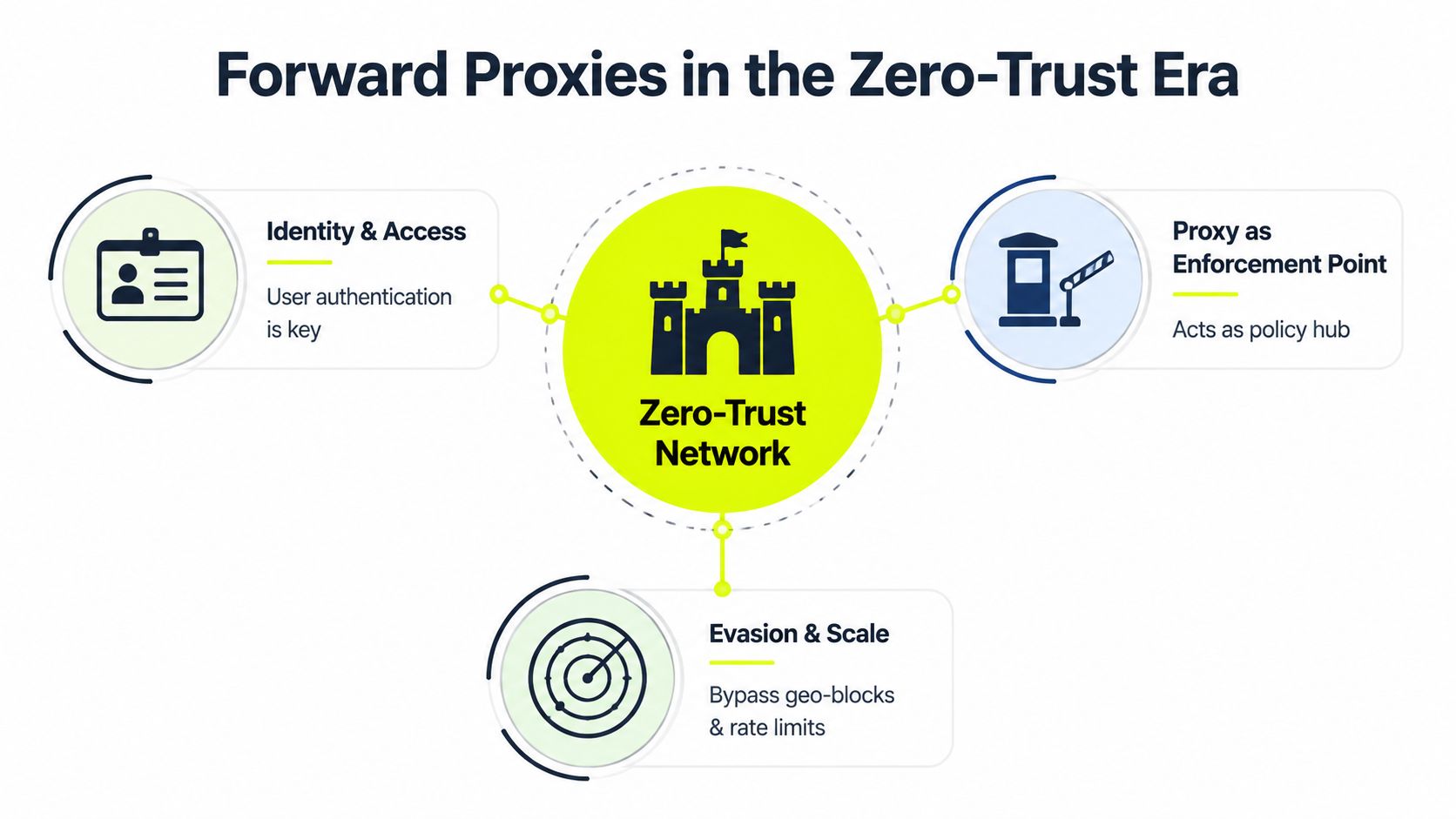
Zero-trust tools, identity-aware gateways, and cloud-delivered secure web access can absorb some of the old proxy role. They are stronger when you want identity binding, device posture checks, and centralized enforcement across managed users. They are less convenient when you need fast, disposable, geo-distributed outbound identities for ad verification, scraping, or account separation.
That trade-off matters in practice. Residential pools are better when a platform is sensitive to trust and behavior, mobile pools can carry stronger legitimacy for some workflows, datacenter pools are cheaper and faster but easier to flag, and IPv6 pools can be useful for scale when the target tolerates them. Forward proxies sit in the middle of that decision tree because they let you route traffic predictably, but they do not give you the same trust profile as a quality residential or mobile exit.
Forward proxies are not obsolete. They are specialized outbound infrastructure that still earns its place when the job is about egress control, not just user authentication.
If you want the zero-trust lens without losing the network-level view, the CloudCops GmbH zero trust guide gives a useful frame. It helps explain why forward proxies now sit alongside, not above, the rest of the security stack.
For operators comparing proxy types and testing stability before a rollout, the proxy reliability testing guide is a practical next read.
Troubleshooting and Best Practices at Scale
The problems show up after the first few dozen accounts, not on day one. Auth failures start climbing, latency gets uneven, sessions drift out of region, and a shared pool starts poisoning otherwise healthy accounts.
What usually breaks first
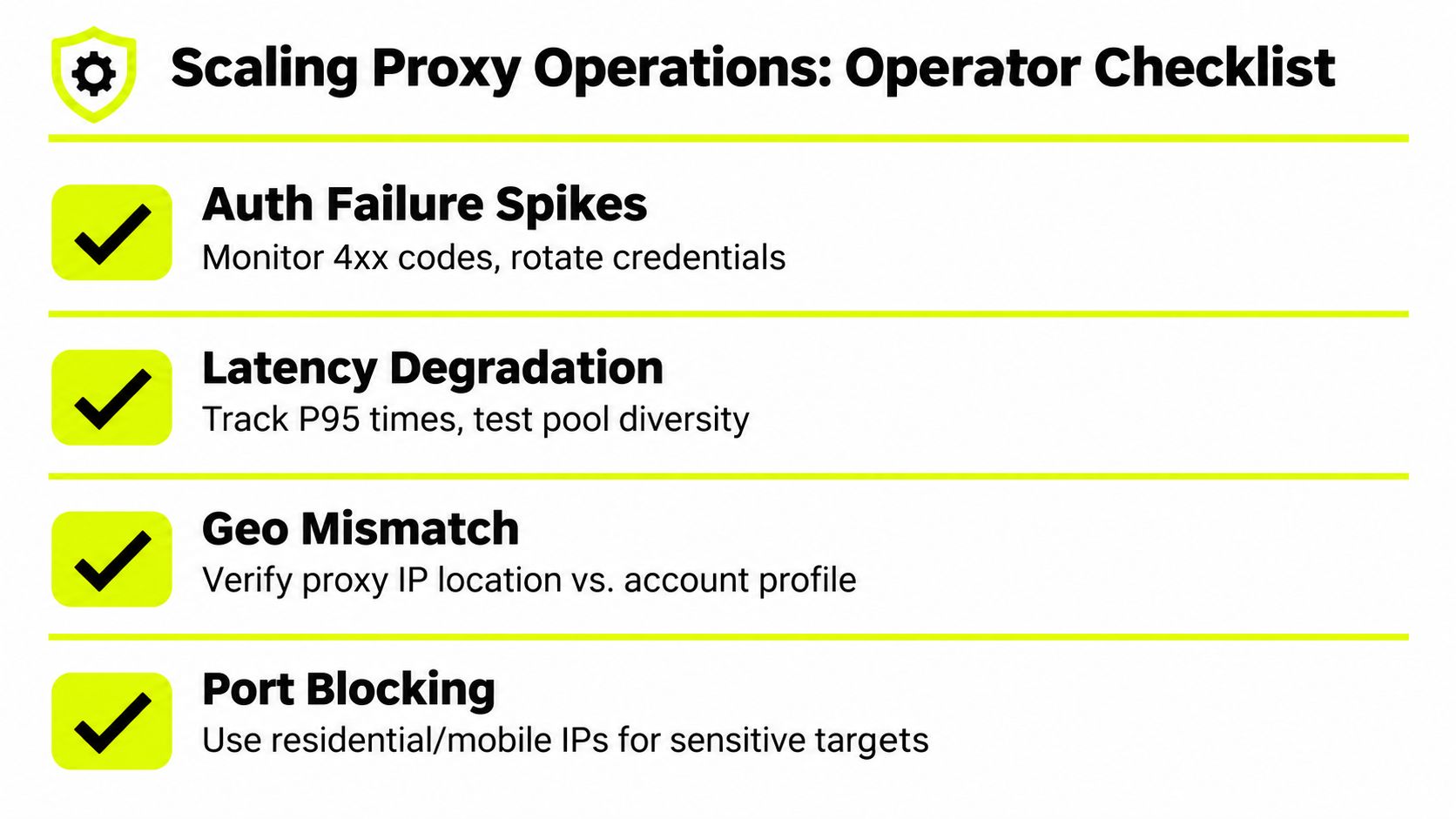
- Auth failure spikes. Check credentials, then separate bad logins from proxy-side rejection. If the error pattern keeps repeating, the pool or auth method is the problem.
- P95 latency degradation. Test a different pool or location before you blame the target. Slow paths often come from overloaded exits, not the destination.
- Geo mismatch on rotated sessions. If an account expects one region and the proxy rotates into another, the session looks inconsistent. Stick to stable city targets for account-bound workflows.
- IP reputation poisoning. Shared pools can get noisy fast. Move sensitive workloads to residential or mobile IPs when the target gets picky.
- Policy block rate increases. That usually means the platform has started flagging the proxy or the session pattern, not just the content.
A simple provider checklist keeps the team honest. Look for 99.9% uptime, clean IP pools, redundant clusters, real-time usage monitoring, and 24/7/365 human support. If a provider can't show you which pool failed and why, you'll waste hours debugging the wrong layer.
For provider evaluation and testing discipline, the reliability testing guide is a useful reference when you want to pressure-test a pool before you commit serious spend.
If you need forward proxies for Facebook and TikTok ad accounts, scraping, ad verification, or cloaking workflows, start with an infrastructure stack that can stay stable under load. Visit Sota Proxy to compare proxy types, locations, and session controls, then pick the pool that fits your campaign instead of forcing one setup to do everything.
Related articles

Fingerprint Spoofing: Methods, Detection, and Antidetect Use
Learn how fingerprint spoofing works, the methods used to bypass detection, and how antidetect browsers with proxies manage multi-account operations safely.
What Is a Proxy Used for: 2026 Arbitrage Guide
What is a proxy used for - Learn what a proxy is used for in 2026, from boosting security to managing multi-account operations for arbitrage teams
Residential Backconnect Proxy: 2026 Guide & Best Practices
Master the residential backconnect proxy. A 2026 guide on how it works, its benefits over other proxies, and best practices for ad verification & account

Rotating Proxy Server: Mastering Techniques for 2026
Master rotating proxy servers for farming, ad verification & scraping. Learn architecture, rotation, & anti-detection tactics.
Dolphin Anty for Multi-Accounting: Features, Automation, and Proxy Integration
How to use Dolphin Anty for multi-accounting: browser profiles, Cookie Robot, scenarios, Synchronizer, API automation, and three ways to connect SotaProxy proxies. Promo code SOTA20 gives 20% off.
ISP vs Residential vs Datacenter vs Mobile Proxies: Which One You Actually Need
Static residential and ISP are the same product under two names, which is why half these comparisons compare a thing to itself. What each type is, what it costs per unit, and the one task each is genuinely best at.