API Integration Guide: Best Practices for 2026
A practical API integration guide for proxy platforms. Covers auth, rotation, geo-targeting, error handling, and SDKs for scraping and ads.
You're probably staring at a proxy setup that “works” in Postman, but keeps losing sessions inside AdsPower, Multilogin, or a custom scraper the moment a campaign hits real traffic. That gap is where account farms die, Facebook and TikTok ad profiles get flagged, and geo-targeted campaigns fall apart because the proxy layer isn't built to survive rotation, auth churn, or browser handoffs. A real api integration guide for this job has to treat the proxy API like production infrastructure, not a one-off request.
Table of Contents
- Why Proxy API Integration Breaks in Production
- Authentication Methods and Credential Setup
- Picking the Right Proxy Type for the Job
- Sticky Sessions, Rotation, and Geo-Targeting Parameters
- SDK and Code Examples in Python, Node, and Go
- Error Handling, Retries, and Rate Limits
- Production Hardening, Monitoring, and Scaling Safely
Why Proxy API Integration Breaks in Production
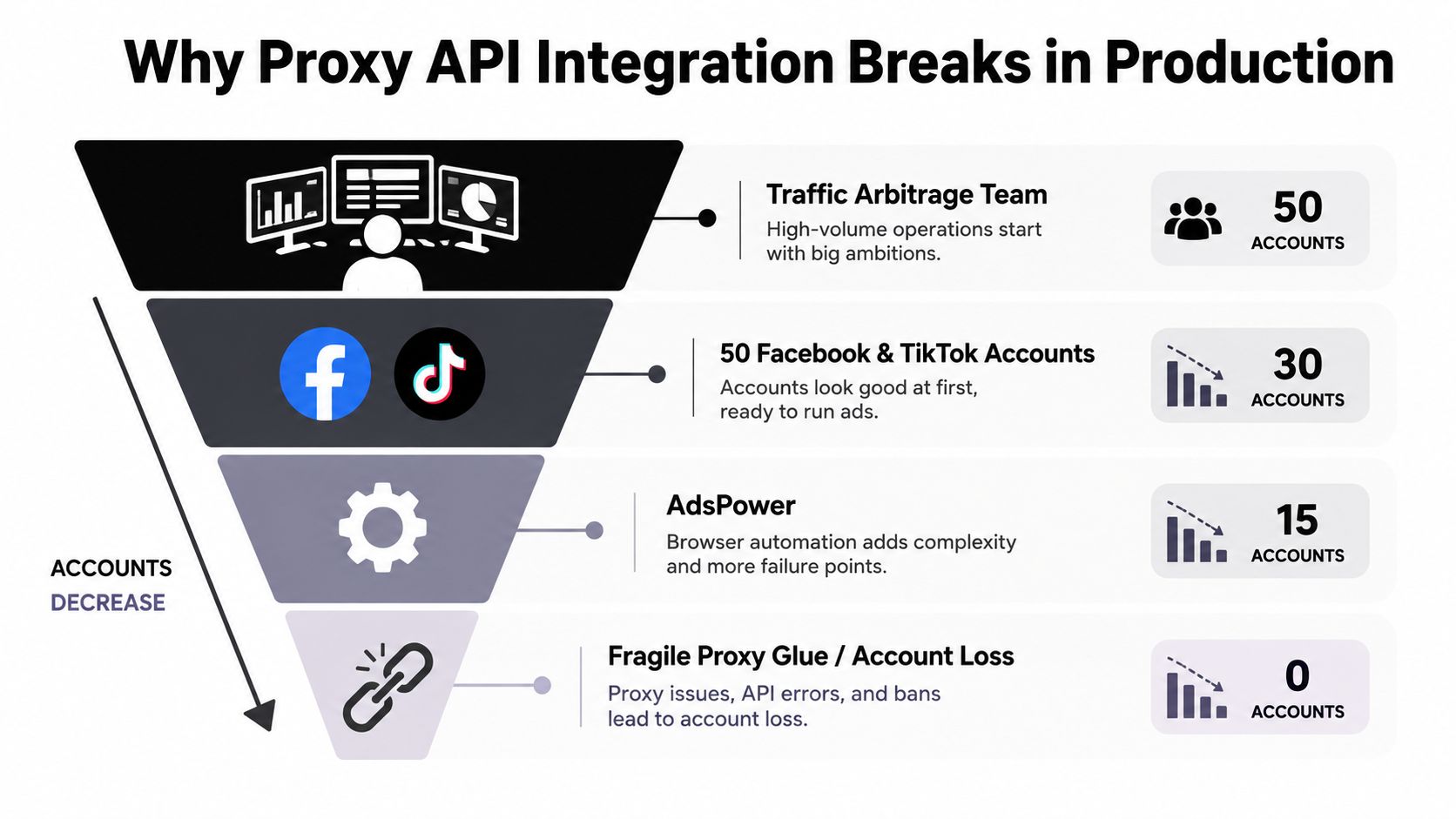
A traffic arbitrage team can have 50 Facebook and TikTok accounts running through AdsPower, every proxy test can pass, and the whole stack can still unravel the first time a profile gets rotated onto the wrong IP family. The problem usually isn't the API call itself. It's the glue around it, the credential storage, session persistence, geo consistency, and the retry logic that nobody thought about when the integration was still a clean curl example.
What breaks first
The first breakage is usually invisible. A session flips too often, an endpoint starts returning a new error code, or a browser profile reconnects with a different ASN than the account expects. In account farming, cloaking, and geo-targeted campaigns, that drift matters more than the raw request success.
Practical rule: if your integration cannot survive a proxy swap without changing the browser fingerprint, it isn't production-ready.
The broader context matters too. Integration systems are now nearly universal in organizations, with 99% of organizations already using some form of integration system in the 2021 Vanson Bourne report, and 64% running hybrid deployments across on-premises and cloud environments, 23% cloud-only, and 12% on-premises only. That shift means the guide can't stop at “connect to the endpoint.” It has to cover the messy reality of routing, security boundaries, and failure handling across environments, especially when the same operator is juggling AdsPower, Dolphin Anty, GoLogin, Multilogin, or Hidemyacc across different workflows. The report also makes the point indirectly that modern integrations need examples for REST, webhooks, retries, pagination, and observability, because the work now spans complex estates instead of isolated apps. Vanson Bourne integration report
How to think about the rest of the stack
A working request proves almost nothing beyond syntax. A durable integration needs to survive IP rotation, rate limits, session reuse, and vendor-side changes without burning through profiles or ad spend.
That is why the rest of this guide leans on production behavior. It treats the proxy endpoint as part of a long-lived system that needs credentials, proxy-type selection, sticky sessions, retry policy, and monitoring that catches drift before your farm starts dropping accounts.
Authentication Methods and Credential Setup
Start with the auth mode that matches the workload, not the one that feels easiest in the dashboard. Proxy integrations usually need three different credential patterns, and each one fits a different kind of automation.
Use the right auth method for the workload
User:password on the proxy endpoint fits antidetect browser profiles. It's easy to paste into AdsPower, Dolphin Anty, GoLogin, Multilogin, or Hidemyacc, and it keeps the browser-level proxy config self-contained. That matters when a human operator or a profile manager needs to move fast without touching server-side allowlists.
IP whitelisting fits server-side scrapers and datacenter workloads. If the job runs from a known host or a fixed egress IP, whitelisting cuts down on credential sprawl and makes automation simpler. It's also the cleanest option when your scraper lives in a locked-down environment and doesn't need user-scoped credentials.
API keys fit account, usage, and rotation endpoints. That's the control plane, not the data plane. Use a key when you need to query balance, inspect sessions, or manage infrastructure from code rather than from inside the browser profile itself.
To generate and rotate keys in a Sota Proxy dashboard, keep the process boring. Create the key, scope it only to the operations you need, store it in an environment variable or a secrets manager, and rotate it on a schedule that matches your operational risk. If a key ever leaks into a repo, rotate immediately and invalidate the old one before anyone reuses it.
Never hardcode proxy secrets into browser profile notes, shared spreadsheets, or deployment scripts. That's how a single leaked token turns into a farm-wide incident.
If you want a simple auth walkthrough for a basic proxy request, this basic auth example for cURL is a practical reference point. Use it as a starting shape, then move the secret into env vars before you push anything live.
Build the endpoint shape around the auth mode
A browser-facing proxy URL usually looks like a user:password endpoint with host, port, and credentials embedded in the profile settings. A control-plane request, by contrast, uses an API key in a header or query-controlled call against the account endpoint. Keep those paths separate, because mixing them creates brittle code and confused access boundaries.
For the teams running Facebook and TikTok account farms, the cleanest split is simple. Browser profiles get user:pass credentials. Backend tools get API keys. Dedicated scrapers with fixed infrastructure get IP whitelist access. That division keeps operations predictable when a profile is cloned, a server is redeployed, or a billing check runs from a different machine.
Picking the Right Proxy Type for the Job
Proxy selection is not a branding problem. It's a trade-off between trust, speed, cost, and how much risk the target platform tolerates before it starts flagging behavior. For traffic arbitrage, cloaking, account farming, and geo-targeted campaigns, the right choice depends on the platform, not your preference.
Compare the four types the way operators actually use them
Residential proxies make sense when trust scores matter. They look closer to consumer traffic, which helps with cloaking, ad verification, and browsing flows where the target expects ordinary home connections. The trade-off is simple, they're usually slower than datacenter ranges, but they're harder to classify.
Mobile proxies are the premium option for social platforms that dislike datacenter ranges. For bulk Facebook and TikTok account management, they can carry more weight in suspicious environments because the traffic comes from mobile carrier space. The downside is cost and availability. You pay for that reputation.
Datacenter proxies fit speed-sensitive scraping where the target tolerates infrastructure traffic. They're useful when you need raw throughput and the site doesn't aggressively score source IP reputation. ISP proxies sit between residential trust and datacenter speed, which makes them useful for steady production runs that need a less obvious footprint than pure datacenter ranges.
IPv6 works well for bandwidth-heavy jobs when the target accepts it. It can be useful for cheap scale, but it's not a universal substitute for reputation-sensitive traffic. Some platforms and endpoints still treat IPv6 differently, so you test it against the actual target before you commit a farm to it.
| Proxy Type | Best For | Speed | Block Resistance | Typical Cost |
|---|---|---|---|---|
| Residential | Cloaking, ad verification, geo-sensitive browsing | Moderate | High | Higher |
| Mobile | Facebook and TikTok account management, account farming | Moderate to lower | Very high | Highest |
| Datacenter | Scraping where the target tolerates infrastructure IPs | High | Lower | Lower |
| IPv6 | Cheap bandwidth-heavy tasks | High | Varies by target | Low |
A clean way to think about it is this, trust buys you access, speed buys you throughput, and cost buys you scale. You rarely get all three at once, so match the proxy type to the platform's tolerance and the campaign's failure cost.
For teams comparing proxy layouts against their own stack, the proxy types guide is a decent companion reference. Sota Proxy also fits into this decision tree as one option for residential, mobile, ISP, datacenter, and IPv6 supply, including the kind of geo spread operators use for ad accounts and scraping.
Sticky Sessions, Rotation, and Geo-Targeting Parameters
Sticky sessions are what keep a profile from looking like it teleported every few minutes. Rotation is what keeps a scraper from getting pinned to one overused source. The wrong balance breaks both account farming and extraction jobs, because platforms notice behavior drift before they notice volume.
Sticky sessions when identity matters
If you're managing a Facebook ad account inside an antidetect browser, you usually want one IP to stay attached to one profile for hours or days. That keeps the browser, cookie jar, and network identity aligned. The practical move is to use a session ID or sticky-session parameter so the same profile gets routed back to the same exit.
When the job is more like scraping or feed collection, aggressive rotation can help. The target sees less repetitive traffic from a single source, and you reduce the chance that one overused IP becomes your single point of failure. The catch is that every rotation can reset trust and break a stateful flow, so don't rotate blindly in browser workflows.
A good pattern is to isolate jobs by behavior. Accounts that log in, warm up, and stay active need sticky persistence. Scrapers that fetch pages, pull fields, and exit can rotate faster. Trying to use the same rotation logic for both is how operators end up with random logouts and duplicate events.
Keep the browser profile stable, rotate the fetcher, not the identity.
Geo and carrier targeting that actually matches the campaign
Geo-targeting works best when the proxy location matches the ad geography, the landing page, and the account's historical behavior. If you need a US city target, request it explicitly instead of relying on a country-level pool and hoping it lands in the right metro area. The same logic applies to state-level targeting, ASN selection, and mobile carrier targeting.
A practical endpoint shape can look like this in concept, host plus credentials plus a session token, with location parameters layered onto the request. Use one path for sticky browsing, another for rotation, and a third for geo pinning when the campaign depends on region-specific delivery. That keeps the profile import field readable inside GoLogin, Multilogin, or Hidemyacc, and it keeps the scraper code from becoming a maze of one-off flags.
The session persistence notes are useful if you need a deeper mental model for how long-lived sessions and location control should behave. Once you've set the rules, copy the same endpoint shape into the antidetect browser proxy field or the worker config and leave it alone unless the campaign changes.
SDK and Code Examples in Python, Node, and Go
The fastest way to break proxy integrations is to bury them inside business logic. Keep the proxy layer thin, testable, and replaceable. That way, when a provider changes auth behavior or a profile manager updates its import format, you only touch one module.
Python with requests
import os
import requests

PROXY_URL = os.getenv("PROXY_URL")  # user:pass@host:port
SESSION_ID = os.getenv("PROXY_SESSION_ID", "profile-01")

proxies = {
    "http": f"http://{PROXY_URL}&session={SESSION_ID}",
    "https": f"http://{PROXY_URL}&session={SESSION_ID}",
}

session = requests.Session()
session.proxies.update(proxies)

try:
    r = session.get("https://example.com", timeout=30)
    r.raise_for_status()
    print(r.status_code, r.text[:200])
except requests.RequestException as exc:
    print(f"request failed: {exc}")
Use this when you need a small worker that can preserve a sticky session across multiple calls. Add retry logic around the get() call only after you decide which failures are safe to repeat.
Node with axios and a proxy agent
import axios from "axios";
import { HttpsProxyAgent } from "https-proxy-agent";

const proxyUrl = process.env.PROXY_URL;
const sessionId = process.env.PROXY_SESSION_ID || "profile-01";

const agent = new HttpsProxyAgent(`${proxyUrl}&session=${sessionId}`);

async function fetchPage() {
  try {
    const res = await axios.get("https://example.com", {
      httpsAgent: agent,
      httpAgent: agent,
      timeout: 30000,
    });
    console.log(res.status, res.data.slice(0, 200));
  } catch (err) {
    console.error("request failed:", err.message);
  }
}

fetchPage();
Use this in Node-based automation where the proxy needs to work across internal services, webhook handlers, or lightweight scraping jobs. Keep the agent creation separate from your route handlers so you can swap credentials without rewriting the app.
Go with net/http
package main

import (
    "fmt"
    "net/http"
    "net/url"
    "os"
    "time"
)

func main() {
    proxyURL, _ := url.Parse(os.Getenv("PROXY_URL"))

    transport := &http.Transport{
        Proxy: http.ProxyURL(proxyURL),
    }

    client := &http.Client{
        Transport: transport,
        Timeout: 30 * time.Second,
    }

    resp, err := client.Get("https://example.com")
    if err != nil {
        fmt.Println("request failed:", err)
        return
    }
    defer resp.Body.Close()

    fmt.Println(resp.Status)
}
This pattern works cleanly for server-side workers that need predictable behavior and simple transport injection. Wrap the transport if you need custom retry policy or circuit breaking later.
Browser profile import fields
GoLogin, Dolphin Anty, Multilogin, and Hidemyacc all expose proxy import fields in one form or another. Paste the endpoint, set the proxy type correctly, and map the sticky-session behavior to the profile you want to keep stable. If you're using a shared team setup, keep one credential set per workload so the profile manager doesn't become a debugging swamp.
The Sota Proxy API docs are the right place to check endpoint shapes before you wire a custom adapter around them. If you're also using Sota Proxy in a larger automation stack, its dashboard-based proxy selection and session controls fit the same pattern this section uses, without forcing every profile into the same transport rules.
Error Handling, Retries, and Rate Limits
Proxy integration fails most often in the parts teams skip during the first build. A clean request path means very little if the system can't recover from auth errors, upstream blocks, or burst limits without hammering the same bad route over and over.
Treat the status code as a routing signal
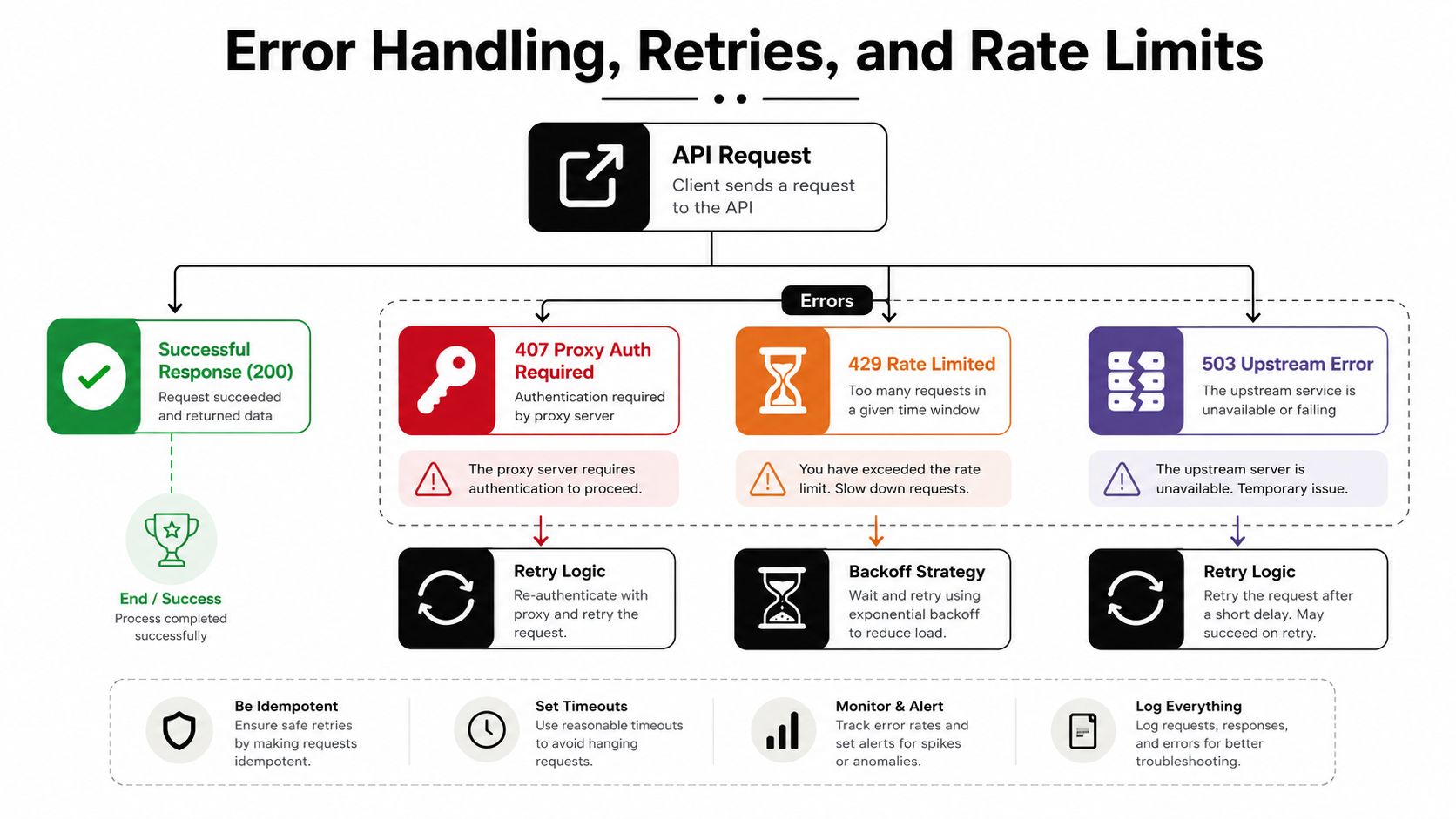
407 Proxy Auth Required means the credentials or auth mode are wrong, so retries won't help until you fix the configuration. 429 Rate Limited means the target or proxy layer wants you to slow down, and the response headers should guide your backoff. 503 Upstream Error usually means the origin or chain behind the proxy is failing, which is common when a target is blocking a batch or an upstream path is temporarily degraded.
The useful headers are the ones that tell you when to try again. Retry-After tells you how long to wait, and X-RateLimit-Remaining tells you whether you're still inside the limit window. Don't guess. Read the headers and let the server tell you the pacing.
Backoff, jitter, and circuit breaking
Exponential backoff with jitter keeps a bad batch from dogpiling the same endpoint at the same interval. If every worker retries at the same second, you create another spike exactly when the system is already under pressure. Randomization smooths that out.
A circuit breaker protects the rest of the farm. If a proxy batch starts throwing repeated auth or upstream errors, cut it off before it takes down a whole account cluster. That matters when one bad exit node can poison multiple Facebook or TikTok sessions in sequence.
For webhook-driven workflows, idempotency is not optional. Duplicate callbacks are the silent killer in automation pipelines because they can create duplicate records, double-trigger account actions, or reprocess the same event after a retry. If a job can be replayed, give it an idempotency key and store the processing state before you emit the next action.
If a retry can create a second ad spend event or a second account action, the handler needs an idempotency guard before it needs another retry loop.
The rate limiting glossary entry is a useful anchor if your team needs a shared definition for what the code should do under pressure. Put the retry policy in one module, test the failure cases, and don't let the happy path own the whole implementation.
Production Hardening, Monitoring, and Scaling Safely
A proxy stack is healthy when it stays boring. The dashboard should show traffic, balance, and session behavior clearly enough that you notice drift before users do. That's the difference between a controlled rotation and a farm-wide incident.
Keep the checks routine
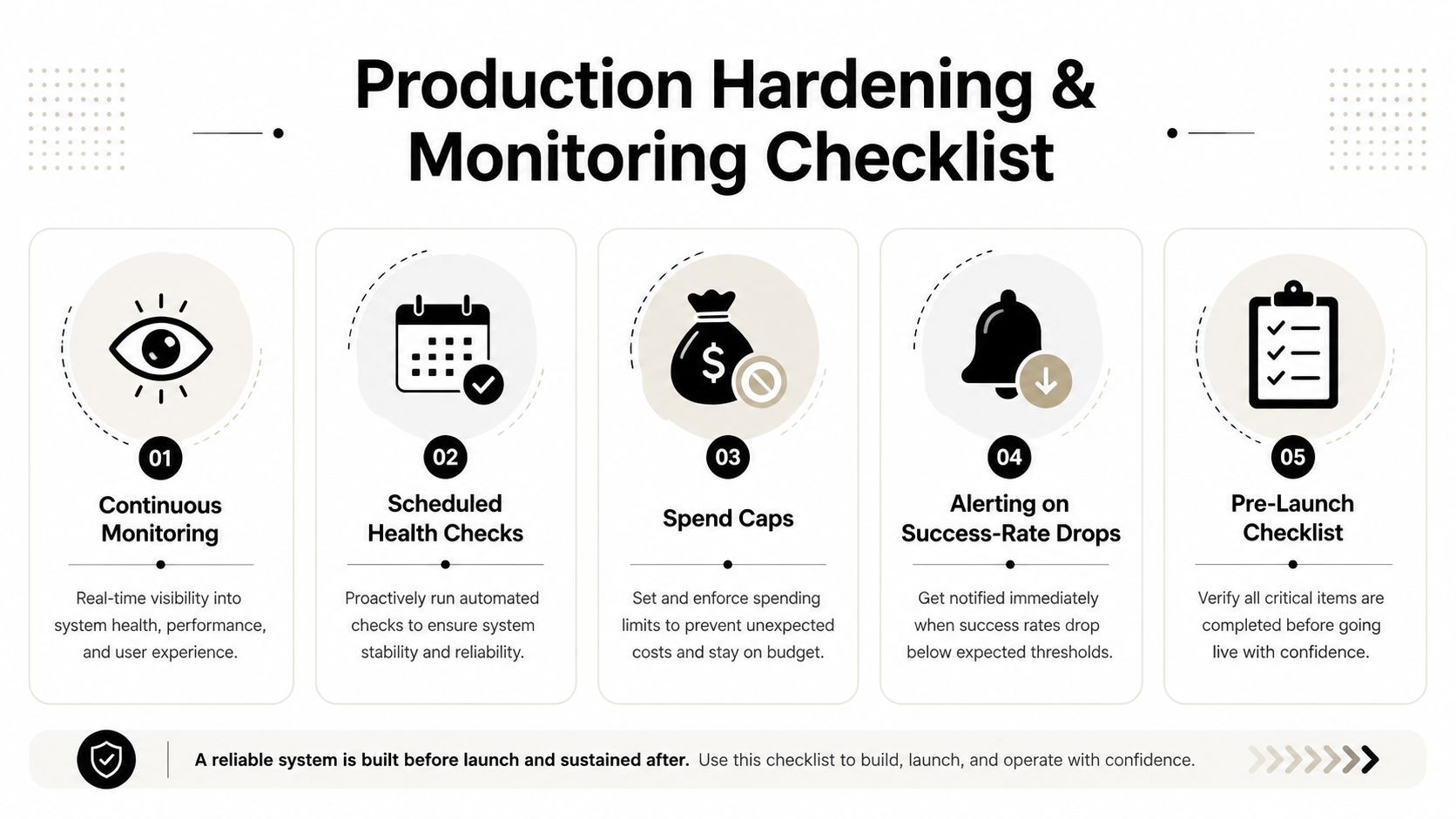
Start with continuous monitoring of success rate, auth failures, and geo drift. Then add scheduled health checks that hit the same endpoints your production jobs use, not a toy endpoint that never fails. A clean test path is useless if it doesn't exercise the proxy behavior your accounts depend on.
Spend caps matter just as much as reliability. If a session loop goes bad, it can chew through balance while the team is trying to diagnose the issue. Tie alerts to sudden drops in success rate and unexpected balance changes, then route those alerts to the people who can freeze a campaign or swap a batch fast.
The real-time dashboard in Sota Proxy is built for that operational view, with traffic and balance monitoring in one place. If your team wants a broader workflow layer around proxy use, browse Passflow products as one reference point for how operators package routines around automation and tracking. Sota Proxy also keeps a referral and affiliate program with up to 40% commission, which can offset proxy spend for teams that move enough volume to care about margin.
Use a launch checklist before the farm scales
- Verify auth mode: confirm the browser profiles, whitelists, and API keys all match the intended workload.
- Test sticky sessions: make sure the same profile lands on the same route when it should.
- Run geo checks: compare the requested location with the actual exit behavior before the first campaign push.
- Simulate failures: kill a proxy batch and watch whether the circuit breaker isolates it.
- Confirm logging: capture request IDs, endpoint names, and error context so incident response has something useful to read.
Support matters when a batch goes sideways at the wrong time. A platform with human support can shorten the gap between “something drifted” and “we found the reason.” That's especially useful for account farmers and media buyers who can't afford to lose a day to guesswork.
Sota Proxy gives you residential, mobile, ISP, datacenter, and IPv6 infrastructure with session control, geo targeting, and dashboard monitoring built for real production use. If your proxy API needs to survive browser handoffs, IP rotation, and rate-limit pressure instead of just passing a curl test, visit Sota Proxy and wire it into the stack you're running this week.
Related articles

API Call with Python for Ad Automation
Master the API call with Python for ad automation. Learn async patterns, proxy rotation, retries, and fingerprinting for multi-account workflows.

Competitor Price Tracking: Technical Guide 2026
Build a robust competitor price tracking system. This guide covers scraping architecture, residential proxies, anti-bot evasion, and data pipelines.
Amazon Scrape API: Build a Scalable Data Pipeline
Build a robust Amazon Scrape API. This guide covers proxy architecture, request engineering, CAPTCHA handling, and data parsing for technical operators.

Effective Proxy IP Rotation: Avoid Blocks in 2026
Master proxy IP rotation for web scraping, arbitrage, and account farming. Learn strategies, implementation, and best practices to avoid blocks in 2026.
Python Web Crawling at Scale: A Practitioner's Guide
Master Python web crawling for media buying and account farming. Our guide covers Scrapy, Selenium, proxies, and bypassing anti-bot measures at scale.

Web Scraping PHP: A Guide for Operators and Arbitrage
Build reliable web scraping php bots for multi-accounting, ad verification, and cloaking. Learn to handle JS, rotate proxies, and evade blocks. For operators.