7 Budget Friendly Options for Proxies in 2026
Explore budget friendly options for proxies. A technical guide to cheap datacenter, residential & IPv6 plans for ad arbitrage, scraping, and account farming.

Stop overpaying. If you're running AdsPower, Dolphin Anty, GoLogin, Multilogin, or Hidemyacc across Facebook and TikTok, the proxy line item can eat the margin out of every account you farm, every geo-targeted campaign you launch, and every cloaked funnel you keep alive. The problem isn't just price, it's whether the setup stays usable after session churn, bans, hot traffic windows, and switchovers between markets. That's why budget friendly options need to be judged by workload, not by the lowest headline number. If you're using cheap top-of-funnel creator traffic to feed performance channels, this top-of-funnel ad tactic guide is a useful companion. Let's get straight to the tools.
Table of Contents
- 1. Sota Proxy
- 2. PacketStream
- 3. Proxy-Cheap
- 4. Webshare
- 5. Geonode
- 6. Proxyrack
- 7. IPRoyal
- Top 7 Budget-Friendly Proxies Compared
- Your Next Move Match the Tool to the Task
1. Sota Proxy
Sota Proxy sits at the top of the list because it covers the broadest range of real operator needs without forcing you into one proxy model. You get residential, mobile, ISP, IPv4, IPv6, and datacenter options across 220+ geolocations, with credentials issued in about 60 seconds and a pay-as-you-go model that fits teams who hate locked-in billing. The platform also lists residential proxies from $2.00/GB, corporate volumes from $1.00/GB, IPv4 dedicated IPs from $1.80/month, ISP proxies from $3.00/month, IPv6 from $0.20/month, and mobile 4G/LTE proxies from $6.72/day, plus volume discounts up to 25% inside the platform. Sota Proxy pricing

For high-stakes traffic arbitrage, that mix matters. Facebook ad accounts and TikTok ad accounts usually punish sloppy IP behavior faster than open web scraping targets, so a provider with sticky sessions, city targeting, and clean pool management is more than a convenience. Sota Proxy's dashboard also centralizes balance, usage, and instant top-ups, which helps when you're juggling multiple accounts and need to scale without pausing to re-buy access.
Why operators keep it in the stack
The practical win is range. If you're doing account farming, cloaking, geo-targeted campaigns, ad verification, price monitoring, or SEO checks, you can move between mobile, residential, ISP, and datacenter IPs without rebuilding your vendor stack. That cuts vendor sprawl and gives you room to route each task to the cheapest viable tier.
Practical rule: use the lowest-trust proxy type that still survives the platform you're touching. Open targets can often run on cheaper infrastructure, while social and ad accounts usually need cleaner identity and steadier sessions.
Sota Proxy also leans into operational control. It advertises a 99.9% uptime SLA, redundant clusters, a self-healing pool, route optimization, and 24/7/365 human support, which is exactly what you want when a batch of sessions starts failing mid-run. The platform's pricing model avoids the usual subscription trap, and the FIRST15 promo gives you 15% off on a first order, which makes it easier to test before you scale.
The affiliate side matters too if you're advising other buyers or running a media-buying education angle. Sota Proxy's referral program pays up to 40% commission, which can offset a meaningful chunk of your own proxy spend if you're sending qualified users into a vendor you already trust. For operators who care about both performance and cost control, that's a serious upside.
2. PacketStream
PacketStream is the cleanest low-friction option for teams that care most about predictable meter math. It uses a simple $1.00/GB residential model, which is one of the lowest verified per-GB rates in this list, and the balance doesn't expire, so you can buy once and burn through it as campaigns or scraping tests come online. It's built for price monitoring, geo checks, and proof-of-concept work where you need a low absolute entry point before you commit to a larger proxy stack.

PacketStream is not the choice I'd make for the hardest protected targets. Peer-to-peer residential networks can be perfectly fine for lighter workflows, but they can also be more variable in reputation than premium pools, which starts to matter when you push into stricter anti-bot environments. If your main objective is testing volume, verifying geography, or keeping spend tight while you validate a process, the pricing model is the attraction.
Where it fits in a buying stack
Use PacketStream when you need a cheap first pass before graduating to more expensive residential or mobile options. It's especially useful when your team wants to forecast cost with minimal overhead and you don't need a long list of bells and whistles. The gateway endpoints, session control, and reseller API are enough for straightforward automation, but they're not the point of the product.
When a campaign is still in validation, the best proxy is the one that lets you learn cheaply. Once success rate starts to matter more than cost per GB, move up the stack. To put numbers on that trade, the stack cost calculator prices a whole setup by size.
The brand also works as a budget test bed for teams comparing vendors against a more full-featured platform. If you want to see how a pay-as-you-go structure behaves in a broader pricing context, this pay-as-you-go pricing guide gives useful framing.
3. Proxy-Cheap
Proxy-Cheap goes after buyers who want a broad catalog without paying premium entry prices. It covers rotating residential, static residential, ISP, mobile, IPv4, IPv6, and SOCKS5 options, with country and city targeting plus sticky sessions. The draw is simple, very low entry cost on the residential side, which makes it a plausible fit for smoke tests, non-critical workflows, and teams that want to keep one vendor ready for several proxy types.

The trade-off is the usual one. Cheap pools can look attractive on paper, but peak-hour stability can be less consistent, and some floor prices only show up under specific conditions. That matters in ad arbitrage and account operations, because a proxy that looks affordable but starts failing under load costs more than the better-priced option you skipped.
Best use case and failure mode
This is a reasonable vendor when you want to switch between proxy types without retooling your workflow. If your team tests multiple browser profiles in Multilogin or Hidemyacc, or you need a mix of mobile and residential endpoints for different social workflows, the catalog breadth helps. The issue comes when you lean on the cheapest tier for production traffic, then discover you needed something more stable.
- Good fit: smoke tests, light geo validation, short runs, and non-critical scraping.
- Watch out for: peak-time inconsistency, promo pricing that depends on conditions, and the temptation to scale production on the lowest tier too early.
- Best habit: validate one SKU at a time before rolling the same setup into multiple accounts.
The operator mindset here is simple. Buy the least expensive SKU that can survive the task, not the least expensive SKU on the landing page. That distinction is what keeps proxy spend from becoming a false economy.
4. Webshare
Webshare appeals to teams that want many inexpensive IPs without overcomplicating procurement. Its product line is straightforward, datacenter, static residential, also called ISP, and rotating residential proxies. For entry-level scraping, SEO checks, and ad QA, that mix can be enough, especially if your workflow depends on a lot of static IPs that behave consistently inside lighter-protected environments.

Where Webshare often lands well is speed to start. Quick sign-up, low headline prices, and dedicated/static options make it easy to get a test environment running fast. That said, static residential IPs can be easier to detect on stricter platforms, so this is not the provider I'd reach for first if I were trying to keep high-value Facebook or TikTok accounts alive under heavy scrutiny.
The practical trade-off
Webshare works best when the target site isn't punishing IP reuse aggressively. In that environment, the lower pricing can carry a lot of weight because you're not paying for quality you don't need. On more hostile surfaces, the same cost advantage can disappear if you have to rotate more often or replace failed sessions.
Rule of thumb: static IPs save time when the platform tolerates them, but they turn into a liability when detection gets strict.
The vendor's own documentation on proxy types and detection caveats helps teams avoid overcommitting to the wrong product line, which is useful for operators who want a cheap start without blind spots. If you're comparing this against a broader platform with more proxy variety, the Webshare comparison page is a direct reference point.
5. Geonode
Geonode is the budget option that starts to make more sense once you've outgrown pure per-GB thinking. It advertises residential pricing from as low as $0.27/GB on high-volume or committed tiers, plus concurrency-based unlimited request monthly plans for teams that prefer paying for access instead of raw bandwidth. It also supports 190+ country coverage, sticky sessions, and a Scraper API, which gives it a solid footprint for buyers who care about scale and predictable workload design.

This is a strong fit for media teams and scraping shops that can use concurrency as a budgeting lever. If your traffic is continuous, thread-based pricing can beat a pure bandwidth model, especially when your workload is spiky but steady across many requests. The catch is that the cheapest tier usually depends on large commitments, so the advertised floor is not the starting point for every buyer.
Who should pay attention
If you run mid-to-high volume price intelligence, ad tech checks, or repetitive scraping across multiple regions, Geonode can be cost-effective. If you're a small buyer, you need to read the plan details carefully because small-buyer pricing is typically higher than the eye-catching low end. The upside is that a concurrency-based model can be easier to operationalize than constantly managing bandwidth burn.
- Strong match: committed buyers, steady scraping operations, and teams that value thread-based predictability.
- Less ideal: casual users, one-off audits, and buyers who only want the lowest published rate.
- Operational edge: sticky sessions plus broad country coverage reduce the need to keep rebuilding your session logic.
For teams that already know they need rotating infrastructure at volume, the best rotating proxies guide is a good benchmark against Geonode's positioning.
6. Proxyrack
Proxyrack is for operators who prefer to pay for access instead of micromanaging bandwidth. Its unmetered residential proxy plans use ports or threads as the billing unit, which can work out better than per-GB pricing when your workload is continuous or unpredictable. The catalog also includes residential, mobile, ISP, and datacenter proxies, plus geo-targeting down to the city level and support for HTTP/SOCKS.

The unmetered model is appealing because it can flatten spend when traffic spikes. That matters in scraping, but it also matters in ad and social workflows where one account batch can generate far more requests than expected. The downside is that effective cost depends on how many ports or threads you need, so the same plan can be great for one workload and wasteful for another.
How to evaluate it properly
Don't buy Proxyrack just because unmetered sounds cheaper. Test your actual connection pattern, thread count, and usage rhythm first. If your current workflow burns through bandwidth in bursts, the port model may save money. If your traffic is light and intermittent, you may end up paying for capacity you don't use.
Practical rule: unmetered only wins when your volume is high enough to justify the access fee. Otherwise, per-GB billing is easier to control.
A key upside here is flexibility. If you switch tactics across ad, social, and scraping targets, having one vendor with multiple proxy types can reduce operational friction. That makes Proxyrack more interesting to technical operators than to buyers who just want the lowest-looking first invoice.
7. IPRoyal
IPRoyal is a solid budget-oriented option for teams that want pay-as-you-go residential bandwidth with rollover. That rollover feature is the main reason it belongs on a cost-optimization list, because unused bandwidth doesn't expire, which fits intermittent projects, small teams, and campaigns that come and go. The platform also supports rotating and sticky sessions, 195+ country coverage, and a product matrix that includes residential, ISP/static, datacenter, and mobile proxies.

This is a practical choice when you don't want to keep repurchasing bandwidth for small bursts of work. Multi-accounting teams often like that model because a test run in an antidetect browser can happen one week, then sit idle the next, and the balance still has value when you come back. The trade-off is that some community feedback flags mixed performance on certain static and ISP SKUs, so you should test the exact product you plan to use instead of assuming every line behaves the same.
Best fit for intermittent operators
IPRoyal makes sense when you need predictable ownership of bandwidth without a big upfront commitment. That helps with account warm-up, occasional scraping, and smaller ad verification batches where the total burn is hard to predict. It's not the first choice for every high-pressure social workflow, but it can be a smart holding option in the toolbelt.
The integration side is useful too. Documentation and guides for automation and antidetect browsers reduce setup friction, which matters when you're rotating between browser profiles, markets, or account clusters. If you want a direct comparison between its approach and a broader platform, the IPRoyal comparison page is the most relevant reference.
Top 7 Budget-Friendly Proxies Compared
| Provider | 🔄 Implementation Complexity | 💡 Resource Requirements | ⚡ Speed / Efficiency | ⭐ Expected Effectiveness | 📊 Outcomes & Ideal Use Cases |
|---|---|---|---|---|---|
| Sota Proxy | Moderate, quick onboarding + advanced config for optimizations | Moderate–High, pay‑as‑you‑go; higher cost for mobile/dedicated | ⚡ High, AI route optimizer, low latencies | ⭐⭐⭐⭐, reliable for mission‑critical flows | Reliable scraping, ad verification, account management, large automation projects |
| PacketStream | Low, simple gateway and API | Low, $1.00/GB metered; minimal setup | ⚡ Moderate, cost‑efficient but variable P2P speed | ⭐⭐⭐, good for basic tasks | Budget PoCs, geo checks, scalable trials where low $/GB matters |
| Proxy‑Cheap | Low, straightforward use and switching between types | Low, promotional pricing but may have conditions | ⚡ Moderate, performance can dip at peak times | ⭐⭐, suitable for non‑critical tasks | Smoke tests, low‑cost scraping, switching IP types without vendor churn |
| Webshare | Low, quick sign‑up and standard controls | Low, very low headline prices, dedicated IP options | ⚡ Moderate, good for light‑to‑medium workloads | ⭐⭐⭐, economical for entry‑level needs | Entry‑level scraping, SEO/ad QA, tasks needing many inexpensive IPs |
| Geonode | Moderate, concurrency/unlimited plans require planning | Low–High, very cheap at volume; commitments needed for best rates | ⚡ High (at scale), concurrency model efficient for sustained loads | ⭐⭐⭐, strong for committed, high‑volume buyers | High‑volume scraping, predictable concurrency billing, long‑running projects |
| Proxyrack | Moderate, port/thread billing requires testing | Variable, unmetered ports may reduce cost for continuous loads | ⚡ High, unmetered model excels on continuous/spiky workloads | ⭐⭐⭐, cost‑effective for specific workloads | Continuous scraping, high‑throughput workflows that prefer port‑based plans |
| IPRoyal | Low, standard PAYG with rollover, easy integration | Low–Moderate, PAYG with rollover suits intermittent use | ⚡ Moderate, stable for occasional/medium tasks | ⭐⭐⭐, good for testing and sporadic projects | Intermittent projects, testing, multi‑accounting workflows with rollover needs |
Your Next Move Match the Tool to the Task
The cheapest proxy isn't always the most cost-effective. The best budget friendly options align price with performance for a specific job, and the right call changes depending on whether you're scraping open sites, managing social accounts, or running geo-targeted campaigns through an antidetect browser like GoLogin or Multilogin. If the target is soft, a lower-cost datacenter or IPv6 setup can be enough. If the target is a high-value Facebook or TikTok account, clean residential or mobile quality becomes the most effective budget choice because it reduces churn, resets, and rebuilds.
The proxy categories also behave differently in practice. Residential proxies tend to look more human and fit sensitive platforms better. Mobile proxies usually carry the strongest trust but cost more, so they belong in the tightest, most valuable workflows. Datacenter proxies are the cheapest way to get raw volume, which makes them useful for open web scraping, testing, and low-risk automation. IPv6 proxies can be extremely cheap and useful for scale, but they only help where the target stack accepts IPv6 traffic. That's why “cheap” has to be measured against the actual platform, not the marketing page.
Billing model matters just as much. Per-GB plans are easy to forecast when usage is tight and well-bounded. Unmetered or port-based plans can win when traffic is continuous, bursty, or difficult to meter cleanly. If you run account farming, cloaking, or rotating geo campaigns, your best buying decision is usually the one that leaves the fewest hidden costs behind, including failed sessions, replacement time, and the labor of swapping vendors.
If you also advise other buyers, the economics can work in your favor. Sota Proxy's affiliate program pays up to 40% commission, which can offset your own proxy burn while you recommend a stack that fits operator-grade use. Test small, measure failure rate, and expand only after the proxy holds up under the exact workload you plan to scale.
If you want a proxy stack built for real operator workflows, Sota Proxy gives you residential, mobile, ISP, IPv4, IPv6, and datacenter options in one place. It's a practical fit when you need predictable cost control for ads, scraping, account management, and geo-targeted campaigns. Visit it, test the pricing against your workload, and see whether the mix lowers your total spend.
Related articles
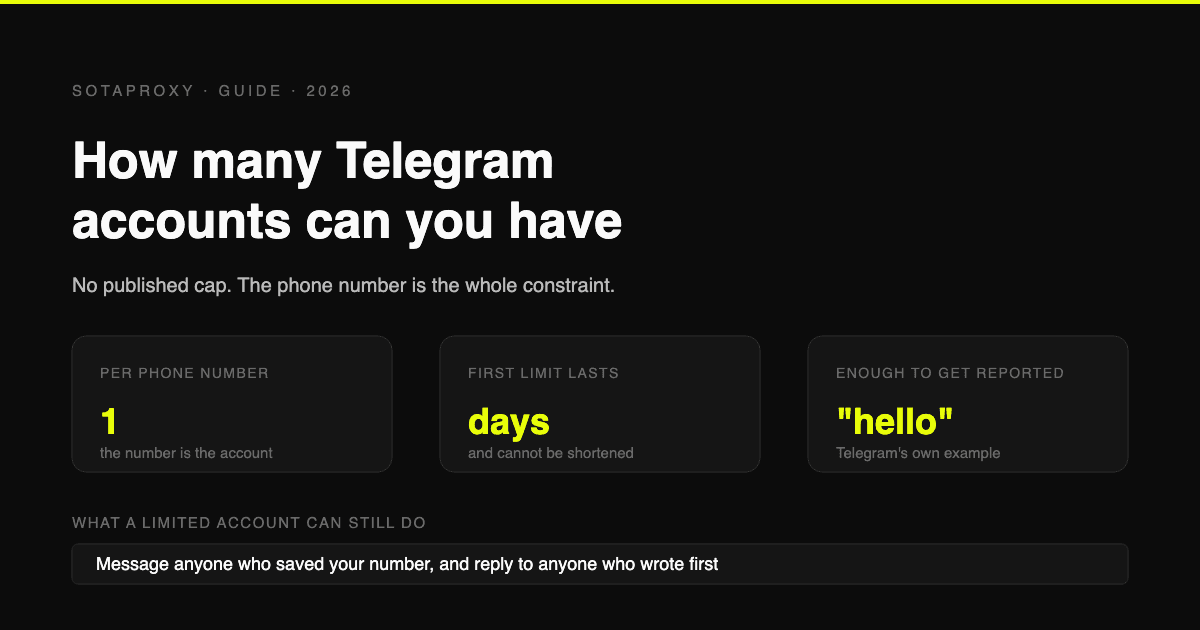
How Many Telegram Accounts Can You Have in 2026 (And What "Limited" Really Means)
Telegram publishes no account cap, one number per account, and its own Spam FAQ says a limited account can still message anyone who saved your number. What triggers a limit, why VOIP numbers get flagged before you send a word, and why there is no early release.
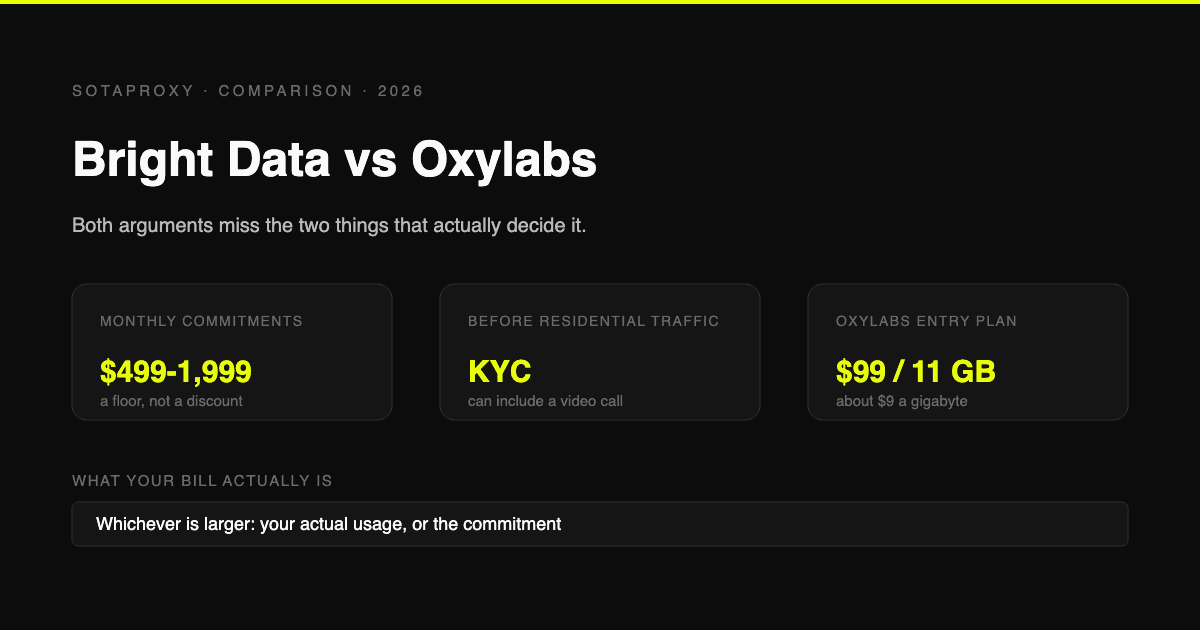
Bright Data vs Oxylabs in 2026: Prices, Commitments and the KYC Nobody Mentions
Both are enterprise platforms with minimum monthly commitments and a compliance check before you can touch residential traffic. Current prices from both vendors' own pages, what the commitment actually costs if you underuse it, and who each one is genuinely for.
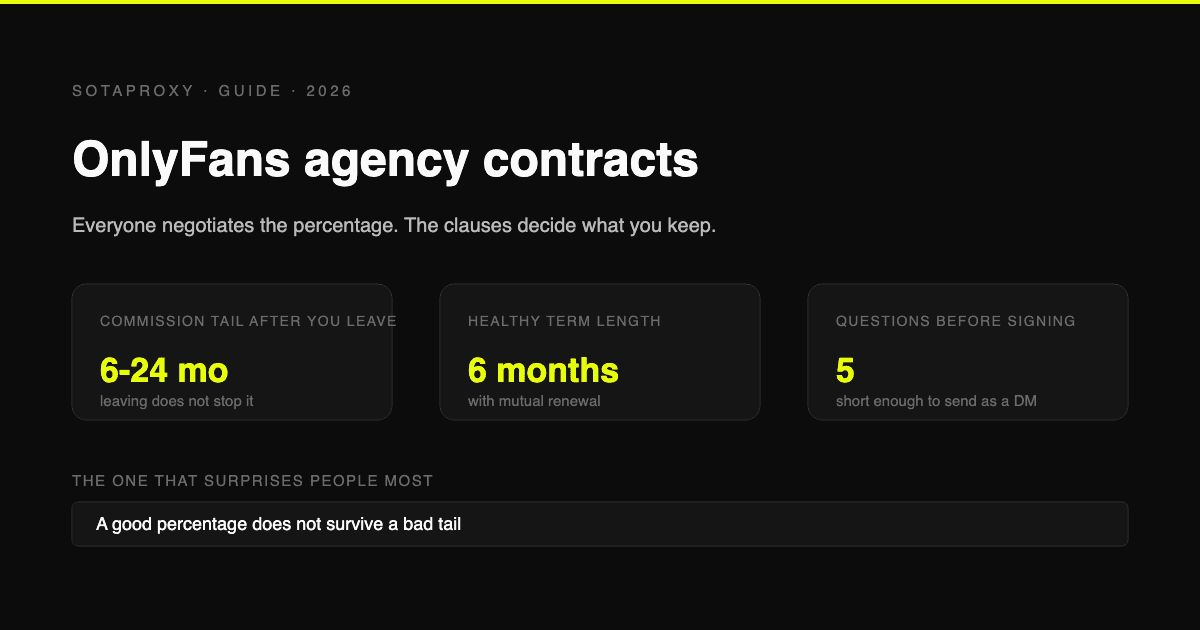
OnlyFans Agency Contracts: The Clauses That Decide What You Keep
The split is the part everyone negotiates and the part that matters least. Commission tails, clawbacks, perpetual subscriber commission, exclusivity and content ownership are what decide whether leaving costs you anything.
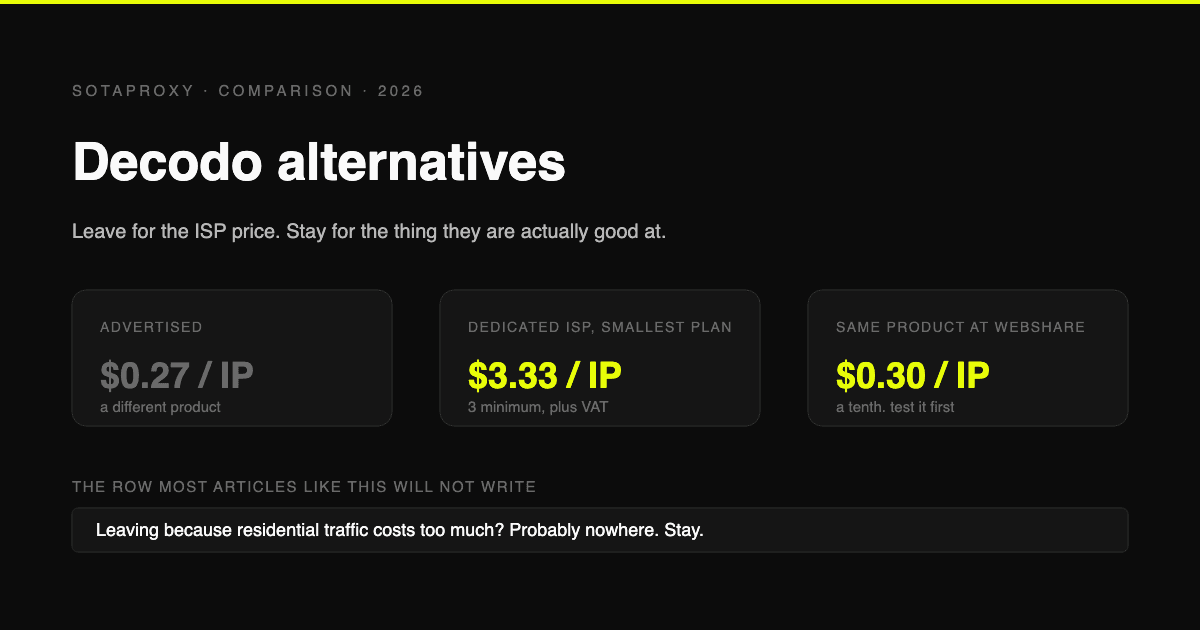
Decodo Alternatives in 2026: Who to Move to, and Who Not to Bother
Decodo is the cost leader on rotating residential and one of the pricier options on dedicated ISP. Verified prices for both, the reasons people actually leave, and which alternative fits each one.
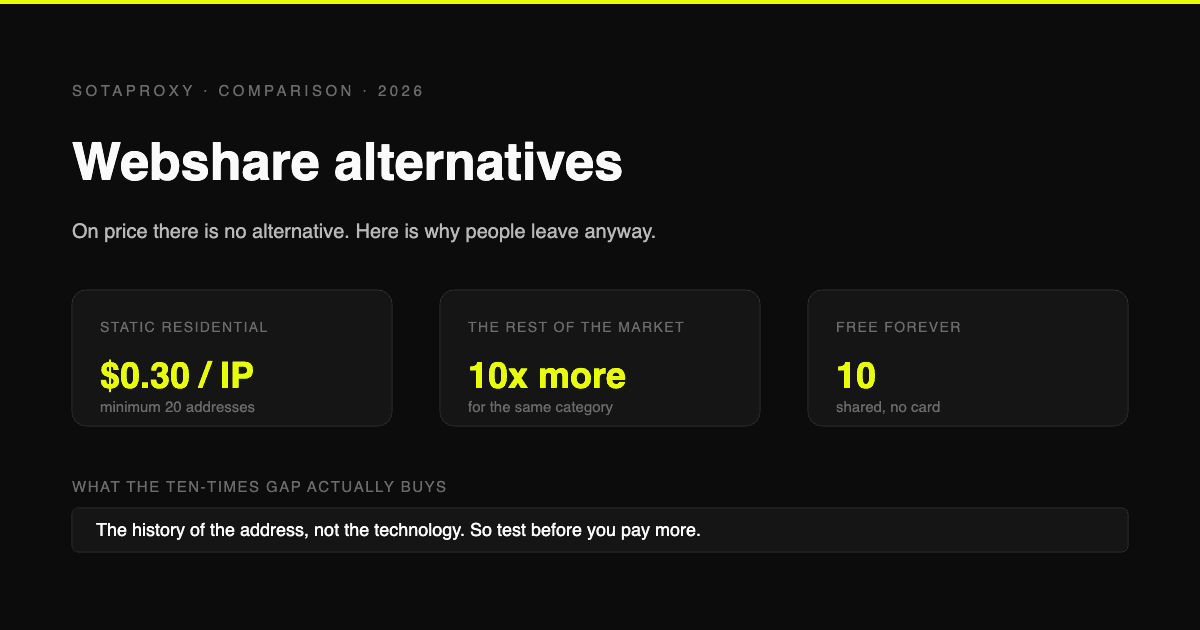
Webshare Alternatives in 2026: When the Cheapest Proxies Stop Being Cheap
Webshare gives away 10 proxies and sells static residential at $0.30 an IP, a tenth of what most vendors charge. Verified prices, the four reasons people still leave, and the one reason to stay.
Dolphin Anty for Multi-Accounting: Features, Automation, and Proxy Integration
How to use Dolphin Anty for multi-accounting: browser profiles, Cookie Robot, scenarios, Synchronizer, API automation, and three ways to connect SotaProxy proxies. Promo code SOTA20 gives 20% off.